July 24 – 26, 2007
These restored messages come from the Quilt History List, an online forum where quilt historians, collectors, researchers, appraisers, and enthusiasts discussed antique quilts and related textiles. The archive dates from 1996 through approximately 2016 and is being restored gradually. Sign up in the form at the bottom of the page if you want to know when a new page is added. Original spelling, opinions, formatting, and inactive links may remain unchanged.
Primary topics of this QHL Digest:
- Marking Tools and Methods for Quilting — Members compare water-soluble graphite pencils, soapstone pencils, and other marking tools, plus how to remove leftover masking-tape residue from an antique quilt.
- What It Takes to Become a Certified Quilt Appraiser — Members discuss the appraisal certification exam and praise a fellow member’s professionalism as an appraiser. (see the article on quilt appraisers)
- Regional Food Nostalgia — A long, cheerful tangent on corn bread with sugar, homemade ice cream, and hard-to-find regional foods after moving somewhere new.
- Quilters Hall of Fame Annual Celebration Recap — A member reflects on attending the Quilters Hall of Fame celebration and meeting fellow enthusiasts.
- Best Practices for Displaying Textiles in Historic Houses — A museum professional weighs in on display standards and expectations for historic-house settings. (see the article on caring for antique quilts)
- Myths and Folklore About Broken Needles in Quilting — A research request about needle-breaking superstitions draws several folk explanations from the list. (see the article on quilt folklore)
- Researching the “Tree of Life” Quilting Pattern — A member starts a study of the Tree of Life pattern as used in quilting and asks for leads.
- Childhood Memories Triggered by an Ice Cream Freezer — A nostalgic chain of stories about kids and hand-crank ice cream freezers, sparked by the ongoing ice cream thread.
Date: Wed, 25 Jul 2007 06:49:54 EDT | From: KJB139@
Michael’s crafts stores carry a water soluble graphite pencil. It is called Sketch and Wash made by Generals and it is black with a silver top with the numbers 988 written on it. They come two to a package with a small sharper enclosed. I looked at Joann Fabrics and also AC Moore for it but only Michael’s seems to carry it.
Date: Wed, 25 Jul 2007 06:59:47 -0500 | From: “Sarah Hough” <dougandsarah1@>
OK, now I have to wade in. Teddy is a great appraiser, thoroughly professional. And from someone who has taken a road trip with her (and a couple others from the list who may want to remain anonymous), she is lots of fun. Our trip to the Southern Quilt Conference was memorable. I am looking forward to next year’s.
Now about ice cream … since moving to Florida from Northville, MI where we had not one but two local dairies that made ice cream, I haven’t found any that compare. Yes, we have the “designer” ice creams, but they aren’t the same as Guernsey and Cloverdale dairies so I have to console myself with Snickers frozen ice cream bars.
Sarah In the Panhandle of Florida where every day the weather forecast is hot, muggy, 40 percent chance of thunderstorms — but no complaints — no hurricanes.
Date: Wed, 25 Jul 2007 08:39:45 -0400 | From: “Greta VanDenBerg-Nestle” <maquilter@>
Brenda,
I have seen samples and there are a few in quilt history books of machine quilted quilts. One in particular I’m thinking of is pictured in several books including the “Smithsonian Treasury of American Quilts” – on pages 64&65. The caption quotes “The Ladies’ Hand Book of Fancy Ornamental Work” by Miss Florence Hartley, Philadelphia, 1859 as reading “Quilting on a Grover & Baker’s sewing machine, is no trouble at all, and the rapidity with which it is accomplished, enables us to apply it to many things which would cost too much time and labor for hand sewing.”
I have seen others in person (some perhaps tops quilted later) but some were most probably machine quilted in the late 19th century.
I remember the days when popular belief was that it’s only a quilt if it’s made by hand. However, while I love to do hand work (hand quilting I can only do in cooler weather) I have to agree with Miss Florence Hartley with the exception that I use a Bernina 150 with no stitch regulator. I have recently acquired a treadle machine to experiment with but my Bernina and I do a great deal of work together. It’s the only way I will ever have the time to get the densely quilted look I love. After all, we are making these quilts in the 21st century and I would hope quilt historians of the future would like to see quilts made with the techniques available in our time as well as those made ‘traditionally.’
Greta VanDenBerg-Nestle Craving good Mexican food on the beach overlooking the Pacific – which is hard to get here in Lancaster, PA
From: “Pam Weeks” <pamela.weeks@>
Hi Sharon,
Many of us have had our applications to test accepted on first try, and have passed on first try. I think in my “class” for testing in Paducah, more than half of us passed, and 3 or 4 of us were there for the first time. I am seriously convinced that half of it is attitude. I think we all go pretty well prepared, but can be totally tripped up by a bad case of nerves. And if we weren’t prepared, I agree with Teddy–we shouldn’t be passed.
If you choose to go ahead with the process, try to immerse yourself in every kind of quilting you can. You’ll find that one or more periods will thrill you and you’ll become more versed in these quilts. Of course, you do need more than a general knowledge in all eras, but it will come.
Attend as many national quilting events as you can afford to get to. The antique quilt dealers were wonderfully helpful to me when I was beginning to learn values, but be respectful of their time and products. They are there to sell quilts and need to serve their customers, but most are happy to let you stand in a corner and observe, as well as check out values, and learn about fabrics and styles. I always asked first, though.
NEVER consider yourself an expert. Every time I think I’ve seen it all, something new pops up–a twist on something or something completely different in a genre I thought I had nailed down. “Expert” is an attitude and can be a bad one to adopt–there’s always more to learn, and when you consider yourself an expert, your pride in your knowledge and prejudices can block new understandings and insights.
Also, take history and dating classes from as many folks as you can manage, and don’t forget the history behind the objects. I’ve enjoyed learning more US and NH history in the years that I’ve been a serious student of quilt history than in my formal schooling. It’s so important to have at least an inkling of what was going on in folks’ lives socially, politically, domestically, etc. in 1850 if that’s the period you love in quilts.
Well, how’s that for a lecture? Most of all, love it! If you don’t, don’t do it!
— Pam Weeks, writing from ABQ today, but headed toward Denver. http://weeksie.blogs.com/weeksies_blog_/
Date: Wed, 25 Jul 2007 09:31:50 -0400 | From: “Dale Drake”
Jan and Sharron:
I took Nancy Kirk’s restoration classes in April 2006 and learned a tremendous amount. She loves to share the practical experience she has, and the five days of the class were definitely worth every minute.
Dale Drake Restoring quilts in central Indiana when I’m not spending time with the grandkids – or working, darn it!
Jan said: Sharron Evans, you asked about restoration. You might check out Nancy Kirk’s website: www.kirkcollection.com. Nancy conducts restoration workshops each year in September, both beginner and advanced, and also has a DVD set for sale on restoration.
Date: Wed, 25 Jul 2007 09:32:57 -0400 | From: “Dale Drake”
Susan:
Thanks for the feedback on the water soluble pencil. I just got my new Connecting Threads catalog and saw them in there – was wondering how they worked. I think I’ll get some and try them myself. And I’ll get the sharpener!
Dale in Martinsville, IN
Susan said: I have recently tried a “water soluble” pencil – carefully- the binder for the graphite breaks down so that it can be released upon washing. I am marking lightly and sparingly, but the sample I tried first gave reasonable results. I bought it from the Stencil Company. If you decide to try them, treat yourself to the pencil sharpener, too – none of mine at home from the school and office supplies seemed to fit and make a sharp point. Susan
Date: Wed, 25 Jul 2007 09:36:39 -0400 | From: “Dale Drake”
Thanks, Lynn, for the extra information – your personal experience as well as the product information. I’m not planning on doing conservation work but I keep information like this in an MS Word document. I’ve tucked this one away under “Tetex vs Crepeline.” You never know.
Dale in central Indiana
Date: Wed, 25 Jul 2007 09:48:43 -0400 | From: “Dale Drake”
Gaye:
Can you describe that bed more? I’m trying to visualize it – does the little rolling pin detach so that it can be used by hand all along the feather mattress, or does it slide down the entire bed?
My mother remembers that when she spent the summers as a girl out with her French-speaking grandparents in Breaux Bridge, LA during the mid-1930s, her job was to fluff up the corn shuck mattresses with a long stick every
morning. The mattress fabric had holes in the sides for the stick and she’d stick the stick in and poke it around to fluff up the contents. And then yes, no one was allowed on them all day. Some of you met Mom at the Southern Quilt Conference – she was the one who came to the conference so that she’d know what Joanne Stuttgen and I were talking about on the way home to Indiana.
Dale Drake A displaced Cajun in Indiana (married to a Hoosier who insists on sugar in his corn bread)
—– Original Message —– From: “Gaye Ingram” < I have a reproduction of an old bed that had been made by a French Acadian furniture maker before the Civil War and that my paternal grandmother owned. It too had a feather mattress, but it had the little rolling pin attached with dowels to the head of the bed. Easier to get a smooth surface for the spread or coverlet.
Date: Wed, 25 Jul 2007 14:04:41 +0000 | From: pollymello@
Dale, Sugar in corn bread, That is sacrilidge!! Polly Mello Elkridge, Maryland via Irving, Texas
. –NextPart_Webmail_9m3u9jl4l_15874_1185372281_0–
Date: Wed, 25 Jul 2007 10:33:28 EDT | From: JLHfw@
Dear Laura, You have my sincerest sympathy regarding your depravation of excellent ice cream. In your honor, I will be going to the grocery store later today to replinish my supply of Blue Bell Homemade Vanilla and, for your sake, i will invest in another flavor as well. After all, we have to do the best we can for our friends. As I emailed Gaye, I am jealous of my friend, Kathi Babcock, who lives in La Grange. Kathi had the honor of having her photo made with Belle, the cow. Gaye and I are thinking that maybe we should meet in Brenham and see if we can’t arrange a photo shoot as well. Problem is, Belle, lives in La Grange, but we can manage a short skip over there. Kathi says the best people live in La Grange and most certainly the best cows. In case you have never heard of La Grange, think The Best Little Whorehouse in Texas location. No extra comments, that was a long time ago. Regards, Janet Henderson
Date: Wed, 25 Jul 2007 10:34:34 -0400 | From: “Dale Drake”
I know. Mom was horrified … but now that she’s moved here SHE cooks the corn bread – and he eats it. 🙂
Dale Drake Who believes that life is too short to bother with cooking – there’s too much quilting to do!
Dale, Sugar in corn bread, That is sacrilidge!! Polly Mello Elkridge, Maryland via Irving, Texas
Date: Wed, 25 Jul 2007 10:51:17 -0400 | From: “Greta VanDenBerg-Nestle” <maquilter@>
Sugar in corn bread is a must and so is sugar on my buttered corn on the cob!
Greta VanDenBerg-Nestle
Date: Wed, 25 Jul 2007 10:54:53 EDT | From: JLHfw@
Dear Pam, Make a stop at Santa Fe Quilting in SF just off Cerrillos. No reproduction fabrics but one of the best selections of batiks, brights, and southwestern fabrics you will ever see. Super staff and classes. Janet Henderson in Fort Worth. Headed to SF Saturday for a medical conference and quality time visiting friends and going to the Opera.
Date: Wed, 25 Jul 2007 10:59:59 EDT | From: Mitzioakes@
I’m with you Mitzi from Vermont! (home of Ben & Jerry’s if anyone is still talking ice cream!-we knew them when all they had was a dirty old garage to make their ice cream in)
Date: Wed, 25 Jul 2007 08:10:53 -0500 | From: “Donna Sparlin” <nilraps@>
Greta – You make my mouth drool for a good California Salsa or Rancho Huevos – I never realized how much I would miss CALMEX till we moved. You buy salsa in the grocery store same brand as California and it taste different – everything is Regional. Dawn
Date: Tue, 24 Jul 2007 21:54:56 -0400 | From: “Janice”
Still trying to rest up from the Quilters Hall of Fame Annual Celebration this past weekend. Was nice to meet Dale Drake, and her lovely daughter Andrea who makes wonderful dolls. Where do you buy Tetex?
We had three excellent completely full fabric dating workshops. Everyone was “in stitches” laughing at Georgia Bonesteel and Eleanor Burns trying to be the fastest making a block – one on a treadle, the other on a Bernina.
Some of the quilts and fabric samples in the dating workshops were to die for! It was interesting to see the differences between Pa and Md cradle quilts – one in particular that stuck in my mind was a red and green square crib quilt, it was outstanding – Pennsylvania quilts were definitely more colorful.
We will again have dating workshops, and technique workshops along with lectures and our fundraising auction. Dates for next year are July 17,18,19 –
Janice in Marion Home of the Quilters Hall of Fame
Date: Tue, 24 Jul 2007 22:04:25 -0400 | From: “Sharron K. Evans” <quiltnsharron@>
Thanks Jan. I own all Nancy’s dvd’s and subscribe to all of her newsletters. I’ve really enjoyed participating in her telephone “seminars” and have learned tons.
Best regards, Sharron
Date: Wed, 25 Jul 2007 11:03:10 -0400 | From: “Sally Shelton”
I had to come out of lurking on this one, as a museum person.
As I was informed by a historic house/farm expert years ago, the typical corn strains in the 19th century were overall more sugar-rich than many strains available today. 19th century recipes (like the ones I inherited from my great-grandmother) did not call for sugar because they did not need it. Current strains are not as sweet, which extends their store life. The person telling me this had made a research career out of replicating 19th century farm recipes from the frontier, and she practically ordered us to put a little sugar in our cornbread if we wanted a real taste of the times. She was a little intimidating, so I tried it and have never gone back. It doesn’t take a lot, and my grandmother agreed it tasted more like her mom’s cooking.
My great-grandmother’s recipes were not elaborate, and most of them are just lists of ingredients she used, no instructions. (She didn’t need any steenkin’ instructions.) The produce she grew to feed a family (and later a boardinghouse) was not the same as the produce we see in today’s supermarkets. If you use heirloom seeds and grow your own, as it were, you can really taste the difference, not just in corn but in practically everything. I am not going to raise and grind my own corn crop any time soon, so there will continue to be a tiny dash of sugar in my cornbread.
And my great-grandmother kept her quilting frames on the ceiling, too. Would that I had inherited those….
Cheers, Sally Shelton
Date: Wed, 25 Jul 2007 11:07:50 EDT | From: HKnight453@
If you want to use masking tape, I strongly recommend the blue kind for painting from 3M. It leaves much less residue than the conventional beige kind.
Heather
Date: Wed, 25 Jul 2007 08:13:58 -0700 | From: Julia Zgliniec <rzglini1@>
Good Morning All, I am going to second Pam’s excellent remarks on what it takes to be an appraiser and add a couple of comments too.
Don’t forget that to be certified by AQS, the appraiser must have a good working knowledge of contemporary work. Many of my clients are quilt makers who are sending their work off to shows and need something to verify replacement value. This is an important service to the quilt makers of today. An appraiser may decide not to appraise art quilts after certification, but the ability to approach the subject is needed in order to pass.
The ability to recognize repairs is another skill that is required, as well as the ability to identify reproduction fabrics so as to know when they have been used in a repair. I have found this list is a wonderful resource for discussions on the materials used for repair and conservation. I save many posts in my “Resource” folder.
Anyone who has additional questions regarding appraisal may email privately – my email is always on and I am happy to answer questions. Of course I do not have all the answers but I am happy to help if I can.
Julia Zgliniec, Appraiser, certified by The American Quilter’s Society, Class of ’91 ps. Into every serious group – a little ice cream must be served.
Date: Wed, 25 Jul 2007 11:16:13 -0400 | From: “Greta VanDenBerg-Nestle” <maquilter@>
Dawn – I agree whole heartedly! Nothing here tastes the same. In Escondido I could go to the local shops and buy fresh tortillas – the package stuff just doesn’t get it.
Greta
Date: Wed, 25 Jul 2007 11:05:28 -0500 | From: “Stephanie Grace Whitson”
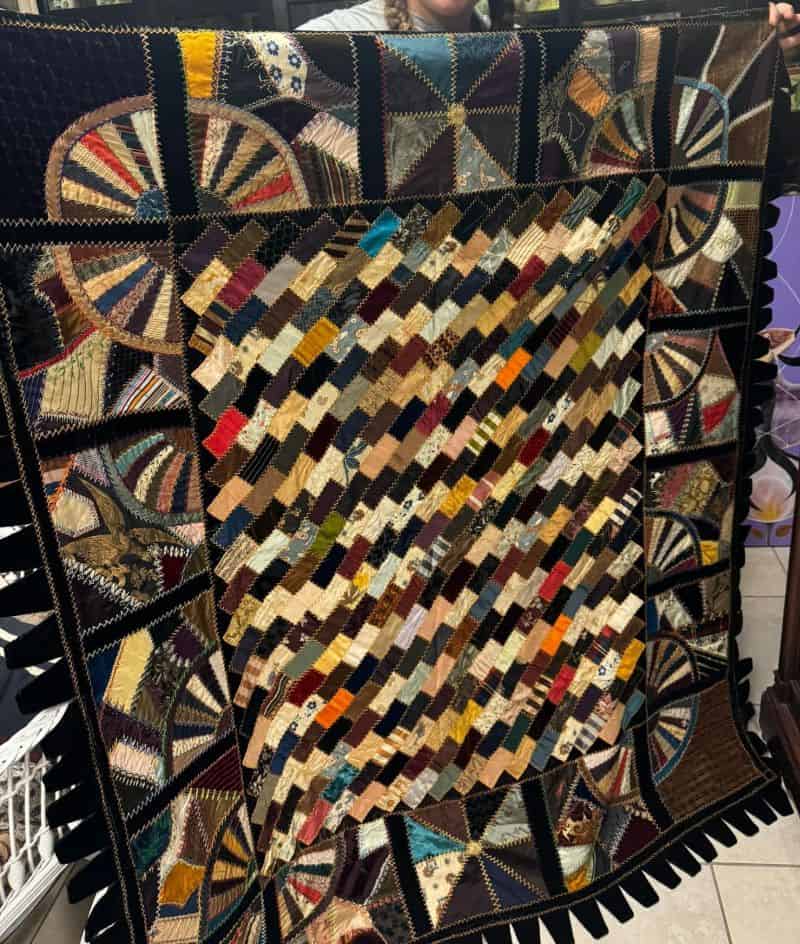
Painting motifs for use on Victorian Crazy quilts was done a lot. . . I’ve seen ads from that era in our local newspaper where a woman in Minnesota was offering painted motifs for sale for use in crazy quilts. The ad was in a Lincoln, NE newspaper. Stephanie Higgins
Date: Wed, 25 Jul 2007 11:13:36 -0500 | From: “Stephanie Grace Whitson”
I live in Lincoln and was so pleased to hear a vote for the Dairy Store on East Campus. . . which is in walking distance of the new museum opening March 2008 ladies, so come on down! Stephanie Higgins (who volunteers at the IQSC as much as she can)
Date: Wed, 25 Jul 2007 11:05:13 -0400 | From: “Elaine Kelly” <elainekelly63@>
Just back from visiting Winterthur’s quilt exhibits and the exhibit at the Chester County Historical Society. An easy day trip from the D.C. area and well worth the time. What a collection of quilts! Whole cloth with stuffed work galore, wonderful chintzes . . . . To see so many *very* old quilts in wonderful condition in one day was a real treat. Many of the quilts (particulary at the CCHS) were autographed with that wonderful Spencerian script. Some signatures were stamped, and we did see a display of a metal stencil, ink bottle and a little round (fabric?) “pouncer”. Since I’m not about to add “learn calligraphy” to my list of things to try in 2007, can anyone tell me whether such stencils are still available? I did a 30-minute google search for custom metal stencils/laundry stamp and the like, without real success. There do seem to be lots of custom rubber stamp companies around. Can a rubber stamp provide a very fine line with indelible fabric inks?
Elaine Kelly Reston, VA
Date: Wed, 25 Jul 2007 09:03:12 -0700 | From: “Alan”
There are also soapstone pencils that leave a white line.
Alan
Date: Wed, 25 Jul 2007 08:53:22 -0700 | From: “Alan”
Yeah, it seems there are several, if not most, who have someone to blame for their love of needlework. Myself, I have both of my grandmothers to blame directly. The maternal one is my quilting muse as she taught me to quilt. The other one tauaght me a couple of forms of crochet. My eldest great aunt did drawn embroidery work (I have a couple pieces). Another actually sewed professionally for a doll company making doll clothes. My sisters each had a doll with clothing made by Minerva. My sisters didn;t realize how lucky they were. There’s also a mysterious someone on my father’s side who
quilted. I have a sweet little quilt that I rescued from being uused to transport furniture that came from his mother’s home. I should photograph it and ask my aunt if she remembers it. Sio I draw inspiration from each of the ladies., my maternal Grandmother, Margeurite, being my main one. Strangely enough, the needle bug entirely skipped my parents generation. What’s worse, in my generation I’m the only one who does this at all.
Whatever was done previously is now in my repetiore. I onnly wish I had a child to pass it on to.
Alan
Date: Wed, 25 Jul 2007 13:37:05 -0400 | From: “Sharron K. Evans” <quiltnsharron@>
I’d just like to take a moment to thank everyone for the information they shared. My head is swimming with thoughts.
If anyone is coming to Houston for Quilt Festival or Market, let me know. I’ll be happy to meet for lunch or dinner.
Best regards, Sharron
Date: Wed, 25 Jul 2007 09:00:26 -0700 | From: “Alan”
<GRIN> They have air conditioning in Texas. As in Florida, it’s a must!
Alan
Date: Wed, 25 Jul 2007 08:56:31 -0700 | From: “Alan”
Oh my, yes! I remember as a child in the seventies there was this fad for paiinting fabric, rather than embroidering. It invovled pre-printed fabric and these tiubes of paint with a pen tip. I remember hours of fun just coloring away. It was very simple. You would know if this is it, becuse the pen lines were always obvious.
Alan
Date: Wed, 25 Jul 2007 09:52:42 -0700 (PDT) | From: “Sarah E.” <texascalamityjane@>
Hey there!
I’m beginning a study on the Tree of Life pattern as used in quilting. Would it be possible to post a picture of this almost-done painted fabric with the ToL pattern? Or if a pic has already been posted somewhere, if you could point me in the right direction? I am just today getting caught up on things, was unable to do email yesterday.
Thanks so much! Sarah E. in TX
Candace Perry <> wrote: I’ve seen painted silks (and have an example in this collection) from the late 19th, and painted stuff pre 1940. I don’t know if it was a fad per se, but certainly I would think the fabric painting — esp. silk — might have gone along with the crazy quilt phenomenon. Candace Perry Schwenkfelder Library & Heritage Center
Date: Sat, 21 Jul 2007 20:41:20 -0700 | From: “Alan”
I looked at them first. Easy to remember. They don;t have what I’m looking for, sadly. I’m kind of miffed because I can’t find the link I had once saved.
Alan
Date: Wed, 25 Jul 2007 16:58:54 EDT | From: JLHfw@
–
Dear Alan, Have you tried Vintage and Vogue? They too have a large selection of Repro fabrics as you probably know. Regards, Janet Henderson in Fort Worth
Date: Wed, 25 Jul 2007 17:41:34 -0500 | From: “Lisa Erlandson”
Hi, doing a little research here – I am looking for “myths” involving broken needles in quilting. I found such a myth concerning sewing: “If you break a needle making a dress for yourself, you won’t live to wear it” – apparently, it’s OK to break a needle if you are making the clothes for someone else to wear and break the needle. Anyway – just wondering if there were any myths strictly related to quilting and broken needles?? Thanks, Lisa Erlandson
Date: Wed, 25 Jul 2007 20:11:24 -0400 | From: “Sharon in NC” <patchworksecrets2@>
For fine lines I like the Roxanne’s pencils. They come in both silver and white. I have been using them for several years now on both hand quilting and machine and they have always washed out first time. They stay on very well even when you rub them with an arm or hand while quilting. I find that sharpening them can be a challenge and an electric sharpener works best.
Most of the time I just use plain old kids chalk sharpened in a crayon sharpener. Never had a problem with this in over 20 years of using it. The cheaper the better. I usually buy the 4 boxes for a dollar at our local dollar tree. The colored chalk is great for white and light fabrics and always washes out for me too. Sharon in NC http://community.webshots.com/user/sharonsews
Date: Wed, 25 Jul 2007 22:15:18 -0400 | From: “Newbie Richardson” <pastcrafts@>
When my daughter – now 26 – was 2 she took an usually long nap one hot summer day. I peaked in on her to discover her covered in “tatoo marks” from a laundry marking permanent black ink pen…we were due to meet her great grandmother for dinner SOON! I tried everything to get the markings off – nothing. In desperation I grapbbed the “Spray and Wash” – not only did it work like charm – but did not irritate her skin!
newbie
Date: Wed, 25 Jul 2007 22:10:00 -0400 | From: “Newbie Richardson” <pastcrafts@>
Just remember, you do not have to have everything memorized! I crossed my own professional Rubicon when I came to the realization that that is why LIBRAIRIES were invented! ( and knowledgable colleagues) You have to know what you do not know – so you can go look it up! – or have an excuse to buy those books!
Seriously, the more you see “stuff” of every type and quality, the better educated your eye becomes. So when you are confronted by something new, your instincts will be refined. Case in point: I knew very little about pre-Columbian textiles, but was brought in to appraise a collection. When I examined the collection, and photographed the pieces, my “gut” told me that they were not exceptional. Turns out I was right – pieces such as these had been everyday market goods in South America in the 1940’s – brought in by Andean farmers who were finding them when they plowed new fields.
So go to antique shows and museum exhibits – what hard duty!
Ok, so enough talk of ice cream – I am alergic to dairy – now what about sorbet?
Newbie Richardson
Date: Wed, 25 Jul 2007 23:07:22 -0400 | From: “Newbie Richardson” <pastcrafts@>
Dear list The posts about Tetex/Stabiltex reminds me that I have not gotten on my soap box extolling the virtues of low heat set monfilament bobbinet – conservation net – for a while. So for those of you who have heard this – hit the delete key – the rest of you – please pay attention!
Conservation grade nylon net is woven on 19th c netting machines in Nottingham, England. This is the standard in most Western European textile conservation workshops/departments. It is used by the conservators at Winterthur. Visualize bridal illusion veiling – but so very soft, not scratchy like veiling.
It is exceedingly soft and supple – yet strong and fairly easy to work with. It does not ravel. It has some “give” to it – so it works well on textured surfaces and on upholtered pieces. It is quite sheer and see through – though only available in off white. I have never tried dying it – but I have used a dye stick on it. That was for an 18th silk man’s dressing gown (banyon) which was never going to be washed.
That is the good news – the bad news is that it is only available from one supplier in Britain: Dukeries Textiles – no website – does not take credit cards. If you are with an institution he will bill you – if not, I think he will ask that you deposit the amount needed in his American account. It is sold by the metre and is at least 63″ ( inches) wide. It runs about $90 a yard – so figure $115 with shipping to the US – One metre goes a LONG way! ( Order with two friends!)
This is FANTASTIC conservation fabric. I just finished using this net to provide a total support for a French silk shawl c1802 belonging to Mrs. James Monroe ( he would be come our 4th President) when her husband was American minister to court of Napoleon. The shawl is so sheer it could have been drawn through a gold wedding ring. It is 8′ long and 24″ wide – and is splitting throughout. The netting did a great job of providing stability – but not hurting the drape of the garment. I also encased the splitting silk lining of one of President Monroe’s waistcoats from the 1780’s with this net. – It worked beautifully – you can see the lining, but the net protects the fragile fibers. Due to the nature of a knitted net – it “grabs’ the fabric it covers, unlike Stabletex/Tetex which is so very slippery.
I have lost count of the number of quilts I have used this netting on.
He also has wonderful cotton nets, as well.
Dukeries Textiles and Fancy Goods Spenica House,15A Mebourne Road West Bradford, Nottingham NG2 5DJ England Direct from USA: 011-44-115-981-6330 Fax: 011-44-115-981-6440
No Affiliation
Newbie Richaardson The Costume and Textile Specialists Appraisals, Conservation, & Exhibition www.costumeandtextile.net
Date: Thu, 26 Jul 2007 07:10:46 EDT | From: Edwaquilt@
I have been using and The Stencil Co has been selling the Sketch and Wash graphite pencils for years. Many repeated customers. I worked with General Pencil Co a few years ago to get the lead hardened a bit to make it more adaptable for fabric marking. I marked some off white cotton sateen wholecloth with it and machine quilted and when I had finished it was almost disappeared. Little erasing finished it. Stencil Co has it on their web site and in catalog.
Holice
Date: Thu, 26 Jul 2007 09:49:30 EDT | From: Mitzioakes@
Don’t know about needles, but the myth goes on about making one mistake in a quilt so as to let God know you are not perfect , only he/she is!. Mitz BTW – I have never had a problem putting ONE mistake in my quilts – I am sure to have good luck if I count mine….. Hot in Vermont today – but we take it happily and don’t think about February and 6′ of snow……
Date: Thu, 26 Jul 2007 10:18:18 -0400 | From: “Carol’s Quilt Closet” <imaquilter2@>
“Marking Utensils” a topic that goes straight to my heart.
A few years ago I used a pencil to make a very light mark about 1/4 to 1/2 in. on a quilt I was appliquéing. I did not test beforehand (my mistake) and it did prove to be an unresolved marking. Many of you responded to my post about solutions for taking off the mark but they proved futile. I used everything from solutions to gum erasers and batting. At that point it may have just been on too long.
The quilt was entered into a number of shows and in favor of all of you that judge quilt shows I have such high praise for your thoroughness. I would like to commend the high standards judges and appraisers have set for
themselves. Every judge at every show the quilt was entered in found that small pencil mark even with hand quilting over it. I can barely see it even though I know it’s there (have to search myself for mark)
With this in mind you can well imagine why this topic hit home with me. Since that ordeal I have hunted for a truly safe marking tool and have not returned to pencil. I have tried everything from soapstone, chalko liners (yellow does not come out), water erasable marking pencils, Roxanne’s, the Ulitmate pounce powder and many more. Nothing is truly safe, yet. I do feel that a lot of factors play into marking and erasing; the fabric, the marker itself, how long it has been on the textile, the temperature at which your environment is, perhaps even down to how hot your hands are when
handling the quilt.
In keeping with this information, using something that is mediocre, almost dissappearing or sometimes vanishing is not good enough for me. Using painters tape, slivers of white soap or a hera marker is fine. I have restricted myself to crosshatching, in the ditch, echoing or free style quilting.
I felt this too important not to share with you all. My hopes are that someday something will be resesarched and manufactured for using in all conditions. For now, we will all have to make a choice we can live with.
This was a first mistake, of course (ha ha), you realize the other mistakes were intended so not to imitate God’s perfection and tempt divine wrath.
This “lists” information is a wonderful guide to so many issues. Thank you ONE AND ALL for your openness and willingness to share. I keep learning daily.
Carol in Connecticut
_________________________________________________________________ http://liveearth.@
Date: Thu, 26 Jul 2007 10:07:10 -0400 | From: “Dale Drake”
Thanks, Newbie – your post has been copied into my growing Word document!
Dale Drake Restoring quilts in the RAIN (yay!) in central Indiana
Date: Thu, 26 Jul 2007 11:12:12 -0500 | From: “Susan Wildemuth”
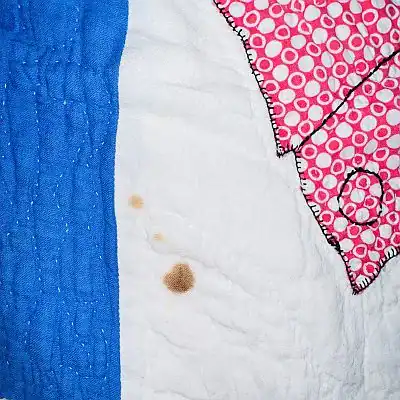
What will remove masking tape residue (the sticky) from the back of a
1870-1890 quilt without ruining the front of the quilt?
The back where the residue is at is muslin-like – the front (in the same spot) is red.
Thanks —
Sue
No Virus Found In This Message Scanned at barracuda.geneseo.net
Date: Thu, 26 Jul 2007 17:42:32 +0000 | From: jocelynm@
>and one of us kids sat on the top to keep the freezer >still. And did you have the tradition that the child who was doing this duty must also tell a story while sitting? At the conclusion of which, the child was to say, ‘My tail is told’ and then yield the seat to the next child? <G>
Date: Thu, 26 Jul 2007 17:52:06 +0000 | From: jocelynm@
>THIS is a traveler I want to learn from! >Stephanie Higgins >> My sister Dodo was the world’s champion in the travel-light category.=
>> She once went (literally) around the world with a single carry-on bag.=
Stephanie, My first thought was, ‘She’s obviously mastered two skill I don’t have: eating without spilling anything on myslef, and avoiding catching clothes on anything, or ripping seams when bending over!’ <G> I always pack extra clothes because I’m quite sure something will happen to them if I only take one pair of pants! And sad to say, there have beenenough times that I HAVE had to rearrange my plan for what to wear because some accident rendered an outfit unwearable. There was the time the waiter dropped the tray of frozen daiquiris…. not to mention the time I assumed I would still fit into ‘those pants’ after several days of feasting….
Date: Thu, 26 Jul 2007 18:19:41 +0000 | From: jocelynm@
>ANd Jocelyn – many thanks for the thoughts that cleared up a slight confusion. I am very discomforted by the thought of leaving an unsettled or unkind vibe, so I feel better now. Teddy, I’m glad you do. 🙂 I really don’t intend to be mean to people on the list, and it’s so easy to say something that to the author is perfectly clear, but is confusing to the reader. I appreciate it when people ask what Imeant by something rather than just assuming that they ‘know’ that I meant to be rude. I do tend to go off on tangents, of the ‘now that you’ve said that, it reminds me…’ and off I go, leaving the original poster wondering how I got there from here. 🙂 For example, Pepper’s comment about coffee ice cream got me off thinking about my coffee and butterscotch cake, and how Pepper will be here at Assembly Day on Saturday, and do I havetime between now and then to make one of the cakes…which would, if I do, leave Pepper quite perplexed as to why a woman would come up and hand her a cake! <G> Not to mention, what would she do with it, since she’s traveling on from here to another teaching engagement. Which reminds me of a medieval legend about a pike… So you see how my mind goes from topic to topic, and it takes very little stimulus for me to be off on ‘That reminds me,’ <G> Groups that try to stay on topic all the time astound me. I can’t think of any ‘real world’ groups that are successful at staying on topic all thetime, not even ‘work groups’ at one’s place of employment! Personal comments about off-topic events just seem to naturally creep in. Internet discussion groups over time start to become more and more like ‘real world’ groups, as we cease to be a group of strangers and start recognizing posters in context. In fact, it seems really artificial to me to try to stay on topic, because ‘real life’ doesn’t have conversation police, and it would be thought rather rude to announce, ‘I’m tired of this topic’ or ‘I’mnot interested in this topic’ as a way of changing it…yet this happensall the time in online discussion groups…sigh. To make this quilty… I’ve been organizing my third bedroom, which is the repository of the craft supplies. It never has fully achieved organization since the move (at least partially because things are having to stay in boxes since there is just nowhere near enough space to unpack everything). Well, I got to the point where I could open the drawers of the VoguePattern cabinet, and go through the things stuffed in there…including quilt tops I had forgotten I have! Oh, I’m looking forward to the day when I can have a nice big studio, and can unpack some of the things in boxes and drawers! 🙂
Date: Thu, 26 Jul 2007 18:38:45 +0000 | From: jocelynm@
>Yeah, it seems there are several, if not most, who have someone to blamefor >their love of needlework. My mother always claimed that I had inherited her mother’s needlework interests (not that my mother had none, mind you; her college major was in clothing construction!). As I’ve gotten older, I’ve had relatives say thatI look just like my grandmother, when I’m doing needlework. 🙂 But then…my paternal cousin researched the family tree, and found that our great-grandmother was the ‘professor’ of needlework at a girls’ school in Germany! So I guess I get it from both sides of the family, even though I never knew either of these women.