June 2 – 7, 1999
These restored messages come from the Quilt History List, an online forum where quilt historians, collectors, researchers, appraisers, and enthusiasts discussed antique quilts and related textiles. The archive dates from 1996 through approximately 2016 and is being restored gradually. Sign up in the form at the bottom of the page if you want to know when a new page is added. Original spelling, opinions, formatting, and inactive links may remain unchanged.
Primary topics of this QHL Digest:
- Quilting Stitches Per Inch Debate — Extended discussion about how to count and evaluate quilting stitches, whether 20 stitches per inch was historically achievable, the difference between single-stitching and rocking stitch methods, and how fabric and batting affect stitch size.
- Coverlets in Museum Documentation — Jeanne Fetzer notes increasing numbers of coverlets turning up in museum and documentation work, and asks about dating a pieced-block quilt using Brackman’s references. (see the article on quilt museums)
- Dating Quilts from Herrschner’s and Kit Catalogs — Members discuss using mail-order catalogs like Herrschner’s and LeeWards to establish date ranges for quilt kits, noting that kits were often repackaged across companies and years. (see the article on dating quilts)
- Quilt History Reading Lists — Xenia Cord provides an extensive list of recommended books for anyone building a quilt history reading list, including titles by Brackman, Orlofsky, Lasansky, and others.
- Historical Clothing and Corsets — A tangent about tiny Victorian waist measurements leads to a discussion of corsets, historical body proportions, and one member’s firsthand experience wearing stays for reenactments.
- Rolling Stone Signature Quilts — Judy Grow describes a newly acquired late-19th-century Rolling Stone signature quilt from Pennsylvania, and Pepper Cory offers dating and attribution insights.
- Preserving Quilt Signatures — Discussion of methods for preserving inscriptions on signature quilts, including scanning, transfer paper, archival ink for bubble-jet printers, and photocopying onto fabric. (see the article on repair, restore, or conserve)
Date: Wed, 2 Jun 1999 20:11:29 -0000 | From: “Jeanne Fetzer” <jeannefetzer [at] integrityonline3 [dot] com
>Hi Jeanne, is it hand or machine pieced? Have you checked the thread as to ply and twist? That may not help you much, but you can start eliminating some things that way. Hands All Around did appear in the KC Star series….if my memory serves me correctly. And I know that it is in the Ladies Art Co., catalog.
>anyone else with any suggestions?
>Laura
Brackman lists the pattern as KC Star 1936. Is that the first time the pattern was used? What does the ply and twist tell you? Where would that be referenced? It is machine and hand-pieced, mostly machine pieced. Could it be prior to 1900? I know machines were widely available after the Civil War.
Thanks, again!
Jeanne Fetzer
Date: Wed, 2 Jun 1999 22:17:12 -0400 | From: “John Cawley” <cawley [at] goeaston [dot] net
I think counting stitches top and bottom makes no sense. I don’t know any quilters who do that. The resulting astronomical numbers of stitches to the inch are silly and don’t convey the sense of what the quilting is like that numbers like 10 or 12 to the inch do. This is a pet peeve of mine.
Cinda on the Eastern Shore
—–Original Message—–
From: Jeanne Fetzer <jeannefetzer [at] integrityonline3 [dot] com> To: QHL [at] cuenet [dot] com <QHL [at] cuenet [dot] com>
Date: Wednesday, June 02, 1999 7:20 PM
Subject: QHL: Stitches per inch
>When you are measuring stitches per inch on a quilt documentation, do you count the ones you see on top or both top and bottom? I have been only counting the ones on top, but have come across some museum records which use both top and bottom. Comment, please!
>Jeanne Fetzer
Date: Thu, 3 Jun 1999 06:22:47 -0500 | From: “Ann G. Hubbard” <ahubbard [at] usmo [dot] com>
When I went to fashion design school in Ca. we were taught that from the stitch and the space after were one stitch. When you went back down into the fabric you were starting the 2nd stitch. So the underneath stitch is part of the first stitch. If you are counting stitches per inch, lay your ruler down and count from the beginning of a stitch until you get to the 1 inch marking on the ruler. I honestly think when they said 20 stitches per inch in olden days, it would be 10 stitches per inch. When you consider machine stitching and how small the stitches are when you sew 20 stitches per inch, it would be impossible to handsew 20 stitches per inch by hand.
For whatever it is worth IMHO. Ann G. Hubbard Lake of the Ozarks, MO
Date: Thu, 03 Jun 1999 08:05:47 +0400 | From: Xenia Cord <xecord [at] netusa1 [dot] net
To Carole in Maine and anyone else developing a reading list, some suggestions for beginning:
Orlofsky, Quilts in America
Kiracofe, The American Quilt
Adamson, Calico & Chintz
McMorris, The Crazy Quilt
Grannick, The Amish Quilt
Brackman, Encyclopedia of Applique
Meller & Elffers, Textile Design
All of the state search volumes
Any of the volumes of Uncoverings, annual publications of the American Quilt Study Group (join!)
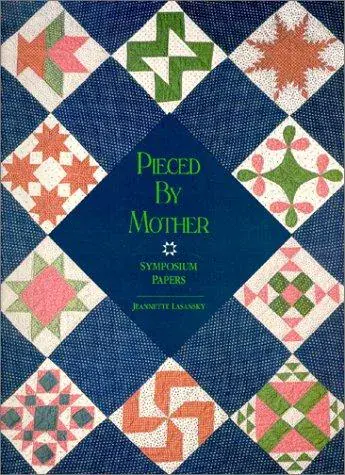
Any of the volumes of symposia papers edited by Jeannette Lasansky: Pieced By Mother; In the Heart of Pennsylvania; Bits & Pieces; On the Cutting Edge
Some of these are out of print and available thru your library or a book search engine; most are seminal works but may contain information no longer accepted today, just as what we write may be subject to argument in the future <G>!
Xenia
Date: Thu, 03 Jun 1999 08:59:15 -0400 | From: “jawhite [at] courant [dot] infi [dot] net” <jawhite [at] courant [dot] infi [dot] net>
Hi Jeanne. On p. 50 in Brackman’s “Clues in the Calico“, she explains about thread ply and age.three ply thread (3 separate threads twisted together) was available in 1812 or before. In the late 1840’s,six ply thread was developed and in 1860, Clark developed six cord thread which they called Clark’s O.N.T. spool cotton. Hope this helps a little.
Judy White – Ct
Date: Thu, 03 Jun 1999 07:37:48 +0000 | From: Shirley McElderry <tigersoup [at] lisco [dot] ne
Re: dating quilts from Herrschner’s magazines: I think the Herrschner’s and LeeWards companies bought “remainder” stock from Progress, Homeneedlecraft, etc. quilt kit companies. For example, the Progress #1365 “The Pansy” quilt kit was advertised in the Herrschner 1948/49 catalog as “Pansy Design.” It was again offered as “Perky Pansy” in LeeWards F/W 1960/61 catalog.
The Homeneedlecraft #7452 “American Beauty Bouquet” (also Gold Art #0052) was offered in the LeeWards F/W 1960/61 as “Rose Bouquet,” and in the Herrschner 1962/63 catalog as “Princess Rose.” (A rose by any other name–?) But the kit was available earlier; Dr. Jeanette Throckmorton made this quilt in 1957, according to her meticulous records. Oh what fun (and how confusing) is quilt research!
irley Mc from Iowa
Date: Thu, 03 Jun 1999 09:06:56 -0400 | From: “jawhite [at] courant [dot] infi [dot] net” <jawhite [at] courant [dot] infi [dot] net>
Hi again Jeanne. Re Hands all around – McKim’s KC Star pattern call Hands all ‘Round was published in 1929. It suggests “light and dark areas be alternated” – “Hands All ‘Round looks like a plump little rose with leafy green corners. With the center of white and the four pink blocks of green with pink, blue or yellow corner diamonds it becomes a four lillies block. . . ” In 1935 the pattern called Hands All Around was published again suggesting bright colors. The third printing was July, 1935 with no color suggestions. But none of these patterns suggests yellow and red combination.
Judy White – Ct
Date: Thu, 3 Jun 1999 09:43:24 -0400 | From: “Pat McAnally” <patmc [at] netcarrier [dot] com>
I’m probably a little late with this suggestion for the travelers to the Philadelphia area but my friend Cathy, formerly a director of one of our historical properties, suggested that you contact the Germantown Historical Society and ask to see their quilt collection. Apparently it is a real unsung treasure (with maybe 70 pieces?) She remembers a gorgeous blue and white “orange peel” friendship quilt made for a Germantown minister, many crazy quilts, a big Quaker friendship quilt in silk.
Cathy also suggests at the other end of the spectrum, if you have a car and are stopping in the Lancaster area, a visit to Sauder’s will probably lighten your spirits. They are off the PA turnpike near Zinn’s diner (see www.quiltart.com/sauders.html for directions) and sell lots of fabric, including Hoffman batiks for very reasonable prices — just check the quality of the griege goods first! They also have a wall of modern Amish fabrics (poly blends) and, my favorite part, bulk foods like mega-pound bags of Jello. I have no clue why. And one last tip, the bathroom is outside and down back. Thanks to those of you who have written about my quest for a library card catalog. The consensus seems to be that they get sold off at city auctions or taken to the dump (sigh.) The real key is drawer space to fit odd shaped craft things, like big rolls of ribbon. I’ve expanded the search to include seed bin counters from hardware stores, etc. It could also double as a cutting table with one of those big mats. I’m going to try some architectural salvage places. Will let you know what I find.
Pat, Southeast PA
Date: Thu, 3 Jun 1999 09:19:41 -0000 | From: “Jeanne Fetzer” <jeannefetzer [at] integrityonline3 [dot] com>
I am seeing more and more coverlets in my museum and documentation work. Tell me more about Rabbit. Who is he/she?
Any publications or books?
Jeanne Fetzer
Date: Thu, 3 Jun 1999 09:01:05 -0700 | From: “R & L Carroll” <Robert.J.Carroll [at] GTE [dot] net
Hello!
My first quilting teacher quilted with the tiniest stitches I have ever seen.
One day when she was not looking some of us took a ruler and measured her stitches. We counted an average of 22 stitches on top!! When she noticed what we were up to she came over and when we exclaimed “22 stitches per inch” she laughed and said “Oh, I can do better than that, when I want to!” And I think she could.
Just received my
August American Patchwork and Quilting magazine yesterday and there is a great article on Conversation prints by Xenia Cord. Lots of pictures of 19th century prints. Great article Xenia!
Laurette in rainy So. California
Date: Thu, 3 Jun 1999 20:41:07 EDT | From: [from unknown, signed “Janet”]
In a message dated 6/3/99 6:23:07 AM Central Daylight Time, ahubbard [at] usmo [dot] com writes:
<< I honestly think when they said 20 stitches per inch in olden days, it would be 10 stitches per inch. When you consider machine stitching and how small the stitches are when you sew 20 stitches per inch, it would be impossible to handsew 20 stitches per inch by hand. The fabric and batting make a huge difference in how small you can get your stitches. The looser the weave, the easier it is to get more stitches per inch.
Janet
Date: Thu, 3 Jun 1999 20:48:54 EDT | From: [from unknown, signed “Janet”]
In a message dated 6/3/99 8:27:00 AM Central Daylight Time, tigersoup [at] lisco [dot] net writes:
<< Re: dating quilts from Herrschner’s magazines: I think the Herrschner’s and LeeWards companies bought “remainder” stock from Progress, Homeneedlecraft, etc. quilt kit companies. For example, the Progress #1365 “The Pansy” quilt kit was advertised in the Herrschner 1948/49 catalog as “Pansy Design.” It was again offered as “Perky Pansy” in LeeWards F/W 1960/61 catalog. >>
I agree that using the catalog is not ‘proof’ of the age of the quilt – however, it can be used to put a kit into a date range. If the pansy kit was available in 1948, there’s a temptation to date the quilt as 1948. However, if you also know it was available again in 1960, you’ve got a good reason to take a closer look at the material, marking, etc.
It’s all a mystery & much more interesting than TV murders that get solved in an hour.
Janet
Date: Sun, 06 Jun 1999 22:08:41 -0400 | From: Alan Kelchner <quiltfix [at] mail [dot] jax [dot] bellsouth [dot] net
Don’t forget the corsets – those mighty instruments of mass, self-inflicted torture used in the name of beauty! And I also seem to recall reading that in extreme cases, the lowest pair of ribs was sometimes removed to achieve the effect.
Alan
Date: Mon, 7 Jun 1999 00:25:51 -0400 | From: “Judy Grow” <Judygrow [at] blast [dot] net
I bought a nice late 19th century quilt today: unwashed, Rolling Stone blocks, sashing with corner blocks, in double pinks, Lancaster blue, yellow, orange, and a brown and white border print for backing. It has a lovely triple cable quilting pattern in the border.
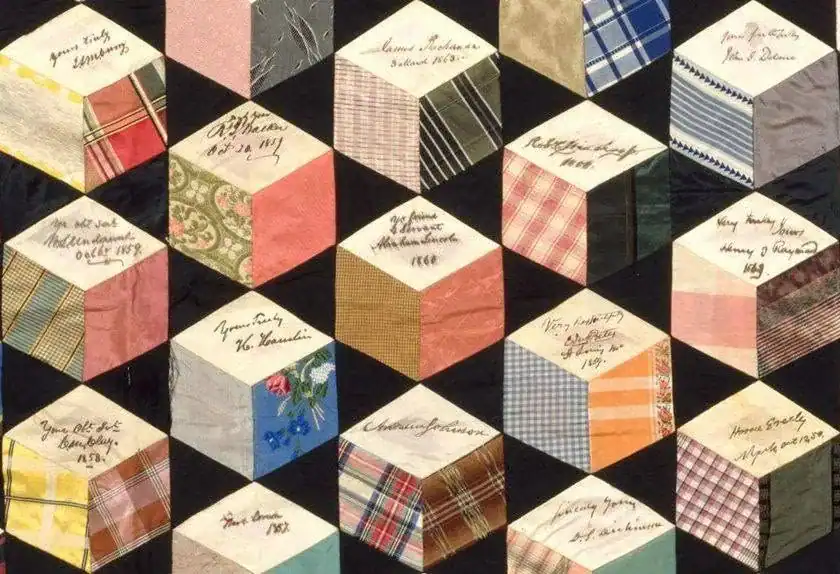
The problem I need help with is — onto the center square of each of 5 or 6 of the blocks, a slip of paper, perhaps 3/4″ x 3 ” is basted down with 1/2″ stitches in brown thread. Each slip of paper has a different name written on it in a beautiful copperplate script.
Even though the quilt is in perfect condition, the papers are not. A few of them are in tatters, ready to fall off completely. Indeed, a number of the other blocks have the brown basting thead with no papers left at all. What should I do to make sure that the paper signatures that are left do not disintegrate any more?
My first thought was to tack bridal illusion down over the papers, but that wouldn’t really protect them from further shredding. My next thought was to unstitch each one of them from the quilt, encase each one separately in mylar and then stitch that back down in the appropriate place. That would put a shiny surface in those places that I don’t think I would like. I can’t think of any other way — unless I fuse each piece of paper to fusible interfacing and stitch it back on without any protective covering on the front. But then I would be forever changing the original, and I am loathe to do that.
Can any of you bright lights think of any other way to preserve these names?
Judy in Ringoes, NJ judygrow [at] blast [dot] net
Date: Mon, 07 Jun 1999 05:03:18 -0400 | From: Judy Kelius <judy [at] chesco [dot] com>
Could you scan each one, print them onto transfer paper, press them onto plain fabric, and then tack them to the appropriate squares? Then put the originals in some kind of casing and tack it to the back of the quilt. This would preserve the originals while being reversible, and the signatures would “bend” with the quilt. You could do the same thing with new photocopies, of course, but it seems they would also begin to disintegrate.
At 12:25 AM 6/7/99 , Judy Grow wrote:
>I bought a nice late 19th century quilt today: unwashed, Rolling Stone blocks, sashing with corner blocks, in double pinks, Lancaster blue, yellow, orange, and a brown and white border print for backing. It has a lovely triple cable quilting pattern in the border.
>The problem I need help with is — onto the center square of each of 5 or 6 of the blocks, a slip of paper, perhaps 3/4″ x 3 ” is basted down with 1/2″ stitches in brown thread. Each slip of paper has a different name written on it in a beautiful copperplate script.
>Even though the quilt is in perfect condition, the papers are not. A few of them are in tatters, ready to fall off completely. Indeed, a number of the other blocks have the brown basting thead with no papers left at all. What should I do to make sure that the paper signatures that are left do not disintegrate any more?
>My first thought was to tack bridal illusion down over the papers, but that wouldn’t really protect them from further shredding. My next thought was to unstitch each one of them from the quilt, encase each one separately in mylar and then stitch that back down in the appropriate place. That would put a shiny surface in those places that I don’t think I would like.
>I can’t think of any other way — unless I fuse each piece of paper to fusible interfacing and stitch it back on without any protective covering on the front. But then I would be forever changing the original, and I am loathe to do that.
>Can any of you bright lights think of any other way to preserve these names? Judy in Ringoes, NJ judygrow [at] blast [dot] net
Date: Mon, 7 Jun 1999 10:47:45 +0100 | From: “Sally Ward” <sward [at] t-ward [dot] demon [dot] co [dot] uk>
Before we all sigh too much over the tiny waists – weren’t people shorter then as well ?, so the tiny waists in proportion on a 5′ 4″ turn-of-the-century girl would not be the same as a 16″ waist on my 5′
10″ 90s dd ?
Sally W in UK
Date: Mon, 7 Jun 1999 07:46:47 EDT | From: Kittencat3 [at] aol [dot] com
There is a documented wedding dress in a collection in western Pennsylvania with a 10″ waist. The original wearer was very small, very young, and only wore it for a few hours. My own mother, uncorseted and not a dieter, wore a size 2 wedding dress. She *easily* could have been corseted to 16 inches. I have her dress. I don’t know what my grandmother wore a hundred years ago, but I would bet it had a very small waist.
You have to remember that the average American is significantly taller and heavier than s/he was a century ago; we eat more protein, have healthier diets, and various ethnic/racial groups have intermarried to an extent unknown in the rest of the world (remember hybrid vigor from biology class?). Modern brides are also several years older than 19th century brides (mid 20’s as opposed to mid teens). I don’t find small corsets out of the question.
One last thing: very small waists were worn almost exclusively by the upper classes, for formal occasions. Servants, factory workers, teachers, and students in class needed to move.and didn’t tight lace at all, while rich women and girls spent most of their days in tea gowns and more casual clothing before donning tight corsets for balls and late parties….
Lisa Evans
Date: Mon, 07 Jun 1999 07:21:26 +0400 | From: Xenia Cord <xecord [at] netusa1 [dot] net>
To Judy Grow and QHLers –
Just a suggestion, of course, but it sounds like the papers are meant to be reminders of the makers of each block, and possibly not signatures in the classic sense? I think I would diagram the quilt, with the placement of each name. Then carefully unstitch them and make photocopies. Save the originals together, but not sewn to the quilt, and keep all the documentation together. Then you could encase each name slip in mylar or other clear bond.
Xenia
Date: Mon, 07 Jun 1999 10:38:01 -0700 | From: pastcrafts [at] erols [dot] com
Now we are into my area of expertise! Yes there were a few, very few 18″ waists, but only one has been documented to belong to an adult woman. Most of what we have to go by are those clothes laid asside to remind a woman of the glory of her youth. I can’t be the only one who has saved afew items cause I just know that i will get back into it some day (I wish!)
Seriously though, the corsets created an optical illusion. The natural form is shaped like an oval – the wide part is on the front and back of the figure. The corsets reshaped that oval so that the front and back were manipulated into being the short part of the oval. Sorry, this hard to describe in words! Think of the front and back appearance of the corset wearer as like the prow of a ship. When you look at the corsets on forms from the side, these waists were not that tiny, just rearranged. Yes some women did have a rib amputated to make their waists smaller, but that was a fashion aberation just as were the women who had their little toe amputated in the 1960’s inorder to wear those impossible Italien designer shoes. Just as women dosing themselves with water before making an entrance into a party in 1800 -1810 so as to have the fabric hug their form like the ancient statues they were emulating,were also an aberation, not the norm.
I sell wedding dresses part time and take girls measurements all the time. In the past 5 years my tinest bride, an oriental child who was a size -2, had a 22″ waist. She was 20 years old.
People were smaller around in the 18th and 19th centuries, they did not have the skeletal developement that our 20th access to nutrition has given us. They were just about as tall, though, depending on ethnic origin.
I suspect that the same is true of the 20 inches quilting. Yes it existed, but as an aberation not the norm. As a material cultures historian I am much more interested in the norm!
Newbie
PS if You measure around a roll of paper towels, that is 16″!
Date: Mon, 07 Jun 1999 10:48:35 -0600 | From: Jocelyn <jocelynm [at] sw1 [dot] socwel [dot] ukans [dot] edu>
> There *were* 16 and 18″ waists. My grandmother’s tea gown and wedding gown, turn of the century [the last one!] had 18″ waists. When we had a ‘fashion show’ including vintage clothing in the late 50s we could find only one girl who could close either of the gowns around her waist.
I daresay the original owners who could have gotten into those gowns without a corset were few and far between. <G> But still, I bet that far more ladies claimed to have a 16″ waist, than could have gotten into a dress with a 16″ waist, even with their corset laced to the tighest! <G>
As to # of quilting stitches possible: I can get 20 to the inch,
> sometimes, but keep in mind that I am a ‘single stitcher’ (I don’t like the term ‘stab stitcher’) and that would be on a *really* good day with plenty of warm-up and no tensions or disruptions.
I know I could definitely make smaller stitches if I went to single stitching, but I’d also go out of my tree. Right now, I enjoy quilting…if I keep pressing for smaller and smaller stitches, it ceases to be relaxing and becomes a chore. Also, I’m not sure I really like the quilting where the stitching is so tiny, it’s almost invisible- just a pucker in the fabric. I guess it’s a matter of WHY we quilt- I do it to feel a connection with my ancestors, none of whom ever made a Baltimore Album heirloom. They stitched fast to get the covering on the bed, and I guess that’s good enough for me, too. <G>
Jocelyn
Jocelynm [at] delphi [dot] com
Date: Mon, 7 Jun 1999 16:08:31 -0700 | From: “pepper cory” <pepcory [at] bmd [dot] clis [dot] com>
Hello Judy and congratulations on finding such a nice PA quilt! In my experience, the Rolling Stone pattern was often used by Dunkard families in PA and a lot of the these quilts did not have the names written in the middle of the block (as we’re most used to seeing them-) but rather the names were stamped in little block letters about 1/4″-1/2″ high. My friend Susan has a Rolling Stone quilt in PA colors, just as you describe except her’s is stamped, and since she bought her’s, I’ve seen three others. Perhaps it was a fad in certain churches or counties to do signature quilts in this fashion? It would certainly take care of the problem of gathering signatures directly if all you had to do to get your name on a quilt was to send so-and-so your name on a piece of paper and she’d stamp it for you! Hall also refers to this pattern as ‘Single Wedding Ring’ so perhaps these were made as wedding gifts. Good suggestions for preserving signatures.
Pepper Cory
Date: Thu, 03 Jun 1999 22:53:45 -0500 | From: Karen Bush <Birdsong [at] worldnet [dot] att [dot] net>
I ditto Cinda…I saw an ad once for hand quilting…20 stitches to the inch..no way. So, i called the number and asked her, just HOW did she get 20 to an inch. I got l2 and thought I was doing good. She counted top and bottom, I’d never Heard of this before! That was several years ago, and have seen it once or twice since then. I feel like it’s ‘false’
advertising.
I mean, if you have stitches on the top, you’re BOUND to have them on the under-side..right? ugh…Pet Peeve #2… number 1 is the theory…”she can quilt out the puckers”….HATE it when they say that!
🙁 kb
— > esulting astronomical numbers of stitches to the
> inch are silly and don’t convey the sense of what the quilting is like that numbers like 10 or 12 to the inch do. This is a pet peeve of mine.
Date: Fri, 04 Jun 1999 04:18:44 PDT | From: Ann-Louise Beaumont <albeaumont [at] hotmail [dot] com>
To add to the discussion about small quilting stitches, the tiniest stitches that I have seen were in a stuffed whitework toilet cover in the Amherst (MA) museum. When Melinda LeLacheur and I examined the piece, dated first quarter, 1800’s, we found that the stitches outlining the stuffed work that were impossibly small were done in backstitch. This would be one way to control the stitch size.
Best wishes,
Ann-Louise Beaumont
Date: Fri, 04 Jun 1999 06:47:08 -0500 | From: Laura Hobby Syler <texas_quilt.co [at] mail [dot] airmail [dot] net>
>number 1 is the theory…”she can quilt out the puckers”….HATE it when they say that!
Karen,
For those of us that hand quilt, and have been doing it for as long as you and I have, and have seen all the hundreds of quilt tops discovered in the attic that GM & GGM pieced, there ARE reasons why those little darlings were never quilted…….they don’t lay flat and no amount of pressing, even with a steam roller will get those suckers to lay flat and those puckers get quilted “IN” not “OUT”. (And a right nice piece of surface design often results! I just finished one for a HS bud whose mom passed from cancer a couple of years ago and had the quilt 1/4 done…what a mess, but I didn’t want to remove any of her stitches, although I did have to take the borders off and shorten them a full 6″!!) I guess that we quilters for the public & textile historians need to do some more education on what can & can’t or should & should not be quilted, and the real reasons for that!
You know, I was always taught that museum quality stitching was 10 or more stitches to the inch. and I was also told to count it both ways…10 to the inch or 21 F&B…..guess that dear soul that taught me that was using the ole one-upsmanship rule <VBG>
Happy Quilting!
Laura
Date: Fri, 4 Jun 1999 08:06:23 EDT | From: Kittencat3 [at] aol [dot] com
In a message dated 99-06-03 21:52:06 EDT, you write:
<< it would be impossible to handsew 20 stitches per inch by hand. >> Uh, no, it’s not. I’ve seen *modern* quilts with 18 stitches (all on the front) per inch, and I understand that Virginia Ivey’s trapunto quilts have around 20 stitches per inch. It depends on the skill of the seamstress, the thinness of the quilted sandwich, and the sharpness of the needle. *I* can’t do it, but I’m not ruling it out for others.
Lisa Evans
Date: Fri, 04 Jun 1999 07:40:12 -0500 | From: Laura Hobby Syler <texas_quilt.co [at] mail [dot] airmail [dot] net>
But wait, isn’t that embroidery, not quilting? <G> Sorry, just had to play devils advocate here!!!
I’m in a pixie-ish mood…..looking forward to my new class of beginners this morning–all over 65
Later folks!
Laura
>dated first quarter, 1800’s, we found that the stitches outlining the stuffed work that were impossibly small were done in backstitch. This would be one way to control the stitch size.
>Best wishes,
>Ann-Louise Beaumont
Date: Fri, 04 Jun 1999 10:41:29 -0600 | From: Jocelyn <jocelynm [at] sw1 [dot] socwel [dot] ukans [dot] edu>
> When you are measuring stitches per inch on a quilt documentation, do you count the ones you see on top or both top and bottom? I have been only counting the ones on top, but have come across some museum records which use both top and bottom. Comment, please! Jeanne Fetzer
Jeanne,
I don’t think it’s as important HOW you do it, as that you tell how you did! Personally, I don’t see the point of counting top and bottom. Everyone knows that a quilt will have stitching on both the front and back, and the number of stitches will be roughly equal, plus or minus 1.
Personally, it ticks me off, especially on the eBay, for people to say a quilt has ’16 stitches to the inch’…and not specify it’s front and back. I know it’s durned near impossible to stitch at 16 stitches to the inch, front only– but there’s something cheesy about it, like they’re trying to trick the gullible. My preference is for top only- but say so! I wouldn’t want to pass up a quilt that really IS 16 stitches to the inch, top only, that’s going extra-cheap…<G>
Jocelyn
Jocelynm [at] delphi [dot] com
Date: Fri, 04 Jun 1999 10:44:13 -0600 | From: Jocelyn <jocelynm [at] sw1 [dot] socwel [dot] ukans [dot] edu>
> I came across a quilt today that appears now as red (eight hands around block) and pale yellow. I wondered if the yellow had been green, but even the thread of the quilting is yellow – and does not appear to be faded. Were yellow and red quilts common? Also, what kind of a date if it was yellow and red. If it was green and red, wouldn’t it be easier to date. Thanks for your help. Jeanne Fetzer_
Jeanne,
I’ve seen red and yellow quilts, that were dated to 19th century (sorry, can’t remember any more precisely than that!).
But regardless…there could always have been one maverick who didn’t like the green and red quilts her neighbors were making. <G> It took me a looonnnnnggggg time to get into those red and green quilts, and I still don’t have any particular desire to make one. <G> Maybe I would have, if I’d lived at the that time, but I suspect I might have made it in different colors….
Jocelyn
Jocelynm [at] delphi [dot] com
Date: Fri, 04 Jun 1999 10:48:39 -0600 | From: Jocelyn <jocelynm [at] sw1 [dot] socwel [dot] ukans [dot] edu>
> I honestly think when they said 20 stitches per inch in olden days, it would be 10 stitches per inch. When you consider machine stitching and how small the stitches are when you sew 20 stitches per inch, it would be impossible to handsew 20 stitches per inch by hand.
Ann,
Awhile back I met a woman who stated that she quilted 16 stitches to the inch, front only. That would be 32 ins-and-outs per inch.
Now, 180 percale sheets have 45 threads across…so if she were quilting on something woven like 180 percale, she’d be quilting over and under individual threads! That makes no sense to me, either for modern quilters or for those of the last century. I suspect it may have been like the 16″ waist…more boasted of it than actually had it. <G>
Jocelyn
Jocelynm [at] delphi [dot] com
Date: Fri, 4 Jun 1999 22:09:22 EDT | From: KennaleeM [at] aol [dot] com
Maybe they are using the same ruler that some fishermen measure their fish with.
Date: Sat, 5 Jun 1999 07:32:11 EDT | From: CToczek [at] aol [dot] com
Dear Ann and re: the discussion on stitches-per-inch,
When I self-taught myself to quilt six years ago, I began with one generic, sewing shop book. Decent instructions for a beginner, but nothing about hand quilting techniques, only machine work. After ordering a “medley” from Keepsake Quilting, (a friend had clued me in on the shop) I designed my own wall-size pattern and dug in. It came together so nicely….and then the quilting! Look at my tiny stitches, I thought, I really have the knack for this! Then I ordered Ami Simms’ book on perfecting the quilting stitch. <g> Ah, no wonder my lines were thick instead of graceful. I had backstitched half the wall hanging together! <VBG> Had to re-teach myself the quilting stitch to finish the piece and now can manage 8-10 stitches on a REALLY good day. I don’t have the wrist strength/skill to push smaller ones through the layers with cotton batting. I have to agree with Jocelyn and others that 20 stitches to the inch would be too tiny, almost. I’d rather see larger, even ones in the design.
Best to all,
Carla
West Point, NY
Date: Sat, 05 Jun 1999 22:12:31 -0500 | From: Russell-Hill <russhill [at] ctesc [dot] net>
I suspect it may have been like the 16″ waist…more boasted of it than actually had it. <G>
This comment was join with the response to 16, 18, or 20 stitches to the inch. Well I would be suspicous of those claims also but the 16″ waist or even the 18″ waist was the measurement given to the corset maker. The true waist measurement would be 3 or 4 inchs larger. There was a 3 or 4 inch space so that the wearer could move some.
There is documentation though of a woman with a true19 inch waist but she trained herself from an early age. No Chocolate for her. Well this is just FYI Debbie
Date: Sun, 6 Jun 1999 06:04:53 -0500 | From: “Ann G. Hubbard” <ahubbard [at] usmo [dot] com>
It is still my feeling that if you are going to handquilt 20 stitches to the inch do it by machine. In the newest Better Homes and Garden APand Q, there is an full page ad by Fairfield Batting. I did not count the stitches per inch, but the quilting is lovely with a mix of stippling and background grid. What makes quilting pretty is the space as well as the stitch. Evenness and straightness of stitch is much more important than a discussion of how many per inch. Machines do not always sew perfect, and neither do humans and sometimes I think we lose sight of the overall picture. Enjoy the day it is the first one of the rest of your life. Ann Hubbard
Date: Sun, 06 Jun 1999 15:58:11 -0600 | From: Sharon Harleman Tandy <harleman [at] micron [dot] net>
Hello all QHLers,
There *were* 16 and 18″ waists. My grandmother’s tea gown and wedding gown, turn of the century [the last one!] had 18″ waists. When we had a ‘fashion show’ including vintage clothing in the late 50s we could find only one girl who could close either of the gowns around her waist. As to # of quilting stitches possible: I can get 20 to the inch, sometimes, but keep in mind that I am a ‘single stitcher’ (I don’t like the term ‘stab stitcher’) and that would be on a *really* good day with plenty of warm-up and no tensions or disruptions. Wonder how many I could get on Valium? (;D Might also keep in mind, I seldom have no tension. Does anyone in this decade? Keep laughin’ and stitchin’, Sharon.