March 15 – 22, 2005
These restored messages come from the Quilt History List, an online forum where quilt historians, collectors, researchers, appraisers, and enthusiasts discussed antique quilts and related textiles. The archive dates from 1996 through approximately 2016 and is being restored gradually. Sign up in the form at the bottom of the page if you want to know when a new page is added. Original spelling, opinions, formatting, and inactive links may remain unchanged.
Primary topics of this QHL Digest:
- The Underground Railroad Quilt Myth Reaches Cable TV — Members report the debunked quilt-code myth being repeated on a Pennsylvania cable network and discuss further pushback. (see the article on Underground Railroad quilts)
- York, England Quilt Exhibition Review — Sally Ward reviews the opening day of a major quilt exhibition in York.
- Deciphering “Lomb Rathis and Barrs”: 18th-Century Textile Terms — Members work together to decode obscure textile terminology from a 1775-1830 North Carolina probate inventory. (see the article on cotton and textile terms)
- A Hidden Sleeve on a Double-Sided Quilt — A museum curator describes an unusual hanging-sleeve construction found between the layers of a double-sided quilt.
- Natural Dye Myths in eBay Quilt Listings — Members debunk assumptions about natural dyes, mordants, and fruit-dyed fabric claims made in an eBay listing. (see the article on natural dyes)
From: Laura Robins-Morris
It gets even worse than the quilt codes myth.
I watched the video and there is a student re-telling the stories of real escaped slaves. One is about Eliza Harris in ‘Uncle Tom’s Cabin’ who “ran across the Ohio River on big chunks of ice.” Eliza was, according to Stowe herself, a real person. But the river crossing was a symbolic and dramatic story.
After this project, the students prepared a presentation with booths and displays on all that they had “learned” about the Underground Railroad.
Who knows how many other myths those students now believe and then displayed as historical fact.
Among the written aims of the project was that students would learn about doing research, and evaluating resources and information. I don’t think they accomplished that part.
Laura in Seattle
From: Candace Perry
Our archivist at the Heritage Center was watching PCN — a PA cable network — this a.m. and said he saw Cinda Cawley discussing the quilts presently on exhibit at the PA State Museum. He said she did a great job! I’m not sure if it will be re-run at any time — Pennsylvanians who are interested should check schedules. Props for Cinda! Candace Perry Schwenkfelder Library & Heritage Center
From: <kerrybrack@>
how wonderful! i believe that judy day (an australian quilter)has a miniature on display alongside a picture of an original quilt in the collection. from memory it is called the rebekkah kohlberg quilt. i am wondering how it looks in the display.
judys is an 18 inch miniature from memory. too awesome, as i have seen the reproduction of the quilt in the original size. i am figuring that the reproduction is on display as the original is too fragile. i was the go between for judy days quilt to go to pa. cheers kerry x
This message was sent through MyMail http://www.mymail.com.au
From: Judy Schwender
Hello all-
I received a response from Judy R. Williams, Education Consultant, School Library Media, Indiana Department of Education this morning. She wrote, “It is encouraging to know that someone is reading our website and links and to see the power of communication. Eventually, I plan to write to all the quilters who have e-mailed Laura and me. Also, we invite you and organization members to send lesson plans that you write for future consideration. Please link to Lesson Locator to see lessons addressing Indiana’s Academic Standards.” Ms. Williams also reported that due to budget constraints, the interdisciplinary class is no longer being taught at South Ridge High School, and that she had forwarded my email to Doris Dilger, the school library media specialist and member of the team that wrote and used this collaborative lesson/project.
My reply included the following:
“I am always disappointed when budget problems force good programs to end. I do know that teachers work very hard to do the best job they can, and it is frustrating to have money get in the way. And we in the quilt world do not mean to simply criticize. We have to go a step further and actually help develop lesson plans.
“I agree that the next step is lesson plan development, in such a way that the lessons are pre-packaged for teachers as much as possible. In regard to the lesson presenting the concept of quilts used as signals on the UGRR, however, quilt scholars have found that providing a disclaimer does not work. The link between the visual and tactile images and the idea of a ‘secret code’ is simply too strong. In spite of such a disclaimer, many participants will come away with the belief that quilts were used as signals on the UGRR. The community of quilt scholars would prefer that the suggestion of a ‘secret code’ not be made at all.”
We in the quilt community have to be able to assist in lesson plan development. Armchair quarterbacking won’t get the job done. So unless we want to create complete lesson plans from scratch ourselves, we will likely need to be proactive in providing our names and qualifications to curriculum specialists and developers in our counties and states, and invite them to include us in the planning process.
And, by the way, Ms. Williams has made two full size quilts and several pillows!
Judy Schwender
From: Dana Balsamo
Hi all, While we are on the subject of UGRR quilts in schools…remember back in December? I found a bulletin board in one of the schools in my district with a class project titled “Quilt Codes as Signals in the UGRR” (or something to that effect), based on the book “Sweet Clara and the Freedom Quilt”. I had written the teacher and received no response, so I contacted the Principal, who put me in touch with the Superintendant of Curriculum. After many snow days, sick children, a bout of pneumonia, we had our meeting last week. The head of the Social Studies/Language Arts Department was there as well.
In this particular situation, a 5th grade teacher took the book from her mother, who is a teacher in the middle school, and took it upon herself to use the book in the class. It is not a part of the curriculum, nor a recommended resource in elementary school for the South Brunswick, NJ School District. It is used in the Middle School as an introduction to the slavery/Civil War subject. It is taught as a work of fiction. And only used as an introduction, no projects, papers, etc based on it. The elementary school teachers have been notified how not to use the book. The Middle school Social Studies teachers take history very seriously, and from what I understand are constantly debating contraversal historical subjects. Good to know some of our teachers are actually thinkers!!
The school district takes the opinion that, and I will quote here, “Many people believe that quilts were used as a secret code to help aid slaves escape through the UGRR, but there is no evidence of such, and many historian dispute this belief.” What more can I ask?
I also asked if HIPV was being used in the highschool…it is not.
There are 3 quilters that are teachers in the school system, each use quilts in their class room in various ways, not though, to teach about the UGRR.
There are hundreds of school districts in NJ, each district follows a very general curriculum outline from NJ State, but there is a lot of room for interpretation and opportunity to concentrate more/less on certain topics. For example: health studies is taught in the highschool. South Brunswick has experienced several suicides commited by highschool students in the past three years. Suicide and mental health is a topic, but our district will probably concentrate more on this particular topic because there seems to be a need for it. A district with a strong quilt history might use quilts more in their curriculum.
And just an addition, NJ is starting (within the next couple of years) of implementing the “Armistad Program” (sorry if I spelled that wrong). African American History is going to be more intergrated into American History, so that we are not just studying great African Americans and their accomplishments just in February for “Black History Month”, but throughout the entire year. I was told I might want to watch that program very carefully to see how it unfolds…
My best to all, Dana
Material Pleasures Affordable Vintage Linens, Lace, Textiles, Buttons & More! www.material-pleasures.com
From: Christine Thresh
I just ran across this marvelous mosaic by Romare Bearden: http://www.dia.org/education/connect/bearden.htm
The information says it represents a scene remembered from his childhood.
Christine Thresh http://www.@
From: Judy Schwender
I was trying to locate the size of that- turns out it’s 24 x 36. In the process I found this: http://www.genesisartline.com/m08.htm
Christine Thresh <christine@> wrote: I just ran across this marvelous mosaic by Romare Bearden: http://www.dia.org/education/connect/bearden.htm
The information says it represents a scene remembered from his childhood.
Christine Thresh http://www.@
From: Daniele Seyrig
Hi Daniele- Your input is intriguing, regarding the dilution of the blue powder and 3D > ironing in order to fix it. I was wondering if they provided an 3D > approximate time period this method was used? If not, did they show it 3D > on a dated piece of clothing? No they do not mention any date nor show any piece of cloth . But they do show the stencil ( metal ) and a paint brushe.Both items show blue marks . the article in the catalog is written by Celine Diebold and is called Embroidery Patterns ( Les modeles de broderies )But I found out since I wrote the message that in her encyclopedia Therese de Dillmont says that if you want to copy a model on fabric , you copy the model on transparent paper ( calque ) and put the fabric over it . Then you take very dark indig o powder that you dilute ( in french delayer wich meansto mix with a liquid but she does not say wich, may we suppose it is water ?????)) with a pinch of sugar and the same quantity of arabic gum .She says this preparation wil l be used as an ink using a feather or a fine paint brush . She adds that you must do a fine line because if you were not to embroidery immediately then the lines might not wash out . ( all this is in chapter called A few recommandations )p.597 of my end of 19th c . copy of the encyclopedia . When I talk about it here everyone above 50 knows the process either with powder or with liquid but no one knows what the powder or liquid was . I am trying to learn more . Will let you know if I do Daniele Daniele Seyrig Les theories passent , la grenouille reste (Jean Rostand )
From: Julie Silber
Hi All, I have had a request from a gentleman here in California who needs a quilt for his California King Size bed. He would like an antique, but also wants a quilt big enough to use as a spread. I’m figuring at least 104 x 110 inches. I explained that he was going to have to get a “reproduction” quilt to make such a fit. He is willing to pay around $1,000. He wants good quality work, all cotton, hand quilted, and an “antique look.”
Help! I’m stuck in quilts made prior to World War 2, and quite ignorant of where to send him. Any suggestions? E-mail me privately, if you prefer, at quiltcomplex@
Thanks, Julie Silber
From: Lucinda Cawley
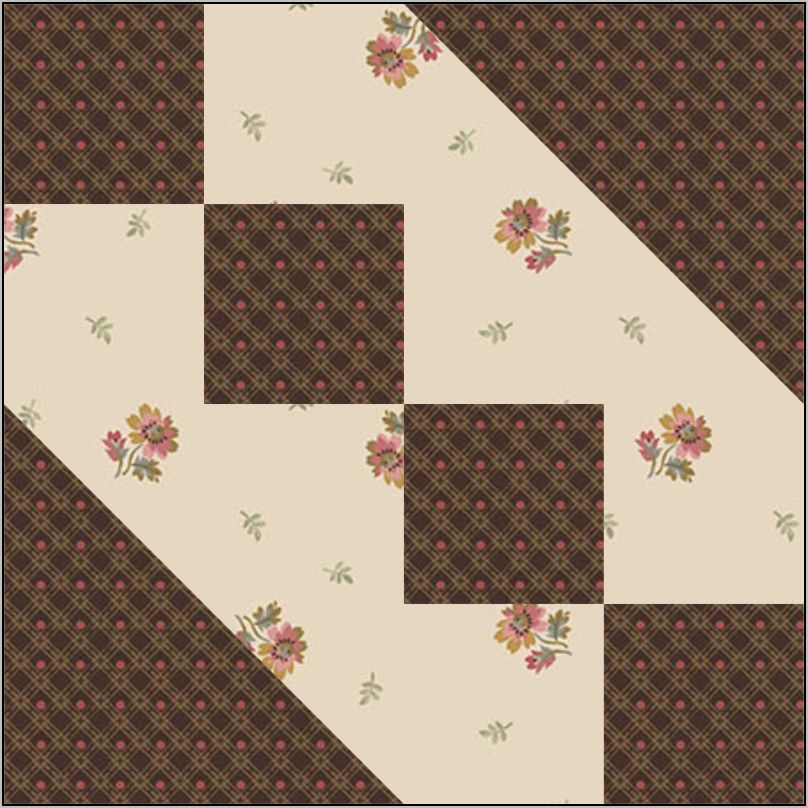
I was in Lewes (pronounced Lewis) Delaware yesterday and stopped at the Zwaandael Musuem, a copy of a town hall in the Netherlands which commemorates the Dutch settlement of Delaware. They are exhibitng a handful of Delaware quilts to compliment a much larger exhibit in Dover, the state capital. Most of the quilts are attributed to Sallie and Sarah Carey of Cool Spring in the southeast corner of the state not far from the mouth of Delaware Bay. What interested me was a Puss in the Corner of only two fabrics a brown and beige print on a muslin background with cut out corners. Jeanette Lasansky has taught us to think of this as a New England phenomenon so I always pay attention when I see it in the mid-Atlantic states. Even more interesting was a Strippy alternating strips of Lemoyne Stars with panels cut from a Marseilles spread. The label called it stuffed work, but it was obviously Marseilles. There were five peiced strips. The three in the center were 1840s fabrics and hand quilted. The strips on either edge were 1880s fabrics machine quilted. The quilts were in a large case that allowed me to see the back which showed that it had been assembled quilt as you go style. Somebody salvaged part of an old quilt and reconstructed it. I’ve only seen this once before, in an appliqued Album made in Cecil Co., Maryland at the top of the Chesapeake Bay. Cinda on the Eastern Shore always happy to see something surprising
From: Lucinda Cawley
Hazel Carter posted about this exhibit at the Maryland Historical Society in Baltimore. I’m sorry I haven’t given you my impressions earlier because it closes on Sunday. American Fancy presents the decorative arts of the first 40 years of the 19th century when the American republic was becoming itself. I smiled the entire time I was there looking at objects decorated with total exuberance: painted furniture and architectural details, coverlets, pottery and porcelain, clothing, paintings, faux graining and, of course, quilts. There were only five and they were grouped together with a display on the invention of the kaleidoscope. The quilts are: a huge (128″x132″) Sunburst, c. 1840, of diamonds made by Rebecca Scattergood Savery (a Quaker who made several such quilts for her children) belonging to Winterthur; a Lone Star, c. 1835, on a dark green background bordered on three sides with wonderful bird fabric almost two feet wide in a the border; an 1830 Hexagon tablecover; a mid-century 8-point Star, a 36″ square Lone Star (dated early 19th cen.) from Memorial Hall in Deerfield, MA in yellow, pink, red, green, blue on white with a rose on a graceful stem in each of the four corners. The theme of this display was that women began to make such quilts because they were inspired by the kaleidoscope which was invented in 1816 (or 19, I forget). The same idea was expressed in the Baltimore Album quilt exhibit the Historical Society presented in 2000. In fact Sumpter Priddy, the curator of the current exhibit, quotes Nancy Davis of the MDHS when advancing the kaleidoscope theory. I didn’t buy it 2000 and I still don’t. I was educated by the Jesuits; I took logic. Post hoc ergo propter hoc is a logical fallacy; because one thing happens after another does not mean that it was caused by the first event. Later that same day I spent a lovely hour looking at the Baltimore Art Museum’s Antioch Mosaics which date from the 3rd to the 5th centuries AD. Various panels have Lemoyne Stars, medallion framed centers, typical Baltimore Album motifs with “sashing” and kaleidoscope borders, Garden Maze, Baby Blocks, cable borders, grapevine borders, even a Maryland stepped border. In other words many of the motifs ascribed to the influence of the kaleidoscope were employed while Rome still ruled the world. Somethings are just in our collective consciousness/imagination because we are human. They please the eye. Sorry to be preachy. Cinda on the Eastern Shore getting off my soapbox
—
About custom quilts: the best folks for this sort of work are the Schenks. Visit their website at http://www.quiltdesigns.com/index.html . They come to the Houston show. Their quilts are American-made and of extremely high quality. I’d recommend them without hesitation. Hope this is helpful- Pepper
I saw “Turkey Red” (this was on the label) at a JoAnn’s store near me. Thought it was interesting since I hadn’t seen any before but I was also looking for something else when I spotted it. I bought a small piece to compare to the Turkey reds I have in my collection. You might want to check and see if a store near you has some. I don’t remember the name on the bolt but could go back and check if you would like. Also, in regards to the Egyptian cotton which has been discussed lately – one of the ladies at JoAnn’s says the warehouse is no longer stocking it. There were only 2 colors available, which really surprised her, when I brought it to her attention. Anyway, that may be a source for you. Babette in Illinois
Gail Ingram <gingram@> wrote:> I do plan on making a red and white feathered star quilt in my “leisure” > time (in my next life?) and truly want to keep the exact shade on hand for > this. Plus, I find this shade very pleasing in other projects, particularly > the Baltimore Album repro quilt I am working on and want to do red and white > sawtooth sashing and borders for. At any rate, I just “need” to know some > good information.
Linda,
I smiled when I read the passage above, as, I am sure, did many other fabric savers. It called to mind a story a friend recently told me. The people in her Sunday School class are in their mid- to late-fifties. Recently the teacher used the term middle-aged, somewhat to the chagrin of one of the members who announced that he did not consider himself middle-aged. The teacher replied, “Well, how long are you planning to live, Frank?” The fellow was 55.
I hope you will let the list know when (for I am hopeful) you locate sources for the solid Turkey red, for many of us are in your situation, though perhaps for less altruistic reasons.
Gail Ingram
From: Sally Ward <sallytatters@>
Yesterday I visited the first day of the quilt exhibition in York, England. It is entitled ‘Through the Needle’s Eye – 250 Years of Quiltmaking’.
Cinda sets the bar high <G> but I have done my best to write a comprehensive review and hope I have included the sort of information on exhibits that you will want. It turned out so comprehensive that I have put it on a website rather than clog up the list.
Please visit at http://www.geocities.com/Sallytatters/YorkShow.html
A word of warning, this is a ‘free’ geocities site and has a daily bandwith limit, if you all rush at once you may find a message saying ‘come back tomorrow’.
Sally W
— Sally (‘Tatters’) Ward
Babette — How did Joanne turkey red compare to your old turkey reds?? Re Egyptian cotton — is the color selection of two due to selling out other colors? Our Joannes has about 5 colors in the broadcloth and 3 or four in the sateen. There were plenty of bolts left.
A comment about “turkey red” – this is actually a process, rather than a color, and the process involves vat dyeing, numerous steps, and noxious substances not condoned by the EPA today. Among the steps, the fabric was boiled in oil, hence the old designation “oiled boiled red.” So fabrics labeled “turkey red” are merely hoping to approximate the surface color, and are made with a different process.
One characteristic of 19th century “true” Turkey Red fabric was that a piece could be soaked in today’s laundry-grade chlorine bleach without affecting the color at all!
Around the turn of the (20th) century when true Turkey Red dyestuffs were unavailable in the US because the patents were held by German dyers (wars and politics, you know), US dyers invented another apparently clear, saturated red called Congo Red. While fabrics dyed with Congo Red appeared to match Turkey Red fabrics, over time the Congo Red faded to a pumpkin tan. Many of us have seen quilts with odd reddish-tan segments in an otherwise red arrangement; this is why.
Xenia
I do a lot of natural dyeing and I have never once contemplated trying for Turkey Red. It takes several weeks and involved mordanting with oil, urea, fatty soap, and a whole bunch of other smelly, vile things (one old recipe called for burying the goods in a dungheap for a month!). It’s *the* best red, but it was terribly expensive for a reason.
Karen Evans
Good point Xenia, on the Turkey red issue. We as quilters , quilt historians and questers should remain set in our thoughts about not calling an apple a banana. If we can just remember that the country Turkey and not the bird is responsible for the dye and not a color explanations can be simple. Looking for a particular shade of dark red seems to have gotten sid tracked. Leave red colors to the Red hatters and make wonderful designs for tops with all shades of red, dark, deep or bright. Velia
Date: Sun, 20 Mar 2005 18:34:10 -0500 | From: Karen Evans
I just picked up my entry from the Hands Across the Valley quilt show in Amherst, Massachusetts. And whose quilt was hung on the same panel as mine? Jan Drechsler’s!
Small world, no?
Karen Evans
From: Lucinda Cawley <lrcawley@>
I have to do this tonight lest I become addled by too much quiltiness in my life. FVF meets tomorrow and I know I’ll get confused. I know that nobody should have as much fun as I do, but I am secure in the knowledge that the downturn will come and have resolved to adopt my sister Dodo’s role of “life stuffer.” Hazel Carter and Bunnie Jordan’s Fabric Dating Club met this afternoon at G Street Fabrics in Falls Church, VA. The theme was “circles.” Up first was a Rose variation circa 1850 from Ohio make by Elizabeth “Ellen” Johnson which has remained in the makers family. It did not fit the theme, but that was definitely okay. The background and backing of the quilt (the appliques done in an elegant white buttonhole stitch) are green cotton–a great example of the mid-19th century attempts to grow cotton of different colors. The green is a cast only, but very interesting. Hazel had a couple of hold-overs from the theme of the last meeting and challenged us to date a quilt looking at the back only. Debbie Cooney rose to the challege and was correct. On to the circles; there were some really weird ones: a Spider Web on peach; a Maze with a snake through all the blocks dated 1969; a 1950’s New york Beauty set as a Snake; a really weird quilt made of two sizes of circles with red and green spokes (9″ and 5″) circa 1900; a 1940 “impossible to piece” pattern (shades of Hubert Ver Mehren and the Home Art Studio–read Uncoverings 2000) and an identical pattern in the clarets and cadet blues of the 1890s; also from the 1940s a lovely pieced Circle of Tulips in response to which Hazel whipped out a nearly identical top peiced by her mother with a Lemoyne Star in the center of the circle; a scrap Sunflower, c. 1900, with triple sashing, probably from North Carolina; a c. 1890 New York Beauty variation also with triple sashing and this time with 9-Patch cornerstones and finally a fabulous Ver Mehren multicolor Giant Dahlia (a kit, no doubt) of red, peach, orange, green, yellow, lavendaer and blue solids with an Art Deco border (Ver Mehren designed the Giant Dahlia in the 1930s, again see Uncovering 2000–even before I joined AQSG I invested in a complete set of Uncoverings and am I glad I did!). In a departure from the theme we saw a scrappy 1000 Pyramids, last quarter 19th century, with big triangles including one that says “Let Us Have Peace U. S. Grant). We heard the story of asking a neighbor to bid on two Mariner’s Compass quilts and ending up with a Coxcomb variation top (c. 1890) in orange, green and red turned to tan, but with a border that alone justified the price: green eagles alternating with pots of flowers! Back to circles, curves, etc. with an Art Deco Rainbow appliqued in bias strips (see Vintage Quilts, Bobbie Aug et al, p. 45); a 1930-40s Fan, 1950s flowers made of rick rack circles appliqued with leaves. We went from the rediculous to the sublime with a c. 1850 Reel in a single fondu blue with a second blue for the sashing (it’s pictured in the Quilt Engagement Calendar 1984, plate 10) and a beautifully quilted 1830s Snow Ball pieced of a single dark blue floral print. There just isn’t anything more elegant than blue and white! The 1st quarter was represented by a crib quilt from Lancaster County, PA with the chintz basket of fruit in a floral circle framed by several borders of brown triangles printed with blue and beige circles. We saw an amazing top, a collection quarter circles of turkey reds on green backgrounds and a wild green yellow and blue plaid border (1840s). Farmer’s Fancy is an unusual circular design with three rings of narrow triangles surrounding a diamond-pieced star. The pattern is associated with the Shenandoah Valley of VA and the mountain valleys of eastern West VA (see West Virginia Quilts and Quiltmakers by Fawn Valentine). We saw an 1860 example and a set of blocks. There was a Mariner’s Compass from Rochester, NY in red, blue and orange solids (maybe 1860, maybe not) and an elegant Compass from Frederick Co., MD in what had to be one of the ugliest green fabrics printed circa 1850 (“regurgitation green” might give you an idea of the color). There was a sort of hands All Around variation, also from Frederick, with stuffed feathered wreath quilting. The afternoon had to end and it did with a bang: a 4-block Rose (PA circa 1850) with bunches of huge (3″) grapes, a graceful leaf and vine border less successfully adapted to form sashing and topped off with a tiny orange piping (see The Art of the Needle, p. 70 for a similar block). I was stunned to find that while we’d been looking at quilts it had hailed, thundered, snowed and rained. Ah, the first day of spring in Washington. Cinda on the Eastern Shore
From: Sally Ward <sallytatters@>
You only need to read this if you’ve already read my review on the webpage.
I have an admission that just goes to show you should trust your own brain. When I looked at my notes after visiting the show I couldn’t find anything on the 1970s Crazy quilt with school badges. However, I had been given an exhibit list previously, and have seen the quilt and know it well (and love it). So I assumed I had had a senior moment and walked past it, and wrote it into the review anyway.
This morning I’ve discovered the reason I didn’t see it is that it isn’t there, at the 11th hour it was omitted through lack of space. Being the most modern it was felt it was the most suitable to omit.
Apologies if that was the one you wanted to go and see <GG>
Sally W — Sally (‘Tatters’) Ward
From: laurel@
My former professor is doing some research in household inventories in Mecklenburg County, North Carolina, for the period about 1775-1830. He sent me a list of textile terms for clarification, and I could handle most of them, but a couple have me stumped. I’m hoping that someone else might offer clues to what they refer to.
One term is a fabric called “Nunsopusly,” as in “1 Bolt of Nunsopusly.” The closest thing–but not very close–that I can find is a reference in Florence Montgomery’s Textiles in America to “None-so-pretty” as a term applied to tapes or ribbons, but I think these would more likely have been sold on rolls rather than bolts.
The other, rather Jabberwockian, term is “Lomb Rathis and Barrs.” I suggested that “Barrs” might be “Barras,” described by Montgomery as a “coarse linen fabric.” For the rest, I wonder if “Lomb” might mean “loom,” but I can go no further with it.
He also asks if there’s a source of identification information for old textile equipment like looms, reels, and spinning wheels, either published or online.
Any ideas?
Laurel Horton
From: jocelynm@
> The seller also professed that the Amish quiltmakers were the best in the > world. Maybe some of them are, but I’ve also heard stories to the contr ary. > Indeed! ‘Amish’ isn’t a type of quilter, it’s a religion. While their relig ion may provide them with ethical standards about doing their work well, th ere’s still got to be some Amish women who didn’t get gifted with much tale nt. 🙂 Just like there’s got to be some Frenchwomen who are lousy cooks. <G>
I have a small collection of quilts that defy the stereotype that ‘in days gone by, people were excellent craftsmen and took pride in having all their work be excellent.’ Maybe some, but there were obviously people who couldn ‘t cut out a quilt with accuracy, and who just kept going when the corners didn’t match. <G>
I am just hazarding a guess here, as this type of stuff generally confuses me — but I’m wondering if the “lomb” phrase refers to the loom and parts of the loom? Not sure which parts. Candace Perry
The Textile Museum in Lowell, MA has a large display of spinning wheels, as well as big looms. Maybe they would have the information on the textile equipment. Peggy in NC
From: Joan Kiplinger
One of the best books on the subject and the “Bible” for most authors is The Story of Textiles by Perry Walton, 1912. Subtitle is A Bird’s-Eye View of the History of the Beginning and and the Growth of the Industry by Which Mankind Is Clothed. The book was commissioned by one of the largest commission houses for the distribution of textile products in this country, Lawrence & Co. of Boston. Contains photos of old looms, company and production histories and just about everything inbetween. Available reasonably through www.addall.com
Just a thought on the Lomb Rathis and Barrs — sounds like a dry goods store or other business. I went through all the Ns in my glossaries thinking nunsopusly might be a phonetic spelling. But the closest I could come was nuns veiling which didn’t quite line up.
Peggy O’Connor wrote:
>The Textile Museum in Lowell, MA has a large display of spinning wheels, as >well as big looms. Maybe they would have the information on the textile >equipment. > > > >
—
My thought is that this is a loom raddle and [beater] bars. The raddle is an item that is fastened to the back of the loom as it is warped, used for spacing the warp before it is threaded through the heddles. Perhaps some transcription errors are adding to the confusion.
Best, Lynne
> The other, rather Jabberwockian, term is “Lomb Rathis and Barrs.” I > suggested that “Barrs” might be “Barras,” described by Montgomery as a > “coarse linen fabric.” For the rest, I wonder if “Lomb” might mean > “loom,” > but I can go no further with it. >
Friends,
I remember reading a few years ago about how to make a hanging sleeve that was integral to the body of the quilt. I can’t remember whether it was on-line or in a magazine. I know that somehow the backing at the top of the quilt gets separated from the front for about 6 inches and each section gets its own batting and quilting, with an extra fabric added on the inside. I believe the sides are bound separately and then the binding is put on at the top of the quilt. The hanging rod can then be slipped through the tunnel thus made.
Does anyone know where I can find those directions, or does anyone have them on their computer? As you can tell from the paragraph above I remember the basics and could probably intuit how to do the deed, but it sure would be nice NOT to have to invent the wheel again.
Many thanks in advance to whoever you are who had the smarts to save the instructions somewhere where you could find them again.
Judy in Ringoes, NJ judygrow@
Date: Tue, 22 Mar 2005 07:37:27 -0500 | From: Teddy Pruett <aprayzer@>
In my next life, I want to come back as Cinda Cawley, who gets to spend more time in museums and wonderul places than anyone I know. Teddy Pruett – just back from a quilt show in Ft. Lauderdale, but the darned exhibit there was my own – sigh. Nuttin’ new to see.
Date: Tue, 22 Mar 2005 09:19:17 -0500 | From: Patricia Keller <berrett@>
Laurel — It may sound like a stretch, but from the work I’ve been doing with inventories, I’d suggest that “Lomb Rathis” refers to “Loom apparatus” or “Loom and loom-relatedapparatus.” Not seeing the actual handwriting, it may be possible that what is being read as “Barrs” may refer to “Gears.” “Loom, appurtanances and gears” is a typical entry for such items in 18th and 19th century probate inventories in southcentral Pennsylvania in my experience with more than 3,000 of them thus far.
Warm regards, Pat Keller
From: laurel@ Sent: Monday, March 21, 2005 10:52 AM To: Quilt History List Subject: [qhl] Textile terms in old inventories
My former professor is doing some research in household inventories in Mecklenburg County, North Carolina, for the period about 1775-1830. He sent me a list of textile terms for clarification, and I could handle most of them, but a couple have me stumped. I’m hoping that someone else might offer clues to what they refer to.
One term is a fabric called “Nunsopusly,” as in “1 Bolt of Nunsopusly.” The closest thing–but not very close–that I can find is a reference in Florence Montgomery’s Textiles in America to “None-so-pretty” as a term applied to tapes or ribbons, but I think these would more likely have been sold on rolls rather than bolts.
The other, rather Jabberwockian, term is “Lomb Rathis and Barrs.” I suggested that “Barrs” might be “Barras,” described by Montgomery as a “coarse linen fabric.” For the rest, I wonder if “Lomb” might mean “loom,” but I can go no further with it.
He also asks if there’s a source of identification information for old textile equipment like looms, reels, and spinning wheels, either published or online.
Any ideas?
Laurel Horton
From: munsey@
Judy:
Hawaiian quilter Elizabeth Akana developed an “Invisible Quilted Sleeve” (TM). It works quite well. I saw it demonstrated it in a class I attended a lotta years ago. It was published in a magazine, I think, but with my mind on the Medfield Historical Society Quilt Exhibit in less than 2 weeks, I can’t quite focus on where the article was published even though it is probably right in front of my nose. It might have been on the Hawaiian quilting video that Hawaiian public TV produced.
However, Kathy Tsark of Kwilts ‘n’ Koa quilt shop in Honolulu might be able to help you with instructions and a source. Her e-mail is kwiltsnkoa@ and she also has a web site. She carries Elizabeth’s patterns. Elizabeth now lives in Colorado.
Or perhaps Laurie Woodard has the sources that I can’t remember.
Sandra on Cape Cod where the sun is shining, the snow is melting, and I saw some crocuses – in someone else’s yard.
From: Joan Kiplinger <jkip@>
Another possibility for this word — nuns is an umbrella word for shirtings and was found in an 1745 household inventory. Maybe broken down the word could represent nuns o[of] pusly [paisley which is really stretching it]or shirting of pusly. I haven’t looked up pusly in any old glossaries — I suspect it is a phonetic — but possibly Montgomery has something which will correlate to that word. That is one glossary which I do not have 🙁 .
Date: Tue, 22 Mar 2005 08:36:25 -0800 | From: ikwlt@
judy, i believe these instructions were aired on simply quilts. i’ve looked thru their website and don’t find anything using “quilt sleeve” or “hanger”. i’m on digest so this may have already been answered, but like you said, you might be able to wing it without specific instructions. patti
…I know that somehow the backing at the top of the quilt gets separated from the front for about 6 inches and each section gets its own batting and quilting, with an extra fabric added on the inside. I believe the sides are bound separately and then the binding is put on at the top of the quilt. The hanging rod can then be slipped through the tunnel thus made…
Judy in Ringoes, NJ judygrow@
Elizabeth Akana showed how to do it on Simply Quilts episode #631, on Two-Sided Quilts, but there are no instructions on the SQ web site. (But there is an email address for her.) Maybe a rerun will be coming up soon.
From: sue reich
I spent the weekend on the beautiful Gulf Coast of Florida at my son’s wedding. The ladies were decked out in all sorts of finery. It seems appropriate to present some newspaper accounts of ladies’ dress. Thankfully for us, the style reported in this press release is not the fashion of our time.
Adams Sentinel Gettysburg, Pennsylvania December 7, 1840
Tight Lacing. — A physician in Albany says: —‘ We read last week a heart sick ening account of a fine and amiable young lady who fell a victim to fashion — she laced herself to death ! Apart from the prevailing infatuation which leads fe- males to commit elegant and refined sui- cide, she is said to have been as uncom- monly intelligent and promising girl — The body presented a dreadful sight.– The ribs were contracted to within half their natural circumference, and the shoulder blades were actually lapped over each other ! The chest was of course extremely narrow, and not half the natu- ral room was left for the action of the heart, and the inspiration of air into the lungs. The consequence was Death !
Ugh, sue reich
Joan, sorry I didn’t respond sooner but today was my first “free” day to check out this “turkey red” fabric. First, let me acknowledge I am not an expert. I have 2 quilt tops which, I am told, have Turkey Red fabric in them. I also have a single piece with black dots. The TR in one of the tops is solid and I know it’s hard to date and/or be sure it is, in fact, TR. The other has white dots and is a simple 9-patch. The 2nd top I washed and there was no bleeding from the fabric and no apparent change in color, which causes me to think it is TR but also probably from the 1st quarter 20th C due to the dots. I could be wrong as to the date. It’s only been in the last 3 years or so that I have become fascinated with the “dating” of fabrics. Prior to that I just collected!! Now to answer your question about the JoAnn’s TR: at first glance it appeared to be something I could use if I were doing a repro quilt that called for that particular color. However, NOT! Really a disappointment. I checked it against what I have and it was very dull looking and not bright at all. And then I washed it! Totally different color once it dried. I think anyone using it for the purpose of duplicating a quilt with TR’s in it would not like the results. As to the Eqyptian cottons: there were only 2 bolts which were “marked” with that designation. When I took them up to the clerk to ask about it she was surprised I had only found the 2 bolts. She scanned the bar codes on both bolts and found “no longer in stock in the warehouse”. She wasn’t sure what that meant except that perhaps those particular bolts would no longer be available. I’m going back next week and see if another shipment has arrived. I agree with other assessments.. nice feel to it and I look forward to working with it in a project. The colors are a gold and green which I can use on my son’s Celtic quilt. Hope I’ve answered your questions. Will definitely not be purchasing a large amount of the JoAnn’s TR’s! Babette
From: Karen Evans
The following letter appeared in Dear Abby today. I was horrified by her reply, and immediately dashed off a reply:
The original letter:
DEAR ABBY: My brother has inherited a very old quilt from our grandmother. Her great-grandmother made it in 1862, when she was 18. We are thrilled to have such a wonderful piece of family memorabilia; however, we don’t know what to do with it. It appears to be in good condition, but I can’t imagine putting it on a bed and risking spills or pet fur getting on it. At present, the quilt is wrapped in plastic and sitting in a box. I’d love to find a way for my brother to display it or use it, but he is 19 and doesn’t really care about things like this yet. Any idea you might have would be welcome. — KRISTA IN SALT LAKE CITY
DEAR KRISTA: The quilt should be stored until your brother has a place to display it. A cleaner that prepares bridal gowns for storage can help you do it so the quilt isn’t damaged. When your brother is ready, consider having the quilt mounted in a large “shadow box” frame. However, make certain it is not exposed to direct sunlight.
My reply:
This is a reply to Krista in Salt Lake, who inherited a 19th century quilt. She should NOT, under any circumstances, let that quilt be cleaned by a commercial dry cleaner! Some 19th century cottons are fragile and will disintegrate when touched by cleaning chemicals.
Krista should contact a local museum (the larger the better) with a textile collection for advice, or get in touch with her local quilt guild. If she can find someone from the American Quilt Studies Group, even better. The quilt should be properly documented, photographed, wrapped in acid-free tissue paper, and stored in a dark, dry place. If she wants to display it, she should invest in a climate-controlled case, have it mounted in the case by someone who’s familiar with antique textiles, and kept out of sunlight.
I hope these suggestions help. Sign me –
Quilt Historian in Massachusetts
Anyone with specific expertise, *please* write in! For all we know Krista’s already sent that quilt to the dry cleaners, and what a tragedy *that* could be.
Thanks –
Karen Evans —–
More one women’s fashions.
Central City Daily Courier Syracuse, New York February 14, 1859
Crinoline not Original. —- The crinolines can not boast of originality. Among the Greek ladies, a long time ago, even a better fashion prevailed than that which is not kept up by whalebone, ratan, brass rods, watch springs, and hogshead hoops. They could enjoy stone petticoats ! The amyanthus or asbetor, a native fossil stone, could readily be split into fila- ments, and woven, like any other threads, into cloth suitable for the purpose in question.—- Moreover, they were exempt from all wash-tub immersions, for, when soiled, they needed only to be cast into the grate, when they came out unharmed, and whiter the snow, “by considerable.”
sue reich ——=
Babette — I know next to nothing about turkey red. Some of the kind folks on this list and my list from time to time have sent me excerpts on the subject from reference sources and a few scraps in an effort to bring me up to speed. However, I have not yet progressed beyond crawling. My reason for asking was that if you felt this fabric was a good repro, I would buy some to add it to my swatch binder as a modern-day example. But your assessment rules that out. Re Egyptian cotton — the gold in our store is sateen; can’t remember what the green was. But next time I’m in the store I will ask about stocking timeline. If you need other colors which won’t be available at Joannes, you can always get the real thing –Swiss or Italian Pima — at www.farmhousefabri@ Of course the price will be slightly higher but the quality will more than compensate. Next best thing to Sea Island.
From: Beth Donaldson <quiltsmuseum@>
Elsie Vredenburg had a beautiful double sided quilt that had a hidden sleeve between the front and back of the quilt. You can view the quilt on her website: http://users.netonecom.net/~elf/page8.html. I recall she had a magazine article on how she accomplished this, probably in American Quilter (published by AQS), but I don’t recall what issue. Maybe if you go to her site you can email her and she can help you out. Beth
From: Sharon in NC <patchworksecrets2@>
How can you tell this is “some type fruit or nut…home dyed”? Or is this seller making an incorrect assumption?
http://cgi.ebay.com/ws/eBayISAPI.dll?ViewItem&category=2221&item=7310325562&rd=1
Sharon in NC
From: Karen Evans
Well, it sure wasn’t dyed with fruit! I also doubt that nuts had anything to do with it, as nut dyes are usually brown.
The gray fabric *might* have been dyed at home, either with a synthetic or an iron/oak gall mix, but I have my doubts. I also doubt that it’s a 1930s quilt – looks more 19th century to me, but I’m scarcely an expert on this subject.
It’s a striking quilt regardless. I wonder if it could be Mennonite? The color choices are quite interesting.
Karen Evans
From: J. G. Row
“Susanlk” suggested I get in touch with the New England Quilt Museum library for an answer to where I would find the directions for the iinvisible hanging sleeve. I did, and here is the answer I got. What a wonderful resource for us!!! By the way, my answer came overnight — I sent my message at 11 PM last night and the answer was waiting for me at 8 AM this morning. Judy, aka the Ringoes Kid judygrow@ _______________________________
Hi Judy,
I’m so glad you were referred to us. This is exactly the kind of question we’re equipped to answer. You read the article in Quilter’s Newsletter Magazine #287 in November 1996. The title was “Invisible Sleeve” by Elizabeth Akana with Kay Jesse.
The New England Quilt Museum Library has a complete set of Quilter’s Newsletter Magazines from Issue 1 to the present. The pattern and subject index from 1969 through 2003 is available online at http://qnm.com/qnmindex/ in PDF format. The museum library also has a continuous yard sale with hundreds of back issues of magazines for sale at just $.25 each or 6 for $1.00. We have so many back issues of QNM that we bundle them and sell a whole year for just $2.00. We also have several shelves full of used quilting and needlwork books for half their original price. The library is entirely staffed by volunteers and our yard sale is the library’s sole source of funding. The proceeds from our yard sale raise at least $1,000 per year for the museum to fund projects that might otherwise be impossible.
If you send your mailing address to
Questions@
I will look for a used copy of that issue and mail it to you. If we don’t have a used copy of that issue in our yard sale, I’ll copy the pages and mail them to you. In either case, you’ll owe us a donation of at least $25 plus postage for the magazine or $.50 plus postage for 2 color copies.
I’d love to know who referred you to us so I can thank them personally. And I’d be very pleased if you would send this response to the Quilt History List so others will know how quickly you got the answer to your question. The museum library welcomes their research questions but especially wants quilters to come visit us in person and join the museum even if they don’t live nearby. Members anywhere in the US can borrow books and videos from our circulating collection by mail.
Martha Supnik New England Quilt Museum Library Volunteer and Webmaster http://www.NEQuiltMuseum.org/Library.shtml
From: Lynne Z. Bassett
Hi,
Thought I would share this wonderful letter that a friend recently gave to me:
Warsaw, Ind.
Dec. 30th 1873
Dear Josie & Jerome.
It is a shame to think I have not written to you before. if you could hear from me as often as I think of you, you would get a letter every day, but you see I can work and think but cannot work and write besides I write so seldome that it is quite a task for me to get started. You must excuse me. I have not written one letter since I come back and that was to Kate just after I got home. I cannot write a letter when I have so much work waiting to be done, and I cannot write a very good one any time.
Well Josie I have the children all riged out for winter and am ready to piece quilts. I commenced one out of our woolen scraps yesterday, and I have one pieced out of the calico scraps just ready to quilt, and after I get boath of them quilted I must go at carpet rags for the one in our kitchen is wearing out pretty fast this winter, with so many little feet tramping over it & sliding chairs over it. Well Josie how are you all getting along this winter. how is Alvie this winter, does he get around as fast as he used to.
Jan. 1st 1874
Well Josie & Jerome and son. I wish you all a happy New Years. I was very busy all day yesterday and today we have all been over to Tommy’s sister’s to a big dinner and we have got home and two of the children put to bed (Lillie staid over to her Aunt’s) I have a few leisure moments to finish your letter. Christmas we had a dinner at our house and Olive and Ambrose was here. The children are wondering for sometime before Christmas come what Santa Clause will bring them, and this year each of the girls got a set of furs and some toys and candy, and a new dress from Aunt Olive and Charlie got a set of building blocks and toys and a china cup and saucer to drink cow out of he always calls milk “cow.” and aunty gave him a new dress. Tommy gave me a pair of nice shoes, and fifteen yards of black alpaca 75 cts per yard, and I gave him a pair of slippers and a neck tie. Now Josie tell me how to make my dress. I like the redingote the best of the winter styles but I will not wear it much this winter and do not know wheather.[rest of letter is missing]
The letter is addressed to Mrs. Jerome Phillips of Elmwood, Ohio
I hope that someone can put together the clues and figure out who the writer is! The stationery is embossed with the letter “S,” so I would assume that the writer’s last name began with that letter. I’ll wonder if she’s writing to her sister?
Best,
Lynne
From: Karen Alexander
From =B3A History of Textiles=B2 by Kax Wilson, page 238 (1979) Westview Press, Boulder CO., ISBN: 0-89158-491-9 and 0-8653-368-7 (pbk): =B3Among colonial textiles there were bays and says, lustrings and perpetuanas, tammies and druggets, fearnaughts and cherryderries =AD all of them names we don=B9t hear anymore=8A.Spellings of the hundreds of fabric names were often unique, phonetically inspired, and so varies as to lead researchers to think there were more kinds of fabrics than was actually the case. Many textiles were named for the places where they were made, and so two identical ones might have different names. Sometimes a name indicated a width, a color or a finish. The fiber content reported was not always accurate, especially with regard to cotton. Mixtures were often reported as being a single fiber, and whether a fabric was a woolen or a worsted was no t always clear.=B2 Unfortunately, this book is no where near as well indexed as it could be fo r in browsing through the book, I found many terms that were not listed in th e index. A bit off the subject of quilting itself, but still fiber related: on pages 187-197 in =B3Cloth and Human Experience=B2, edited by Annette B. Weiner & Jane Schneider, Smithsonian Institution Press, 1989 ISBN: 0-87474-986-7 and 0-87474-995-6 (pbk) there is a rather long discourse on =B3Linen Promotion an d the Mobilization of Labor=B2 which goes to great lengths to describe the premiums and bounties and annual monetary prizes that landlords began to offer to promote spinning, as well as the role the spinning bees (spinnstuben) played in courtship in the 18th century Europe. (Shades of future quilting bees in America??)
Karen Alexander in the sunny San Juans
From: Karen Evans
I think the seller is making an assumption based on the myth that natural dyes equal dull colors (anyone who’s seen a cochineal pink knows what nonsense that is). You really can’t tell without close examination. And I can eliminate fruit right away – fruit juice may stain, but it’s useless as a dye. The *only* juice I can think of that might work is pomegranate, and I seriously doubt it was ever used.
Karen Evans
—–Original Message—– From: Sharon in NC <
How can you tell this is “some type fruit or nut…home dyed”? Or is this seller making an incorrect assumption?
http://cgi.ebay.com/ws/eBayISAPI.dll?ViewItem&category=2221&item=7310325562&rd=1
Sharon in NC
From: Pepper Cory
And now a bulletin from PUK (practically useless knowledge) department: pomegranate does indeed yield a dye and has been used since biblical times. Two years ago I saw pomegranate-stained leather items being sold in Spain. But one of the lesser-appreciated uses of pomegranate is that the juice has medicinal applications. When ingested, pomegranate juice paralyzes tape worms which can then be expelled through use of a purgative (laxative). Work that jewel into conversation when your mother-in-law is regaling you with stories of her bypass surgery! Let’s start a ‘bloopers on ebay’ department. Pepper
From: Karen Evans
Really? You don’t happen to know what mordant they used, do you?
Hm. Maybe I should pick a bottle of the stuff and try it….
Karen Evans —
From: sewsewsarah@
This email came from another group I’m on. The quilt owner posted the link so we could see this unique quilt. I have her permission to forward it to this group. She plans on joining QHL.
Sarah in WV ~~~~~~~~~~~~~~~~~~ Subject: great grandmother’s quilt
http://community.webshots.com/user/hemming117 last album titled great grandmother’s quilt:
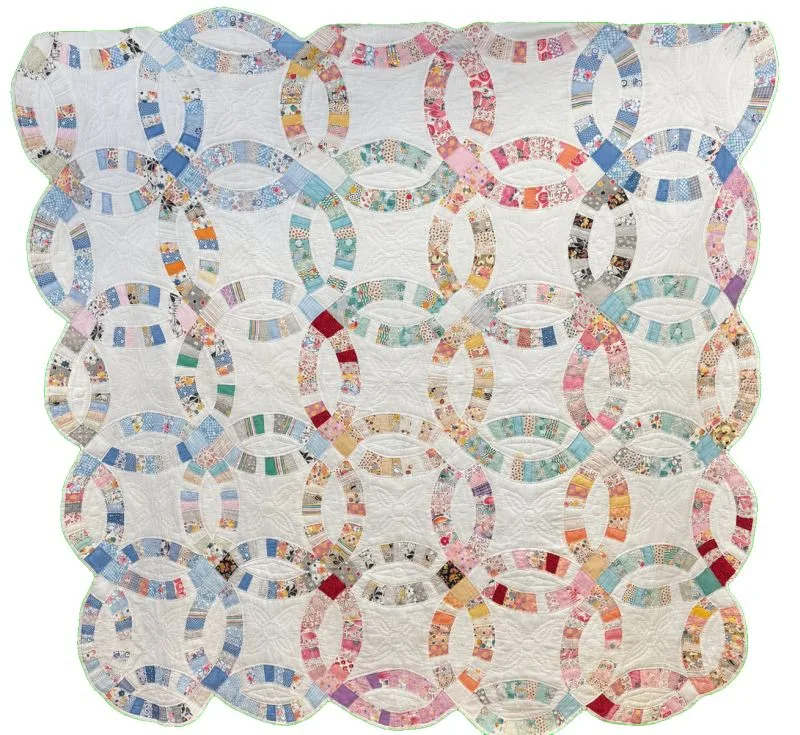
If you have a minute, check out these photos from my Webshots photo album! Antique quilt made in 20’s or 30’s ? Some of the feedsacks include stamped words and pictures. Feedsacks- some of the things I could make out printed on them: Jack Frost, Witchita Flour Mill & Co. Witchita Kansas USA, American Standard of Living and Purity, Labor Laws, Eat More Bread, Volume, picture of large truck with two men opening back doors and large loaf of bread is popping out-side of truck says Eat More Bread and underneath it says VOLUME in big letters. The lady who made this is my Great Grandmother, Ida Bushoire. Family tradition holds that it was made sometime in the 20’s or 30’s. 49 Blocks are 7 inches square- finished size. All hand sewn. There is a quilt inside the outer quilt. The inner quilt contains raw cotton. Hand tied quilt. Two blocks are set straight- the rest are on point. Rolled self binding.
Enjoy, Kathryn
From: Edith L. Taylor
Judy:
I plugged “Elizabeth Akana” and “Invisible Quilted Sleeve” into Google and got the 1996 index for Quilter’s Newsletter Magazine. It is in Issue no. 287, pp. 36-37. Since I’m at work, however, I can’t give you the correct month or title. BUt you might check this out to see if it’s what you need.
Best,
Edie Lawrence, KS
From: J. G. Row
Thanks Edie,
I’ve already ordered that back issue from the New England Quilt Museum. I must have it somewhere in the house, but can’t find it in the stacks, and stacks of magazines. It is like I knew I wanted to mark that issue to come back to and put it somewhere safe. Right!!!
Judy, aka the Ringoes Kid judygrow@
From: LindaKMc@
Hi, Charlotte Just read your note about Kansas City and the Steamboat Museum. I have been there on a field trip with my kids. It really is interesting. They have rescued many, many, many items that were on the boat. It is amazing all that the boat was carrying.
I just wanted to ask where in the Ozarks you are located? I am in Pilot Point, TX now, but originally grew up in the Springfield, MO. area. Lived in the KC metro area for the past 20 years before moving to Texas.
Just wondering. Linda