March 2 – 10, 2006
These restored messages come from the Quilt History List, an online forum where quilt historians, collectors, researchers, appraisers, and enthusiasts discussed antique quilts and related textiles. The archive dates from 1996 through approximately 2016 and is being restored gradually. Sign up in the form at the bottom of the page if you want to know when a new page is added. Original spelling, opinions, formatting, and inactive links may remain unchanged.
Primary topics of this QHL Digest:
- The Color “Charles the Tenth” — Members puzzle over a color name in an 1887 girls’ magazine and trace it to the deposed King Charles X of France.
- Underground Railroad Quilt Code Museum — A traveler finds the Atlanta museum, and members sort out who founded it and repeat doubts about the quilt code story. (see the article on Underground Railroad quilts)
- Finishing a Quilt Edge Without Binding — Members compare the folded-in edge finish (called “butting” in the UK) with narrow edge binding and share examples of each.
- European Patchwork History References — Celia Eddy and others share sources on Von Gwinner, Janine Janniere’s French patchwork articles, and early pieced clothing from Italy and Germany. (see the article on quilting in Europe)
- Preferred Terms for Describing People — After a Piecework article on an Underground Railroad quilt, members discuss which terms are preferred and why there is no single right one.
- Walk Around the Mountain and Streak of Lightning — Members start to trace the names and dates of two traditional patterns, one tied to an Alice Walker short story.
Date: Thu, 2 Mar 2006 22:23:16 -1000 | From: Loretta Woodard <Lwoodard@>
La Conner museum is hosting an exhibit of contemporary Hawaiian quilts
made by Hawaii artists. “Hawaiian Quilt Inspiration,” curated by Patricia Lei Murray, will be on view March 15 – May 14, 2006. An article about Patricia Lei and the show appeared in the Honolulu Advertiser on Tuesday. http://the.honoluluadvertiser.com/article/2006/Feb/28/il/ FP602280302.html http://www.laconnerquilts.com/upcomingshows.php
Also, while not directly quilt-related, there is a not-to-be-missed exhibit at the Honolulu Academy of Arts offering the opportunity to see
pre-Western contact Polynesian artifacts including tapa collected by Captain James Cook. There also is a small exhibit of Hawaiian tapa–kapa moe or sleeping kapa–in the textile gallery. For more info
see: Life in the Pacific of the 1700s: The Cook/Forster Collection of the Georg August University of Göttingen Luce Galleries February 23 through May 14, 2006 http://cms.honoluluacademy.org/cmshaa/academy/index.aspx http://the.honoluluadvertiser.com/article/2006/Feb/04/ln/ FP602040330.html
Laurie Woodard
Date: Fri, 3 Mar 2006 00:48:57 EST | From: Mendofleur@
I am not sure if this had been mentioned, but there is a new book to be released March 15, 2006 by Dave and Kathy Prochnow titled Quilts Sold: Your Guide to Heirloom and Antique Quilts. Does anyone have any information on this book and if it is a good resource?
Phyllis de Vries
Date: Fri, 03 Mar 2006 21:22:10 +0000 | From: “JG Kane” <jgkane84@>
I don’t know if it’s the kind of thing that you’re after Pepper, but I found the following references to orange in the “Dress in Season and In Reason” section of the 1887 “Girls Own ” magazine…
“Charles the tenth is a new colour that is like an old terra-cotta……….a golden brown is Pactolus…..A very bright golden yellow is called Croesus and a very ugly shade of mustard is called Tumeric”.
I can understand all but ” Charles the tenth”!
Jill, in U.K.
Date: Fri, 3 Mar 2006 16:57:42 -0500 | From: “Sharon in NC” <patchworksecrets2@>
I believe that would be in reference to the tyrant Charles the tenth the King of France He was overthrown in 1830. http://en.wikipedia.org/wiki/Charles_X_of_France Sounds like they named a color after him. Sharon in NC http://community.webshots.com/user/sharonsews —– Original Message —– From: “JG Kane” <jgkane84@> To: “Quilt History List” <qhl@> Sent: Friday, March 03, 2006 4:22 PM Subject: [qhl] Orangey colours in England
I don’t know if it’s the kind of thing that you’re after Pepper, but I found the following references to orange in the “Dress in Season and In Reason” section of the 1887 “Girls Own ” magazine…
“Charles the tenth is a new colour that is like an old terra-cotta……….a golden brown is Pactolus…..A very bright golden yellow is called Croesus and a very ugly shade of mustard is called Tumeric”.
I can understand all but ” Charles the tenth”!
Jill, in U.K.
Date: Fri, 3 Mar 2006 18:21:05 EST | From: Edwaquilt@
I am in Atlanta and while going around sightseeing etc, I went to the Visitors Center to get info about things to see. While flipping thru some pamphlets my eye caught one that describes the “Underground Railroad Quilt Code Museum” I don’t recall this facility being mentioned. The web site is _www.PlantationQuilts.com_ (http://www.PlantationQuilts.com) . WOW what reading. The description in the pamphlet says: Visit the Underground Railroad Quilt Code Museum at Underground Atlanta. Learn abut the Underground Railroad and how to document your family’s history. Hear and see how the Farrow-McDaniel family used the “Secret Quilt Codes”. View over 30 hand-stitched quilts, 9 from the 1800’s. Don’t miss our exqusite gift items and merchandise for sale.” The web page will even give you teaching ouslines etc.
Just had to pass this on to the list……..
Holice
Date: Fri, 3 Mar 2006 19:52:42 EST | From: Mitzioakes@
In a message dated 3/3/2006 6:22:43 P.M. Eastern Standard Time, Edwaquilt@ writes:
www.PlantationQuilts.com
And the myths continue……….. Vermont quilter
Date: Sat, 04 Mar 2006 13:23:27 +0000 | From: “JG Kane” <jgkane84@>
Sharon said- ” I believe that would be in reference to the tyrant Charles the tenth the King of France He was overthrown in 1830. http://en.wikipedia.org/wiki/Charles_X_of_France Sounds like they named a color after him”
Which I thought too – but, no matter how long I search, I can’t find any reason for naming a golden colour after him. I wondered if it was to do with religion, but he was Catholic.
Jill, curious, in blue-skied, crisply cold Leeds.
Date: Sat, 4 Mar 2006 09:19:37 -0600 | From: “Kathy Moore” <kathymooreneb.@>
If memory serves me right, the quilt code museum you speak of in Atlanta was opened a couple of years ago by extended family members of the woman who originally told the quilt code story to Jacqueline Tobin who then wrote the book, Hidden in Plain View. I don’t know if they still own it.
Kathy Moore Lincoln, NE
Date: Sat, 4 Mar 2006 08:16:41 -0800 (PST) | From: Pat Cummings <pat@>
Yes, the museum in Atlanta was started by Teresa Kemp, and family. The website mentioned pre-dated the opening of the museum. For awhile, the site was inaccessible, a few years ago.
Leigh Fellner contacted Ms. Kemp, asking for more historical information in regards to family claims. Leigh was not given the info. she sought, as far as I know.
Patricia Cummings www.@
— Kathy Moore <kathymooreneb.@> wrote:
> If memory serves me right, the quilt code museum you > speak of in Atlanta
Date: Sat, 4 Mar 2006 13:44:37 -0500 | From: “Pepper Cory” <pepcory@>
Looked around all over the web and found that a gold coin was minted in honor of Charles the 10th and that his reign got France into a war in Algeria. Your info states a kind of terracotta (brick orange) so probably gold (like the coin) is too great a stretch. Although there is a very impressive portrait of Himself at http://www.lewrockwell.com/wall/wall24.html . Scroll halfway down the page-notice his nice “red” (could this be called old terracotta?) sash. Also, the French infantry soldiers of this time were called ‘Red Legs’ due to their pants being dyed red. The madder fields of France would have been in full swing at the time of Charles X and madder produces many shades of red, among them brick or terrcotta shades. Could this have been the connection? Your much later color forecast Jill–perhaps due to a portrait? Still musing, Pepper ——_NextPart_000_0036_01C63F91.C76B65B0–
Date: Sun, 05 Mar 2006 00:29:46 +0000 | From: Sally Ward <sallytatters@>
> Which I thought too – but, no matter how long I search, I can’t find any > reason for naming a golden colour after him.
Here’s a reeeeeally long stretch of the imagination. According to Wikipedia, he died of cholera. And the maritime signal for a ship with a cholera victim aboard was a yellow flag………
Sally W Happy to be back in Yorkshire, and with a vivid imagination <G>
Date: Sat, 04 Mar 2006 21:03:54 -0500 | From: “Newbie Richardson” <pastcrafts@>
Dear list, My daughter, Ruth, 23, has just accepted a job in Montgomery Alabama in the Governor’s office co-ordinating the Americorps desaster relief projects in that region. They were looking for someone who could be in grubbies one day, and working with the chief of staff the next! She has been working temp jobs while waiting for the gate keepers at the Peace Corps medical office to clear her application – for almost 15 months! She finally gave up. I am hoping one of you would be so kind as to email me privately so we can find her a safe place to live, etc. Perhaps send us the local real estate listings from the paper, etc. They will only be paying her $800 a month – so we will not be looking for a full service condo! Many thanks Newbie Richardson 703-548-1563 pastcrafts@
Date: Sat, 4 Mar 2006 23:07:18 -0500 | From: “Sharon in NC” <patchworksecrets2@>
I know I am a couple of weeks behind in this discussion but..
The origins of religious head coverings for Christians comes from 1 Corinthians 11:3-10.
“(3)But I would have you know, that the head of every man is Christ; and the head of the woman is the man; and the head of Christ is God. (4)Every man praying or prophesying, having his head covered, dishonoureth his head. (5)But every woman that prayeth or prophesieth with her head uncovered dishonoureth her head: for that is even all one as if she were shaven. (6)For if the woman be not covered, let her also be shorn: but if it be a shame for a woman to be shorn or shaven, let her be covered. (7)For a man indeed ought not to cover his head, forasmuch as he is the image and glory of God: but the woman is the glory of the man. (8)For the man is not of the woman; but the woman of the man. (9)Neither was the man created for the woman; but the woman for the man. (10)For this cause ought the woman to have power on her head because of the angels.”
It was during the time when Paul wrote to the church in Corinth explaining how to identify problems within the church and how to live for Christ in a corrupt world. He teaches how to be careful not to blend in with the world and accept its values and lifestyles.
I believe there are more references to head coverings during the teachings of Moses also but unfortunately I don’t know my bible well enough to remember them.
Sharon in NC Who is really not trying to teach religion!!
Date: Sun, 05 Mar 2006 18:09:56 -0500 | From: “Fawn Valentine” <fawnvalentine@>
Quilt Code Museum in Atlanta: Mrs. Kemp is the daughter of Serena Wilson, who originally collaborated with Tobin and Dobard, and then went out on her own. Serena Wilson is a neice of Ozella McDaniel Williams, the source for Jaqueline Tobin in South Carolina. Ozella’s mother is Nora Bell McDaniel, and Nora Bell is also Serena Wilson’s grandmother. I first met Serena Wilson in November 2000 at a program she presented at Concord College in West Virginia. With all respect to Serena Wilson, she does not understand quilt history. She is, however, an emotional and uplifting storyteller and recieves accolades from her audience. Fawn Valentine
Date: Sun, 5 Mar 2006 19:11:39 -0500 | From: “J. G. Row” <JudyGrow@>
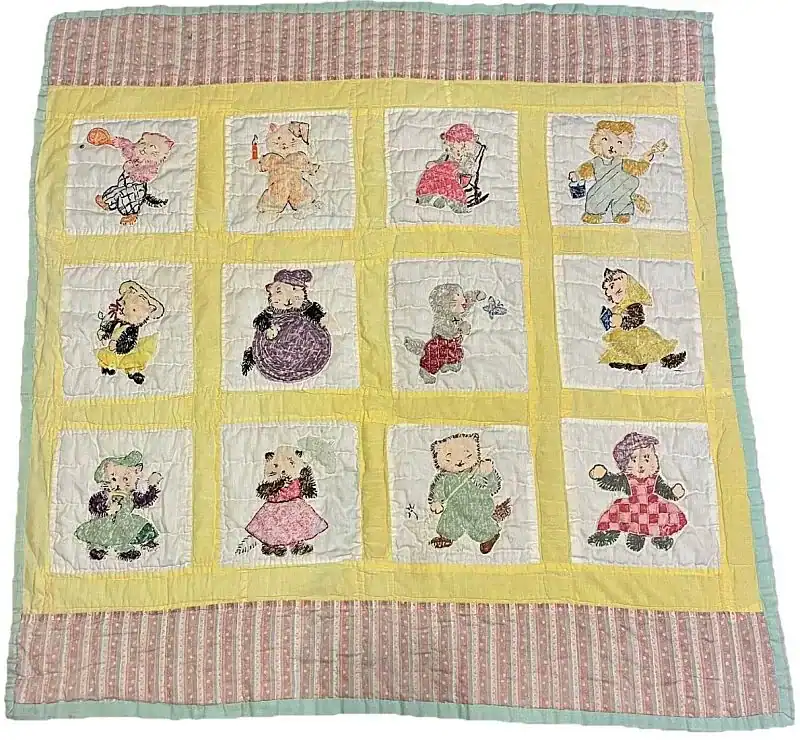
I thought this quilt on e-bay deserved another look, so I wrote to the seller and asked pertinent questions, about being imported, evidence of label, etc.
http://cgi.ebay.com/ws/eBayISAPI.dll?ViewItem&item6259715545&sspagenameAD
Here is her reply: “Hello and thank you for your interest in this item. The quilt is about 30 years old and has no tag or remnants of one. I do not know if it was imported. The quilt top and backing are flush, and there is no binding per se. They have been turned in towards each other and finished in this manner. Have a nice day! Jo Ellen”
I still think it is imported, but have never seen anything like it in catalogs or shops.
Anyone else?
Judy, now in Flemington NJ aka The Ringoes Kid
Date: Mon, 6 Mar 2006 07:14:24 -0800 (PST) | From: Anita Loscalzo <aloscalz@>
Hi, all,
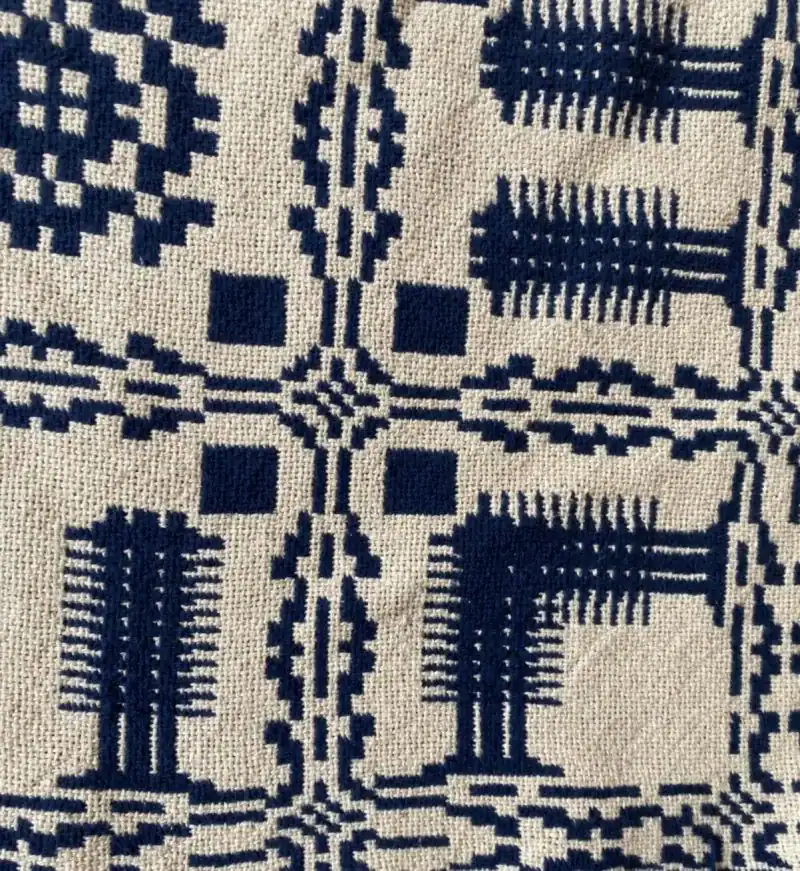
Here’s another item from a donation given to us to put on auction to raise funds for conservation:
Item #7396157879
http://cgi.ebay.com/REVERSIBLE-WOVEN-COVERLET-IN-NAVY-BLUE-CREAM_m
Thanks for bidding!
Anita
Anita B. Loscalzo, Curator New England Quilt Museum 18 Shattuck Street Lowell, MA 01852 ——–
Date: Mon, 6 Mar 2006 13:42:45 -0800 (PST) | From: Laura Fisher <laurafisherquilts@>
I try to keep picture files of new quilts from catalogs and ads just so I know what’s cominginto the marketplace today.
In my experience, imported quilts have no bindsing or edging as do vintage ones, so a “folded in” finish might suggest a new import. However, I have had 20th century quilts from Canada also finished with no binding, with top and back folded in, and usually stitched close to the edge,an ending off that is different from these contemporay imports but hard to put in words.. At some point, will we be able to recite characteristics that idenfiy these pieces as absolutely new imports? who knows. Some manufacturers do way better work than others.
Laura
Date: Mon, 6 Mar 2006 21:49:28 -0500 | From: “Bonnie Dwyer” <bonniedwyer@>
This type of edge finish is the only one I knew before I started making quilts in the 1980’s and learned to do a narrow edge binding.
My grandmother (1900-1977), who lived in Maine, NH, and then Arizona, finished all her quilts with edges folded in. She was a maker of what I call cotton crazy quilts — scraps sewn to a foundation and flipped. Nothing fancy, and no binding on a one of them. Knife edge, or front and back brought together and folded in, then machine sewn very close to the edge all around. I would say she mostly made quilts from 1930’s through 1950’s. I would be interested in hearing about this edge treatment in other parts of the country.
Bonnie Dwyer Quilt Appraiser Manchester, ME 04351
Date: Tue, 07 Mar 2006 07:34:27 -0800 | From: Laura Robins-Morris <lrobins@>
Interesting point, Bonnie. I have a quilt that was a 30s top, quilted in the mid-70s by an elderly quilter named Mrs. Best in Nappanee, Indiana. She used a knife edge finish because she didn’t have any bubble-gum-pink fabric for a binding to match the border. She also used a cotton-poly blend for the back.
Future collectors/historians will have to know a lot about fabrics and colors and techniques and availablilty, etc, to distinguish between mass-produced imported, and domestic or truly vintage American. They won’t be able to rely on simple rules like knife edges, etc. Quite confusing, 50 years hence! We definitely need a good book on the subject, for current and future use. Laura
…….-original message-…… This type of edge finish is the only one I knew before I started making quilts in the 1980’s and learned to do a narrow edge binding. My grandmother (1900-1977), who lived in Maine, NH, and then Arizona, finished all her quilts with edges folded in…. Nothing fancy, and no binding on a one of them. … I would say she mostly made quilts from 1930’s through 1950’s. I would be interested in hearing about this edge treatment in other parts of the country. Bonnie Dwyer
Date: Tue, 7 Mar 2006 09:57:50 -0800 (PST) | From: karenquilt@
Would you believe, someone googled Prudence Penny and came up with my 1999 QHL post about the passing of my MIL and contacted me, yet this quilter is not a member of QHL so can’t search our archives directly. (I have now told her how to join!) Anyway, I thought I would take this opportunity to clarify what I wrote in 1999 since it has now been brought to my attention. (Be aware of what lurks in any archive! It’s not always the latest info on a subject.) Additional research into in my MIL’s personal stuff since I posted that story to QHL in 1999 has shown that my mother-in-law did not actually write the Prudence Penny column as I had first thought since she was a home ec graduate herself. She merely worked in the Seattle Post-Intelligencer “Penny Prudence office” (!) and answered the phone and helped with the mail.
It is my understanding at this point that the Prudence Penny column originated out of the Chicago Herald Examiner (at one time a Hearst owned paper) and was eventually syndicated to other newspapers around the country. One of the real people behind Prudence Penny was Leona Alford Malek of Chicago, a home economist. She was succeeded by a woman by the name of Pearl Serbus from Arkansas. But they may have been only two of several who had the nom de plume of Prudence Penny. Here is a little something from time Magazine on the subject, dated Jan. 21, 1924: <<Prudence Penny is a lady registered in the United States Patent Office, or rather she is several ladies whose name is thus registered. Prudence is one of the ways in which Mr. Hearst collects pennies by the million. In the words of one of Mr. Hearst’s full page blurbs : ” ‘Mother Prudence,’ ‘Aunt Prudence,’ ‘Sister Prudence’ they call her. She is all that and more.” She is a walking dictionary, a “Confidanté of thousands,” an expert in all the household arts, past master in how to keep husbands, children and a figure. In short she is an…>>
(that’s all I could get from Time archives without paying to dig further. Anyone have this issue? <g>)
Karen Alexander
Date: Tue, 7 Mar 2006 18:44:58 +0000 (GMT) | From: CELIA EDDY <celia.eddy@>
I don’t know if anyone has already mentioned this, but the ‘folded-in-edges’ method (we call it ‘butting’ in UK) of finishing a quilt is the method which almost invariably appears on early English quilts. Indeed, when dating ‘old’ quilts, despite other appearances, if they have bound edges they are often suspected of dating from after the period when American influences began to be significant in UK quiltmaking – maybe in the first quarter of the 19thC onwards, but especially since the 1970s. Nowadays, bound edges are the most commonly used finish.
Celia in North West England
Laura Robins-Morris <lrobins@> wrote: Interesting point, Bonnie. I have a quilt that was a 30s top, quilted in the mid-70s by an elderly quilter named Mrs. Best in Nappanee, Indiana. She used a knife edge finish because she didn’t have any bubble-gum-pink fabric for a binding to match the border. She also used a cotton-poly blend for the back.
Future collectors/historians will have to know a lot about fabrics and colors and techniques and availablilty, etc, to distinguish between mass-produced imported, and domestic or truly vintage American. They won’t be able to rely on simple rules like knife edges, etc. Quite confusing, 50 years hence! We definitely need a good book on the subject, for current and future use. Laura
…….-original message-…… This type of edge finish is the only one I knew before I started making quilts in the 1980’s and learned to do a narrow edge binding. My grandmother (1900-1977), who lived in Maine, NH, and then Arizona, finished all her quilts with edges folded in…. Nothing fancy, and no binding on a one of them. … I would say she mostly made quilts from 1930’s through 1950’s. I would be interested in hearing about this edge treatment in other parts of the country. Bonnie Dwyer
Date: Tue, 7 Mar 2006 15:32:11 -0800 (PST) | From: “Pat L. Nickols” <patlnickols@>
[input] [input] [input] [input] In answer to Newbie’s question:
History of the Patchwork Quilt: Origins, Traditions, and Symbols of> a Textile Art by Schuppe Von Gwinner 1988.
I echo the comments made by Julia & Karen. Schuppe was here in states and we met, perhaps 1985 at AQSG, she was very intense with her information gathering efforts. Asked many, many questions, some of which I could answer, but would not exchange information, to my surprise. With apologies, she explained she was working on a book and the value of it in Germany would be having her material published first.
The book was the first of it’s kind, for me, to think outside the box. Where else did we find dated world-wide examples of patchwork, appliqué and quilting. Eighteen years later this is still a valuable addition to our quilt history. Glad this book was mentioned, gave me a reason to look at it again.
Pat L. Nickols
Date: Wed, 8 Mar 2006 10:05:39 +0000 (GMT) | From: CELIA EDDY <celia.eddy@>
Hi, everyone,
I’m more often ‘lurking’ on this list than contributing, but the discussion and comments about Von Gwinner’s book interested me a lot. I found the book extremely useful as a reference source, and jumping off point, for several subjects when I was researching my book, Quilted Planet, published by Mitchell Beazley last year.
It’s obvious that to cover every area of quilt history in the entire world would take a much bigger book than hers – or mine – but nonetheless I think Von Gwinner did a valuable job in attempting, for the first time as far as I know, to give an international perspective to quilt history.One thing that became clear to me during my own researches was the paucity of information and research which so far exists in relation to the European scene; for example, very little has been written, or indeed researched, in relation to the French tradition, other than the famous Marseilles quilts and boutis of Provence. Yet Janine Janniere uncovered a treasure trove of French patchwork and quilting at Chateau de Cuchous in the Eastern Pyrenees which has inspired her to further research and to the discovery of what she calls ‘an unknown universe ‘ of French patchwork. (I can provide references for Janniere’s articles if requested.)
Surely, the quilting and other textile traditions of ‘ the old world’ must be important in the study of early American quilts, which developed from them. I accept that the major influences came from UK but many other nations contributed their skills and traditions. I feel that there is still much scope for further research and documentation of European quilts and traditions.
Celia Eddy (in the far North West of England)
“Pat L. Nickols” <patlnickols@> wrote:
[input] [input] [input] [input] In answer to Newbie’s question:
History of the Patchwork Quilt: Origins, Traditions, and Symbols of> a Textile Art by Schuppe Von Gwinner 1988.
I echo the comments made by Julia & Karen. Schuppe was here in states and we met, perhaps 1985 at AQSG, she was very intense with her information gathering efforts. Asked many, many questions, some of which I could answer, but would not exchange information, to my surprise. With apologies, she explained she was working on a book and the value of it in Germany would be having her material published first.
The book was the first of it’s kind, for me, to think outside the box. Where else did we find dated world-wide examples of patchwork, appliqué and quilting. Eighteen years later this is still a valuable addition to our quilt history. Glad this book was mentioned, gave me a reason to look at it again.
Pat L. Nickols
Date: Wed, 8 Mar 2006 06:30:49 -0500 | From: “Karen Evans”
I would *definitely* like references to the French patchwork articles – how far back does this tradition go? I know that Jannine Janniere was the one who uncovered the reference to Phillipe de Vignuelles’ patchwork banner of 1507.
As for lack of sources…I’ve spent most of the last fifteen years picking up a reference here and a reference there, mostly in non-textile sources. I’m presenting a paper on the quilts of Henry VIII at a medieval studies congress in Michigan in early May, after which I’m planning to do some serious work on pieced clothing in the Renaissance, particularly in Italy and what is now Germany. There is a lot of work to be done in Europe, and my “what I’d do if I won the lottery” dream would be to visit as many small museums and country houses as possible to see what they have. I’ll bet we’d all be shocked by how much has survived.
Karen Evans
Date: Wed, 8 Mar 2006 12:06:14 +0000 (GMT) | From: CELIA EDDY <celia.eddy@>
Karen Evans expressed an interested in the Janniere references I offered. The following is the list of references to Janine Janniere’s articles as it appears in Quilted Planet. There may be more, but this material alone gives a huge amount of information and pointers to further research.
JANNIERE Janine and MOONEN An:‘Mosaïques d’Etoffes: A la recherche de l’hexagone’ Exhibition catalogue, Musée des Traditions et Arts Normands, Conseil Général de la Seine-Maritime. 2003. 128 pages. JANNIERE Janine: ‘An Important Discovery of French Patchwork’ The Magazine Antiques New-York, Dec. 1995. Pp.822-829. JANNIERE Janine:‘A New World in the Old: European Quilt Scholarship’. The Quilt Journal, Vol 1, N° 1. 1992. The Kentucky Quilt Project. Pp 4-9. JANNIERE Janine:‘Filling In Quilt History: A 16th Century French Patchwork Banner’. The Quilt Journal. 1994.Vol 3, N° 1. The Kentucky Quilt Project. Pp 1-6 JANNIERE Janine:‘The Hand Quilting of Marseille’. The Quilt Journal, 1993. Vol 2, N° 1. The Kentucky Quilt Project . Pp 5-9 Karen asks how far back the French tradition goes: in her book Quilts of Provence, Kathryn Berenson surmises that quilted good would have been among the many textile items traded between India and Marseilles from as far back as the early 13thC. There seems to be even less information about patchwork, though. I’m very intrigued by Karen’s reference to ‘pieced clothing in the Renaissance’ – although quilted clothing was a highly regarded feature of fashionable wear in several parts of Europe (not least in England) I’d like to know more about any specific examples which exist of pieced clothing. As for hidden gems in European collections, I’m sure Karen is right – Janniere’s experience probably proves the point – and in UK, despite strenuous efforts at documentation by the Quilters’ Guild of the UK (See Quilted Treasures – out of print, not on Amazon or ABE at present), I know from personal experience that provincial museums up and down the country have collections of quilts and other textiles which remain undocumented and rarely visited – lack of funds, as usual. Textiles, as we know, are notoriously difficult and expensive to keep and maintain so are often neglected. The Quilters’ Guild Museum (in Halifax, UK) is a beacon in the world of quilt preservation, and there is another wonderfully maintained collection in Lancashire at the Jacobean house Gawthorpe Hall. Celia
Karen Evans <charter.net> wrote: I would *definitely* like references to the French patchwork articles – how far back does this tradition go? I know that Jannine Janniere was the one who uncovered the reference to Phillipe de Vignuelles’ patchwork banner of 1507.
As for lack of sources…I’ve spent most of the last fifteen years picking up a reference here and a reference there, mostly in non-textile sources. I’m presenting a paper on the quilts of Henry VIII at a medieval studies congress in Michigan in early May, after which I’m planning to do some serious work on pieced clothing in the Renaissance, particularly in Italy and what is now Germany. There is a lot of work to be done in Europe, and my “what I’d do if I won the lottery” dream would be to visit as many small museums and country houses as possible to see what they have. I’ll bet we’d all be shocked by how much has survived.
Karen Evans
Date: Wed, 8 Mar 2006 07:28:43 EST | From: MMiller138@
If you haven’t seen the latest issue of Piecework…try to find a copy…a picture of a UGRR quilt is displayed with a caption about the maker and patterns taken from E. Burns book and what the slaves would look for escaping to freedom! (p. 8) It was a part of a program from the Brandywine (PA) chapter of the Embroiders’ Guild of America. Here we go again! Mary in Ohio
Date: Wed, 8 Mar 2006 07:40:08 -0500 | From: “Karen Evans”
Here are the links to some examples of pieced clothing in Italy and Germany from the mid-15th to mid-16th centuries. Note that there is *very* little evidence of pieced bedclothes at this time, beyond some mention of “payned quilts” in Henry VIII’s death inventory of 1547:
Adoration of the Magi, early 16th century: http://www.artandarchitecture.org.uk/images/gallery/de23e376.html
Pieta, by Lorenzo Lotto, 1508: http://gallery.euroweb.hu/html/l/lotto/1507-10/04recan3.html
Woman with a Drawing of Lucrece, Lorenzo Lotto, c. 1530: http://www.abcgallery.com/L/lotto/lotto6.html
Healing of the Madman (detail), Vittore Carpaccio, c. 1495: http://www.abcgallery.com/C/carpaccio/carpaccio27.html
Portrait of EKarenbetta Gonzaga, Raphael, early 16th century: http://www.beniculturali.it/Liocorno/r_gonzaga.html
Fresco of Serbian Orthodox bishops, c. 13th-14th centuries: http://www.kosovo.com/sopocani3.html
Portrait of Ludovico Sforza and his wife, c. 1495: http://www.smtrombini.valtellina.net/castellaccio_dosso/ludovico_il_moro.html (I own a copy of the dress, which I wore when I was elevated to the Order of the Laurel in the SCA in late January)
St. Sava and the Archbishop, 14th century: http://www.suc.org/culture/history/Serb_History/Monasteries/Pec/p_sava2.html
Knight in a Landscape, Vittore Carpaccio, 1510: http://www.museothyssen.org/thyssen/coleccion/ficha616.htm?
Madonna and Child, school of Cimabue, 1290: http://www.nga.gov/cgi-bin/pinfo?Object41402+0+none
Calvary, Luca Signorelli, c. 1504: http://www.nga.gov/cgi-bin/pimage?41417+0+0
The Mass at Bolsena, Raphael, 1512: http://www.abcgallery.com/R/raphael/raphael38.html
Hope this helps…
Karen Evans
Date: Wed, 8 Mar 2006 08:08:04 EST | From: Mitzioakes@
I recently purchased this publication and find it wonderful – it sure enlightens some quilters to the fact that not all quilts/patterns came from Africa – something that seems to be passed around a lot lately. Mitzi
Date: Wed, 8 Mar 2006 08:51:17 -0800 (PST) | From: Pat Cummings <pat@>
Hi!
I had not noticed the latest sighting of a UGRR quilt that was mentioned, until I just turned to page 8 of Piecework magazine. It is true that several people are holding up a quilt of this nomenclature.
The quiltmaker, Rose Morgan, appears to be African-American, Black American, or whichever term is used now. I wish someone would tell me what to say. I do want to get the terminology right and not displease anyone of that ethnic origin.
I wonder if perhaps there are those people who (should) know the difference but don’t want to hurt the quiltmaker’s feelings, or lose her membership in the organization.
It is mindboggling to think that the Embroiderers’ Guild of America published my ten page article (on the UGRR and quilt blocks) in their magazine, just a short time ago, and yet this kind of meeting is still happening. There are too many politics surrounding the situation now.
Clearly, those who have made a quilt of this type really do FEEL that they have tapped into history, and perhaps, their own “heritage.” telling them the difference is like bursting their bubble. They think that they have come by their information by “good authority,” and therein lies the problem.
As an aside, I will say that today, people don’t read words and try to make sense of anything. They look at photos and jump to conclusions.
This has happened to me lately, more times than I like to remember, when people visit my website. For example, just yesterday a poor misguided soul wrote to inquire about my price of feedsack cloth with a “chicken” on it that she saw in an online article of mine.
I have no such thing for sale although a piece of rooster feedsack is shown in the history article. I bought that piece at a yard sale for $3.00. and I ain’t partin’ with it. She assumed that I had multiple feedsacks, all the same, that she could use to make a quilt.
It seems that no matter how many words a body strings together, the average internet reader does not take the time to read enough information to “get the picture.”
And so it goes…we are quickly becoming a society of parroting, non-thinking people. This trend has even trickled down to higher education.
As someone who should know told me, the student is always supposed to be allowed to think that his/her thoughts are valid, even if historically, they are not.
It is not a good thing to disturb a student’s self-esteem. Administrators look at the bottom line which is: happy students stay enrolled, and that equals $$$$. This particular person still guides his students to the truth. He assumes (perhaps mistakenly) that they are there to learn.
Yes, I am on a rant today. I will leave you with the cheery thought that perhaps because we all care about the TRUTH, we do make a difference. However, maybe we can only be effective by explaining the situation to ONE person at a time.
Keep up the good work and together we will beat the myth.
Pat Cummings www.@
Date: Wed, 8 Mar 2006 10:05:19 -0700 | From: “JESSICA VAUGHN” <vaughn8047@>
Hi Pat! The preferable term is African American. Which issue of Piecework magazine are we talking about? Looks like I must go find it!
Jessica M. Vaughn Aurora, CO vaughn8047@
Make yourself familiar with the angels, and behold them frequently in spirit; for without being seen, they are present with you. – St Francis de Sales – ——
Date: Wed, 8 Mar 2006 12:53:08 EST | From: Mitzioakes@
From Vermont – 110% in agreement with you!!! Keep it up! Mitzi (http://www.smileycentral.com/?partnerZSzeb001_ZS)
Date: Wed, 8 Mar 2006 10:20:47 -0800 (PST) | From: Pat Cummings <pat@>
March/April 2006. It just went out to subscribers.
Pat
> Which issue of Piecework magazine are we talking > about? > > Jessica M. Vaughn
Date: Wed, 08 Mar 2006 19:02:32 +0000 | From: Sally Ward <sallytatters@>
Karen Evans wrote: > Here are the links to some examples of pieced clothing in Italy and > Germany from the mid-15th to mid-16th centuries. Fabulous selection of pictures Karen, you’ve been doing some diligent searching!
I’m interested in where you draw the line for definition: when does creative tailoring become piecework/patchwork? For example looking at the yellow and black doublet http://www.artandarchitecture.org.uk/images/gallery/de23e376.html the seams seem to be part of the process of shaping the actual garment. So if it had been made in one colour, but of lots of pieces with those seams for shape, would it still be a patchwork garment or just a tailored garment?
Sally Ward
Date: Thu, 9 Mar 2006 07:32:23 -0600 | From: “Laura Syler” <texas_quilt.co@>
Good morning all, I’ve been more of a lurker for a while, but am really enjoying all the discussion on the UGRR myths, as well as the herd mentality!! As Pat said, maybe it’s best just one person at a time!!! Anyway, I just posted a photo of a DWR variation to the e-board. All of my obtuse documentation books are in storage and this one doesn’t just jump out at me. It looks to be a combination of a Improved 9-Patch, DWR and even part of a Kaleidoscope…..melons are angular. Let me know if you have any clues at to a more “proper” name….(and yes, I can see Ms. Brackman rolling her eyes at me!!!<G>) Laura Hobby Syler Certified Appraiser of Quilted Textiles Teacher, Judge Richardson, Texas texas_quilt.co@ hi-spirit@ ——_NextPart_000_0027_01C6434B.9B490560–
Date: Thu, 9 Mar 2006 22:20:07 -0300 | From: “Pilar Donoso”
Dear Karen:
For people like myself, a quilter and a History teacher, living in Chile, with so little access to see Quilt History, specially Patchwork History in Europe, you made me go Huu, AHHH and Wow, all morning, checking the sites that you listed today (maybe yesterday for you). I have giving some lectures about Quit History, based in my readings, but I allways felt a gap about Patchwork before this technique/art came to USA. It is amazing to see the pictures, most of them showing clear patchwork clothing. I Thank you very much for sharing this information with us, specially with the ones that don’t have direct access to this information.
Thanks again,
Pilar Donoso I. The Quilt Shop Vitacura 7867 Santiago, CHILE (562) 211 9877
Date: Thu, 9 Mar 2006 18:58:44 -0700 | From: “Judy Anne” <anne_j@>
I’ve had students looking for information on my website for the pattern, “Walk Around the Mountain”. It is mentioned in Alice Walker’s story, “Everyday use”. It’s not in Barbara Brackman’s book. At least it’s not in the pieced quilts book, I don’t own the applique book.
I suspect it is a local name or perhaps even a name Alice Walker made up though I’m inclined to think it was a quilt name at least known in her family.
Judy Anne
Date: Fri, 10 Mar 2006 05:22:02 -0500 | From: “Linda Heminway” <ibquiltn@>
Hi! The quilt that was made by my grandmother that I now have is called a streak of lightening pattern. Can anyone tell me when that pattern was most popular? Thanks, Linda Heminway Plaistow NH
Date: Fri, 10 Mar 2006 07:23:47 -0600 | From: “Karen Musgrave” <KarenMusgrave@>
The Alliance for American Quilts (www.centerforthequilt.org ) eBay auction this week has two wonderful wool quilts, many OOP books including “Always There: The African-American Presence in American Quilts,” and lots of interesting Russian fabric and much more! You can check it out by going to http://search.ebay.com/_W0QQfgtpZ1QQfrppZ25QQsassZalliancequilts or search by our seller’s name- alliancequilts.Your purchases also benefit a great organization which is doing incredible things for quilts. New auctions are posted every Sunday. Happy bidding and thanks for the support.
All the best, Karen Musgrave Join us! Become a member and get advance news on our auctions AND help preserve our great quilt heritage. www.centerforthequilt.org
Date: Fri, 10 Mar 2006 14:31:37 +0000 | From: jocelynm@
Pat, There is no ‘right’ terminology. The closest we get is when a particular ac 3D ademic discipline chooses a term and requires all its authors to use that t 3D erm.
But really, in every ethnic group, there are some people who care very stro 3D ngly, some who don’t care at all, others who have a preference but are OK w 3D ith it if someone uses another term.3D20
It would be pretty bizarre if a group of millions of people all agreed on a 3D nything! I know some pale-skinned people who are vehement that they are not 3D ‘white’-that ‘white’ is an unrealistic way of describing their color. Some 3D of them prefer Caucasian, others prefer to be named after the country of t 3D heir ancestors’ origin, others think that no color name at all is the best 3D way to go.
If you can imagine how hard it would be to get everyone in your town to agr 3D ee on what word should be used to describe your ethnicity, then you can see 3D how impossible it would be to get any sort of consensus about what to call 3D people who have dark skins. The best you can hope for is to choose a term 3D that connotes your best efforts to be respectful and kind, and rely on the 3D other person not to take offense at it. It doesn’t always work- but there’s 3D not much of an alternative. 🙂
Date: Fri, 10 Mar 2006 06:59:58 -0800 (PST) | From: Pat Cummings <pat@>
Thanks for your input, Jocelyn. The only thing that comes to mind is that ANY of the current preferred words that are used to describe people whose ancestors came from Africa are an improvement over some of the derogatory sounding descriptors that have been used in the past.
At least we are trying to be more respectful of each other, and that has to be a “good” thing.
Pat Cummings
<jocelynm@> wrote:
There is no ‘right’ terminology. The closest we get is when a particular academic discipline chooses a term and requires all its authors to use that term.