May 12 – 13, 2005
These restored messages come from the Quilt History List, an online forum where quilt historians, collectors, researchers, appraisers, and enthusiasts discussed antique quilts and related textiles. The archive dates from 1996 through approximately 2016 and is being restored gradually. Sign up in the form at the bottom of the page if you want to know when a new page is added. Original spelling, opinions, formatting, and inactive links may remain unchanged.
Primary topics of this QHL Digest:
- “Out of Control” Quilt Collections — A lighthearted thread has collectors comparing notes on quilt (and frame, and salt-cellar) collections that have outgrown their houses.
- Choosing a Digital Camera for Documenting Quilts — A long thread of camera recommendations and comparisons helps a member choose a digital camera suited to close-up quilt and fabric photography.
- AQSG Symposium and Feed Sack Exhibit Recaps — Members recap papers from a recent AQSG symposium and share news of a feed sack clothing exhibit at Louisiana State University. (see the article on the feedsack story)
- Cotton Ginning and Regional Terminology — A discussion of cotton grades and ginning history broadens into a conversation about regional identity and terminology in the American South. (see the article on the cotton gin)
From: Jean
If anyone lives near Alton, IL, and is able to visit Loomis Hall, please try to authenticate this supposed “message quilt” referred to in the travel ad at the following web site, sponsored by Springfield, IL: http://www.visit-springfieldillinois.com/grouptours/i-secrets.htm I’d be curious to know its age and provenance. This museum is apparantly exhibiting the quilt as a relic of the UR. May be an interesting outing for the Midwest QSG. Jean in MN
From: Karen Alexander
Lynn wrote <<As a quilt collector I recently had the “ah-ha moment” when I realized that my quilt collection is out of hand.>>
I’d love to hear more stories from those whose collecting has gotten out of hand. <g> My collection finally took over the guest bedroom in our last home in Virginia. Anybody who visited had to be willing to sleep on an air mattress on the floor in the living room or go to a motel. I moved all the quilts for a guest once – for my youngest daughter when she flew home one last time from Seattle to help me pack. Figured it was the least I could do. <g>
That brings up a question I keep forgetting to ask. Did anyone on the list attend the IQSC Symposium in Nebraska in February on “Collectors, Collecting, & Collections”? Could you share with us — sort of give us a “Cinda Report” of your own? Thanks.
Karen Alexander in the sunny but comfortably cool Pacific Northwest
From: Margareta.Faust
Hi Jane, Thanks for your mail. You’re quite right about there being ‘only so many ways you can use geometric shapes’ and it’s fascinating how they re-emerge in different cultures and contexts. Recently I visited the San Marco Basilica in Venice, and the floor was a mosaic of different shapes, among other things the elongated hexagons that reappear in the ‘Kansas dugout’ pattern from the 1930s! So yes, part of the fun of being a textile historian is tracing influences between cultures, but also ‘universal’ patterns and motifs – and trying to explain their ubiquity! Margareta
From: “Karen Evans”
It’s like the old joke:
“Must sell. Complete works of Isaac Asimov on microfiche. No longer have room in two story house.”
I used to collect salt cellars and they almost *did* take over. Now I collect old hymnals and have been much, much more selective…because there’s only so much room in a two story house.
From: Gail Ingram
Lynn Gorges wrote “As a quilt collector I recently had the “ah-ha moment” when I realized that my quilt collection is out of hand.”
Now Lynn, I hate to sound like Dr. Laura, but I must ask whether you REALLY want a “rational” solution to your “problem.” <g>
Only last night while driving from the post office, I heard Dr. Laura recommend self-control to a woman caller to her radio program who, without apparent cause, behaved in ways distrustful of her husband. Dr. L. said, “Stop the behavior and the impulse will follow. When you choose not to respond to your impulses to check on him, reward yourself: have one oreo cookie. Just one. You will feel your power to control your actions. You will come to enjoy your self-control.”
I was passing a grocery at the time and had to force myself not to turn in and purchase a pint of Bluebell fresh strawberry ice cream, which I thought I would then eat in the next hour —just one bite at a time, of course.
I wonder if there is not a difference between quilt lovers who are interested primarily in the aesthetics of quilts and those who are also passionately interested in the entire process and/or the history that produced the quilt. Is it easier for the first group to assemble a collection that is guided by a clear principle?
Collecting is one of the signs of intellectual giftedness, a tendency that expresses itself by age three or four. It probably grows out of the desire to organize experience, make sense of it. Isn’t the body of experience you are seeking to understand different from that which an art historian would be considering?
When I look at my collections, I realize that with the exception of my collection of 18th-century editions of Milton’s minor poems, they are all somehow related to women/textiles/home/the South. My situation, in other words. My mother’s and grandmother’s situations. Cultural traditions. They are ultimately very personal. Even the fine laces and linens made abroad interest me not only for their extraordinary beauty, but also because they are examples of fine handwork, of women’s work. The baskets are Southern, made by people with real faces from materials that grow in the woods in which I have spent a lifetime. The aprons are those worn by the women of my childhood and represent the kind of domesticity I associate with abiding love and the yeasty smell of bread rising and of coffee dripping.
Would collecting only one kind of quilt make you happy? Could you look at a quilt out of that niche without the kind of lust that leads to purchase? Would collecting in that manner really supply the answer which you are seeking or fill the need you are expressing in your present collecting habits?
Have faith: the children will begin moving out of your house soon. Their rooms, which you probably think you will keep as they are forever, will provide more storage. And when those are full, you can exercise self-control and refuse to buy quilts for, say, six months (Have someone lock you in your studio). With the money thereby saved, you can add a little storage room onto your house. Find a quilt collector whose husband is a carpenter and barter.
I suspect passion and pruning are a often inconsistent with one another. But try the Oreo test: can you eat just one bite of something you really really love?
Like Karen, I’ve hoped to hear from someone who attended the seminar on collecting.
Good luck, from the owner of 23 Japanese maples, Gail Ingram
From: Sandra G Munsey
Lynn:
The side bars on my grandmother’s rug hooking frames are about 2 x 1/2 inch stock (if I recall correctly – it’s been a while since I have seen them). There are holes drilled about every two inches excepting in the middle section where there are no holes. That section is the appropriate width for working space. She had dowel pegs that had been tapered to fit securely in the holes. The cross bars are large – an honest 2 x 4. (Today’s stock sold for 2 x 4s being much smaller in actual finished measurement.) Each end of the cross bars have a slot through which the side bars are inserted. She used wooden matchsticks to keep the side bars tight in the slots. A strip of tightly woven burlap of an excellent quality is tacked along each cross bar to which the rug foundation is basted. After sewing the rug onto the burlap, the side bars are inserted, the rug rolled to the desired width, and the pegs inserted through the holes on the side bars. Since my grandmother wanted her rug foundation to be drumhead tight, she would stand on the cross bar to really stretch it before inserting the peg. Or she would have me stand on it or insert the peg for her. All of the wood was well sanded and polished to smoothness so there are no splinters! There are two sizes of cross bars – one large enough to take a 9 foot wide rug, probably about 10 feet long. The bars she used most frequently were only about 6 feet long. She had a pair of stands that are about 3 feet x 10 inches or so wide and have storage “pockets” in the bottom half where she kept patterns, some wool, and the like. These frames are also suitable for quilting. I know that she tied quilts and recovered and re-tied worn quilts, although I don’t actually recall seeing the rug frames being used for that purpose. However, she would have worked on quilts before my appearance in the world, and when I was extremely young. She hooked rugs on these frames until a few years before she died in 1959. The frames are modeled after those familiar to her from her Pictou County, Nova Scotia background. They were made for her by a local carpenter after she was married in 1909 in Rye, New Hampshire. I am not sure what kind of wood was used. It is very heavy so it might well be oak or maple. In all those years the frames didn’t warp.
I don’t know if any of this applies to your boards. Since you described your boards as rough and not sanded, perhaps there was some other kind of farm work for which adjustable frames were needed for drying, using pegs to secure them. The old quilting (and rug) frames I have seen – admittedly those concentrated here in New England – have been sanded smooth. If rough quilt frames didn’t damage the cloth, they might damage the quilter with splinters. <G>
Sandra on Cape Cod
From: “Charlotte Bull” <charlou@>
My grandmother quilted all of her life (1875 to 1962). In Kansas. When I visited her she was living in a 3 story Victorian house and rented rooms. Every bed in her 13 bedrooms had her quilts on them. She had a Floor Frame permanently set up in what had once been the “front parlor”. She also had the Curtain Frames you’ve mentioned. She called them Stretchers. But she no longer used them for that purpose. When I saw them in the 1940s she had stretched fabric across them. She placed them on the flat roof of a large porch. She climbed out through a window and sprinkled fresh corn cut from the cob upon them and used them to dry the corn. This was used throughout the winter to feed livestock, but also for use in a favorite dried corn casserole! She also dried apple slices.
Years later I used my memories to dry foods that we used in our many weeklong backpacking trips in CO. Even later I had a real quilt frame, but it is stored in my attic now. I never had the space that she had, but I did quilt the top she’d made for me when I was born on the frame. My cats thought it was a trampoline! So one quilt was it! From then on it was by standing hoop or by “clutch quilting.”
I now, due to your letters, regret turning down an offer to buy a very old frame. It was huge. Homemade. It needed a public room as it would have fit ten ladies on each side. I suggested that the young lady, who did not know what it was, donate it to a nearby museum or contact a really big city guild as I knew no one with space to store it, let alone set it up & use it. But it was fantastic home made lumber. Not 2 x 4s! Some times we do regret “Just saying NO” to a collectible.
But I have NEVER EVER said NO to an old quilt in any condition! I do understand Lynn’s comments about her collection. Maybe she should contact the QHS folks in Lincoln, NE! You know we really ought to have a quilt museum in every state! I am beginning to give mine away to good kids who will give them good homes!
Have a nice day! From cb in hot & humid Ozarks (Well it is H&H today!)
From: Joe Cunningham
The frame with holes all along the boards was held together by pegs at the corners. You just pull the top board to the tightest spot and drop a peg through the two aligned holes.
It could have been hung from the ceiling, or it might have suspended on legs of some type. Someone the other day wrote correctly that quilt frames, being homemade, were never standardized. People were forever always thinking of a more sturdy, or more simple, or more handy way to make and use them.
Joe, on a break from his old-fashioned frame in San Francisco
From: “sue reich”
“Collecting is one of the signs of intellectual giftedness.” Oh! Gail. May, I may save this forever! and use it to validate my “collecting excesses,” a husband term. It will buoy me up the next time I am compelled to buy another signature quilt or WWII item. Now that the Oreo Cookie is slimming down, getting rid of its trans fat, and using only the good fat, well, we must all be diligently careful not to over control our quilt-loving impulses. I am also having a Teddy-moment. I recently hung a grouping of my quilts at a local show. They are now piled on my chest freezer in the basement waiting to be returned to their rightful home on the second floor. Only problem is, their little niche has been claimed by votive candles, their decorative glass holders, hurricanes, etc., for my daughter’s December wedding. My daughter has termed my gradual take-over of their childhood rooms and closets “the Mom-Invasion.” Forget the fact that the childhood collections of my adult children, ages 34, 32, and 27 and a half, should be long-gone and moved from my house to theirs. Each still lays claim to at least a closet and corner in the basement set aside for their stuff. As for my own quilt collection, I am more compelled by “those who are also passionately interested in the entire process and/or the history that produced the quilt.” I do not need a pristine example of a particular quilt. It’s the way a quilt plays into its place historically that stretches my purse strings. Often the qualities of used and worn factor mightily in the provenance of a quilt, and are more appealing to me. Gail, the next time I am in the garden I’ll photograph my prize Japanese maple. A “master gardener” was here last week and valued it at $6,000. It is about 3 1/2 feet high and has a limb stretch of about 8-10 feet. It lives very happily in my garden, just as my quilts have comfortably found their place in my home. sue reich
I always liked the idea of one that could be hung from the ceiling for storage…older houses simply don’t have the floor space we take for granted today, and what else could one do if one had visitors coming over?
I have a nice modern quilting frame on semi-permanent loan from a friend who’s moving back to Canada. I usually quilt in the hand or with a hoop, so this should be an interesting experience.
Karen Evans
From: Joan Kiplinger
This is for Newbie — a new source for your fringe-making projects. The latest Nancy Notions catalog offers a fringe and trim maker.
From: “sue reich”
I am bringing up the digital camera for a little more advice. I am finally, in earnest, going to take the plunge and purchase the digital camera of my dreams. If you remember my requirements; good enough to photograph textiles fibers from across the room. Ease of use. Rechargeable battery. And will not produce images that are too large for Power Point shows. I just returned from a Ritz Camera shop and this is what I was told after I gave my stats to the expert. The sales clerk recommended a mega pixel under 6. He stated that over 6 requires a tripod and stabilizer to get clean image. Also, anything over a 6 mega pixel will produce images that will take a Power Point show forever to load onto your computer. He recommended a Fuji camera for photographing textiles and general use, because the shape of the Fuji mega pixel is octagonal instead of rectangular. Think of a rectangular pixel with 4 color quadrants, this is what every other camera has. The Fuji’s octagonal shape is sliced into thin vertical colors and give a better quality image at a lower number of pixel, thus easier on Power Point. He recommended the Fujifilm FinePix 3100 Digital Camera or the Fujifilm FinePix S5100 Digital camera. Both have good reviews. The first is a 6x zoom. The second is a 10x zoom. My concern is that they seem too inexpensive. I know that digital cameras are coming down in price but I never expected to buy the basic camera for under $300. Do any of you have either one of these? Does what this sales clerk say make sense to those of you with more experience? I just kept thinking that he could be trying to sell me one of those $700-900 cameras on the shelf but he immediately recommended these two. By the way, this is the same person who teaches all of the photography classes at the store on Power Point, so I think that he has a good working knowledge of the interaction of the two mediums. Thanks for your help. sue reich
From: “jhorsey”
Sue, My husband just retired from managing a camera store, so I asked him about your questions.He says that it *is* reasonable to get excellent quality images from a digital camera costing less than $300. He agrees that the Fujis have octagonal pixels, but doesn’t feel that this would make any difference, but thinks that a camera that is between 3 and 6 megapixels will suit your purposes best. His comment was “most any digital camera will take a good image, but it’s what you do with the image (or maybe how you interpret the image) that will make the difference in your satisfaction.” He specifically mentioned good color balancing , which would be important in textiles. He thought it might be a good idea to look at Canon cameras, because he feels that they are generally more intuative in use, and he likes the compact flash card, and he thinks the color balancing is better right out of the camera, without manipulation. ( as I write this, I am laughing, because I just realized that *his* camera is a Canon, and the one he got for me is a Fuji <LOL>). So you are on the right track- HTH, Jo in Newnan, Ga
From: “J. G. Row”
Sue,
You’ve seen me with my Canon Power Shot S-50 and know that I am “one” with my camera. I can easily set the camera for low, medium and high resolution. I will send you privately a couple of images of blocks that I took of a signature quilt at AQSG in Portland. This was hand-held, at full resolution or 2592 x 1944, 1.32 MB. A single thread will leave a visible shadow.
When I am at study group or anywhere there are quilts I have two CompactFlash Memory Cards at 256 MB each, plus the small one that comes with the camera. I also have 2 rechargeable batteries and am thinking of getting a third so I don’t have to carry the charger with me and hunt for an outlet — moving in and out all the time for closeups of fabrics and overalls of quilts uses up a lot of battery.
The day study group met at Lititz and also at Montgomeryville I used up both batteries, and kept switching them in the charger to get extra time out of them. It worked.
Are you on a windows operating system? My photos don’t automatically download to my hard drive — I have to make it happen. The card I take out of my camera goes into a tiny separate drive called a San Disk which is my E drive. I go to “My Computer” and open up Drive E. Little thumbnails of everything on the disk will appear in a window. I can hit “select all” or Control and click on as many images as I want, and then on the left side of the screen in the blue drop down menu click on “Move These Files” and stipulate Drive C, My Documents, My Pictures, and just dump them or make a new folder for the group in My Pictures and dump them there. That will empty the little card from the camera so it is good to go again. You can always go back to My Pictures and move images to new folders that you set up. I’ve been saving images from e-bay to folders I set up in 10 or 20 year intervals, or by style.
When I click on an image in “My Pictures” it opens up full screen in Microsoft Photo Editor. Then from the menu on top click Image, and RESIZE. When I take photos using very high resolution the larger number will be around 2500. You want to change that to around 800 or even 600 and then click OK. The lower number will change in proportion all on its own. Save the image with a new name — I actually save with the same name but append the word “small.” That should make life easy with Power Point.
We can play with the camera next week when we meet for study group.
Judy, aka the Ringoes Kid judygrow@
From: “pines”
I would suggest going to another camera store, tell them what you are looking for, see what they say, and then do some comparison shopping on the internet. I did that a couple of years ago and found a better price at Amazon then the camera shop.
Pines who is almost no help here.
From: Sandra Millett
Dear Sue: Having read the two replys to your question about digitals, here is my opinion. I purchased an Olympic CAMEDIA C-60. Had looked at everything and really lust for a Nikon D70 which will use the lenses from my SLR Nikon. However, since this is around $1000, that’s not in the picture right now. The C-60 is a 6.1 megapixel and I’ve used it for my latest submission (about half the photos) that just went in the mail. I’m thrilled with the color quality and printouts, which are clear and sharp enough to have printed in a book. Only drawback is that I can’t get within 4 inches to photograph. But for anything else, it works great and it has a zoom feature.
Here is what I do. I am able to hand hold the camera, but also use a tripod if it’s anything near a closeup. I then take the camera to Walgreen’s or any other store that has good photo reproducing equipment, and pop the XD Picture Card in the machine. I can then zoom in to get a larger image, do a simple crop, rotate, save to a CD and print out, plus other stuff I don’t need. Where in the past for earlier books, I used to write checks for anywhere from $75 to $125 each time I had professional developing and printing done, writing a check for $5 to $10 is enervating to both me and my bank balance. And I’m picky about the quality. My last book of 250 photos cost about $1200–and that was just for developing/printing. Imagine my joy now! By using the store equipment, I can save money on my printer ink and prints range from.29 for a 4×6 to.59 for a 5×7. The store equipment may not have all the higher end advantages of photo editing, but it works for me. Of course, you can always manipulate a photo with your software, save it to CD and then take it to a store for developing.
I throughly researched all brands and was sold on the Olympus–more bang for my buck. The prices I found for a C-60 ranged from $299 to $350. I was ready to order if from New York (B&H photo suppliers–they are on the web and I’ve used them before–best prices on film), as their price was $279 + $11.95 shipping. That was the cheapest until Fry’s offered it one day at $249. I became a digital camera owner that day. Bought the 256 mb card also. Have used the camera on closeups of butterflys, bluebonnets, people, and quilts, of course.
A digital is a joy and so fast. I needed a line drawing of a wall hanging for the proposal. Took a photo while it was hanging on the wall, ran down to the store (5 minutes away), got the print made and came home. Traced over the photo, enlarged it on my copier and in one evening had a perfectly proportional drawing. Drop dead wonderful!
Best of luck on your quest. Sandra Millett
sue reich <suereich@> wrote: I am bringing up the digital camera for a little more advice. I am finally, in earnest, going to take the plunge and purchase the digital camera of my dreams. If you remember my requirements; good enough to photograph textiles fibers from across the room. Ease of use. Rechargeable battery. And will not produce images that are too large for Power Point shows. I just returned from a Ritz Camera shop and this is what I was told after I gave my stats to the expert. The sales clerk recommended a mega pixel under 6. He stated that over 6 requires a tripod and stabilizer to get clean image. Also, anything over a 6 mega pixel will produce images that will take a Power Point show forever to load onto your computer. He recommended a Fuji camera for photographing textiles and general use, because the shape of the Fuji mega pixel is octagonal instead of rectangular. Think of a rectangular pixel with 4 color quadrants, this is what every other camera has. The Fuji’s octagonal shape is sliced into thin vertical colors and give a better quality image at a lower number of pixel, thus easier on Power Point. He recommended the Fujifilm FinePix 3100 Digital Camera or the Fujifilm FinePix S5100 Digital camera. Both have good reviews. The first is a 6x zoom. The second is a 10x zoom. My concern is that they seem too inexpensive. I know that digital cameras are coming down in price but I never expected to buy the basic camera for under $300. Do any of you have either one of these? Does what this sales clerk say make sense to those of you with more experience? I just kept thinking that he could be trying to sell me one of those $700-900 cameras on the shelf but he immediately recommended these two. By the way, this is the same person who teaches all of the photography classes at the store on Power Point, so I think that he has a good working knowledge of the interaction of the two mediums. Thanks for your help. sue reich
From: Sally Ward
> Had looked at everything and really lust for a Nikon D70
My indecisive/ubergeek DS has just taken me every exhausting step of the way with him as he considered all options for a new digital SLR. In the end he liked best the Nikon D70. It really was the one he wanted, but an added attraction was that until the end of this month Nikon are doing a cashback offer if you purchase. In the UK it is a cheque for £100 – might be worth checking if this offer is available in the US. This is because they have just launched the D70s, with slightly improved spec. and slightly less weight but £250 higher price tag.
If you are in the market for an expensive digi SLR now might be the time to look for bargains on the D70 as they try to clear them off the shelves.
At least this means I shall get my (now valueless) film Pentax SLR back from him <G>
Sally W in the UK
From: Joan Kiplinger
Sue — you have had some great information on cameras from this list. Just a thought — rather than inquiring from an expert on cameras, have you asked anyone who professionally photographs textiles who might have some tips on digitals. The people at FIT [Fashion Insitute of Technology] and Kent State fashion museum are very helpful, as well as other museums might be. While most textile pros use sophisticated 35mm and lighting system, I’m sure there are occasions when digitals are used.
From: “Teddy Pruett”
Sue Reich wrote: “I am also having a Teddy-moment. I recently hung a grouping of my quilts at a local show. They are now piled on my chest freezer in the basement waiting to be returned to their rightful home on the second floor.”
She is referring to a post I wrote to the appraiser”s list. I gave a lecture last Saturday, on Southern quilts, and it was not a lecture I had done before. So, it was necessary to go all over the house, pulling quilts from hither and thither (doncha love that expression? Why, I am thrilled to know that I have a hither and a thither.) ANyway, I pulled quilts from everywhere. Now, they are riding around in the back of the car, because there are no holes left in which to stuff them if I bring them back in.
SOmeone truly ought to come to my house to do an article on “365 ways to display quilts and get them out of boxes after you move.” My guild had a meeting and a tour here a while back, entitled “How Many Quilts Can You Cram in One House, Anyway?” THere were 120 quilts on display here and there, and more stashed in various hidey holes. My daughter and her 12 and 14 year olds have moved in, and I lost the entire back half of my house. My poor grandson is living in a room with 4 full-face 30’s quilts on the walls – I wont take them down. No where to put them.
Oh, I almost forgot – when I realized the quilts were running us out of our house, I began to give them away. Mostly the ugly old fat southern quilts. One of my friends had just moved into her grandparent’s old cracker house, so I gave her a cracker quilt to go in it. Danced a happy dance when she was thrilled to take it away. BUT THEN – our own SUe Reich strong-armed me into doing a study center on southern quilts. I went into it kicking and screaming, but as one of my local friends said this week, after seeing the lecture on Saturday, “SOmetimes you search and search for a subject, and just when you have given up your search, a subject finds you.” She was so right.
SO now, instead of giving away my southern quilts, they are my research. Darn you, Sue!!!! ANd Gail Ingram, honey, you are right in there with her. Your insistance, after the AQSG tours in Texas, that someone ought to promote the quilts of the south was a factor in this thing. I’d never given them a second thought until you mentioned it. Where would we be without our friends to push us around and sow seeds into our heads?
ALso, as for quilt frames: DOn’t use ’em, don’t want ’em. have a half dozen sets of all configurations in my attic. People keep giving them to me. I’ve learned to say no. NO!!!!!!Teddy Pruett
From: Laura Robins-Morris
I will happily offer a loving temporary foster home to any overflow from out-of-control quilt collections <g> Just think of it as rotating the collection. Laura in Seattle
Sue, I currently have two digital cameras. (I have had 3, but recently gave my first one away.) My newest is a 4.0 megapixel Nikon Coolpix 4300, which I have had for almost 2 years now. I chose it because not only is Nikon is an excellent brand, but mainly because it was (at the time) the only digital for which I could buy a wide angle lens.
As a quilt and textiles photographer, a wide angle lens is crucial, because I can stand fairly close to a piece and am able to get the entire quilt or whatever into the photograph, and, in focus. Even when there is little light in a room, because I can stand close to the piece, the photo is always well lit with just the flash on the camera and NO photography lighting. (I never have used special lighting for photography.) I have done photography for books, the NQA, as well as other clients.
WHen I take a professional photo, I set the camera for highest resolution for the best clarity, but to set it on my computer for emails, I just resize and save it as a smaller file to about 600 pixels, which is what Judy Ringoes mentioned in her email. That way it lquickly loads for email (and I assume power point, too, which I don’t use yet.)
Oh, a 4.0 megapixel camera is “big” enough (has a high enough resolution) for quilt show entries that can be sent on CDs.
Of all my cameras, and I have a number of them for professional work, my digital Nikon Coolpix 4300 with wide angle lens is the best camera I have ever owned or used for what I do. Say, it’s even great for snapshots of my grandaughters and my pets!
Caryl Schuetz
From: “Kathy Moore”
As the symposium coordinator I can’t talk at length about the papers we heard because I was working and had to come and go from the conference rooms. But I can tell you that for those discussions I was able to sit in on, I was thrilled by the amount of interest and information sharing which went on. All the papers were interesting and well presented and the question and answer periods were lively and thought provoking. I could tell that people carried their questions and comments with them and shared them during the breaks and lunch on Friday, so the discussions spilled out into the hallways.
If you want to see what was presented you can go to the IQSC website: www.quiltstudy.org and click on the symposium link. Then click on the program link and you should be able to see the entire program.
Kathy Moore Lincoln, NE
From: Marie Johansen
I use two digitals consistently. My Sony (that uses compact cd’s) – works wonderfully and is very easy to use – has lots of good features. My “new favorite” an Olympus C765 UltraZoom. I love it for it’s small size, ease of operation and – tada- it has a wonderful Ultra close up feature that lets me take detailed shots of fibers and flowers – literally with the lens just about “on” the selected object. I generally have that camera where ever I go. The technology has really gotten to be SO good – that I DO believe quality IS available for $300 or even less – and I DO also agree that it is more a matter of what you do with the image and at what resolution you shoot the image that matters the most. Good luck in shopping – get other opinions and then enjoy ! Marie JOhansen
JOB OPENINGS AT THE NEW ENGLAND QUILT MUSEUM:
Museum Shop manager
The New England Quilt Museum is seeking a highly motivated and experienced individual to manage its Museum Shop. The successful candidate will be responsible for all aspects of the museum shop and museum merchandise sales, including purchasing, merchandising, window display, inventory control, product development, and budget. Supervising new initiatives, overall profit and loss of the shop, product mix, inventory management, product placement marketing, and customer sales. Reporting to the Executive Director and supervising part-time staff and volunteers. Qualifications: Retail management experience. Knowledge of quilting desired.
Part-time, 30 hours, Wednesday-Saturday. Salary range, $20,000-$22,000. Send resume, cover letter and salary history to: Executive Director, New England Quilt Museum, 18 Shattuck Street, Lowell, MA 01852. Fax: 978-452-5405.
Accounting/Finance clerk
The New England Quilt Museum is seeking a Accounting/Finance clerk to support the museum’s accounting functions including, processing and reconciling of cash receipts and credit card sales and accounts payable and receivable; general ledger transactions; reconciling monthly bank statements and preparation of monthly financial reports; assisting in administrative work relating to ongoing development initiatives. Qualificatons: Knowledge of accounting practices, experience with Quick Books and excellent computer skills.
Part-time, 14 hours, Tuesday-Wednesday. Salary range, $10-$12 per hour. Send resume and cover letter to: Executive Director, New England Quilt Museum, 18 Shattuck Street, Lowell, MA 01852. Fax: 978-452-5405.
From: Barb Garrett
Good Evening All –
My husband and I will be attending a conference in Peoria, Illinois, from July 2 thru noon on July 6. We are planning to vacation on the way home, so I am seeking help in locating “must do” sites.
Bill has already agreed with me that Kalona, Iowa, is on the way home (yes, he is a truly supportive husband), so I need information about there. He has requested stops in and near Shipshewanna, Indiana, and Holmes County, Ohio — but it’s been over 12 years since we’ve been to either place so I need current information to maximize the trip. Does the midwest study group meet in July? I’m seeking Illinois, Indiana and Ohio sites that are history and/or quilt history related.
I’m seeking opportunities to see old quilts — not fabric/quilt shops — more like museums, old houses. Bill particularly enjoyed the “out of the way” Amish bakeries, etc, when we traveled earlier, so current information about those would be helpful. Does anyone know anything about things to see/do in Arcola or Arthur, Illinois?
We need to be back in PA Tuesday July 12 — so I want to fit as much in as possible. Thank you for any help you can give me.
Sincerely, Barb Garrett in southeastern PA bgarrett421@
From: louise-b
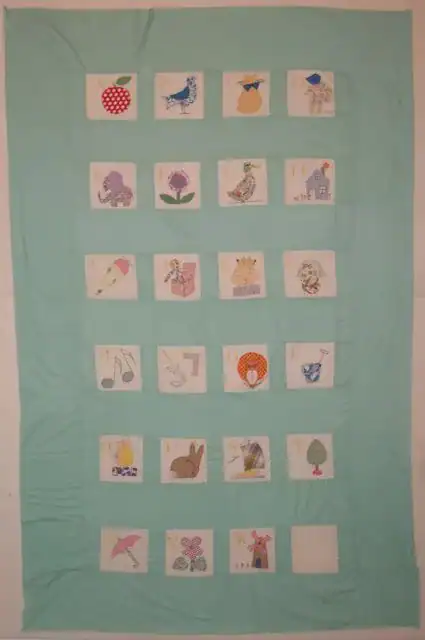
Found a picture and description of The Elephant’s Child in Quilters Journal, no. 20, from 1982. The kit was originally published in Ladies Home Journal, Feb 1934, and was “designed by E. Buckner Kirk” and sold by Woman’s Home Companion, Service Bureau, NY. The applique was easy “as the edges need not be turned under. They have been treated by a special process so that they will not fray.”
So two questions from this description: 1) Who was E. Buckner Kirk? and 2) What was the special process applied to the edges and does anyone have this quilt or seen it and how did the fabric hold up?
Wish I had found this 10 days ago as I could have taken this to a presentation on Kit Quilts sponsored by the MOKA group in Joplin, MO. We did have some marvelous examples of kit quilts, including two identical rose quilts made by different people.
Louise Bequette — in mid-Missouri
From: “Karan Flanscha”
Barb, If you are going to Kalona, you probably already know about the Quilt Museum at the Kalona Historical Village… a wonderful place to visit!! If you are thinking about Shipshewana, IN, it is a wonderful place, too 🙂 I just spent 5 days there at a Dear Jane retreat, and didn’t want to come home. You could contact Rebecca Haarer of “Rebecca Haarer Arts & Antiques, Historic Morton Street Shops, Vintage quilts. Authentic Amish-made goods. Quality American arts and crafts; Jane Graber miniature stoneware. Glass Christmas ornaments. Open all year. 165 Morton Street. 260-768-4787” One of the few places I spent more $$ than at the quilt shops (Yoder’s and Lolly’s). Here is a website: http://www.shipshewana.com/fleamarket.php I did not get to visit the Menno-Hof Museum, good reason to go again!! “The Mennonite Amish story told with inspirational and educational multimedia in historical environments. 260-768-4117 www.mennohof.org We stay twice a year at the Farmstead Inn: Farmstead Inn and Conference Center, Trading Place of America, Peaceful country style inn. Three story atrium, fireplaces, complimentary breakfast, pool, recreation center and conference center. Located directly across from Shipshewana Flea Market and Auction. 260-768-4595 www.tradingplaceamerica.com I might add they do have wireless internet access, if you are traveling with a laptop. Two of the DJers who live in the Shipshe/Goshen area are accomplished quilters with lovely patterns of their own in print, and might be able to meet you when you visit… if you are interested in that, let me know & I will e-mail them. I have met both in person & they are delightful ladies.
There are a couple of ideas for you!! Karan from rainy NE Iowa
From: Sandra Millett <
Sally: So glad to have confirmation from the UK. What I didn’t mention is that I’ve used the D70–borrowed from a friend. And it is wonderful. It has a nonprinting grid that you can use, or not use, so that the subject is perfectly squared in the lens. Would have kept me from having fits trying to crop something that’s not perfectly aligned in the frame.
Sandra Millett
From: Karen Alexander
Barb,
Wait one more week and you can see all this at The Quilters Hall of Fame i n Marion, Indiana!! But stop by anyway July 5 so that you can see the restore d Marie Webster House and the exhibit hanging there. (And this gives me an excuse to post a clean Exhibit list to all of you now that I have figured out how to turn HTML off!) ~Karen Alexander
Exhibits that will hang concurrently in various locations in Marion, Indiana during Celebration July 14-17week:
“Bets Ramsey: A Retrospective 1972-2005” (July 14-17, 2005) at the Marion Public Library Carnegie Gallery
Florence Peto’s Challenge: Little Quilts by Bets Ramsey” (July 5- Oct 31, 2005) – at The Quilters Hall of Fame. Fabric for these small quilts came from the fabric stash of Honoree Florence Peto (1881-1970). The American Quilt Study Group Two-Color ChallengeB2 (July 5- Oct 31, 2005) – at The Quilters Hall of Fame. These wall hanging-size quilts are reproductions of antique originals. Quilting Arts Magazine 2004 Trading Card ChallengeB2 (July 5- July 19, 2005) at The Quilters Hall of Fame. A selection from Quilting Arts Magazine 2004 Trading Card Challenge. (see their Winter 2004 issue) Botanical Beauties: 1800-1950B2 (July 14-17, 2005) at Kendall Elementary School. Quilts from the collections of members of the Midwest Quilt Study Group. We are also pleased to announce that The Midwest Quilt Study Group has once again chosen The Quilters Hall of Fame Celebration week in Marion as their gathering point for their July meeting. “Quilts From the Heartland” (July 14-17, 2005) at Kendall Elementary School a selection of quilts from today quilters.
PLUS the chintz quilt contest entries!
From: Judy Kelius
Thanks Louise… this is fascinating information. What is the “Quilters Journal”? At first I thought of the Quilt Journal published by the Kentucky Quilt Project, but that wasn’t until the 1990s. Can you post the photo to help us identify the quilt if we see it? I sold a 1930s quilt with elephants last year but the appliques were sewn down. –_1735500.ALT–
From: Judy White
Judy, the Quilter’s Journal was published by Joyce Gross of Mill Valley Ca. I began subscribing in 1985 shortly after I learned to quilt. However, I have been able to pick up issues from the beginning of the magazine. It was in black and white, with pictures, ads, a calendar and historical articles that were submitted by people such as Cuesta Benberry, Hazel Carter, Sue McCarter, etc. The early issues were just stapled together, but by issue No 31, it was a real magazine with a slick finish printed with what Joyce called a “technique of desk top printing.” That was in 1987. It was still in black and white. That issue featured the Orchid Wreath quilt by Rose Kretsinger along with photos of her house in Emporia, Ks, Rose at home, Rose at the Art Institute in Chicago, plus a lengthly article and a list of quilts made by her. There was a continuing article about the Caden Sisters, one by Barbara Brackman called The Tuley Park Quilting Club with pictures and a book review of a new book by Barbara Brackman, the American Patchwork Quilt.
In my mind way back (I’ve been quilting for 20 years and things get a little foggy), it seems to me that this Journal was tied in some way to membership in the American Quilt Study Group. Don’t quote me on that, but I just remember joining AQSG and receiving this Journal or maybe I just was then able to purchase the journal. Anyway, that’s was the Quilter’s Journal was all about.
Judy White
If you are traveling in Indiana…and Shipshewana is a great place to go…you might also want to take a tour of Quilter’s Hall of Fame in Marion, Indiana……that will be have festivities during the summer….check their web site for dates! Holmes county is also a great place to see in Ohio…and just seeing the quilts hanging out on the lines is worth it….not to mention the food…which sort of tells where my thoughts lie! Mary in Ohio
From: “Pepper Cory”
About that Indiana trip…don’t miss Rebecca Harrer’s Arts & Antiques in uptown Shipshe. The best selection of antique quilts around! If you’re there auction day (Wendesday) do what the locals do: get up super-early and have breakfast at the auction restaurant. If you can’ fit it in at breakfast, leave room for a dinner dessert of old-fashion cream pie, the best! The Mennhof is a must-see. The self-guided tour explains the history of the Mennonites as they came to this country (a lot also pertains to Amish history) and you end with the Palm Sunday tornado room. Hope that’s enough of a hook to get you to go. It’s a moving and thoughtful experience. Pepper Cory in windy NC
From: “Rosie Werner”
My collection seems to have a mind of its own. I started out collecting interesting quilts that spoke to me and that I could afford. I stumbled onto an auction of an antique dealer’s personal collection. Among the thousands of items there were 100 quilts. There was a Minnesota blizzard that day and I left home knowing I’d have to stay in a hotel overnight. Few people showed up for the auction (There are good things about blizzards.) so I came home with 11 quilts, having spent less than $1000.00. Those sort of lucky happenstances keep happening, so my collection keeps changing directions. Right now, I am deep into a quilt kit project, so kit quilts feature prominently.
I need to give serious thought to storage. My biggest concern at this time is the possibility of a moth invasion. Any suggestions? I do not want to use mothballs. Rosie in Minnesota
From: “Andi”
Hi Barb,
“Bill has already agreed with me that Kalona, Iowa, is on the way home (yes, he is a truly supportive husband), so I need information about there.” – He’s a keeper, for sure.
Go to www.kalonachamber.org or call 319-656-2660 for all kinds of info on the Kalona area. Karen is right about how wonderful the quilt & textile museum, as Marilyn Woodin probably won’t say, modest gal that she is. There is a nice gift shop there and a rock museum, and the whole shebang is set in the middle of a historical village of wonderful buildings. Bill will enjoy that. He will also enjoy the Chamber of Commerce’s countryside tours that go into the heart of Amish country. The bus is driven by a man whose parents grew up Amish but “went liberal and joined the Conservative Mennonites.” He really knows his stuff and has been charming every time I drag yet another visitor on the tour. It stops at an Amish country store and he points out a fabric store you can easily return to on your own. Sara Miller’s store was sold and is now Kountry Kreations selling quilts, crafts and furniture. Marilyn’s shop is now in the hands of two other women, but The Woodin Wheel is still the place to go to look at and buy quilts. Don’t miss The Cheese Factory on Highway 1, and don’t be surprised at the upscale Tuscan Moon gift shop in downtown Kalona – the little town is changing. Sadly, the great old Reif’s general store burned very badly last fall and has closed for good (although the building is being repaired). The Chamber gives out a wonderful coupon book for all of these places and a great map, too. There are several B&Bs in the area they can recommend; I don’t know how much time you can spend here but two days will be full ones. When you’re getting close to Kalona, get in touch! Maybe we can meet at the museum. Email me for my phone number.
Andi in Keota, Iowa
From: “Susan Wildemuth”
If you are looking for a neat antique mall to stop at in Peoria there is one along the waterfront downtown. Husband and I live within driving distance of Peoria and go down there for a Sunday afternoon drive once a summer. Some good restaurants along the waterfront too. Downtown Peoria is a bit of a ghost town, but they have been trying to revitalize the waterfront for at least ten years now.
Illinois Antique Center – 0.4 miles S – 311 SW Water St, Peoria, 61602 – (309) 673-3354
If you want to know about Kalona — the person on the list to speak with is Marilyn Woodin – she lives in Kalona and is the quilt curator for the Kalona Quilt and Textile Museum. If you want a neat overnight experience in Kalona – ask her about Edie’s B and B too. Marilyn’s e-mail address is on the Iowa-Illinois Quilt Study Group page.
http://www.quilthistory.com/study/IISQG.htm
Sue in Illinois
From: “Marcia Kaylakie”
Hi All, Can someone refresh my memory about joining QHL? I have a friend that would like to join. Thanks, Marcia Marcia Kaylakie, AQS Certified Appraiser Austin, TX
My collection is still very new, but one thing that has struck me very quickly is just how much room these quilts take up! I have about 20 pieces on hand, but over half of them are in off-site storage since apartments offer few places for quilt racks or wall hanging.
I grew up surrounded by quilts and quilters, but it was a couple of years ago when Mom gave me a Drunkard’s Path cutter to sell on eBay for her that got me really interested.
So I set out to collect only Drunkard’s Path. But I discovered very quickly that while it was not too hard to find a great variety of them in terms of color combinations, it was VERY hard to find ones that really “got me”. Many of those early acquisitions, most from eBay, have since found other homes.
Then, in November of last year, I attended Festival for the first time.
That was also the first time I ever saw quilts that inspired raw emotional reactions and was fully aware (being older now and directly interested in quilts) of the power of what I was experiencing. One in particular just blew me away. A dealer had the most amazing Mariner’s Compass I have ever seen. The colors were quite vibrant and the detail was astonishing. But it went beyond that- the quilt had a sort of majesty about it that I still cannot explain.
The brief story behind the quilt was even more extraordinary. I was told it had come from an estate and was found buried deep in trunk. Apparently noone in the family of the woman who made it had ever seen it before. Yet it very much seemed to have been made by her when compared to the other quilts in the collection which the family members were aware of.
What a grand question that posed. Why, so long ago, would someone have made such a stunning masterpiece and never shown it to anyone? What a personal and private tribute it must have been.
The maker seems to have wished that be kept secret, and so the quilt lives on keeping that secret in respect for its maker- and endearing itself all the more to all of us who gaze on it.
Back to more mundane matters, the quilt was well out of my price range so it did not come home with me that night. But to have seen it was enough.
And since that night, I have bought 3 quilts total- as compared to almost 30 purchased in the prior year of which many were passed on to others.
Perhaps as budget permits there will be more frequent acquisitions, but Festival set a new benchmark for me. I no longer focus on patterns or eras as much as I do quilts that move me when I see them. Few may ever compel me like that Mariner’s Compass did- but seeing that quilt set me on a good direction in my future collecting and enjoyment.
So, to answer an earlier eloquent post by another member, I have come to seek quilts that do have a known history attached- and I have come to prize those that just by their presence tell some of that story without words.
Take care,
Tom.
From: “L. C.”
There are several sites available that review the various digital cameras, but one I like particularly is
http://www.dpreview.com/reviews/
After lots of study, I recently purchased a Canon EOS 20D with a 17-85mm lens and 580EX external flash. It is a digital SLR with 8.2 megapixel. I have a Canon film SLR and one of my main considerations was to be able to exchange my existing lenses between the two. I’ve not found a review yet that didn’t rate this camera at the top or close to it. As far as not being able to hand-hold and get a good picture-not true. The resolution of the camera does not dictate whether you need a tripod-the speed setting, available light, distance, and subject and movement are what matters when it comes to hand-holding or tripod.
You will get plenty of argument about which camera is “best”. It mostly depends on what you want to use it for and your individual preferences. Do you want to do you own digital processing in Photoshop or other software (if so, you want a camera that will shoot in RAW mode)? Do you want to be able to tweak your camera settings such as shooting in manual mode, shutter priority, aperture priority etc? Do you want to be able to push a button and get a decent photo without worrying about settings and computer manipulation-then look towards the point and shoot cameras. Do you want to shoot close-ups-then study the macro output in tests of the cameras you are deciding on.
Speed is a strong consideration if you are shooting any kind of action. Most of the non-SLR cameras will have a delay from the time you hold down the button to when it actually takes the picture which makes it hard to capture that perfect moment. Continuous shooting was a big consideration for me. My Canon can shoot 5 frames per second for up to 25 frames before slowing down to write the pictures to the memory card. Great for picking out the best shot and throw away the rest when shooting live subjects. What is the battery life and what type do they use? Definitely a cost factor in many cameras. My Canon battery will last through about 400 shots and I keep two of them so I can switch out immediately and always have one charged. Many point and shoot cameras consume AA batteries with gluttonous abandon.
If you already own a 35mm SLR film camera, and want a digital SLR the logical choice is one that will interchange all those expensive lenses. You’ll hear folks on the NIKON side insisting that the D70 is best and folks on the Canon side telling the same story about the 20D or digital Rebel. Both are right–for them.
Keep in mind that resolution is not everything. To make large prints, yes you need a higher resolution camera. If you are never going to print larger than 4×6 or 5×7, then it is far less of a consideration. High resolution also helps if you want to do lots of cropping and changing of your photos-more pixels to play with.
My husband likes to just take the snapshot without worries about settings etc-he has a CANON Powershot A510 which works great for this purpose-nice and small so you can take anywhere without lugging a huge case.
I’ve also owned several of the NIKON Coolpix series and they are great cameras as well and very good on the macro end.
Hope this helps, Lavonne Currier Nikiski, Alaska
From: “Anne Datko”
Teddy wrote: “So, it was necessary to go all over the house, pulling quilts from hither and thither (doncha love that expression? Why, I am thrilled to know that I have a hither and a thither.) ANyway, I pulled quilts from everywhere. Now, they are riding around in the back of the car, because there are no holes left in which to stuff them if I bring them back in.”
Two recent notices about quilts being stolen from cars brought distress. Please, Teddy, get those quilts unloaded or maybe just keep the car in the garage! AnneD
From: Jackie Joy
This is an article about an exhibit of feed sack clothing at Louisiana State University. I thought it might interest those who are feed sack collectors.
http://www.2theadvocate.com/stories/051305/peo_peo001.shtml
Jackie Joy
From: “Susan Wildemuth”
Here is some imput about digitals cameras from an Iowa journalist — this information is being posted to the list with her permission:
“I would suggest either a Canon Rebel with interchangeable lenses or the top of the line Nikon D-70. Both are not cheap, but the Canons can be had for maybe $600. The Nikon lists for 1600, but is available for less. Even an inexpensive camera such as a Nikon coolpix with less than 3 megapixels does a great job. I know I got front page photos with it. Five megapixels, by the way is plenty, unless you plan to do extreme poster size prints. that particular Nikon coolpix one is available for less than $190 right now. Fuji is fine, but I have had no problems with rectangular shape. And some of my stuff gets used by others for various presentations. By all means rechargeable batteries are good. But they too have a limit of about 80 to 100 rechargings. a 10x zoom will have some falloff at the extreme setting. Better a 300 mm telephoto with a telX extended that would give you some 400 mm. No one needs more than that unless they are paparazzi.”
From: Barb Garrett
Good Evening All –
If you enjoy folk art, and particularly Pennsylvania German folk art, including quilts, you will enjoy this link and the catalog pages/pictures it leads to. I just returned from the preview and the quilts are beautiful. I love previews — you are allowed to open, touch, study — what could be better <grin>, except maybe being able to buy one or two. There is one mistake in the catalog — quilt #137 is beautifully machine appliqued, not hand sewn as indicated. The machine applique has turned under edges and is tiny and precise — just what I love in 1800s machine work.
http://www.conestogaauction.com/auctions/special.htm
We’ve been talking about collections — how to store, what to do with when we are finished with them. This couple is well known in the area for their PA German folk art collecting, and they have chosen to share their collection with others. The fracturs and wood carvings were exceptionally lovely also.
Barb in southeastern PA
From: “weemsjm”
howdy,
If you have a local college with a photo journalism department you might be able to fined great used equipment from students. I have found that most get really good cameras during there first few semesters then upgrade to the most current stuff as they are preparing to fine real work during their later years in school or after they are about to graduate. This is a way to get a $500-$1000 camera for a few hundred they love to sell to real people because pawn shops do not pay well. I have found most students take really good care of their cameras and most do have digitals.
Just a thought.
Jeff
From: “Nancy Roberts”
Teddy, would you elaborate some on this topic? You mentioned it in your recent post. I notice in browsing antique shops in Florida, that there are many quilts that I’d classfiy in this category. Most have survived, but not always gracefully. What’s the story with fat batts in warm climates? Are these simply utility quilts that have gotten handed down through generations? Thanks for any enlightenment you are willing to provide. Nancy Roberts
I am not Teddy, but I will stick my 2 cents in. I have lived in the South for most of my life and seriously collect quilts. I am not sure of the age of the quilts that you are referring to, but once the cotton gin was common and cheap to use, “ginned” cotton was readily available. Early on, using slaves to remove the seeds were cheaper than paying to have it ginned. Eli Whitney and his business partner, Phineas Miller, opted to produce as many cotton gins as possible, install them throughout Georgia and the South, and charge farmers a fee for doing the ginning for them. Their charge was two-fifths of the profit, paid to them in cotton itself. Farmers copied the designs, changing it slightly to get around the patent and the fee and started ginning in co-ops. Interesting that Eli Whitney didn’t make any money from his cotton gin business and invention.
Eli Whitney’s machine was the first to clean short-staple (American) cotton. His cotton engine consisted of spiked teeth mounted on a boxed revolving cylinder which, when turned by a crank, pulled the cotton fiber through small slotted openings so as to separate the seeds from the lint — a rotating brush, operated via a belt and pulleys, removed the fibrous lint from the projecting spikes. Because of the way the cotton is pulled through the openings using the spiked teeth, this cotton can be used directly for a fat quilt. However, as far as I know, if you want to have a thin batt, you card the ginned cotton by hand to get small amounts at a time to put on the backing (in the basting frame).
Most of this is simply my common sense and information from older generations passed along to me when I asked questions. I am interested if you have other information. I also referred to this web site to make sure I had my facts straight about the cotton gin itself.
http://inventors.about.com/library/inventors/blcotton_gin.htm
My in-laws grow cotton, and I do repairs of old quilts. I have them gin the cotton twice for me and then give me a black trash bag full which lasts me for years doing repairs where a mouse has chewed up sections of a quilt or something. I also have old cards which I use to create thin batts. One of these years I am going to take one of my old tops, make the batt and quilt it. I figure it will give me a greater appreciation for the quilts that I own.
We think quilting is a lot of work, but many folks now don’t realize how much work truly went into some of these quilts. Think about those with homespun backs! Pick the cotton, spin the cotton, probably bleach the cotton then dye the cotton, weave the cotton, pick some more cotton, card that cotton for batting, then you can use your scraps for piecing the top, and only then does the quilting begin.
I too have been fascinated by southern quilts. I am more interested in the ornate quilts though, which folks speculate involved a lot of slave labor — perhaps even the quilting. I consider Maryland a southern state, but somehow when people talk about southern quilts they aren’t thinking Baltimore Albums. The “southern quilts” are the Gee’s Bend or the fat quilts, or the utility quilts that happen to come from a southern state. Interesting…
Kay Triplett
From: Gail Ingram
Thanks for raising some important issues!
Kay, you live in a state that considered ITSELF southern in the ante-bellum South, at least. Its border status in the Civil War helped others redefine it, but like many such classifications based on political positions, that classification has always struck me as artificial. Outsiders forget there is a lot of Maryland outside Baltimore with its early large German population. Why don’t you research the whole issue?
While distinctive in their number and specific similarities, he BAMs are in many points consistent with many of the early southern quilts made along the eastern seaboard and in the older and more prosperous inland areas, generally along the then navigable rivers. (see Laurel Horton’s work on SC quilts from counties along rivers leading to/from Charleston and near major trading roads, e.g.).
You raise an important point: there almost surely is no “Southern quilt.” Just as in other regions of the country—and maybe more so—there are major variations owing to culture, location and availability of materials, financial means, and the time in which they were made.
While united by its strong Scots-Irish culture, the South is many Souths.
In my view, it is a serious error to call all Southern quilts “fat” (or ugly, for that matter).
It is important to remember that the hinterlands were still pioneering after the Civil War. The town in which I live in North Louisiana was founded in 1884, a result of the railroads that grew like mushrooms after the War and of the burgeoning timber industry which Chicago investors fed. Atlanta itself was no metropolis in 1860, had no established culture such as the one that flourished in Middle Tennessee, for instance. It was created by railroads.
Thus, owing to our more recent pioneering period, we might have more of the “fat” utilitarian quilts left. The world of Reconstruction and the quilts that were used for bandages and everything else during the War also used up a lot of our thinner quilts. There were probably proportionally more of the thick quilts, blankets and woven wool coverlets being less common and/or available in the hinterlands. And the Deep South like most of the Mid-South and Coastal South, has had a traditional culture that encouraged the preservation of even the most mundane objects as reminders of their makers. The one thing my mother desired from her grandmother’s textiles was a utilitarian quilt, which I now have. She had slept under it in a home that had always been a haven of love for her. So she asked for that and the sheepskin rug her grandmother always placed beside her bed when she visited. The fine quilts—and there were a number—went to others.
I think many of the fattest of the fat quilts now remaining date from a much later and poorer time than the CW days. And they were made with “bought” cotton, not home-ginned and combed cotton. Most importantly, they were made for warmth and were used daily from November through February and early March.
Everything is relative, and while we don’t have long periods of cold in the Deep South, we have very cold weather in winter. Those thick quilts were thought to provide warmth better than a series of thiner quilts. There were women in communities who made a small cottage industry of providing such quilts to others. I knew several in the 1950’s in Central Louisiana. And they were not African-American, though I met African-Americans who did this when I returned to Louisiana after graduate school. Many of these wowen needed money and quilted “on the halves”—they made a quilt for the buyer and she provided enough fabrics for them to make a quilt top. Cash was hard to come by for most ordinary Southerners into and past the mid-20th century.
My own collection of Southern quilts and my personal experience and observation in no way suggests that the “fat” quilts were the norm for “nice” Southern quilts. They were simply one kind, mostly a utilitarian kind, that survived because of the time they were made (really recently), the production in a sentimental, traditional culture, and the number produced for practical purposes. My experience and observations might be wrong, however, so I look forward to the research that is beginning and has been done in response to this question.
Lori East is researching conditions under which Civil War and post-Civil War were produced, and her work will add to our understanding of these quilts.
Maybe this is a good place to remind QHL members of the CONFERENCE ON SOUTHEN QUILTS to be held this coming September in Nashville—Sept 16-17. Its purposes are –to determine whether certain characteristics make southern quiltmaking a coherent, individualized tradition; –to seek bases for such a tradition –to identify regional differences that might occur within this tradition; –to identify patterns, fabrics, techniques, styles, or preferences peculiar to the region’s quilts; –to identify fabric preferences.
In general its purpose is to stimulate renewed scholarship in quiltmaking and elements of the quiltmaking tradition, focusing particularly on the southern region of America.
All of us hope it will redefine what we know (a burst of scholarship led by scholars like Merikay Waldvogel, Fawn Valentine, and Bets Ramsey has already established much about the Mid-South’s quilts) and suggest what we need to discover about these quilts. Want to help, Kay?
Getting ready to set out 15 old roses from the Texas Antique Rose Emporium—all in a veggie garden turned formal for these and David Austin Roses and the perennials native to the South that flatter the old roses,
Gail Ingram
From: Joan Kiplinger
Kay — a question re your use of the term American cotton meaning short staple. Was that term peculiar to the first days of ginning? Generally American cotton is that grown in this country of all 3 staple lengths in hundreds of strains and hybrids and including the finest, Sea Island. I had not heard of limiting it to just short staple, so would be interested in knowing more about source and origins.
I too have been fascinated by southern quilts. I am more interested in the ornate quilts though, which folks speculate involved a lot of slave labor — perhaps even the quilting. I consider Maryland a southern state, but somehow when people talk about southern quilts they aren’t thinking Baltimore Albums. The “southern quilts” are the Gee’s Bend or the fat quilts, or the utility quilts that happen to come from a southern state. Interesting…
Kay Triplett
From: “Suzanne Cawley”
Hi All!
Just a quick note to let everyone know that there are still a few spots available in the Heritage Center Symposium to be held next Saturday. You may register by phone if interested.
**************************************************************************** *** Heritage Center of Lancaster County, Lancaster, Pennsylvania, 717-299-6440 Symposium – Arts of the Pennsylvania Germans May 21, 9:00a.m.-5:00p.m. Rates: $50.00 ($47.00 Heritage Center members); lunch included. Join us for a day-long symposia that looks at the decorative and folk arts of some of Pennsylvania’s most distinctive communities. Mennonite and Amish arts, Moravian needlework and clothing of the Plain sects will be among the featured topics in this informative program.
Speakers Include: Peter Seibert, President, Heritage Center of Lancaster County, “Amish Arts”. Candace Perry, Curator, Schwenkfelder Library and Heritage Center, “Fraktur and Textile Traditions of the Schwenkfelders”. Clarke E. Hess, author and lecturer, ” Mennonite Arts”. Stephen Scott, Assistant to the Director, The Young Center for Anabaptist and Pietist Studies, Elizabethtown College, “Plain Clothing – Uniformity and Diversity”. Dr. Patricia T. Herr, Textile author and scholar, “Ornamental Branches – Moravian School Girl Arts”. **************************************************************************** ***
Suzanne Cawley In wild, wonderful Keyser, WV
From: “Teddy Pruett”
Well, now, I am pleased as punch that you want to know more. Amazed would be more like it. Can this mean that our homely sister quilts are getting more interesting? Anyway, I may hold my cards close to my chest for the moment – at least, until I give my study center at AQSG in October. I would hate to tell everything I know – which can be done mostly in one sentence or two – and have nothing to offer the very nice folks who are willing to sign up for my study center.
I dont mean for it to sound like there are any big deal secrets, because certainly there are none. ANd, if there were wonderful things to know, I probably would not be the one who knew them. But I did work very, very hard to gather enough info for my class. Actually, Nancy, it is very possible you will get to learn it all first hand. I am using the study center info to create a new lecture that I can offer to the FL groups. Just got to get that info out there someway. Gave a version of it to the SSQA group last Saturday.
ANd, as I sit here, pondering whether or not to hit “send” or “delete’ I can hear people saying “What a selfish, uncaring unsharing biddy……” which does sound accurate, except that normally I am the first to tell everything, everything, everything about anything, anything, anything. Hmmmm…perhaps a magazine article is in order?
There were 20 people in my study center last year, so there are at least 19 people who know what I know. And what I dont know —– I make up!!!! Teddy (just kidding, just kidding)