May 18 – 26, 1999
These restored messages come from the Quilt History List, an online forum where quilt historians, collectors, researchers, appraisers, and enthusiasts discussed antique quilts and related textiles. The archive dates from 1996 through approximately 2016 and is being restored gradually. Sign up in the form at the bottom of the page if you want to know when a new page is added. Original spelling, opinions, formatting, and inactive links may remain unchanged.
Primary topics of this QHL Digest:
- Lace Collection Discovery — A member reports finding a treasure trove of antique lace from a relative’s collection, sparking discussion of lace preservation.
- Silamide Thread for Quilting — Detailed responses to questions about Silamide thread, its properties, and best uses in quiltmaking.
- Washing Antique Wool Rugs and Quilts — Continuing advice on washing methods for antique wool pieces, including creative solutions like car washes and rushing streams. (see the article on cleaning antique quilts)
- Charm Quilts — Discussion of charm quilts and their appeal among collectors and quiltmakers.
- Quilter’s Newsletter Magazine Survey — A member shares results from QNM’s reader survey on the most popular quilt patterns and quilting habits.
- Dating Reproduction Fabrics — Members ask about and share information on when specific reproduction fabric lines were first produced. (see the article on dating quilts)
- Sugar Loaf and Triangular Trees Patterns — A member seeks help identifying a quilt pattern found in Brackman’s encyclopedia, linking it to early indigo and white shirting examples.
- Quilt Engagement Calendar — Discussion of back issues and remainder copies of the popular Quilt Engagement Calendar series and related publications.
- Embroidery Thread Preparation — A UK member shares how her mother and grandmother prepared stranded embroidery floss, including historical winding and storage techniques.
Date: Tue, 18 May 1999 22:24:37 -0400 | From: [from unknown, signed “Nancy Hahn”]
Oh Judy, what a treasure you have found with Bernice’s lace collection. Thanks for describing it to us. Whenever I stumble across something with a name, or address, or even just a wonderful portrait during my antiquing hunts, I also feel a bit sad, that surely there must be a relative of Bernice (or whomever) out there who would have treasured such a remembrance of a friend or relative. I guess because my family, on both sides, immigrated to America and tossed aside most family things to: “buy American” as soon as possible, I wish I had some family momentos. But now you are the new caretaker of this wonderful treasure, and it sounds like you will really take care and enjoy it…
Nancy Hahn, Bowie, Maryland
Date: Tue, 18 May 1999 22:05:05 -0500 | From: Russell-Hill <russhill@>
Hi All,
The lint was used in the stopping of the bleeding in wounds. DH and I are part of a Civil War Medical /Hospital unit and that is what they would have used the lint for. It was also packing in a wound. Debbie ,who is glad to know there is a question I can answer.
Date: Tue, 18 May 1999 20:52:54 -0700 (PDT) | From: “Pat L. Nickols” <patlnickols@>
RETread going on Charm quilts Sue and Judy have both commented on Charm quilts. They have been of interest to me and a great deal of information I have gathered on charm quilts was presented in a paper for the American Quilt Study Group and published in UNCOVERINGS 1996. I believe these books are still available. Although charm quilts were very popular in the late 1800s there appears to: have been a strong interest in the 1920-1930s as well judging from the number of examples I have found. A charm quilt kit was mentioned but that is a new possibility to me, I have never come across one, nor any mention of one. If one has been found I would be most interested in learning more about it. A variety of sources sold fabric scraps, some by the pound, so fabric was readily available by mail to the homesewer.
Pat L. Nickols
_____________________________________________________________ Do You Yahoo!? Free instant messaging and more at http://messenger.yahoo.com
Date: Wed, 19 May 1999 06:13:47 -0300 | From: susan silva <woody@>
Greetings QHL’rs
Recently I found a singer model 99k sewing machine at a garage sale. It was in great shape, with a case (not featherwt). The top part of case had a clamp-thing on each side. It was about the size of a featherwt but didn’t have the part that folds out to the left of the throat plate. Does anyone know anything about this model of machine. It was so cute, but I’m not sure if the price ($99.00) was good. thanks susan in spokane
Date: Wed, 19 May 1999 10:27:51 EDT | From: Pennstudd@
Hi All,
This is in response to the question of what lint was used for during the Civil War. The Southern States had very few supplies in the last 2 1/2 years of the war due to the blockade the North had on the harbors. The doctors were forced into using natural herbs and potions in place of the medicines of the day. But, they also pioneered a sterilization technique that was 25 years before its time. The used the hair from a horse or mule’s tail and boiled to make it pliable {sterilization and they didn’t know it} to use as a suture material. The lint was made from scrapping cotton cloth with sharp knives to get the lint. Cloth was very scarce and they used the scrappings and boiled them to clump together. Then they used the lint to pack wounds. The remaining thin cotton cloth was boiled and lightly pressed {when time permitted} to give it some body. An interesting note, the rate of infection at Northern hospitals vs. Southern hospitals was 30% lower due to their crude unknowingly sterilization techniques. Bill
Date: Wed, 19 May 1999 09:40:24 -0700 | From: cmsc@
Judy Grow asked several questions about Silamide thread.
This URL http://7echoes.com/silamide.htm explains a lot about the thread except for how to get it out of those #$@ folders. I bought the thread from Joyce Scott at a beading workshop. She showed us how to handle it. Leave it in the long poly tube. Pull one end of the hank out of the tube and secure it with a small piece of twist tie. Pull the other end out of the other end of the tube and cut through the hank. Now you can pull one thread at a time from the secured end without tangling. Sounds like Judy’s hank may already be prepared for easy access. I would never use it on cloth no matter what is said about its use as a fine tailoring thread. If you try to break a thread with your bare hands, you will end up with bloodied hands. Imagine what it would do to antique fabrics. I don’t use it for beads either – I do heavily beaded and sequinned quilts and am afraid the waxing might eventually migrate into the fabric. That would be okay if my quilts could be easily washed or drycleaned but that’s not the case.
So what am I doing lurking on the Quilt History list?
Recently we cleared out my mother-in-law’s estate, which included things from her mother and grandmother, and found -a red, buff, and blue (faded green?) on white pieced top said to be from around 1860 by a local appraiser (Seattle)
-a double wedding ring top, 20’s-30’s era fabrics -a feedsack quilt top somewhat in pieces because an appraiser had told MIL it would be worth more if she took out the pieces that were disintegrating and replaced them with new fabric (!) -two absolutely gorgeous (and dirty) wool utilitarian tied quilts from: around the turn of the century – my favorites -several 1920’s-30’s tied quilts, various patterns. -60 or more crazy quilt tops of various sizes that GMIL made for charity – we gave them to a local guild to finish and give away After reading this list for a few months, I decided not to clean or finish the red/buff/blue/white top – it’s in great condition and doesn’t smell. I would like to clean the wool quilts and use them on the wall but they are quite fragile, with threadbare wool pieces and some holes. I might take them to the cleaners who do my beaded quilts; they would most likely sandwich them in muslin and handle gently while cleaning as they do with my beaded quilts. I thought of laying them on the deck, spraying with an Orvus solution and then rinsing, all without moving the quilt. But then I would have to figure out how to dry them and I live in Seattle where the sun doesn’t shine and it’s cold. What would you all recommend about cleaning these wool quilts?
Carol Castaldi cmsc@
Sorry this went on so long; when I de-lurk I do it with a bang.
Date: Wed, 19 May 1999 13:14:31 EDT | From: AlineMcK@
Re the smelly wool quilts Orvus in the tub (after testing for colorfastness). You can gently, gently, gently hand-agitate them, then simply open the plug to drain. Let it drain about half an hour or more. I use a very mininmal amount of Orvus, to make rinsing easier. After about three rinses, I do another wash if it seems necessary. Do lots and lots of rinses, since agitation is minimal. I did a 1920s filthy-and-smelly-like-diseased-sheep wool quilt this way. When it was at the point where it smelled like a clean sheep, I let it drain in the tub for a few hours, then picked the whole thing up in a ball, supporting it from the bottom, and set it, still wadded up, on a flat sweater-drying rack. After a day, it had drained enough that I could handle it with less danger of the weight tearing the stitches. At that point, I very carefully arranged it in the washer, positioning it by hand against the outer wall, and put the machine on “spin” to help remove the remaining water. The now just-damp quilt could then be spread out flat to finish drying. Wool quilts are a bitch and a half, since weight is the enemy. This method takes about four days total. But it can be done. And actually, wool quilts worry me less than cotton ones. We hand-wash wool sweaters all the time without disaster. And I have a very expensive 9×12 all-wool Oriental rug that must weigh 150 pounds dry, that about once a year has something terrible done to it by my big dogs. I hose it off in the back yard. (I put Orvus in the hose-end sprayer.) Never had a problem yet, except the intrinisic difficulty of dealing with several hundred pounds of wet rug.
Date: Wed, 19 May 1999 18:45:03 +0100 | From: “Sally Ward” <sward@>
My mother and grandmother would prepare their stranded embroidery thread (floss to you , I think) by taking the new hanks and cutting through all the threads at one end of the hank. Then it was hooked over somethind handy (my finger when I was small) and plaited all the way to the bottom, with a short piece of thread tied around the end to secure it. Then whenever they wanted a piece of thread they pulled it out of the loop at the top and it just slithered all the way up the plait without disturbing the rest. Once I was allowed to make the plaits I used to mix up the colours and make patterns. It didn’t matter, you could still pull out just the thread you wanted.
Sally in UK
Date: Wed, 19 May 1999 14:01:40 -0500 | From: Laura Hobby Syler <texas_quilt.co@>
Aline, I took my rug in the back of the pick up to the car wash….hand sprayer type..Just used the rinse cycle…making sure that there was no soap (which at the one I seem to visit, that will *never* be a problem<G>) The other patrons thought I was nuts, but it got clean and when I got home all I did was spread it out over the sides of the pickup (the neighbors are used to that kind of stuff with me!) The other alternative is to find a good friend that you want to spend the day (or weekend) with that has a trampoline!!! Start early in the AM and with a nice breeze it should be done my sundown….hopefully! Dont forget to wash the trampoline first and put down sheets. works great!! Laura >And I have a very expensive 9×12 all-wool Oriental rug that must weigh 150 >pounds dry, that about once a year has something terrible done to it by my >big dogs. I hose it off in the back yard. (I put Orvus in the hose-end >sprayer.) Never had a problem yet, except the intrinisic difficulty of >dealing with several hundred pounds of wet rug.
Date: Wed, 19 May 1999 14:21:29 -0600 | From: Jocelyn <jocelynm@>
> I constantly see dealers refer to various flaws in quilts as imperfections > intentionally put into quilts by their makers to avoid blasphemy (the idea > being that only God is perfect so they mustn’t make their quilts > perfect…) Has this really been substantiated or is it just an excuse > for a flaw? (I guess both are possible, depending on the circumstances)
> For what it’s worth it seems more blasphemous to assume that unless you > intentionally make an error you would achieve perfection!?
Tammy, I’ve never heard it substantiated. I have heard Amish quilters say it isn’t an Amish tradition, for the reason you stated! <G>
The story goes back to ancient Greece, where Arachnae challenged Athena to a weaving contest, and was turned into a spider for her arrogance. I suspect that since classical educations were fairly common in the 19th century, and this legend was one that would be a good moral to teach daughters, that probably many women were familiar with the myth. I can see mothers consoling daughters about errors in their quiltmaking, by telling them it would be an offense to God to try to create a perfect quilt, and to let the error remain– which, as you pointed out, is distinctly different from saying the ‘error’ was deliberately made. Anyway, I don’t see how it’s an error if someone plans it- doesn’t it then become an unusual design element? <G> I think it’s much more likely that, once the mistake was made, it was left in as a reminder that only God is perfect, rather than being deliberately made. I’ve heard people say that this is also true of Navajo rugmaking, but then, I’ve heard it said that it’s that they believe that as one creates, one puts one’s spirit into the work, and the line leading from: the design to the edge of the rug is the ‘escape route’ for any pieces of the spirit that might have gotten trapped into the rug. I keep forgetting to ask my Navajo student if that’s what she was taught , but from what I know about the tribe’s spiritual beliefs, having a part of your spirit trapped in a rug– especially a rug that’s being made for sale– would be a terrible calamity.
Jocelyn
Jocelynm@
Date: Wed, 19 May 1999 14:21:34 -0600 | From: “Cindy Brick” <Brickworks@>
Quilter’s Newsletter Magazine has recently released the results of the Ultimate Quilt Search’s ‘100 Best Quilts of the 20th Century’. You can read the list at http://www.mccallsquilting.com/best5.htm. Some are no-brainers, and some are “huh?” That’s what makes these kinds of lists so interesting! In case you’re wondering, QNM (plus Quiltmaker and Quick Quilts) is now owned by the same folks who put out McCalls Quilting Primedia. That’s the reason for the odd website name.
Have fun,
Cindy
Date: Wed, 19 May 1999 17:05:07 EDT | From: AlineMcK@
But this web site makes me chuckle every time I go to it. Make sure your computer’s sound is on http://www.hamsterdance.com
Date: Wed, 19 May 1999 17:06:24 -0700 | From: Marilyn Maddalena <marilyn@>
Lois You may have read about it in the NQA magazine, The Quilting Quarterly, Winter 1998 issue. It’s the Illinois State Museum in Springfield, I believe it is. The phone number for more info is 217-782-7387. Good luck! Perhaps you should also take in the NQA show in Omaha, which is June 24-27. All that week the whole Omaha area is turning into quilt country with exhibits and displays and shows everywhere, it seems like. Check the NQA website at www.his.com/~queenb/nqa or the Omaha show website at www.radiks.net/yankee2/NQAOMAHA99. I’ll be there all week, and can hardly wait! Enjoy yourself.
MM Marilyn Maddalena
Date: Thu, 20 May 1999 23:55:25 -0400 | From: “Judy Grow” <Judygrow@>
Kristi,
I think think a flying goose strippy quilt would be quite appropriate and fairly simple to do. I know quilts such as I have described have been made from: early in the 19th century through late in the century. I have seen many others pictured from all periods.
Judy in Ringoes, NJ judygrow@
>A friend and I purchased some DAR museum reproduction fabric and >were wondering what would be an appropriate pattern to make it >into.
Date: Fri, 21 May 1999 00:00:39 -0400 | From: “Judy Grow” <Judygrow@>
I had another thought about washing rugs. How about finding a nice rushing stream with plenty of clear water and leaving it there for a couple of days.
Isn’t that what the original rug weavers did?
Now if we could only find a nice rushing stream with unpolluted water where you could leave a rug for a couple of days, unattended, and expect to find it when you return.
Judy in Ringoes, NJ judygrow@
Date: Fri, 21 May 1999 02:03:38 EDT | From: AlineMcK@
In a message dated 5/20/99 110153 PM, Judygrow@ writes
>Now if we could only find a nice rushing stream with unpolluted water where >you could leave a rug for a couple of days, unattended, and expect to find >it when you return.
While we’re at it, I’d like a pony.
Date: Fri, 21 May 1999 06:34:45 EDT | From: CToczek@
Hi Kristie,
Some appropriate patterns for the museum fabric would be Flying Geese, Puss in the Corner, 4 patches, 9 patches, Bear’s Paw, Lady of the Lake, Hexagon Designs(not necessarily Grandmother’s Flower Garden.) Also try some of these blocks in a strippy/bar set. Nice way to use lengths of the big florals/birds in the DAR and other early 1800-1850’s reproduction lines. For books the state books like New Jersey Quilts show examples of early designs. Try Hickory Hill for quilts and books at http://www.hickoryhillquilts.com/books.htm Plus another we discussed here a year ago Calico and Chintz, Available from the Smithsonian/Renwick Gallery then for $24.95. #(202)357-1445 Hope that helps some, Carla Toczek, resident quilt history student and appraiser-in-waiting <G>
West Point
Date: Fri, 21 May 1999 15:29:03 -0500 | From: “Ann G. Hubbard” <ahubbard@>
I am making a sampler quilt with Judie Rothmeral’s civil war collection 1 and 2. I also have some sassafras and buttermilk and cinnamon and pine. I want to know if the last two are in the same time frame as the civil war collection. The civil war collection is mostly mediums and darks and I need some lights and I don’t want all of the lights to be muslin. Even the solids for that period are medium and dark. Also I wanted to know if there is anyone group or company that is categorizing fabric swatches of all of the fabric that is in current print. My question is, will it be just as difficult 100 years from now for people to: determine when a fabric was actually printed? I guess I should be better at taking my own fabric swatches and labeling them when I buy the fabric.
TIA Ann Hubbard in beautiful Lake of the Ozarks, MO.
Date: Fri, 21 May 1999 15:58:24 -0500 | From: “Ann G. Hubbard” <ahubbard@>
back to dating my fabrics. Does anyone know the reproduction date of Marsha’s Staples? I have a lot of her fabric, also. TIA Ann Hubbard still pretty here in lake of the ozarks
Date: Mon, 24 May 1999 21:39:48 -0400 | From: “Judy Grow” <Judygrow@>
DYS is the only tenant in what is otherwise a historic house museum. It is the Benjamin Temple House, headquarters of the Ewing Township Historic Preservation Society, located at 27 Federal City Road in Ewing Township, NJ, and easily accessible from Interstate 95 and Route 31. The ETHPS is sponsoring a series of lectures titled “Focus on Fashion.” The first lecture is this Thrusday, May 27 at 700 PM. It is “The Foundation of Fashion A Brief History of Underwear and Ideals” presented by Kristina Haugland, Ass’t Curator of Costume and Textiles at the Philadelphia Museum of Art. She will focus on the 18th, 19th, and 20th centuries in a slide presentation. Sunday, June 6, 1999 at 200 PM Amy Hopwood, Costume Consultant and Historian will give “The Fashion Makers Haute Couture, Clothing the Masses,” and Dennita Sewell, Costume Designer will give “Fashion Frivolous or Fundamental.” Thursday, June 17 at 700 PM, “Topping it All The Art and Craft of Millinery.” Sunday, June 27, 1999 at 200 PM, “The Latest ModeDress in the Modern Age.” I know those of you in Ohio, Florida, Colorado and California won’t make it, but perhaps some others in closer states might be interested. I have driving directions, so contact me.
Judy in Ringoes, NJ judygrow@
Date: Tue, 25 May 1999 06:33:01 -0400 | From: Alan Kelchner <quiltfix@>
Gold, Laura? Spun gold? Sorry if I snicker, but I can get them at any of the major book stores (although I get it from a local bookseller if I can, and I also wait for the new year to start (half-price, y’know). Actually never thought to check the local quilt stores. This year’s was gift.
Alan thinking of selling them on the street for big bucks <G>
Date: Tue, 25 May 1999 09:02:48 -0400 | From: roosien <roosien@>
Coming out of “lurdom”! Our Barnes and Nobel had about two dozen this year – but my “main” (I try to buy from locally owned business) book store did not have any and couldn’t order any. Go figure! Back to “lurkdom”.
Chris
From: REALLY REALLY cold Michigan
Date: Wed, 26 May 1999 13:55:54 EDT | From: QuiltFixer@
normah@, suedolliver@ Subject: QHL The Redwork Lady is back home again. Hi to everyone! Just wanted to say “Hi” and tell all I am back home again. I had a great lecture tour in the Pacific Northwest and met many wonderful people. Can’t list them all, would be so long, but here are a few highlights. If you are ever near Dallas, Oregon be sure and stop at Grandma’s Attic, a terrific quilt shop. We did a great tea/slideshow/trunkshow/workshop there. Rachel Greco and her staff were just terrific and very knowledgeable. The high point of it all was sitting around Pat Smith’s living room that evening (Pat was our hostess and a staff member). All of the shop staff had come over and we had great Chinese Take-out Food, and afterwards, I did the trunk show all over again as they had missed it because they had to stay and run the shop. What fun! Husband Charles was the only guy there most of the time until Rachel’s husband, Steve came, and he had a great time. Rachel also has an on-line quilt shop at www.grandmasattic.com. Later on in the trip we had the pleasure of meeting and giving our program to the Quiltmakers of Olympia, WA. Our gracious host and hostess, Dave and Sue Dolliver gave us a roof and a tour of the Olympia area. Just beautiful! Got to: meet sister, Margaret and Buster the Dog! For those of you who also do reenactments, Dave builds and repairs black powder guns. What a collection he has! I could hardly get Charles to leave. Next, on to the Sunbonnet Sues of Sequim, WA where Norma Holbold and her cat, Oliver had us stay at her wonderful quilters retreat, Greenhaven. If you have ever considered going on a quilters retreat with a friend or a vacation with your husband to this area, consider this. On the beautiful Olympic Peninsula in the state of Washington, Norma and Oliver will make your stay a happy one. normah@ for more information. Well, what I am leaving out would make a book, so will close with saying the Quilt Market in Portland was overwhelming and educational. Wow! One last thing, I would like to thank one of our members, Joan Stevens, of American Doodah (AMDOODAH@) for her kindness and interest in helping me assemble many of the Redwork pieces that are in my Program. Joan, I never would have made it without you. Hope to: see many of you at Albany for the conference and at Omaha at the quilt restoration conference where I will be giving my program. Toni B.
QuiltFixer@ RedworkLdy@
Date: Wed, 26 May 1999 14:52:46 EDT | From: ZegrtQuilt@
Marilyn Woodin of the Woodin Wheel in Kalona, Iowa , a well respected and long time quilt dealer has a small museum at which she hosts wonderful quilt exhibits and sales . She is having a Sunbonnet Sue quilt show in June amd July and has asked to borrow The Sun Sets on Sunbonnet Sue quilt from my collection. Duting our conversation, she asked me if I knew of any collections of old sunbonnets she could use in the exhibit. It seems a perfect query for QHL. You can contact her directly by phone 319-656-2240 or email me and I will pass them on to her .. Thanks Shelly Zegart
Date: Wed, 26 May 1999 13:00:34 PDT | From: “JuLee King” <piecingitogether@>
Belated congratulations to those of you who recently earned your appraisers license!!! I don’t get to get my mail often and was just getting caught up. I also am pursuing my appraisers license and would like to know what books you found were the most helpful for you in your studies. Thanks for all the wonderful information that I get through this list. JuLee from Utah
Date: Fri, 21 May 1999 21:22:55 +0000 | From: [from unknown, signed “Kristie”]
I want to say a big thank you to Carla and Judy for replying on patterns and books to look at for the DAR museum reproduction fabric. I really appreciate it! I knew I could count on you guys for knowing the right answers…. I’m really learning a lot from this list, it’s like going to school (and enjoying it!)
Kristie in Colorado
Date: Sun, 23 May 1999 08:06:59 -0400 | From: “Kathie Fortner” <kathleen@>
Hi Everyone
I’m looking for advice & or information for a friend regarding a collection of blocks she acquired of grandmothers flower garden and nosegay blocks all in ‘s and 30’s fabric. There are 132 blocks (flowerettes) about 8″ in size, all different, the same fabric may appear in a second block but all blocks are different. The hexagons in these blocks finish about 1 1/2 inches. There are 9 large hexagon blocks (flowerettes) and all but one has a white border of hexagons attached to it. They are about 22″ in size. There are 122 nosegay. These are all hand pieced and my friend said she didn’t think the fabric had ever been washed.
Her questions are Would you think they would best be sold as a set?
Would you be inclined to break them into smaller sets?
What approximate amount would you think they would be worth (ball park figure)? Has anyone had any experiences with this Ebay Auction I’ve heard about, would this be something she should look into? Any help would be appreciated. If you want to address your comments to me, I will pass them on. Thanks. kathleen@
Date: Sun, 23 May 1999 16:03:14 EDT | From: [from unknown, signed “Carolyn”]
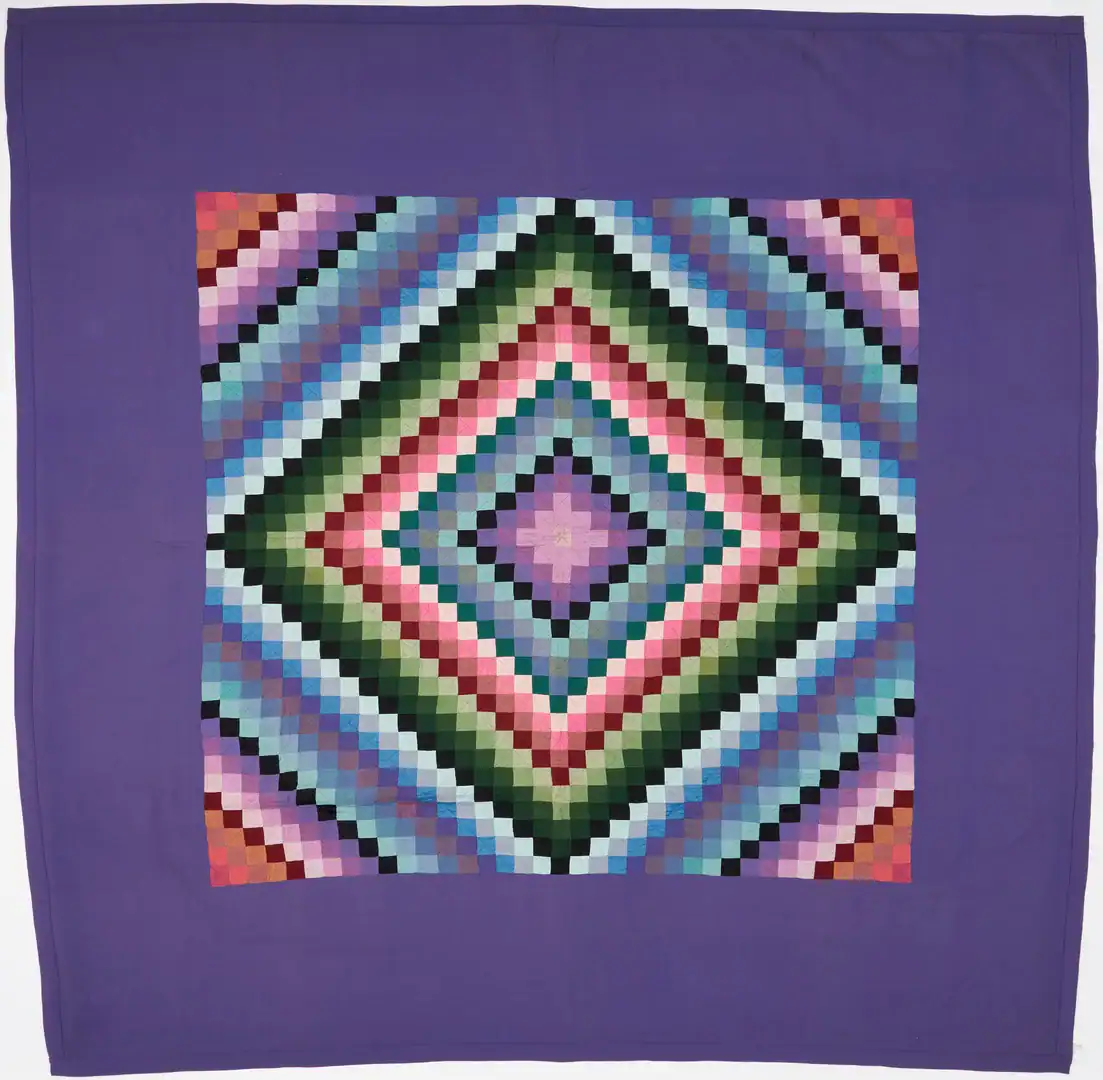
I recently purchased a quilt that I first called the ‘sugar loaf’ pattern. I looked in Brackman’s encyclopedia and it is pictured exactly on pattern #2. It states that the earliest example is ca. 1865 in Phyllis Haders’s “The Warner Collector’s Guide to American Quilts”, p. 86.
If anyone out there has this book would you please contact me about the information found there.
The pattern was referred to as ‘triangular trees’.
Mine is composed of different indigos and white shirting prints, with the large alternating triangle being indigo. Probably a Texas quilt.
Looking forward to my week in Nebraska for NQA, Carolyn in Texas
Date: Sun, 23 May 1999 22:52:11 -0400 | From: “John Cawley” <cawley@>
Yesterday I went to the annual Quilt and Needlework Show at Sotterley Plantation in St. Mary’s County at the southern end of Maryland overlooking the Pautuxent River. This Tidewater area is a whole other world for a native Pennsylvanian. I was pretty up on PA history and PA quilts and now I’m starting over; I love it. Anyhow, I don’t imagine there are too many quilt exhibits is a setting as glorious as Sotterley. Quilts were displayed in the manor house, the farmhouse, the one room school and a number of other out buildings. They had vendors and demonstrations and a wonderful lunch in splendid garden setting. We had a great time. The exhibit was of new pieces, but they did have three antique quilts borrowed from the DAR. If you have the book A Maryland Album check out pages 64, 71, 74. All three quilts (2nd quarter 19th century) were made in St. Mary’s Co. The two large quits were in nearly perfect condition. One is a Lone Star (made by a St. Mary’s woman who had moved to Texas) in only two colors, dark blue and a sort of oxblood brown (rather unusual to say the least) with broderie perse in the open spaces and a chintz border. The other a fabulous Variable Star with blocks made of the same large scale blue chintz with sashing strips of a small figured blue chintz with a wide and wonderful brown floral chintz border. The third was a baby quilt, badly worn, in red, pink and blue Lemoyne Stars alternating with pink bouquets of broderie perse. A committee of 15 women put this show on every year and make a raffle quilt (a very impressive medallion of poppies on a pieced background). They haven’t called yet so I guess I didn’t win. The perfect end to the day were really scrumptious crab cakes eaten on a deck overlooking the river at Solomon’s Island. My hunt for the perfect crab cake is serious research project (VBG). This move to the Eastern Shore was a great idea. I’m having lots of fun.
Cinda in Easton, MD
Date: Mon, 24 May 1999 :43:24 +1000 | From: nomad1 <nomad1@>
Dear All,
On this cold and wet day here in Sydney Australia my thoughts turn to Antique Quilts of course! Savouring my books I have been reminded of a quest I am on at present. I have been going barmy trying to get hold of The Quilt Engagement Diary. Okay, I know we are in May and nearly tiptoeing into June; however what i am after it, is for the Antique quilt pictures. I have been snootily informed by Quilt Shops here that I should have had my name on a waiting list last year!! So…what is the story here? Pretty please do let this ignoramus know how i go about acquiring any Quilt Engagement Diaries from years past, present or future??? Thanks muchly. Must choof, Hiranya Loder from Sydney Australia :>
Date: Mon, 24 May 1999 07:01:45 -0400 | From: Alan Kelchner <quiltfix@>
Now I won’t go anywhere near pricing blocks – have no idea where you live. Area will definitely affect what you can expect to receive for them. Personally, I wouldn’t break up the set, but that’s personal bias. I do know that in this area, smaller sets go more quickly. And if you sell locally, say for commission at an antique shop, you may have to wait a long time to get the money. With Ebay, you can gat your money relatively quickly, since you’d have a nationwide, if not worldwide, customer base. I believe Ebay does have a commission. You can also set a reserve price to keep from losing money (if the reserve isn’t met, it isn’t sold). My only suggestion there would be to say in the text what it is. I find it frustrating at ANY auction to be told there is a reserve, but the auctioning starts well below that. But you need to find an appraiser to price your blocks. Size and condition are important, but quality has a definite bearing. Then you can proceed.
Good luck!
ALan
Date: Mon, 24 May 1999 08:32:33 -0500 | From: [from unknown, signed “Laura”]
Hi Hiranya,
Sorry that the shops treated you so haughtly, but they are right. The shops only get 1, maybe 2 dozen, and they are statched up fast. Most having been “pre-ordered” by customers. I’ve been collecting the Quilt Engagement Calendars since 1981!! (they started printing them in 1975) I had them in my shop back then and they were quickly snapped up. For some reason, not all shops understand how wonderful they are, but those that do treat them like they were made of spun gold. They are HIGHLY collectable and back issues are almost impossible to find. (I missed a couple of issues when I had a lifestyle change a few years ago and have not been able to find those!) Mainly because, unlike most used books offered for sale, they are dated, and calendars (which get thrown away if out of date) and if these get written in, the are considered unsaleable by the dealers. There is a book, “The Quilt Engagement Calendar Treasury”, published in 1982 by EP Dutton, ISBN 0-525-93252-6 (cloth) D-525-47712-8 (DP) I guess that means paper, that’s what mine is. It states that it covers the first 8 editions of the calendar, There are 186 pages of beautiful color photos (some I wish were larger or closeups, but beautiful nontheless! There are also 86 pages of patterns and basic instructions (see, some things never change!) I paid $24.75 for it new, who knows what it would go for today. Ailene may be able to locate it at one of our Half-Price Bookstores, but I’ve never seen one there. If you want a copy of 00’s I’d find it for order somewhere and put your name in ASAP!!
Good luck!
Laura
Date: Mon, 24 May 1999 10:08:31 -0400 | From: “Lonnie Foley” <redloon@>
Please excuse my ignorance but are we talking about the American Quilter’s Society Quilt Art Engagement Calendar 00? Or have I missed something as per usual 🙂 If so the AQS has issued an order form for those.
Lonnie
Date: Mon, 24 May 1999 12:24:04 -0400 | From: “John Cawley” <cawley@>
The Quilt Engagement Calendar is a different beast entirely from the AQS calendar. The QEC is edited by Cyril I. Nelson and pictures antique quilts almost exclusively. Among the 50 plus illustrations there may be four or five contemporary quilts. There’s a full page picture of a quilt for each week of the year with some extras thrown in as a bonus. I’ve been keeping a diary in them for years (very appropriate since quilts are such a huge part of my life); someday somebody will write an article for AQSG using me as the primary source. I don’t have the complete set, but I did find some back issues at Thos. K. Woodard several years ago.
Cinda on the Eastern Shore —–
Date: Mon, 24 May 1999 12:58:19 -0600 | From: Jocelyn <jocelynm@>
> I had another thought about washing rugs. How about finding a nice > rushing stream with plenty of clear water and leaving it there for a > couple of days. Isn’t that what the original rug weavers did?
> Now if we could only find a nice rushing stream with unpolluted water > where you could leave a rug for a couple of days, unattended, and expect > to find it when you return. But, after you did this, you’d no longer have a nice rushing stream with unpolluted water! <G>
Jocelyn
Jocelynm@
Date: Mon, 24 May 1999 16:30:00 -0500 (CDT) | From: Carol H Elmore <celmore@>
Back copies of Quilt Engagement calendars can sometimes be obtained from Peddler’s Wagon, the used book sellers in Missouri. I am at work and don’t have their number with me. Does anyone out there have the phone number or address for them? I believe they are in LaMar, Missouri, or somewhere like that. They have a card file and put your name on items and will notify you if they ever get one. I sent them a bibliography of the books I needed and they every now and then find one for me.
Carol Elmore
Manhattan, Kansas
Date: Mon, 24 May 1999 14:46:29 -0700 | From: “R & L Carroll” <Robert.J.Carroll@>
Hello!
gsquilts asks about patchwork patterns of the 18th century. In Uncoverings 1993 Barbara Brackman wrote an article on early patterns. Some of them are… 4 patches, 9 patches, Double Nine Patch, Diamond in Square, Art square, Variable star, Star of Bethlehem, Checkers, Yankee Puzzle, Wild Goose Chase, Broken Dishes, Dresden Plate, Snowflake, Star of Lemoyne, The Reel, Sawtooth, Diamonds, Honeycomb. There are others listed but only with diagrams, no known names.
This is a very interesting article.
Hope this helps,
Laurette in So. California
Date: Mon, 24 May 1999 16:39:38 -0500 (CDT) | From: Carol H Elmore <celmore@>
Our local Hastings Books, Records, and Videos had 1999 remainder ones for $3.95 each. I bought several. The AQS ones have never been remaindered. You might check your bookstore chains to see if they have any left.
Carol Elmore
Manhattan, KS
Date: Tue, 25 May 1999 08:57:35 +1000 | From: nomad1 <nomad1@>
Laura, you sweet lass :> Thanks heaps for getting back to me so quickly. Okay i shall put my name down pronto and i will start looking for Dutton’s book. Thanks heaps for the fill in info as well, it all helps to make my grey cells grow!:>I did have the opportunity to get hold of last years and i was too slow! Stupido Maximus on my part for sure!
Thanks again, Hiranya from Oz :>
Date: Tue, 25 May 1999 09:06:25 +1000 | From: nomad1 <nomad1@>
Dear All,
Since Laura’s email lots more have come in.Thanks Pepper, Cinda, Carol and any others I have missed for all your wonderful input.
Hiranya Loder from Sydney, Australia :>
Date: Mon, 24 May 1999 19:24:40 -0400 | From: “Peggy O’Connor” <mnoc@>
Wow, I finally found a bargain! I bought the 1985-1989 versions of the Quilt Engagement Calendar at an auction that our guild had in January for 50 cents or less apiece! I guess there aren’t many quilt history fans in the guild because these came from the guild’s library. There were great bargains on books and magazines, but I thought they were so underpriced that I bought back the book I had donated!
Peggy in NC