October 24 – 30, 2005
These restored messages come from the Quilt History List, an online forum where quilt historians, collectors, researchers, appraisers, and enthusiasts discussed antique quilts and related textiles. The archive dates from 1996 through approximately 2016 and is being restored gradually. Sign up in the form at the bottom of the page if you want to know when a new page is added. Original spelling, opinions, formatting, and inactive links may remain unchanged.
Primary topics of this QHL Digest:
- Divided Quilts: A Family Tradition Across States — A wide-ranging thread on quilts deliberately cut in half and split between family members, with examples from Missouri, New Hampshire, Nova Scotia, Montreal, and beyond.
- Underground Railroad Quilt Code, Revisited — Members discuss and largely debunk a website claiming quilt block patterns were used as coded signals on the Underground Railroad.
- Reading Obituaries as Mini-Biographies — A tangent on why some members enjoy reading obituaries for the historical detail and life-story insight they offer.
- Searching for a Ladies Art Company Pattern Catalog — A member looks for a copy of the Ladies Art Company Quilt Pattern Book, prompting others to help track down the right edition.
- Dating a Bicentennial-Era Reproduction Quilt — A quilt bought in Lancaster County is identified as a circa-1970s attempt to reproduce a classic pattern, sparking discussion of “pre-Bicentennial Revival” as a dating term.
Date: Mon, 24 Oct 2005 08:05:57 -0500 | From: “Rosie Werner” <rwerner@>
I had a similar problem. I was blocking a feathered star wall hanging in preparation for entering it at the fair. When I wet it the navy blue hand dye fabric bled all over the light fabrics. I too had washed the fabric beforehand and rinsed till it ran clear. I used Synthrapol, which takes off the excess surface dye, keeps it in suspension in the water so it cannot deposit again on the fabric. I had to wash it twice, but every bit of the dye came out. Good luck. Rosie Werner —-
Date: Mon, 24 Oct 2005 09:11:44 -0400 | From: Cassie Kilroy Thompson <cassiekt@>
Peggy: No way of knowing for sure whether this will work, BUT it has worked on some cottons I had bleed (after pre-washing as well). I bought a product called “Color Catcher” (Johnson & Johnson, Shout, http://www.shoutitout.com might have more info). I machine-washed the quilt top in just cold water and one of their “dye-trapping wash cloths” and the color came out of the white (and I am sure it came out of the red, too). I have an old silky fabric wedding ring that bled all over the place and am going to try it on that one of these days since it is already “ruined”. Good luck….. — Cassie Kilroy Thompson Clarksville, MD (member, Catonsville Village Quilters) cassiekt@ —– On Oct 24, 2005, at 12:00 AM, Quilt History List digest wrote:
Subject: Help–dye bleeding From: pkeirstead@ Date: Mon, 24 Oct 2005 03:02:16 +0000 X-Message-Number: 1
I was nearly finished piecing a quilt top when I dampened it to remove a spot. Then, to my horror, I realized the dark blue fabric was bleeding into the white. I had pre-washed the fabric, but obviously not well enough.
Is there any way to wash the entire top and remove the excess blue dye without its bleeding into the white? I have enough fabric left over to experiment with.
I want to be able to wash the finished quilt, and I will go no further until I determine whether it will be safe to do so.
Thank you for your help. I know I’ll find the answer among this wonderful group.
Peggy Keirstead Richardson, Texas
Peggy, you might have good luck washing the quilt in Biz. Biz seems to remove the bleeding without harm to the quilt. I have used it numerous times with very nice results. Jeannie Austin Graham Washington —– Original Message —–
Date: Mon, 24 Oct 2005 09:34:18 -0700 (PDT) | From: Judy Schwender <sister3603@>
Hello- A couple came to the museum today and brought a quilt with them. It was randomly machine-pieced fabric straight-set rectangles in a top that was tied. Examining inside one of the deteriorated fabrics were randomly pieced fabric straight-set rectangles in a top that was hand quilted. And, examining inside one of the deteriorated fabrics inside THAT top was a hand-quilted quilt that had half-square triangles in the piecing. If anyone is researching quilts within quilts, please email me off-list and the owner said I could give you contact information. I have never see a quilt within a quilt within a quilt! Judy Schwender Curator of Collections / Registrar Museum of the American Quilter’s Society
Date: Mon, 24 Oct 2005 15:48:45 +0100 | From: “Audrey Cameron” <audreycameron@>
Hello, There is a wonderful web sitehttp://pathways.thinkport.org/secrets/secret_quilt.cfm – well worked out & interesting letting you make your own quilt with “message” blocks to help you or your friends along the Underground Railroad.
It’s a shame it’s not valid hostory. I am afraid this is a new myth for US history. Audrey Cameron in a very well dark October day in Lincolnshire, England ——_NextPart_000_000E_01C5D8B2.6A702580–
Date: Mon, 24 Oct 2005 15:23:01 EDT | From: ZegrtQuilt@
In a message dated 10/24/2005 3:05:53 PM Eastern Standard Time, ZegrtQuilt writes
AAA National Conference November Fri Nov 11 E28093through Monday November 14 My part: Sunday Nov 13-3:30-5:00 p.m. Saybrook Room Yale Club New York, N.Y. by membership registration only Title: Quilts : The E2809CPerils of PaulineE2809D. Misperceptions vs r eality in the world of old quilts. How can you establish value when auction houses rarely have these objects for sale ? How do you determine comps? Old rules donE28099t apply anymore. Beginning with The GeeE28099s Bend phenomena and going beyond to the worl d of Amish quilts the group will look at the perils and misperceptions in these u nique areas and others . Special attention will be given to the importance of due diligence given th e explosion of technology and the resultant proliferation of excellent reproduction fabrics from all time periods.
I am on this program and created this plan for my breakout session. It is great that they are having a session about quilts since most of the appraise rs in the national organizations know so little about quilts. There are exceptions , of course.
I would like to make my part of this national meeting very interesting and informative but not in the usual “this is a quilt” way. I am asking for you r help and I welcome your thoughts on any of the topics I am covering but I am especially interested to see if any of you have a quilt made of the original 19th C fabrics and another of the repros from the exact same period. I would love to be able to show the people attending several examples of how good the repros have become. Comparison is the best way to do that. If you are willin g to lend the actual quilts that would be the best. If any of you have slides wit h such comparisons. they would work also and lastly some great samples of the best examples of repress both 19th c and 20th c feedsacks. I would like to h ave all three if at all possible. I will have a resource list for participants a nd if you choose to help with this, I am more than happy to list you with your contact information as a resource
I am also looking for input re where you all go to get your comps these days…and what you feel are the most reliable and respected sources. I have many Amish and Gee’s Bend stories to tell, but another really unusual one is always welcome. I would like to have this info by the end of the week if possible, especiall y if we have to arrange for you to send things to me in advance by snail mail.
Thanks so much for thinking about this.
Shelly Zegart President, The Alliance for American Quilts
Shelly Zegart zegrtquilt@ 502-897-7566 http://www.shellyquilts.com/ http://www.centerforthequilt.org/
Date: Tue, 25 Oct 2005 00:44:09 EDT | From: Blackeyesandysue@
Judy, I have seen it several times. I have one. Many times when a quilt worn out it was recycled to be the “batting” for a new quilt. Polly
Date: Mon, 24 Oct 2005 22:46:51 EDT | From: Mendofleur@
List members,
Many years ago I inherited a quilt top from my Great Grandmother. I always wondered why it was very narrow yet long. Recently my ninety year old mother revealed that it had been cut in half for two sisters that both wanted it, my mother, the baby of the family, not being one of them. For some reason, she was given one of the halves, but cannot remember which sister gave her the piece. She is now the only surviving sibling in her family of twelve children. She was born in Salem, Oregon and raised in Portland. I post this question – is this typical to divide a quilt or top in this manner, and what is my best approach in finding the other half? As far as I know, none of my cousins have an interest in quilts. I would love to find the match to this piece if it even exists. It is a bow tie pattern, one that is not remarkable, yet worthy of its twin. Ironically, my mother and her brother were the only twins in this large family. Certainly, the other half of this quilt is somewhere. Perhaps it was made into pillows. I hope not. Any insight would be welcome.
Phyllis
Date: Tue, 25 Oct 2005 13:14:30 +0000 | From: <patch_madam@>
http://community.webshots.com/user/hemming117 Judy, if you go to my webshots page- click on link to Great Grandmother’s quilt-this one is a quilt within a quilt! Its one of my most cherished possessions.
🙂 Kathryn
From: Ark Quilts
I looked up the web site posted to QHL by Audrey Cameron about the web site on Underground Railroad Quilts http://pathways.thinkport.org/secrets/secret_quilt.cfm and discovered it was a link to pages posted by the Maryland Public Television. The following disclaimer appeared on one of their pages called, The Language of Quilts. http://pathways.thinkport.org/secrets/quilts2.cfm
“Some people question whether quilts were actually used as a form of secret communication. They say that there is little in writing or oral reports that says this is true. However, others, such as Tobin and Dobard, think otherwise. After all, they say, the Underground Railroad was built on secrecy. No one would have written down information like this, or told too many others. If the secrets were well known, lives would be at stake. What do you think?” This information is copyrighted 2005.
In answer to their questions, What do you think?, I think they should consult other sources of information that either support the information they represent or present unbiased sources of information so that both points of view are respresented. If anyone has a list of recommended UGRR web sites & printed sources in a bibliography, would you email me a copy and email a copy to the Maryland Public Television ?
Apparently this web site was underwritten by a competitive/discretionary grant from the U.S. Dept. of Education. http://www.ed.gov/programs/starschools/index.html Perhaps the QHL needs to contact them re: how their grants are being used to prevent unproven theories as facts to the educational community. Has anyone on this list sent information about the UGRR myth to the U.S. Dept. of ED?
Just musing about teaching facts vs. myths in the 21st. century. What’s the use of having a wealthy amount of information that can be accessed instantaneously by millions of people if we don’t separate fact from unproven fact or fiction?
C. Ark A High School Library Media Specialist & Avid Quilt History Fan from NW Ohio
Date: Tue, 25 Oct 2005 10:14:26 -0500 | From: “kim baird” <kbaird@>
In our survey of quilts for the ND Quilt Project, we found one quilt (of the 3500) that was cut in half like yours. It was a similar situation–two daughters, one quilt. I never did find out what became of the other half.
In your case, it should be simple genealogy research–trace the family, asking everyone about the other half. Sending photos will help.
BTW, the half quilt we found is actually rather famous. There is a photograph at the State Historical Society titled “quilters in the Pendroy Post Office” that shows this quilt being quilted bac in the 1880’s. You’ve probably seen it, it gets used in many books. You can see a not very good scan of it here: http://home.att.net/~pendroysiteimages/quilters.jpg
Kim
From: Blackeyesandysue@
Phyllis, A few years ago I bought a small border piece of a beautiful circa 1850 applique quilt. The border piece was a rouched rose vine. The quilt must have been magnificent. I bought it from the owner that told me that their mother had cut the quilt up into small tray cover sized pieces and divided it among her children. I have had people tell me that quilts should never leave their families. That would be ideal, except, many quilts run out of any one in the family that values them or wants to or knows how to care for them. Be careful who you leave your quilts to for posterity. It is better to give or sell them to some one who will vallue and care for them. Write what you know about the quilts history on white cotton fabric with a pigma pen and sew it as a label to the back. Good luck finding the other half. Ask as many decendants of your family members as you can get in touch with. It may or may not survive but it could be stored or forgotten in a family members home. Send photos of the half that you have to family. Even if it is not found now, one might come across it in the future and remember that you are looking for it. Polly Mello
From: DDBSTUFF@
Many years ago, at the height of my Amish Quilt collecting, I purchased an Ohio Amish Crib quilt in an Irish Chain pattern that was dated in the teens. After owning it for a few weeks, I realized that there was another quilt inside. The back of the crib quilt was definitely a 19th century fabric and I could see that there were two quilting patterns on the back . One that was obviously for the Irish Chain but the other one didn’t make any sense. I decided to explore a little further. I picked apart several of the small squares in different areas of the quilt. It was obvious that the quilt inside was a 19th century quilt and it had not been washed. This fact made me thing that there might not be much wrong with the quilt inside. After sole searching for a couple of weeks, I decided to gamble and remove the Irish Chain top all together. It took a while but sure enough, inside was a wonderful 19th century crib quilt in tones of browns, blues and greens. It had never been used or washed and I still own this quilt and the top that was removed. I guess the last owner just didn’t like the one inside and decided to recover it. I have had many others as well, that had quilts used as batting. Once I had a quilt with 4 different tops. All were badly worn but its a great study piece.
Darwin
Date: Tue, 25 Oct 2005 13:43:15 EDT | From: Mendofleur@
Kim,
Thank you for your comments. Obviously, this is not common practice to divide a quilt in this way. I am glad to know most preserve the pieces they inherit, or at best, do not divide them. It seems like cutting a treasured book in half to share, and without the other half, one never really gets any sense of the original whole. I’ll keep you posted on what I find.
Phyllis
Date: Tue, 25 Oct 2005 16:58:59 -0700 (PDT) | From: CAROL GODREAU <imaquilter2@>
Sorry to post this way.
Pepper, if you sign on would you mind sending me an email. It’s in regards to Patti Brown and quilts for miss and Louisiana.
Thank you, Carol, CT
Date: Wed, 26 Oct 2005 10:28:59 -0600 | From: Pat Lyons <patricialyons@>
Divided quilts may not be as uncommon as we think. Sharon Harleman Tandy wrote her Master’s Thesis at Boise State University on a divided quilt.
When I lived in the Northern Kentucky suburbs of Cincinnati, I encountered a quiet tradition of dividing/splitting quilts among family members. I say “quiet” because those for whom it was a family tradition were aware of the larger society’s opprobrium for the practice. There was even a framer who specialized in this. It was not clear whether he actually split the quilts, or just mounted and framed the remnants after the deed was done. A good friend of ours couldn’t wait to show me her divided family quilt, proudly mounted, framed, and hung in her family room. (Her sister has the other half similarly hung in her FL home.) Because she is a good friend, I could ask probing questions. From what I learned in this one instance, this practice might have dated back as much as a century, and appeared to be practiced in the urban and suburban areas of Northern and northeastern Kentucky. Then again, this is just where this extended family had lived.
Polly’s point is well taken. In her instance and in the case I’m familiar with, these remnants at least are still extant and even treasured.
Not the geographic distribution in just these few examples: Phyllis inquires about an Oregon quilt, Sharon wrote about an Idaho quilt, Kim references a North Dakota quilt, I know of a Northern Kentucky quilt, and Polly’s in Maryland. These may not be so uncommon, and seem to be widely distributed.
Pat Lyons in Pocatello, Idaho (no, I haven’t encountered any divided quilts here yet, but I have heard murmurings of the practice)
Date: Thu, 27 Oct 2005 01:11:01 -0400 | From: Diane Shink <dimacquilt@>
This discussion re quilts divided in half is interesting. Here in Montreal I have seen two examples. I purchased half a log cabin quilt at a second hand store, 1940’s fabrics but the filling is a hand woven Catalogne which Quebec is noted for, I still wonder where the other half is.. A few years ago I met a curator of a local museum, who had brought a small quilt to Montreal for consultation with Quebec museum officials. I was permitted to examine it and was delighted to see a raspberry pink calamanco quilt. The Quebec officials had simply labeled it a lindsey Woolsey crib quilt and indeed that is the backing but only one edge of the quilt has the knife edge finish typical of the time.. This quilt has documentation .made in 1761 and brought to Quebec in 1792 by United Empire Loyalists. My research indicates that the probable size of the original quilt was 100×100 and it was cut into 6 pieces. It would be wonderful if the other 5 pieces still exist, maybe somewhere in a closet or at the back of a museum storage area. I know I should do genealogical research as to number of people in the family etc but there never seem to be enough hours in the day. I have spoken to Lynn Bassett and she has pictures of this small piece. In relation to quilts within quilts within quilts as an appraiser I too have seen a few, most recently at an antique show . My assistant went home, across the street and brought back quilts one of which was a whole cloth 1950′ style print. When I examined it under the inadequate lights in the tent I saw 2 quilting designs and could identify an Irish chain design under the whole cloth, even the artisan who was re-caining chair seats was impressed. Diane Shink, Quebec.
Date: Thu, 27 Oct 2005 06:46:46 -0400 | From: “Newbie Richardson” <pastcrafts@>
Dear List If any of you is in (or very near) North Andover, Mass could you please help me find a caterer? My sister is going in for serious neck surgery next week. She has two young elementary school kids and a husband who can’t boil water without scorching the pan! I would like the name of someone I could hire to do a bunch “freeze ahead” meals to put in her freezer. I tried the Yellow pages but as this is the Boston area the list was way too long to sort thorugh! Please email me privately. Thank you so much Newbie Richardson pastcrafts@
Date: Thu, 27 Oct 2005 07:04:35 -0500 | From: “Charlotte Bull” <charlou@>
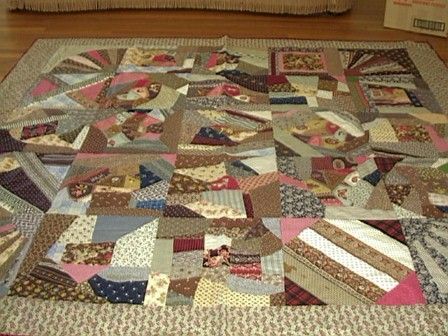
Add MO to the list of divided quilt locations. About 15 years ago I visited a quilter in a nearby town. Hanging at top of her stairs (very visible when you entered front door!) was a long narrow Victorian Crazy quilt. Yes, divided between 2 sisters. It was simply cut down center. Then the cut side had been bound with black fabric. I do not know the actual location of quilt when it was divided! But the one side was in MO.
I have a vague recollection of another that was cut into 3 parts for same reason. 3 Sisters. 1 quilt of Grandma’s making! Ended up as 3 crib quilts. Cut crosswise.
Date: Thu, 27 Oct 2005 12:22:41 GMT | From: “munsey@” <munsey@>
Although I have known re-covered quilts – a common practice in my own Ne w Hampshire family and by my Nova Scotian grandmother, I haven’t persona lly run into the divided quilt practice.
However, it was a common practice in the 19th and early 20th C to divide up a woman’s “good” china set upon her death. My Haverhill, MA grandmo ther owned a half dozen or more examples of the “good” china from her fa mily. There is at least a cup and saucer, but often cup, saucer, and de ssert plate and occasionally a dinner plate. Grandmother had carefully identified each one with a stick-on label. After she died, a housekeepe r hired by my grandfather carefully scrubbed each label off to “get them clean”! So much for identification. Since one finds partial sets of s ilverware placesettings or half dozens of teaspoons etc. in the antique shops, it may have been a practice to divide the silver service, too. I n fact, I have 6 teaspoons and 6 coffee spoons from the estate of my hus band’s grandmother that do not match her silver service and appear to be an older pattern. It isn’t a big leap to dividing a treasured quilt, e specially if the family may not have owned sterling silver or imported p orcelain. Sandra on Cape Cod
Date: Thu, 27 Oct 2005 13:48:27 +0000 | From: “jocelynm@” <jocelynm@>
_Boundary_11149764.4989825 Content-Type: multipart/alternative; boundary”————-1464576.70430783″
On October 26, 2005, Pat Lyons wrote:
> Divided quilts may not be as uncommon as we think. > Sharon Harleman Tandy wrote her Master’s Thesis at
>Boise State University on a divided quilt:
Pat,
My family contributed two divided quilts to Sharon’s thesis.
Both were divided by my mother, from family quilts that had
reached the too-shabby-for-use stage. One she made into 4 wall
hangings, for herself and each of her daughters. Another she
divided into individual blocks and was able to salvage enough
that all of my generation got one block. It was a Dove in the
Window quilt, and mine is matted and framed with a navy-blue mat
that is the same color as the blue and white fabric in the block.
We shot pictures for Sharon, and I know she used them during her
thesis defense but I don’t know if they’re included in the
thesis itself. If anyone looks, I’m talking about the Sunbonnet
Sue wallhangings and the Dove in the Window blocks. 🙂
Date: Thu, 27 Oct 2005 07:54:53 -0700 | From: “Julia D. Zgliniec” <rzglini1@>
Dear QHL, One half of a divided quilt made it to California and turned up in the Quilt Days held for our state project.
There is a picture of it in : Laury, Jean Ray and California Heritage Quilt Project 1990. Ho For California Pioneer Womean and Their Quilts. E.P. Dutton, New York. Regional Survey Pages 26 and 27. It was a beautiful album syle applique quilt, heavily quilted. Although the quilt was made in VA, it was divided in MO and one part was sent to CA.
Regards, Julia Zgliniec
Date: Fri, 28 Oct 2005 00:50:30 EDT | From: Mendofleur@
I am finding by many of your responses that divided quilts may have not been “common practice”, but they were divided by common caring and love for the one who had created them. I guess that is why they now seem endearing and more rare. I must say I am gleaning much from the comments and realizing that half of a quilt says more than I ever imagined it would.
Phyllis
Date: Fri, 28 Oct 2005 09:20:45 -0400 | From: Beth Donaldson <quiltsmuseum.@>
About 15 years ago I was commissioned to make a quilt out of a family wedding gown. Six blocks were hand quilted with different motifs on the white satin. Each block was individually bound, then stitched together. Each block also had the embroidered name of a different child of the woman who first wore the dress. The intention of the owner (a daughter who also wore the gown) was to someday divide the quilt and give each child their own block. A side note, both marriages where the gown was worn ended in divorce! Beth
Date: Fri, 28 Oct 2005 12:33:37 -0400 | From: “J. G. Row” <JudyGrow@>
http://www.nytimes.com/pages/obituaries/index.html
If you can’t get there through the link, Google “Kathryn O. Scott, 94, Textile Work Pioneer, Dies.” A really interesting obituary. She leaves “no immediate survivors.”
As an aside, the voice of the Jolly Green Giant also died.
Judy, now in Flemington NJ aka The Ringoes Kid judygrow@
Date: Fri, 28 Oct 2005 10:26:10 -0800 | From: Gloria hanrahan <gloria@>
We have divided a family quilt in the last 10 years. My Grandmother made a summer spread in the late 1920’s, while she was pregnant with her sixth child. She had my mom quilt it in the 1960’s. We cut away the part over the pillow and the main center basket. I have the main center basket as a 3 x 4 foot wall hanging in my dining room. My cousin will keep the other portion, which has been framed and really looks nice.
Gloria
Date: Fri, 28 Oct 2005 23:06:35 | From: Elpaninaro@
Good evening all,
Just got back from another week of working in downtown Houston, one of the side benefits being that I could attend preview night and then walk a few blocks to spend a long lunch today browsing.
Wednesday’s Preview Night crowd was about 50-60% of what I saw last year. I think everyone was really worried about parking with Game 4 of the World Series a couple of blocks in one direction and a Rocket’s game a couple of blocks in the other direction! Tuesday night for Game 3, many of the pay lots right by the Convention Center were $50-75 each instead of the usual $5-10 for special events. There was a real fuss at the Courthouse because people on jury duty had an almost impossible task finding parking since several garages shut down for business hour parking to be able to accomodate baseball fans at a much higher price starting in the early afternoon.
But good things came to the faithful. Houston takes care of Festival-goers and when Mom and I headed to Preview Night we had little traffic to deal with and plenty of parking in the Hilton (attached to the Convention Center) for $10 a spot. With that worry aside, we set out to have a blast!
Thanks to the smaller crowds, there was time to check out a few of the prize winners before dashing over to the quilt vendors. I am not familiar with how all the prizes work, but what I believe was the grand prize/best of show winner was a quilt called “Scarlet Serenade” (pdf shot on the website at quilts.com.) This quilt was just incredible. I loved the simplicity of the design- deceptive given how crushingly difficult it must have been to get all those points in the Mariner’s Compass-inspired elements so perfectly sharp. To my eyes, despite the masterful craftsmanship, the quilt’s depth of color and contrast was what really made it a worthy winner. I cannot recall having ever seen such a pure and passionate shade of red in a quilt- the perfect offset to the white and ivory shades of the compass points.
Baltimore Album IV, another top prize-winner, had an obvious immediate appeal due to its enormous complexity that flowed brilliantly. But closeup, this quilt became all the more inspiring. The photo on quilts.com does not even begin to demonstrate the achingly complex and emotional quilting on this piece. I could have stared at it for hours in wonder the whole night.
And then it was time to head for the booths! Maybe with time I am getting more disctriminating, but I felt like there were fewer really top of the line antique and vintage quilts for sale this year. That said- what there was tended to be very unusual and incredibly fine. On Wednesday night I saw many things I have read about, but never seen in person. One vendor had a very endearing tile quilt for a start- wonderful piece. At another place, I saw a large funeral/memorial quilt in what I would say was a Baltimore album type format. It came with a touching story about how it came to be made in memory of a military officer. On close examination, many of the flowers in the quilt appeared to have been made from officer uniform clothing- perhaps that of the deceased?- this is the part where tears develop in the eyes.
I also saw my first New York Beauty in person- still wondering why this quilt is called New York Beauty when every one I have ever read about was made well outside of New York?! (this one came from Georgia), along with many other wonderful old quilts the likes of which I have never seen.
Even though there seemed fewer great pieces this year, I hope in the future to see as many new and really enchanting things again in the future.
It seems my research project on the pine tree/cherry quilt reached a few years lol (a good thing!) and I was able to find out some more info here and there when a couple of folks made the connection between me and the emails. Even found the Primedia booth with back issues of Vintage Quilting Magazine- this issue was not there unfortunately, but I am now able to order it and check it out!
In fabrics, I saw very little western this year- but Batiks seem even more popular than ever. Great news too since I found a lot of really neat ones, including some handmade examples that were directly imported. That said, I did not hit all that many fabric spots- so I might have missed where all the new Henry western prints could be found.
Hope all other attendees had as much fun as we did! As fun as Preview Night it, I enjoyed going today and having more time to leisurely stroll around. Big crowd, but less pressure to “get there first” for all the quilts lol. Two vendors reported also that Thursday’s crowd was huge, likely thanks in part to so many staying home on Wednesday.
Take care,
Tom.
Date: Sat, 29 Oct 2005 08:54:31 -0400 | From: “Teddy Pruett” <aprayzer@>
<< Google “Kathryn O. Scott, 94, Textile Work Pioneer, Dies.” A really interesting obituary.>>
And, I ask you, what would we do without our friends to keep us in touch with the world? I read every word of the obit, and I want to be this woman when I grow up. I want museums waiting impatiently for my arrival, I want people listening to my every very wise word, I want to get my hands on wonderful things that no one sees, I want to get inside the underwear of someone famous…………well, on second thought……..
I absolutely do not have time to surf the net, look at ebay, or read the NYT – and I am truly grateful for those of you who do so, and send the hotlinks so that people like myself can click on, enjoy, and get right back out of there.
Before we get off the subject of divided quilts, I notice that no one has mentioned the term “Solomon’s Choice” for the practice of dividing quilts. That is the term I always use, and I must have heard it somewhere. Just a little FYI for those of you really tuned in to the subject.
<<As an aside, the voice of the Jolly Green Giant also died.>> As the former owner of a small chain of supermarkets who attended many, many trade shows, I am sooooooo familiar with the Green Giant image and voice. What a very sad Ho Ho Ho to hear. And now, back to the previously scheduled sociology homework…..
Teddy Pruett in hurricane free Florida
_________________________________________________________________ Express yourself instantly with MSN Messenger! Download today – it’s FREE! http://messenger.msn.click-url.com/go/onm00200471ave/direct/01/
Date: Sat, 29 Oct 2005 09:50:34 EDT | From: Kaytriplet@
There is a book about a family divided quilt. The Salt Lake City 14th Ward Album Quilt, 1857 – Stories of the Relief Society Women and Their Quilt by Carol Holindrake Nielson is about a particular quilt which her husband inherited. She did the genealogy and tracked down the other half, put the two halves together for the book, then researched the lives of the women who made blocks for the raffle quilt. The great-great-grandfather had won the quilt when he was 12 years old. A written version of the story had been passed down with the quilt. After his first wife had died, he cut the quilt in two and it was given to the two oldest daughters. It was passed down through the lines to the oldest daughter, until Mr. Nielson was the oldest son in a family with no daughters. The book is quite interesting.
Kay Triplett
Date: Sat, 29 Oct 2005 12:32:30 -0400 | From: “J. G. Row” <JudyGrow@>
> I absolutely do not have time to surf the net, look at ebay, or read the > NYT – and I am truly grateful for those of you who do so, and send the > hotlinks so that people like myself can click on, enjoy, and get right > back out of there.
Teddy,
I’ve got to admit — I don’t read the NYT every day, (although it does have a new meaning in my life, and I see a lot of their pictures every day) but my husband sits with the NYT and his coffee every single morning. He glances at the front page then goes right to the obituaries — perhaps he’s waiting to see if he gets a write-up there. I think it is a morbid taste, but he does share interesting obits with me, as with the Scott obituary yesterday. I get to the book review and the magazine and it usually takes me a week to read everything there.
At 65 I’m supposed to be taking it easy, but I am busier than I ever was! No time to read newspapers. And thank goodness for that.
Thanks to Elpaninaro for sending us to the Houston winner’s site. Are the Japanese the only ones doing quilts completely by hand anymore?
Judy, now in Flemington NJ aka The Ringoes Kid judygrow@
Date: Sat, 29 Oct 2005 12:11:52 -0700 (PDT) | From: Donald Beld <donbeld@>
Hi Everyone, I haven’t posted for awhile, but I am so excited about this quilt that I had to share it with you. You can see it and close ups at www.vintagepictures.eboard.com under general category.
I volunteered last year to design–and mostly make my guild’s 2006 Opportunity Quilt–because I wanted to do something with the old traditions to honor the firefighters and police officers who died in the collapse of the Twin Towers on the 5th Commemoration of that horrible event.
So I took a variation of Drunkard’s Path called Falling Timbers and designed this quilt. It is made with reproduction fabrics and is ENTIRELY hand pieced, hand trapunto, and hand quilted–mostly by me–all the quilting is mine and I personally cut out all of the pieces by hand with scissors (the old fashioned way), marked them for sewing and had the women in my guild piece them by hand. It has been appraised by an AQS certified appraiser at a value of $5,000.00.
I love history and quilting and enjoy taking the old ideas and old ways and making something new. I hope you all enjoy seeing it. Best, Don Beld
Date: Sat, 29 Oct 2005 15:17:41 EDT | From: Elpaninaro@
In a message dated 10/29/2005 11:33:13 AM Central Standard Time, JudyGrow@ writes:
> Thanks to Elpaninaro for sending us to the Houston winner’s site. Are the > Japanese the only ones doing quilts completely by hand anymore? >
Hi Judy,
You raise a question I had meant to ask earlier. How does all that work in terms of hand versus machine? Are many of the quilts in this competition machine pieced and /or quilted? Given how long it must take to do some of these by hand, I figured machine was fairly common. If that Baltimore Quilt IV was done completely by hand, then I stand in awe that it could be completed in a few months time! (assuming the contest parameters were announced sometime after last year’s Festival, which I do not know.)
Take care,
Tom.
Date: Sat, 29 Oct 2005 16:00:43 -0400 | From: “Lucinda Cawley” <lrcawley@>
Last weekend in Lancaster Co. I bought what is clearly an attempt by someone (circa 1970) to reproduce a classic 19th century applique quilt. In fact, I have the feeling that I’ve seen the original. Sixteen large (17″) Oak Leaf and Reel motifs are appliqued to a cotton sheet. On three sides there is a swag and leaf border with stars, thistles, tulips and other, unidentifiable, shapes. The Oak Leaf and Reel pieces are stuffed. The workmanship is not bad, but the maker obviously had limited fabrics available. She used only two Ely Walker prints: a mint green printed with a darker green flower and an orange and yellow print. What should we call something like this? “Reproduction quilt” evokes what so many of us are doing now with all of the great repro fabrics available (not to mention the profusion of books about and images of antique quilts). I also have a summer spread (1930s) and a Princes Feather quilt (polyester batt) which are obviously trying to recreate the look of 19th century quilts without access to appropriate fabrics. Any suggestions? Cinda on the Eastern Shore
Date: Sat, 29 Oct 2005 15:25:45 -0600 | From: Xenia Cord <xenia@>
Interesting question!
IMHO, these have to be called reproductions or recreations, with their time periods included. After all, current quilters are not the only ones to have tried to revisit the past, often creating quilts in designs from earlier periods, but done in their contemporary or “more pleasing” colors. For instance, I have an early 1930s Prince’s Feather in alternating blades of plain bright pink and plain medium green. I see this as a retake on the “classic” red and green compositions of the 1850s. And the 1920-30s women’s magazines and pattern and kit sources based much of their advertising on the idea of endorsing feminine ideals by making quilts “like our foremothers did.” So we got pastel Irish Chains and Lone Stars and Whig’s Defeat and Harrison Rose etc. – and even crazy quilts in pastel cotton prints.
The Bicentennial and the slightly earlier “new earth movement” urged recreating the past, but the textile industry had not yet recognized the potential there. Do we not have 1970s remakes of Baltimore Album quilts? There was at least one pattern source (Women’s Day magazine, I think) that promoted this. I have the blocks, execrably done in Ely & Walker gold, brown, green, and red and pink prints (all similar / alike but in different colorways). Bless her heart, she could not applique, and the figures were pretty clunky at that, and the fabrics too coarse to turn under smoothly, but she persisted! And she did all the blocks, but apparently gave up when it came time to assemble the top and quilt it.
And what about the Harriet Powers Bible quilt? Surely the licensed creations by the Smithsonian have to be called reproductions.
Lots of food for thought in Cinda’s question…
Xenia
Date: Sat, 29 Oct 2005 16:49:33 -0400 | From: “Karen Evans”
I’d call it pre-Bicentennial Revival.
Karen Evans
Date: Sat, 29 Oct 2005 17:40:01 EDT | From: AG32040@
Teddy, Glad you are in hurricane free Fla.,but do you have to rub it in .Just kidding .We in south Fla. cheer when we get power this year. This is the third time this year we have been out for almost a week. I love my quilts,but tired of moving them back and forth to saftey . Amy Goodhart in the hurricane zone
Date: Sun, 30 Oct 2005 05:20:53 -0500 | From: “Linda Heminway” <ibquiltn@>
I’m looking for a source for this particular book: Ladies Art Company Quilt Pattern Book, Patchwork & Appliqué Groves Publishing Co. Kansas City, MO
It’s on the AQS Quilt Appraisal program course study book list.
Thanks if you can help,
Linda Heminway
Plaistow NH
Date: Sun, 30 Oct 2005 05:14:13 -0800 (PST) | From: Mary Anne R <sewmuch63@>
I confess that I too read obits. I think of them as mini-biographies and I love to read biographies. It’s history but in the context of everyday life.
As to the 1970s reproduction quilts, the term “vintage reproduction” comes to mind.
Mary Anne (in cold No. FL)
__________________________________________________ Do You Yahoo!? Tired of spam? Yahoo! Mail has the best spam protection around http://mail.@
Date: Sun, 30 Oct 2005 23:46:35 +1000 | From: “Quiltstuff” <quiltstuff@>
From the world of furniture , they use the term revival. So in the 1920s a lot of Jacobean Revival furniture was made which looked a lot like the furniture form the 18th century to the average person but quite different to those with knowledge.
Is that suitable?? Suzy .
>> What should we call something like this? “Reproduction quilt” evokes >> what so many of us are doing now with all of the great repro fabrics >> available (not to mention the profusion of books about and images of >> antique quilts). Any suggestions?
Date: Sat, 29 Oct 2005 12:27:15 -0700 (PDT) | From: Pat Cummings <pat@>
Dear Don:
Thanks so much for sharing the image of the quilt you designed and you and your guild worked on. It is a wonderful tribute, and a true inspiration.
As always, best wishes,
Pat Cummings www.quiltersmuse.com
— Donald Beld <donbeld@> wrote:
> Hi Everyone, I haven’t posted for awhile, but I am > so excited about this quilt that I had to share it > with you. You can see it and close ups at > www.vintagepictures.eboard.com
Date: Sat, 29 Oct 2005 09:28:26 -0500 | From: Gail Ingram <gingram@>
Teddy P. wrote: > Before we get off the subject of divided quilts, I notice that no one has > mentioned the term “Solomon’s Choice” for the practice of dividing quilts . > That is the term I always use, and I must have heard it somewhere. Just a > little FYI for those of you really tuned in to the subject. >
Teddy, it was the first thing I thought of—Solomon’s ploy failing (for he must have known his women—and besides he was dealing with a baby, not quilts). While I myself have never known a quilt divided for this reason, all my life I’ve known people who cherished quilts so they would have divided them. I think most of them have been devious enough to secure the whole quilt, by hook or by crook and maybe by both.
I was surprised when list members imagined amicable divisions. I myself believe if someone were so amicable, she would not lay scissors to the quilt, would do like Solomon knew the real mother of that baby would do: leave it whole.
Has NOBODY else had such thoughts?
Now here is a subject for your sociology paper, Teddy, for the splits speak to the value vested in these quilts. Even IF they were harmonious splits made by altruistic, turn-the-other-cheek Solomaic women.
Gail
P.S. Does anyone remember that wonderful section of “Huck Finn” where Jim waxes eloquent about Solomon? He misses the point of the story (maybe), but tells Huck, ‘DonB9t talk to me about Solomon. Why he’d just as soon chop a chile in two as a cat.’ He attributes Solomon’s lack of wisdom to his havin g thousands of wives and a commensurate number of chillun ‘runnin around the house.’ Says Solomon doesn’t know “how to value chillun. Now you give me a man that got only two or three chillun. That’s a man who knows how to value a chile.” I’ve always thought Jim might have been wiser than Solomon. I bet a lot of these heirloom splits were made by women who didn’t have a housefu l of quilts.
Date: Sun, 30 Oct 2005 07:44:47 -0600 | From: “Jean Carlton” <jeancarlton@>
Hi all I’ve not visited the Eboard for some time and did so today – and I wonder if this suggestion makes sense. I saw a few things (like someone looking for a block name) that may already have been answered and in fact may have been posted months ago. If we put the date at the beginning (or end) of our text – and included our name or email addy it would really help those of us who only check in once in awhile and are not always ‘current’! What do you think? Jean
Date: Sun, 30 Oct 2005 21:33:00 -0600 | From: “Rosie Werner” <rwerner@>
Linda, Is it the Ladies Art catalog that you are looking for? That has the same title you listed. It’s 27 pages long. I have 2 copies that were published by Ladies Art in St. Louis, not Groves Publishing Co. If this is what you need, I am willing to part with the duplicate. Rosie Werner rwernerrconnect.com