September 27 – October 12, 2006
These restored messages come from the Quilt History List, an online forum where quilt historians, collectors, researchers, appraisers, and enthusiasts discussed antique quilts and related textiles. The archive dates from 1996 through approximately 2016 and is being restored gradually. Sign up in the form at the bottom of the page if you want to know when a new page is added. Original spelling, opinions, formatting, and inactive links may remain unchanged.
Primary topics of this QHL Digest:
- Reports from the AQSG Seminar — Attendees write from Farmington, Connecticut about the icebreaker, reimagined bed rugs, the study centers, and the events that left everyone worn out and delighted.
- The 1995 Smithsonian Conference Transcript — Linda Hunter tells a European member how the 1995 What’s American About American Quilts conference transcript was ordered, and the member decides to contact the Smithsonian.
- Early Indian Quilts at Christie’s — An auction listing of early quilts from the subcontinent, the earliest with a cord-quilted border, prompts Karen Evans to weigh in on the dating of a fragment.
- Ceiling Frames and Log Cabin Tools — Members ask how ceiling quilt frames are rigged and lowered, and hunt for a Log Cabin marking ruler while others say plain paper foundations still work best.
- Quilt Shows and Travel Tips — Members share details of the Hopi Quilt Show near the Grand Canyon, a quilt club’s 70th anniversary show, and the Roofs Over Our Heads display.
- Planning a Quilt Documentation Day — Pepper Cory asks for advice on a simple documentation form for Quilt Appreciation Days at a coastal North Carolina museum, and adds a recipe for good measure.
- African-American Quilting and Cloth — Gail Ingram and Kyra Hicks trade links to a Louisiana Folklife photo essay and a blog post about dressing in West African fabrics.
Date: Wed, 27 Sep 2006 11:09:23 EDT | From: Mitzioakes
I would love a copy of the article. I am doing a short lecture on the History of Quilts and the Myths That They Hold at our quilt show the first weekend of November. I will reimburse any costs involved with this mailing. Mitzi Oakes 48 East Terrace So. Burlington, VT 05403-6144
Date: Wed, 27 Sep 2006 17:20:37 -0500 | From: Karen Erlandson
Hi all, I have been contacted by a non-quilter who is trying to help re-build a ceiling quilt frame for her great-aunt. They have the “parts” for the frame (she isn’t sure it is complete), but they have no idea how to hang it or rig it to raise and lower. Does anyone have access to one of these frames so they could photograph it for me? I would appreciate any input, directions or plans that you can direct me to. Thanks, Karen Erlandson in Texas
Date: Wed, 27 Sep 2006 23:12:47 -0400 | From: Linda Hunter (hunterlj)
This is a reply to Margareta in Europe. I am not Xenia, but I attended the conference that was held at the Smithsonian in March, 1995, and I have a copy of the transcript. I don’t know if it is available any more, but there is an order form with an address: “What’s American about American Quilts?”, Textiles Collection/MRC 617, National Museum of American History, Smithsonian Institution, Washington, DC 20560. It states that no part may be reproduced or republished without written permission from the Smithsonian Institution. The volume is 265 pages in a spiral-bound soft-cover form. At the time it cost $10.00 American to receive a copy, payable to the Smithsonian Institution. They may have copies in their archives. Also, Linda Claussen completed the publication. Perhaps someone on the list knows Linda and can contact her to see if she has any information. I hope this is of some help to you.
Linda Hunter AQS Quilt Appraiser, Instructor and Lecturer linda www.hunters-stars.com
Date: Thu, 28 Sep 2006 13:11:27 +0200 | From: Margareta.Faust
Thanks Linda, for your reply. I will contact the Smithsonian about this – unless there is somebody from that Institution on the list who would like to inform me whether copies are still available? In my studies of quilts from an international perspective, I think this would be a valuable addition to my library. Margareta
From: J. G. Row
17th, 18th and 19th century., the earliest one a cord-quilted border.
http://www.christies.com/LotFinder/search/LFA.asp?eid=5371714
J. G. Row
Date: Thu, 28 Sep 2006 18:44:33 -0400 | From: Karen Evans
That fragment of the early quilt might just be earlier than the 17th century…it’s certainly no older than mid-century, tops. The technique looks similar to that used in a red/gold reversible silk top in the Castello Sforzesco in Milan. Very cool!
Date: Thu, 28 Sep 2006 19:37:51 -0400 | From: Louise (ltiemann)
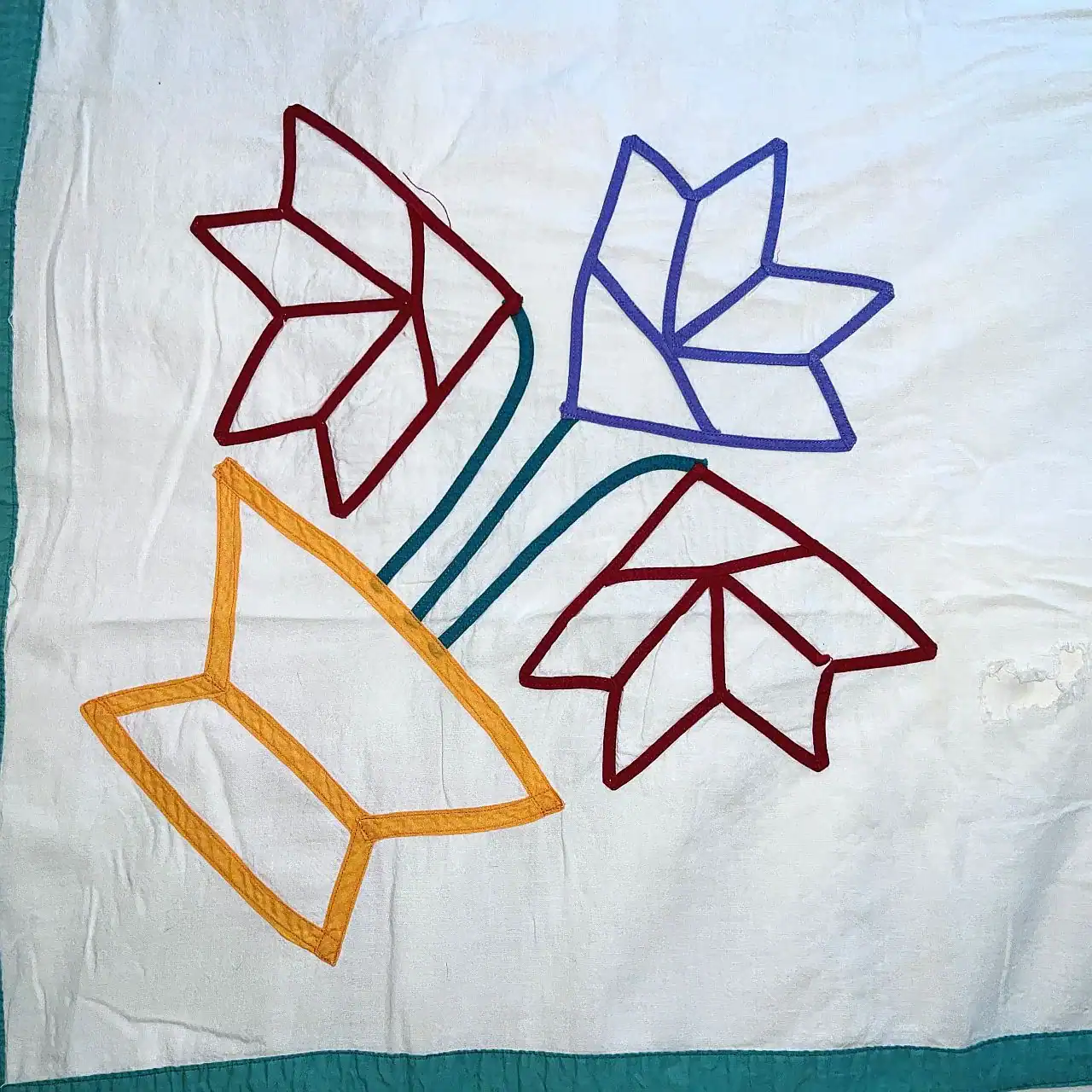
Hello, has any found patterns for May Day Flower Basket Quilt from Colonial Quilts (pg 23)? I have blocks for the “Mother’s Old Fashioned Flower Garden Quilt” (pgs 16-17) and “Flower Garden Set No. 2” (pg 21) of the 32 page version of Colonial Quilts by H. Ver Mehren.
There is also another flower pattern called “Blossom Time” (pg 19) that I am looking for. Each of these patterns have 32 motifs and came in pre-printed blocks.
Thanks, Louise
Date: Thu, 28 Sep 2006 17:46:59 -0500 | From: Sarah Hough (dougandsarah1)
We are leaving Sunday for Salt Lake City and on to the north rim of the Grand Canyon. Anything fabric/quilt related going on in that area at this time?
Appreciate any info you can give me.
Thanks
Sarah
From: Marsha MacDowell
Re: the query about quilt events near Grand Canyon I will pass on what my friend Gloria Lomehaftewa (Native affairs liaison at Museum of Northern AZ) just sent me: “Come visit the Hopi Quilt Show at Bacavi Village, AZ October 6 & 7, 2006.” I hope that many on the QHL list can see it.
— Marsha MacDowell
Date: Sat, 30 Sep 2006 07:10:43 EDT | From: DDBSTUFF
Here is a link to the Bacavi Village Quilt Show with lots of pictures:
http://hopibiz.com/quiltshow.html
Darwin
“To the world you are nothing; to a rescued dog or cat, you are the world”
From: Velia Lauerman (velialive)
Yesterday Molly MacDonald was in the news organizing thepinkfund.org selling her plaster of Paris torso on eBay. Please look at the site for further information on the auction. Here in the Detroit Michigan area we are constructing pink/white blocks for Molly’s campaign to aid the financial need to Women and men in their struggle. We also have a funny looking oversized bra decorated from a game we played at our quilting group trying to weed out or share our unwanted notions. Please let me know if you would like to be included. And look at www.thepinkfund.org Thanks, Velia
Date: Tue, 3 Oct 2006 08:24:08 -0700 (PDT) | From: stephanie drake (gsadrake)
To Karen, there are pictures of a quilter using a hanging quilt frame in John Rice Irwin’s book, A People and Their Quilts. They show how it is raised up also. Hope this helps. Stephanie in NH
Date: Tue, 3 Oct 2006 19:54:15 -0500 | From: Kathy Moore (kathymoore)
The quilt exhibition Reading, Writing and a Rhythmic Stitch: Quilts from the Mary Ghormley Collection will be on view at the Great Plains Art Museum in Lincoln, Nebraska from October 6, 2006 through March 18, 2007. More than 40 examples of nineteenth and early twentieth century doll quilts will be displayed with antique doll cribs and cradles.
Children were thought of as miniature adults before the late 1600s. As views of childhood changed, children’s books, toys and games became popular. Doll quilts started to appear in the early years of the 1800s,
Doll quilts are some of the most endearing of quilts. Made by mothers for a young daughter’s playtime, they embody love and care. Young girls made them as they learned to sew. As collector Mary Ghormley observes, “Perhaps the dearest of these quilts are those on which we see the childish imprint, youthful concentration in every stitch. “
Mary Ghormley’s Doll Quilt Collection contains more than 200 quilts made between 1800 and 1950. Collected over a forty-year period from all over the United States, the collection is one of only a few such quilt collections in the world. Mary Ghormley is a founding member of the Lincoln Quilters Guild and was a leader in the Nebraska Quilt Project, which documented the rich quilting heritage of Nebraska and resulted in publication of the book Nebraska Quilts and Quiltmakers. Today, Mary Ghormley is a weekly volunteer at the International Quilt Study Center at the University of Nebraska-Lincoln. In 2005, Mary Ghormley and her family agreed to add her doll quilts to the IQSC’s collections.
Mrs. Ghormley will share her knowledge in a lecture on October 18, 2006 at 3:30 P.M. at the museum.
The Great Plains Art Museum is located at 1155 Q Street in Lincoln. Hours are Monday-Friday, 10-5, Sunday 1:30-5, closed Mondays.
For more information visit www.quiltstudy.org or call the International Quilt Study Center at 402-472-7232.
Date: Tue, 03 Oct 2006 11:13:28 -0400 | From: Velia Lauerman (velialive)
The www.thepinkfund.org was in the news yesterday. Please check it and let me know if you are interested in being part of constructing a quilt top in pink/white for a quilt to be included for this fund. MollyMacDonald married our friend Tom Pettit about three years ago. She is a real go getter and survivor. After taking part in Pink Day at Sauder Village and helping to construct 12 1/2″ quilt blocks with seven year olds I became more aware of the need more than ever. The research will continue trying to get there but what about the great need for funding and helping Women and men in their struggling hours. Please pass this information on to quilters who are willing to construct a block. In our librarything.com we carry a book donated by Virginia Melcher from Tuesday Sit/Stitch about Breast Cancer quilt constructed a few years ago. If you need to see it the book will be at the quilt show.Velia
Date: Wed, 4 Oct 2006 05:20:33 -0700 (PDT) | From: Ark Quilts (quiltarkmv)
I heard about a log cabin foundation marking tool on television and did not get the name of the product or its manufacturer. It was a hard plastic (as opposed to lightweight stencil plastic) and it was used to trace the lines for long cabin blocks on fabric. Then when you sewed down the strip logs for the block the edges of the fabric were aligned with the pencil drawn lines on the fabric. This helps keep the blocks square. Does anyone know of such a tool or where to purchase it? Thanks for any help. C. Ark in NW Ohio
Date: Wed, 4 Oct 2006 08:47:47 -0400 | From: deb
Sounds like Marti Michell’s new ruler. Michell Marketing “My Favorite Log Cabin Ruler”. They come in different sizes. Any quilt shop would be able to order for you if they don’t have it in stock.
Debbie Quilting Possibilities www.quiltingposs.com
Date: Wed, 4 Oct 2006 08:52:46 EDT | From: Mitzioakes
What’s wrong with paper foundation papers for log cabins – they work great for me and have for many years now – a ruler sounds a bit more work than just good old paper. Mitzi from VT.
Date: Wed, 4 Oct 2006 18:35:18 -0500 | From: Catherine Litwinow (litwinow62)
Good Evening, Are you in for a treat! The pictures and report on the August IA/IL Quilt Study Group can be found at www.quilthistory.com<http://www.quilthistory.com/>.
For all who get to sit at Rosie Werner’s lunch table there is a sneak peak at some of her wonderful Kit Quilts. Enjoy the rest of the pictures. Join us April 13 & 14, 2007. The study topic will be Iowa and Illinois (and our other state attendees).
Have a wonderful time in Conn (without me )
Catherine Noll Litwinow
Date: Thu, 5 Oct 2006 09:18:01 -0500 | From: Karen Musgrave (KarenMusgrave)
The Alliance for American Quilts (www.centerforthequilt.org) eBay auction ending Sunday has lots of great out-of-print books including “Abstact Design in American Quilts,” “Kentucky Quilts 1800-1900,””Quilts in American Heritage,” two Quilt Engagement calendars and a sweet quilt top at a great price. You may check the auction by going to http://search.ebay.com/_W0QQfgtpZ1QQfrppZ25QQsassZalliancequilts or by searching under the seller name (alliancequilts). Remember new items are available every week and these auctions are bringing in much needed funds.
Thanks, Karen Musgrave
Date: Fri, 6 Oct 2006 08:48:36 -0400 | From: Pam Weeks (pamela.weeks)
We’re having a great time here in Farmington, CT at the Annual Seminar for the American Quilt STudy Group. Wish you all were here!
Last night was the icebreaker, held at the Mark Twain/Harriet Beecher Stowe property in West Hartford. There is a brand spanking new Visitor Center which was filled with quilts from the eighteenth and nineteenth centuries, as well as two bed rugs. It was a spectacular display and I know that Cinda M. will do a much better job than I of cataloging the quilts for you later.
The foyer held two c. 1840 kaleidescope or Connecticutt Block quilts. The main hall held nine tables with quilts and bed rugs. Some of the tables held as many as 6 early nineteenth century quilts. We saw first hand many that are published in “Quilts Covering Connecticutt”. In the auditorium was a woman and her dear husband who showed only 50 of the hundred or more quilts in her collection–most family quilts, documented in most cases, and just a marvelous view of one family’s best and utility quilts.
The Harriet Beecher Stowe House and the Day Manse were draped with quilts from the special exhibit of Connecticutt quilts being held through mid-November. If any of you are within driving distance of CT, do try to get here. The quilts from 1785 and earlier are wonderful. I’ll try to provide details later.
Gotta run!
Pam Weeks
Date: Fri, 6 Oct 2006 08:50:38 -0400 | From: Karen Evans
I’ll be arriving later this morning, just in time for lunch. Hope to see lots of you there!
Karen Evans (still groggy from late night writing binge to finish her presentation)
Date: Sat, 7 Oct 2006 18:26:22 EDT | From: MargaretFahey
My club, Genesee Valley Quilt Club, is celebrating its 70th year. Our show is going on now and we have Roofs Over Our Heads display. And it is gorgeous, inventive and taking much attention. I believe many, many folks are learning about Alliance for the first time Thank you all artists who contributed to this event.
In fact, one piece is by Pamela Allen. who is our 2007 May speaker. Now if she will just bring some more of those little hair curlers, I’ll try my own face. These pieces are each little jewels. I love the humor.
Margaret
Date: Sun, 8 Oct 2006 09:36:49 EDT | From: Mitzioakes
Glad to hear about the Roof Quilts – our Guild has reserved them for our show – the 4-5 of November here in Shelburne, VT. You must be from NYS with your name (I am from NYS – Utica/Hamilton). Congrats on being 70 years young – thought our guild was doing well at 27 years. But we just hit a milestone of about 300 members – that’s a lot of fabric fanatics…. Mitzi form Vermont
Date: Sun, 08 Oct 2006 11:57:46 -0400 | From: Velia Lauerman (velialive)
Dear sewing friends, If you would like a kit to sew up a 12 1/2″ block for the quilt top we are constructing for a quilt that will be put in thepinkfund.org ebay auction you may either complete one of your choosing or I will send you a kit for pink/white ( no money involved ) or any colors any pattern as long as it is 12 1/2″ cotton. Please look on line and comment to Molly MacDonald and also let me know if you agree or disagree with the site.Thanks in advance for our togetherness and trying to help with our sewing skills. Velia Lauerman,
Date: Mon, 09 Oct 2006 00:13:06 -0500 | From: Gail Ingram (gingram)
I would like to call to the attention of our group a photographic essay on African-American quiltmakers and quilting on the Louisiana Folklife site, done by Susan Roach, Ph.D. It does not purport to be definitive, but for that very reason, I find it thought-provoking. It may be accessed at http://www.louisianafolklife.org/quilts/features/aa_quilters.shtm
I note particularly the statement of the late Anna Lee Morrow, who was one of the first people I met when I moved to Lincoln Parish: “When asked how she decides which colors to piece together, she explains: ‘I would just try to match them, to keep from putting two red pieces together . . . You just have to use your own judgment about it. Now when I was first started quilting, I would just lay mine [squares] down and see which would match this piece and put it down there and maybe I’d have something else that would match the other piece and put it down there. . . .My mother would always say `Don’t put the same colors together all the time; just mingle them up, and that makes it look pretty.’ So that’s the way I would do.’ The term “match” used here means coordinate colors rather than the same colors”
That statement deserves attention, in my view. It articulates something I’ve seen all my life but never been able to state.
The last quilter pictured on this page is the late Ms. Emma Russell, whose death 3 years ago diminished the entire world, so large was her spirit. A brilliant, articulate, creative woman to the end (she died at 93), she made me a quilt top which she said “minds me of you.” Had I not understood her aesthetic, I might have been insulted for a minute or two. Think chartreuse and move more lively.
Kathy Moore, speaking specifically of the Gee’s Bend quilters and a member’s lament that “standardization” was the result of marketing, earlier wrote of the poor conditions under which many African-American quiltmakers lived. Emma Russell and her handsome, courtly husband Mister Will lived in a house with a kitchen that had a dirt floor. Yet I had to be reminded of that after I left, so compelling were those two people. And bright as she was (I would estimate her IQ at above 140 on the old Otis-Lennon scale), Emma was ripped off by “city people” who paid$10 apiece for her most remarkable quilts, the story quilts. She was proud when her family installed her in a mobile home set down beside her old place, but mainly because it made her arthritis better in winter (115 degrees farhenheit will do that!<g>). She is the person who gave me the information that, had I been more mindful, might have made me a little better off: NEVER, she said, NEVER let a red-headed man step across your threshold first on New Year’s Day. When I told her my son was auburn-haired and would likely be the first one to enter the house, she said, “Hire you somebody to beat him in. Get you a broom. But don’t let him in first.”
Susan Roach is a member of this list. I recommend the entire folklife site, to which she has made more than a large contribution.
Gail Ingram
Date: Mon, 9 Oct 2006 21:28:47 EDT | From: MargaretFahey
Not only do we have a large membership, but the newer members are far from beginners, as our show demonstrated. It’ll probably be about a week before the quilts will be posted on our website, but check it out. http://www.gvqc.org
We had a fun History display, done as an Amish quilt…Indiana version since we used pink and yellows too. The MRS CLUB MEMBER, in heels, hat and gloves, of course a dress was contrasted with MS CLUB MEMBER who wears pants, quilted vest and tote bag, low heels, etc. They represented the graph showing growth from original 10 members to 350
Our show is every other year, but we are now debating this since the 75th, of course, is around the corner. When, and how often, is your show?
Margaret
Date: Tue, 10 Oct 2006 01:13:11 -0700 (PDT) | From: kyra hicks (kyra262)
Gail,
Thanks for the link to the Louisiana Folklife from Dr. Roach. The images of the quilters and their quilts are quite endearing!
Kyra Hicks www.blackthreads.blogspot.com quilt blog
Date: Tue, 10 Oct 2006 13:08:10 -0500 | From: Gail Ingram (gingram)
May I recommend a site that will make everyone yearn for a wasp waist? Go to Kyra Hicks’ site, specifically http://blackthreads.blogspot.com/2006/09/dressing-in-west-african-fabrics.ht ml
Now, how’s that for “cross-cultural”?!
Makes your little black dress run for he back of the closet.
Gail Ingram
Date: Tue, 10 Oct 2006 15:07:28 -0400 | From: Candace Perry (candace)
New England Quilt Museum 18 Shattuck Street Lowell, MA 01852 http://www.nequiltmuseum.org
Region: Eastern Massachusetts Category: Executive Type: Full-Time
Description: The New England Quilt Museum in beautiful downtown Lowell, MA, seeks an energetic and dynamic leader to help take the 20-year old Museum to the next level of excellence. Qualifications: The Museum is seeking a candidate with a minimum of 5 to 7 years senior management experience in museum or art related non-profit organizations to implement the strategic plan, manage operations, programming, finances and community relations and run the Lowell Quilt Festival. Degree in museums studies, museum administration or art history preferred. Individual must have demonstrated fundraising success and be entrepreneurial and creative in their approach. Excellent managerial, communications, interpersonal and organizational skills are necessary. The successful candidate should possess a passion for the textile arts, and professional experience with quilts or textiles is a plus, but not required. How To Apply: Send resume, cover letter, three references and salary requirements to Carrie Meikle, Board President, at csmeikle
Apply by: 11/15/2006 Salary: Comesurate with Experience Date Posted: 10/10/2006
About this Organization: The New England Quilt Museum is a non-profit, national institution founded in 1987 to educate the public about the art, craft, history, and heritage of quiltmaking. The museum meets this purpose through its collections, exhibitions, education programs, and outreach activities. The museum’s purpose and programs are rooted in the lives of American women who have used quiltmaking as a means of artistic expression and historical record from the earliest days of this country to the present. Located in Lowell, Massachusetts, the historic heart of America’s 19th century textile industry, the museum serves a broad audience ranging from neighborhood residents to international tourists.
Date: Tue, 10 Oct 2006 20:53:02 -0400 | From: Louise (ltiemann)
Hello, I just got a c.1906 Singer Treadle machine last night. In one of the drawers was the machine booklet if any one needs a photocopy, let me know. There was also a hand pieced Friendship Fan Block in a Laura Wheeler envelope along with the pattern. In another drawer there was a Crazy Quilt block with a Walter A Wood Hay Rake ad on the backing fabric, dated 1888. There were also several needle booklets. A few of the needles were very ornate – I have never seen any like them before. Looks like there are 2 holes – a smaller one on top of a larger one. The needles have a blunted end (not sharp) and some are flattened. Any ideas? Thanks in advance for your help. Best regards, Louise
Date: Tue, 10 Oct 2006 21:53:08 +0000 | From: jocelynm
Gail, Hmm…maybe that’s what I should do with that African fabric I bought at Paducah, without having the slightest idea what I was going to do with it. 🙂
Date: Wed, 11 Oct 2006 10:03:08 +0100 | From: Sally Ward (sallytatters)
> Looks like > there are 2 holes – a smaller one on top of a larger one. The > needles have > a blunted end (not sharp) and some are flattened. Any ideas?
For threading ribbon or narrow elastic through trims or casings. You thread through one eye and back through the other so it doesn’t unthread as you pull. The flat ones help whatever you are threading to stay flat as they travel through the casing. Very useful.
Sally Ward
Date: Wed, 11 Oct 2006 18:20:21 -0400 | From: Pepper Cory (pepcory)
Hello friends, You get a bright idea and then the dang thing snowballs. Such is the evolution of Quilt Appreciation Days at a local museum here in eastern coastal North Carolina. For a glimpse of the museum and its unique perspective on coastal NC life, go to its website at http://www.coresound.com/ . In February 2007 a bunch of us interested in preserving and applauding the crafts of the distaff side are proposing a two-day event. While the local women have always woven fishing nets, this bash is about, you guessed it, quilts. We’re hoping that people will bring in their family quilts, get them photographed, and have the last church quilting bee in the area set up their old-time frames and sit-n-stitch. People will get to talk to anthropology students who’ll have the rare opportunity to record the Downeast dialect (which sounds Cockney when spoken by a fast speaker) and stay to have ‘dinner on the grounds,’ the term for a picnic lunch. Being February it will be heartier fare. Here’s a freebie recipe for a local delicacy—-broth-based clam chowder. Downeast NC Chowder 2 Dozen clams, shucked; reserve juice 1 lg Onion, diced ? lb Good fatback, diced substitute 1/3 lb good smoky bacon 3 m -4 md ‘Ice’ (Irish) potatoes, cubed.
Lots of coarsely ground black pepper. One can clam juice. Other mild-tasting seafood optional. Render out the diced fatback or bacon and fry till crisp. Remove pieces and reserve. Sauté onions in the grease. Add the potatoes and coat well. Add pepper and clam juice, supplement with another can of clam juice. Cover and simmer gently about 15 minutes. Add clams (which you will have chopped), cook about 3 minutes. At this point you can add other seafood if you like. White fish like flounder and shrimp are great in it. Serve this in deep soup bowls and top with crisp bits of bacon and serve with light (yeast) rolls. This is the way they’ve made it down home for more than 100 years. It ain’t fancy, but oh my is it fine! What I’d appreciate from my more knowledgeable QHL comrades: advice and comments on what you’d do if this was your special event. We do need a simple documentation form and any other advice would be appreciated! Thank you for your support Pepper Cory
Date: Wed, 11 Oct 2006 21:17:48 -0400 | From: Lucinda Cawley (lrcawley)
I’m still trying to recuperate from an incredible (long) weekend at the AQSG Seminar in Farmington, CT. We all know that Sue Reich’s powers of organization are super human, but I didn’t think that even Sue could command the Harvest Moon and the flaming foliage. Somehow she managed to provide both for our visit to Connecticut. This account is not in chronological order because the wonders of the weekend are floating chaotically in my head. A behind the scenes visit to Old Sturbridge Village gave us a look at some of the early textiles in the collection: woven coverlets, rose blankets, quilted petticoats, a petticoat recycled into a quilt, a stenciled coverlet, a chintz Star quilt with stenciled motifs in every background space dated 1828, a stuffed whitework medallion, an English-style coverlet with pair of exotic animals embroidered in facing triangles alternating with patchwork, a quilt which used a Constitution print as the center of a medallion (p. 23 of Threads of History). The hit of the day was a fabric sample book from Rouen dated 1827. The curator intended to show us just a few pages, but she took pity on our greedy little hearts and turned every glorious page for us as we leaned over the treasure for 45 minutes. I think everybody shared my feeling that much of what I thought I knew about dating fabric is due for revision. The book was full of Hershey chocolate browns! There were color combinations that probably never occurred before or since (especially in the plaids). There was a shocking pink fabric printed with mushrooms which seen in isolation each of us would have dated as Haight Ashbury 1968. We all need to re-examine our certainties. The kickoff for the weekend was at Nook Farm, the home of Mark Twain and Harriett Beecher Stowe. Both houses were open for tours. In both houses the gaslights have been electrified, but the light level is as if it were gas. It was magical to tour them as they would have been if the Clemens or Stowes were having an evening party. In the visitors center Sue had arranges for about a dozen CT historical societies to share some of their best early quilts. It was incredible. In the administration building we saw a Chinese export quilt made for the French market, c. 1760, in silk and linen. It has a painted center and a lavishly quilted pink border (120″ square!). It was on a slant board across the room from Anna Tuels Bed Quilt made by her mother in 1785 (this information is appliquéd in the center medallion. If I hadn’t seen another quilt all weekend it would have been worth the trip to see this icon. Back at the hotel was the exhibit of AQSG Study Quilts, a biennial project co-coordinated by Penny Tucker and Bobbi Finley. This year’s study was “Quilts Made Before 1840.” Not everyone is AQSG is a quilt maker, but we have some masters in the group. The maximum size of the quilts is 200″ around. There more than 20 exhibited ranging from bed rugs (2) to wholecloth to chintz appliqué, pictorial, hexagon. This exhibit will be traveling; maybe you’ll be lucky enough to see them. The vendor room was the best ever–Aladdin’s cave couldn’t have held more treasure. I found a set of 24 blocks (an enormous variety of turkey reds and chrome yellows) with names sewn on tiny slips of paper waiting for the scrivener to arrive and write them on the blocks (a fraktur quilt in it’s embryonic state). There were two (count them) quilts with Centennial Exhibition scarves as the center, a full size Bowmansville Star and a crib size, a real Baltimore Album, a simpler folky Maryland Album. I felt in danger of aesthetic whiplash. Edward Maeder of Historic Deerfield was the keynote speaker. He won the hearts of his audience (except perhaps other museum curators) when he said that we should be allowed to photograph quilts in museums, using flash if necessary. The prohibition of flash came from the old days when bulbs were likely to explode and possibly damage textiles. He pointed out hat in medieval art the people in quilted clothing were usually the “bad guys” and showed us images to prove it. His presentation took us up to John Hewson at the end of the 18th century. Richard Cleveland stopped the Show and Tell by producing a quilt with a Hewson print in the center (only at AQSG). That was a tough act to follow, but we saw some pretty spectacular quilts. The centerpiece of the AQSG Seminar is always the presentation of the research papers. Uncovering 2006 is outstanding: Lorrie Woodard on Hawaiian Pattern Collecting, Crazy Quilts and “Fairyland” by Beverly Gordon, Polk’s Fancy by Teri Klassen, a KKK quilt from Michigan presented by Mary Worrall, Norwegian-American Quilter by Laurann Gilbertson. I am looking forward to reading every word of the book. You can get a copy from the AQSG office. I have to tell you a little bit about two of the papers. Nao Nomura and Janneken Smucker’s work on the Amish quilts of the Big Valley in central Pennsylvania is groundbreaking. By using fiber and fabric analysis, genealogy and fieldwork Nao and Janneken have redefined the idea of a classic period of Amish quiltmaking. You could have heard a pin drop as they presented their findings. From the simplicity of the Amish to the extravagance of the Baltimore Albums Ronda McAllen presented fascinating information about Jewish Baltimore Album quilts. Ronda has identified a dozen quilts made by Jewish women in Baltimore that exhibit a specific iconography and aesthetic. I feel privileged to have heard these presentations and to have participated in the excitement of the discoveries. There are lots of learning opportunities at the Seminar. Saturday lunch features roundtable discussions on everything from Centennial prints to kit quilts, documenting your quilt collection, stenciled quilts, to starting a regional study group. Twenty-seven different topics were offered. Study Centers have become a very popular addition to the program. Alden O’Brien’s “The Diary of Sylvia Lewis” offered insights into the life of a New England woman who kept a diary from 1801 to 1820. We are all hoping that Alden will publish her research. Stephanie Hatch shared her vast knowledge of “Tools for Signing Signature Quilts.” Stephanie didn’t need visual aids. She had the best and most complete handouts I’ve ever gotten at a class and passed around the real thing in multiple varieties: stamps, stencils, inking kits. It was amazing. Bridget Long one of our international contingent blew us away with her presentation “British Patchwork Techniques at the end of the 18th and Beginning of the 19th Century>” This was another “who knew” moment for me. I’d always thought of British patchwork as all those complicated hexagon designs. Bridget opened our eyes and left us open-mouthed with wonder at the incredible complexity of these pieces. She also told us that the V&A is having a major quilt exhibit in 2010. I think everyone of the 30 people in the class is ready to go. Deb Roberts start planning now, please. Cinda happily exhausted on the Eastern shore already looking ahead to next year in Lowell
Date: Wed, 11 Oct 2006 21:29:58 -0400 | From: Karen Evans
I have to second Cinda – Seminar was fabulous. Sue Reich and Jan Drechsler are officially Crazy People for their magnificent reimaginings of bed rugs, the Connecticut Historical Society virtual tour included an 18th century backstitched wool petticoat with a mermaid (!), and the papers on the Amish quilts and the Jewish Baltimore Albums were wonderful. The KKK quilt brought out many emotional members for the older people present, and the paper itself was an extraordinary look at a part of history most of us prefer to forget.
A few more things:
Edward Maeder’s lecture/slideshow was wonderful, as usual – I’d been privileged to see some of his slides before, but it was fun to see the Milanese chicken quilt again (no, *really* – it’s a backstitched 17th century linen quilt with chickens and grapes). I also very much enjoyed meeting people and putting faces to names after so many years.
Finally, a word about the hotel – it was possibly the best lodging experience I’ve had in the last, oh, twenty years. The food was good, the service was excellent, the rooms were comfortable and clean, and the hotel had a free business center for the checking of e-mail and making of copies. I was very impressed with everything.
Finally…I was one of those who took fabric to make a quilt for a returning soldier. Regardless of how one feels about the current situation in Afghanistan and Iraq, the brave men and women who are risking their lives out there deserve our support, and I hope that the quilt I make gives comfort to GI Joe or Jane.
Karen Evans
Date: Thu, 12 Oct 2006 09:15:34 -0400 | From: Bobbi Finley (bobbi_finley)
Karen Evans wrote: “Sue Reich and Jan Drechsler are officially Crazy People for their magnificent reimaginings of bed rugs,” It was Sue Reich and J. G. Row who “reimaged” the bed rugs.
We had 30 pieces in the Study by 28 participants — all marvelous. As the exhibit travels, I’ll post the locations, which are just now being set up.
Seminar itself exceeded expectations, as Cinda and Karen have already described.
Bobbi
Date: Thu, 12 Oct 2006 6:21:18 -0700 | From: Karen Evans
—- Bobbi Finley bobbi_finley wrote: > Karen Evans wrote: “Sue Reich and Jan Drechsler are officially Crazy People for their magnificent reimaginings of bed rugs,” It was Sue Reich and J. G. Row who “reimaged” the bed rugs. >
Aaack! You’re right! My apologies to Judy, even if she IS crazy!
*needs more caffeine*
Karen
Date: Thu, 12 Oct 2006 10:03:04 -0400 | From: Sandra G Munsey (munsey)
Thanks, Cinda, for your excellent review of the seminar. My thoughts are still in a whirl from the weekend!
I attended Karen Evans “Quilted Clothing” study center. She used visuals, relating many of them to Edward Maeder’s lecture, AND provided each attendee with a folder stuffed full with copies of the visuals, her presentation and two other short papers she had written related to the topic!! Great presentation, Karen! I learned much. Thank you.
Mary Worrell gets my kudos, too, for her triple play – moderating the Quilt Index Roundtable, leading the Quilt Index Workshop, in addition to her top notch presentation of the research on the KKK quilt.
And for those of us who remember the Cincinnati accommodations —- How far AQSG has come!!!
Sandra on Cape Cod
Date: Thu, 12 Oct 2006 15:51:09 -0700 | From: Julie Silber (quiltcomplex)
Hello,
I think this is likely a subject that has been discussed, perhaps more than once. Sorry for duplication.
I have a friend here in Northern California who has a collection of about 150 antique quilts, some of them quite valuable. She can not find an insurance company that “understands” her collection. I would appreciate any suggestions for her for a reliable and “simpatico” insurance company.
Thanks,
Julie Silber quiltcomplex