September 18 – 22, 1997
These restored messages come from the Quilt History List, an online forum where quilt historians, collectors, researchers, appraisers, and enthusiasts discussed antique quilts and related textiles. The archive dates from 1996 through approximately 2016 and is being restored gradually. Sign up in the form at the bottom of the page if you want to know when a new page is added. Original spelling, opinions, formatting, and inactive links may remain unchanged.
Primary topics of this QHL Digest:
- Marie Daugherty Webster’s Quilt Legacy — Members discuss the life and influence of early 20th-century quilt designer Marie Daugherty Webster.
- Crayola Fabric Crayons — A follow-up thread on using Crayola fabric crayons for quilt coloring, including where to find them.
- Provenance of a Butterfly Quilt — Xenia Cord shares the documented history of a Butterfly quilt made around 1935, later spotted at the New England Quilt Museum.
- Finishing Great-Grandmother’s Antique Blocks — A debate on the ethics and practicalities of finishing unfinished antique quilt blocks inherited from family.
- American Quilt Study Group Seminar in Lawrence — Members share excitement and travel plans for the upcoming AQSG Seminar in Lawrence, Kansas. (see the article on quilt study groups)
Date: Thu, 18 Sep 1997 14:40:04 -0400 (EDT) | From: SadieRose [at] aol [dot] com
If any of you are looking for an informative & fun speaker….Baglady (Jane) is GREAT!! As she will tell you herself, she isn’t the best on geography (so I will forgive her saying she came to Cedar Rapids, IA- when she really was in Cedar Falls!) It was fun for me to get to meet “Flash Finger” too!! And our members are still chuckling at some of her stories (esp. the feedsack underwear some resourceful wife made for her DH with “self rising” across the front!) I’m still not quite sure if her comment that she expected me to be a blond was a compliment or an insult (LOL)….anyway, I am sending her business card to the new program chair for our state guild, to see if we can have her visit Iowa again! I am off to teach at the Autumn Gems quilt show, put on by the Gems of the Prairie Quilt Guild, in Peoria, IL….if any of you are visiting the show….say Hi!! Karan (SadieRose)
Date: Thu, 18 Sep 97 12:06:52 -0700 | From: Cindy Tittle Moore
PJones7625 [at] aol [dot] com writes: >sentimental value. Several weeks ago I found a great book. The name is >Quilt Restoration A Practical Guide by Camille Dalphond Cognac, ISBN# >0-939009-83-8. I bought it at a local quilt shop, the Painted Pony, in >LaPorte, Texas.
This is available, by the way, at www.amazon.com … Just pick out title search (from the left of the page) and enter Last name, first, and the book will come right up. I’ve been pleased with Amazon.com in the past. The book is listed for $29.95.
–Cindy — On the Internet, nobody knows you’re a dog. tittle [at] netcom [dot] com –P. Steiner http://www.zmall.com/tittle.html
Date: Thu, 18 Sep 97 12:12:07 -0700 | From: Cindy Tittle Moore
All this talk of shows has got me a little envious. Hard for me to pop over to Omaha, Nebraska on a moment’s notice! All that spare cash goes into my hobbies!
Are there any good shows coming up in southern California? Where would I find out?
–Cindy
Date: Thu, 18 Sep 1997 14:05:39 -0500 (CDT) | From: akcruz [at] ix [dot] netcom [dot] com (Alfonso & Alice Cruz )
I have a couple boxes of Crayola Craft fabric crayons which I bought back in early ’80s with the intent of immortalizing my DDs art forever in fabric. I don’t remember ever doing it, but the crayons are used. Probably by the same elves who leave the lights on & eat the red M&Ms.
They came 8 colors to a box – magenta, violet, blue, yellow, orange, burnt sienna, green & black. The picture is drawn on white paper, then heat transferred to fabric. Decorated articles can be machine washed in warm water, no bleach, no dryer. The instructions say “use synthetic fabric if permanency is desired”. Don’t know if they are still available for sale.
Will try these on Friday with a bunch of 5 yr olds & report what I can, if I survive. If you have any ideas or anything you’d like me to experiment with, let me know.
Alice Cruz The Quilted Chile akcruz [at] ix [dot] netcom [dot] com
Date: Thu, 18 Sep 1997 14:24:40 0400 | From: Xenia Cord
Hi, Pam – and any other QHLers interested, Marie Daugherty Webster (1859-1956) was born in Wabash, Indiana, and lived most of her adult life in Marion, Indiana, about 20 miles from Wabash (and 35 miles from Kokomo, where I am). She is credited with being the founder of the first quilt revival of this century. She wrote, in 1915, a book called QUILTS, THEIR STORY AND HOW TO MAKE THEM, which was the first book written on quilt history. She was needlework editor for more than one US woman’s magazine and had her quilt designs pubished therein, was a popular lecturer on quilts and their history (dressed in colonial costume!), and had a very successful cottage industry which she ran from her home. It was called Practical Patchwork Co., and from it one could buy her designs in a tissue paper pattern format, as stamped kits with fabric, as appliqued tops, or as finished quilts. Women in the area quilted for her.
Her designs are considered Art Nouveau, and feature naturalistic florals in medallion style designs and curved bouquets. Her granddaughter, Rosalind Webster Perry, in 1990 published an updated version of her book, with biography (ISBN 0-9620811-6-9 paperback), as well as a companion pattern volume called A JOY FOREVER.(my copy is loaned out, but someone will have the ISBN).
Webster’s home in Marion is currently undergoing restoration, and will be the museum home of the Quilters’ Hall of Fame when it opens. The target date is summer 1999. Send money <vbg, but seriously, it is needed to complete the project=””> The house is on the historic register. There is a QHF Celebration each year in Marion in July, featuring the quilts of the year’s inductee, as well as other quilt exhibits.
Xenia, in Indiana
Date: Thu, 18 Sep 1997 17:58:54 -0700 | From: Kathy D
I must have missed the information about the Fabric Conference at the Textile History Museum in Lowell, MA Could someone repost the info or if you think no one else is interested – send me the info directly. — Kathy in NH 🙂 DeSchuit [at] ix [dot] netcom [dot] com “Families are like quilts: lives pieced together, stitched with smiles and tears, colored with memories, bound with LOVE.” QuiltFixer [at] aol [dot] com wrote: > > Are any of you thinking about going to the Fabric Conference at the Textile > History Museum, Lowell, Mass. in May? The deadline for the special offer to > QHL is December. As everyone knows once Holloween comes, December is the > “next day”. 🙂 > I really am considering going, wondering if any of you would like to meet me > there. > > Toni Baumgard > QuiltFixer [at] aol [dot] com
Date: Thu, 18 Sep 1997 19:17:13 -0400 | From: Gail Wagner
As a perhaps-not-discussed-before thread, I am interested in quilt pattern names. I know many patterns have the same design but different names, i.e., Drunkard’s Path, Robbing Peter to Pay Paul, Solomon’s Puzzle, etc. But I am interested in our experts’ opinions, as to whether use of different fabrics or layout (quilt layout – not block layout) can cause the name to change. I started thinking about this when trying to ID a quilt. A friend in Nashville had bought a quilt and didn’t know the name. She tried describing it to me and that was totally confusing, so she e-mailed me a jpeg of the quilt. In the meantime, I bought a quilt at auction, and after I got her jpeg, discovered it was the same pattern, but totally different fabrics and in a different configuration. The pattern is 3086 in Brackman’s Encyclopedia of Pieced Quilt Patterns. Her quilt was off-white in all the corner curved pieces and the center piece. Her arc pieces were green and her triangle pieces were red. The quilt was assembled without sashing. My quilt was scrappy and assembled with sashing. Of course, they looked like two totally different patterns — so my questions is, can color/fabric choices and layout choices cause the name of a quilt to be changed? Or are both of these quilts, Broken Stone (aka Lover’s Quarrel, New Wedding Ring?). Thanks. Gail.
Date: Thu, 18 Sep 1997 18:49:18 -0700 | From: Quilting Heritage ListServ
Dear QHL’ers,
Well, I guess the cat is out of the bag! Camille Cognac and I have been planning a Fabric Conference in Lowell, MA. I have been reluctant to make the official announcement because all the contracts haven’t come back yet, but I don’t mind sharing what we do have so far.
Camille and I originally thought that this would be a Quilt Restoration Society function. At Nancy Kirks suggestion, we visited Lowell this past July. We came to the realization that Lowell is NOT about quilts. Lowell is considered the birthplace of the American Industrial Revolution in textiles. It was the city where the farm girls went to better their lives. The reality was somewhat different! There are several museums in the Lowell area which celebrate both the mills and the women who made the profitable.
Camille and I decided that we were looking at a convention that would be of interest not just to quilt restorers, but to anyone interested in antique textiles. Since this is the definition of QHL, we decided this would become a QHL function. Although both she and Nancy are very much involved! They have both been providing me with love and guidance and on occasional prod.
The Sheraton Inn Waterfront has agreed to discount their room rate to $79 a night for up to four people. Sharing a room would be an excellent way to save costs! (Bring your bathing suit, they have an indoor pool.) I am asking them to extend the rate for an extra few days – the only weekend they had available for us was Memorial Day weekend, so my thought was that people might want to spend an extra day or two exploring the area. (They have not confirmed this yet, though.) Lowell has a wealth of textile related activities, and it is not too far from Boston, or Keepsake Quilting either. Lowell has a public transportation system of trolleys, which has a stop across from the hotel. They also have an extensive canal system, with wonderful sunset tours. For more information, see http://Lowell.org
Here is our tentative schedule. I am open for comments and suggestions – including what to name the conference. The working title has been “An Expedition through Textile History” but it is too broad based.
Thursday: 9:00 registration and welcome in the hospitality room 12:30 meet in the lobby for the bus ride to the New England Quilt Museum (which is actually within walking distance) 1:00 Personally guided tour of the NEQM by its curator, Jenny Gilbert 4:00 Back to the hotel 6:00 Lecture at the hotel: Assessing Your Antique Quilt by (a QHL member) Bring your own antique quilt for evaluation for an additional fee. This lecture/fee is still tentative.
Friday: 9:30 Gather in the lobby for the bus trip to the American Textile History Museum 10:00 Coffee at the museum. Welcome speech by Camille (?) 10:30 Lecture: New England Quilts and Their Care by Jenny Gilbert (above) and Susan Wellnitz, assistant conservator, ATHM 12:00 Lunch (included) 1:00 Lecture: American Printed Textiles by Diane Fagan Affleck, senior curator of ATHM and author of Just New from the Mills. 2:30 Behind the scene tours of the textile conservation center and the collections department. (small rotating groups.) Groups can view the No White Gloves exhibit (?) when not on their personal tours. 4:00 Meeting ends. Bus trip back to the hotel. 6:00 show and share. Moderated by (a QHL member)
Saturday: 9:30 Gather in the lobby for the bus trip to the museum. 10:00 coffee at the museum 10:30 Lecture: The Adirondack Quilt by Kathryn Greenwold, quilt historian and appraiser. 12:00 Lunch (included) 1:00 Guided tours of the Museums permanent exhibit Textiles in America Groups of 20, with time between the tours to revisit the museum or the store. 4:00 Meeting ends. 6:00 Vendor night. Any registrant who wants to sell something can do so that night for an additional fee. We are thinking about opening the store to outside antique textile vendors as well. We could also do some appraisals here, too.
Pricing: I am holding the line at $195 for QRS and QHL members. In fact, the reason for the December first deadline is to give those members the opportunity to sign up before the general public. For obvious reason, we have to limit the size of the convention – you can hardly have personal tours with 300 people! So we are limiting the number of registrants to 75. I will open it to the public December first, and the price will go up to $225.
A $25 deposit will hold your spot, but it will NOT be refunded should you cancel. This was a difficult business decision, one I was not happy about making. But it was necessary for economic reasons.
Any comments, criticisms, suggestions? Unfortunately, I am doing a show this weekend and won’t be able to pick up my mail until Sunday night. I promise to respond to everyone then.
Thanks!
Kris
Date: Thu, 18 Sep 1997 21:27:49 -0500 | From: cabhoney [at] juno [dot] com (Cindy A Honeycutt)
I bought some Crayola Fabric Crayons this summer at Hancock’s. I’m so glad to read the post about them because I kinda forgot I had them. Was especially excited about coloring on the back of leaves. I am getting ready to move in 4 weeks and would like to preserve the memories of some of the trees we have, so I think I’ll try coloring on them this weekend. My husband just loves his trees. Also, it would be a neat project for the residents at the nursing home where I work. Could make a small wall quilt, and they could sew it and quilt it. Something fairly simple but different. Cindy Honeycutt, Norman, Ok where it was 98 degrees today but expecting a cold front on Saturday.
Date: Fri, 19 Sep 1997 01:24:16 -0400 | From: “Judy Grow”
“Quiltart Digest” <quiltart [at] lists [dot] his [dot] com>, “Kaffee-Klatsch” <kaffee-klatsch [at] quilt [dot] com>
OK, gang, here is the info you all have asked for.
My Secret Shelf 5613 Second Street Katy, Texas 77493 1-800-959-7811
web site is: http://www.mysecretshelf.com/
I finally unpacked my bag from Fort Washington and found a catalog that they had packed with my dresses, and it had all the information above.
I think they must know that we quilters sit for long hours and so need more room in the skirt for our fat quarters. Their clothing is comfortable and flattering. And I just love the primitive patterns on the cotton dresses.
No affiliation, just a very satisfied customer.
Judy in NJ judygrow [at] blast [dot] net
Date: Fri, 19 Sep 1997 07:37:45 -0400 (EDT) | From: Qltldy10 [at] aol [dot] com
I haven’t seen any relplys to the question about a fabric conference in may in Lowell, mass. can someone describe what it’s all about, and how to register, please? Beth in Maine- very close to Lowell
Date: Fri, 19 Sep 1997 08:18:53 -0400 (EDT) | From: QuiltFixer [at] aol [dot] com
Flyers on the Fabric Conference were available at the Quilt Restoration Society meeting in Omaha. More information can be obtained by contacting Kris at oldquilt [at] albany [dot] net.
I missed some of the replys to the list. My own post did not even come through to me. If you are interested in going after hearing more information, please e-mail me privately at QuiltFixer [at] aol [dot] com. Toni
Date: Fri, 19 Sep 1997 08:27:32 -0500 | From: Laura Hobby Syler
face …yet!
A friend sent this to me and I thought you’d enjoy it too! Laura
Every night I lie in bed This little prayer inside my head God bless my Mom and Dad And bless my children too And God there is just one more thing I wish that you would do If you dont mind me asking To just bless my ‘puter too??????? Now I know that is not normal To bless a small machine But listen just a second and I”ll try to explain……………….. You see that little metal box Holds more then odds and ends Inside those small components Rest a hundred loving Friends Some it’s true I’ve never seen And most I’ve never met We’ve never shaken hands or Ever truly hugged,and yet………….. I know for sure they love me By the kindness that they give And this little scrap of metal Is how I get to where they live By faith is how I know them Much the same as I know you A share of life brings them close to me So if i’ts OK with you…. Just take an extra minute From your duties up above…………………. To bless this little hunk of steel Thats filled with so much Love……
Date: Fri, 19 Sep 1997 08:56:17 -0400 | From: Ricki Maietta
Kris – Conference sounds great! Please post the address to send reservations, & the dates (I’m too lazy to go for a 98 calendar). Been looking for an excuse to get to those museums.
In response to Lynn’s problem getting paid for restoration services, I’m relatively new so haven’t been stuck yet. I do have a contract, with a blank space where we write in what is to be done to the quilt. I don’t give an estimate on the spot – you miss too much when you’re talking, etc. I keep the quilt for a few days & go over it really well. Then I call with an estimate. I ask for a deposit, usually $50, & I force myself NOT TO TOUCH THAT QUILT until $$$$ is in hand. If they hesitate sending the deposit, I take that to mean they are not sure they want to move forward, so I wait. I have had one instance where I later discovered a problem that required additional work, fabric, $ – wasn’t a problem.
I have another item to mention. I was recently looking at antique quilts from a dealer & began getting suspicious that what I was looking at was not on the up-&-up. For instance, what was being presented as a crib “top” was very obviously just old blocks (yes, quite old) sewn together. The blocks & their thread was old & yellowed. The thread holding them together was pure white, new-looking & the sewing was different, too. Red flags went up.
Then I looked at a crib quilt. The top was badly deteriorated. However, the back was pristine & white, the quilting perfect – not one broken stitch! Even a stain on the front did not go through to the back. The binding felt too thick. I REALLY examined this little quilt. The lady accosted me, before I even said a word, with, “That back is not new!” I actually laughed, cause we both knew it was!
Then she proceeded to show me 2 other crib quilts that were obviously big quilts cut down to small size & rebound. On both of them, they cut right through the middle of a block. Binding obviously different. I should note that these people also had REAL antique quilts. All the suspicious ones were child/baby quilts.
My point in telling you all this – please be careful when buying antique quilts. Take the time to really look at them. Most dealers are honest & love them as much as we do. But this is the second time (in about 10 years – not bad really) that I have come across what I consider to be deliberate misrepresentation of antique quilts. Of course, maybe the dealer doesn’t know their stuff & was taken by someone else – but, I don’t think so. BUYER BEWARE!
Ricki – & no, I won’t name names
Date: 19 Sep 97 07:48:00 MDT | From: BReynold [at] admin [dot] nmt [dot] edu
Meredit300 [at] aol [dot] com wrote:
“Congratulations to Cinda Cawley on her grandson’s quilt. I am just finishing a Man in Moon Quilt for great-granddaughter and my next will be a quilt for expected (today) grandchild which is Good Night Moon. Planning to quilt titles of children’s classics into the borders of both quilts.”
For others interested in doing quilts from “children’s classics” you might want to take a look at classic and not-yet-classic children’s quilt fiction at
http://www.nmt.edu/~breynold/quiltfiction_kids.html
And if you have any titles to add to this list, I’d be happy to hear from you.
Thanks, Betty ==================================================== Betty Reynolds — New Mexico Tech Library — Socorro NM USA breynold [at] nmt [dot] edu http://www.nmt.edu/~breynold/quilts.html
Date: Fri, 19 Sep 1997 10:32:35 0400 | From: Xenia Cord
Hi, all – Cinda commented that she had seen a Butterfly quilt on her recent trip to the New England Quilt Museum, which made me e-mail her. I know this quilt very well. In 1993, after the NEQM had had its disasterous flood, they had a booth at the Houston show and were raising restoration funding. In the back of the booth was a Butterfly quilt, maker unknown, that set off bells in my mind. It was in fact the quilt that I had sold to American Hurrah in 1985 or 1986, made by Nina Shrock of Greentown, Howard Co., Indiana. The folks in the NEQM booth did not have any identifying information on the quilt.
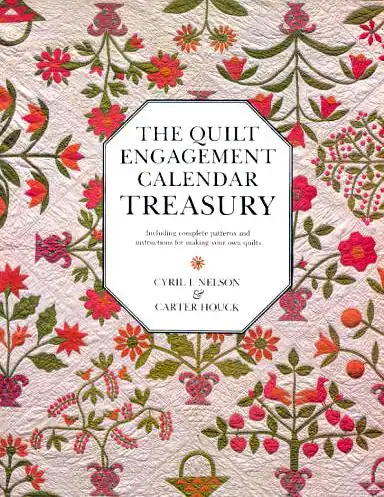
What I knew about the quilt – and what I subsequently sent to the museum – was this. Nina Schrock (never married, teacher) made the quilt about 1935, probably from a Laura Wheeler design that is identical. After I sold it for her to American Hurrah, they lent it to Cyril Nelson for the 1987 Quilt Engagement Calendar, where it was used in monochrome for the cardboard mailing box, for the cover of the calendar, and for one of the pages for May. At that point Nina Schrock was still credited as the quiltmaker. Also in 1987 the quilt appeared in a calendar produced by Avon Cosmetics as a give-away to its representatives, but without attribution (“maker unknown, Midwest, c.1935”). In 1988 the quilt was used by the U.S. Postal Service as an illustration in its “Folk Art & Crafts: An American Collection” (40 pp. covers, with sample stamps), and was attributed to American Hurrah as owner. American Hurrah sold the quilt to Gale Binney Smith (crayon family), who donated it to the Quilt Museum.
Nina Shrock died in October of 1988 at the age of 86, but she knew about the fame her quilt had acquired, and had a copy of the Engagement Calendar. Sorry for the long post, but sometimes quilts take on a life of their own, and they often go off without an ID in their pockets! (In fact the quilt left me with a fabric label identifying the maker, but somewhere in its travels that was “lost.”) Anyway, the NEQM has all of this collected information in its files now.
Xenia, in Indiana
Date: Fri, 19 Sep 1997 09:33:22 -0800 | From: Deborah Hopkinson
Content-Disposition: inline
If anyone knows what the Lowell Museum will be exhibiting in November, it would be great to find out. I grew up there and am going back for a weekend in November to see family, and will also do a signing of Sweet Clara and the Freedom Quilt at Barnes and Noble on the 8th.
Deborah Hopkinson
Date: Fri, 19 Sep 97 11:29:48 EST | From: “Christine Grant”
I haven’t seen any of you mention: “the first biennial North American Textile Conservation Conference, TEXTILE SYMPOSIUM 97, Fabric of an Exhibition: An Interdisciplinary Approach”
It is being held at the National Gallery of Canada in Ottawa, September 22 to 25, 1997. The symposium is designed to bring curators, designers, conservators, and other museum professionals together to address issues related to the exhibition of textiles. I don’t think that there are any sessions specifically about quilts, but I know that many of you work with quilt collections in museums and so may be in attendance. Those QHL lapel pins sure would be handy!
I was disappointed not to be able to attend the conference in Omaha, but since Ottawa is only a 1.5 hour drive away, it is a reasonable commute for me.
Hope to see some of you there! Chris Grant
Date: Fri, 19 Sep 1997 10:40:58 -0400 | From: Alan
The talk on crayon quilts made me think of a wall in Shands Hospital in Gainesville, FL. Shands is a major teaching hospital in this area, and they had their child patients in for major medical problems draw on tiles (their families could too). These tiles were fired, and then placed on the wall. When I saw it, I thought it’d make a great quilt. If you’re ever in Gainesville, you ought to stop at Shands atrium (a public space, not in a patient room area) and see this.
Alan
Date: Fri, 19 Sep 1997 16:42:08 -0400 | From: Alan
Jane, didn’t save your email address, but I have a question for you. Please email me privately. Thanks.
Alan
Date: Fri, 19 Sep 1997 19:23:23 -0400 | From: “Diana Reynolds” (by way of “Kris Driessen, Hickory Hill Quilts” )
This is a unique exhibit of quilts owned by governors of Florida. It is part of The Havana Quilt Event in Havana FL. (Havana is a tiny, agricultural southern town that has become an arts and antiques center.) Also taking place will be expert lectures and workshops (for a fee), and in Tallahassee (30 miles away) at Florida’s State Museum, is the 16th Annual Quilt Show (free). E-mail Andi Reynolds — andir [at] supernet [dot] net — for more information.
Thanks. Diana Reynolds
Date: Fri, 19 Sep 1997 21:03:44 -0400 (EDT) | From: JOCELYNM [at] delphi [dot] com
On 18-SEP-1997 10:10:33.7 texas_quilt.co said to JOCELYNM > common comment is “Don’t!” Unless you have “flapped a lot of quilts and > tops” and worked with the vintage textiles aLOT! it’s something that no But isn’t this a lot like the old saw about how employers only want to hire people with experience, but the only way to get experience is to have had a job? Seems like someone’s gonna have to take a chance on developing his/her skill, or eventually all the people with experience are gonna die off and no one will know anything about restoring quilts! Jocelyn
Date: Fri, 19 Sep 1997 21:37:20 -0400 (EDT) | From: Kittencat3 [at] aol [dot] com
This sounds wonderful, Kris – keep us posted. I should be able to go, God and graduate school willing….
Lisa
Date: Sat, 20 Sep 1997 15:56:10 -0400 (EDT) | From: Feathrwate [at] aol [dot] com
If any of you are travelling I-85 through South Carolina, stop at exits 14 or 19, go to the historic village of Pendleton(1790) and see the quilts hanging at the Visitors” Center in Hunter’s Store. The work of Kathryn Smith and Linda Harral is titled “Best Quilt Friends” and will be exhibited until Nov 15. Feathrwate [at] aol [dot] com
Date: Sat, 20 Sep 1997 18:34:01 -0400 (EDT) | From: Baglady111 [at] aol [dot] com
Alice, not all sacks HAVE to have the holes, but most do..you will be the holes on tall isdes..they would sew down on side of the length, across the bottom, up the other side, THEN fill the bag of it’s content, THEN SEW IT SHUT..sides and bottom would be straight stitching but after filling the bag and sewing it shut..that line of sts would be curved..almost like you were drawing water line..like in a ocean.or like a roller coaster..that is one of the identifying clues..those holes because they never heal..and they are the ones easy to identify..that and the texture..BUT don’t be fooled..the ones with a smoother textrue..are as nice as any percale pillowcases you have on your bed..Jane of THE FEEDSACK CLUB
www.his.com/~queenb/feedsack.html www2.netcom.com/~leelman/feedsack.html
Date: Sat, 20 Sep 1997 18:49:18 -0500 | From: Laura Hobby Syler
JOCELYNM [at] delphi [dot] com wrote: > > On 18-SEP-1997 10:10:33.7 texas_quilt.co said to JOCELYNM > > common comment is “Don’t!” Unless you have “flapped a lot of quilts and > > tops” and worked with the vintage textiles aLOT! it’s something that no > But isn’t this a lot like the old saw about how employers only want to hire > people with experience, but the only way to get experience is to have had a > job? Seems like someone’s gonna have to take a chance on developing > his/her skill, or eventually all the people with experience are gonna die > off and no one will know anything about restoring quilts! > Jocelyn
My sentiments exactly! I guess, since you are not the first to comment, I did not make my self totally clear that I was quoting Brackman…and I also neglected to post to the list that my new kitten decided to take a walk on the keyboard and sent the post before I finished it!!! anyway…That’s why I do the restoration class, so that I can teach what I’ve spent the last 19 years learning the hard way! Laura
Date: Sat, 20 Sep 1997 16:47:27 -0800 | From: Opalka
Laura, Regarding the post about old quilts. You mean that I should probably not be putting together the quilt blocks my great-grandmother pieced. They are dated 1925-28 (in her handwritng). My sister and I have many blocks which ggm handpieced. When we discovered these we thought sashing them and putting them together(we’ve had some of them done) would be better than to have them in stacks and unfinished. In your opinion, what should be done with them? Perhaps if we use reproduction fabric, cotton batting, muslin backing and hand quilting it would be ok? Please respond and let me know before we do anything more. Thanks, Susan(in Alaska with new snow on the mountains)
Date: Sat, 20 Sep 97 20:47:55 PDT | From: John & Cinda Cawley
Xenia, Thanks for sharing the story of the Butterfly quilt. One of the things I like most about quilt history (I’m not crazy about the term, but we all know what it means) is that I feel that we are insuring the immortality of the quiltmakers. Most of the women who made the quilts we wrote about in Saved for the People of Pennsylvania have been dead for over 100 years; their great-, great-, great-grandchildren probably don’t know anything about them. I think that it’s an act of virtue to recall their names. Don’t mean to preach. Label your quilts (I quilt mine on so they’re less likely to be lost) and a hundred years from now they’ll tell a better story than your name on a tombstone. Cinda in Scranton
Date: Sat, 20 Sep 1997 22:11:57 -0400 (EDT) | From: Kittencat3 [at] aol [dot] com
Ricki – what you describe is evidently quite common. Dealers will try to profit from a chewed up quilt by lopping off the border and selling the undamaged section as a crib quilt. Crib quilts usually are made to a smaller scale (doll quilts smaller yet), and contrary to the old myth, uneven stitching on a small quilt does not necessarily mean it was made by a child.
Doll quilts are particularly vulnerable to this sort of misinformation – they don’t take much fabric, and because of the stories about very young children learning to sew by making doll quilts, it’s easy to slap a few old blocks together, crudely quilt them, and claim it’s a doll quilt. Since doll quilts were intended as a learning tool, uneven stitching would usually be removed and corrected until the child could keep an even stitch, or follow a quilting line accurately – I started embroidering when I was seven or eight, and I know my mother made me redo a crooked or sloppy section. And I was doing it for pleasure, not as a matter of household necessity.
When it comes to little quilts, it’s definitely “buyer beware” – and if a dealer is knowingly selling frauds, at least let your friends and your guild know to check everything from that particular dealer. The only person who gains when good people keep silent is the one doing wrong…..
Lisa Evans
Date: Sat, 20 Sep 1997 22:18:10 -0400 (EDT) | From: Kittencat3 [at] aol [dot] com
Something that just occurred to me about the Butterfly quilt – in a case like that, where the information about a quilt’s maker is solely oral, should a collector possibly make a label stating whatever she knows about the quilt and baste it to the back? I usually sign and date all my quilts, but my medieval-style linen one is not signed because I made it for a specific audience (a re-enactment group where we all take on personas during the years between the fall of Rome and the English Civil War), and signing it with my real name would have ruined the illusion that it was made by Sarah Davies, Welsh merchant’s daughter, and not Lisa Evans, American administrative assistant. I’m retiring the quilt from competition after the Big E and will add a signature square at that time, but if anything happens to me in the meantime…..:)
Lisa
Date: Sat, 20 Sep 1997 22:37:17 -0400 (EDT) | From: QuiltFixer [at] aol [dot] com
If I may, can I add a small opinion on this subject? If you love these blocks and they are in reasonably good condition, I would go ahead and put them together very gently and use them. Certainly you know enough to be very careful with the finished quilt. It would be a complement to you GGM to care enough to do this. I think using reproduction material from the same time period is fine, and I would put a label on the back of the quilt(s) to explain what you have done and what was done before. A very good book to read is “Time Span Quilts, New Quilts from Old Tops” by Becky Herdle. After all old tops are just old blocks sewn together. The important think is to do what your heart tells you to.
Toni Baumgard QuiltFixer [at] aol [dot] com
Date: Sat, 20 Sep 1997 22:34:38 -0400 | From: suewho [at] juno [dot] com (Susanne Ellenberger)
Susan, When you decide what you are going to do with the blocks, please take a few minutes out and wash them in the Buttermilk recipe. It will definitely brighten the colors and take out all the age spots. Do you have a copy of the recipe? If not, here it is:
BUTTERMILK RECIPE
1 Gallon Water 1 Quart Buttermilk 1 Tablespoon Lemon Juice
Soak quilt or quilt blocks in mixture and gently wash in mild detergent. Since all the elements are natural, you have no fear of damaging the fibers. Let me know if/when you try it.
Susanne Ellenberger One Stitch At A Time :>)
In Ohio, where the leaves will be a little different color after tonight. No snow on the horizon, but the temperatures are a welcome break from humidity and heat.
Date: Sun, 21 Sep 1997 06:13:47 -0400 (EDT) | From: ROM1026 [at] aol [dot] com
In a message dated 97-09-19 08:05:13 EDT, you write:
> But the links do not work. However, with some diligence I discovered the > URLs for the separate gifs. They are > > http://scican.net/~haxton/quilt/English%20Rose1.gif > http://scican.net/~haxton/quilt/English%20Rose2.gif > > The patterns apparently come from EQ3. > Betty, Thanks for the info. I originally found the pattern in a book Successful Quilting by Linda Seward. She has a couple pages that show applique patterns. In her referense section I could not find the English Rose pattern. I wanted to find the origin and how old this pattern might be. Pat
Date: Sun, 21 Sep 1997 10:52:19 -0400 (EDT) | From: Baglady111 [at] aol [dot] com
In a message dated 97-09-19 05:16:00 EDT, you write:
<< am interested in our experts’ opinions, as to whether use of different fabrics or layout (quilt layout not block layout) can cause the name to change. I started thinking about this when trying to ID a quilt. A friend in N>>
in reply to Gail..changing the layout of the blocks, altering the pattern a bit for instance the HOLE IN THE BARN DOOR..remove the framing and it becomes the SHOO FLY, or change the color..THE WANDERING FOOT was in black and white ONLY..and know by TENTS of KEDAR before WF..but a quilter broke with tradition and used red and yellow..hence..THE TURKEY TRACK.. someone would move from one area to another..that too would change the name of the pattern..they would combine a bit of “this” pattern and a bit of “that” pattern..hence..a different name..Jane of THE FEEDSACK CLUB check my websites for added info
www2.netcom.com/~leelman/feedsack.html www.his.com/~queenb/feedsack.html
Date: Sun, 21 Sep 1997 10:42:58 0400 | From: Xenia Cord
Bits and pieces in defense of (most) dealers: the majority of us are honest, and do not knowingly try to defraud the public. After all, one’s reputation is the most valuable part of one’s business. The best protection a buyer can have is prior knowledge of the kind of merchandise he/she is seeking – educate, educate yourself! But if you buy just because you like it, then it’s a good idea to know and trust your dealer. At Houston last year I had for sale an unusual Singer Featherweight. A Singer retailer (new machines, not old) from another booth brought one of his customers (who was also a vintage sewing machine collector of my acquaintance) into MY booth and told her that the machine before them had been altered by me to make it appear rare! (I was speechless about such an accusation!) Very quickly, the customer came back to my area and bought the machine, having recognized as I did that the machine was indeed rare. BTW, she told me what the Singer salesman had said about the machine – and me. That machine is now pictured in a new book on Featherweights. Take what lesson you like from that.
My primary business is selling antique quilts and tops, fabrics, what have you. With each item we try to include the name of the maker, her residence when she was of quiltmaking age, her dates if available, and the approximate age of the item. Used to do this on fabric labels attached to each piece, but we learned that others often removed these when they resold (because the labels had my business name on them). While we know that not everyone who sells quilts goes to this length to memorialize the quiltmakers, we think it is an important part of the reputation we have for accuracy. Hopefully, the purchaser will at some point include that information in a more permanent form on the quilt or top. Okay, I’ve put the soapbox away for a while. Xenia, in Indiana
Date: Sun, 21 Sep 1997 12:44:36 0000 | From: “mary persyn”
A friend of mine recently purchased a finished crossstitch kit quilt top at a garage sale (for $2!). The design is yellow and brown sunflowers with green stems and blue butterflies. It was supposedly done by the seller’s grandmother who has been dead about 20 years. The seller had no interest in the top.
In the border of the top is the number 8258. There is no brand name.
Could one of our “kit experts” help Betty identify the company who made this top and a possible age?
Thanks,
Mary
Mary G. Persyn mpersyn [at] wesemann [dot] valpo [dot] edu Law Librarian (219) 465-7838 School of Law Library FAX: (219) 465-7917 Valparaiso University Valparaiso, IN 46383
Date: Mon, 22 Sep 1997 09:02:17 1100 | From: Sven Olsson
Hello All, I need help to identify a fabric. I recently purchased a set of embroidered quilt blocks, along with the original 1928 pattern. The blocks are 9 1/2″ square almost white, even weave cotton with the design stamped on. The blocks were all beautifully embroidered (exactly the same) and the pattern stated that “Green Charmuse” should be the setting block. I showed this to a well known Australian quilter yesterday and she bought the set from me, but she also does not know the fabric to use to set the blocks. Please Help!!!!
Lorraine in Oz
Date: Mon, 22 Sep 1997 00:11:47 -0400 (EDT) | From: BEVPEV [at] aol [dot] com
I WOULD LIKE TO ADD MY OPINION ABOUT FINISHING GGM ANTIQUE QUILT BLOCKS. I THINK THE “CROSS GENERATIONAL” QUILTS ARE A WONDERFUL IDEA. IT IS MOST HELPFUL IF YOU DOCUMENT THE QUILTERS ON THE BACK OF THE QUILT AND SPECIFICALLY STATE WHO DID WHICH PART OF THE WORK. IF YOU DO NOT WANT TO COMPLETELY FINISH A QUILT BUT WANT TO BE ABLE TO SHOW IT YOU MAY WANT TO CONSIDER SEWING A MUSLIN (OR OTHER) BACKING ONTO THE TOP LEAVING ONE SIDE OPEN. THAT WAY, GGM SEWING CAN BE APPRECIATED AND YOU CAN STILL ENJOY SEEING THE BLOCKS. WE HAD SEVERAL DISCUSSIONS ON THIS SUBJECT AT THE AMERICAN QUILT STUDY GROUP CONFERENCE LAST YEAR AND THIS WAS PROBABLY THE MOST POPULAR CONCLUSION.
THIS IS A METHOD EMPLOYED BY THE AMERICAN MUSEUM OF QUILTS AND TEXTILES FOR UNFINISHED QUILT BLOCKS. OF COURSE EVERYTHING IS DOCUMENTED IN THE COLLECTION REGISTRATION FILES.
Date: Mon, 22 Sep 1997 00:51:25 -0400 | From: “Judy Grow”
I bought a set of quilt antique quilt blocks –19 of them — from the last quarter of the 19th century. The pattern fabrics differ but are mostly madder browns and reds in paisleyish designs. The background fabric in all the blocks is the same, a chrome orange with blue pin dots and a little greyish/white dash almost connecting them.
As you know, 19 blocks does not a quilt make, but 20 blocks does. I’ll have no trouble getting fabric for the design segment of the 20th block, but have had no success locating an old chrome orange with blue pin dots. I need a piece about 10″ x 10″, but can piece together smaller scraps to make the sizes I need.
Anybody out there have something like I’ve just described? I’d be most grateful, and some anonymous 19th century quiltmaker might be grateful too — wherever she is. Judy in NJ judygrow [at] blast [dot] net
Date: Mon, 22 Sep 1997 09:18:57 -0500 | From: Laura Hobby Syler
Let me go on the record as saying again that IMHO…qulting old tops is purely a personal decision. I have made that decision many times over the last 20 years and in a few instances now regret having done so. It takes a lot of pressing the flesh to the fabric to begin to get the feel for those textiles that are just not going to make it in a transformed life, and that is something that you just can’t really put into words. I have several old tops that I do plan on quilting up. But I know how they have been stored and cared for. I am one for only hand quilting the old tops. Not only for esthetics and period correctness, but the 2 machine quilters that I use do a lot of quilts and (one in particular) really does not want the responsablilty of what the machine needle can do to the fabric.
I wish I could write a definative answer to this problem…as I stated in my initial post on the subject, Brackman told us that after the 50 year mile marker most cotton fabrics go thu a metabolic change and really can not withstand the stress. The tops that I now regret having quilted seemed fine at the time and even for the first few years, but I am watching a wonderful turn-of-the-century bowtie just fall apart before my eyes. So fast so that I really can do nothing about it!
Trust your heart. Or that of someone who has done lots of quilting on old tops, both hand and machine. If it is your grandmothers quilt top…trust your heart. I will not be quilting mine, I truely wish I could. I have them out, however, and can still enjoy them, but they won’t withstand the stress.
I know this doesn’t help much!!! My grandmother-Susie Violet Epperson- turned 93 yesterday and we got her engagement quilt out (1924) and looked at all the names of all the relatives on it. I think I need to go talk to her quilt tops too!
Laura
Date: Sat, 20 Sep 1997 23:23:04 -0400 | From: laurel horton
Who all is going to the American Quilt Study Group Seminar in Lawrence, October 10-12? I’ll be arriving on Thursday the 9th and plan to see the exhibition at the Spencer Museum that day. As usual, I found it hard to choose among the Friday tours. The research papers look especially intriguing this year. This is my first trip to Lawrence, and I’m really looking forward to it. (On my first trip to Kansas, at age two, I reportedly announced loudly to the other train passengers that I had a new baby sister and my mommy wasn’t fat any more.)
Laurel Horton
Date: Mon, 22 Sep 1997 17:24:34 -0700 | From: Sharon Harleman Tandy
Dear Laurel and all QHLers, I am so excited to be able to say I am going to Lawrence in mid October also, my first trip, though I won’t have such exciting news to announce as Laurel had! Do you suppose we could do something similar to the stickies created for those of us QHLers at Omaha for the QRS conference? Those little sticky pieces of fabric with QHL overprinted worked very well and as Chris said, after hers fell off and left just a whiter patch, “That means I’m just a lurker!” They were as wide as a regular strip of scotch tape with a tiny patchwork fabric background and had QHL (computer?) printed on the surface. We just attached them to our name tags and were immediately identifiable and it made it so much more fun. I wouldn’t know how to create them but I know of at least a half dozen of us going and surely it will be more than that. Sharon, Quilts & Answers, Boise, Idaho.
Date: Mon, 22 Sep 1997 20:55:58 -0400 (EDT) | From: JOCELYNM [at] delphi [dot] com
>them, and claim it’s a doll quilt. Since doll quilts were intended as >a learning tool, uneven stitching would usually be removed and >corrected until the child could keep an even stitch, or follow a >quilting line accurately – I started embroidering when I was seven or Lisa, My mother learned to piece before she started to school. She’d always kept her quilttops in a chest in the basement, for ‘someday’. I finally made her bring them out a couple of years ago. (she’s now quilting one of them…. 70 years later!) To her amazement, she realized that one 9-patch she had ‘made’ was obviously made by two different people! Apparently, her mother had pieced some 9-patches secretly, and had sewn the top together using both their work, so that that little 4 year old wouldn’t despair at how much work it took to make a quilt! My grandmother used alternating squares, too, so my mother actually pieced less than 1/4 of a quilt top. I thought that was a great idea…..otherwise, a child would become so discouraged trying to get together enough squares to make a full-sized quilt. Jocelyn