December 4 – 8, 1998
These restored messages come from the Quilt History List, an online forum where quilt historians, collectors, researchers, appraisers, and enthusiasts discussed antique quilts and related textiles. The archive dates from 1996 through approximately 2016 and is being restored gradually. Sign up in the form at the bottom of the page if you want to know when a new page is added. Original spelling, opinions, formatting, and inactive links may remain unchanged.
Primary topics of this QHL Digest:
- Quilted Petticoats: Dating and Identification — A major thread on quilted petticoats spans several days, with members discussing construction details, machine vs. hand stitching, fabric types, and how to date these garments from the 18th and 19th centuries. (see the article on dating quilts)
- Lisa Erlandson’s Petticoat Acquisition — A member shares her newly acquired white quilted petticoat and seeks help identifying its age and origin, drawing detailed responses from experienced collectors including Xenia Cord.
- Turkey Red and Discharge-Printed Textiles — A UK-based member reports on a British Quilt Study Group lecture covering quilted petticoats made from paisley-style discharge-printed turkey red fabrics. (see the article on Turkey Red dye history)
- Quilt Insurance — Members discuss the need for insurance riders to cover quilt collections, with requests for recommendations on reputable quilt insurance agents.
- Formaldehyde in Fabric Finishing — A brief exchange clarifies that formaldehyde is no longer used in fabric finishing, correcting a commonly repeated claim.
- Continued Dry-Goods Store and Meter Memories — The nostalgic thread about old fabric-measuring meters and dry-goods shopping continues, with members recalling pneumatic tubes, bolt-cutting tables, and fabric stores still using traditional equipment.
- Fading Fabric on the Car Dashboard — A humorous aside about using a car dashboard to sun-fade reproduction fabric for a more authentic antique look draws lighthearted responses.
Date: Fri, 4 Dec 1998 19:24:07 -0800 | From: Katrina Worley <kworley [at] ns [dot] net>
some questions: is it hand or machine sewn, is it sewn in straight panels or in flared gores, is the skirt attached to the waistband evenly or with the fullness towards the back, how is the waistband closed (ties, hook or button) and are you absolutely sure that the lace is crocheted (is it possibly bobbin lace, netted lace or knitted lace instead).
I can probably come pretty close with the answers..
Katrina
>I have acquired a new toy!! A white quilted petticoat. Not overly full, but just a little. In perfect condition. All white with a crochet lace on the bottom. Now: how can I date this thing??? Any ideas on how to find out? I thought about checking with a fashion history book to see when this particular amount of fullness would have been in vogue – definitely nothing you could wear with a hoop skirt!, but fuller than the late victorian/Gibson girl look. anyone???
Date: Sat, 05 Dec 1998 17:28:30 -0800 | From: Denise Clausen <nadyne [at] oregoncoast [dot] com
Dear Lauri
As to “where have all the meters gone” …. the Latimer Quilt and Textile Center has one from Penny’s among the collections. People always enjoy seeing it when we use it in a display. Brings up lots of “remember when” comments! My favorite fabric shop as a kid, was Paul’s in Sunnyvale, CA. My wedding dress was made from that wonderful new fabric….polyester double knit, purchased at Paul’s.
I mostly sew with old fabrics now days.
Just reminiscing
Denise
Date: Sat, 5 Dec 1998 00:22:09 -0500 | From: “Judy Grow” <Judygrow [at] blast [dot] net>
>On a busy day,” said she, “the air’d be that thick in here with dust & lint you’d cough like anything and go home with a sore throat — no
thanks.”
My mother, who was an ace seamstress, got to the point of not being able to stay in a fabric shop for more than 10 minutes, or she would get violently ill. I remember having to go with her, so she could quickly pick what she wanted, tell me how much to have cut, and quickly leave the store while I stayed behind to have it cut/ripped (I don’t remember, but probably ripped, because I remember the meters) and pay for it.
We found out later it was the formaldehyde used in the fabric finishing that she was allergic to. I haven’t smelled it lately, but I remember walking in to some large chain fabric stores and being immediately hit by the odor. I wonder if the OSHA laws have gotten to fabric finishing.
Judy in Ringoes, NJ judygrow [at] blast [dot] net
Date: Sat, 5 Dec 1998 00:28:54 -0500 | From: “Judy Grow” <Judygrow [at] blast [dot] net>
Having just seen the photos in Antiques magazine about the supposedly Portuguese quilt, and the others, I picked up an older quilt book today and while paging through it I was stuck by the similarities between the quilts pictured in Antiques Mag and Welsh quilts! The Welsh are usually whole cloth, with maybe patchwork on the reverse side, and heavily quilted in concentric lines, as are the “Portuguese”. They are a couple of centuries apart, but I wonder if there could be any connection.
Judy in Ringoes, NJ judygrow [at] blast [dot] net
Date: Sat, 5 Dec 1998 02:15:27 EST | From: EllynLK [at] aol [dot] com
Oh, Alan, I thought I was the only one goofy enough to try and fade faric on my dashboard! I had one of the commercial cadet blue repros… I overdyed some. I bleached some. I had pieces in my car, on the black dashboard, for two months– to no avail.
Thanks to everyone about the tearing/cutting thing. I’m amazed at how many of us have happy memories about those meter machines used to measure and notch fabric.
Date: Sat, 5 Dec 1998 09:29:37 -0000 | From: “Sally Ward” <sward [at] t-ward [dot] demon [dot] co [dot] uk>
Anyone in the UK can go to an IKEA store and play to their heart’s content with a meter (assuming you know what it is and how to use it – most of those under ‘a certain age’ don’t seem to). The store has taken customer service to new heights – you lug your fabric from shelf to table, unwind and cut it yourself, fold it yourself and then find an assistant whom you can interrupt long enough to get her to weigh and price it. However, do-it-yourself does mean low prices so we all still flock there for cheap calico (muslin)! On petticoats – at the recent inaugural British Quilt Study Group Conference we had excellent lectures on Aspects of Turkey Red which included description of quilted petticoats made in paisley style discharge printed turkey red fabrics. There was so much to take in on that day that the details are now hazy (I am looking forward to the published papers) but I wondered if these were a very ‘British’ thing, or part of the American experience also?
Sally, in very damp and cold Yorkshire where a quilted petticoat sounds like a good idea.
Date: Sat, 5 Dec 1998 06:21:28 EST | From: QuiltFixer [at] aol [dot] com
I am feeling very old here with all this talk about meters. 🙂 I can remember when not only were meters used in JC Pennys, but the money was sent up to the second floor on a pulley in a little basket. Change was then sent back down. There was a maze of little pulley lines all over the store and I was just fascinated with them as a kid. Wow, we really have come a long way! Does anyone else remember these, or am I the Senior Old Lady here? Toni B.
QuiltFixer [at] aol [dot] com
Date: Sat, 05 Dec 1998 08:23:21 +0400 | From: Xenia Cord <xecord [at] netusa1 [dot] net>
While we are reminiscing about old stores, I worked in downtown Cleveland at Higbee’s when I was in high school. There we had pneumatic tubes into which one put payment and sales slip (in a tubular container). Then “WHUMP!” – they would be whisked away to the business office and dealt with, and the transaction returned to the floor. Sort of like the machines at bank drive-up lanes.
Xenia
Date: Sat, 5 Dec 1998 08:12:47 EST | From: HKnight453 [at] aol [dot] com
Hello all- Quilted petticoats were part of the 18thc. American experience, when we still took our fashion clues from the British. They were made of linen or satin, and often done with feather motifs…I have a pattern for a quilted skirt from Folkwear that copies this design for streetwear. No if only I had 24 more hours in the day. Can anyone recommend some good fabric shops in New York, preferabley stocking cotton/wool blends?
Heather
Date: Sat, 5 Dec 1998 08:50:48 -0500 | From: “Phyllis Twigg” <ptwigg [at] radix [dot] net
Keep in mind when dating petticoats that quilted petticoats can also be of Amish derivation and, in that case, can more recent. I have a silk quilted petticoat (no lace !)from Lancaster County, Pennsylvania. Barb Garrett, are you out there ? What do you know about Amish quilted petticoats ?
Phyllis
Date: Sat, 5 Dec 1998 08:50:28 EST | From: JQuilt [at] aol [dot] com
“There we had pneumatic tubes……”
I remember when my mom would take me to Macy’s in NYC,to see Santa, and I would watch those those tubes wizzz through the air,and then come back with the change…Thanks Xenia for memories of my mom, who taught me embroidery, knitting,crocheting and all kinds of needlework…without her, I probably wouldn’t be the quilting today….
jean jquilt [at] aol [dot] com
Date: Sat, 05 Dec 1998 09:09:13 -0500 (EST) | From: JOCELYNM [at] delphi [dot] com
On 5-DEC-1998 00:59:10.5 Judygrow said to JOCELYNM
> We found out later it was the formaldehyde used in the fabric finishing that she was allergic to. I haven’t smelled it lately, but I remember walking in to some large chain fabric stores and being immediately hit by the odor. I wonder if the OSHA laws have gotten to fabric finishing.
Judy,
It’s definitely changed. I used to be highly allergic to fabric stores, and now I’m not. I think it changed some time in the late 70s or early 80s.
Jocelyn
Date: Sat, 5 Dec 1998 08:29:23 -0600 | From: “Lisa Erlandson” <erland [at] cooke [dot] net
Okay, here are more details on the quilted petticoat:
It measures 80 inches around at the bottom. It appears to be machine stitched and hand quilted. The quilting begins 6 inches from the waistband. The first 9 inches of quilting are straightline (around) quilting. The next 10 inches are quilted in 1/2 inch hanging diamonds. The last 10 inches are quilted in a cable design with the lines 3/4 inches apart. The waistband has a button (old pearl) and the petticoat is of white cotton. The lace at the bottom looks to be crochet (but I know nothing of lace) The length of the entire petticoat is 38 1/2 inches.
It reminds me of the “Edwardian whites”, but the fabric is heavier – more densely woven.
BTW – It came from the Midwest, not Texas!
Thanks for all the great info, so far!!
Lisa
Date: Sat, 5 Dec 1998 09:48:23 EST | From: JQuilt [at] aol [dot] com
what i love about this list is a “rememberance of things past”(both fabric and human)…
jean jquilt [at] aol [dot] com
Date: Sat, 5 Dec 1998 10:37:41 EST | From: JQuilt [at] aol [dot] com
alan, while you’re fading fabric on the dashboard…wrap some chicken in foil, tape it to the motor and after the drive home you’ll have dinner all cooked.:)
Date: Sat, 5 Dec 1998 12:41:59 EST | From: Kittencat3 [at] aol [dot] com
I’d say it could be anything from the mid-19th century on back. Remember, most women didn’t wear actual hoops except for formal occasions – they’re way too awkward for any kind of housework (or even walking through doorways). Numerous petticoats were used for warmth because of the lack of central heating.
To date it, I’d check with a local museum that has a textile collection, or see what the design motifs looks like. You can get a good idea of the approximate time period from that. Good luck!
Lisa Evans
Date: Sat, 5 Dec 1998 13:45:28 -0600 | From: “Lisa Erlandson” <erland [at] cooke [dot] net
Dear Lisa,
If only there were a museum with a textile collection anywhere close, that would be nice – but I live in North Texas in a town of 14,000 (give or take a few cows) – that’s why I love QHL – it brings the experiences of those who have access to wonderful sites to those of us who live in “Podunk”!! I am sure it couldn’t have been used with hoops, not nearly enough fabric for that! But, hoops were only used for a “part” of the 19th century – I would be tempted to say this is from the late part of the 1800’s, but have no knowledge of quilted petticoats being worn then – but, the research has just begun!!
Lisa in Texas
—–Original Message—–
>I’d say it could be anything from the mid-19th century on back. Remember, most women didn’t wear actual hoops except for formal occasions – they’re
way
>too awkward for any kind of housework (or even walking through doorways). Numerous petticoats were used for warmth because of the lack of central heating.
>To date it, I’d check with a local museum that has a textile collection, or see what the design motifs looks like. You can get a good idea of the approximate time period from that. Good luck!
>Lisa Evans
Date: Sat, 05 Dec 1998 18:32:17 +0400 | From: Xenia Cord <xecord [at] netusa1 [dot] net>
Hi, Lisa and QHLers – I own three quilted petticoats: one in black silk with tobacco brown cotton lining, one in 1840s floral and obre stripe wool with madder cotton print lining, and with a growth tuck all around it midway down, and one from the 1870s, in madder narrow stripes on both sides, 2 different fabrics. The silk is bound at the hem with something like Trenton twill tape, the wool and cotton has a knife-edge bottom hem, and the double cotton has thick brown woven wool (coat weight) as binding.
The silk one is elaborately quilted with braid, lattice, and other fancy work, and ties at the waist – same fullness all around, and fairly narrow. The wool and cotton has a handworked buttonhole at the waist, but no button. It is quilted in channels. The all cotton is the most interesting in that it has handwoven blue and white tape ties like shoelaces, but also brown tape suspenders, basted hastily to the waistband. It is apparent from looking at this garment and holding it up that the owner was very petite (5’1″ or so) with a 20″ waist; the suspenders would allow the same garment to be worn during late pregnancy without alteration. I know nothing about the other pieces, but the last one was owned by a woman who lived in the mountains east of Knoxville. My guess is that all of these were for daily wear under different economic circumstances, and at different time periods, and may have been worn with other petticoats for additional volume and warmth. In fact the 2 in wool may really have been reversible skirts, worn with bodices or jackets.
Xenia, in Indiana
Date: Sat, 05 Dec 1998 16:07:48 PST | From: “Karen B.” <txkarey [at] hotmail [dot] com
Hello,
I have been reading the digest version of this list for several months over the shoulder of a gal who works for me. I am now going to be spending more time at home and have decided that if I want to contiune being educated on quilts and their history, I’d better join myself. I run a small bed and breakfast in Texas, as well as an antique business, although I do not sell quilts. I became interested in them because I bought some to decorate my bed and breakfast, and the intersest grew into fascination.
I wanted to ask a question – you may email me privately if you don’t feel comfortable responding here…this is a delicate situation. Is there anyone who is familiar with Rocky Mountain Quilts? Are they reputable?
Also..the real reason for my post today is a quilt exhibit I saw last week while in Denver on business. It is at the Rocky Mountain Quilt Museum in Golden, Colorado. The exhibit is a chronological exhibit of quilts from the Mountain Mist collection, and details company and quilt history. It is very well done, and the history behind the company is quite interesting. If anyone is in the area, it is a MUST SEE.
Well, enough for now,
It is wonderful to be here with you!
Karey
Date: Sat, 5 Dec 1998 20:03:03 -0600 | From: “Lisa Erlandson” <erland [at] cooke [dot] net>
hello again – wow, so many posts in such a short time from a usual “lurker”!!
I am in need of some help (again)
I am working on an article for the Vintage Quilt and Textile Society newsletter on “Favorite Quilts”
I would love to hear your story and description of your favorite quilt! You VQTS members especially!!
Any non-members who would like to contribute can get a complimentary copy of the issue with the article in it by sending me your snail mail. Thanks in advance – QHLers are also ready with wonderful info and great memories!!
Lisa in Texas – with no Christmas decorations up yet!!
Date: Fri, 4 Dec 1998 17:51:19 EST | From: QuiltFixer [at] aol [dot] com
I have to jump in here and back Shirley up on her opinion about this. While I have always made it a policy not to be the “police” and accept that the object belongs to the owner and it is their responsibility, I would strongly urge them to preserve the piece as it is because once it is changed in any way it is, in a sense, gone forever and it sounds to me that it should not happen in this case. Toni Baumgard
QuiltFixer [at] aol [dot] com
Date: Fri, 4 Dec 1998 17:52:22 -0600 | From: “Lisa Erlandson” <erland [at] cooke [dot] net>
I have acquired a new toy!! A white quilted petticoat. Not overly full, but just a little. In perfect condition. All white with a crochet lace on the bottom. Nowhow can I date this thing??? Any ideas on how to find out? I thought about checking with a fashion history book to see when this particular amount of fullness would have been in vogue – definitely nothing you could wear with a hoop skirt!, but fuller than the late victorian/Gibson girl look. anyone???
Lisa in Texas with tomorrow’s predicted high – 80 degrees!!!! From: KAREN BUSH <Birdsong [at] worldnet [dot] att [dot] net>
To: QHL [at] cuenet [dot] com ohhh…no Toni..you’re not the Only one who remembers! hahaha….The receipts and lay-away tickets zooming up the line to the bookeeping office upstairs!! and the keerrr-chunk of the meter snipping the fabric…I think I was a little ‘addicted’ even THEN to the fabric department! And …oh, yeah, the orange/lime green polyester plaids….now THOSE were the days, huh!?? hhahaha…kb —
Whatsoever ye sew, so shall ye rip….. DateSun, 06 Dec 1998 214415 -0500 From: Alan Kelchner <quiltfix [at] mail [dot] jax [dot] bellsouth [dot] net>
To: qhl [at] cuenet [dot] com
Hold the phones!
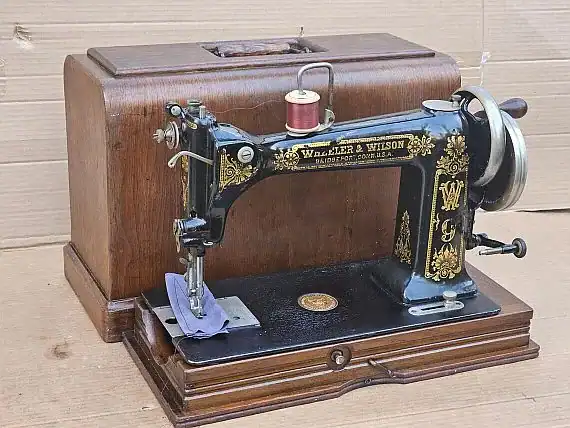
In this debate over the petticoats, unless I missed it, there’s an important fact overlooked. We were told that the petticoat is machine pieced, and hand quilted. Since the sewing machine was not invented/patented until the mid 1840’s (that date never stays in my brain), and was not readily available until the 1850’s, then that petticoat cannot be any older than c.1850.
As for the piano scarf, I’m going to take the part of anti-Christ <G>. Take that piece and do what you will, but my suggestion is to make a parlor quilt, fringe and all. Don’t cut it apart, but do use it. Layer with a very thin batt and nice backing, and tie occasionally, with the knots on the back, and the sew-thrus hidden in the embroidery. This would be reversible. I see the piano scarves around here quite frequently, and while the prices may be a bit extravagant, there appears to: be no market, as they don’t sell. Perhaps they are yet a bit too common (many appear to be machine embroidered)?
Now I relinquish my horns and tail!
Alan
Date: Mon, 7 Dec 1998 17:55:43 -0500 | From: “Daniel & Diana Dillman” <deedillman [at] mail [dot] wideopen [dot] net>
The machine stitching wouldn’t have been done before 1840’s, would it?
Date: Sun, 06 Dec 1998 08:56:46 -0500 | From: Anthony <ajones2 [at] tampabay [dot] rr [dot] com>
There’s still one in everyday use at Sewing Circle Fabrics on 33rd Ave. in St. Petersburg Florida. they use it all the time if you’re getting more than a yard. You can no longer tear cotton because it isn’t manufactured on grain in the new high speed machines. By tearing or pulling a thread, you will get a straight edge, but it may not be parallel to the selvage and may be as much as 15 degrees off. What a shame.
Another “fact” lost to progress and technology.
When making bias, it is sometimes good to tear to find true grain and measure 45 degrees off of that edge rather than off a rotary cut edge. If you’ve had a problem with bias that didn’t lay quite flat on tight curves (as in celtic work), this could have been your problem.
Another store that still uses meters is Calico Corners, a home decor fabric chain.
I too love this list.
Anthony
Date: Sun, 06 Dec 1998 07:38:59 -0800 | From: arlenegg [at] icanect [dot] net
I want to say thank you for the numerous responses to my question about the tray I bought. It sounds like these trays were made through most of this century and were quite common. It is pretty and I’ll leave mine the way it is, but now I’ll be on the lookout for more that I can use, adding blocks or fabric myself.
Arlene
Date: Mon, 7 Dec 1998 00:13:21 -0500 (EST) | From: “Joanna E. Evans” <jevans [at] bluemarble [dot] net>
In the early 1980s when I was an assistant manager for SoFro Fabrics in western Massachusetts, we still used those meters for measuring the fabric. They may still use them for all I know. After notching the fabric, we straightened the fabric, and then used a metal track to guide our scissors in a straight line. It was all very efficient and almost foolproof. We did get requests to tear, but we had to politely refuse. We did tear a few fabrics–like fake fur. We also did the old pull a thread trick on coarse fabrics like burlap. And on woven plaids, we opened the fabric out and followed the weft threads.
As far as I know, the pneumatic tubes into which sales clerks put payment and sales slips that Xenia mentioned are still in use in an old (independent, I think) department store in downtown Northampton, Massachusetts. They were still using the system last time I was there about a year ago. If you want to know the name of the store (it slips my mind at the moment), email me privately and I’ll ask my mom–or maybe Lisa Evans knows the place.
Joanna Evans
Bloomington, IN
Date: Mon, 7 Dec 1998 19:52:32 -0500 (EST) | From: quiltsnbears [at] webtv [dot] net (Roberta Geanangel)
Alan…I believe you just played “Devil’s Advocate”…but, you do have a point…piano scarves are still common and better to use it as you suggested than to cut it up or hide it away for another century. Your idea might save the entire scarf…I hate to think that fabulous fringe will be cut!
Roberta in FL
Date: Sun, 06 Dec 1998 10:09:49 -0700 | From: Eileen Trestain <ejtrestain [at] earthlink [dot] net>
Lisa,
You live close enough to Denton, which has the huge clothing collection! If you have never gone to see those things, you should make the trip. Nieman Marcus made many donations to the women’ university there. It consist of clothing from early to mid 1800 up through the couture gowns of the 1960-70’s. They have hundreds of gowns and acessories, some of whic were put on display here in Scottsdale when the new Nieman Marcus opened this fall, so I know the collection is still there. Give the curator a call. Would love to see your petticoat myself.
To: o bad we are so far away!
I also would hope that the piano scarf skipped the second life as a quilt.
Eileen
Date: Sat, 05 Dec 1998 23:41:02 -0600 | From: Mary Waller <mswaller [at] iw [dot] net>
Judy, you’re correct that formaldehyde is no longer used in fabric production because of health concerns. I seem to remember that as an EPA action rather than OSHA, but don’t quote me on that.
Mary Waller
Date: Sun, 06 Dec 1998 16:48:08 PST | From: “Karen B.” <txkarey [at] hotmail [dot] com>
Dear Laura Hobby-Syler,
Thank you for your reply, and your offer to sell me quilts, or put me in contact with others who do. I have pleanty of resources, there was just a particular matter I wanted to check on regarding Rocky Mountain Quilts.
In response to your question about my B&B, I appreciate your interest, however I do not feel it is right to self promote on a public forum or even personally for that matter. Thank you anyway for your interest. I am sure your PAAQT will be able to find a location, there are many wonderful and charming B&B’s and historic inns in Texas! In a message dated 12/5/98 72336 PM Pacific Standard Time, texas_quilt.co [at] mail [dot] airmail [dot] net writes <<Where is your B&B…..VQTS is looking for a “retreat” location as is PAAQT,
>the organization of appraisers certified by the American Quilters Society……..
>Laura
__
Date: Mon, 07 Dec 1998 21:30:13 -0600 | From: Russell-Hill <russhill [at] ctesc [dot] net>
HI everyone,
Here is a message from my friend who asked her email list on this subject and this is what she recieved. When she says our era it is 1860.
Debbie,
This is the one response on the quilted petticoat. Glenna Jo is a very knowledgeable lady, so if she says it could be our era, I’d believe her.
The machine made, hand quilted thing is a good point. I hadn’t thought of that. And the 80 inches does say it has to be under the hoop. Anyway, its a thought.
Janet
The fact that it is machine made and hand quilted starts it out easily within our era. I doubt it would be much later since the skirts became much too narrow for something like this fuller style. As you pointed out, petticoats were frequently worn under hoops both for modesty as well as warmth in winter. Once the hoops were gone, drafts were not such a problem under skirts so the need for quilted petticoats faded away, at least among the fashionable. 😉 I have seen a few quilted petticoats from our era, two were all white and the others were of a variety of print fabrics, often with brown holland lining. BTW, I resisted the idea of petticoats worn under hoops at first, but the evidence mounted and now I won’t be without mine. If I’d tried it first, I would have been sold without all the evidence.
Glenna Jo Christen gwjchris [at] rust [dot] net
Visit our web site, “The Curiosity Shop”
http://www.rust.net/~gwjchris/
–Next_Part_2995911013_384042_MS_Mac_IMN–
Date: Sun, 6 Dec 1998 05:52:33 +0000 | From: Steve and Jean Loken <sandjloken [at] worldnet [dot] att [dot] net>
All of the memories have been wonderful. I also recall having a bad reaction to: the smell of the formadehyde – it made my eyes hurt. My Mom worked in the fabric department of Gertz (Long Island dept. store) and had to have her watch cleaned almost every few months because of the dust. The jeweler said he’d never seen anything like it. I also remember the meters, but I guess I’m too young to remember the pneumatic tubes <VBG>
Jean in MN
Date: Tue, 8 Dec 1998 09:40:32 -0500 | From: “Pat McAnally” <patmc [at] mailserver [dot] netcarrier [dot] com>
Strange sightings
Believe or not, I just saw a pneumatic tube thingie operating this past weekend at the customer service desk at Home Depot in Willow Grove, PA, and this store was only built a couple of years ago.
I’d love to get one of those old meters for my sewing room – just the thing for measuring just how much backing fabric I bought for the projects I started years ago.
Pat (who’s in the middle of constructing rather than quilting)
Date: Tue, 8 Dec 1998 16:17:26 +0000 | From: Steve and Jean Loken <sandjloken [at] worldnet [dot] att [dot] net>
I thank all of you for your good advice. You can rest in peace, as I’ve spoken to the owner of the piece, and she has told me what she wants is just to: make the item suitable for display or use, and will take suggestions from conservators as to how to do it best. She doesn’t insist on quilting it. Since the fringe is so heavy, hanging is pretty much out, but perhaps the museum folks here in the Twin Cities will have ideas.
Jean in Minn
Date: 8 Dec 98 10:00:02 MST | From: Debi Gipe <debididit [at] usa [dot] net>
I would also like the name of a reputable quilt insurance agent.
Thanks,
Debi
_
Date: Tue, 8 Dec 1998 09:10:48 -0800 (PST) | From: Jackie Joy <jjoy [at] med [dot] unr [dot] edu>
>Society..and am currently working with HGTV on a documentary on quilting and helping to scout filming locations for them…….
This sounds like so much fun! Please elaborate. I’ve just gotten HGTV and it is my favorite channel, even though our viewing times are three hours later than what’s scheduled.
I am looking forward to seeing this documentary when it is finished.
Jackie Joy
Reno, Nevada jjoy [at] med [dot] unr [dot] edu
Date: Tue, 8 Dec 1998 12:03:43 EST | From: QuiltEvals [at] aol [dot] com
Hi all,
I haven’t been on in a while, missed everyone. I have scanned the digest every night, but y the time I get it, the news is always old. Warmest holiday wishes to you all!
The best in insurance guy in the business (IMHO) is Bill Lyle – he can be reached via e-mail at jslyle [at] bcl [dot] net. He is quite knowledgeable about all aspects of insurance and quilts! He’s the man to talk to!
Deb Roberts
Date: Tue, 8 Dec 1998 11:28:59 -0600 | From: “Lisa Erlandson” <erland [at] cooke [dot] net>
Just to kind of “wrap up” the petticoat discussion, here’s what has been sent to me, both on QHL (which you would have read) and privately Thanks to several helpful QHLers, the following information is probably correct about my beautiful white cotton quilted petticoat It is probably from the 1860’s era. No earlier (the machine piecing does give that away, doesn’t it) It was probably what is known as a “Modesty” petticoat, worn under the hoops as protection against the hoops on the legs (an for warmth, etc)
Many thanks to Debbie for her “networking” to help me find out more about this great piece.
There’s more quilting on this undergarment than I have ever put into a quilt for show!!
Lisa
Date: Tue, 8 Dec 1998 14:59:20 EST | From: EGinebaugh [at] aol [dot] com
Hi all,
Happy holidays to all!
Just thought I’d pose a question to all of you, since I have a challenge ahead.
I have agreed to help out at our church with the youth education program in making a quilt. Part of the reason for making it is to educate and strengthen their spiritual foundation. What I need, is reference sites or other information on any blocks that had a biblical meaning or background. I would like to educate on the historical aspects of biblical blocks & quilts, as well as finding a modern interpretation of a block to fit their own beliefs. We have no idea of what type of quilt to do, so any suggestions there would help, to: o.
If you would prefer, you can email me privately, unless the list would find this of interest.
Thanks, and pieceful quilting to all,
Liz in Michigan
Date: Tue, 8 Dec 1998 14:22:36 -0600 | From: “GRichter” <richter2 [at] frontiernet [dot] net>
> The machine stitching wouldn’t have been done before 1840’s, would it?
The invention of the sewing machine goes back to 1790 when Englishman Thomas Saint patented a version. Several different people were involved in it’s evolution in the the 1800’s. Singer became involved about 1850 and was responsible for developing one which actually worked reliably and then marketing it. According to The Encyclopedia of Antique Sewing Machines by Charles Basebase Law he had difficulty selling them in the beginning because of the bad reputations of the previous machines. Sewing machines were very expensive and he introduced the idea of selling them by installments.
Gail R in NE Wis.
Date: Tue, 08 Dec 1998 15:43:15 +0000 | From: Jocelyn <jocelynm [at] sw1 [dot] socwel [dot] ukans [dot] edu>
> Does anyone on the list know much about insurance riders for quilts? My insurance agent has suggested one as my collection has grown beyond what my blanket policy will cover.
~~~~~~~~~~~~~
Karen,
Couldn’t you just get coverage for your quilts from whoever insured your blankets? <G>
Jocelyn
Jocelynm [at] delphi [dot] com
Date: Tue, 8 Dec 1998 17:07:51 -0500 | From: Debby Kratovil <kratovil [at] his [dot] com>
At 259 PM -0500 12/8/98, EGinebaugh [at] aol [dot] com wrote
>I have agreed to help out at our church with the youth education program in making a quilt. Part of the reason for making it is to educate and strengthen their spiritual foundation. What I need, is reference sites or other information on any blocks that had a biblical meaning or background. I would like to educate on the historical aspects of biblical blocks & quilts, as well as finding a modern interpretation of a block to fit their own beliefs. We have no idea of what type of quilt to do, so any suggestions there would help, too.
How “providential” that you posted this note. I have been thinking along the same lines and plan this next calendar year to put up a new series of pp patterns with the biblical theme. So, this will spur me on sooner! One book I have enjoyed is by Rosemary Makhan entitled “Biblical Blocks”, a sampler series. The central medallion is my all time favorite – the tree of life, which, by the way, is the very first pattern in the Kansas City Star newspaper series. It is surrounded by 16 blocks with biblical names, with several alternates to also choose from. Then it has a Rose of Sharon appliqued border. Never made the quilt as such but made the Tree of Life block 4 different times as central focus of other quilts. Rosemary gives a Biblical passage to accompany each block. Some of the older books (like Carrie Hall’s) have some background info on names of blocks with biblical names. But this book by Makhan is still in print (I think)g and is published by That Patchwork Place (which is now Martingale Publishing).
Debby Kratovil — Quilter By Design kratovil [at] his [dot] com
I found this site while surfing one day and have it bookmarked. I thought you may like to take a look. There are bible blocks for each month of the year with instructions. Some are 12″ and some are 15″.
Winnie Ledoux http://www.mountain-inter.net/~graham/index.html
Date: Tue, 8 Dec 1998 22:40:49 -0500 (EST) | From: “Joanna E. Evans” <jevans [at] bluemarble [dot] net>
Hi Liz,
Check out Kaye England’s book (Road to Jericho, I think). As I recall it is done as a sampler with traditional blocks that have biblical names.The finished quilt has a contemporary look to it. I think she shares some of the extensive research she did for the book in the text. I know several people have done this, but that’s the one that comes to mind. Good luck working with the youth.
Joanna
Bloomington, IN
Date: Tue, 08 Dec 1998 23:04:30 -0600 | From: Russell-Hill <russhill [at] ctesc [dot] net>
Hi everyone,
Just got the digest. Boy I need to find out why I am not getting the individual post any more I have missed a lot having to wait for the digest. Any way thatk you Lisa for the thanks it was my pleasure. Everyonce in a while I can give back info in return for all you have given me. I am sorry that the forward was so long I did not think that it would look like that in a post next time I will try to clean it up. Oh I am still learning this here modern toy. I have spent to much time these past weeks in the 1830’s and 50’s.
Glad to have helped and thanks for a great group.
Debbie