November 7 – 10, 1998
These restored messages come from the Quilt History List, an online forum where quilt historians, collectors, researchers, appraisers, and enthusiasts discussed antique quilts and related textiles. The archive dates from 1996 through approximately 2016 and is being restored gradually. Sign up in the form at the bottom of the page if you want to know when a new page is added. Original spelling, opinions, formatting, and inactive links may remain unchanged.
Primary topics of this QHL Digest:
- Eileen Trestain’s Quilt Dating Book — Bob Mills recommends Eileen Trestain’s book on dating quilts, and Eileen herself joins the list discussion. (see the article on dating quilts)
- Quilt Storage and Acid-Free Shelving — Alan Kelchner asks about safe materials for quilt storage shelves, prompting advice on acid-free barriers and avoiding direct wood contact. (see the article on caring for antique quilts)
- Charm Quilts and Their History — Robert Carroll traces charm quilts back to the 1860s, with most examples from the late 1870s and 1880s, and their ‘no two alike’ collecting tradition.
- Japanese and International Quilt Traditions — Members discuss Jill Liddell’s book on Japanese quilts, African Dahomey textile hangings, and Norwegian folk textiles with rick rack.
- Professional Appraisal Ethics and Charging — Jeanne Fetzer asks when and how to start charging for quilt appraisal expertise, sparking discussion of professional boundaries and guild expectations. (see the article on quilt appraisers)
- Wool, Linen, and Cotton Quilts Through History — A thread on whether wool quilts predate cotton and linen, and how fiber availability shaped regional quiltmaking traditions.
- Quaker Lace Company History — Members identify the Quaker Lace Company of Philadelphia (est. by 1914) and note it is still in business producing cotton lace goods.
- Steamboat Arabia Recovered Textiles — Discussion of textiles recovered from the 1856 Steamboat Arabia wreck in the Missouri River, preserved in a Kansas City museum.
- Restoration Techniques with Netting and Tulle — Russell-Hill discusses using cotton tulle netting for stabilizing fragile antique quilts during restoration. (see the article on quilt restoration)
Date: Sat, 7 Nov 98 11:53:10 EST | From: “Bob Mills” <decision [at] tigger [dot] jvnc [dot] net>
Eileen, Welcome to QHL.
Your book is wonderful and I hope that sales are going well. For those who missed the announcements, Eileen is the author of ‘Dating Fabrics A Color Guide 1800-1960.’ The colors are printed true, and it is well organized by date: s and colors. Kris carries it and it is a bargain for it’s value. If only it were one of the many fabric catalogs that arrive in the mail- my checkbook would be in the red…
QHL will benefit with your participation, Eileen.
I just got the surgeon’s bill for my rotary cutter injury. Imagine if you received $108 for each hand stitch YOU made!
Jan Drechsler in NJ
Date: Sat, 07 Nov 1998 12:52:42 -0600 | From: Russell-Hill <russhill [at] ctesc [dot] net>
Hi Everyone,
I asked a friend who is more up on the fashions of the 1860’s and so I asked her if she had any knowledge of rickrack being used during that time. She wasn’t sure but went to her list and asked. She sent me the responces and I will be glad to email them to you privatly if you wish the documention they gave. Rickrack also known as wavy braid was found on clothing back in the 1850’s. This was in a photo. (Sorry I don’t have the correct name of it in front of me) The Ohio Historical Society has a camersol with small rickrack like trim around the neck line. this is dated around 1860 and there were several cdv’s showing the same. From the discription it sounds that this rickrack is hand made and may look some what different then the more modern rickrack (1920’s +) Well this is my 2 cents. You all were so great answering my question I thought I would try to do some research for you.
Hope this helps.
Debbie russhill [at] ctesc [dot] net
Date: Sat, 07 Nov 1998 13:13:48 -0600 | From: ShirleySpencer <ShirleySpencer [at] prodigy [dot] net>
I don’t post very often, but some of you may remember me. It doesn’t really matter. My problem is I’ve relinquished my Queen of Spot Removal Badge and severely tarnished by Mother Badge.
Here’s the problem and I would welcome any suggestions. My daughter is a new mother and baby is 6 mos. old. Mother is very particular, therefore, about her clothes. She has 2 baby garments that had picked up a little darkening in the wash and I volunteered to take care of this right away since I *am* the Queen of Spot Removal. They are both 100% cotton. I washed them with a load of lingerie using All-Color Cheer (“Triple Color Guard helps protect against fading, color transfer & fuzzy buildup on Cotton”.) and then used Mountain Spring Downy. I then washed them alone with 1/2 teaspoon Synthrapol. I did not dry them or even look at them carefully due to time constraints and delivered them to: her in a plastic grocery bag which I checked for cleanliness. Showed them to DD and she found tiny spaghetti-colored spots on the pure white body suit thingy and blue spots on the off-white pajamas. These looked more like the kind of spot you see if somethings runs or lays next to another running garment in the wash. (I hope I’m making myself clear, here.)
I took a deep breath and said, “Just let me rinse those out in cold water.” Didn’t work. So I took her dishwashing detergent, Antibacterial Dawn (orange colored) and squirted it directly on the garments. For some reason I always thought Dawn was supposed to be “safe.” The pure white looked better, but Oh My Gosh……..the off white garment turned white where the detergent touched it, just as though I had poured bleach on it. OK. So now I’m in really big trouble, and DD is not a bit happy. I told her not to do anything more to: them, not even wash them, until she heard from me. They have been hung to dry and I am shopping for new clothes for baby. Obviously there has been some chemical reaction. I have used synthrapol before with excellent results. I think I should have rinsed them in clear water before using the synthrapol wash since I had used Downy in the previous rinse. Unfortunately I didn’t think of this at the time. This is the only thing I can think of that would cause a problem. None of this explains the Dawn reaction.
Can anyone help??
TIA from Shirley, Beth and Olivia
Date: Sat, 7 Nov 1998 19:28:16 EST | From: Qltldy10 [at] aol [dot] com
First off, Jane languishes because I didn’t like the “feel” of the Lunn fabrics polka dots. Maybe just a tad bit of tan dye will make me feel better.
Just a tad.
Well, the colleagues quilts are here, all 10 of them. This actually is a little overwhelming, as I need to photograph, identify, and investigate family history… then document all. Not too mention find a spot to keep them in- which means housework, not in my personality trait.
These are really a great journal article- there is an immaculate courthouse steps, madders and shirtings, seems never used or washed. done on musliny backing, then whipped together with the tiniest of stitches-so it gives the sense of quilted, but no batting of course. The next quilt, scrappy also, has some of the same fabrics. there is a beautiful strippy, done with 2 madders, one of which also shows up in scrap quilt #2. then there is a quilt in a quilt, and the inside quilt is a madder wholecloth, fabric shows up in scrap copurthouse…. do you feel the story? At last count 5 of the quilts have “matching” pieces. Only four of them are madders, the 5th is a strippy with an orange stripe combined with a beautiful delicate blue with brown overprint. while this strippy is in worn/faded condition, the stripe shows up pristine in scrappy #2. Quilt #6 is a whole cloth, a very faded (and thin “cheaper”) fabric, which is a paisley. This paisley shows up as a beard/chin protector on one of the madders. So 6 quilts now related by fabric. There’s more to this story, no doubt, but the post has eaten my allotment of cybertime. Who made the much earlier pink paisly star? What of the pieces of 2 whole cloths inside of quilt #10? Back after this commercial break…
Beth in Maine qltldy10 [at] aol [dot] com
Date: Sun, 08 Nov 1998 11:59:53 +0930 | From: John Chris and Peter Lawrance <lawrance [at] cobweb [dot] com [dot] au>
Hi I am just briefly coming out of lurkdom to ask some advice. I have a fellow churchgoer who has a hexagon quilt made by her mother of a 1970’s vintage. It is quite a big top but not finished.
Several Questions
1. It is not square should I take units from one side to another to square it up or endeavour to find more material from that vintage and make some more units.
2. Should it be quilted if so how?
3. I would like to put a border on it I gather you can applique the top onto a border.
4. If not quilted tied maybe or just backed?
It is not a particularly historic piece or valuable really but I would like to help this lady out as she wants to give it to her daughter on her 21’st b/day. It could be important in some years from now because it contains material that people of my era grew up wearing. It is all dress scraps.
Any advice would be gratefully received
Thanks
Chris L Adelaide
Date: Sun, 8 Nov 1998 08:48:39 EST | From: Tubeywooby [at] aol [dot] com
In a message dated 11/8/98 25547 AM, you wrote
<<Hi I am just briefly coming out of lurkdom to ask some advice.>>
Me, too…..
I am researching wool usage in quilts. Any good sources? I know most Amish quilts were wool in the last century. Did wool quilts predate cotton and linen?
Thanks,
Melissa in Houston, on her way to the Renaissance Festival….
Date: Sun, 8 Nov 1998 13:04:00 EST | From: SudaNim [at] aol [dot] com
Picked this up at a funk-and-junk shop yesterday, and just can’t stop drooling over itIt’s not a quilt, but a placemat-sized piece of applique and reverse applique with an apparent Biblical theme, but darned if I can figure it out. Base fabric is red with tiny white almost-maltese-crosses on it, with a reverse applique of blue (ie, blue is actually the predominant background), then appliqued figures of white & very pale shirting fabrics over more blue. Geez, I really need to buy a scanner, don’t I? But for those of you who know the Harriet Powers Bible quilts, the figures look very much like that style. There’s a human holding up a stick that may or may not be a cross, with an arrow pointing up from it. Another figure is definitely an angel, but two things coming from above, where you’d expect more angels, look more like sharks than anything. Then there’s a box, just an empty rectangle, to one side.
The figures are boxy & lopsided, but applique work is very skillfully done. It’s about 17×23 inches. Guy at store knew nothing except a buyer picked it in Chicago area. It’s in excellent condition, but musty.
I’ll try to post it on a web page soon, but from the description, can anyone give me any clues? I’m guessing late 1800s African-American altar cloth or hanging, but I’ve never seen anything like this.
Date: Sun, 8 Nov 1998 10:03:24 -0800 | From: Ellene Gravelle <gravelle [at] ridgecrest [dot] ca [dot] us>
What a fabulous experience the IQF in Houston was this year!. Enjoyed meeting Kris Driessen (a dead ringer for Kim Bassinger!–there, I said it Kris) in the Kirk booth and purchasing those cute ‘canning jar’ kits, as well as the QHL pin. Wish now that I had remembered to thank Kris for hooking me last year up with the 222K (sold by Kimmey Decker) that I added to: my collection.
The amount of antique quilts and fabrics being sold at Festival was unbelievable. I purchased a ’29-’30’s state flowers quilt top from Legacy and now have a very interesting project to finish.
Anyone who hasn’t been to Houston for IQF Market or Festival doesn’t know what a quilting feast they are missing. Something for everyone. My classes included teachers Bonesteel, Beyer, Pearson, Fielder, Sudo, and Doak (more projects to finish) all of whom were very professional and experts in their fields of expertise. Couldn’t have asked for anything better.
All in all, I have enough inspiration to last me for another year when I hope to have the good fortune of attending another IQF. Ellene
Date: Sun, 8 Nov 1998 13:59:23 EST | From: EllynLK [at] aol [dot] com
After I found my turn-of-the-century Trip Around The World top a couple of weeks ago, someone posted a query on the list as to how you made this pattern the old-fashioned way (as opposed to the modern make-a-tube manner. I lost the post and the poster’s address… I love this pattern and have used it to make pillows– and I do it the old-fashioned way. I had some time today to write it up and do diagrams– only to discover I lost the address! I learned how to do a Trip pattern by taking apart a quilt I found about three years ago– 9 Trip Around The World panels in a latticed 1970’s quilt. I bought it because it had a quilt inside (a totally thrashed 1940’s star quilt. TOTALLY thrashed). I really had no great love for the outside quilt– it was tied, torn and terribly neglected and I guess it was just calling out “love me.”
So I took the pieces apart (figured out how you do Trip) and began to fix it with that stash of 1970’s fabrics I had left over from high school. My best friend went to a garage sale and found a load of white fabric with hot pink and brilliant orange flowers which she donated– and that was it. I went crazy on this one. Took out the psychedelic yellow-patterned-with-flowers latticing (worn, faded and just not pretty anymore) and the jewel-toned aqua cornerstone blocks. Went to Crazy Ladies fabrics in Santa Monica and found the very same jewel-toned aqua. Used it for the latticing and it just set off the Trip blocks like you wouldn’t believe! Bought hot, hot, HOT pink and fluorescent yellow for the cornerstones and did stuffed work on them— remember those “ricky-ticky-sticky” flowers kids used to put on EVerything? I did those in stuffed work.
I repaired all the (9) Trip blocks, replaced some fabrics (it even has some of that off-white with avocado green and orange kitchen condiments fabric!) and honestly, I put in back together as a joke. I mean, you can see the thing from: across the county, it’s that screamingly bright! And it has become one of my favorite restorations! While technically not an “antique,” well, it was a very, very well-loved old quilt that no one wanted anymore (cost me $10)… it’s now rather outrageous, mega-’70’s to the max– but everyone loves this one! It makes them laugh.
Anyway, if the person wanting to know how to do a Trip pattern is out there, please e-me…
BTW, my mother recently told me that as a 13 year old, she went to the Golden Gate Exposition in San Francisco on Treasure Island in 1939… she recalls seeing a quilt exhibition there. Anyone know about this? Is there any reading matter on the quilts of that fair? (my dad also went a few times but as a 19 year old, he remembers seeing the girls of the Follies Bergere…. <<gg>> and he saw television for the first time)
Lauri Klobas
Pacific Palisades, CA where we are enjoying the FIRST RAIN of the season– first precip since June, if I’m not mistaken!!!
Date: Sun, 8 Nov 1998 16:29:53 EST | From: Baglady111 [at] aol [dot] com
WOW!!! I receieved a copy of a new quilt magazine and GREAT PATTERNS..QUILT magazine is the parent of Quilt Presents SAMPLER QUILTS.. several subjects/articles caught my eye immediately..LOTS OF PATTERNS & DIRECTIONS..a must for me..nothing worse than to see some great quilts but PATTERN NOT AVAILABLE..
most of the patterns in this issue are samplers..sooooo you get a great variety of pieced AND applique patterns..stars, blocks, triangles, etc..even hand dyed fabric a floral design..
Something else that noticed right away..DEBBY KRATOVIL has so many articles/pattern directions in this issue…I had to check to see if HER NAME was on the staff as as editor..but no…it is our very own JEAN ANN EITEL..might have known Jean Ann would edit a winner…some of the patterns are from previous quilt mags and always standard patterns..beginners, intermed, and advanced..something for EVERYONE..Debby Kratovil is one talented lady on patterns/writing and can always count on her to help me with them when needed..and my need is OFTEN!!! Nice going Debby..congrats to you AND Jean Ann..hope everyone likes it as much as I do..Jane of THE FEEDSACK CLUB who is lousy at math!!!!
Date: Sun, 8 Nov 1998 16:07:44 EST | From: Baglady111 [at] aol [dot] com
A new member of THE FEEDSACK CLUB posed a question that interested numerous people at dinner last night…what patterns would you use with the least amount of waste?? Naturally, no one wants to waste fabric..and especially feedsacks because they are vintage and there are no more being made…what pattern (s) would YOU use? Jane of THE FEEDSACK CLUB www.hickoryhillquilts.com/feedsacks.htm www.his.com/~queenb/feedsack.html
Date: Sun, 8 Nov 1998 19:10:40 EST | From: Baglady111 [at] aol [dot] com
I am coming into Phoenix, on my way to Tucson tomorrow nite an arriving late..can anyone recommend a reasonable/clean hotel within range of the airport and that has shuttle service to and fro??? Please advise if possile, privately..Jane of THE FEEDSACK CLUB
Date: Sun, 08 Nov 1998 18:05:52 -0500 | From: Alan Kelchner <quiltfix [at] mail [dot] jax [dot] bellsouth [dot] net>
Hi y’all – have a quick question. I just put up a new shelf in the studio. 1.5’x8′, it sits at the top of the closet door frame. Ceilings are about 9′, which gives me 2′ (more or less). Plans are to put the quilts waiting-to-be-restored or cannibalize-for-other-restorations on this shelf, so they don’t fill up the room at my level. During the last 3-4 days, I’ve put 2 coats of latex paint, then two coats of polyurethane on the top (which was raw plywood with smallish knots). The polyurethane went on the shelf today.
How long should I wait before putting the quilts on the shelf? I don’t want the quilts to stick to the new surface, which happens even after a couple of days. I’m really anxious to get these quilts up and out of the way, but don’t want to damage the quilts or the shelf’s surface.
The shelf was really cheap – came out of my office at work when they remodeled. Made the mistake of only getting one. Shelf cost me about $5 outright, as I only needed brackets (cheap metal). The paint and polyurethane were partial cans.
I’m working at making the space “feel” bigger (9×13). Well, this wasn’t really quick – oh well.
Alan
Date: Sun, 08 Nov 1998 22:21:39 -0500 | From: Anthony Jones <ajones2 [at] tampabay [dot] rr [dot] com>
Alan, I’d wory about <<ever>> putting my quilts in direct contact with the shelves. Especially if they might be there for a while. PolyU is just a hard varnish. It is not neutral or acid free. Suggest you put down a layer of folded bed sheets or muslim as a shelf liner at least 4 layers.
Have fun fixin up your space. Everyone on this list is so active, it makes me feel like a slug. A happy slug, but a slug nonetheless. ;>))
Anthony
Date: Sun, 08 Nov 1998 22:38:20 -0500 | From: Anthony Jones <ajones2 [at] tampabay [dot] rr [dot] com>
As many of you know I’m a beginning collector who asks questions even if they might be stupid. So, here goes. In the past I’ve just left my quilts alone. Since I can’t afford mint stuff, the quilts I find mostly have some sort of damage/stains/wear In the past I’ve just sort of folded and refolded them and not thought much about restoration. I’t’s been drilled into me that you don’t refinish an antique. But listening to many of you, I’m beginning to think that restoration i may not be tantamount to Blasphemy. >)
What got me on this kick was falling upon an ohio rose/rose of sharon quilt type that is nearly flawless except for wear on the binding. It had one block in which the appliqu� was loose, but being a good appliqu� artist I felt comfortable putting those stitches back in. And mine are more invisible than the original quilter’s. So I thought I should restore the binding.
I feel that if I’m going to do this right, I need to get a better overview the art and the philosophy before I do irreversible damage. I’m overwhelmed by the amount of information available. Are there some particular books that are considered classic and important that would be a good place to start studying. I suspect that many of you have degrees in textiles, and I don’t expect a book to give me that type of knowledge. But I like to have some background before I attend classes or conferences. Then I have a better handle on what type off questions to ask. Books and web site suggestions welcome.
I am familiar w/our host hickory hill and the kirk collection sites
Anthony
“sleepless in Tampa”
Date: Sun, 8 Nov 1998 21:39:44 -0800 | From: “Mary Cross” <mbcquilt [at] web-ster [dot] com>
Greetings
At the time, I was researching the quilts for my Mormon Migration Quilt Project, there was not definitive work done on Utah-produced silk to be able to document the fabric that was produced by that industry. I believe research had been undetaken at the University of Utah to see if Utah-produced silk could be clearly identified. Most of the information available was based on family tradition and lore. The silk industry there was encouraged by Brigham Young during his tenure and the economic isolation maintained by the Church in order to practice their faith as they chose. The earliest efforts were in the early 1870s and lasted until the 1890s. Brigham assigned one of his wives Zina D.H. Young the mission or assignment of establishing the silk culture to produce the desired silk cloth. She successfully overcame her personal dislike of the silkworms, learned sericulture, and taught other women how to raise the worms. In 1875, she became the head of the Deseret Silk Association whose purpose was to: dispense information from nurturing the worms to weaving the cloth. Under her leadership, the Women’s Relief Society sponsored silk projects in nearly 150 communities throughout Utah.
The Daughters of the Utah Pioneers Museum in Salt Lake City has an extensive display of items connected with the Utah-based effort. The women even sent an exhibit to one of the world’s fairs.
I second Pepper Cory’s report on the Shakers at Pleasant Hill. I stayed overnight there on my way to AQSG. A wonderful experience except I didn’t sleep well. I was staying in one of the Women’s Buildings. I learned the next day that my room was one where they had raised the silk worms. No wonder it was so hot! There are silk scarfs produced by the Shakers there on display. They are lovely, soft, graceful, and elegant. There is an Ohio woman who is their consultant on silk if anyone is interested, they could email me privately.
I too toured the small quilt collection with the current director. I saw the quilts Pepper described. My feeling in talking with the Director that the cotton sateen ones were done by one of the older women (I can’t find my notes right now) in the teens or 20s. The museum has been given a third quilt that was purchased directly from the quilt maker by the donor’s family.
An interesting thought crossed my mind that weekend as I toured Shelly Zegart’s exhibit at the Kentucky Folk Art Center. There I saw and heard about Eleanor Beard’s work with quiltmaking in Kentucky. She used cotton sateen in her projects. I wondered if there had ever been any interaction (formal or informal) between Ms. Beard and the Shaker quiltmaker. The Shakers were always very current in their products and responsive to the market needs. I suspect that the Shaker lady knew what the fashions were and sought to please her market. I asked and Shelly hadn’t heard of any. Speaking of Shelly and her exhibit – I came away thrilled to have discovered the Log Cabin quilts by Tom Pfannerstill of Louisville. Since I was curating a Log Cabin Quilt exhibit for a former Oregon mill town, Springfield, I was intriqued and wondered if he had others. When I contacted his gallery, they immediately called him on the phone. While I waited, we negogiated the arrangements for him to ship a sample quilt to Oregon. It has arrived and is fabulous. It’s made of colored wooden broom handles. Fanner recycles materials into quilts. This is a four block sample of dark and light pieces.
The exhibit is up and looks great. There are a wonderful balance of never-before-shown antique quilts and newly-made design challenges. The visual links connecting the exhibit together are Lincoln logs from my childhood and antique Log Cabin blocks from the Latimer Quilt and Textile Center in Tillamook, Oregon. The special gallery tour is this Tuesday night at 7 for those of you in the Eugene-Springfield area. One final sharing for tonight. My Elderhostel course was this last week. One of the participants was the granddaugther of a New England mill girl. She has fabric samples that her grandmother brought home from the mill. Elizabeth herself worked in the mills while in high school, making sure bobbins were distributed as needed. WOW! I was impressed. Elizabeth was thrilled to learn of the interest in her history and the value of her saving those small fragments of her family’s history . She will be heading off to Lowell in the near future with a promise to report back to me.
Mary
Date: Sun, 08 Nov 1998 22:06:11 -0800 | From: Julie Silber <quiltcomplex [at] earthlink [dot] net>
> Hi All,
I wonder if the “placemat” described here is a hanging from Dahomey (Africa). Tourist pieces were made there in a style which sounds similar to this description. In this century. Cottons. Solid colors — reds, blues, whites, yellows. Would be great to see an image…
Also reJEWISH QUILTING. I don’t know a book on the subject but I wrote an article on the subject in for Quilt Digest many moons ago. And I have gathered a little bit more published material on the subject which is hidden in some files.
E-mail me privately and I’ll see what I can dig up…
Julie Silber
> Picked this up at a funk-and-junk shop yesterday, and just can’t stop drooling over itIt’s not a quilt, but a placemat-sized piece of applique and reverse applique with an apparent Biblical theme, but darned if I can figure it out. Base fabric is red with tiny white almost-maltese-crosses on it, with a reverse applique of blue (ie, blue is actually the predominant background), then appliqued figures of white & very pale shirting fabrics over more blue.
> Geez, I really need to buy a scanner, don’t I? But for those of you who know the Harriet Powers Bible quilts, the figures look very much like that style. There’s a human holding up a stick that may or may not be a cross, with an arrow pointing up from it. Another figure is definitely an angel, but two things coming from above, where you’d expect more angels, look more like sharks than anything. Then there’s a box, just an empty rectangle, to one side.
> The figures are boxy & lopsided, but applique work is very skillfully done. It’s about 17×23 inches. Guy at store knew nothing except a buyer picked it in Chicago area. It’s in excellent condition, but musty.
> I’ll try to post it on a web page soon, but from the description, can anyone give me any clues? I’m guessing late 1800s African-American altar cloth or hanging, but I’ve never seen anything like this.
Date: Mon, 9 Nov 1998 07:35:51 EST | From: Kittencat3 [at] aol [dot] com
Jill Liddell and Yuko Watanabe wrote a book on Japanese quilts a few years back. It now seems to be out of print. Does anyone know where I can get a copy? It has several pictures of pre-colonial quilts, and of course that’s my area of expertise.
Thanks in advance –
Lisa Evans
Easthampton, MA
Date: Mon, 9 Nov 1998 07:38:13 EST | From: Kittencat3 [at] aol [dot] com
In a message dated 98-11-08 215520 EST, you write
<< Did wool quilts predate cotton and linen? >>
Melissa –
To: the best of anyone’s knowledge, the oldest quilts and quilted pieces were all of linen or cotton; the use of cotton and linen can be documented back to around the 1st century C.E. Wool was used in applique well before that (see the article in the National Geographic a few years back about the appliqued pieces found in the Pazyryk tombs in Siberia), but actual *quilting* seems to have been mainly in vegetable rather than animal fibers.
Lisa Evans
Date: Mon, 9 Nov 1998 08:00:30 -0700 | From: “Jeanne.Fetzer” <Jeanne.Fetzer [at] integrityonline3 [dot] com>
Okay, I have gotten up my courage to ask another question. . . but first, to Anthony Jones “there are no stupid questions”!!!!!!! I have learned a lot by reading the messages from everyone. You’d be surprised at how much the rest of us don’t know. Also, thanks for the anwers about the silk industry. You have given me good things to follow up on.
Question
I am going to a steering committee meeting tomorrow (the third one I have been asked to come to) for a university who wants to establish a permanent collection. It is very obvious that those on the committee know very little. I have freely given them suggestions and ideas and sources of where to: learn about exhibits, conservation, etc.
At what point do I start charging. And how do I tell them? I am like many of you, who spend lots of time and money gathering information. They are taking notes of what I say and asking for my input. The only paid members of the committee is an associate dean of the textiles department and a staff member from the library special collections office. Any suggestions? Should I just be content to be asked??? I am really in a stew over this one. How do you move from being accepted as someone who knows a lot and is nice about sharing to the legitimate status of a paid professional?
Thanks for any advice!
Jeanne Fetzer
Date: Mon, 09 Nov 1998 09:12:18 -0600 | From: Laura Hobby Syler <texas_quilt.co [at] mail [dot] airmail [dot] net>
Anthony, the October issue of the Vintage Quilt and Textile Society newsletter has a good article by QHL list member Marcia Kaylakie on internet sites. I also wrote an article (the first in a seriese) on quilt restoration. I think that with the questions that you are asking you might want to check VQTS out. All the information is included below.
Laura
******************************************************** We invite you to become a memeber of the Vintage Quilt and Textile Society. An organization devoted to the sharing of research and knowledge of antique quilts, textiles and related subjects. While monthly meetings in the Dallas, Texas area are available for those who can attend, our monthly newsletter mailed worldwide enables those members to participate by contributing articles and book reviews pertaining to the selected topic of the month.
Membership dues are $24.00 anually US membership, International membership $30.00 US funds only
**For more information, contact <vqts1 [at] airmail [dot] net> (that’s vqts*one*)
or write to
VQTS
2401 Blue Cypress
Richardson, TX 75082 for a complimentary copy of the newsletter and membership application. ******************************************************** At 1038 PM 11/8/98 -0500, Anthony Jones wrote
>As many of you know I’m a beginning collector who asks questions even if
they might be stupid. So, here goes. In
>the past I’ve just left my quilts alone. Since I can’t afford mint stuff,
the quilts I find mostly have some sort
>of damage/stains/wear In the past I’ve just sort of folded and refolded
them and not thought much about
>restoration. I’t’s been drilled into me that you don’t refinish an
antique. But listening to many of you, I’m
>beginning to think that restoration i may not be tantamount to Blasphemy. >)
>What got me on this kick was falling upon an ohio rose/rose of sharon
quilt type that is nearly flawless except
>for wear on the binding. It had one block in which the appliqu� was
loose, but being a good appliqu� artist I
>felt comfortable putting those stitches back in. And mine are more
invisible than the original quilter’s. So I
>thought I should restore the binding.
>I feel that if I’m going to do this right, I need to get a better overview
the art and the philosophy before I do
>irreversible damage. I’m overwhelmed by the amount of information
available. Are there some particular books
>that are considered classic and important that would be a good place to
start studying. I suspect that many of
>you have degrees in textiles, and I don’t expect a book to give me that
type of knowledge. But I like to have
>some background before I attend classes or conferences. Then I have a
better handle on what type off questions to
>ask. Books and web site suggestions welcome.
>I am familiar w/our host hickory hill and the kirk collection sites
>Anthony
>”sleepless in Tampa”
Date: Mon, 09 Nov 1998 12:44:36 +0000 | From: Jocelyn <jocelynm [at] sw1 [dot] socwel [dot] ukans [dot] edu>
> At what point do I start charging. And how do I tell them? Should I just be content to be asked??? I am really in a stew over this one. How do you move from being accepted as someone who knows a lot and is nice about sharing to the legitimate status of a paid professional?
Jeanne,
Are you in the business of consulting? If you are, it seems to me that saying something along the lines of ‘When I agreed to do this, I thought it would take less time than it is. I thought I was agreeing to: donate X hours of my time to help. I am willing to continue to help, but I can’t afford to continue to donate my time.’ If you aren’t in the business, then it might be harder. I guess you would have to decide whether this activity is something you’d want to do as a resume builder, or whether you’ve gotten everything out of it that you can. If it’s a resume builder, go back to them and say something like, ‘I’m willing to donate the time to help you, but I need to make sure that my name will be attached to this and you are willing to serve as references for my future clients’. And if you decide not to continue, you could say, ‘I’m sorry, but I just don’t have the time to continue to devote to a volunteer project. I need to be devoting my time to my professional clientele.’ (you don’t have to say you don’t HAVE any at the moment. <G>) That way, if they’re willing to pay you, they can inquire about your rates. If someone says ‘What are we going to do without you?’ you can joke and say, ‘Pony up for my consulting fee?’
You become a professional at the point you insist that others pay you for the privelege of using your knowledge! <G>
Jocelyn
Jocelynm [at] delphi [dot] com
Date: Mon, 09 Nov 1998 12:13:11 -0700 | From: Sharon Harleman Tandy <harleman [at] micron [dot] net>
Jeanne, Jocelyn, and all QHLers,
Jocelyn is SO right, simply letting them know you _are_ a professional will show them that you expect to be paid. Then all the other things to say are ways of backing that up.
Other ways to find acceptance as a professional1. Look for your state’s Humanities Council, get their application for a Speaker’s Bureau. In Idaho, not-for-profit organizations that cannot afford speakers can get mini-grants. They get the speakers, speakers get paid, you get the professional listing. 2. Advertise–yellow pages, online locally, leave fliers at museums, etc. Find the audience you want to reach, find where to reach them.
Other QHLers, can you add to this list for Jeanne, me and the rest of us? We are in a field where it’s hard to get our names out there except among ourselves. My grad. committee chairman asked me the other day, “Who is your audience? If you write, who will be buying?” I had to say that we are bookaholics, for the most part, and we buy from each other! Been thinking about that and we have to find ways to stretch beyond our own people. Sharon.
Date: Mon, 09 Nov 1998 20:32:03 -0500 (EST) | From: JOCELYNM [at] delphi [dot] com
On 8-NOV-1998 163935.3 Baglady111 said to JOCELYNM
> A new member of THE FEEDSACK CLUB posed a question that interested numerous people at dinner last night…what patterns would you use with the least amount of waste?? Naturally, no one wants to waste fabric..and especially feedsacks because they are vintage and there are no more being made…what pattern (s) would YOU use? Jane of THE FEEDSACK CLUB
Jane,
Presuming the feedsacks are rectangular, I’d think that any pattern that’s made up of squares or half-square triangles would be the most efficient.
At first, I was thinking that smaller squares would be better, as you’d be less likely to have some left over at the end of the strip. (that is, if your bag were 28″ long, you’d have 4″ left if you cut 8″ squares, 2″ if you cut 6″, 3″ for 5″, but nothing left over for 4″ squares). Then, I realized that the smaller the square, the greater the proportion of fabric that’s in the seam allowances! So I’m not sure which way of ‘wasting’ fabric is better. <G>
Jocelyn
Date: Tue, 10 Nov 1998 22:22:33 -0600 | From: Mary Waller <mswaller [at] iw [dot] net>
M
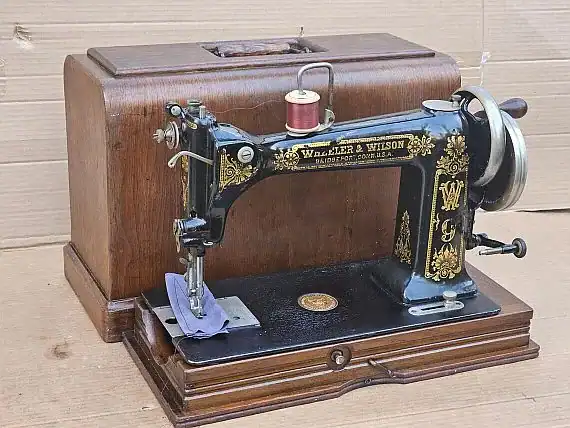
This came up on another BB, from Judy, the owner We have just set up a website for Judy’s Sewing & Craft Museum in Morro Bay, CA. The museum has over 20 antique sewing machines, and has Featherweights on display and for sale. The Museum also has many other sewing related displays … of finished work as well as sewing tools. You can check it out at http://members.aol.com/JSewCraftM/index.html
Mary Waller, snowed in South Dakota, who has an article in the current issue of The Professional Quilter, photo of recycled jeans Christmas stockings in Traditional Quiltworks (same issue Alan’s in), a quilting tip in Sew Many Quilts, a couple of paragraphs in The Electric Quilt’s Floppy Gazette and a nice mention in Nancy Kirk’s Quilt Heritage Foundation News — won’t pay the mortgage or make me famous, but makes me look more “professional” and pads the C.V.!
Date: Tue, 10 Nov 1998 21:35:00 -0000 | From: “ROBERT J CARROLL” <robert.j.carroll [at] gte [dot] net>
The first charm quilts date back to the 1860’s. Most were made during the late 1870’s and 1880’s. They were made throughout the following decades, continuing through the 1930’s, becoming popular in recent years. They are usually made with one template but there are two and even three template charm quilts. Typically all the fabrics in a charm quilt will be different, although many quiltmakers would duplicate one fabric just for fun.20
See Pat Nichols research paper in Uncoverings 1996 where she explains in detail20 these rare and “charming” quilts. Laurette
Date: Tue, 10 Nov 1998 23:03:26 -0700 | From: “Jeanne.Fetzer” <Jeanne.Fetzer [at] integrityonline3 [dot] com>
Dear Friends,
Thanks for all your advice. I combined thoughts and decided that I could volunteer for a few more items, but had a cordial visit with the faculty member on the committee and suggested that work in 1999 needed to be on a business level. I think that she not only understood my position, but agreed. I have driven 90 miles each way to 3 meetings and will do one more. In addition, by donating forms developed for the collection and offering “free” advice, I think that the committe trusts me and knows that I also respect what they are trying to accomplish. So thank you, once again. I love reading the list each day.
One more comment like Sharon, I have returned to school – to finish a bachelor’s degree. I am finding the professors in the history department to be very helpful. I would encourage anyone considering returning to school to: find faculty who will encourage the academic study of quilt history. They are out there! The more of us doing such things will only add to our professional status.
Jeanne Fetzer
Date: Tue, 10 Nov 1998 22:56:47 -0600 | From: Laura Hobby Syler <texas_quilt.co [at] mail [dot] airmail [dot] net>
“August, Rachel” <papillon [at] alaskalife [dot] net>
Cc: QHL [at] cuenet [dot] com
Hi Rachel,
In addition to Xenia’s info, it is my understanding that a charm quilt was comprised of 999 different fabrics and *1* repeat.
Laura
At 0933 PM 11/10/98 +0400, Xenia Cord wrote
>Hi, Rachel – my understanding is that the traditional charm quilt had only one pattern shape, and that all the shapes were cut the same size. I suppose that might be so the collector could carry her template with her, cutting fabrics from among her friends’ stashes as she visited. I believe the strongest interest was in the last quarter of the 19th century.
>I suppose if you had a design with more than one pattern shape, but still limited in the number of shapes, you could call it “charm-like” – would that work? The charms I have sold have mostly been hexagons, lozenges, or squares.
>Xenia, in Indiana
Date: Mon, 09 Nov 1998 22:57:27 -0600 | From: rshink <mcr2 [at] musica [dot] mcgill [dot] ca
Kris. I hope this is going directly to you as I am wondering abput the going prices for silk quilts today. I have started to do quilt apprasails and examined a lovely silk quilt done in the quilt as you go manner even the back squares are silk. it has a jole and i WOULD LOVE TO FIND A BIT OF THE BEIGE COARSE WEAVE FOR REPAIRS. iT IS VERY UNUSUAL WITH CENTER OF THE SQUARES A 4 PATCH AND THEN A COURTHOUSE STEPS FINISHING The square. Any idea what price the owner may get. He thinks in the thousands but I rather doubt thet. On a lighter side sounds like you had a great adventure in Hiuston. I am planning to go to Paducah this April. I learn so much from QHl keep up the good work Diane Shink in Frost free Montreal
Date: Tue, 10 Nov 1998 00:18:09 EST | From: KennaleeM [at] aol [dot] com
Hi all: I read with much interest about the quilt on Ebay because my mother had purchased some of the same blocks last summer. I happened to order a catalog of redwork patterns from “Sally Goodspeed” and found the patterns for “Colonial History” quilt blocks, the very same as she bought! So of course, I ordered the patterns.
The catalog contains many designs suitable for embroidery, all kinds of sunbonnet girls and ladies, Nancy Cabot quilt patterns and other McKim patterns. Catalog was $2.95 (in July ’98) from Sally Goodspeed 2318 N. Charles St.
Baltimore, MD 21218-5130
410-235-6736
Kennalee in So. Calif.
Date: Tue, 10 Nov 1998 00:12:56 -0500 | From: “Judy Grow” <Judygrow [at] blast [dot] net
Anthony — I am not a restorer, although I did take the the restoration workshop in Omaha this September. I am a collector.
If your quilt was my quilt — and I wish it was — I don’t think I would restore the binding. By that I mean trying to find a new matching fabric, and sewing it over the old binding. Nor would I remove the old binding. Nope. I think I would get matching bridal veiling and applique it over the old binding. The way we were shown to do it was to cut a larger piece, applique it down, then trim close to your stitches. It should be almost invisible when you are done, and will protect what is original and still there, leaving the original visible. Joanns sells it cheap, and it is at least 60″ wide.
Judy in Ringoes, NJ judygrow [at] blast [dot] net
Date: Tue, 10 Nov 1998 00:22:49 EST | From: JQuilt [at] aol [dot] com
there is a new Applique list online. It is on the Quiltropolis “Mailing List” page at the website: http://www.quiltropolis.com for anyone who wants to join.
jean jquilt [at] aol [dot] com
Date: Mon, 09 Nov 1998 22:32:08 -0700 | From: “ROBERT J CARROLL” <robert.j.carroll [at] gte [dot] ne
Hello!
I have a question for the list. I came across two books listed in a catalog and I’m wondering if anyone had read them and could tell me if they would be useful in dating fabrics in quilts.I have all the usual books on fabric and dating and thought I might add these to my book collection, but they are rather costly and I’d like to know a little more about them. Any information will be appreciated. The books are=20 Encyclopedia of Textiles, by Judith Jerde and
Textiles/5000 Years, by Jennifer Harris
Thanks, Laurette
Date: Tue, 10 Nov 1998 06:07:51 -0500 | From: Debby Kratovil <kratovil [at] his [dot] com
At 12:13 PM -0700 11/9/98, Sharon Harleman Tandy wrote:
> Other ways to find acceptance as a professional: We are in a field where it’s hard to get our names out there except among ourselves. My grad. committee chairman asked me the other day, “Who is your audience? If you write, who will be buying?”
May I suggest that quilting magazines are always on the lookout for quality writing on any of the subjects that have been discussed on this list! I regularly write for Quilt Magazine and her sister quilting magazines (10-12 magazines a year) and I know the editor, Jean Ann Eitel, is always open to articles dealing with any of these issues. I am not an historian, though I dabble here and there. I mainly do instructional articles (cut this many squares, slice up that many triangles, etc), but we are ALWAYS wanting one or two pages of text on topics like redwork, dating fabric in antique quilts, etc. Of course, if they can be accompanied by a slide or two of an antique quilt, so much the better.
Privately email me for how to contact Jean Ann. I’m not sure about the other quilting magazines out there, but I do know that there are some representatives on this list to whom you can query! When you are published on a regular basis, your name does elevate to “professional” status because it gets recognized. It has helped me get other jobs locally, get recognition in exhibiting, etc. Not to toot my horn, ’cause I’m still just a regular person washing laundry and cooking meals for my family in between quilting and writing! Debby
Date: Tue, 10 Nov 1998 06:25:38 -0800 | From: “fall” <fall [at] teleport [dot] com
I agree completely with Debby.
As a gal who’s worked with many quilt, sewing and craft related magazines, I can assure you that being regularly published is one of the best ways to get your name and your services known to people.
Putting together a “talk” or lecture for guilds, historical societies etc. on some fun and interesting aspects of quilting, whether it be history, restoration or some other topic, is also a good idea.
Make certain that the magazine article or lecture hand-outs have a mean for folks to contact you if they are in need of your services. A website URL that they can visit and find out more about you would be great, too.
Happy Quilting!
Cheryl Fall in wet and soggy southwest Washington State
Date: Tue, 10 Nov 1998 10:19:41 EST | From: ThreadDog [at] aol [dot] com
On Sept. 11, 1856 the Steamboat Arabia hit a snag, and sunk in the Missouri River few miles upstream of Kansas City. All aboard, save a mule survived, but the cargo of merchandise destined for the frontier merchants upstream went down. A rumored “bounty” of Kentucky Whiskey spurred an attempt at recovery in 1877. It failed. An attempt in 1897 had men inside a steel caisson, on their first cut through the decking found precut lumber intended for a frontier home or store, a month later they got through the deck and found leather boots and shoes. After trying a third shot, they completely missed the deck, and ran into some of the sand and river pebbles they had moved on the first two attempts. They gave up.
The Missouri River, being very active, continually changes its stream bed. In 1987, using old river maps and a Proton Magnetometer, the Hawley Brothers found what they believed to be the hull of the Steamboat Arabia, 45 feet deep and over one-half mile from the river edge, in a cornfield belonging to the Sortor family.
To make a long story short, they began excavating the site in Nov., 1988, and in less than four months brought the later day equivalent of a well stocked Walmart to the surface. (No Kentucky whisky, but some French Cognac) They found tools, hardware, dishware, yard goods, beaver hats, shoes, and of course buttons.
Thousands and thousands of beautiful 5/8″ white buttons, with calico surface designs on them from France. When in Kansas City, visit the Arabia Steamboat Museum. You’ll see row upon row of glass dishes, filled with calico buttons. (No you can’t run them through your fingers.) I think it is an amazing story, for the adventurer, the earth mover, the history lover, and those of us who are thrilled to witness the stuff of our past. If you’d like me send you a copy of the buttons’s portrait, to judge whether they have a “contemporary look” contact me by e-mail.
Date: Tue, 10 Nov 1998 09:49:32 -0600 | From: Jennifer Jones <jjkjones [at] springnet1 [dot] com
This is going to sound crazy, but I need to know from anyone when the quilt show is going to be in Paducah this next year. My DH said he would take me this time on one week of our vacation. Isn’t that great! And he told me that I’d better find out in a hurry so I could start making arrangements to go. Can anyone out there help me. A fellow quilter, but in the first stages of learning. I can sew but have an awful time quilting with the arthritis in my hands but still enjoy it. Even though it takes me longer than some.
Can’t wait to see some of you there.
Jenny
Jennifer Jones
Date: Tue, 10 Nov 1998 11:44:18 +0000 | From: Shirley McElderry <tigersoup [at] lisco [dot] net
At least by 1914, there was a company in Philadelphia called “The Quaker Lace Company.” In a Woman’s Home Companion issue of March, 1914, was a half page ad: Quaker Craft–Lace for window draping, sold by the yard. –makers of Quaker Laces, Quaker Lace curtains, and Quaker Craft Lace.” The brand name of “Quaker” was registered in a 1926 Davison’s Blue Book. The address was 4th & Lehigh Aves., Philadelphia, PA. They were still in business in 1933; and their salesroom was at 330 Fifth Ave. NYC. I would presume this company also made tablecloths.
Shirley Mc from Iowa
Date: Tue, 10 Nov 1998 10:24:13 -0600 | From: Laura Hobby Syler <texas_quilt.co [at] mail [dot] airmail [dot] net>
Judy, Anthony etal….
Good morning! I’ve been pondering your question Anthony, and I guess I’ll better jump in. As a restorer with 20 years experience, I cannot give you a definate answer. I will give you some suggestions. First off, The first question that I ask any client is…”What is your intent? Do you want to put the quilt to a useable condition or do you want to preserve the quilt for posterity?” I would have to say if it were my quilt…if the wear on the binding was not such that there is batting falling out or threat of bits of wonderful vintage fabric falling away each time you open the quilt up…I’d leave well enough alone.
As to the use of bridal illusion or silk crepeline…if you want to merely conserve the quilt then the use of these products is perfectly acceptable and appropriate. One word of caution. Be sure that you do not use nylon bridal netting. Even the shearest is much stronger than the cotton fibers that you are attempting to preserve and will in time (as little as 15 years) with just a little use abrade the fibers further. I have spoken on the list several times about the ongoing debate with quilt shops caring polyester batting and customers using it in antique/vintage quilt tops…and that’s another discussion for another time. Just know that both the silk and nylon are stronger than the cotton and should be used only when the quilt will receive no further use. As Judy said, do not remove the original binding. If you feel the need to replace the binding, try to find a vintage fabric that will work or a repro that is suitable.
Again, since this is your personal quilt, just as I tell my clients, it’s a judgment call…what do you want to do with the piece and how do you intend to: use it. That is really the bottom line that should tell you what direction to take.
Hope this helps……..
Laura
Date: Tue, 10 Nov 1998 10:57:12 -0600 | From: Russell-Hill <russhill [at] ctesc [dot] net
I have been pondering the question of what to use for the work some one has asked me to do on their quilt that is approx. a 1930’s quilt. I knew I did not want to use nylon netting over the worn areas and had thought that maybe cotton netting would be the answer. I had the opportunity of using it in an 1860’s bonnett makeing workshop this summer. I wasn’t sure if it would be sheer enough. Any thoughts out there on this. I know I can get it from a wholesaler in Dallas.
Debbie russhill [at] ctesc [dot] net
Date: Tue, 10 Nov 1998 12:57:56 EST | From: HKnight453 [at] aol [dot] com
Hello all-
Quake Lacre is still in business, providing cotton and cotton-rich tablecloth, curtains tc in American made Nottingham style lace. I believe they even have a web site.
Heather in Chilly RI
Date: Tue, 10 Nov 1998 12:39:37 -0600 | From: Russell-Hill <russhill [at] ctesc [dot] net
I should have said that the netting is cotton tulle. So it is fine. Sorry it was an after thought.
Debbie
Date: Tue, 10 Nov 1998 10:42:13 -0800 | From: “August, Rachel” <papillon [at] alaskalife [dot] net
I am the owner/moderator of the Y2K Quilt List. We are planning to put up a web site for this “event” and would like to have answers for everyone’s questions. You folks are the authorities…please help us Please describe charm quilts? Specifically, can it contain charms of different sizes and different shapes? Is it enough that no one fabric is duplicated? When were the first charm quilts made?
The beginning of a new millenium is a major event for all of us, which is why so many quilters are enthused about making millenium quilts. Did quilters do anything special in 1900 to celebrate the new century? Any other information you would care to provide would be appreciated. And if anyone would like to contribute a charm and signature square for my quilts, I’m collecting 2″ and 2.5″ charms. Also, you are cordially invited to join us…just click on the URL beneath my name and follow the directions. Thank you in advance for your assistance…
Date: Tue, 10 Nov 1998 17:07:38 -0800 | From: Denise Clausen <nadyne [at] oregoncoast [dot] com
Hi to all
I would like to recommend the “The En Garde Cutting Edge”. This is what we now use at the Latimer Quilt and Textile Center. I used to worry furiously that a volunteer would slice a finger with a rotary cutter, until we received an unsolicited ad in the mail regarding this ruler, that has a built in guard. It looks very awkward (takes up a lot of room to store), and some didn’t want to use it. But it really is great, not a problem to use at all. And now I don’t worry, especially when young people use it. We bought a 24″ and a 12″ version.
For info:
Collier Enterprises
P.O. Box 2081
Littleton, Colorado 80161-4848
303-770-4848
Safe fingers to you all!
And tell them the Latimer Quilt and Textile Center sent you.
Denise Clausen
Director LQTC
< Bob Mills wrote:
It’s been a while since I could type-had a nasty accident with my 45mmrotary cutter. Even though I have used them extensively since they firstcame out, all it takes is one second of carelessness or inattention. My cutter can and will cut 1/4 inch deep and didn’t even stop at the nail. YUK. So be less aggressive and more attentive than me.And I ruined a new blade also! Am OK now. I ordered one of those clear lucite ‘sissy bars’ from Pinetree but haven’t put it on yet. I have the feeling that I will find it annoying so am procrastinating using it. Anyone else use one and like or dislike it?>