February 16 – 20, 1999
These restored messages come from the Quilt History List, an online forum where quilt historians, collectors, researchers, appraisers, and enthusiasts discussed antique quilts and related textiles. The archive dates from 1996 through approximately 2016 and is being restored gradually. Sign up in the form at the bottom of the page if you want to know when a new page is added. Original spelling, opinions, formatting, and inactive links may remain unchanged.
Primary topics of this QHL Digest:
- Antiques Roadshow Quilt — Members discuss a quilt appraised on Antiques Roadshow and react to the televised estimate.
- Orvus Paste for Quilt Washing — An extended discussion of Orvus paste concentrations, sourcing at feed stores, and emerging concerns from conservators about residue on textiles. (see the article on cleaning antique quilts)
- Batting Choices: Poly vs. Cotton — Quilters compare experiences hand-quilting with polyester versus cotton battings, including Hobbs and Quilter’s Dream brands. (see the article on quilt batting)
- Martha Stewart Textile Conservation Segment — A television spot featuring a textile conservator demonstrating Orvus washing and proper storage prompts further discussion of cleaning methods. (see the article on repair, restore, or conserve)
- Reproduction Fabrics and the Shelburne Museum — Members ask about sourcing reproduction fabrics, including lines based on Shelburne Museum collection pieces. (see the article on quilt museums)
- Humility Blocks — A newcomer asks about the tradition of deliberately placing a ‘mistake’ in a quilt, and members weigh in on its history and authenticity.
- AIQA Exhibition Rules Controversy — Discussion of the American International Quilt Association’s policy requiring quilts not previously exhibited elsewhere.
- NQA Show and Quilt Heritage Foundation — Preview of the upcoming National Quilters Association show in Omaha and questions about the Quilt Heritage Foundation.
Date: Tue, 16 Feb 1999 23:16:40 -0600 | From: Mary Waller <mswaller@>
I also saw the quilt Jeanne asked about on ‘Antiques Roadshow’. I’m not going to second-guess Leslie Keno’s estimate, but I will mention his business is in New York City and his main area of expertise seems to be furniture, it’s a great quilt in great condition, has a family history and a cross-stitched label about the maker and the person who made the label on the back. I was concentrating on every word, so when they went to the next item, DH Steve said, “I can’t believe you weren’t yelling, ‘Tell her to get it the hell out of the cedar chest!'”. But of course I would have added, “And refold it!”
Mary Waller, Vermillion, SD
Date: Wed, 17 Feb 1999 07:36:52 EST | From: CToczek@
Hi everyone,
I’ve lurked for awhile; enjoying the commentary and doctoring the boys’ chicken pox here at home.
Poly batts-For a while I’ve been machine quilting several smaller projects, playing with the technique. (new things-not vintage) However, recently I went back to a small applique project to hand quilt and was reminded of how much tougher, literally, it is to hand quilt through cotton batting as opposed to the thin poly batts. Yes, I saw posts here regarding wool batts and the newer cotton batts like Hobbs organic and Fairfield Soft Touch, but I would like to throw out this question: Can any of you say from hands-on experience that you’ve found one of these cottons to quilt as easy as the thin poly-batts? Any “stories from the field”
are welcome.
Thanks,
Carla, at chilly West Point, NY, who hears of 70F from Mom in Little Rock, AR
Date: Wed, 17 Feb 1999 08:07:23 -0500 | From: Alan Kelchner <quiltfix@>
I’m glad to know my predilection for using orange in my quilts is genetic !
(family is Pennsylvania Dutch). But to paraphrase an old quote, gaudy is as gaudy does, so forgive the poor souls that call PA German quilts gaudy.
They don’t know better 🙂
The lack of knowledge of quilting in dealers extends from country auctioneers all the way to those fancy-types that appraise for the Antiques
Roadshow. I watched it Monday night and was dumbfounded when they appraised a fantastic quilt (textiles are so uncommon on this show).
Well, the appraiser, Mr. Keno from Sotheby’s (that 40ish thin blond guy who’s a furniture expert, and occasionally we see him with his brother – they look very much alike). Anyhow, he appraised the piece as a piece of folk art, rather than as a quilt. Verrrrrry interesting. But his ignorance was showing very badly (I was quite embarrassed for him). He talked about the design work, the “pinwheels” pattern, and the weaving patterns (this was a magnificent 1850 Princess Feather, four blocks, peacocks and other birds appliqued into the border,and it was quilted, not woven !). He appraisal bowled me over. I’m definitely dealing in the wrong sellers’ market. But really, if you’re gonna get up and talk, you need to talk intelligently. I was so disturbed by it that I emailed the Antiques Roadshow. It’s a disservice to the viewers to appraiser something when you can’t discuss the piece properly. And yes, this was a Southeby’s auction price for what appeared to be an extraordinary.
What’s that other saying …. Keep your mouth shut and be thought a fool, or open it and remove all doubt ……?
Alan
Date: Wed, 17 Feb 1999 08:07:43 -0600 | From: Laura Hobby Syler <texas_quilt.co@>
Hi Carla,
As I stated before, I quilted many, many tops in the late ’70’s & early
’80’s with Fairfield poly batts….traditional to be specific, until they came out witht he low loft…..and yes, they are like quilting on butter… I now use the either the F. Soft Touch or the Hobbs Organic. Yes, they are a little stiffer to quilt on, and I do bend many more needles that I would like, but I am still able to get my 18-22 (on a *really* good day) stitches to the inch …..incidently, not only does the batting effect the sluggishness of your stitching, but I’ve found that the fabric really plays more of a role. I am finishing up a baby quilt that my mother did for my cousins baby and they used decorator fabric with a shrinirized (sp) finish…boy, even after washing it’s so stiff I cant quilt on if for very long…and they put a poly bat it in! As I tell my beginning students, quilting is a masochistic art form and we just have to * suffer in silence* <VBG>
Laura
Date: Wed, 17 Feb 1999 08:10:10 -0600 | From: Laura Hobby Syler <texas_quilt.co@>
I’m glad that others of you saw the quilt on Antiques Roadshow.
I loved Mary’s comments – and her husband’s. I am teaching a conservation class in a couple of weeks and will probably tell them remember at least their two comments. As to the price of the quilt . . . after seeing some of the pieces in the James collection last fall, I’m not so sure the pricing was out of line (remembering he is from New York.)
We were shown a Baltimore Album quilt which the James’ paid $160,000 for in 1989.
A quilt is always worth what someone will pay for it “with a knowledgeable seller and a knowledgeable buyer.
Date: Wed, 17 Feb 1999 11:57:15 -0600 | From: Laura Hobby Syler <texas_quilt.co@>
Jeanne, et al,
Did anyone else happen to see Martha this morning? I caught just part of it and she had a woman on there that was talking about caring for your antique and fine linens. She was a textile conservator. She showed how to wash a deuvet cover using Orvus paste in a professional washing table (can you see the envy here) like the one that Maury has….<G> Her formula for Orvus was 1 tsp per quart of water or 1 TBS per gallon…..is’nt this similar to what was discussed in Omaha this year?
Then she talked about storage, acid free tissue, buffered tissue and acid free boxes….She also discussed all of the wrong ways that people send items into them wrapped in paper, masking tape and all the horrors….
anyone else see the spot?
Laura
In springy N. Texas
Date: Wed, 17 Feb 1999 11:23:20 -0700 | From: “Jeanne.Fetzer” <Jeanne.Fetzer@>
I saw it, too. There are a couple of things different about her recommendations on the use of Orvus. One is that Deborah Bede uses a lot (understatement) more than 1 TBS. per gallon. Due to my brain cell deterioration, I can’t remember the amount, but I think that it was a least a cup to a gallon of water. I am sure it would depend on the amount of soil and the type of textile you are cleaning. Also, other sources for Orvus are available in larger quantities – like an animal feed store. It is horse shampoo.
Please correct me if any of this is incorrect. The great thing about brain deterioration is that you also lose any sensitivity to correction! Jeanne
Date: Wed, 17 Feb 1999 17:42:36 EST | From: SudaNim@
Thanks to the folks who responded to my request for interviews. There were enough of you that I didn’t get to call everyone. Apologies to those I left out. (And also, apologies to those I interviewed who also got left out.)
The story is scheduled to run Sunday. It may be posted on the web site as early as Saturday; not sure about that, though. The paper’s website is www.dallasnews.com.
Be warned it’s not entirely about the URR code, or the Hidden in Plain View book. It’s more of an essay, based on an interesting personal fabric- identification experience. I only get to write in first-person about once a year, so gotta milk it for all it’s worth! 🙂
Aline
From: KirkColl@
To: QHL@
Subject: QHL: Re: Orvus and cotton batting
Message-ID: <2a7aa2fc.36cb8c0e@>
1. I was talking to Deb Bede yesterday. She”s planning to move to New
Hampshire and go into private practice in late spring/early summer, so all of you in New England will have a new great resource. She recommended a 2% solution of Orvus for maximum cleaning power. It also takes a lot of water for rinsing, and of course she uses all deionized water (special plumbing). 2. Re: cotton batting. The new batts, especially Quilter’s Dream, are great, but it still helps to have the right needles. We recommend the Majestic 88 which is an English steel needle that is brought to the States and taken to an electroplater where the outer coating of steel is stripped off and then individually dipped in nickle. If you look at a regular needle under a microscope, there are all kinds of little ruts from the mass production process. These are absolutely smooth. They are expensive — 2 for $3.75, but I always tell people there are very few things you can get for less than $5 that will change your life, but this is one of them. The downside is that they are so slick they will fall into your pin cushion, never to be seen again, so they must be kept in their case when not in use. Also, if you get them mixed up with your other needles you have to get out the microscope.
They are not stronger than steel needles, but because there is no resistance as they go through the batting, it takes a lot less effort to quilt, usually meaning fewer bent and broken needles.
I don’t mean this to be an ad — I know these are available at some other shops and frankly I wish every shop in the country carried them because it would convert a lot more people to using cotton batting. They are great for wool as well, and an absolute must for silk batting. Plus I usually lose money selling them — by the time I pay for the 800 call and explain about the needle I’m in the hole about $5 on the sale.
Nancy Kirk
The Kirk Collection www.kirkcollection.com
Date: Thu, 18 Feb 1999 00:07:54 -0500 | From: “Judy Grow” <Judygrow@>
Correct me if I am wrong.
Deborah said that the “ions”(?) in Orvus bind themselves individually to particles of dirt in the object being washed. When all the Orvus particles are attached, no more cleaning can be done. So you might as well use a lot of Orvus the first wash, than have to go back and do a second wash. We want a lot of suds and foam. No suds, no foam, no cleaning.
Yes? Do I have it right?
Judy in Ringoes, NJ judygrow@
Date: Thu, 18 Feb 1999 07:35:02 -0500 | From: Alan Kelchner <quiltfix@>
If you want large quantities of Orvus, go to your local feed-n-tack store (supplies for your barnyard animals, for all you city-types <G>.
Hmm, for you those stores may not be all that local !! ) And if memory serves me right, when I last saw a large bottle at the feed store, it said on the label it was for washing the teats on a cow’s udder prior to milking. The horse shampoo is the Mane and Tail on the supermarket shelves. But if you buy this stuff at the feed store, it’s much more inexpensive than those 8 oz bottles at Joann’s !
Alan
Date: Thu, 18 Feb 1999 06:42:46 -0600 | From: “Sehoy L. Welshofer” <sw4quilt@>
Hi everyone,
Can any of you say from hands-on experience that you’ve found one of these cottons to quilt as easy as the thin poly-batts? Any “stories from the field”
are welcome.
Thanks,
Carla,
Reply:
Clara – I use nothing but Hobbs all cotton or 20/80 for my hand quilting. I love it. The needle glides through with no problem at all. The secret for hand quilting is to presoak, spin out, put in dryer on high heat. No, it doesn’t come apart, and it doesn’t shrink. It comes out of the dryer wonderfully soft.
Visit Web Threads, the Newsletter for Net Savvy Quilters at:
Date: Thu, 18 Feb 1999 08:02:30 -0600 | From: Laura Hobby Syler <texas_quilt.co@>
Judy, Even though I was not in Omaha, I have talked to a couple of my friends that work in the textiles testing lab here for JC Penney’s and they concur with Deborah’s theory….molecule for molecule kinda thing……as opposed to detergent that acts in a scraping method to remove the dirt molecules the Orvus binds itself to the dirt ( do they have something that I can spray over my whole house?????)
Laura
In Springy N. Texas.
Date: Thu, 18 Feb 1999 08:59:52 -0700 | From: Eileen Trestain <ejtrestain@>
Deborah Bede said three cups of Orvus to 10 gallons of water, in a big textile tank, with very little agitation. You need enough soap molecules to bond with the free radical dirt molecules to remove dirt. Not enough soap leaves the textile still dirty. She said to rinse rinse rinse. Even after many rinses, you may have a few bubbles in a test tube when shaken, but she also said you could have bubbles in the test tube when the soap could no longer be chemically measured.
Eileen
Date: Thu, 18 Feb 1999 11:59:31 -0800 | From: “R & L Carroll” <Robert.J.Carroll@>
Hello! Our quilt study group had a speaker a few months ago, Kay Walcher, a textile conservator. She mentioned that other conservators in their group were no longer using Orvus because it leaves a residue which shows up later as a film on textiles. They have seen it most notably on carpets. They feel that it cannot be rinsed out completely. For myself, I have not found
Orvus cleans a quilt very well. I don’t see the point of washing a quilt if it does not clean up. Using the high concentrations mentioned would only add to the difficulties of rinsing. Has anyone used the new Quiltwash by Craftgard? I met the people from Quiltwash and they tell me it is perfectly safe for antique quilts, and that Piecemakers is using it for all their antique quilts. They explained it all in scientific terms, but I’ve forgotten. I have used it to wash new quilts and it does a great job of cleaning.
Laurette in So. California
Date: Thu, 18 Feb 1999 17:12:39 -0500 | From: Steve Greco <GrandmasAttic@>
I had to laugh about the comment that your dear husband said he couldn’t believe you weren’t yelling “tell her to get it out of the cedar chest”
because when my husband and son came into the living room during Antiques
Roadshow, they actually did see me hollering at the TV, “Get it out of the Cedar Chest and for heaven’s sake REFOLD it!!!” I too noticed that this fantastically beautiful quilt was being talked about as a piece of “folk art” and not as quilt, and I couldn’t BELIEVE the guy doing the appraising didn’t know what he was talking about. Sigh. Anyway, husband and son decided I needed to calm down with a cup of hot tea since I was yelling at the TV!.
Rachel Greco
Grandma’s Attic Sewing Emporium, Inc.
155 SW Court Street
Dallas, OR 97338 1-503-623-0451 e-mail: GrandmasAttic@ www.grandmasatticquilting.com
Date: Thu, 18 Feb 1999 15:53:32 -0700 | From: “jenniferl hill” <hilljl@>
The first quilts that I made were quilted with poly batts, on the advice of my aunt, who taught me the basics. She was one of those mid-century quilters for whom poly batting was the best thing to happen to quilting since the sewing machine (she obviously never used a rotary cutter!). By 1994 I decided to try cotton, since I liked the old fashioned feel it imparted. I used Hobbs Heirloom, and I sure regretted it, at least for the first few “reaches” of my queen-sized Lone Star. However, by the time I finished it, I was quite accustomed to it, and now, I think I could quilt through steel wool, if I really had to (well, maybe not!) I use cotton batting almost exclusively now, and I find poly quilts have a very limp drape to them.
My favourites are Hobbs Organic Cotton for very fine work, and Mountain
Mist Blue Ribbon for scrappy, “utility” quilts. I like to quilt rather densely, so I don’t think it worthwhile to pay extra for the brands that say they can be quilted up to 5″-10″ apart.
Like Laura mentioned, the fabric used can make a big difference, blends, and decorator fabric being tough. However, I think the quilting pattern chosen can also have an effect. I did a fairly comprehensive survey of quilting needles on a wholecloth muslin quilt I made. I broke over 40 needles in it, quilting lots of feathers and grape clusters.
Jennifer Hill
Calgary, AB
Date: Fri, 19 Feb 1999 08:45:06 EST | From: CToczek@
To: QHL@
Subject: QHL: batt info
Message-ID: <9d3df7a9.36cd6ae2@>
Thanks to everyone who has offered field advice on the cotton batts. Thanks also, to Nancy, in regard to the note about the needles. You read my mind! I have wondered if perhaps my difficulties with the cotton batts might be partially related to my generic quilting needles. I’ll try the stronger ones and see if I find an improvement.
Best to all,
Carla, at West Point where the snow forecast disappeared…..as a new resident up here, I think you’re all pulling my leg about winter snow amounts! <vbg>
Date: Fri, 19 Feb 1999 08:26:47 -0600 | From: “Brian/Jen Schmidt” <brian_jen@>
I have used Hobbs Thermore Ultra-Thin poly batting and the thinnest loft of Quilter’s Dream Cotton Batting. To me, they needled the same. However, I favor Quilter’s Dream Cotton because it ends up shrinking a little after I’ve washed the finished quilt, and I like the effect. But if I had to use a poly batting, it would be the Hobbs Thermore.
Jennifer
Can any of you say from hands-on experience that you’ve found one of these cottons to quilt as easy as the thin poly-batts? Any “stories from the field”
are welcome.
Thanks,
Carla,
Date: Fri, 19 Feb 1999 10:43:49 -0500 | From: “Judy Grow” <Judygrow@>
I’ve got two things to share with you today, both from newspapers.
1. On page 3-A of the March issue of the Maine Antique Digest are two small photos and accompanying short editorial. The photos are of a quilt that is just a single large apple tree; one photo of the quilt itself (wish I could see it in color) and one of the quilt as the cover of “Yankee”
Magazine.
The paragraph says that in August of 1998 M.A.D. took a picture of the apple quilt in a dealer’s booth at the Union, Maine, antiques show. At the time the dealer told them that the quilt was “probably” turn of the century and signed by the maker, Polly Leavitt. In January M.A.D. got a letter from Polly Leavitt with a picture of her making the quilt in 1974. It was on the cover of “Yankee” in September of that same year.
When M.A.D called the dealer, he said, “Nothing surprises me anymore.”
Right! Isn’t he supposed not to be surprised if he gives a prospective buyer a description?
2. New York Times, Thursday Feb 18, page F-11. There is a large article/review by Phil Patton of the book “Hidden in Plain View” . This is the first review or article about the book that I have read or seen that finally casts doubt about the veracity of the facts as stated in the book.
Some quotes follow —
“Did Ms. Williams, who died last May, really present the code as a practical aid? As recited, it seems more inspirational than navigational.”
“John Michael Vlach, chairman of African American studies at George
Washington University, reviewed an early proposal for the book for a rival publisher and was not convinced. ‘ It’s a nice idea,’ he said, ‘ and it would be marvelous if we could prove it. But from the evidence I don’t see the smoking gun — or quilt.’ ” “Quilt codes are not mentioned in contemporaneous accounts of the underground railroad, and the code doesn’t reach the systematic nature of, say, the symbols scrawled on fences by tramps a century ago to set apart friendly farms from hostile ones.” ” …. the Northern Star for guidance; the Drunkard’s Path pattern advised taking an irregular course to avoid apprehension; Flying Geese signaled the way north — but only in the spring. These are not exactly Rand Mc Nally maps.” “Designs for escape or designs for the dream of escape, the quilts raise problems…………But to romanticize efforts to escape from slavery underplays the hopelessness that made the institution so evil.”
And finally:
” The sad but likely truth is that for many, if not most, quilts were not the escape map but the only escape.”
What a wonderful last line. As quilters we know that quilting does not show us how to get OUT of unpleasant situations in our own lives. But we do know that we can escape from those situations, even momentarily, INTO our quilting.
Judy in Ringoes, NJ judygrow@
Date: Fri, 19 Feb 1999 08:45:02 -0800 | From: Marilyn Maddalena <marilyn@>
I am a Board member of NQA and Publications Chair, so I produce the magazine, The Quilting Quarterly. I am not aware of any “flap” about entering quilts in the NQA show. I think you may be thinking of Houston, where I understand there were some problems with entries. The NQA show is held annually at a different location each year, to ensure we reach the most members possible. It is a non-juried show, and in my experience has been great. It is a big show, with quite a variety of quilts to be seen from all over the country, and great vendors — everything you’d like to see in a quilt show. The magazine has an article about the show this year, which is in Omaha, NE. If you’re not an NQA member, at a cost of $17.00 per year, you won’t be able to get the magazine — it’s sent only to members. NQA is completely non-profit, has a program to certify teachers and judges (where AQS has a program to certify appraisers), also gives grants and lots of other “good stuff.” You might look into it. You can call the office at 410-461-5733 for more information,
Date: Fri, 19 Feb 1999 12:29:19 EST | From: ZegrtQuilt@
For those of you in Florida and near Naples, I will be speaking at the Naples
Philharmonic on Monday, March 22 at 10 A.M. The title of the lecture is
American Quilts: A Patchwork of Meanings, Purposes, and Origins. It is part of a series called The Tactile Series. Please contact the Philharmonic for individual ticket prices. I would be pleased if some QHL folks could be there. Shelly Zegart
Date: Fri, 19 Feb 1999 13:28:05 -0800 | From: “pepper cory” <pepcory@>
Friends, let’s get the facts straight before some misunderstanding happens about the “quilt flap.” Last year AIQA (Houston organization) came out with some guidelines for entry into their fall show that included a prohibition against exhibiting the submitted quilt elsewhere. Perhaps this was in response to some famous quilts that had been making the quilt show circuit and AIQA wanted to ensure that new and different quilts were seen at their show. However, in response to many letters and communications, AIQA rescinded this prohibition. The jurying for that show took place much later than usual because folks had to get their facts straight. I know this to be true because I was one of the jurors along with Jane Hall and Linda
Feidler. Locked in a room with 500+ quilt slides–throw me into the briar patch! If you have questions, please go to the source (AIQA). I was glad to see Mary from NQA (another fine organization) getting information out.
Don’t worry–both AIQA and NQA hold fine shows as does AQS (Paducah).
Pepper Cory
Date: Fri, 19 Feb 1999 15:45:50 EST | From: Lekhbah@
Hi,
I am the mother of two equestrians, and the wife of another. Orvus is the shampoo for horses. Mane and tail, as my daughters sniff, is just shampoo, and is available for human heads. (they won’t use it on horses) You can buy little bottles of Orvus at quilt stores, or big jugs of it at tack/feed stores. We have to buy a halter this week-end, so I’ll check out
Maryland prices.
Kim
Date: Fri, 19 Feb 1999 22:47:54 -0000 | From: “Jenni Dobson” <jenni@>
Sorry I’m a few days late but I read Carla’s enquiry about quilting = other batting compared to poly. I still have a cotton batting waiting = for a hand project – I know cotton is popular with machine quilters & = that’s what I’ve used it for, a limited amount.
Just wanted to say, I recently finished hand-quilting a double quilt = with a wool (+ a small percent poly) batting (Hobbs). It was fantastic – = so easy on the needle & the quilt feels lovely. If you want a natural = fibre instead of polyester, you could try wool. It is light & fine, but = warm yet not “sticky” to sleep under. I guess where you live in the US = affects how useful wool is for you.
BTW, I’m not making a commercial plug here – just a satisfied user.
Jenni, in cloudy England.
Date: Fri, 19 Feb 99 21:45:23 EST | From: “Bob Mills” <decision@>
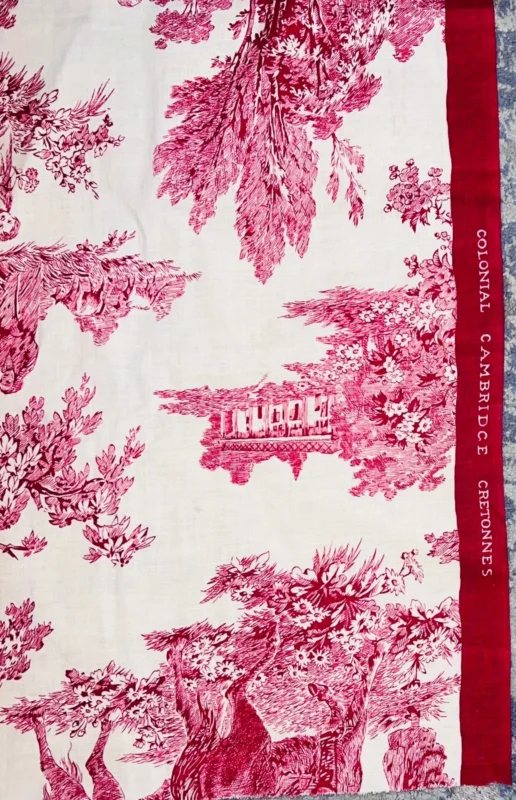
Does anyone know if the repro fabric from the antique quilts and clothing at the Shelburne Museum in VT is sold anywhere besides their museum shop and a Shelburne Quilt shop? I bought two fat quarters there this summer, thinking I could find it elsewhere. I would love to see a catalog with these fabrics. Also, is Sharon Newman’s fabric line sold thru any catalogs? Who is the manufacturer of this fabric? The DAR quilt fabric line is sold in several catalogs but I was wondering if anyone knew if there was a larger selection than appears in Hancock’s catalog.
I feel more comfortable knowing who designed the fabrics (Sharon) or from what museum the fabrics were chosen. Much of the repro fabric in catalogs is advertised as ‘based on’ or ‘inspired by’ quilts in a museum or collection. My question becomes how closely was a fabric based on real fabric? Even the DAR Museum Collection ad in Hancock’s catalog uses waffley words like ‘are the inspiration for’.
Can someone explain the process as to how an antique textile fabric is reproduced?
My other question for the experts is how reliable are the ‘reproductions’ to reality? Why would they be called inspired by rather than an accurate reproduction ?
Is there a graceful way of suggesting to QHL which of the designers seem to have patterns and colors in line with the experts knowledge of fabrics?
Kaye England Voices of the Past, P & B DAR, Moda English Oak, Moda Secret
Garden, Moda Folk Art Wedding, Shelburne, and Sharon Newman’s Browns…
Part of the reason I ask is that if these are good repro’s I want to catalog the pictures of the fabrics in my brain as well as in a notebook. If not, I don’t want to look at them anymore. And Eileen, Judy Grow and I were hopping up and down last night when we found an exact match of fabric in your book to a quilt top I own. It is a yellow with small red figures from 1830-60. If only your book was three times the size!
Jan Drechsler (not Bob)
Date: Sat, 20 Feb 1999 11:10:00 +0100 | From: “Tilde Binger” <binger.hougaard@>
To: QHL@
Subject: QHL: Once more ? Hidden in Plain view.
Message-Id: <199902201010.LAA09404@>
Now, I’m getting curious here. Can any of you ladies, who have actually read this book (! “Hidden in Plain View”) tell me a little more about it. From the review extracts that Judy sent, it seems, that the information of which it is based, has been collected rather late in this century, and that nothing exists from any Underground-users ? Is that correct ? Please e-mail me privately, if this horse has been beaten to death on the list already. Since the matter seems to have created quite a stir on other lists as well, I would be interested in knowing exactly where the data for the book came from, and when. I would also be interested in knowing, whether any material from “Underground-users” has been published, and what this material says about the Underground.
Thank you in advance
Tilde in Copenhagen ….
>2. New York Times, Thursday Feb 18, page F-11. There is a large article/review by Phil Patton of the book “Hidden in Plain View” . This is the first review or article about the book that I have read or seen that finally casts doubt about the veracity of the facts as stated in the book.
…..
>Judy in Ringoes, NJ judygrow@
Date: Sat, 20 Feb 1999 06:29:40 -0500 | From: Jean Ann <quiltmag@>
Well, for my two cents, I supported the decision of the (A)IQA to have only quilts that had not been exhibited elsewhere. There are so many wonderful quilts out there that it is good to see different quilts at the different shows instead of quilts “making the rounds”. It made good sense, but public opinion is also very important and I am sure that the people making both decisions did so with great thoughtfulness and much consideration.
Jean Ann Eitel, Editor
QUILT magazine site: http://www.quiltmag.com – IRC chat site:
http://www.quilttalk.com
Personal web site: http://www.mindspring.com/~quiltmag/jeanann/jaeindex.html
Date: Sat, 20 Feb 1999 09:01:53 EST | From: EGinebaugh@
Hi All,
I need some opinions on a quilt I saw yesterday. It’s calling my name, but I need more info on it before I buy.
It’s a single Irish Chain, made from that “creamsicle” orange & white. It has very little batting, almost full-size, pretty worn on the edges, and a nickle- sized hole on a side, about 2″ away from the edge. The quilting is a crosshatch grid, with feathered wreaths in the open spaces of the chains, and is exquisite! I love it for the quilting, but it is very fragile. My questions are: About what year are we talking for this quilt? Can it be displayed in any way? (I think hanging is out) Should it be repaired or restored? Any other input you have would be appreciated, and you may reply privately to me if it is not of interest to the list.
Thank you for your input,
Liz in Michigan
EGinebaugh@
Date: Sat, 20 Feb 1999 09:31:44 EST | From: Jilly31@
Hi Everyone. I am a beginner here and my question is about humility blocks.
Do quilters still put them in their quilts? Many quilts I have seen at auction or at quilt shows do not have them. If quilters don’t use them anymore…when did they quit? Is this a useful way to help date a quilt?
Thanks for any input.
Jill —- In cold Indiana — If you don’t like the weather stick around — it is bound to change in an hour or two. It was 70F one day and it snowed the next day!
Date: Sat, 20 Feb 1999 09:44:47 EST | From: CToczek@
Not an expert (yet!<VBG>), but I can answer some of Jan’s questions regarding the reproduction fabrics.
Having had the great opportunity to work at Sharon Newman’s shop for a year in Lubbock, TX before the military moved us to New York, I can say first hand that she’s an interesting lady with a head filled with facts and a temperament for accuracy. (I learned quickly to measure through the center to avoid wavy borders!<G>) Sharon bases her repro collections on actual fabric pieces from blocks, tops and quilts in her collection, plus some from friends and some that Moda adds. Moda falls under United Notions Corp. out of Dallas.
By the way, Bobbie Aug and Sharon have a new book out this spring called
“String Quilts With Style,” a modern twist on an old favorite. Through AQS, I think?
Back to repros……Some lines have an “accurate” coloring in say, reds and greens, and then a modern update in blues and purple to attract a variety of customers. Sharon is particular and tries to have ALL accurate colorings.
For instance, with the Vintage Garden line last fall, she was unhappy with the blue colorway, (which I loved), because “it wasn’t right” for the period, but lost out to the Moda folks on the decision. As for the production methods, I don’t know the technicalities, but do know samples are sent numerous times from the plants to the designers for adjustments.
Hope that helps a little; hopefully we’ll hear more from the experienced folks about the process involved in the fabric lines.
Oh, and a teaser….Sharon has a red and green reproduction line in the works for later this year!
Have a nice weekend,
Carla Toczek
Date: Sat, 20 Feb 1999 09:12:26 +0000 | From: Bobbie Aug <qwltpro@>
Dear Jilly,
By humility blocks are you speaking of the purposeful practice of making a “mistake” in one’s quilt top? The “Devil’s Eye” to allow a place for the “evil spirits” to escape the quilt? The belief that to make something perfect would be evil – only God made perfect things? If this is your meaning, then I would say to you that there has never been any conclusive evidence shown in any research that I or anyone else has ever done that supports any of the above as being an intentional practice – at least as it would apply to any formal time period or group of people. In other words, one individual quiltmaker may have done this throughout her lifetime of making quilts, but this does not constitute a “practice.” Too bad as it is such a romantic idea!
Bobbie A. Aug
Jilly31@ wrote:
> Hi Everyone. I am a beginner here and my question is about humility blocks. Do quilters still put them in their quilts? Many quilts I have seen at auction or at quilt shows do not have them. If quilters don’t use them anymore…when did they quit? Is this a useful way to help date a quilt?
> Thanks for any input.
> Jill —- In cold Indiana — If you don’t like the weather stick around — it is bound to change in an hour or two. It was 70F one day and it snowed the next day!
Date: Sat, 20 Feb 1999 10:21:01 -0700 | From: “jenniferl hill” <hilljl@>
I guess the horsey set hereabouts have deeper pockets than quilters, or maybe they just seldom wash their horses. I went to a local tack shop seeking Orvis or even an Orvis-like product in large quantities. I was told it was a special order, and the price quoted was more than the local quilt shops charge for the little 8 oz. bottle. Go figure.
Jennifer Hill
Calgary, AB
Date: Sat, 20 Feb 1999 12:20:25 EST | From: KirkColl@
Two things to comment on:
1) I hope everyone can come to Omaha in June for the NQA Show. The local committee is knocking themselves out to make it the best NQA show ever. In addition to the main show, there are 28 other special events and exhibits around town at the various museums and historica houses including patriotic quilts at the Strategic Air Command Museum.
The Quilt Heritage Foundation is coordinating the appraisals and offering lectures across the street at Trinity Cathedral in a “Quilt Heritage Days”
celebration. We’ll be doing two lectures a day on “Taking Care of Grandma’s
Quilt,” “What’s My Quilt Worth?” and “Tell Me About Grandmother’s Quilt”.
The last is kind of like super show and tell with a lecturer commenting on each quilt.
On Friday night, everyone is invited over to our shop for a party (and shopping of course). We’ll have free trolley rides from the Doubletree up til about midnight.
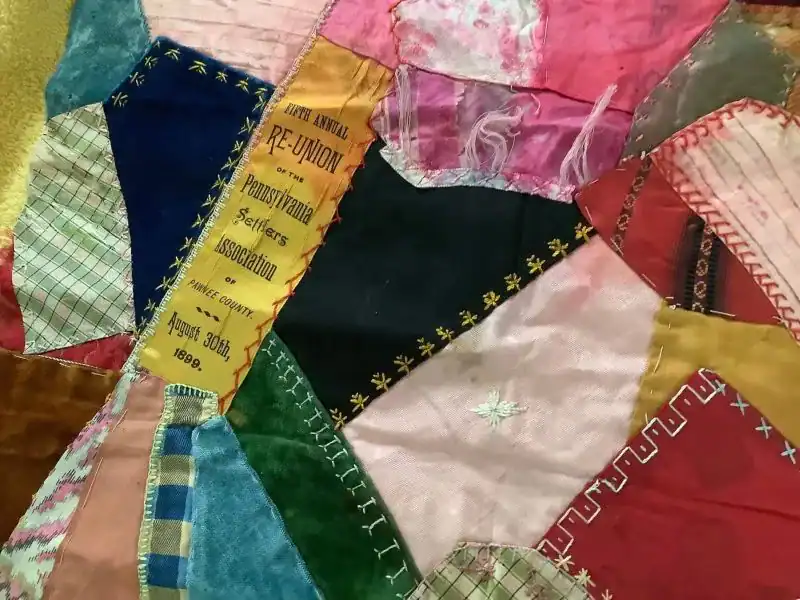
The other big news is NQA has established a new category for Crazy Quilts this year — the first big national show to do so. (Yeah!)
2. On reproduction fabrics. The surface design on most of the reproductions on the market today is great, because it is all done with computers and they can get it very accurate. Sometimes the companies take liberties with the sizing however.
The colors, on the other hand, are a different story. In some lines, all the colors are taken from fabrics of the period. This was true of Harriet
Hargrave’s first collection from P&B. Two pieces (the light cadet blues) were taken from faded fabrics, but otherwise they were dead on. I remember Harriet was in the shop the day after she got the strike offs and showed them to me and I was on the phone ordering them before her car pulled away from the curb.
Some other companies take only the design and don’t worry at all about the color — they just go with 1990’s colors so they fit in with the rest of their line.
Many are now going to a plan of one fairly accurate original colorway, and two or more alternate colorways that probably are based in contemporary colors rather than original ones.
Remember, their business is to sell fabric, and there are many fewer quilters wanting to re-create older quilts, than contemporary quilters wanting to make new quilts.
The minimum run of a given print is 3000 yards with a minimum of 1000 yards in each color — if you print in Japan. If you print in the the U.S., the minimums go up to 7500 yards of one print, with a minimum 3000 yards in one color. That’s why many of the companies sell the fabric at market from painting and color copies before they even print the fabric. Then they don’t even print what doesn’t sell well — and if that was the original colorway — sorry.
A few companies are finding that color accurate reproductions are selling better than “kind of close” reproductions, and are trying to do a really good job with at least one color way.
Some retail businesses sell all the “reproduction” fabrics that come out. We decided to focus on the ones we felt were accurate for both color and surface design. But there are still some good ones out there we miss. Usually we pass because those particular companies don’t stock the fabric and you can’t reorder with any certainty. Because we’re primarily mail order, we need reliable supplies. It’s a fascinating business, and there are lots of factors that come into play. It certainly makes sense for appraisers and quilt historians to try to keep up with the repro market because some of them are very, very good and in 100 years it will be hard to date the quilts if they are quilted with traditional cotton batts and thread that doesn’t flouresce.
Right now we don’t worry about counterfeiting because it costs so much more to make a new quilt than the buy an equivalent old quilt.
Thanks for the forum.
Nancy Kirk
The Kirk Collection www.kirkcollection.com
Date: Sat, 20 Feb 1999 11:46:27 +0000 | From: Bobbie Aug <qwltpro@>
Nancy, thanks for the repro information.
Please tell us who is the Quilt Heritage Foundation. How does one become a member. Who will be doing quilt appraisals. The lecture titles sound great! Who is giving which lecture?
Thank you.
Bobbie A. Aug
Date: Sat, 20 Feb 1999 18:26:55 EST | From: Jilly31@
In a message dated 2/20/99 11:22:51 AM US Eastern Standard Time, qwltpro@ writes:
<< In other words, one individual quiltmaker may have done this throughout her lifetime of making quilts, but this does not constitute a “practice.” Too bad as it is such a romantic idea! >>
Thanks for the input. I am really sorry to hear that this isn’t or wasn’t a “practice” of a particular period of time or a group of people. Personally, I like the idea…it is a romantic idea! I have seen on samplers where the maker cross-stitches the letter Z backwards so as not to offend God by making a perfect piece and have thought the practice might carry over to quilting. I have a Rose of Sharon quilt which is quite old and I am having difficulties trying to date it. Anyway, the quilt has what I would call a humility block in the lower right hand side of the quilt. The “mistake on purpose” is that the flowers are a totally different color than the rest of the quilt. It looks quite purposeful that the colors are different. Any ideas on this?
Also, I am sure this topic has been discussed before…but what is the best way to fold and store quilts. Also any display ideas out there?
Jill in Indiana – and it is snowing again!