February 6 – 16, 1999
These restored messages come from the Quilt History List, an online forum where quilt historians, collectors, researchers, appraisers, and enthusiasts discussed antique quilts and related textiles. The archive dates from 1996 through approximately 2016 and is being restored gradually. Sign up in the form at the bottom of the page if you want to know when a new page is added. Original spelling, opinions, formatting, and inactive links may remain unchanged.
Primary topics of this QHL Digest:
- Polyester Batting as a Dating Clue — Members pin down when polyester batts first reached quilters (Mountain Mist points to 1956) and how a newer batt can hide inside an older top. (see the article on quilt batting)
- Identifying a Poppy Kit Quilt — A finished Poppy kit top found in Maryland turns up in a 1963-64 Herrschner’s catalog under the name “Majestic Poppy.”
- Cheddar, Poison Green, and Regional Color — A Variable Star in cheddar, poison green, and rusty red starts a discussion of eastern Pennsylvania color choices and whether they traveled.
- The Antiques Roadshow Red-and-Green Quilt — Several members react to the 1850 red-and-green quilt shown on the February 15 broadcast.
- Dealers, Prices, and Imports — Talk of overpriced quilts at general antique shops, cheap imports passed off as old, and American quilts shipped overseas by the boxload.
- Hawaiian Flag Quilts and Quilt Magazines — An editor reports on photographing historic Hawaiian quilts, and members discuss QUILT magazine’s new owners.
- Nancy Cabot and Pattern Researchers — A request for background on the Nancy Cabot newspaper columns, Edna Van Dos’s scrapbooks, and the collector Wilma Smith.
Date: Sat, 6 Feb 1999 16:58:19 -0500 | From: Steve Greco <GrandmasAttic [at] compuserve [dot] com>
First, does anyone have any information regarding the Nancy Cabot advertisements for patterns that were in the Chicago Tribune newspaper in the 30s and 40s? I have “inherited” tons of booklets with Nancy Cabot patterns and Nancy Cabot advertisements in them. These came from the estate of Wilma Smith who was quite the quilt historian before her death in the early 1990s. I would like to be able to continue the research but don’t want to “reinvent the wheel” if it’s already out there. Perhaps someone can guide me to more information. I would like specifically information regarding the three women who wrote the column and sources for where I might go to learn more.
Secondly, does anyone have any information about Edna Van Dos. Edna published a series of “scrapbooks” under the name of Dutch Girl Publications (at least I think that’s the title–the actual scrapbooks are at home and I’m at work on the computer trying to remember all this stuff). This was during the 1970s. Edna Van Dos was also a very big quilt pattern historian and very active with this. Edna Van Dos and Wilma Smith were correspondents who collaborated with each other at times and shared information. This is how I came to know about Edna. An early subscriber to Edna’s “scrapbooks” was Cuesta Barberry (are you on our list?). I am familiar with Cuesta’s wonderful work through Quilter’s Newsletter magazine and other sources and am awed by the knowledge that she has as well! (If you’re on this list Cuesta, thanks for writing such great articles!j) Thirdly, if any of you have any information about Wilma Smith herself, I would be very grateful. I know some things about her but not a great deal. It is Wilma’s collection of goodies that I was able to purchase at a garage sale (and not before some of it was pilfered by local antique dealers) that has inspired me to continue on with quilt research and documentation.
Rachel Greco
Grandma’s Attic Sewing Emporium
155 SW Court Street
Dallas, OR 97338
1-503-623-0451 e-mail: GrandmasAttic [at] compuserve [dot] com
I would be grateful for any information that you have.
Date: Mon, 15 Feb 1999 00:34:12 EST | From: WileneSmth [at] aol [dot] com
A few more thoughts and personal experiences — I began buying and selling old quilts in 1978 and continued until the mid-to-late-1980s, but continue now to make the rounds of shops, malls, and flea markets for other quilt-related items, especially old published paper and old quilt blocks for my research. Of course, the old quilts still catch my attention, too, and always will. Throughout the last 20+ years, I’ve often observed that general antiques dealers, especially the newer ones, tend to overprice quilts without knowing anything more about them than the fact that “it’s a quilt,” and often don’t know the difference between a hand-quilted quilt, a machine-quilted quilt, or a tied comfort, not to mention how old (or new) it might be. The general idea seems to be that since it’s a quilt, then it must be valuable. How many auction goers out there have observed much the same thing among the auctioneers? Especially the farm auctioneers? I rather enjoy watching them stick their foot in their mouth, but keep silent because the bidding will usually tell the tale.
On the reverse side of that coin, not all long time dealers in vintage textiles, including quilts, always know how to date quilts. One long time dealer that I’ve known for a long time doesn’t have the slightest idea how to distinguish an early 1800s quilt from a mid-1800s from a late-1800s, and just figures they’re all around 1900 somewhere. What’s even worse, she washes many of them in her washer and dryer at home because her younger customers like them “puffy.” Actually, I think it’s probably the dealer herself that likes them that way, not to mention wanting them clean, too.
As to the idea of antique dealers paying “wholesale” for a doubling of the price to “retail” is, in my view, an old wives tale so to speak, especially for high dollar items such as quilts. Dealers generally pay a price that’s reasonable enough that they feel they can add to and make a profit to pay the bills and expenses (not to mention taxes), and hopefully have something left over for themselves. Of course, this varies from person to person, and place to place, and greatly depends on the dealer’s location and overhead. For Sally in the UK — I haven’t the slightest idea just where overseas all the quilts are going (I’ve often wondered the same thing), but a lot of American antiques of all descriptions have been going to Japan for about the last ten years. Even some of the TV network news magazines have done stories relating to this phenomenon. And not just antiques, but most anything American. Perhaps Americans will reciprocate in the compliment one day?
–Wilene
Date: Mon, 15 Feb 1999 01:04:56 -0500 | From: “J. G. Row” <Judygrow [at] blast [dot] net>
The last issue I have is from just a number of months ago. The new owners, Firestone Publishing, installed a wife and son (of the publisher) as editor and art director, and they just didn’t know nothin’ about birthin’ a quilt mag.
I am filling out a form to try and retrieve the rest of my subscription from them.
I find it really sad that the editor who replaced Louise Townsend and is primarily responsible for the magazine’s content neither enjoys or appreciates history.
Please remember that the best of today’s quilting usually winds up in the best of today’s quilt magazines, and these quilts are tomorrow’s history. Don’t neglect them. I think it is important to know where those historical examples have taken us.
Judy in Ringoes, NJ judygrow [at] blast [dot] net
Date: Mon, 15 Feb 1999 01:41:50 EST | From: WileneSmth [at] aol [dot] com
<< Please remember that the best of today’s quilting usually winds up in the best of today’s quilt magazines, and these quilts are tomorrow’s history. Don’t neglect them. I think it is important to know where those historical examples have taken us. >>
Absolutely. My point exactly. The old ones lead us to the new ones, and both, together, take us into the future. The old ones tell us where we’ve been and the new ones tell us where we are. The only thing I worry about with all the absolutely incredible quilts being created today is if today’s fabrics will allow them to be around 200 years from now, but, then, we’ll never know, will we? Sure hope so, though. (I especially enjoy looking at today’s optical illusion quilts and the realistic picture quilts.) –Wilene
Date: Mon, 15 Feb 1999 01:48:41 -0500 | From: “susanlk” <susanlk [at] erols [dot] com>
I just came from an antique show and saw a vendor, Lin’s Quilts, from Connecticut. She’s been around for several years and has a beautiful and large selection of vintage quilts. She also sells individual and packages of vintage blocks, and tops. As for her quilts, they are all in perfect or near perfect condition; mostly dating from 1860-1890 or so with a very few earlier and some few from the 1920s-1940s. I have noticed several factors about her quilts: 1) at every show I see her, the inventory she has is many times larger than anyone else’s 2)her quality is superb; most other quilts have more condition problems 3)I do see some quilts time after time. This last factor could suggest the market is softening; on the other hand, I’ve noticed fewer and fewer of her quilts are priced below $1000. Where a couple years ago a quilt marked $1800 seemed high to me, now there are several at that price and a few between $2000 and $3000. So the fact that some quilts are still there from year to year, and only one or two have been marked down, and there are many new additions to her inventory, and the prices are as described, all tells me that she’s buying more than ever, holding some for a long time, but ($64000question) must be selling enough to justify a busy schedule travelling around doing show after show. And there’s no doubt that the average price I see at her booth is UP over recent years. I would not be surprised to find quilts at general antique dealers who may have an entire estate which included a few quilts to have all kinds of different prices since as non-specialists in quilts, they’ll be more likely to accept an offer just to turn over their goods.
As for the auction information, one single event, one single quilt, none of these defines a trend. To be valid a large number of instances has to be tracked for any credible result. Finally, I’ve heard more than once that value is definitely geographic which makes perfectly good sense. If “new” quilts are coming to market in locations where vintage quilts are likely to be found, and the “money” looking for such quilts is elsewhere, the value will be higher where the money is and lower where the quilts are, to oversimplify the question. I have been told by appraisers that certain parts of the country will bring better prices than in other parts of the country. If you believe the “Antiques Road Show” appraisers, they reiterate frequently that an item will be worth “even more” when local to the place where it was made, as early furniture for example has a more enthusiastic following in the region where it was made. SusanLK
Date: Mon, 15 Feb 1999 08:51:48 -0500 | From: Merry May <cluesew [at] jerseycape [dot] com>
Hi all 🙂 Just wanted to inject a couple of thoughts/comments on the recent topics. On pricing, I think the cheap imported quilts have hurt in two ways: first, they’re available at the local Wal-Mart for $29.95, so the typical consumer will shun the good ones (antique or not) because of the bargain-basement prices; the second way they’ve hurt, especially in the antiques market, is by being carried by either disreputable or unknowledgeable dealers (I’m talking general antiques dealers, not our wonderful antique quilt experts) who try to pass them off as antiques. I can not tell you how many times my DH and I have been browsing in an antiques mall and seen these imported quilts with deceptive tags on them, trying to pass them off as the real thing… of course, the prices are upwards of at least $200; often $350 or more. Sometimes the tag will say, “Hand-stitched Quilt,” but when the average buyer sees this in an antiques shop, they naturally tend to assume that it’s an oldie. Again, caveat emptor. You REALLY know it’s a fraud when you see the hole in the seam at the edge of the quilt where the manufacturer’s content tag used to be!
On QNM, for those who are unhappy with the new format and such, I would recommend that you take a few moments to look up either their editorial address, or their email address and tell them about your complaints. Don’t assume that they’re monitoring this list, or any other list, and that they’ll somehow read our minds! Believe me, editors DO read mail; maybe not as quickly as we’d like them to, but they do read it and take it into consideration. If they get enough mail about an issue or concern, then they’ll start making some changes.
And (although I realize this is sort of off-topic, and I beg your indulgence) as for LCPQ, Part 1 of my Inspector Cluesew’s Case #110 appeared in their LAST issue (came out around last August)… this means there are people who have cut their fabrics for this mystery quilt, and now have no idea how to find Part 2. Rob at The Quilt Channel has kindly agreed to carry the instructions as a series, so it can now be found at:
http://www.quiltchannel.com/strippy1.htm
Please spread the word to those lost souls out there who have all of these fabrics cut and don’t know where to find the rest of the instructions!! Thanks. … and now, back to lurkdom…. 🙂
Take care.
Merry 🙂
—
Merry May (a.k.a Inspector Cluesew & Jessica Four-Patch)
Schoolhouse Enterprises
Date: Mon, 15 Feb 1999 09:48:51 EST | From: CABHoney [at] aol [dot] com
I know this has been discussed a lot, but one more time, what is the name of the author and the new book about underground railroad quilts? My coworker is African American and her church is doing a presentation about African American History Month and would like the name of the book. The discussion among the ladies in her church was exactly as I read on this list: different quilt patterns meant different things, and even the way a quilt was hanging outside meant something different. Thank you for the info once again and I promise to pay more attention.
Cindy Honeycutt
Date: Mon, 15 Feb 1999 09:51:44 -0500 | From: Jean Ann <quiltmag [at] mindspring [dot] com>
I just spent a week in Hawaii, after being invited there to feature Hawiian Quilts in QUILT magazine for the next year. I was able to photograph historic quilts at four historic sites. They were the Bishop Museum, Lyman House Museum, Mission House Museum and Queen Emma’s Summer Palace. I found the flag quilts especially interesting. They were made after the USA took over the Hawaiian Islands because the women were determined that they would sleep under the Hawaiian flag even though the flages were banned from being flown. Each of these flags has the coat of arms or crowns signifying the Hawaiian royal family which was abolished by the USA, although descendants of the family still live in Hawaii and still use their titles as do the other residents there.
The Lyman House Museum is on the big island and the other three museums are on Oahu in Honolulu. The Lyman House Museum has a splendid small exhibit of a half dozen full size antique Hawaiian quilts. There are also several miniature quilts in mini room vignettes. The mini quilter were made by Elizabeth Akana and the historical info for the exhibit was written by her. This exhibit is available to travel to other museums and we hope to get the word out about this in the magazine.
Naturally all of the museums hope to attract tourists to their museums to see their quilts and their other interesting exhibits that show Hawaiian life from the time the first missionaries came.
I didnt go to the beach even one time. I spent the time when I was not at the museums visiting quilters on the islands and seeing the magnificent quilts they make. I have never had a particular interest in making a Hawaiian quilt but now I cant wait to do so.
In the past year QUILT has been invited to more and more museums to photograph quilts in their collections. In the summer issue we will feature a Baltimore Album quilt that was recently acquired by the DAR Museum in Washington DC that has twenty-five blocks each and every one of them signed by Mary Simon. It is believed to be the only quilt that has every block made by Mary Simon. A writer from DC interviewd Nancy Tuckman about the quilt and its acquisition.
I came prepared to pay a fee to each of the museums for the photography of their quilts. This was required by each of the museums to cover the cost of the personnel that had to be in attendance at the photography sessions. It is a perfectly understandable cost involved with photographing historic quilts in museum settings as museums today are struggling to get funding to cover the costs of operating. Fortunately my publisher allows a budget for these expenses so I can work with the museums and get the pictures and stories. Also, in Hawaii I would probably not have gotten entre into the museums without the State of Hawaii sponsoring my trip and supporting our writing the stories. He also paid the expense of the photographter to be in Hawaii and the professional day rates for the photography. Quilters who have small museums in their area with quilt collections can do advance work with the museum administration to see if they would be willing to have their collection photographed and featured in a quilt magazine with a story about the museum. It takes a bit of advance planning to get such a story to a magazine. If your museum is willing then the next step is to contact a magazine and see if they are interested. Editors would need to know what fee they need to pay the museum and what limitations there would be on actually taking the pictures. Can quilts be moved to be photographed on a bed, for instance. Can glass cases be opened so a picture can be taken? All of these things need to work together for historic quilts to be photographed and featured in your favorite magazine.
That’s my two cents worth in seeing more historic quilts in quilt magazines. It is a lot of work, and expense, but I think it is well worth it. But then, I live in a hundred year old house that is a half mile from a Civil War national battlefield and everything in this town is historic and I love it! I wouldnt live anywhere else.
Jean Ann Eitel, Editor
QUILT magazine site: http://www.quiltmag.com – IRC chat site: Personal web site: http://www.mindspring.com/~quiltmag/jeanann/jaeindex.html
Date: Mon, 15 Feb 1999 11:22:29 EST | From: Baglady111 [at] aol [dot] com
Can anyone offer the email address or web site for the ELDERHOSTEL? please email privately..thanx…Jane
Date: Mon, 15 Feb 1999 22:18:38 +0300 | From: “John Ordway” <ordway [at] glas [dot] apc [dot] org>
Hi all — I have a mixed posting here.
Qs:
1) 150th statehood CA quilt: would someone see if they can find out the schedule for June for me (i.e. what part of CA it will be in)? Thanks. 2) Handpiecing w/silk: I am thinking about vacation hand projects, and am thinking about a grandmother’s flower garden (no brainer). I can get silk inexpensively here, but should I back it first with some light interfacing? At this point I don’t have a lot of free time, so I’d like to order those nice heavy English paper piecing templates — there used to be a mail order company that I think was called Paper Pieces … anybody have an address? Also, working with silk — should I use silk thread for basting and whip stitching?
3) If I don’t do the silk, I’ll do baby blocks. Forgive me for being so elementary, but I don’t think I need to paper piece those … can’t I just put them together as if I were doing lily petals or something? XENIA: There was an article in the Moscow Times last week — I’ll find it for you and send it to you if you like (send me an address) — Feb. 6 was St. Kcensia’s name day. She was a combination of a helper of the poor, a healer, and … a mystic (a nice way of saying the locals thought she was a little touched in the head )
Quilting in Russia: I was at the Russian museum in St. Petersburg this weekend. In the “Folk Art” wing, I saw a very colorful pieced pineapple quilt. The pineapple quilt was made in 1981, was called “patchwork quilt” and was from the Archangelsk region (far north). You can tell it was machine quilted. There was a booklet to buy, for all of $1.50 or so, that had some other pictures of equally colorful scrap quilts – log cabin, le Moyne star, folded patchwork star coasters, and fabric braided rugs. The only “old” piece was a picture of a medallion style quilt from the end of the 19th century, from the Kazanskaya province full of one patch squares, flying geese, and diamonds in a square. The fabrics are fascinating: the edge larger triangles are made of the famous red “cambric” (copper dye plate fabrics) that are no longer made in Russia. The one patch squares look as if they were right in the same age group of US fabrics at that time– it’s almost as if I am recognizing some of the Smithsonian reproductions here! I wonder where all the fabric came from.
A first: a patchwork quilt book (w/instructions) published in Russian by a Russian woman, Irina Muchanova, 1998. All of the quilts are from Russian fabrics and she does a good job of making them work. Russian fabrics are similar to our 60s and 70s calicos. There are a few original pieces, but most seem to be along the Jinny Beyer line of patterns using diamonds and color placement — I recognize them. Not that they look like Jinny Beyer quilts — the fabrics are completely different! There are no pattern templates, but illustsrations for many blocks.I think the book cost under 2 dollars!
That’s alll,
Maryjo in Moscow
Date: Mon, 15 Feb 1999 14:22:52 -0500 | From: “John and Cinda Cawley” <cawley [at] epix [dot] net>
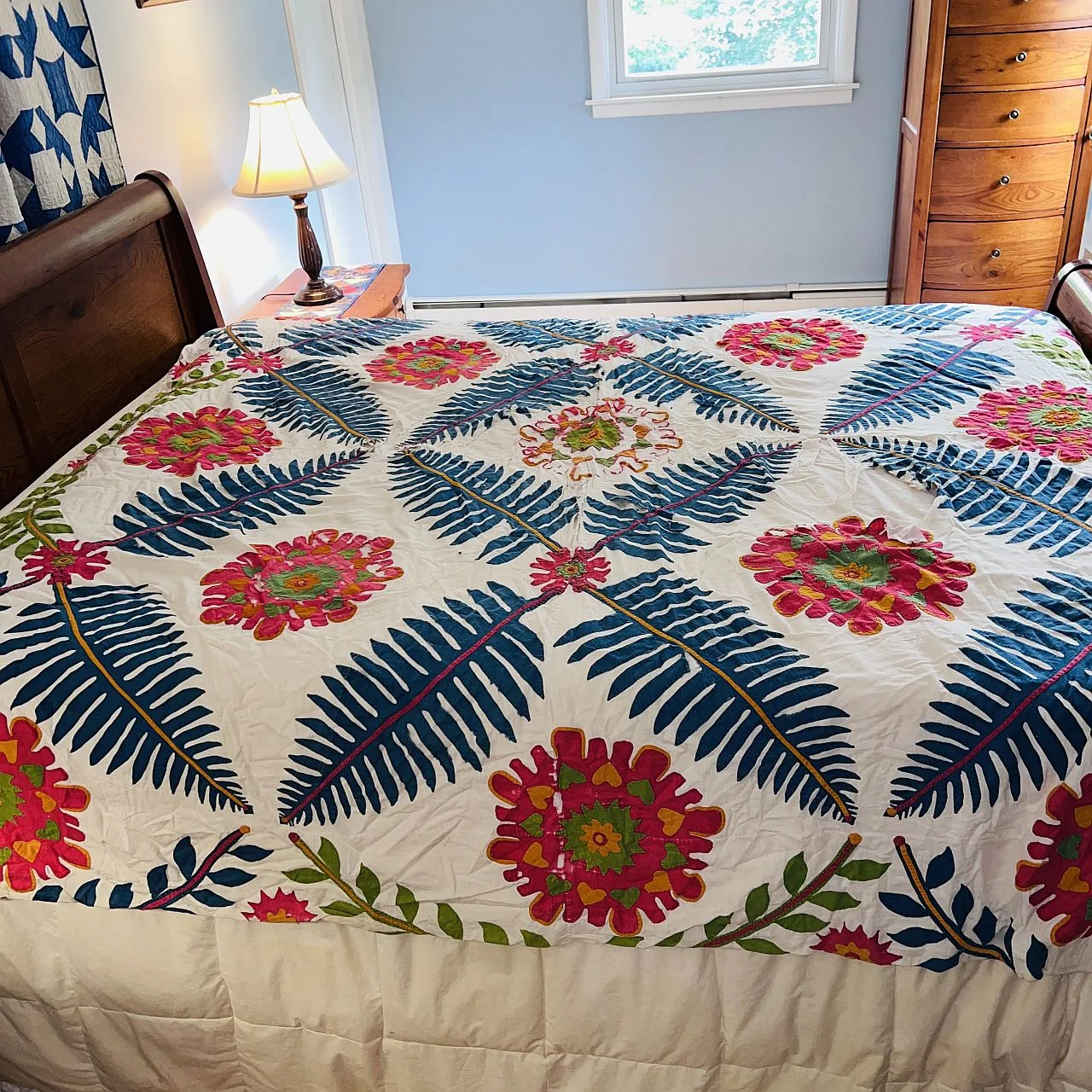
I was in Easton, MD on the Eastern Shore last week and found a completed top of a Poppy quilt kit. The top is 82×98″.
The flowers are in two shades of red, the leaves and stems in two shades of green. The only identification on it is the number 7-2477 stamped on the top and bottom. The workmanship is beautiful, applique and embroidery. It has a couple of “liver spots,” but is otherwise perfect. Questions: Can anybody help identify this quilt as to date and manufacturer. It is not Marie Webster’s Poppy and it is not the Progress Company Poppy Wreath on p. 5 of the Mary Schaffer book. The flowers are similar to the Progress Poppy but they are arranged in swags in each quarter of the quilt sort of outlining a large quilted center; there are smaller versions of the motif in the outer corners of the top. I’m assuming I should make no attempt to remove the spots for fear of losing the blue quinting marks. Am I right?
Zenia or Wilene can you help?
My other new acquisition (a Valentine present found yesterday in Sciota, PA in the Poconos) is a Variable Star in cheddar, poison green and an odd shade of rusty red which since I saw the exhibit in Bethlehem last fall I associate with the Moravians. Barb Garrett will know exactly what I mean. Are these incredible color combinations found anywhere other than eastern PA?
John said he doesn’t think anybody else would want a quilt with so much orange. In my best condescending voice I told him it was cheddar not orange. “Looks like Velveeta to me” was his reply. But I know in his secret heart he loves it too.
Cinda in Scranton
Date: Mon, 15 Feb 1999 15:05:59 -0500 | From: “Phyllis Twigg” <ptwigg [at] radix [dot] net>
Does anyone know the earliest dates for polyester batting? I have a baby quilt in question. The owner feels it was made in 1949 but it contains a polyester batt. According the the “Mountain Mist Blue Book of Quilts”, the polyester batts were first marketed in 1956 in a twin size for the wholesale price of $ 3.40. Barbara Brackman refers to poly batts as a clue to the 1960’s and later. Did any other company produce one earlier ?
Thanks !
Phyllis Twigg
Date: Mon, 15 Feb 1999 15:49:10 EST | From: QuiltFixer [at] aol [dot] com
In a message dated 2/15/99 11:19:47 AM Pacific Standard Time, ordway [at] glas [dot] apc [dot] org writes:
<< Also, working with silk — should I use silk thread for basting and whip stitching? >>
I always use silk thread with silk. I always try to use like thread to fabric such as cotton to cotton, etc. I have done a lot of quilt repair work and have found this to be best. Also have you seen much Red Embroidery in Russia? I teach and lecture on Redwork and am always looking for more information. I have seen lots of German work, but think there must be Russian work as well.
Toni B.
QuiltFixer [at] aol [dot] com
Date: Mon, 15 Feb 1999 21:59:33 -0000 | From: “Jenni Dobson” <jenni [at] dobson4qu [dot] freeserve [dot] co [dot] uk>
I’d be really interested if any members of this list would like to send me any thoughts they have about an ‘old’ quilt I recently bought, intending to write about it for a short history chapter in my next book. I was looking for a design that would be simple to sew & originally thought it’d be good to choose a non-antique piece, i.e. something old but not significantly so, the sort of thing people might come across rather than a museum piece. So I decided to buy a quilt that I saw & took a quick pic. of last July, on sale at a quilt exhibition in Wales. I’m still happy to write about it now I’ve got it but closer inspection has changed some of my ideas. I know you can’t see the pattern but if anyone really wants to, I could attach a pic to an e-mail (email me direct to request it). The quilt was labelled “Skyscrapers” and “40s / 50s fabrics” & that it came from Ontario. Through contact with Barbara Brackman the block is actually already identified as one in her Encyclopedia called Monument, (# 889). She says it was published in the Ohio Farmer magazine in 1890, and is a mourning pattern. This is interesting to me partly because it means the pattern was already an old one when the blocks were made. I found this out while waiting for the quilt to come. Now I have it, I don’t entirely agree with the proposed dates of the fabrics – I’m waiting for my Dating Fabrics book to come, but tho’ I’m no great scholar, I’ve helped on the UK Documentation project & many of the fabrics look older, some were probably recycled into blocks from clothing. I know a quilt can be no older than the newest fabric so it still might’ve been made in the 40s. However, as I handled it I turned to the back & this looks like quite newly washed muslin. Closer inspection thro’ the holes in one block also showed polyester batting. The general appearance of the top looks as if maybe it’s an older top that has been more recently layered & quilted!
As I didn’t buy it for great historic worth, I can live with this – in a way, it’ll make a good story about how you ‘detect’ its story. But it prompts some questions – e.g. when did the kind of polyester batting we’re familiar with come into production? Can anyone help me on this one? or with any other thoughts?
Thanks for taking time to read all this – looking forward to comments.
Jenni Dobson, UK.
Date: Mon, 15 Feb 1999 17:18:20 -0500 | From: Vivien Lee Sayre <vsayre [at] nesa [dot] com>
Hi All,
Does anyone know Penny McMorris’ address? Is she on e-mail? Thanks in advance for any help you can give me.
Vivien in Cold but Beautiful Massachusetts. (No snow yet 🙁 )
Date: Mon, 15 Feb 1999 17:43:14 EST | From: KareQuilt [at] aol [dot] com
RE: <A couple of years ago, I met a lady who had a friend whose son worked nights for that dealer and his primary job was packing boxes and boxes of quilts for shipment overseas.>
This would be a fascinating area of research. Wilene, do you have any more info? I go to Switzerland on business twice a year. Stopped at a quilt shop in a major city. They had stacks of antique American quilts. I was amazed, but should not have been, I suppose. The woman was not about to tell me her trade secrets (source). She was quite upset about an issue in Europe over “patchworkers” vs “real quilters/quilt artists.” I had not even be aware of such an issue prior to encountering her. Her “passion” left me speechless. My “observer me” just LISTENED and tryed to take some mental notes. Her assistant finally came over and intervened and diplomatically steered her partner off her soapbox. Very interesting experience. We quilters and researchers ARE passionate about our subject, aren’t we!
Date: Mon, 15 Feb 1999 18:37:13 EST | From: Baglady111 [at] aol [dot] com
5th ANNUAL FEEDSACK CLUB CONFERENCE
APRIL 1999
We are
MOVING!! MOVING!! MOVING!!
NEW LOCATION
HOLIDAY INN LANCASTER-VISITORS CENTER
521 GREENFIELD ROAD
LANCASTER, PA 17601
PH 717-299-2551
DATES: APRIL 8-9-10, 1999
THURSDAY the 8th. 10:00am-6:00pm
FRIDAY AND SAT 10:00am-9:00pm
FEEDSACK QUILT SHOW
FEEDSACK DISPLAY/EXHIBIT
VENDORS
LECTURES
SHOW & TELL
DEMOS
BUY-SELL-TRADE
FOR MORE INFORMATION
SEND A LONG SELF ADDRESSED ENVELOPE TO
FEEDSACK CONFERENCE
25 S. STARR AVE #16
PITTSBURGH, PA 15202
PH. 412-766-3996
Date: Mon, 15 Feb 1999 19:29:33 EST | From: WileneSmth [at] aol [dot] com
<< Subj: Quilts Shipped overseas
Date: 99-02-15 17:43:14 EST
From: KareQuilt
To: WileneSmth, QHL-Digest [at] cuenet [dot] com
RE: <A couple of years ago, I met a lady who had a friend whose son worked nights for that dealer and his primary job was packing boxes and boxes of quilts for shipment overseas.>
This would be a fascinating area of research. Wilene, do you have any more info? I go to Switzerland on business twice a year. Stopped at a quilt shop in a major city. They had stacks of antique American quilts. I was amazed, but should not have been, I suppose. The woman was not about to tell me her trade secrets (source). She was quite upset about an issue in Europe over “patchworkers” vs “real quilters/quilt artists.” I had not even be aware of such an issue prior to encountering her. Her “passion” left me speechless. My “observer me” just LISTENED and tryed to take some mental notes. Her assistant finally came over and intervened and diplomatically steered her partner off her soapbox. Very interesting experience. We quilters and researchers ARE passionate about our subject, aren’t we! >>
Yes, I agree that it would make an interesting subject for research, and I wish I had more info re all those boxes. I gingerly pressed for more, but she seemed reluctant after I showed interest in, not to mention knowledge of, the subject. I suppose she felt that she may have let the cat out of the bag so to speak. But Switzerland has been a country that I’ve often wondered about and I’m not really sure why except to say that the last good quilt that I sold about 1986 when I had a small booth in a local antique mall was to a lady visiting America from Switzerland. I can’t remember now if she bought quilts from the others in that mall or not. Does Switzerland have less stringent import regulations maybe? Or is it its rather central location? << stacks of antique American quilts >> Hmmmm! Interesting, especially the “stacks” part. –Wilene
Date: Mon, 15 Feb 1999 20:00:28 -0500 | From: “jawhite [at] courant [dot] infi [dot] net” <jawhite [at] courant [dot] infi [dot] net>
Hi Vivien. You can mail Penny at electric quilt list info-eq [at] lyris [dot] planetpatchwork [dot] com or equilt [at] wcnet [dot] org.
Judy White
Date: Mon, 15 Feb 1999 21:26:20 -0500 | From: Barb Garrett <bgarrett [at] fast [dot] net>
Cinda and interested others –
First, the Variable Star quilt in cheddar, poison green and rusty red sounds wonderful!. Cinda asked if these color combinations are found anywhere else besides Southeastern PA. Yes, they are found 1 other place.
At Jeannette Lesansky’s Symposium at Franklin and Marshall College in Lancaster, PA, in 1991, there was a speaker from the North Carolina Quilt Project, Kathy Sullivan. She spoke about the very German quilts, with very “strange” combinations of fabrics, found in one part of North Carolina. Her talk particularly stuck with me because these were the first antique quilts I was exposed to and don’t think the color combinations strange at all.
Kathy’s presentation is included in Jeanette’s book, Bits and Pieces. A quote —
“When it came to their quilts’ patterns, colors, and designs, the German quiltmakers relied on their own cultural standards — most obvious in their choice of color. As is true in the quilts made by their PA brethren, North Carolina quiltmakers showed a preference for bright, vivid, even gaudy color schemes.”
While I disagree with the designation “gaudy”, I have heard that word used to describe these quilts numerous times. The article says the German settlers came from the southeastern counties (Berks, Montgomery, Lancaster, York) looking for fertile, cheap farm land. She also mentions a Moravian settlement traceable to Bethlehem, PA. Being located in the south, the quilts differ from the PA quilts in that they used more solids (locally made therefore cheaper) than the prints (had to be imported from the north therefore more expensive) available to the PA quilters. These quilts date from the second half of the 19th century.
Enjoy your 2 new quilts, Cinda.
Barb in southeastern PA bgarrett [at] fast [dot] net
Date: Mon, 15 Feb 1999 20:49:56 -0600 | From: Russell-Hill russhill [at] ctesc [dot] net
To: Quilt Heritage List QHL [at] cuenet [dot] com
Good evening everyone,
I am writting for a friend who lives in England and had asked me about 2 books and my thoughts on them and if I had any others that I could suggest . Well I sent my opinions on the 2 but I would like to ask you all the same question.
She would like to get a book about quilts and the history of quilts during the Civil War. She asked about “Quilts of the Civil War” and “Hidden in Plain View.” She also asked about recommandations of other books I thought might be better. That question I did not have an answer to but thought that some one on this list would and would be willing to also give their thoughts on the other two.
Thanks for your help.
Debbie
Date: Mon, 15 Feb 1999 21:01:42 -0600 | From: Russell-Hill <russhill [at] ctesc [dot] net>
Barb Garrett wrote:
Cinda and interested others –
First, the Variable Star quilt in cheddar, poison green and rusty red sounds wonderful!. Cinda asked if these color combinations are found anywhere else besides Southeastern PA. Yes, they are found 1 other place.
She spoke about the very German quilts, with very “strange” combinations of fabrics, found in one part of North
Hello All,
I live in a german town in Texas call Fredericksburg. Founded in 1846 and very German down to the colors. there are many old houses that are painted with the cheddar, poison green (maybe dark forest green more than poison ) and rusty red. These are definately German colors. The main color is the green and trimmed in cheddar and rusty red. Iliked it so much that when we built our house I painted it in those colors. Williamsburg has their colors and Fredericksburg TX has theirs.
Debbie
From: Laura Hobby Syler <texas_quilt.co [at] mail [dot] airmail [dot] net>
Hi Phyllis,
From the information that I have I agree with the ’56 date as to the first poly batts and then in pretty wide distribution in the ’60’s and praised by every quiltmaker from coast to coast in the ’70’s and up to the late ’80’s . When I opened my quilt shop in 1980 we didn’t even carry that “old nasty stuff” and I am paying for it now with the abrasion from the inside out of all the wonderful 1890’s tops that I had quilted up. The best thing to remember is that your client may be right…..the top may have been pieced in ’49 but not finished for several years…..of course none of my desendants will have that problem dating my quilts…..they are all tops!
See ya in a couple of months!
Laura
At 03:05 PM 2/15/99 -0500, Phyllis Twigg wrote:
Does anyone know the earliest dates for polyester batting? I have a baby quilt in question. The owner feels it was made in 1949 but it contains a polyester batt. According the the “Mountain Mist Blue Book of Quilts”, the polyester batts were first marketed in 1956 in a twin size for the wholesale price of $ 3.40. Barbara Brackman refers to poly batts as a clue to the 1960’s and later. Did any other company produce one earlier ?
Thanks !
Date: Mon, 15 Feb 1999 20:43:57 -0700 | From: “Jeanne.Fetzer” <Jeanne.Fetzer [at] integrityonline3 [dot] com>
Did anyone see the Antiques Roadshow on Feb. 15 which included a red and green quilt from 1850?
I would be interested in your feelings about the price given to the owner. I recognize that without seeing the quilt in person, it is difficult to pin down a price. I’ll try to describe it as best I can:
full size; never used dated on back as 1850 – made by owner’s grandmother red and green princess feathers (at least four)
quilting was dense and seemed well executed from what I could see on the TV
The price range was $12,000 – 15,000. My first reaction was that this was a quilt of museum quality.
any comments? What do you think about the range. I know I’m probably asking the impossible, but I would be interested in some reaction if someone else saw it.
Thanks! Jeanne.Fetzer [at] integrityonline [dot] com
Date: Tue, 16 Feb 1999 02:36:03 EST | From: WileneSmth [at] aol [dot] com
re: QHL: underground railroad, from Cindy Honeycutt:
<< The discussion among the ladies in her church was exactly as I read on this list: different quilt patterns meant different things, and even the way a quilt was hanging outside meant something different. >> Do you mean the ladies were talking about this WITHOUT reading Jackie and Raymond’s new book? If so, I think we’d all like to hear more. Their book, by the way, is Hidden in Plain View by Jacqueline L. Tobin and Raymond G.
Dobard.
re: QHL: Poppy quilt top, etc., from Cinda in Scranton.
<< Wilene can you help? >>
Cinda, I’m not as “up” on 20th century appliques as some others are even though I’m trying to enter as many as possible in my database along with their numbers, if known. I did a search for the number, 2477, and didn’t come up with anything for you, and “poppy” has so many entries as to be nearly useless in a search. Hope someone else will know more.
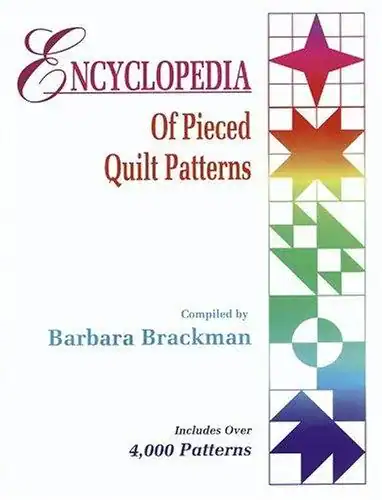
re: QHL: Thoughts on an old quilt?, from Jenni Dobson, UK. << The quilt was labelled “Skyscrapers” and “40s / 50s fabrics” & that it came from Ontario. Through contact with Barbara Brackman the block is actually already identified as one in her Encyclopedia called Monument, (# 889). She says it was published in the Ohio Farmer magazine in 1890, and is a mourning pattern. >>
There are two similar patterns (#888 and #889 in Barbara’s Encyclopedia) that seem to commemorate the death of President James A. Garfield, 20th U. S. President, assassinated July 2, 1881, died Sept. 19, 1881, so it seems safe to assume that the patterns most probably originated after this date. You mentioned that your quilt came from Ontario (I assume in Canada?) and, after seeing it, question that it might be earlier than the 1940s or 1950s as it was represented. If the fabrics turn out to be a lot earlier (like the 1880s maybe?), then it seems rather safe to assume that it was probably made in the states.
Design #888 was published in Farm and Fireside magazine in the 1880s (exact date unknown) and was identified as Garfield’s Monument. A pattern of this name was offered by a reader of Good Housekeeping magazine in the October 26, 1889, issue, but it was not illustrated in the magazine. Then Ladies Art included it in their catalog beginning about 1895 as their No. 136, calling it by the same name but superimposing a capital G on the base. 888 seems to be the more common design of the two, although quilts of either design are uncommon. One is pictured on p. 68 of Marsha MacDowell’s (et al.) Michigan Quilts (1987); another one is on p. 9 of Victoria Hoffman’s catalog, Quilts: A Window to the Past (North Andover, MA: Museum of American Textile History, 1991); and I lucked into one in near mint condition made with 1880s prints at an estate sale a couple of years ago. I’d often wondered if women actually made any quilts using this strange design, and now I know that at least a few did.
Volume 2 (revised in 1987) of Barbara’s Encyclopedia indicates that Design 889 was published in the Ohio Farmer magazine, ca. 1890, and called The Monument. It’s made from pieced strips laid horizontally and, from a distance, looks quite similar to #888. So far, I’ve not found an original clipping of this one for my records.
re: polyester batting — I’ll try to look into this tomorrow and see what the date is on the earliest Mountain Mist ad in my records that mentions polyester. –Wilene
Date: Tue, 16 Feb 1999 12:46:51 +0000 | From: Shirley McElderry <tigersoup [at] lisco [dot] net>
Cinda: I found your poppy quilt top pictured in a Herrschner’s 1963-64 catalog. It is called “Majestic Poppy” and is described as: “For applique! Sunny California inspired design! Quilt top stamped with applique and quilting pattern on type 128 white sheeting. Washfast appliques, poppy colors with green leaves. 7-2477 Poppy Quilt Top $6.59.” By the way, one could order a “finishing kit” consisting of Mountain Mist seamless cotton quilt batting, white percale quilt backing, a quilting needle and 3 spools of quilting thread for $4.98. Or the quilt top kit and the finishing kit both for $10.98. Since your top has the Herrschner’s number stamped on it, I’m going to go waayy out on a limb here and suggest it may have been a special order from a company. I know that Herrschner’s did retail Homeneedlecraft kits, because I have found those kits offered in their catalogs. I think there were some Progress kits offered, too. And it seems–here I go on another limb–that the original quilt kit manufacturers offered kits for quite a while before they were ever advertised in Herrschner’s, so I am wondering if perhaps Herrschner’s simply bought out the discontinued kits? Xenia, or Bev D. what do you think?
Shirley Mc from where winter is back again in Iowa.
Date: Tue, 16 Feb 1999 08:45:24 -0500 | From: “jawhite [at] courant [dot] infi [dot] net” <jawhite [at] courant [dot] infi [dot] net>
Just to add my $.02 to this discussion – I have a poison green/chrome yellow (which today is called cheddar) polkadot (the yellow has black dots) drunkard’s path that I got at Brimfield, MA several years ago. The dealer was not a quilt person. She had picked this up at an estate sale in Maine. The quilt had a small hole in it and the backing didn’t go with the front. It had been stored in a bag with a fabric softener and smelled to high heaven so I took it home, took off the back, threw out the middle and tossed the top and back in the wash. The quilt had been put together with several different kinds and colors of thread including blue embroidery thread and something akin to buttonhole twist. So when I took it out of the washer, the borders came off like they had been put on with a zipper which was okay because I needed to use some of that fabric to repair the hole. I have always called this my quilt with a growth because, even though the dealer I bought it from wasn’t a quilter, she knew that quilts were stuffed and that’s she had repaired the hole – by making a little stuffed patch and sewing it over the hole. I kept that little patch because it is so cute. Anyhow, I now have this wonderful top which has been dated by a reputable quilt person to around 1865 and I have repaired it quite nicely and will hand quilt it. Does anyone know if this color combination was indigenous to Maine and did it migrate to other parts of the US?
Judy White – CT
Date: Tue, 16 Feb 1999 08:56:42 EST | From: JQuilt [at] aol [dot] com
I remember a quilt show on Simply Quilts…with Roberta Horton and Mary Mashuta….Alex Anderson picked out the combination of orange, red and green and
Roberta saying they were those being the colors of the German “1860 quilt”
jean jquilt [at] aol [dot] com
Date: Tue, 16 Feb 1999 09:19:23 EST | From: Qltldy10 [at] aol [dot] com
… was red, green, and orange! I don’t remember where they were- Michigan? Anyway, my thoughts are that these guys are quoting Christy’s kind of prices, and yes, I thought the quilt was worth exctly what he said. It’s just that you and I don’t usually shop at major auctions. In York, Maine, there is a very nice antique multi dealer shop- first table, teacup size, on the way in, is $7,000. A few months back they had a visiting dealer, a beautiful Baltimore album (personally, I thought is may have been Pa), priced at $29,5000. Was ca 1849, and while I decided not to write a check =8-0 I fugured it was priced so someone would buy it. this dealership, by the way, does not take credit cards. To me, it means they are selling to folks with larger cash flows then I tend to have…..
Beth in Maine qltldy10 [at] aol [dot] com
Date: Tue, 16 Feb 1999 10:00:29 EST | From: JQuilt [at] aol [dot] com
in the year 2,099….can you imagine some quilt appraiser/restorer…trying to figure out what year the quilt was made by looking at the batting… in 1999 there was poly/cotton, cotton, silk,wool and poly batting available… jean jquilt [at] aol [dot] com
Date: Tue, 16 Feb 1999 10:29:57 EST | From: JQuilt [at] aol [dot] com
sounds like the antique dealer in York Maine, who doesn’t take credit cards and sells $29,000 quilts…has an clientele of Colombian drug lords. Or maybe York Maine is #1 on the pickpockets top 10 list.
jean
Date: Tue, 16 Feb 1999 08:09:28 -0800 | From: Kathy Tavares <kmtavare [at] uci [dot] edu>
Did any of you happend to see Antiques Road Show on Monday, February 15? My DH and I watch this weekly whenever we can. Anyway last night they had a quilt which they valued at auction to be $12,000 to $15,000. It was 1850’s and as far as we could tell from what they showed on TV, in excellent condition. They woman who owned it kept it stored in a cedar chest and never has displayed it, so the color was not faded at all. I don’t know if I could have something like that and not be able to display it.
Kathy T
Date: Tue, 16 Feb 1999 12:18:17 EST | From: KareQuilt [at] aol [dot] com
Forgive me if this has been posted before. Can’t remember . the gray matter is getting mushier with every grandchild that is born .
NATIONAL MUSEUM OF WOMEN IN THE ARTS – “Quilts of the Future”–a day-long symposium in Washington, DC, at the National Museum of Women in the Arts, co- sponsored by NMWA and Art Quilt, Network, New York (with artists from AQN-NY presenting slides of their work) will be held on January 22, 2000. Speakers are Rebecca Stevens (Textile Museum), Stacy Hollander (Museum of American Folk Art), and Cathy Rasmussen (Exec. Dir. of Studio At Quilt Associates). Topics are quilts in museum collections, traditional quiltmakers who have become quilt artists, and professionally trained artists who have become quilt artists. Tickets will be available from NMWA in the fall. More to come much later, but mark your calendars if you are at all interested. 202-783-5000, 1250 New York Ave. NW, Washington, DC 20005
Date: Tue, 16 Feb 1999 22:07:41 +0300 | From: “John Ordway” <ordway [at] glas [dot] apc [dot] org>
I went silk shopping today.
Silk is not that readily available here and you have to know which stores carry it. A nearby store has a great selection, but it mostly for dressmaking purposes. I found the weight I wanted — I’m not sure what it’s called — it’s raw silk that is heavy, almost of a brocade weight. My first trip to the store was very disappointing — no way was the woman going to cut me any small amounts — it would interfere with her reading her newspaper! I went back later in the afternoon and succumbed to a meter each of three different colors for baby blocks at 130 cm width — at $20 a meter. Don’t gasp. I have no idea whether it’s a lot or money or not, but it’s gorgeous.
The saleswoman said it was from Liechtenstein. So much for getting romantic and getting Russian silk!
Q: I want to handpiece baby blocks — does anyone have any suggestions on whether I would need to paper piece these — the silk is heavy and would definitely hold up on it’s own with piecing. Does anyone have any experience with looking at antique silk quilts: are they paper-backed? The other fun thing was finding silk thread — 23 different colors. They were on very old cardboard spools that said 50k (50 kopek) which even in the old days at other exchange rates was not very much (in the 1980’s it would have been $.80). God knows what warehouse they’ve been sitting in for years. They were 6 rubles today (about 27 cents) for 100 meters — not huge amounts. I’ll now have to match the colors with the fabric I bought and go back and buy more — otherwise I’ll probably never see it again!
Maryjo in Moscow