February 8 – 14, 1999
These restored messages come from the Quilt History List, an online forum where quilt historians, collectors, researchers, appraisers, and enthusiasts discussed antique quilts and related textiles. The archive dates from 1996 through approximately 2016 and is being restored gradually. Sign up in the form at the bottom of the page if you want to know when a new page is added. Original spelling, opinions, formatting, and inactive links may remain unchanged.
Primary topics of this QHL Digest:
- Oral History Bibliography — Judy Grow shares a detailed bibliography of oral-history reference books useful for documenting quilt and family histories.
- Fabric and Thread Costs, Historical and Modern — Members compare fabric pricing past and present, including Civil War-era costs, international thread prices, and the relative expense of quilting supplies in the US and UK.
- Antique Quilt Pricing and Auction Dynamics — An extended discussion on what drives vintage quilt prices at auction, in antique malls, and through dealers, with members sharing personal buying experiences, cautionary tales, and observations on regional variation.
- Vendor Ethics and Online Etiquette — Xenia Cord cautions the list about posting negative opinions of quilt vendors on the internet, noting the lasting reach of public criticism.
- NPR Essay on Quilts — Members discuss a quilting-related essay heard on NPR’s Morning Edition, with Cathy Hooley tracking down the archived broadcast link.
- Regional Quilt Documentation Projects — Marilyn Maddalena highlights Nova Scotia quilt coverage in the NQA magazine and describes the California Heritage Quilt Project’s pioneering documentation work. (see the article on state quilt documentation books)
- Native American Quilts in Film — Valerie Davis discusses the depiction of Native American history and textiles in Dances with Wolves and Last of the Mohicans.
- Teddy Bear Appraisal from Victorian Fabrics — Elizabeth Richards asks for help appraising a contemporary teddy bear made from Victorian silk and velvet log cabin quilt fabrics. (see the article on quilt appraisers)
Date: Mon, 8 Feb 1999 00:38:37 -0500 | From: “Judy Grow” <Judygrow [at] blast [dot] net>
Following is a bibliography of books that have bearing on oral history. I have taken it from the booklet ” Oral History for the Local Historical Society”, third edition, revised, by Willa K. Baum, copyright 1987. ISBN 0-910050-87-2, which is a very good primer for anyone interested in doing oral histories.
Baum, Willa K – “Transcribing and Editing Oral History.” 1977, 127 pp Nashville: American Association for State and Local History (172 Second Avenue North, Suite 102, Nashville, Tenn. 37201. $9.00 Charlton, Thomas L. ” Oral History for Texans.” 1981, 85 pp. Austin: Texas Historical Commission (P.O. Box 12276, Austin Tx, 78711. $5.75. Cutting-Baker, Holly, et al. “Family Folklore Interviewing Guide and Questionaire. 1978, 7 pp. Washington DC. U.S. Govt. Printing Office.
$1.00
Epstein, Ellen Robinson and Rona Mendelsohn. “Record and Remember: Tracing Your Roots Through Oral History.” 1978, 119 pp. Washington DC. Center for Oral History, Chevy Chase, MD (7507 Wyndale Road, Chevy Chase, MD. 20815. $4.25. Especially good for immigrant families.
Ives, Edward D. “The Tape-Recoded Interview: A Manual for Field Workers in Folklore and Oral History.” 1980, 130 pp. Knoxville: The University of Tennessee Press (Knoxville Tenn., 37996) $7.00. A full and readable manual by a leading folklorist, especially strong on recording techniques. Inclueds samples of form letters, agreements, accession forms. Shumway, Gary L and William G. Hartlye. “An Oral History Primer.” 1973, 28 pp. Salt Lake City :Primer Publications (PO Box 11894, Salt Lake City, Utah 84147) $2.50. A simple guide on how to get going, especially aimed at doing one’s own family history.
I don’t know how many of these are still available, or how current the prices given are. But if you are truly interested in getting started doing oral histories, the booklet from which this bibliography was taken is an excellent start. It might be all you need.
Judy in Ringoes, NJ judygrow [at] blast [dot] net
Date: Mon, 8 Feb 1999 01:04:42 EST | From: QuiltFixer [at] aol [dot] com
In a message dated 2/7/99 8:51:24 PM Pacific Standard Time, sandjloken [at] worldnet [dot] att [dot] net writes:
<< I’m sure it was just a slip of the ‘tongue’ when you wrote Brooklyn, NY. I believe McKinley was shot in Buffalo, NY, but it sounds like a great quilt. Jean in MN who grew up in Brooklyn. >>
Right you are Jean, it must have been the excitement. It is Buffalo, NY indeed!
Toni B.
QuiltFixer [at] aol [dot] com
Date: Mon, 08 Feb 1999 08:10:07 -0500 | From: Nancy Roberts <robertsn [at] norwich [dot] net
One source for info on Nancy Cabot designs is Barbara Brackman’s book, The Encyclopedia of Pieced Patterns (AQS). She includes a reference at the back of the book giving background information on pattern sources. Nancy Cabot was the name of a 1930s syndicated column published in the Chicago Tribue. It was written by Loretta Leitner Rising. I have found the B. Brackman book to be a valuable resource in researching the first publication of patterns, pattern names, etc. and recommend it. Nancy
Date: Mon, 08 Feb 1999 12:46:44 -0700 | From: Eileen Trestain <ejtrestain [at] earthlink [dot] net>
I’d like to throw in a small comment about the price of fabric in the south during the war. Remember that the value of money fluctuated at this time. too. Depending on the situation at the time, and who she was trying to buy from, our “$20 a yard” lady could have been paying a lot more OR a lot less than we think of as $20.. BY the end of the war, she could have paid thousands in confederate money, and still not gotten her fabric, as the paper money was worthless. Unlike today, where confederate money is probably worth thousands!
I’ve seen the orange and green applique quilt Diane Leone has up for auction. In fact, I have pictures of it up close and personal. It was beyond my means when I saw it then, but it is a “one of those that got away” quilt that never leaves my mind. What is the chance I can catch it now, do you think? It is definately “me” in many ways. Xenia, if I am coming to Quilt America, I would definately like to go to the Boxes Under the Bed seminar. Do you think I could fit it in?
Eileen Trestain
Date: Mon, 8 Feb 1999 15:45:30 EST | From: Baglady111 [at] aol [dot] com
ROCKY MT QUILT MUSEUM
1111 Washington Ave
Golden, CO 80401303-277-0377 email RMQM [at] woroldnet [dot] att [dot] net and I would like to add..JUNE 1 THRU AUG 28 is a FEEDSACK QUILT/FASHIONS/MEMORABILIA exhibit and I will be there to present a lecture Monday June 14, at 7:oopm..come by and say HI…Jane of THE FEEDSACK CLUB
Date: Mon, 8 Feb 1999 21:13:08 -0000 | From: “Jenni Dobson” <jenni [at] dobson4qu [dot] freeserve [dot] co [dot] uk
Hi, everyone, I’m a new subscriber to this list, introducing myself from the UK. My name is Jenni Dobson and I heard about the list from an American quilting friend who lives over here.
I’m writing on the subject of getting to see old quilts because like the quilter who wrote last week, I recently saw some interesting old quilts too! I was visiting the Mannin Quilters on the Isle of Man (in that bit of sea between England, Scotland & Ireland) and because my flight arrived early in the day, they arranged a visit for me to see quilts in the museum, which aren’t usually on display. We saw about 10 quilts (about 1/3rd of what they have) of many different styles, including ones made from woollen fabrics produced locally, using the local variety of sheeps’ wool. The earliest quilt was probably from the 1820s. It was fascinating that as the curator answered our questions about them, I also learned more about what life was like on the island in the past than I would have otherwise. In most cases, they knew the family names of the makers and because the island is quite a small place, lots of background information can still be found. It’s really sad that most UK museums don’t display their textile collections (incl. quilts) at least on rotation, though I know the right conditions are costly to provide. But in many cases, visitors don’t even know such collections exist and so people don’t even request to see these things. If only they were documented better and talked about more, more people might ask to see them and make the keepers realise we are interested. (BTW, the local group hope to help document these quilts.)
I left feeling like the other contributor – privileged to have seen these quilts.
Jenni Dobson – from the snowy Midlands of England.
From: Xenia Cord <xecord [at] netusa1 [dot] net> I have had a nice email from the director of corporate services at the Nova Scotia Museum. Someone kindly forwarded my post about their excellent book, Old Nova Scotian Quilts, and he informs me that they will shortly reissue the book. he says anyone interested in reserving a copy can reach them at nsmbooks [at] gov [dot] ns [dot] ca Xenia
Date: Tue, 9 Feb 1999 12:12:22 -0000 | From: “Sally Ward” <sward [at] t-ward [dot] demon [dot] co [dot] uk>
We have been discussing the relative cost of fabrics, but can anyone tell me if the high cost of cotton thread is universal? Yesterday I bought a 1000 metre reel of Sylko mercerised cotton which has just had its annual price rise. The price now is UKP 5.25 which equates to USD 8.40. My retailer blames it on a ‘cartel’ controlling the price, and couldn’t understand why I wouldn’t buy some cotton/polyester mix at UKP1.00. Since thread is something we all need all the time I would be happy to stock up with a US order if the price is right and if someone can recommend a brand.
Sally
Date: Tue, 9 Feb 1999 08:29:02 -0800 | From: Kathy Tavares <kmtavare [at] uci [dot] edu>
Can anyone tell me how we could get in touch with someone to have them speak at our guild on this program? It wouldn’t be this year, as our calendar is full, but possibly next year.
Also, can someone email me privately and let me know where to send the $15 to for the BB.
Kathy T,
Kathy Tavares kmtavare [at] uci [dot] edu (949)824-6047 (949)824-2261 FAX
University of California, Irvine
Physical Sciences
Purchasing
172 Rowland Hall
Irvine, CA 92697-4675
Date: Tue, 09 Feb 1999 17:58:34 -0600 | From: Russell-Hill <russhill [at] ctesc [dot] ne
Sally Ward wrote:
> We have been discussing the relative cost of fabrics, but can anyone tell me if the high cost of cotton thread is universal? Yesterday I bought a 1000 metre reel of Sylko mercerised cotton which has just had its annual price rise. The price now is UKP 5.25 which equates to USD 8.40. My retailer blames it on a ‘cartel’ controlling the price, and couldn’t understand why I wouldn’t buy some cotton/polyester mix at UKP1.00. Since thread is something we all need all the time I would be happy to stock up with a US order if the price is right and if someone can recommend a brand.
> Sally
Good afternoon,
Well some of the reason for the price to have gone up is that TX had such a bad drought last year that the Cotton crop in the Pan handle was or is almost non existant. The southern part of the state grows cotton to and what they did have got distroyed in the floods and heavy rain this fall. I talked with Mr Wilbanks from Hobbs asking him about the cost of cotton batts mostly the organic ones they have because they get that cotton from the Pan Handle. Of course it is like anything else coffee goes up because of a problem in Columbia Sugar goes up because of this etc. We get use to the higher prices they never come down then there is a glut of the product and we then see a tiny drop. I know that prices overseas are way higher then ours but I think we to will see higher cotton prices also because of the drought. We can only pray for a good year for the cotton farmers . I never did get an answer on the cost of batts going up so I am stocking up anyway. I like the 100% organic because it is the closest to what was in older quilts of the 1800’s I know they carded the cotton but it is think like they were.
Debbie
Date: Tue, 9 Feb 1999 21:21:25 EST | From: Kittencat3 [at] aol [dot] com
Donna –
There was an exhibit at Old Sturbridge Village in Massachusetts on New England quilts from 1750 to the early 1800’s, with a companion book (=Northern Comfort=).
The very early quilts were wholecloth, usually either of fine wool or plain silk, or occasionally quilted palampores (the early equivalent of an Indian print bedspread). There are also very old quilts at the Metropolitan Museum in New York, the Smithsonian, the Los Angeles County Museum in California, the Wadsworth Atheneum in Hartford, the Winterthur Museum in Delaware, and the Shelburne Museum in Vermont. You might also see if you can find a local Revolutionary War re-enactment group. Rev War re-enactors are *fanatics* for accuracy, even worse than Civil War regiments.
Good luck!
Lisa Evans
Easthampton, MA
Date: Tue, 09 Feb 1999 20:12:11 -0600 | From: Valerie Davis <vpse [at] globaldialog [dot] com
Dear group,
Of the two films, Dances with Wolves, and Last of the Mohicans, the more accurate depiction of Native American history would have to be Dances with Wolves. The 1980’s version of “Mohicans” was taken from the 1930’s film version, which was taken from the James Fennimore Cooper’s book from the late 19th c. Cooper’s book was a highly romantized version of what happened to the Mohican’s and is inaccurate. Both the two films added a romantic interest for Hawkeye which was not part of the book. I must agree the rifle, costumes, and scenary were depicted with much authenticity. I’ve read that the producers of the 1980’s film spent considerable amount of time and effort researching the fighting scenes and weapons. Oh by the way, Cooper was wrong about the Mohicans dying out. When they were kicked out of New York they migrated west and are now happily living in Wisconsin!!!
I just love talking history, Valerie
Date: Tue, 09 Feb 1999 21:16:12 -0600 | From: Russell-Hill <russhill [at] ctesc [dot] net>
To: Kittencat3 [at] aol [dot] com
> You might also see if you can find a local Revolutionary War re-enactment group. Rev War re-enactors are *fanatics* for accuracy, even worse than Civil War regiments.
> Good luck!
> Lisa Evans
> Easthampton, MA
I thought only Civil War units were to the extreme. Its good to know there is someone out there worse than us.
Debbie
Date: Wed, 10 Feb 1999 07:33:56 +0400 | From: Xenia Cord <xecord [at] netusa1 [dot] net>
If I may, I’d like to caution the list about offering negative opinions publicly about dealings with quilt vendors. The internet is a powerful tool, and one bad review can have an instantly devastating effect if we are not careful. I suppose all of us have favorites from whom we buy with confidence, and others we might be less likely to deal with, but unless there has been a clear intent to defraud or mislead, a vendor’s reputation should not be commented upon negatively. Without a good reputation a quilt vendor has little to offer.
IMHO as a buyer and as a vendor; my good name is the basis for my business.
Xenia
Date: Wed, 10 Feb 1999 08:29:53 EST | From: Baglady111 [at] aol [dot] com
and if you are coming to QUILTERS’ HERITAGE CELEBRATION in Lancaster, April; stop by and visit with us at the 5th Annual Conference of The Feedsack Club..we’ll be at 521 Greenfield Rd, HOLIDAY INN..right across from the TOURIST BUREAU..or contact me for the FUN ahead!!! Lectures, demos, silent auction, feedsack display, SHOW & TELL..so popular we have to hold it two nites!!! Jane of THE FEEDSACK CLUB
Date: Wed, 10 Feb 1999 08:44:33 -0600 | From: Laura Hobby Syler <texas_quilt.co [at] mail [dot] airmail [dot] net>
Judy, I’ve bought lots of “blocks” from Betsy.At least Lisa and I did 2 years ago. This last year I think I bought one set….that’s all I can afford. a set of 3 1850 blocks were upwards of $60-75 this last April in Paducah.., we’ve already discussed the fact that blocks and tops are escellating in price now, but do they really need to be Soooooo high?. Know that RMQ sells most of their quilts, and they are absolutely fantastic, to the oriental market and used to change the prices at the US shows, but didn’t have time one year and people still bought them. It’s the old game of the more $$ you are asked to spend the more valuable it must be. I know of a quilt dealer that was advised to mark their quilts up 3X what they purchased them for, eliminate the quilts under $500 and suddenly their business quadrupled!!
And we think that the car repair guy is the only “honest crook” in town The only way that we can have an effect is not to buy them…but then for people like my ‘ole buddy, ‘ole pal Lisa who feels it is her purpose in life to own them all…………<G>
BTW, Lisa has been pretty quiet lately here, her knee surgery was more extensive than they first thought. She’s on crutches for *another week*…cussing and discussing her stairs to her office and the kids room (no problem there!)
But that means that I get to **once again** <G> hang the quilts for the VQTS Quilt College Mini Conference at the end of the month by myself!! I knew she’d find a way not to climb that ladder <VBG>
Laura
Date: Wed, 10 Feb 1999 12:27:17 -0500 | From: “Judy Grow” <Judygrow [at] blast [dot] net
I didn’t hear this, and am quoting from a post to another list. Since the poster didn’t hear the beginning to know who was reading the essay, do you know whether or not it was from the new Underground Rairoad book?
>From: Terry Grant <tgrant [at] teleport [dot] com> Driving to work this morning I heard an essay read on NPR–“Morning
Edition”
>I think. Unfortunately I did not hear the beginning to know who it was, but it was a woman talking about her grandmother’s treasures, which included a quilt. She said she asked her why she kept the old thing and her
grandmother
>said, “you know the story–this quilt is a family treasure.” It seems the quilt was made by HER grandmother and contained fabric from the dresses
worn
>by her grandmother and her grandmother’s sister on the day the sister was “sold” away. They tore strips from their dresses and exchanged them, so
each
>could make a quilt. Then they swore to find one another someday. After slavery ended the grandmother carried the quilt with her and searched for her sister for the rest of her life, but never found her. This story has stayed with me all day and gives me chills to think of it. What if there are two families out there with treasured family quilts that have that same fabric in them? What if those quilts could have brought the sisters back together? What if they could still bring the families
together?
>Wouldn’t that be something?
Judy in Ringoes, NJ judygrow [at] blast [dot] net
Date: Wed, 10 Feb 1999 10:00:44 -0800 (PST) | From: Jackie Joy <jjoy [at] med [dot] unr [dot] edu>
I heard this yesterday; I thought the lady’s name was Lynn Johnson (something like that). I have heard her before on NPR. She is an African-American story teller.
She was speaking about a great-aunt, I believe, who had told stories about her youth. When I started paying attention, it was when she said a little girl (maybe her aunt) was disappointed when she went to the water fountain marked “colored” and the water was plain. And then the little girl had had “Jim Crow” explained to her. I visualized a little African-American girl in awe in front of a water fountain that was truly “colored”, a la Liberace’s dancing waters.
There was nothing about quilts as signals on the UGRR, but only as a part of family history. The speaker in her thoughtless youth had suggested to her aunt that she get rid of all the “old stuff” in her home and get new.
Jackie Joy
Reno, Nevada jjoy [at] med [dot] unr [dot] edu
Date: Wed, 10 Feb 1999 15:23:57 EST | From: Xroadclown [at] aol [dot] com
Fabric is a powerful thing. We have dozen’s of quilts that were made by by grandmother and great grandmother (1864- till 1981) My mother can look at those quilts and remember my grandmother’s dress’s, great-grandmothers, aprons, and even recognize some shirt fabric worn by each of their husbands. It’s wonderful. We’ve begun photographing the specific fabrics she recognizes, and writing the history on the back. that way the memories will live on and on!
melanie
Date: Wed, 10 Feb 1999 12:37:44 -0800 | From: Marilyn Maddalena <marilyn [at] crl [dot] com
All of you who are interested in Nova Scotia quilts should look for the next issue of the NQA magazine, The Quilting Quarterly. An article on some of these will appear in that issue. It should be available to members in early to mid March. I do have an affiliation — I’m Publications Chair of NQA — but since there seems to be so much interest in the subject, thought I’d let you all know so you could look for it. MM in Sacramento, CA
Date: Wed, 10 Feb 1999 12:44:36 -0800 | From: Marilyn Maddalena <marilyn [at] crl [dot] com>
California began documenting quilts about 20+ years ago through the California Heritage Quilt Project. Following their documentation, a book was published entitled “Ho! for California.” I’m on the Board of Directors, and CHQP is currently involved in the oral history part of the Heritage project where we record oral interviews with quilters. We hope to wrap up this part of the project within a year, with 1000 completed interviews. For the quilter in Irvine, I’m sure you could get hold of someone on the CHQP Board who lives in your area who could present a program on conducting oral interviews to your group. A booklet of directions and guidelines for conducting oral interviews through the CHQP is available for $25.00. It was put together by the Project Director. Many guilds throughout the state have been involved in this project. If you want more information, e-mail me privately. Marilyn in Sacramento
Date: Wed, 10 Feb 1999 22:13:53 -0600 | From: Elizabeth Richards <erichard [at] AFHE [dot] ualberta [dot] ca>
TEDDY BEAR — A student has asked me to look at a teddy bear and give her an informal appraisal for a museum class she is taking. Since this isn’t something formal I agreed to help. The item is a contemporary teddy bear made f rom(you guessed it!) a Victorian silk and velvet log cabin quilt top. The top had been in this student’s family (American, eastern) and someone had cut it up to make something with it. The something was never made so the family sent the peices to a friend who made eight teddy bears from the quilt top pieces. I don’t agree with the practice – but I didn’t do it -I just want some help with a range of suggested prices if one were going to buy such a teddy bear on to-day’s market. The fabrics are circa 1880 to 1990 – which fits in with the ages of the quilt makers and the fact that they have two other quilts (intact) made by the same women. You can e=mail me privately if you want.
TRAVELLING TO GEORGIA
My partner won a trip anywhere that Canadian
Airlines or it’s partners fly so we are going to the northeast corner of Florida (can’t remember the city) and will drive up the Georgia coast to Savannah at the end of April. I would like suggestions as to what we might like to see (quilt related or otherwise), where we might stay (remembering an American dollar costs us $1.40 Canadian and we prefer small hotels, inexpensive motels or b & b) and anything else you think we should know for travelling at that time. If there is a quilt group in the area that might like an informal talk on conservation I would be happy to meet with them – perhaps in exchange for a night’s stay.
You can e-mail me privately – as I would welcome suggestions.
Dr. Elizabeth Richards
Professor, Department of Human Ecology
University of Alberta
Edmonton, Alberta
Canada
T6G 2N1
Phone: 403 – 492-2475 Fax: 403-492-4821
Date: Wed, 10 Feb 1999 21:32:14 -0600 | From: “Brian/Jen Schmidt” <brian_jen [at] prodigy [dot] net>
I’ve seen on this list references made to back issues of American Quilt Study Group’s publication “Uncoverings“. However, I’ve not seen how one can obtain these back issues, or even the current one. Could someone let me know how to find issues of “Uncoverings”? Thanks.
Jennifer brian_jen [at] prodigy [dot] net
Date: Wed, 10 Feb 1999 20:22:58 -0800 | From: “Catherine Kypta” <vger [at] cwnet [dot] com>
Just my experience with Betsey. Yes, she has some great things but I think the pricing is way out there. She has been here in California at the Pacific Show a couple of times and I thought most everything was way too pricey, but I did buy some sunflower blocks (mariner’s compass) from her about 4 years ago through the mail and she went back and searched the rest of them out so I would have a set of 20, they are wonderful, 1850’s fabric and all the points on the furthest row are edged witha wonderful decorative embroidery stitch. Good resource for vintage fabric and she has given me a break on some things which were less than perfect condition. I think she’s reliable!
Just my own opinion!
Catherine in Sacramento
Date: Thu, 11 Feb 1999 07:57:34 +0400 | From: Xenia Cord <xecord [at] netusa1 [dot] net>
To Jennifer and anyone else who wants to buy back issues of Uncoverings, write: AQSG, 25th & Holdrege East Campus Loop, P.O. Box 4737, Lincoln, NE 68504-0737.
Email AQSG [at] juno [dot] com.
Why not join while you are at it? It’s a great group!
Xenia
Date: Thu, 11 Feb 99 11:00:30 -0500 | From: Woodford <woodford [at] ix [dot] netcom [dot] com>
Hello everyone,
I need help again.
There is a very nice dress shop in our small town, and the owner is looking for a source of quilted jackets, either made with vintage fabrics, or with new. I made the mistake of thinking that I could just look up the vendors in the Houston International Quilt Festival registration and found I had no idea who actually sold finished quilt jackets, if anyone.
So, please let me know privately of any maker that sells these to retail businesses. She would be delighted to have a source.
Thanks, Barbara Woodford
Historic American Quilts woodford [at] ix [dot] netcom [dot] com
Woodford woodford [at] ix [dot] netcom [dot] com
Date: Thu, 11 Feb 1999 08:27:33 -0800 (PST) | From: Jackie Joy <jjoy [at] med [dot] unr [dot] edu>
Last night at guild meeting, we were told that the NQA will be holding their year 2000 show in Reno and that the three local guilds will be asked to participate in the work.
What can anyone tell me about this show? What is your experience with it, good, bad or ugly? Is this the one that the entry flap was about last year?
Let me know what you know, but please use my dh’s address when you reply lljoy [at] govmail [dot] state [dot] nv [dot] us as I am leaving this job and computer today and only pray that I will have access to my e-mail at the new job. I would miss everyone too much if I didn’t.
Jackie Joy
Reno, Nevada
Date: Thu, 11 Feb 1999 18:15:11 -0500 | From: “Cathy Hooley” <goosetracks [at] albany [dot] net>
You probably already know this, but the story you heard on NPR can be found at the following site – its the last one listed – under the heading Storytelling
http://www.npr.org/programs/morning/archives/1999/990209.me.html
Cathy Hooley
Goose Tracks Quilts
http://www.albany.net/~gooset
Date: Fri, 12 Feb 1999 08:51:21 -0500 | From: Nancy Roberts <robertsn [at] norwich [dot] net>
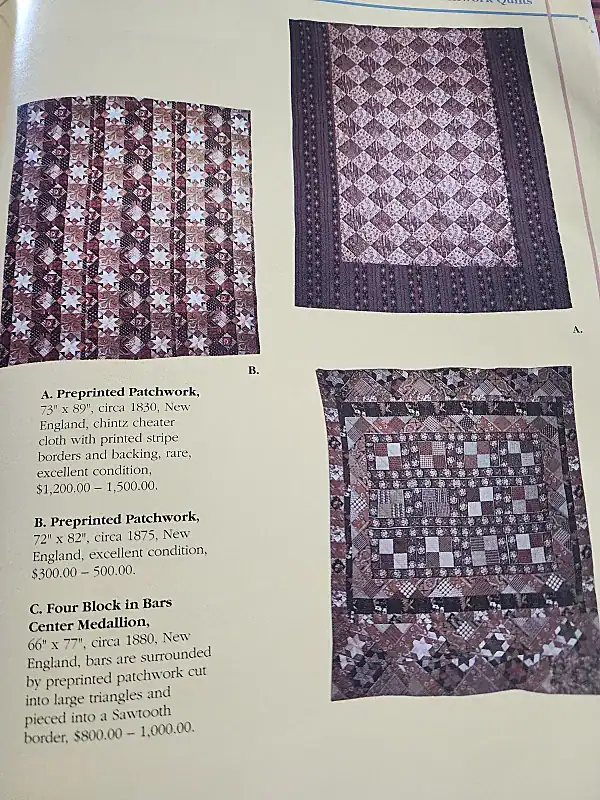
A collector loaned me a copy of one of his special interest magazines that had a feature about the prices of antique quilts at auction. The gist was that vintage quilts are fetching lower prices today than they were a few years ago. The author offered the decline of old quilts as “trendy” decorator items as one possible reason. That made me try to recall if I’ve seen as many quilts in room shots for magazines like Country Living and Country Home lately. I’m not sure. He also cited awareness of the value of family quilts and the availability of them on the market.I’m curious if those who attend auctions have noticed if quilts tend to bring less today? I’m not even sure how one would compare this.
At our recent guild meeting a woman showed a lovely album quilt complete with signatures purchased at auction in western NY for $1100. It was in good condition (some soiling) and heavily quilted. The signatures were authenticated as those of church women in a small village in central NY. So a representative from the village historical society attended the auction and was the successful bidder, thus bringing the quilt “home.” It’s thought that the quilt was made for a pastor at the time he left the community for another assignment. I love to see treasures like these. I’ll be interested in any comments about the value of antique quilts. Nancy
P.S. I can’t find the collectible magazine right now to tell you the title and author, but will try if anyone is interested.
Date: Fri, 12 Feb 1999 10:32:49 EST | From: QuiltFixer [at] aol [dot] com
There is definitely an upward trend in prices of vintage Redwork Embroidered Quilts. Also, when I attended the International Show in Santa Clara, CA, I thought the prices were higher than the previous year on all types of vintage quilts. Whether people are paying those prices may be another matter, but since it is so expensive to be a vendor at these shows, something must be selling.
Toni Baumgard
QuiltFixer [at] aol [dot] com
Date: Fri, 12 Feb 1999 12:08:49 -0500 | From: “Peggy O’Connor” <mnoc [at] brinet [dot] com>
I’d like to know the magazine that discussed antique quilt prices. Are there other (easily accessible) sources for quilt prices? I often wonder when I see quilts whether the price asked for is reasonable for what the quilt is, so I’d like to know of some actual sales prices for comparison – the best I can do is compare dealers’ asking prices. How often do quilt dealers sell at the asking price versus discount? Do prices for the same type quilt vary much from region to region, and what regions are high-priced versus low-priced?
Peggy, enjoying balmy NC before the winter chill arrives later today —–Original Message—–
From: Nancy Roberts <robertsn [at] norwich [dot] net> To: QHL [at] cuenet [dot] com <QHL [at] cuenet [dot] com>
Date: Friday, February 12, 1999 8:51 AM
Subject: QHL: QHL-vintage quilt prices
>A collector loaned me a copy of one of his special interest magazines that had a feature about the prices of antique quilts at auction. The gist was that vintage quilts are fetching lower prices today than they were a few years ago. The author offered the decline of old quilts as “trendy”
decorator
>items as one possible reason. That made me try to recall if I’ve seen as
many
>quilts in room shots for magazines like Country Living and Country Home lately. I’m not sure. He also cited awareness of the value of family quilts and the availability of them on the market.I’m curious if those who attend auctions have noticed if quilts tend to bring less today? I’m not even sure how one would compare this.
>At our recent guild meeting a woman showed a lovely album quilt complete
with
>signatures purchased at auction in western NY for $1100. It was in good condition (some soiling) and heavily quilted. The signatures were authenticated as those of church women in a small village in central NY. So
a
>representative from the village historical society attended the auction and was the successful bidder, thus bringing the quilt “home.” It’s thought
that
>the quilt was made for a pastor at the time he left the community for
another
>assignment. I love to see treasures like these. I’ll be interested in any comments about the value of antique quilts. Nancy
>P.S. I can’t find the collectible magazine right now to tell you the title and author, but will try if anyone is interested.
Date: Fri, 12 Feb 1999 11:29:49 -0600 (CST) | From: magee [at] AXP [dot] WINNEFOX [dot] ORG
I’m interested in info on quilt prices as well. I certainly see that the prices here in Wisconsin vary drastically and are very often not connected to the item as far as I can see. Most of the dealers that i see don’t know much about textiles and only have a quilt or two.
The prices seem to be lower than other places I’ve been, but it is much harder to get 19th century quilts here. If there is a resource for the upper midwest I’d love to know it. Laurie in cold(30) and windy Oshkosh(it was 62 yesterday!)
Date: Fri, 12 Feb 1999 13:16:27 +0400 | From: Xenia Cord <xecord [at] netusa1 [dot] net>
I think we cannot expect to see standard pricing in antique quilts, for a lot of reasons. One is that each quilt is unique (we know that, right?) and deserves its own price. These are not like the imports, “$39.95, any size” at your local Walmart. Second, the manner in which the dealer acquires the quilt may have some effect on the price – consigned? bought at auction? bought from another dealer? bought from the family? The expenses incurred by the dealer include not only the price of the item, but time and travel, vendor space at a show or mall space in a shop, taxes and licenses, and a host of other costs. (Here in Indiana we pay inventory tax on every item in inventory on March 1, every year).
In different parts of the country, the cost of doing business is different. City locations are costlier than rural ones; major antique shows and quilt shows are much more expensive than guild shows. Knowledgeable dealers put the price within reach of their customers, given the cost factors above, and a reasonable profit. After all, we are in business to make money, no matter how fond we are of the stuff we sell! Knowledgeable dealers also have some background in the merchandise they sell, and are willing to discuss quilt style, condition, age, rarity, and other technical aspects with the buyer. IMHO, if you as a buyer are not well grounded in this background as well, then you should shop where you have confidence in the dealer. A final variable – the comparative terms we use when discussing price: higher, lower, value, reasonable, less, more. These terms mean different things to different people. Nancy’s post earlier cited a church signature quilt that sold for $1100. Is that a reasonable price? Some may think so and some may not. Sometimes reasonable is determined by what’s in the checkbook!
Xenia
Date: Fri, 12 Feb 1999 14:42:08 EST | From: Xroadclown [at] aol [dot] com
I guess it makes a difference if you really like the quilt or love it what one would consider expensive. It’s like good chocolate. some of us will pay a lot for the best, other’s like hershey!
melanie (any chocolate will do)
Date: Sat, 13 Feb 1999 07:58:47 +1100 | From: nomad1 <nomad1 [at] ibm [dot] net>
Dear All,
Some time ago I came across a book showing Antique Tumbling Block quilts or baby Blocks as some call them. For the world of me I just cannot remember the name. If any of you have any books on this subject, could you please advise the title, author etc so that I can track them down.
Many thanks in anticipation,
Hiranya from Oz :>
Date: Sat, 13 Feb 1999 07:21:00 -0500 | From: Alan Kelchner <quiltfix [at] mail [dot] jax [dot] bellsouth [dot] net
Xenia had some very good points. The only thing I want to add is this: you cannot compare auction prices to retail prices, hoping to determinecorrect retail. Auction prices are based at 1/2 retail (no one wants to pay retail at auction – but then again, I never want to pay retail – I’m cheap!). But when the auctioneer is deciding what his take of the auction item is, he uses 50% and hopes for much better. Sometimes he gets retail (Roseville pottery seems to get retail prices here). Sometimes he gets what he thought he would. And sometimes he gets a rotten price (I’ve had this happen to me when consigning – not fun).
At an auction, it depends on who is in the audience, what they are interested in, and how deep are their pockets. Sometimes if they’ve got disposable $$ (usually a private person, not a dealer), they’ll pay more. I once fought a bidding war and won, but paid 2-3 times what I expected for the quilt. At this same auction house, I got a more valuable quilt for half what I expected because no one wanted a brown quilt. Then there was the 1870’s applique sampler top (applique and piecing), kind of dark and not something an average dealer would want, but I knew what it was….. Any how, when it came up, I bid it way up and lost because this couple (dealers) that I hadn’t seen before also knew what it was.
The best fun, tho’ is a collectors war. If they have some extra $$, the bidding can go on for ever (but they’re only fun when they’re btween to OTHER people!).
If you want to learn pricing, go out and look at every quilt in your area and learn the pricing. It’ll vary, but you need to learn the quilt pricing to be able to determine if the price is fair on the quilt you want. Once you’re comfortable with that, you’l start muttering that “that’s a fair price” and have you shopping companion look at you in complete horror because the tag is over $1000 “for that old blanket”!
Alan who’s gramma worked at the Hershey factory and thinks you haven’t lived until you drive through Hershey (the town) on a warm spring day with the car windows down so you can inhale the perfume wafting from the factory while you gaze at the street lamps molded to look like wrapped and unwrapped kisses … and it’s not far from Lancaster where there’s a quilt show in the spring…. Ghirardelli’s? Bah! Gimme a good ol’ Hershey bar anyday.
Date: Sat, 13 Feb 99 11:30:49 -0500 | From: Woodford <woodford [at] ix [dot] netcom [dot] com
The very depressing article for vintage quilt dealers was the Rinker Report in Warman’s Today’s Collector, March, 1999, pp. 32-36 . He listed many quilts and their prices as sold at several auctions, one of them the Margaret Cavigga auction, which I attended.
I don’t agree with him on many statements, but overall have to agree that the market is pretty soft!
Barbara Woodford woodford [at] ix [dot] netcom [dot] com
Date: Sat, 13 Feb 1999 22:42:21 -0500 | From: Anthony <ajones2 [at] tampabay [dot] rr [dot] com
I find that there are distinct groups at auctions.
There are the people who are buying for resale, dealers, investors, etc.. They are limited to the half of retail rule.
Then you have people buying for themselves or others. We can usually bid well retail or even above, since the item is for personal use and even retail is a good price to us.
I collect Fiestaware and have bid well above “book value” for items for my collection. Typically we do auctions because we want unusual items that we can’t find retail. Of course, a good price is often a fun bonus.
Of course, the internet is mixing it up even more. I think eBay prices are mostly retail; at the very most, retail on sale. Around here in West Florida, procelain and glass goes for outrageous prices at auctions (Royal Doulton, Limoges, Heisey, Fostoria, etc). That’s because there are a lot of collectors around here who haunt the auctions buying for their own collections. So, when you are determining if auctions prices accurately reflect the market, you need to have a sense of who is bidding.. Once 99% of people at auctions were resellers and we all went to their shops to buy retail. Now you find a lot more people who go to the auctions to buy for themselves.
Date: Sat, 13 Feb 1999 22:32:07 EST | From: WileneSmth [at] aol [dot] com
I think those awful import quilts from the orient are primarily responsible for the prices of American vintage quilts sagging so bad. I don’t buy and sell old quilts like I used to, but several of my antique dealer friends do and they say they only sell less than six a year now, if that many, and all of them blame the import quilts. An alarming number of “our” old American quilts are being shipped overseas, too, in both directions. Since I live and work in Wichita, KS, I’m ashamed to admit that I have to share breathing space with that “other” quilt dealer, who, I have to add, was “at it again” in last Sunday’s paper — “BUYING OLD QUILTS!” among other things. A couple of years ago, I met a lady who had a friend whose son worked nights for that dealer and his primary job was packing boxes and boxes of quilts for shipment overseas. She was fascinated. I was horrified. Again, just my own thoughts, observations, and personal experiences. –Wilene
Date: Sun, 14 Feb 1999 08:40:06 -0500 | From: Nancy Roberts <robertsn [at] norwich [dot] net
Thanks to Barbara Woodford for posting the Warman’s Today’s Collector magazine reference for the article on vintage quilt prices. Several of you replied asking for the source and, although I’ve been hunting diligently, I have yet to find the magazine. Now I can stop looking-it’s sure to turn up that way. I’ve learned a lot from the comments and observations you’ve all shared. Nancy
Date: Sun, 14 Feb 1999 09:25:47 -0500 | From: “Daniel & Diana Dillman” <deedillman [at] mail [dot] wideopen [dot] net
I agree with everything Alan said. I attend the same auction house frequently and sometimes you deflate when you see certain people/dealers walk in because you know there’s no way you’ll win the bidding war. There are times, though, when you really luck out (like the time I walked out with three great quilts) and that makes up for the disappoinments. I’ve learned not to be too serious about it all.
Dee
Date: Sun, 14 Feb 1999 09:02:44 -0600 | From: Laura Hobby Syler <texas_quilt.co [at] mail [dot] airmail [dot] net
VQTS will have our first Quilt College of 1999 February 26 & 27 on the campus of the University of Texas at Dallas…..Friday evening and all day Saturday.
Elizabeth Kruella, author of several books on the history of lace will be doing a lecture on hand and machine made antique laces on Friday evening. Saturday we will continue our ongoing fabric dating studies, a session on *cotton* quilt restoration ( last time we got stuck on silks, velvets and crazies) and we will have a segment on African American quilts. If you are in the area but unable to attend Session I of the 1999 Term of VQTS Quilt College, the African-American made quilts from the Fuquay family in Dallas will be on display in the McDermott Library adjacent to the Womens Center ( who graciously hosts our activities) The story behind the collection is quite interesting. The exhibit will be up after the 15th of Feb.
Mini-conference fee is $40 for members $65 for guests. Deadline for registration for Session I is officially Tues ( I did extend it due to the holiday on Monday) but if you *really* want to come, or want more information about future VQTS Quilt Colleges (we will have them in May, August and November) give me a call at 972-783-4149.or email vqts1 [at] airmail [dot] net
Date: Sun, 14 Feb 1999 10:10:06 EST | From: Tmauvlus [at] aol [dot] com
I want to add one more thought to the discussion about quilt prices, especially those in antique malls/shops.
It has been my personal experince that some (most) antique shop owners/dealers are not completely knowledgeable about textiles. They may be experts in mission furniture, or vintage jewelry, or depression glass – or all of the above, but most are not as well versed in quilts.
For instance, there is an antique mall that I used to visit frequently to check out quilt values – one dealer prices ALL quilts at $350.00. If it is ready for the dog-bed, it is $350. If it is a red and green to-die-for mid 19th C., it is $350. See where I am going with this?
Yet another dealer in the area stopped taking quilts totally. I asked him why there were no more quilts there – he said he could not tell a Chinese import from a priceless heirloom quality quilt, so in order to prevent selling something without accurate information, he just doesn’t sell quilts at all. Please don’t misunderstand me here, I am not saying that you can’t go out into the marketplace and find accurate values; I am just saying to take it all with a grain of salt.
One last story to illustrate my point. A friend was driving thru town at a slow enough speed to spy a quilt inside a shop. She stopped, went inside, and found to her dismay it was a polyester double knit horror. Just underneath that quilt, however, was a C.1860 Princess Feather with wide chintz borders of hanging grapes and vines. Mouth-watering – and actual replacement value would be sky-high. She purchased the P.F. for twenty bucks, all the while the gentleman was insisting that she was buying the “wrong” quilt – he thought the double knit was much finer.
Caveat Emptor. Teddy Pruett in FLorida
Date: Sun, 14 Feb 1999 12:41:31 EST | From: Jilly31 [at] aol [dot] com
Hello to everyone. I have been reading this list for a while some time without comment. I must admit I have learned a lot from all the postings and find everyone’s comments quite interesting. I enjoy collecting old and contemporary quilts. Although I only own six quilts right now I am always looking for more. I recently attended a local auction and wanting to bid on a dated 1848 coverlet. I didn’t get it and really didn’t even get to bid because the price soared quickly and was out of my reach (or so I thought at the time…I could just kick myself for letting it get away!). However, since then I have discovered that the price it went for is actually cheap! Oh well, I will know better next time. I just bought a quilt at the local antique mall and couldn’t figure out why it was so cheap. I thought it may be a fraud but I still am not sure. I am just now beginning to collect quilts (and I love them!) but still don’t know much about them. I have one that I cannot identify the pattern. It looks like an askewed star but a little different. I suppose there are some differences in patterns made in different parts of the country. It is all hand stitched but not dated and heavily quilted. Pinks and calicos dominate the colors. If anyone can tell me how to make a better identification of this quilt it would be appreciated. I also have a Rose of Sharon quilt that I boutght at an auction reasonably priced. Around here quilts at auctions can go anywhere from $50 to $500. I have yet to see one go for more than that. So you can see that coverlet was a steal! Sorry to ramble on….but it is so much fun talking about my quilts.
Jill from Centerville, Indiana
Home of the Historic Centerville Quilt Show (June 1999)
Date: Sun, 14 Feb 1999 11:01:04 -0800 (PST) | From: Pamela Robersson <quiltcollector [at] yahoo [dot] com
I have been following the postings about quilt auctions/pricing for several days now. I agree 110% with Xenia’s comment. It is not a standardized market. If someone really wants a quilt…and has $$ they can outpay the guy who wants it but doesn’t have the money. Same thing in real estate, in every market. Some times it is a sellers market, some times a buyers.
At auctions – it depends upon who’s there, and the number of bidders. I have bought wonderful quilts for next to nothing because only a handful of bidders venture out to an auction on a stormy day – there is no competition.
The best advice is to know your product and what you are willing to pay. I have seen dealers mark up quilts an extra 50% for shows like Paducah, then take those tags off when they get back to town and reality.
I know another dealer who is HAPPY to make $25 off a quilt – after all she says, all she does is buy it and put it on her shelf – if she has to restore or clean it, then she adds on $50 for her time and trouble. There is no way to validate a price – except what a willing and informed buyer will pay at an auction, to a dealer, or the gal down the road.
Pam
Date: Sun, 14 Feb 1999 14:52:24 EST | From: AZquilter9 [at] aol [dot] com
Thank you, Alan, for the wonderful advice. As someone new to the collecting end of quilts, your information was very helpful. Fortunately, when I’ve been out looking, I have had a knowledgeable friend with me who tells me whether the price is fair and advises me what to offer. Maybe one of these days I’ll be able to buy solo thanks to you and Xenia and others on this list willing to share information.
Lois
<< If you want to learn pricing, go out and look at every quilt in your area and learn the pricing.
It’ll vary, but you need to learn the quilt pricing to be able to determine if the price is fair on the quilt you want. Once you’re comfortable with that, you’l start muttering that “that’s a fair price” and have you shopping companion look at you in complete horror because the tag is over $1000 “for that old blanket”!