June 25 – July 8, 1999
These restored messages come from the Quilt History List, an online forum where quilt historians, collectors, researchers, appraisers, and enthusiasts discussed antique quilts and related textiles. The archive dates from 1996 through approximately 2016 and is being restored gradually. Sign up in the form at the bottom of the page if you want to know when a new page is added. Original spelling, opinions, formatting, and inactive links may remain unchanged.
Primary topics of this QHL Digest:
- A Quilt Inside a Quilt — A member discovers a possibly 18th-century quilt hidden inside a Victorian-era Variable Stars quilt bought as a ‘cutter,’ sparking an excited discussion about whether to investigate further.
- Quilt History Books and Publishing — Members lament the shortage of new quilt history books and discuss strategies for encouraging publishers, plus the challenge of finding out-of-print titles.
- Washing and Conserving Antique Quilts — Practical advice is exchanged on methods for safely washing fragile antique quilts, including outdoor pool washing and conservation tips. (see the article on cleaning antique quilts)
- VQTS Quilt College and Vintage Fabric Events — The Vintage Quilt and Textile Society announces a Quilt College event featuring Moda Fabrics, Depression-era feedsacks, and antique button collecting.
- Signed and Dated Quilts — Members share examples of quilts with inscriptions and signatures, including a mid-19th-century Lady of the Lake fragment and a Carolina Lily.
- Coverlet Search and Textile Heritage — A descendant seeks an antique coverlet from his great-great-grandfather’s Pennsylvania woolen mill, and is directed to the Ayling Coverlet Museum.
Date: Fri, 25 Jun 1999 22:07:02 EDT | From: Kittencat3 [at] aol [dot] com
I didn’t see the back rooms at the Shelburne Museum last summer, but some of the quilts on display were hung between huge sheets of plastic so you could see the stitching without touching the fabric. I understand they use something similar in the needlework rooms at the Victoria & Albert Museum in London.
Lisa Evans
Is anyone aware of a current manufacturer of 100 % cotton gingham? I am amazed that this is so hard to find. I have some scraps of 1930s/40s cotton gingham. It seems like once polyester blends came out, gingham never went back to all cotton.
BTW – I don’t know if all of the overseas folks know what I’m talking about – gingham is a two color checked fabric -white and another color, often pastels.
Used often for baby items and kitchen stuff like aprons.
Thanks.
Clare Long
Bay Village, OH
Is anyone aware of a current manufacturer of 100 % cotton gingham?
I am amazed that this is so hard to find. I have some scraps of 1930s/40s
cotton gingham. It seems like once polyester blends came out, gingham never
went back to all cotton.
BTW – I don’t know if all of the overseas folks know what I’m talking about –
gingham is a two color checked fabric -white and another color, often pastels.
Used often for baby items and kitchen stuff like aprons.
Thanks.
Clare Long
Bay Village, OH
——_NextPart_000_001D_01BEBF59.D9726520–
Date: Fri, 25 Jun 1999 20:03:05 -0700 (PDT) | From: Leanna Archambault <leannaarch [at] yahoo [dot] com
Hello!
I’m a new subscriber and looking for information on simple quilt blocks that my sixth grade English students could create as a classroom project. Does anyone have a suggestion as to which pattern would be the easiest to use? Are there any on-line resources that would be particularly helpful? I would appreciate any information that you might be able to offer. Thanks a lot!
Leanna Archambault teacher, Orr Middle School
Las Vegas, Nevada
Date: Fri, 25 Jun 1999 21:57:31 -0700 | From: “Christine Thresh” <christine [at] winnowing [dot] com
There is a pattern for a Cotton Boll block in a book called *Prize Country Quilts* by Mary Elizabeth Johnson published by Oxmoor House, Inc. in 1977. The block was designed by Mrs. T.W. Redding, Sr. of Ashboro, North Carolina. The pattern is on page 103 and 104. Mrs. Redding said she grew up picking cotton and loaded it on the two-horse wagon. She said, “Then Mama would take the children and pick the last of the ‘yellow-scrap-cotton, shirt tails’ to go into the quilts.” The block is appliqued. It is cute. It is shown in color on page 74.
I bought the book at a used bookstore.
Christine Thresh
http://www.winnowing.com
Date: Sat, 26 Jun 1999 10:54:36 -0700 | From: Audrey Waite <awquiltr [at] sedona [dot] net
Schultz in Ga and others interested:
Contact the author of the article in PIECEWORK, Laurene Sinema, at The Quilted Apple in Phoenix, AZ:
http://www.quiltedapple.com
or e-mail: q-apple [at] swlink [dot] net
Laurene is teaching a 12-month class on applique and embroidery and has some wonderful designs. She also has a book out on Redwork and many patterns of 20s-30s designs. They also carry Betty Alderman Designs of nostalgic redwork, bluework, Sunbonnet Sue, etc.
I’m collecting Laurene’s Patriotic Redwork designs for 1999 Block of the Month. Don’t know if I’ll ever make them, but they’re terrific. She’s also teaching at Quilt Camp in the Pines – Baltimore Album Container of Flowers and Folk Art Sampler – both applique classes.
http://www.quiltcamp.com
Hope this helps.
Audrey Waite in Sedona, AZ
Date: Sat, 26 Jun 1999 16:54:03 -0700 | From: “R & L Carroll” <Robert.J.Carroll [at] GTE [dot] net
Hello!
I have to wash an antique quilt. Too fragile for delicate cycle in washing machine, and I don’t think taking in and out of the bathtub will be any better. I know my back will complain.
I’ve read that some people wash them outside in plastic pools and similar containers. Anyone tried this successfully? Which type of container? Cold water?
Thanks.
Laurette in So. California
Date: Sat, 26 Jun 1999 21:12:42 -0400 | From: “Gloria Infinger” <gloria [at] nations [dot] net
Would like more information on the seminars taught by Sharon and Bobbie.
I have some quilts that are old, but not to sure of how to establish their value.
Gloria Infinger gloria [at] nations [dot] net
Date: Sun, 4 Jul 1999 22:01:39 EDT | From: EllynLK [at] aol [dot] com
I was surfing around and found a couple of interesting sites for those of us who live and breathe fabric and sewing….
www.sensibility.com is a site that sells new clothes based on old ipatterns and deas (Regency era stuff). There is a neat Images Gallery with scans of sewing patterns from the 30s, 40s and 50s that are a lot of fun to look at. There is also a Costumes from “Titanic” show going around. The proprieter of the store/site went and took pictures of some of the items– not just full-length pics, but of details, the stuff I would be looking for if I saw this display, beading, lace on a bodice, etc.
From: this site, I also learned that there is a www.voguepatterns.com online and if you go to that site, at the top, there is an “introduction to Vintage Vogue” link– Vogue has brought back some great fashions from the 30s and 40s and you can get the patterns! And for fun, I looked and Simplicity Patterns is also on the web at www.simplicity.com
Anyway, I was just having fun looking at some of the old fashions, new repros and thought some of you might enjoy the same.
Best,
Lauri Klobas a breezy, blustery 4th of July in Southern California
Date: Sun, 04 Jul 1999 23:29:30 -0500 | From: Shirley McElderry <tigersoup [at] lisco [dot] com> (by way of List Mom <qrs [at] albany [dot] net>)
Happy 4th of July to everyone! All our family festivites were yesterday; so today is a freebie. Hope everyone survives safe and sound. J&P Coats and Clark’s ONT companies sold bias cotton trimming by the yard (on cards) in 1931 with an extra little surprise on the inside. They were John Martin’s “Spool Pets.” One was to cut out the little cardboard animals and glue them to empty spools. They were printed in red, or black, or in full colors. They could also be ordered from various periodicals for 5 cents and a coupon. There were 2 different sets; the first one was the “Spool Pets” and the next set was the “Spool Zoo.” So if you are a collector of early bias tape, etc., take a peek at the cardboard inside those package of bias trim; you may find a treasure!
Now, is anyone out there familiar with this John Martin? Was he an illustrating artist at the time, or was he just associated with the Spool Cotton Co.? Don’t think I’ve ever seen any other illustrations by John Martin, but that doesn’t mean he didn’t do this type of work, does it? (G)
Curious Shirley Mc from Iowa
Date: Sun, 4 Jul 1999 23:53:32 -0400 | From: “Judy Grow” <Judygrow [at] blast [dot] net
>I am wondering if we on this list, if you feel the way I do, were to
contact
>publishers, especially ones that have done history books before (Rutledge Hill comes to mind) and expressed our thanks for their previous
publications
>and that we are hoping they have something new coming for us, that it
would
>help to show these publishers that there is a market for this type of publication.
Peggy, I think that is a very good idea. However, unless the members of this list are spoon fed the names and addresses of the people we should write to, I don’t think much will be done. If you would get such a list together and “publish” it on the QHL I am sure many, many will respond with letters asking for more quilt history books.
Judy in Ringoes, NJ judygrow [at] blast [dot] net
Date: Mon, 5 Jul 1999 06:59:50 -0700 | From: “pepper cory” <pepcory [at] bmd [dot] clis [dot] com
Thanks for the tidbit about bias, Shirley. Right now I’m looking at a copy of “John Martin’s Book–A Magazine for Little Children.” It’s dated November 1915 and cost .15 then. It’s a thick (3/8″) half-size book with poems, illustrations, short stories–wonderful artistic stuff. There’s an article called “Make-Things Series” and it features bottle dolls, toys that kids could make themselves. Maybe your bias pets fall under the same category.
I found the book at a flea market (for more than .15) and bought it because of the fine drawings. I love kids books from the first quarter 20th century. In general, the artwork is a stylistic blend of Victorian sentimentality (fairies, flowers in the wind) and arts-and-crafts calligraphy/graphics. Hope this makes sense!
Pepper Cory
Date: Mon, 5 Jul 1999 10:55:47 +0100 | From: “Sally Ward” <sward [at] t-ward [dot] demon [dot] co [dot] uk
Linked to the issue of new Quilt History Books is that of out-of-print books.
There is a book with which some of you may be familiar called ‘North Country Quilts and Coverlets from the Beamish Museum’. The title sounds unpreposessing, but it is really an important little book covering a unique collection of early North of England quilts. The book is much sought after but has been out of print for some time despite the Textile Curator of the museum in question being keen to re-issue. The Director of the museum sees this as a minority interest item which is not worth repeating. I have been trying to encourage people to write and tell him a re-issue would be very much appreciated by quilt scholars worldwide. If you own and appreciate this book, or feel you would be interested in it if re-issued, please contact the Director of Beamish Museum at Beamish [at] neoam [dot] demon [dot] co [dot] uk (As Beamish aims to be a major tourist attraction I think that anything which would make the museum better know to travellers from the US might be seen as worthwhile!)
BTW If anyone knows of a copy available for purchase, I’m still looking!
Thanks
Sally W, UK
Date: Mon, 5 Jul 1999 08:54:02 EDT | From: “jawhite [at] courant [dot] infi [dot] net” <jawhite [at] courant [dot] infi [dot] net
wds [at] texas [dot] net
Hi Darlene. I tried to do the same with Win 95 and ended up deleting a lot of important files that my computer needed to run and had to reinstall Windows 95. Microsoft has planned it this way so (they hope) you will use their browser and server instead ones of your own choosing. I also tried to remove the little icon just by placing it in the recycle bin and again had trouble. If you find out, please let us all know because all that Microsoft stuff takes up a lot of precious (which at this time I am running out of) on the hard drive.
Happy Fourth
Judy White – HOT, HUMID Ct
Date: Mon, 5 Jul 1999 09:23:05 -0400 | From: Kratovil <kratovil [at] his [dot] com
>I am wondering if we on this list, if you feel the way I do, were to contact publishers, especially ones that have done history books before (Rutledge Hill comes to mind) and expressed our thanks for their previous publications and that we are hoping they have something new coming for us, that it would help to show these publishers that there is a market for this type of publication.
Peggy and all. Rutledge Hill did at least two of Merikay Waldvogel’s books (The Quilts of Tennessee and Soft Covers for Hard Times) and then did a very, very nice job. I love these books! I also love what C&T did with Barbara Brackman’s “Quilts From The Civil War” and find the added bonus of having 9 projects included a main reason for buying the book. I did not begin as loving the history part (I’m a “slice-and-dice” quilter myself, more interested in putting the pieces together with my computerized sewing machine than in finding a Singer Featherweight and creating a replica of an antique quilt), but of course, in the process of reading and sewing and interacting with quilters all over the world, this history stuff sort of grabs you!
We had Mimi Dietrich visit our guild in May (delightful, talented, spirited quilter!) and she shared her experience of writing those books based on the Smithsonian quilts. Her books are full of history AND quilts. I think that’s how we have to grab the general quilting population. Give them quilts, patterns, a few how-to’s, throw in some wonderful history and you have them. I’m not an expert in history but my expertise is the how-to’s in the slice and dice realm (graphics for quilting magazines, etc) but I find more and more when I write about a pattern used for a quilt, I always include whatever historical background I can find. So, now my quilting history books are a MUST. Many, many thanks to ALL of you who do the research. You provide the necessary link between yesterday’s quilter and today’s quilter. Debby
Date: Mon, 05 Jul 1999 09:13:00 -0400 | From: [from unknown, likely Judy Grow based on linked URL www.chesco.com/~judy]
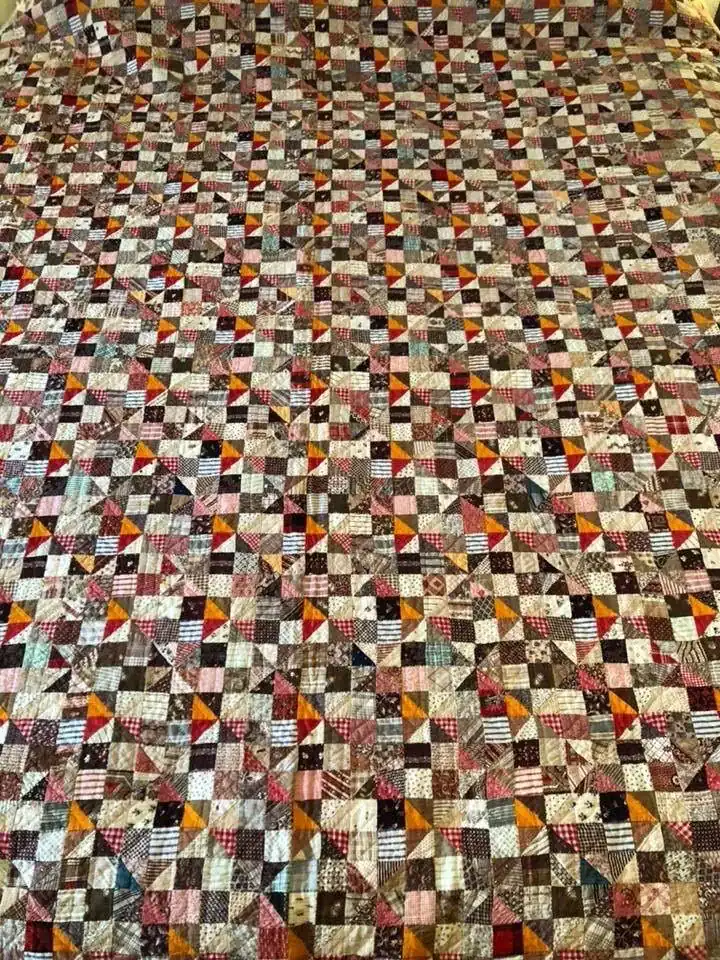
I have often read that old quilts were sometimes used as fillers for newer quilts, but this is the first time I have actually had one where this was obvious. I bought a Victorian era variable stars quilt yesterday, circa 1870 – fabulous fabrics like an elephant and zebra and Victorian motifs. The dealer actually sold it as a “cutter” – I was compelled to buy it just to: save it from this horrible fate, and it was not until I got home that I discovered there was an older quilt inside! (And the dealer is one of the country’s leading folk art dealers who should know better!) It is in good unwashed condition except that there is one block where the browns used as the background of the star have deteriorated and the black flowered chintz used in the alternating blocks has badly split in two of them (but the rest are in great shape – strange!). Anyway, on the damaged squares you can clearly see that there is another quilt inside this one made with a wonderful roller-print indigo with gold highlights. I can’t see the pattern but all the indigo and the white background that is showing looks OK. This is an exciting find to me! I originally bought this as a resale but now don’t think I want to part with it!
My question to all you quilt historians – should I delve further into the insides of this quilt? The quilt inside the quilt appears to be early 19th century or even late 18th century, a rare find. (My daydream is that it’s a Hewson medallion just waiting to be uncovered!) I realize it is probably damaged if it was used as a filler (or perhaps the maker just didn’t like the old one?) It is not heavily quilted, and the batting is balled up at places. If the newer outside quilt were really worn, there would be no question, but the outer quilt is also an exceptionally nice and old one. The quilting is rather sparse and done with large stitches (as you can imagine if the quilter had to go through the old quilt as well as the newer backing and batting), so it would not be too difficult to snip some of the quilting to get a better look at the inside. Help! I’m intrigued by this mystery but unsure what to do next. Have any of you had a similar experience? Recommendations?
I thought some of you would be curious, so I posted some photos on this page http://www.chesco.com/~judy/quiltinquilt.htm
Date: Mon, 5 Jul 1999 11:07:18 -0500 (Central Daylight Time) | From: Mary Persyn <Mary.Persyn [at] valpo [dot] edu
When I took my first quilt class in 1985 we were taught the “quilt as you go” method. Unfortunately, I missed the instructions about making the backing about 4 inches bigger than the front. Just one of the reasons why that quilt is known as “the quilt from hell.” (Another reason – the teacher insisted that all quilts should be totally hand stitched from beginning to end. Another reason – I used the infamous Ginny Beyer rust colored fabric that continued to: bleed. Another reason – the border pattern didn’t make the right length pieced border. You get the idea). I haven’t ever tried “quilt as you go” again. With the right instructions, it’s probably just fine. Mary (who spent a WONDERFUL day at the International Quilt Study Center at UNL last Monday. Thanks Carolyn, Eileen, Sharon and Bev)
Date: Mon, 05 Jul 1999 12:53:46 -0500 | From: Karen Bush <Birdsong [at] worldnet [dot] att [dot] net
bout this. I’m STILL having trouble with e-mails and server…I’ll try to: unsub and resub with my Old, new addie…Birdsong [at] worldnet [dot] att [dot] net If anyone wants to e-mail me, please use the At&T addie…sigh….Hopefully I’ll get this thing working…or….OUT the window, whichever comes first! ( kb
—
TIP- “Never baste a quilt on a water bed….” just another little tidbit from: “Quilt As Desired” Written by Karen Bush http://www.idahoquilt.com The Hand quilting Teaching text- CLASSES- PRIVATE AND IN-SHOP- Inquiries welcome
Date: Mon, 05 Jul 1999 14:53:47 -0400 | From: Lynn and Debbie Cupp <lcupp [at] erols [dot] com
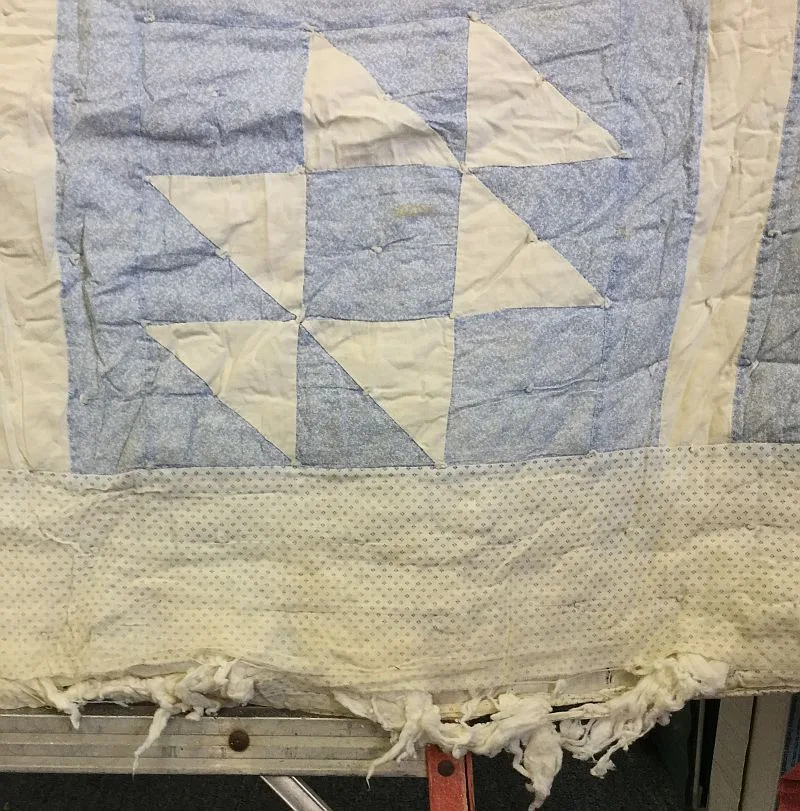
I encountered the quilt within a quilt recently, too. I don’t have any qualms about what to do…yet. ;>
The quilt I bought for a small sum is what I believe to be run of the mill last quarter 19th century. Scrappy 9 patches set with poison green sashing. (If you have Eileen Trestain’s book the green is on page 116, third row, #3 across).
Lots of indigo blocks. Many had turned a dirty brown color. The green sashing was fragile and dry rotted many places.
It had a large fist sized hole through all layers and tattered/torn edges. I know some of you may feel differently about this issue. I wanted to dismantle is for the perfectly good blocks, of which there were several. I didn’t hesitate to dismantle it because it was a 9 patch and not a museum piece.
It is quilted with black thread. So far I’ve determined the following layers
9 patch top as described above cotton batt
Inner quilt consisting of 9 patch in a square (like square in a square) made of scrappy browns, very faded, batting and backing Backing with vermiculate pattern (dark brown, minty green squiggles, smaller rust squiggles and circles of black/white stripes over dyed on one half with a madder brown/rust.
When I am further along with this project, I’ll post some scans to my web page.
Debbie Cupp
Virginia Beach, 94 degrees
Judy Kelius wrote
> I have often read that old quilts were sometimes used as fillers for newer quilts, but this is the first time I have actually had one where this was obvious.
Date: Mon, 5 Jul 1999 14:28:35 -0700 | From: “Beverly Dunivent” <bevquilt [at] sprynet [dot] com
though we have wonderful photos and text in place this isn’t as easy as I supposed. Anne had the latest in scanning and a wonderful top of the line printer, but I am afraid that the photos are still not what I would want to send out with my name attached. We are still hoping for the Fairy Godmother of Quilting Books will wave her wand over us and send us a “real” publisher who is willing to publish a book that we know will sell. (All of you have already told us this!!!)
Beverly Dunivent
Date: Wed, 7 Jul 1999 19:22:03 -0700 (PDT) | From: Kelle Perreault <kelle_p [at] yahoo [dot] com
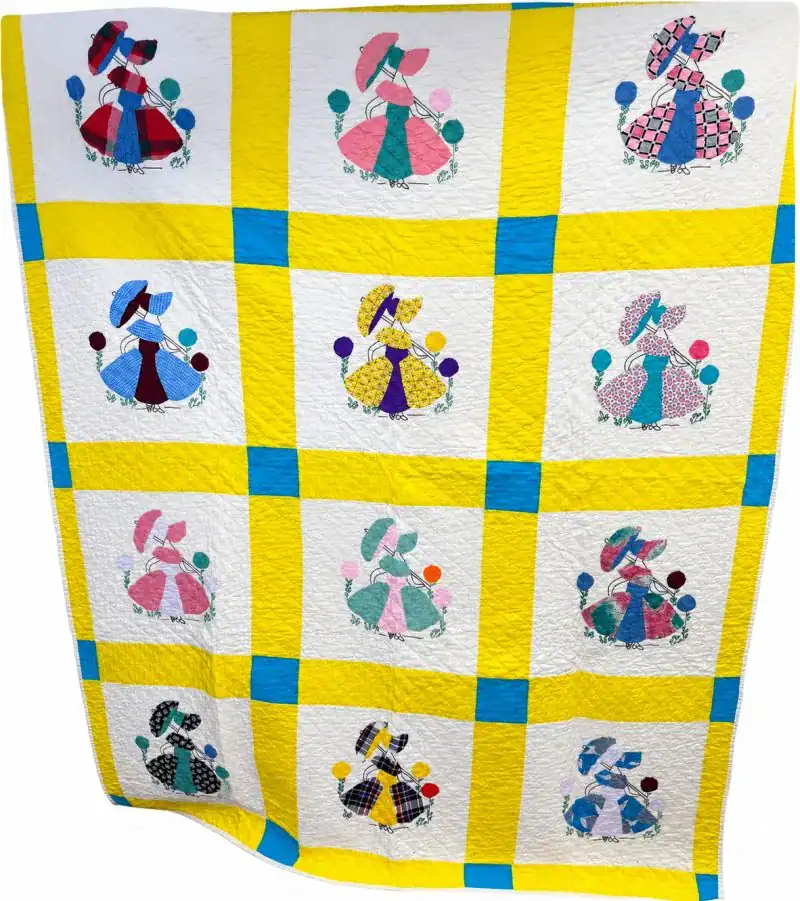
I am new to the list and after reading my first digest, I think I’m going to learn alot! I have been quilting for 12 years and I love “old” quilts and stories about them. I feel very fortunate to have inherited a few quilts from my husband’s Mom, grandmother & great grandmother. I just finished a four generation (1930’s) Sunbonnet Sue. I am currently working on civil war reproduction quilts using repro fabric. I love the new reproduction fabrics on the market now and have been collecting them since the first set of Smithsonian. Does anyone on this list use the repro fabrics? And what do you think of using the “new” repros in an old quilt?
TTYL
Kelle in MI
Date: Wed, 07 Jul 1999 22:38:40 -0400 | From: Peg Gilson <gilsons [at] voicenet [dot] com
At 0655 PM 6/23/99 -0700, you wrote
Date: Wed, 07 Jul 1999 21:39:18 -0500 | From: Laura Hobby Syler <texas_quilt.co [at] mail [dot] airmail [dot] net
Oooh Judy, what a dilema!!! I have to admit, I’m one of those purists that say leave it as the quilt maker intended….but after seeing your photos……I think if you can get a peak at more of the quilt inside and more fabrics seem to be strong then, Honey….go for it. If the batting is badly migrated, then you will be doing it a service to take it apart. Your comment about the quiltmakers taste….I had a client bring me a quilt for “restoration” when infact she wanted me to cover an old quilt with a new top. MIL had made the old quilt and the client *hated* the “awful, dreadful” colors that that “awful, dreadful” woman had put together! I had to chuckle. She left no doubt in my mind that she hated both of them, but loved her husband dearly and couldn’t throw the quilt out (without risking being thrown out herself -is my guess<G>) Anyway, the purist in me declined to use the old quilt as batting, but did finish the top. Told her to put a documentation label on the old quilt and stick it in the closet for the grandkids to find years from now.
Anyway, that roller print looks just too interesting to leave well enough alone…..do a little more investigating and see what else you can find.
If more looks good…..DO IT!!!
Have fun, and keep us informed!
Laura
At 0913 AM 7/5/99 -0400, Judy Kelius wrote
>I have often read that old quilts were sometimes used as fillers for newer quilts, but this is the first time I have actually had one where this was obvious.>
Date: Wed, 7 Jul 1999 21:50:11 -0500 (CDT) | From: Vintage Quilt & Textile Society <VQTS1 [at] airmail [dot] net
This came across my e-mail today, sound very interesting! Especially the button collecting part. Marcia
Deadline is fast approaching, (Aug 10) but we still have a couple of spaces left….
Late Summer term of the Vintage Quilt & Textile Society’s Quilt College will be held Aug 27-28 at the McDermott Library on the campus of the University of Texas at Dallas (Floyd and Campbell actually in Richardson). Friday session is 5-10ish. Saturday 9-5ish.
Friday night we will discuss methods of fabric printing. We will have a brief overview of antique methods and will be treated to a special visit from Jim Salinas with Moda Fabrics. Jim is really excited about speaking to a group of antique textile lovers and fabric collectors. He wanted to know if we would be offended if he brought everyone “samples” of the new lines that Moda has coming out (duh! ) for our swatch books. The more we talked the more ideas he came up with. Be prepared to see vintage fabrics acquired by Moda and the current lines developed from those swatches.
Sounds really cool!!
On Saturday morningVQTS member Cindy Cox will give us some insight into antique button collecting and how to identify them. She has been an antique dealer for almost 20 years and antique buttons have become her passion. This is for the novice (or less than<G>) button collector. We will then move into Fabric from the Depression Era…1920’s -30’s, with a Focus on Feedsacks. It’s not final, but we may have a visit from a special VQTS member from Austin with her 5 notebooks full of feedsack swatches. Late news, we have found more copies of Anna Lou Cook’s OOP book on feedsacks and will have a very few copies available for purchase at QC to attendees only!!!
As always, if you have something that you’d like to show the group, have analyzed, appraised or just ooohhed and aaahhed over, please bring it. Appraisals of any and all quilted textiles by AQS Certified appraisers available by appointment. If you have quilts, tops, blocks, swatches or yardage of fabrics pertaining to the topic that you’d like to sell, contact VQTS for more information.
If you’d like more information on VQTS Quilt College, or information about out newsletter and membership, please contact VQTS through any of the methods below.
Thanks.
For more infomation about VQTS and Quilt College
EmailL<vqts1 [at] airmail [dot] net> That’sVQTS (one)
phone972-783-4149
Date: Wed, 7 Jul 1999 20:26:33 -0700 | From: “Beverly Dunivent” <bevquilt [at] sprynet [dot] com
Laura I recently saw a Carolina Lily with signatures. From the mid nineteenth century. Bev.
Date: Wed, 7 Jul 1999 23:39:42 -0400 | From: “Judy Grow” <Judygrow [at] blast [dot] net
Laura,
I’ve got a large fragment of a quilt top dated 1854 and 1856 in virtually every block. It is muslin and wonderful Turkey reds, and the signatures are in the large triangles of the Lady of the Lake blocks. Many of the signatures are surrounded by stamp and hand drawn designs.
Judy in Ringoes, NJ judygrow [at] blast [dot] net
Date: Thu, 08 Jul 1999 08:03:53 -0400 | From: roosien <roosien [at] gateway [dot] net
I’m going to be traveling on Sat. and through the weekend to Zainsville OH for the Roseville Pottery fest. Are there any quilt shops along the way or around Zainsville?
Thanks!
Chris in sweet summer MI
Date: Thu, 08 Jul 1999 07:41:11 -0500 | From: Merry May <cluesew [at] jerseycape [dot] com
My quilting buddy, Lynn Thomas, and I are in the process of gathering information on the Impact of the Rotary Cutter on Quiltmaking through a survey we made up. If anyone is interested in completing one of our surveys, we’d be delighted to hear from you. Please reply individually to me at cluesew [at] jerseycape [dot] com with your name and address, and we’ll send a survey out to you right away. Please be sure to put “Survey” in the Subject line of your message (or I’ll accidentally send you a Schoolhouse Enterprises catalog!) Also, if you know of someone else (either online or not) whose input would be helpful, we’ll be happy to send extra copies of the survey so you can forward them on to others. Feel free to make copies of the survey and distribute it to local guilds or whatever, too. We’d like to get as many responses as we can. (So far I think we’ve collected about 300, which is a good start, but we’d like to have more.)
Thanks for your help! Let me know if you have any questions.
Take care.
Merry May
—
Merry May (a.k.a Inspector Cluesew & Jessica Four-Patch)
Date: Thu, 08 Jul 1999 10:00:40 +0000 | From: Bobbie Aug <qwltpro [at] uswest [dot] net
Bev,
I know that the publisher that now has your manuscript is looking at it VERY seriously. Hope all goes well.
Bobbie Aug
Beverly Dunivent wrote
> Peggy, Cindy and allI was so interested in the comments about quilt history books.
Date: Thu, 8 Jul 1999 11:12:05 -0700 (PDT) | From: [from unknown, signed “Don Rininger”]
Hello.
I am searching for an antique coverlet or woolen product produced in my g-g-grandfather’s woolen mill. Usually, he wove his name and mill location into the fabric of these coverlets. It was the William Rininger Woolen
Mill, Kantner, Pennsylvania, circa 1895.
If you have one, please let me know. Have you ever seen one?
If you do not have one, can you try to locate one for me??
Any assistance you can provide will be greatly appreciated!
Thanks
Don Rininger dcrin [at] hotmail [dot] com
Date: Thu, 8 Jul 1999 20:00:45 EDT | From: JBQUILTOK [at] aol [dot] com
Have you tried the Ayling Coverlet Museum in Palmyra, N.Y. ? Don’t know if they have anything from your family’s mill or not, but they do have an extensive collection of woven coverlets. I found them thru a AAA tour book – don’t have an address right now, but it shouldn’t be too hard to find. They had 3 floors of exhibits, with one room at the top of quilts (which was my main interest).
Good luck in your search,
Janet Bronston
Date: Thu, 8 Jul 1999 20:51:50 EDT | From: Qltldy10 [at] aol [dot] com
Judy wondered what to do with her “one insider”. Easy- sell it to me. I couldn’t see much of the inside quilt, but I loved all that I saw. Now, you need to know that my neice is getting ready to graduate with a degree in archeological forensics, and my DD will have a degree in archeological anthropology- guess what we’d do!
Now, I need help; not exactly quilt related. A few weeks ago I bought, in a local discount department store, 4 desert plates- with wonderful Mariners Compasses on them! Blue, with a hint of yellow in the border. The border looks like a fabric, the compass sits in the middle, with a white background. The manufacturer on the back says Victoria & Beale, the words “Casual” and “porcelain”, and the pattern is williamsburg- and I can’t find any more anywhere. Victoria & Beale turns up nothing on search, and only one site I found showed a V & B pattern. None of the stores around here have it, and the unboxing person back at the store where I got them looked as blank as only an 18 year old can, and shrugged her shoulders- sigh. Has anybody seen them? Anybody know anything about dinnerware? thanks-
Beth in Maine