January 19 – February 4, 2001
These restored messages come from the Quilt History List, an online forum where quilt historians, collectors, researchers, appraisers, and enthusiasts discussed antique quilts and related textiles. The archive dates from 1996 through approximately 2016 and is being restored gradually. Sign up in the form at the bottom of the page if you want to know when a new page is added. Original spelling, opinions, formatting, and inactive links may remain unchanged.
Primary topics of this QHL Digest:
- Pea Ridge Quilt & Pattern History — A quilt on eBay sparks discussion of the Pea Ridge/Southern Mammy pattern, with Cuesta Benberry tracing it to Robert Bishop’s 1975 book and Opal Phillips’ Quilter’s Swap Shop Monthly.
- Victoria & Albert Museum Quilts Online — Members explore the V&A’s online quilt images including a c. 1765 pinwheel-and-hourglass quilt, with discussion of early patchwork dating back to a 1726 McCord Museum quilt and even a Luca Signorelli painting. (see the article on quilt museums)
- Medallion vs. Frame Quilt Nomenclature — A detailed thread tracing how American and British quilt writers use the terms ‘medallion’ and ‘frame’ differently, citing Jinny Beyer, Celia Oliver, Dorothy Osler, Janet Rae, and others.
- Smithsonian Quilt Conservation Practices — An official statement from the National Museum of American History’s Preservation Services addresses concerns about machine quilting and polyester thread use in quilt conservation. (see the article on repair, restore, or conserve)
- Reproduction Fabrics & Depression-Era Sateen — A member seeks blue sateen for restoration of 1930s-40s quilts, and others point to RJR’s new Sateen Elegance line and Mary Koval’s Dream Weaver reproductions.
- Houston Quilt Show Planning & Other Events — Practical advice for first-time Houston show attendees, plus announcements for the Kalona Quilt Show, an antique quilt scrapbook on eBay, and a crazy quilt with fraternal organization ribbons.
Date: [c. late January 2001] | From: Judi Fibush (via QHL website gallery)
Judi Fibush (www.fibush.net), a new QHL member, was kind enough to share these treasures with us. The descriptions are hers.
The first is a 1940s (1950s) Vogue Art Kit. The embroidery work is exquisite and some of the best I have ever seen. There is a huge clown in the center surrounded by a monkey, seal, lion and elephant. This is a twin size bedspread which would reach the floor on either side of the bed or a full size top. The quilting is 9-10 stitches per inch. The fun part is that there are hot dogs, ice cream cones and hamburgers quilted into the design which makes this a truly wonderful quilt for a child’s room. Backed and bound with a 1/2 inch red and white checked fabric that is from the 40s. There is one tiny (about eraser size) age mark on it but hard to see. Perfect condition. 1840-1860 Appliqued quilt from Maine. No batting but precision applique that has been stuffed from the front and 1/4 inch quilting throughout. The pattern looks like lollipop trees and is so beautiful. Seldom used and kept as a “best quilt”, no damage only slight fading of the green.
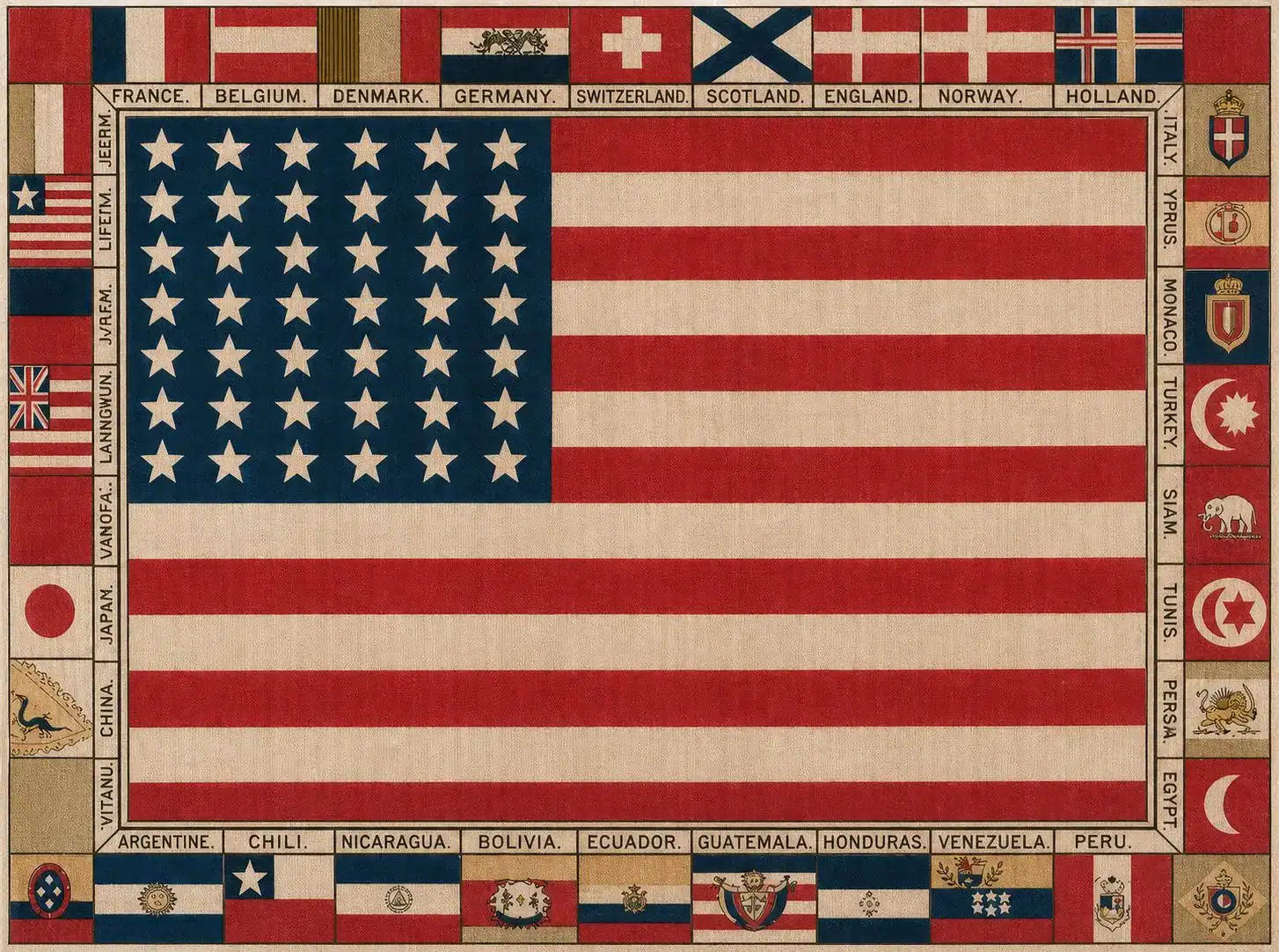
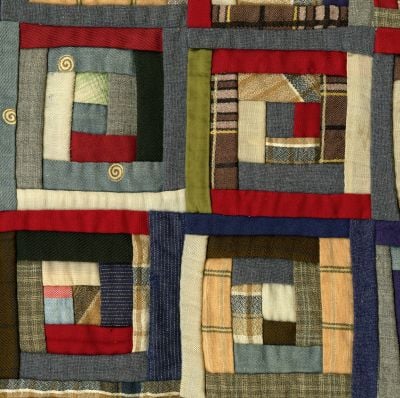
1913 Cigar Flag Quilt – All flannel including borders and back is same as border sashing. These were made from premium flags tucked into cigar boxes/tins as a “freebie”. We became 48 states in 1912 and these flags denote nations prior to WWI. They were made from 1888-1914. This was made by a lady in Marietta, PA in 1913. Some of the flags show monarchy symbols and the nations are spelled wrong at the time; such as: Corea for Korea. 1850-60s Log Cabin pieced quilt. Came from Nebraska with a family to Walla Walla, WA. Family still is living there. Has been restored in 2 places with antique fabrics of the time due to a mouse who made a nest in it and left 2 holes. Double pinks, rich browns, feedsack back. Just a charming quilt that evokes thoughts of pioneer days. An antique top finished for her daughter-in-law: a yellow and white Lone Star/Star of Bethlehem from the 1930s, quilted in an all over feather design with the exception of the diamonds in the star which were outline quilted. There is almost 800 hours of quilting in this one. It measures 84″ square.
An antique top finished for her other daughter-in-law: a double wedding ring also from the 30s, 74″ x 68″, outline quilted on all the smaller pieces and then a fancy design within the white spaces.
Date: Wed, 31 Jan 2001 11:00:40 EST | From: ThreadDog [at] aol [dot] com
I forward the postings regarding the machine quilting threat to quilts at the Smithsonian. Susan Myers, Curator, Division of Social History at Smithsonian’s National Museum of American History. She has asked me to forward the following response from Joan M. Young, Manager of Preservation Services. Linda Claussen Threaddog [at] aol [dot] com From: “Susan Myers” Date: Wed, 31 Jan 2001 11:34:01 -0500 | From: “bonnie wilbur” <bonnie.wilbur [at] oracle [dot] com Question: I’ve never studied this kind of thing except to begin reading these postings a few months ago, but… From my experience listening to people using these terms in Northern Virginia over the last 20 years, I would have said that a medallion quilt was a pieced center with one to many borders optional, and a frame quilt was a single piece of fabric with more than one border mandatory?? Bonnie The debate between the nomenclature for frame and medallion quilts is a tricky one. Whilst its true that essentially it is just a regional difference in usage to mean the same thing, the same thing is a different thing in each country. Sally Ward, Yorkshire UK Date: Wed, 31 Jan 2001 11:25:33 -0600 | From: Marilyn Woodin <woodin [at] kctc [dot] net The Kalona Quilt Show and Sale will celebrate its 30th year anniversary at the Show on April 26,27, and 28. April 26th is the Early Bird part of the show and opens at 6pm until 9pm. On the 27th times are 9am to 7 pm and the 28th 9am to 5 pm. This show and sale is in Kalona, Iowa and hangs approximately 320 quilts–half are new and half are antique. All are for sale. Most of the new quilts are Amish/Mennonite and Kalona is the largest Amish/Mennonite community West of the Mississippi. Approximately 3-4000 persons attend the show and enjoy the shopping in a quiet little town with wonderful shops. Admission is charged at the show. You are invited to come. For any further information : woodin [at] kctc [dot] net, or kac [at] kctc [dot] net or 3196562240. Date: Wed, 31 Jan 2001 17:01:57 -0500 | From: maria [at] lostquilt [dot] com (Maria Elkins) Does anyone know if there is a website for the Georgia Quilt Project? What is the URL? Maria maria [at] lostquilt [dot] com http://www.lostquilt.com/ Date: Wed, 31 Jan 2001 18:35:13 -0500 | From: “Deborah R. Grayson” <deborahg [at] mindspring [dot] com As far as I know there is no web site. Try www.quiltatlanta.com to see if you find anything there. Deborah in GA Date: Thu, 01 Feb 2001 11:19:43 -0500 | From: Newbie Richardson <pastcrafts [at] erols [dot] com I finally found time to read my AIC Newsletter of 1/01. The lead article is entitled “Recent Evolution in Textile Conservation” by Joy Gardiner, Textile Conservator at Winterthur. In it she discusses the different types of net for conservation. As many of you may remember, I have posted warnings against using nylon net to conserve/stablize fagile fabrics as it has been shown to be too abraisve. That is still true. She points out that “nylon net” available in the US is a highly heat set knotted net, with, in effect, small beads of melted plastic at the yarn intersections. However, in the United Kingdom, “Nylon Net” used in textile conservation is a lightly heat set net of bobbin net construction which has no hard beads. This net has a soft hand and can be dyed using dyes for protein fibers. Winterthur now inports this net from England and uses it exclusively, especially on three dimentional upholstery work, as this net has a slight stretch and conforms to shapes. The supplier listed is: Dukeries Textiles and Fancy Goods, Ltd. Melbourne Road 15A West Bridgeford, Nottingham, England +44 115 981 6330 (telephone) I wonder if any our English list members would be kind enough to find out if this company is online and give us either the email and/or web site before we add trans-atlantic phone calls to our quilt budgets! I’d also love to know just how expensive this stuff is! Newbie Richardson in not so sunny Alexandria, Va – where we had 2 days of a delightful 50 degree respite! Date: Thu, 1 Feb 2001 11:56:02 EST | From: Hazelmacc [at] aol [dot] com I had not heard or it didn’t register, that the symposium papers given at Old Sturbridge Village were going to be published, but found a copy in Williamsburg last week-end. The title is “What’s New England about New England Quilts?” and a very reasonable price of $10.95 at the museum in Wmbg. Great buy, great reading. One paper was given by Celia Y. Oliver on Block Set Quilts — she states there are four sets of N.E. quilts: the “medallion”, “all-over”, “strip,” and “block” set. In the footnotes she stated “The ‘medallion’ format features a large central design often set within a decorative border. The central design may be enclosed in a frame or stand alone.” That is a good description in that it allows for both pieced and appliqued work. In Virginia there are many appliqued medallion quilts as well as a combination. Jinny Beyer writing in her book “Medallion Quilts” 1982, “The medallion quilt, known for its ornamental center pattern surrounded by borders…” And begins the first chapter “Historical Development” with this: “Framed center, framed medallion, central medallion–all these are terms that have historically referred to the type of quilt that has a central motif surrounded by a series of borders.” Those are American writers, and l will see what the British writers have to say next. Hazel Date: Thu, 1 Feb 2001 12:24:09 EST | From: QultFrFn [at] aol [dot] com In a message dated 2/1/01 4:57:26 PM, Hazelmacc [at] aol [dot] com writes: <<'medallion' format I agree with Hazelmacc. I’m a quilter who is also an art historian. A ‘medallion’ is a centrally organized design. It can be surrounded by decorative details. They can be: in metal (like coins); stone (like portraits of the Popes in St. Peters’); as rugs (the prototype for Jinny B’s early quilts);Etc.;and they can, most certainly, be in cloth…like our wonderful traditional and contemporary quilts of today. Nancy in AZ Date: Fri, 2 Feb 2001 13:46:03 EST | From: BFquilter [at] aol [dot] com Hi everyone, I’m usually a lurker but a friend recently asked me to write to the list to ask a question for her. She did some redwork and then stored it with the right sides facing each other in her basement where it is apparently damp. After retrieving her work, the red color from the floss has bled on to the white background. Is there any way of salvaging this piece? She also wants to know if there is anything to do in the future to prepare the floss and/or fabric BEFORE doing the work to prevent the bleeding. Thanks for any advice. Barb in VERY cold Minnesota (windchill today about -45) BRRR Date: Sat, 3 Feb 2001 07:47:17 EST | From: Baglady111 [at] aol [dot] com Back a year or so ago, I was searching for info on a logo we found on a feedsack. Small andirons with a flame behind them..EMPIRE was the only word found. After tracking down many towns, counties, and companies called EMPIRE, I finally found a place in Texas with the company with that name. The lady took my info to pass along but I never heard back from them after contacting them several times by mail. Since then, I have lost the info..anyone out there in Texas that knows of a company called EMPIRE? Any leads would be greatly appreciated. Thank you Jane Date: Sat, 3 Feb 2001 13:30:20 EST | From: Hazelmacc [at] aol [dot] com Thought it only right that we see what authors in UK say about medallions and framed quilts. Janet Rae in “The Quilts of the British Isles“doesn’t go into the subject but does call one quilt a “medallion” while across the page from that quilt is a “centre frame” quilt in applique. Dorothy Osler in “Traditional British Quilts” called the central design types “medallions” and says “The earliest documented example of a medallion design is an unquilted piece, dated around 1780…” I assume the date is an educated one and that the quilt is not itself dated. Then she has a section on “Framed covers” and says “A framed cover is a simple but distinct variation of a wholecloth cover. Its distinguishing feature is the very large central area of a single fabric (usually of a solid colour) surrounded by a deep border, or borders, of another (usually patterned) fabric or of patchwork. Unlike the borders of medallion covers, the single-fabric borders of a framed cover are usually mitred.” And she shows a beautiful example on page 36. Have we clarified the difference between a medallion and a framed quilt? l am not certain but hope the information that l have researched is helpful to those interested in this vocabulary. Hazel C. Date: Sat, 03 Feb 2001 12:54:31 -0600 | From: Gail Ingram <GIngram [at] tcainternet [dot] com I am seeking a source of the blue sateen used in so many of the quilts of the depression era-forties. Is there a reproduction line of sateens? Any information on sources of antique and vintage fabrics would be appreciated. I am aware of the Kirck Collection, which has proved a good source for 19th century fabrics. Thanks in advance, Gail Ingram Date: Sat, 3 Feb 2001 15:04:59 EST | From: Baglady111 [at] aol [dot] com Since the subject of patterns was mentioned, I came across some old patterns that I forgot I had..I hve no idea of their origin..they are on a beige or tan paper, a little heavier than tissue..there are tiny dots that form the pattern outline and the pin-point dots are raised..every so lightly, and are in blue. They must be 16″ patterns..the pages measure from 17×24 or 18×23 they are VERY VERY OLD and thought someone might know who put these out..there is writing on some of the sections and indiccate what color or print should be used..they are patterns I have never seen before . They are appliqe and quite interesting. Any clues??? I had asked KRIS about them and she suggested someone out there might have some info on them…Jane Date: Sat, 3 Feb 2001 15:35:11 -0500 | From: Mary Beth Goodman <mgoodman [at] albany [dot] net A friend brought a crazy quilt to my attention and it is intialed in a few place and includes the date: 2/17/02 There is also a ribbon or piece that says: Court Ethen Allen (sic) (large medallion) No. 7382 A.O.F. (design with star in center) Which looks to me like an Odd Fellows organization possibility. There’s also another stamped design that says “Dunmore PA” Are there any good places to look up possibly now-defunct organizations? I tried www.ioof and there didn’t seem like a lot of routes to travel, although I did send an email to someone at the PA site. thanks! I haven’t seen this quilt in person yet, but I just got a bunch of photos of it. The backs of the crazy quilt blocks are feed/sugar/flour sack fabrics from what I’m told. This quilt is going to be on display at our show in May, and I’d like to help track down some info about it if possible. Mary Beth Goodman NYQuilts! Quilts, vendors, lectures, classes with Brenda Papadakis May 19-20, 2001 Russell Sage College, Troy NY http://www.nyquilts.org/ http://www.quiltr.com Date: Sat, 3 Feb 2001 19:42:31 EST | From: Melissa Young (CrazyFolk, Kingwood) I’ve seen a RIT decolorizer product…. I wonder if this would get out red bleeding from the thread? Melissa Young CrazyFolk, Kingwood Date: Sat, 3 Feb 2001 21:59:46 EST | From: Edwaquilt [at] aol [dot] com RJR makes a line of cotton sateen. It is their intention to color specifically for the 30’s and 40’s. Holice Date: Sat, 03 Feb 2001 20:11:26 -0800 | From: Audrey Waite <awquiltr [at] sedona [dot] net RJR just debuted printed sateens in January. They’re called “Sateen Elegance”. Can solids be far behind? RJR’s web site is http://www.rjrfabrics.com. They have shop listings where you can purchase their fabric. Sure wouldn’t hurt to let them know what you want to buy. No affiliation, yada, yada. Audrey Waite in sunny Sedona, AZ Date: Sun, 4 Feb 2001 13:04:43 -0800 | From: Chris Anacker <chrisa [at] jetlink [dot] net Janet Rae does briefly mention this subject in “The Quilts of the British Isles” when discussing the 3 main categories of Bristish quilts, made prior to 1935: “The frame quilt, which usually consisted of a medallion centre, either pieced or appliqued, surrounded by borders”. pg. 10. In “Quilt Treasures of Great Britain” it basicall staes that frame quilts of Britain are unlike the medallion quilts of America because medallion quilts have a “square on point centre’ and repeating blocks, not “square centres” like theirs. However, they show pictures of their quilts with some with “on-point” centers. She goes on to say that “the ‘word’ frame was adopted to describe this uniquely British method of assembling a pieced quilt.” pg. 17 Not only do the pictures provide confusion, but the initial premise is flawed. Medallion quilts do not have to have a on-point center. They can be a basket of flowers! One last statement from an expert is one in the current issue of AQSG’s Blanket Statement. Dorothy Osler, in describing the quilts at the Bower Museum exhibit, says the following about an early one: “two splendid framed (central medallion) quilts from around 1850, bioth showing meticulous organization of colour and shape; and two quilts with the most exquisite central applique, one dated by Averil Colby to around 1795.” pg. 3 Perhaps part of the confusion is the word medallion itself. It seems that this word describes two different apsects of quilts in “quilt language” . In Eurpoe they use the word medallion to describe a complete motif, such as a pre-printed basket of flowers, or a coat of arms, or a plaque celebrating the Queens’ coronation or a Royal wedding, or in France, Napolean some how . The French also use that word to describe the motifs on their toiles. We use medallion to describe a quilt style. And we include medallions in the center of some and also patchwork, and even a solid piece of toile or chintz for the center panel. Kim Wulfert Ojai CA aquiltersjourneytours [at] juno [dot] com