September 1 – 7, 2001
These restored messages come from the Quilt History List, an online forum where quilt historians, collectors, researchers, appraisers, and enthusiasts discussed antique quilts and related textiles. The archive dates from 1996 through approximately 2016 and is being restored gradually. Sign up in the form at the bottom of the page if you want to know when a new page is added. Original spelling, opinions, formatting, and inactive links may remain unchanged.
Primary topics of this QHL Digest:
- Huswifs and Sewing Cases — Members trade sources and descriptions for antique “huswif”/housewife sewing roll-up cases, including references in period quilting literature.
- Textile and Quilt Cleaning — Discussion of vintage textile soaks, laundering methods, and mildew concerns for old quilts and needlework. (see the article on cleaning antique quilts)
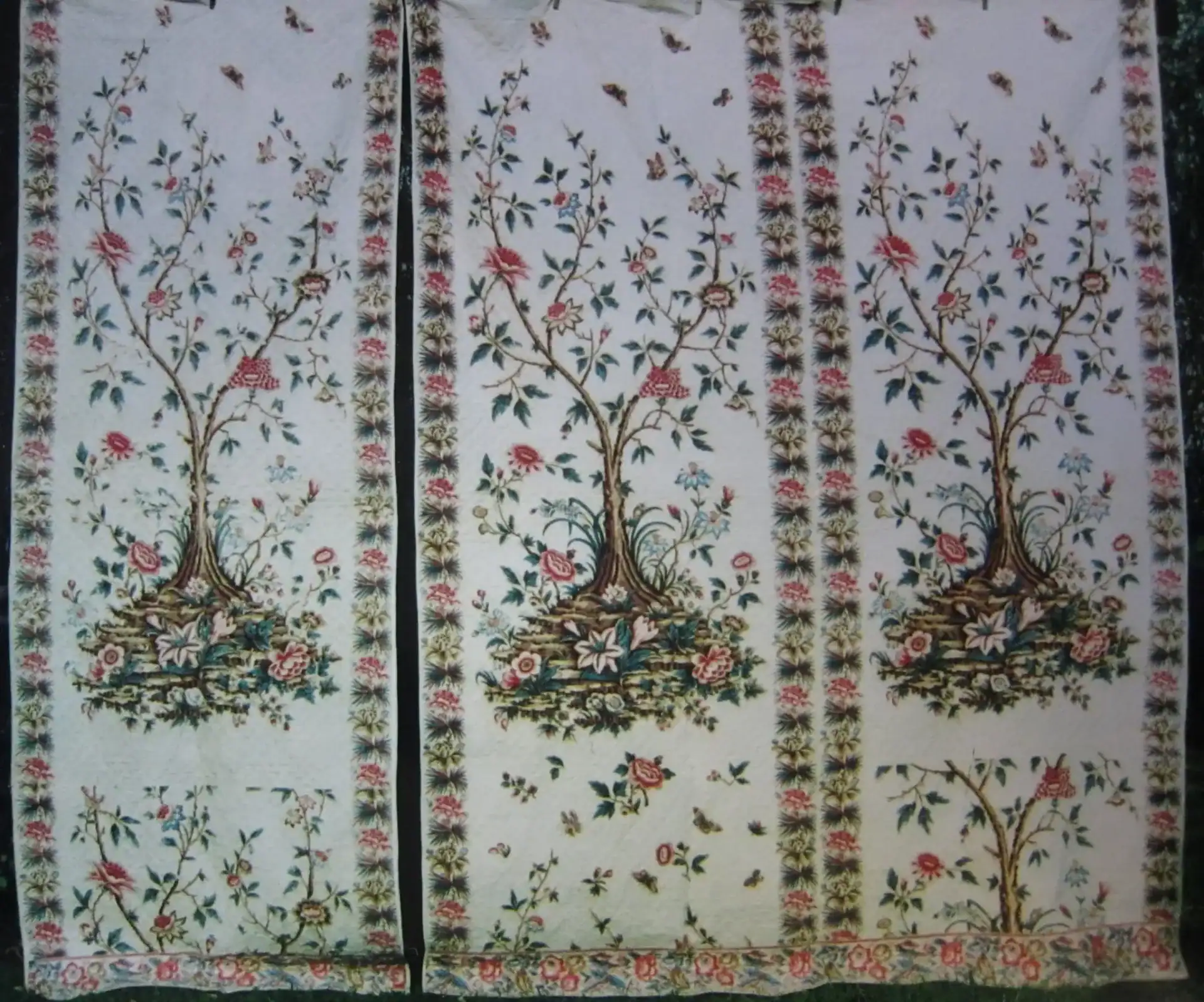
- Drunkard’s Path and Medallion Quilts — Members debate the age of the Drunkard’s Path pattern and discuss medallion-style quilts with chintz and broderie perse. (see the article on the Drunkard's Path)
- Blanket Statements and AQSG Publications — A member highlights an American Quilt Study Group newsletter issue and related quilt history scholarship.
- Chintz Quilt Dating Debate — Members weigh in on the likely decade of a chintz quilt listed for sale online, comparing fabric printing styles. (see the article on dating quilts)
- The Romance of the Patchwork Quilt Printings — A member works out the publication history and print-run dates of the well-known quilt history book.
- Vintage Textile Sale Review — A recap of a vintage textile and clothing sale in Sturbridge, with notes on what was available.
- Fan Quilting Origins — Members discuss whether fan/elbow quilting is a later 19th-century style or appears earlier.
Date: Sat, 1 Sep 2001 22:48:17 -0400 | From: “Phyllis Twigg” <ptwigg@>
Today I discovered a delightful cotton “huswif” or roll-up sewing or
needlework case. It stretches out to 23″ in length and is less than
6″ wide.
A tiny half inch very old paper note attached inside says “mother’s
1830″.
It is possibly from the Annapolis, Maryland area.
The sections include a pouch with a black silk drawstring and four
flat
sectional storage areas that seem to have cardboard linings for
stiffness.
These are enclosed by buttons (bone?). In addition there is a 7″ long
section divided by rows of stitches into ten pockets each only one
half inch
wide. Perhaps these were for crochet hook storage? When rolled up,
the case
is tied with a string made with beige woven cotton tape.
This huswif is constructed from only one fabric overall. It is a dark
brown,
red, yellow, and white cotton print that is strippy in appearance.
I would like to read more about these cases. Despite having a
bookcase full
of quilt and textile books, I can’t seem to put my hand on much
information
tonight. So far I found some brief descriptions in Labors of Love by
Weissman/Lavitt (pages 114- 115) and Classic Crib Quilts and How to
Make
Them by Woodard/Greenstein (page 84, Dover version). I would like to
hear of
additional resources.
Thanks!
Phyllis Twigg
–
Date: Sun, 2 Sep 2001 10:21:39 +0100 | From: “Sally Ward” <Sally.D.Ward@>
> I would like to read more about these cases.
Some time ago these were discussed on the British Quilt History list
and a
lot of members had recollections of the hussifs which were still
issued by
British Armed Forces
until some time in the 60s. The earliest example I found in a
Services
museum was held by the archivist of the Royal Flying Corps, which
became
the Royal Air Force in (I think) 1918. Members also recalled having
to
make them as part of school needlework classes in the 60s, which
presumably
was the last vestige of a very long tradition of needlwork for girls.
There
is a small web-page about the Services hussifs at
www.@/qllsite/Hussif.html
Probably not the sort of hussifs you’re looking for, Phyllis, but
the
conversation at the time demonstrated that they are a traditional
needlework
item which only seems to have died out very recently. We are all now
so
keen on organising ourselves into plastic boxes etc, when the humble
home-made hussif would do just as well.
Sally Ward
–
Date: Sun, 02 Sep 2001 15:24:00 +0000 | From: quiltsnbears@
“An Illustrated History of Needlework Tools” by Gay Ann
Rogers (ISBN 0-9622310-0-2)has some B&W photos of
hussifs which were manufactured.She states,”The word is
derived from housewife and describes various types of
sewing containers.Hussifs were made in Germany,
primarily in Augsburg, from the late 17th century. Many
hussifs had a foot adapted to serve also as a letter
seal…..Many modern hussifs were amusing novelties…”
Using this definition I have a lot of hussifs I’ve
picked up from hotel chains!
Seriously,we hand-sewed felt rectangles in grade school
for the American soldiers during WWII. They were small
envelopes into which the teacher placed needles,thread
and buttons. These were then placed in white boxes with
red crosses on them along with various other essentials.
I still fold wash cloths as we were taught to do for
these Red Cross boxes!
Roberta in FL
–
Date: Sun, 2 Sep 2001 12:12:55 -0400 | From: “Suzanne Cawley” <ccawley@>
Hi all!
I have been a subscriber for a while but have never posted until now.
My
name is Suzanne Cawley (no relation to Cinda, but she is a new
friend!) and
I reside in wild, wonderful West Virginia. I have had an avid
interest in
antique quilts since the late 1960’s but must confess that I have
more
fabric and books than antique quilts!
Several of you may be interested in the latest (October 2001) issue
of Early
American Life magazine. There are four articles about antique
textiles.
Two relate to the fabric mills of old New England, one shows a quilt
made
from reproduction fabrics, and another by Rabbit Goody discusses the
importance of proper identification of antique textiles.
I do have a question for QHL members: Is anyone familiar with a
product
called Vintage Textile Soak? The ad states that it safely removes
yellowing
and brown spots from old textiles. For years I have heard that acid
spots,
etc. could not be removed without weaking the fabric. Is this
product
archivally safe? Has anyone used it and care to comment on the
results?
Thanks for any info you can provide.
Suzanne in Keyser, WV
–
Date: Sun, 02 Sep 2001 20:49:24 -0400 | From: “Kris Driessen, QuiltBus.com” <krisdriessen@>
In this weeks Quilters Nuggets from about.com, Sue Druding gave some
links
for Drunkards Path history, stating quite confidently that the
pattern was
used to advise slaves not to follow a straight path while escaping.
(Not
to be a smart-aleck, but did they really need to be told that?) I
followed
her links and found this
site: http://www.bvlearnnet.org/inncurr/civilwar/lesson2.html,
evidentially a childrens site which expands on the UGRR myth and
refers
visitors to fiction books for more information. Discouraging.
But on the Drunkards Path question, has anyone ever seen one that
predates
the Its use in the Women’s Christian Temperance Union (WCTU), founded
in
1874?
Kris
–
Date: Sun, 2 Sep 2001 19:20:48 -0700 | From: chrisa@
<But on the Drunkards Path question, has anyone ever seen one that
predates
the Its use in the Women’s Christian Temperance Union (WCTU), founded
in
1874?>
I don’t know about the start of the Drunkard’s path block, but I did
learn
something new about the Temperance movement this summer, at the BAQ
exhibit
actually. Appearently there was quite a Temperance movement already
going in
the 1840s (and maybe earlier, but I learned this at a quilt exhibit
from
that era) by the women of the Methodist Episcopal Church, here and in
England. They put symbols on their quilts, such as a triangle
surrounding a
star and large garden water fountains with cups on either side.
The people against drinking held conventions and the Maryland Historical
Society Museum showed silk ribbons from these, where the virtue of drinking water was made into a poem printed on the ribbon, along with dates and pictures. A ribbon dated 1841 from the MD State Temperance Movement said that “cold water is our countries best beverage.”
There was a lady from England in the group and she was well aware of
this being a very strong Methodist movement in England, and she said
worldwide. This made me wonder about only using the Women’s Temperance Movement as a benchmark for quilts relating to temperance. Any thoughts on this?
Kimberly Wulfert
Ojai, CA
Date: Sun, 2 Sep 2001 23:28:25 -0500 | From: “quilt97” <quilt97@>
The following sites mention ‘hussifs/huswifs.’
http://www.anzacday.org.au/miscellaneous/battle.html
http://www.quilttownusa.com/Quilt_Gallery/kathleengallery2.htm
http://www.users.waitrose.com/~grandad/text/memoirs1.html It grieved
us
to have to buy all our cleaning equipment out of our measly 11
shillings
per week. One item of equipment I forgot was something our sergeant
would insist on calling “Hussif” and it was some days before we
learnt
he meant “Housewife”, which was all our needles and cotton and wool
for
stitching things like badges etc., and darning woollen socks. For
those
lads who could not darn for a toffee, and once I’d passed out at the
end
of the training session, I’d darn theirs for 1 shilling a time, but
that’s some time in the future, we haven’t got to that part yet.
http://burt2000.dhs.org/hinckley/slang.html#H HUSSIF
Housewife, a small canvas roll containing needle, thread, buttons
etc,
used for the personal maintenance of a soldier’s kit. Often used
during
interior economy.20
EKarenbeth
Date: Mon, 03 Sep 2001 07:48:16 -0400 | From: Judy White <jawhite@>
Phyllis, in the book, “For Purpose and Pleasure – Quilting Together
in
Nineteenth Century America” by Sandi Fox, there is a little blurb
about
huswifs on p.16 and on p. 18 there is a picture of three of them –
one
is ca 1825, one is ca 1830 and one is early nineteenth century. It
gives the demensions and says they are at the Los Angeles County
Museum
of Art.
Judy White – Ct
Date: Mon, 03 Sep 2001 08:58:26 EDT | From: Cathy Grafton <silkribbon@>
I too love the small sewing kits known at hussifs, housewifs, etc.
When
I was writing my book on silk ribbon I did a bit of research and
included
a pattern for making one. The earliest reference I could find for
them
was about the time of the French & Indian War in America, I found
references to sailors carrying them and lots of different spellings
of
the term. At the Ohio Historical Society in Columbus, they have a
wonderful collection of them all types, sizes time periods.
I have talked to a WWI vet who remembered being issued a sewing kit
called a housewife and have seen some very fancy leather ones from
the
Am. Civil War era.
Have seen only brief mention of them in needlework books, Gay Anne
Rogers
book mentioned has some tidbits. Only included a bit of their
history in
my book as that was not the focus, but am always interested in
learning
more about them. My book is “Nature, Design & Silk Ribbons” published
by
AQS.
I make and sell them at historic festivals and people love them.
Cathy Grafton
_
Date: Mon, 3 Sep 2001 09:39:09 EDT | From: Tubeywooby@
In a message dated 9/2/01 8:55:40 PM, QHL-Digest-request@
writes:
<< I do have a question for QHL members: Is anyone familiar with a
product
called Vintage Textile Soak? >>
I got a pack I used on a wonderufl c. 1870s feathered star – white
(somewhat
spotted) background with red and blue (fugitive green?).
It cleaned it up beautifully, and two years later no sign of damage
from the
“vintage soak”.
I used my mother method which may cause some to cringe as it involves
a
washing machine. She fills the washing machine to the highest setting
with
warm water and soap -without the quilt inside- and lets the agitation
mix the
soap. Then stop the machine, add the quilt, and allow to soak. Gently
push it
around with your hands after a good soak, and allow to spin dwon,
Rinse
without agitation in the same manner (trickier because you must watch
the
machine to stop the cycle after it is almost full of rinse water but
before
agitation starts). Spin to dry. My mother claims this spinning helps
because
the weight of the water is removed from the quilt, so lifting it is
less
likely to cause thread breakage.
Maybe more than YOU wanted to know?
Melissa Young in the deep wet south
Date: Mon, 3 Sep 2001 10:05:54 -0400 | From: “Cinda Cawley” <lrcawley@>
The last issue of Blanket Statements (the American Quilt Study Group
newsletter) had a notice about an exhibit on the art of the
Pennsylvania
Germans at the Lancaster Heritage Museum. Drove up there yesterday
to
combine it with a visit to the Fraktur exhibit at the York Co.
Historical Soc.
They are showing a spectacular chintz applique quilt for which,
according to the label, there is no PA German provenance (kind of
makes
you wonder why it’s included–not that I’m not grateful). The only
information is Northeastern U.S., circa 1800-1825.
The quilt is a framed medallion with the center set square. All
the applique pieces are very large and there are not many of them
considering the size of the quilt. The center is a gnarled branch
with
huge peony-like flowers and two birds, about 14 inches from beak to
tail, which look like raptors but have the colors of macaws.
Wonderful!
There is an extraordinary amount of white in this quilt filled with
glorious quilting. The medallion is enclosed by a frame of
half-square
triangles. The outer border is composed of very large flowers on a
serpentine vine.
I started looking for something similar and came up with the
George
Washington Peter quilt in the collection of the Shelburne Museum. It
is
the quilt on the cover of Chintz Quilts: Unfading Glory by Bullard
and
Sheill it is on page 43 of Quilts from the Shelburne Museum (the
catalogue of the collections trip to Japan). This is not the book by
Celia Oliver. Anyhow, Peter was the great-grandson of Martha
Washington
and the quilt is thought to have been made by his mother Martha Parke
Custis Peter, 1830-1840. The very large arborescent motif in the
center
of this quilt is very similar to that of the Lancaster quilt.
I found the birds on p. 49 of Quilts, Coverlets and Counterpanes:
Bedcoverings from the Museum of Early Southern Decorative Arts. this
quilt is attributed to Elizabeth Gramby Hertford of Perquimans County
(in the Tidewater area near the Virginia border), North Carolina
circa
1800. The birds are not as brightly colored as those on the
Lancaster
quilt, but they look to be on the same scale and appear almost as
fierce.
I haven’t yet found a comparable serpentine border. 20
Cinda on the Eastern Shore who had great plans for the day until I
discovered Shelby Foote on CSPAN-2 and spent three hours listening to
the man with the world’s most beautiful voice talk about the Civil
War–I did work on binding a quilt at the same time.
20
Date: Mon, 3 Sep 2001 11:04:17 -0400 | From: “pepper cory” <pepcory@>
When Lynn Gorges (Palampore) gets back on the computer (she’s at the
beach
right now…) she’ll enlighten us on this subject. Lynn has an
extensive and
enviable collection of sewing kits, some dating from before the Civil
War. I
made one for myself from an orphan quilt block. It has one small card
square, which gives it body, plus flannel ‘leaves’ for pins and
needles and
a pocket for a thimble and small spool. The whole packet ties up
neatly with
a ribbon. The woman who gave me the pattern said that type was early
19th
century and that the frugal housewife kept her precious sewing tools
with
her. This kit wrapped around a waistband string and was kept under
one’s
apron.
Happy (non) Labor Day.
Pepper Cory
Date: Mon, 3 Sep 2001 14:41:21 -0400 | From: “Cinda Cawley” <lrcawley@>
Let me second “Cousin Suzanne’s” recommendation of the articles
in
Early American Life, October 2001. In March 1993 Denise (a.k.a.
Quiltdiva) and I took a two day course called “Dating Quilts by Their
Fabrics” at Rabbit Goody’s Cooperstown Textile School. It was only a
couple of days after a blizzard had devastated the Northeast and I
drove
to Rabbit’s studio in Cherry Valley, NY between banks of snow so high
we
couldn’t see the beautiful scenery of New York’s Southern Tier.
Cherry
Valley is a village whose population peaked about the time the Erie
Canal was completed (late 1820s), just the kind of place a quilter
would
love. Because of the awful weather only one other participant showed
up
for the class. Rabbit was undaunted and we three had the advantage
of
her full attention. I don’t think I’ve ever learned as much in so
short
a time. 20
Rabbit has a fascinating study collection. I was just looking at
my
notes which contain drawings of what various natural fibers look like
under a microscope. One way to recognized someone who has studied
with
Rabbit is that she probably carries a 100x Radio Shack microscope.
Fran
Fitz seems never to be without hers.
Rabbit’s “Textile Trivia Timeline” extends from 25,000BC to
1889AD.
I have stapled to my notes examples of woven cloth (worsted which was
used for early wholecloth quilts, real linsey woolsey which could
never
be mistaken for the former and various other weaves).
Two things stand out about Rabbit as a teacher. She takes a
scientific approach which encourages orderly thought. She is
extremely
knowledgeable about technology (an aspect of quilt history which I
find
ever more interesting).
I don’t know if Rabbit still teaches at her studio, but if you
have
the chance to go take it.
Cinda on the Eastern Shore
Date: Mon, 03 Sep 2001 23:26:02 -0400 | From: “Kris Driessen, QuiltBus.com” <oldquilt@>
To
I am forwarding this message for Cindy Brick, who is buried in
deadlines
right now. Ironically, Cindy just posted a free pattern for a
“Victorian
Housewife” on her website http://www.cindybrick.com even though she
hasn’t
been following our discussion.
Dear Robin et al,
I can tell you, as a former staff member of the Quilt Heritage
Foundation, what I know about the Quilt Restoration Society…Camille
Cognac
and Nancy Kirk (of QHF) actually co-founded the Society, with Nancy
doing
the conference and Camille the newsletter. Several conferences were
held…many of us, myself and QHL’s ListMom, Kris Driessen, attended
and/or
acted on staff.
I am not sure of exact date right at this moment, but more than
three
years ago, Camille and the Kirks (Nancy and her husband Bill) found
themselves disagreeing on the future of QRS…that is when the Quilt
Heritage Foundation was formed, and the Quilt Restoration Society
split off.
Camille was going to continue it, as well as the newsletter — Nancy
and
Bill would host the Quilt Restoration Conference. Well, the
Conference has
continued, though in a different form the past few years…as a
how-to
multi-day hands-on event. (In fact, that is happening in a few weeks
in
Omaha, NE! Check http://www.kirkcollection.com for more specifics. An
excellent way to learn basic restoration tricks and techniques,
taught by
one of the masters in the business — Nancy Kirk herself.)
I had been teaching for the conference, as well as doing some
writing for
it, and right during this time, Camille asked me to co-edit the
newsletter
with her. I was willing, but after asking me, sending me a notebook,
etc.,
Camille basically dropped out of sight. She did not return my phone
calls or
faxes, though I knew they were received. (Her answering machine would
take
the call, etc.) I did not have access to the newsletter data, so
could not
do the work I had said I would.
Months passed. I saw Camille again at the QHL Conference in
Greenville,
NY, which the Driessens hosted. She showed me, at that time, the
paste-up
pages of the next issue of the newsletter, which she said was going
to the
printer’s right after she got home. She never referred to my duties
as
co-newsletter editor; in fact, she had more interest in talking about
the
Columbine shootings (those of you who know me know I live about 15
miles
from that high school) than anything else.
I have not seen, heard from or spoken to her since then…and
that’s been
at least three years. I also never saw any evidence that newsletter
issue
ever was mailed to anyone. I have heard rumblings that Camille has
decided
to go out of the professional teaching business, although there are
comments
now and then that may indicate she is still restoring quilts
professionally.
As far as I know, she has not moved from her studio in Hillsdale, NY.
So Robin is correct…there’s just been ‘nothing’ heard about
QRS. I need
to make clear that Camille retained the rights to use of ‘Quilt
Restoration
Society,’ so it — and the newsletter — are her bailiwick. The
Kirks, in
contrast, are affiliated with the Quilt Restoration Conference, which
is
part, along with the Crazy Quilt Society, of the nonprofit Quilt
Heritage
Foundation, or QHF.
Just a sad situation…what can I say.
Cindy Brick
Date: Tue, 4 Sep 2001 11:18:04 EDT | From: Palampore@
As for any vintage type soaks I am a bit wary. I have seen several
of these
under various names—and some have adorable eye catching packaging.
Due to
this I now have in my wet cleaning room a test set up ready to go
—if I can
ever slow down long enough to do it. My test area has a non-chlorine
or
“vintage” wash set behind a soaking tray with an old stained piece
of fabric
sitting in the tray waiting to be soaked for an hour. At that point
they
will be rinsed and dried and compared. I will take it a step further
and
inspect the fibers with microscopes to examine for changes.One reason
the
test has also been delayed is because I was just going to use old
yellowed
fabric, but I was recently told that Testfabrics has a fabric with a
standardized/controlled stain on it that I should use. Need to order
it!
Anyway….I am testing Staintique, Vintage Fabric Wash, Clorox 2,
Biz, Borax,
Hydrogen Peroxide, Tri-Zyme (AmWay),and a few others. (I am at home
and they
are at my studio.) Some of these items list their ingredients.
Those which
do list ingredients always have listed Sodium Perborate, Sodium
Perbonate,and
a 3rd which I can’t remember off the top of my head. (Will add
later.) What
I am finding from my reading is that these are a variation on the
theme of
the chemical make-up of Hydrogen Peroxide. So these companies are
claiming
that they don’t alter the fabric since there is not a chlorine in
them. If
the color is not altered then they claim there is no change.
So…..if you want to wash King Tut’s buriel robe or Martha
Washington’s
granddaughter’s quilts, avoid all of this stuff and go to a textile
conservator. If you want to hand wash a family christening gown
maybe
consider it. But first of all I would find some yellowed, spotted
cloth and
do some test washes to see what the results are. See what it feels
like wet.
Check to see if there is a residue after washing the items. Don’t
just jump
in head first and trust these items. I think they have been tested
only to
see if they got out the spot. I am not so sure that the future life
of the
items to be washed have truly been considered from a scientific
standpoint.
I hope to write up my findings when this test is done. Is there a
quilt
magazine out there that you think would be interested in this???
Read labels:
Amway Phosphate Free Tri-Zyme (pre-soak and detergent booster- Enzyme
Formula)Caution: Contains sodium sesquicarbonate and sodium
carbonate. Not
recommended for silk or wool. Do not use with chlorine bleach.
But then
on the other side it says “Cleans ALL washable fabrics.” (I guess
they don’t
consider wools and silks washable- just dry cleanable) “Brighteners
and
whiteners in Tri-Zyme help keep your clothes looking clean and
bright.” Also
states that it removes protein and carbohydrate stains….and more.
Ultra Clorox 2 – Non-chlorine color safe bleach – Contains: Cleaning
agents
(surfactant, enzyme), color safe bleach (sodium perborate), water
softeners
(sodium carbonate, sodium silicate), fabric whitening agent and
fragrance. I
am going to call their 1-800 to find out what the whitening-agent is.
I am
assuming it is a type of blueing.
So now all of you run to your laundry area and begin to read. I
would love
to hear from you if you come up with any interesting facts.
Happy washing,
Lynn Lancaster Gorges
Historic Textiles Studio
New Bern, NC
Date: Tue, 4 Sep 2001 19:41:27 EDT | From: Vici47@
I would like to thank Sue,Xenia, and Beth for all the helpful
information
they gave me dealing with documenting family quilts. I have read
through the
Boxes Under the Bed web site and there is more information there than
I was
hoping to deal with, but I think I will give it a try. I will let you
know
how it all turns out. Thanks again,Vicki
Date: Tue, 04 Sep 2001 20:05:18 -0400 | From: “Jan Drechsler” <quiltdoc@>
Two years ago, J. G. Row, Barb Garret, Newbie Richardson and myself
attended
the Cooperstown Textile Conference organized by Rabbit. (And perhaps
Kris?
Anyway..) It was more of a lecture series, than a hands on series
although
we did get to do a behind the scenes tour of the quilt storage area
of….Hmm, perhaps it was the Cooperstown Museum. That was a lovely
opportunity to see some very old interesting N.Y. state quilts.
The conference, held in the summer, was an equal combination of woven
textiles, which I believe is Rabbit’s main focus and quilts. As a
bonus,
Cooperstown is just down the road from Hickory Hill Quilts. It was a
pleasure having time to share with Kris at the conference and to
visit her
shop as well. And no, we didn’t go to the Baseball Hall of Fame.
Here is Rabbit’s e-mail to be put on her mailing list:
rabbitg@
—
Jan Drechsler in Vermont
Quilt Restoration; Quilting teacher
www.@/~bobmills
Date: Tue, 4 Sep 2001 20:06:39 EDT | From: Palampore@
I am writing this separately in case laundry is a bore to someone who
likes
sewing kits. As Pepper told you, I have a rather extensive collection
of
sewing kits and among the items are housewives.
There is the cloth type which has been discussed at length. Those
are made
of mostly calicos or a wool bunting. These were used by men and
women. When
cloth began to be covered with tar this also became a suitable outer
covering. I have some that are flat and just like the traditional
calico
ones. Then there is another design which employs a small roll pillow
at one
end that is used for various things. It can be used as a pin
cushion, and I
even have a couple that a hole has been cut from it to store the
thimble. I
have one that is a round tin covered in cloth which acts as a holder
for
thread or knitting needles. From the roll extends a flat piece of
cloth which
then has a place for needles, thread, etc. It can be rolled onto the
“roll”
and tied with the attached cord.
Soldiers in the Civil War (and probably Mexican War) on up to present
carried
sewing kits called a “housewife”. In World War I and II many were
issued by
the government, but many were given to them by the Red Cross and by
advertisers. Liquor companies gave lots of them to soldiers. There
are
several variations on the theme for these. Do soldiers still carry
a sewing
kit? I need to check on that.
I guess I have another article to do…….
I also collect sewing bags that have the needle felts. The bags are
a
half-round shape with the felts underneath a cardboard covered piece
on the
side which flaps over the felts(or pinked bunting). They have
string/cording
which acts as a shoulder strap. I have those spanning about 75 years.
Does
anyone else have these???? Please write if you do.
Not exactly quilting, but certainly used by the women in order to
make their
quilts.
Off and running to make a sleeve for a quilt.
Lynn Lancaster Gorges
Historic Textiles Studio
New Bern, NC
–
Date: Tue, 04 Sep 2001 21:02:35 -0400 | From: Paul and Nancy Hahn <phahn@>
This weekend I was the lucky receiver of a small overnight-size
suitcase
of vintage quilt patterns/ads clipped from the newspapers of the
1930’s. They were collected by the mother and aunt of a dear friend
in
the Old Order Mennonite community of Lancaster County, PA. Many were
in
brown paper bags of local businesses that are no longer in
existence.
Quite a few are packed in individual used envelopes, along with the
cardboard patterns the ladies drafted for the pattern, mostly on the
backs of Corn Flake boxes. I am having more fun opening each small
packet to see what is within!
I am thinking of placing them in either 2 or 4 to a page
archival
pages and putting them into a binder, similar to my vintage fabrics.
However, the papers smell quite musty. I don’t see any mold or
mildew.
Is there something I can place in a sealed container with these paper
treasures to get rid of the odor? Are there other ways to
store/display
such items? Also, is there a listing of this type of quilt patterns
from the 1930’s? The ones that do not have the Laura Wheeler or
McKim
Studios name, are just identified by a number. Am I correct to think
I
should keep the cardboard patterns with the clippings-the cardboard
squares and triangles are really quilt crude, but I think, for some
reason, they should remain together. Any suggestions?
Nancy Hahn
Date: Tue, 4 Sep 2001 21:57:35 EDT | From: Palampore@
After typing up the other messages I went on a “search”—- If you type in “sodium perborate” you will find more than you ever wanted to know. I searched Yahoo and Alta Vista. Borax has an especially good site, but is a bit slanted. Take that into consideration if you look it up. Yes, it is sodium perborate that is in the family of hydrogen peroxide. It is used by many industries —-dental, wood pulp, textiles, cleaning milk tanks, etc. Sodium Carbonate gave me less in my search but for our purposes think of it as water softener. If you want to explore it more encyclopedia.com has a simple little write up. Now I will combine this with my notes at my studio and trudge forward. It really drives me crazy when industry wants us to feel ignorant. Now that we know these 2 chemicals for what they are we can make better choices. Thanks for your positive comments. Lynn Lancaster Gorges Historic Textiles Studio New Bern, NC
Date: Tue, 4 Sep 2001 21:02:53 -0500 | From: “Leigh Fellner” <hcquiltspeoplepc.com>
My guess is that an airing for an afternoon on a sunny day would kill the mildew that is causing the odor. You could try the old trick of putting them in a box of CLEAN kitty litter which is itself enclosed in a plastic trash bag (a favorite trick for smoky smells) but that’s not going to stop the mildew problem.
Date: Tue, 4 Sep 2001 21:04:57 -0500 | From: “Leigh Fellner” <hcquiltspeoplepc.com>
In my endless search for vintage fabric I found this quilt listed on ebay last night. (Please understand that I do not know the seller and am getting nothing out of this auction – in fact she’s a competitor of sorts. This is an intellectual exercise for me.) http://cgi.ebay.com/aw-cgi/eBayISAPI.dll?ViewItem&item=1461954536 Does it look like 1930s to you? I know little about British/Irish quilts, but my understanding is that medallion quilts, chintz, and broderie perse were a feature of the first part of the early 19th century, not of the 20th. I emailed the seller and asked for some closer closeups, which I can pass on to any of you who are interested. The quilt is finished by bringing the front around to the back and secured with a backstitch (that obviously does not go through to the front). The white fabric used in the front looks to be handwoven. Some of the chintzes clearly appear to be handprints – they have that “woodblock” look and occasionally are slightly out of register. Were reproductions of 19th c. chintzes like these popular or even available in the ’30s? I suggested to the seller that she stop the auction until she can get the quilt appraised, which as you can see she’s done. But I’m sure she’d appreciate the input of this group as well! Click on the thumbnails to see these pictures up close. <table border=”0″ cellpadding=”0″ cellspacing=”0″ width=”100%”> <tr> <td width=”20%”><img alt=”quilt102.jpg (55029 bytes)” border=”2″ height=”60″ src=”images/quilt102_small.jpg” width=”100″/></td> <td width=”20%”><img alt=”quilt104.jpg (70554 bytes)” border=”2″ height=”75″ src=”images/quilt104_small.jpg” width=”100″/></td> <td width=”20%”><img alt=”quilt101.jpg (69583 bytes)” border=”2″ height=”75″ src=”images/quilt101_small.jpg” width=”100″/></td> <td width=”20%”><img alt=”quilt106.jpg (24710 bytes)” border=”2″ height=”44″ src=”images/quilt106_small.jpg” width=”100″/></td> <td width=”20%”></td> </tr> <tr> <td width=”20%”><img alt=”quilt1033.jpg (66086 bytes)” border=”2″ height=”75″ src=”images/quilt1033_small.jpg” width=”100″/></td> <td width=”20%”><img alt=”quilt105.jpg (54800 bytes)” border=”2″ height=”75″ src=”images/quilt105_small.jpg” width=”100″/></td> <td width=”20%”><img alt=”quilt107.jpg (58417 bytes)” border=”2″ height=”75″ src=”images/quilt107_small.jpg” width=”100″/></td> <td width=”20%”><img alt=”quilt108.jpg (58459 bytes)” border=”2″ height=”75″ src=”images/quilt108_small.jpg” width=”100″/></td> <td width=”20%”><img alt=”quilt109.jpg (64490 bytes)” border=”2″ height=”75″ src=”images/quilt109_small.jpg” width=”100″/></td> </tr> </table>
Date: Tue, 4 Sep 2001 19:35:19 -0700 | From: “Penni Ryan” <penniquilts@>
I’ve only been signed up on the newsletter for a few months. I have thoroughly enjoyed reading about everything especially since I am in the soaking it all up mode. I just couldn’t help myself though when Cindy Brick mentioned the Quilt Restoration Workshop. The workshop is this weekend September 8th and 9th in Omaha. The reason I’m telling you this is because I am going. I am so excited I can hardly wait. I also have made arrangements to go and see several of the quilts at the University of Nebraska at Lincoln. Anyway I am sure that I will come back with lots of knowledge and information. Just thought I would share my excitement. Quilting and packing as fast as I can. Penni Ryan-Pitre
Date: Wed, 5 Sep 2001 01:02:52 -0400 | From: “J. G. Row” <Judygrowrcn.com>
Before I launch into my post I want to thank Xenia for keeping us all spellbound with her tales of the Amish quilts histories. And Lynn for all her cautionary information on textile cleaners. Now. The September/October issue of the Magazine of the National Trust for Historic Preservation, called “Preservation” arrived today and has a short article on page 14 about the town of Oella, Maryland, and the man who owns it and has saved it. The town was a 19th century mill town which had been in Charles Wagandt’s family since 1887. He bought it outright 30 years ago in order to preserve it. The mills closed for good in 1972, but this gentleman restored and modernized the company houses making sure that the mill workers could remain in them. They had no public water or sewers nor indoor plumbing until he began his program of restoration and modernization. The one really interesting, and puzzling sentence in the article states that Oella was “named for the woman said to have first spun cotton in America.” Does anyone know anything about this? Phyllis? Cinda? You live in that section of the country. Has anyone ever heard of this woman before, or do you think this is a local or apocryphal tale? Oella? What was her last name? When did she live? When did she spin cotton? I wonder when the town took her name as their own? The town was founded “early in America’s industrial revolution.” Was she a local heroine? It sure would be neat if we could say she was the first, for sure. Judy in Ringoes, NJ judygrowrcn.com
Date: Wed, 5 Sep 2001 07:59:14 +0100 | From: “Sally Ward” <Sally.D.Wardbtinternet.com>
> my understanding is that medallion quilts, chintz, and broderie perse > were a feature of the first part of the early 19th century, not of the 20th. Absolutely. I’ve passed on the email about this ‘1930s’ medallion quilt to the British Quilt History List and a couple of museum contacts to see what they think. It may be that the seller knows something we don’t, but I can’t for the life of me think why she picked that date. This looks to me like an exciting find, I hope we hear the rest of the
Date: Wed, 05 Sep 2001 08:27:06 -0400 | From: Judy White <jawhiteinfi.net>
Good morning everyone. Hope everyone had a lovely holiday. I went to an “antique textile and vintage fashions” show and sale on Labor Day. It was held in Sturbridge, MA at a hotel there. I never saw so much bark cloth and drapery fabric in any one place, but there were some lovely quilts, wonderful clothing and interesting fabrics. I bought a painted pillow top made from a kit – this is the third one of these painted pieces I have bought. One, a Bucilla pillow kit, I had framed and it’s just beautiful. I also have an entire quilt top with painted basket motifs which I’m sure was a kit quilt. This pillow is also wonderful. It is a basket of flowers done in shades of pink, dark green, black and white on a painted pink background. The whole picture was stamped on muslin. This is another one of those mysteries of “why didn’t the maker finish it after putting so much work into the embroidery?” Stamped on the edge is,”No. 50 – Pillow top & back S32 – Vogue NY. I know at one time Beverly Dunivent and was it Xenia Cord? were working on a book about quilt kits – is this still a viable project? Also I bought some quilt blocks to add to my growing collection – these are tumbling blocks made of cadet blues and mourning prints. With these blocks was a little roll of vintage checked fabrics rolled together with a large piece of mourning print. On the selvedge of one of the checks it says, “Lancaster Kalburnie” I think. The Kalburnie could also be “Kaldunnie”. It’s hard to read because it’s printed exactly so that a black line runs through the words. But anyhow, does that sound familiar to anyone? I’m sure these fabrics are in the 1880-1910 era. This is the second time I have been to this show and both times were very interesting. I was roundly chastised by some prissy boy for touching a dress (which was for sale by the way) on a manikin because it was so old of all things. He had about a thousand reasons why we shouldn’t touch it or even look at it very much – my answer to that is get it off the sale floor it you don’t want it touched. My friend and I were both taken with how small much of the vintage clothing was. The women who wore these dresses were no more than 5 feet tall and about a size 2 with 16-18 or maybe 14-16 inch waists. I also found out that the shop “Amazing Lace” on Cape Cod has closed. That’s a shame because she had wonderful victorian laces and linens and a good mix of interesting things. However, someone else told me that the owner is now selling on the internet so all is not lost. If anyone knows anything about the Lancaster, etc. company, please post to the list. It might be very interesting. It seems whenever I buy something, there is usually a mystery to be solved. Judy White in cool,dry CT
Date: Wed, 5 Sep 2001 11:58:42 EDT | From: Trimble4@
Hi all, I will be travelling to the Savannah/Hilton Head area this weekend. Can any of you pass on some “must-see’s”? Quilt sites, quilt shops, or antiques shops are my favorites, but since my travelling companion is not a quiltie, any historic sites of particular interest would be nice too. Thanks in advance, Lori in windy Massachusetts, where fall is fast approaching
Date: Wed, 5 Sep 2001 15:34:12 EDT | From: Palampore@
Our cable connection for the internet has been messing up so I had workers in my yard all day trying to solve our problem (for the ump-teenth time!!!). They needed me to stay on the Internet so they could try to find out what was going on. Anyway…due to this I was all over Ebay. I saw a Quilt Game that was listed as 1870. Really interesting. Thought some of you might like to see it. There is also a “homespun” quilt on there that is said to be pre-CW. I would like to get some discussion going on it. I am not selling either of these items, nor bidding on them. I just wanted the list to discuss them. Now to go do some work that I need to be doing. It looks like the buried cable had a problem, so they are stringing one over our yard for a few days……. Lynn in New Bern, NC
Date: Wed, 05 Sep 2001 14:47:45 +0000 | From: Bobbie Aug <qwltpro@>
Leigh, Good questions! The quilt was removed from the site so I could not view it, but to answer your question – Chintzes were reproduced in the 20th century at different times, including the 1930’s. Also, fabric with poor registration was printed to resemble that “antique look.” However, finishes and griege goods – the basic “cloth”, differed. We find reproductions occurred throughout history – in fabrics as well as styles. Bobbie Aug
Leigh Fellner wrote: > In my endless search for vintage fabric I found this quilt listed on ebay > last night. (Please understand that I do not know the seller and am getting > nothing out of this auction – in fact she’s a competitor of sorts. This is > an intellectual exercise for me.) > > http://cgi.ebay.com/aw-cgi/eBayISAPI.dll?ViewItem&item=1461954536 > > Does it look like 1930s to you? I know little about British/Irish quilts, > but my understanding is that medallion quilts, chintz, and broderie perse > were a feature of the first part of the early 19th century, not of the 20th. > I emailed the seller and asked for some closer closeups, which I can pass on > to any of you who are interested. The quilt is finished by bringing the > front around to the back and secured with a backstitch (that obviously does > not go through to the front). The white fabric used in the front looks to > be handwoven. Some of the chintzes clearly appear to be handprints – they > have that “woodblock” look and occasionally are slightly out of register.
Date: Wed, 5 Sep 2001 17:15:08 -0500 (EST) | From: Teri Klassen <teresakbloomington.in.us>
Kris, I believe there is at least a Drunkard’s Path block in a sampler quilt in Jane Bentley Kolter’s wonderful book “Forget-Me-Not” that pre-dates WCTU – maybe 1860? at least I think that pre-dates the WCTU. There’s also a picture of a “very old” one in Ruth Finley’s book I believe, that looks as if it could be mid-1800s but hard to say. Also I think there is one in the Oregon Trail book that may be 1860s or earlier. But it may have a different name, Wandering Foot or something. Teri in Indiana (where I just attended my first contemporary Amish-country quilt auction: 83 quilts – all contemporary and made to be sold – brought in a total of about $49,000 in 3 and 1/2 hours. at Cannelburg) http://www.QuiltHistory.com.
Date: Thu, 06 Sep 2001 00:10:28 -0500 | From: Jennifer Perkins <qltrstoreharlannet.com>
IMHO, the seller of this chintz quilt dated it as 1930’s because she
saw
that the fabrics were bright with the red prints, the Prussian blue,
the
ombre prints, not dark like the turn-of-the century quilts. This is
so
obviously an 1840-1850 quilt, that blue color is so distinctive and
has
never been successfully reproduced. What do you all think? Also,
the
medallion style and broderie perse surrounded by the half/square
triangle
borders, it just reminds me so much of the 1840’s quilt I
reproduced-my
Yellow Quilt-it just has to be of the same era. If you saw this
Bobbie,
you’d know it right away.
Jennifer in Iowa-thinking this would be a fun quilt to try to
duplicate!
Date: Thu, 6 Sep 2001 01:39:47 -0400 | From: “J. G. Row” <Judygrowrcn.com>
>There is also a “homespun” quilt on there that is said to be pre-CW.
>I would like to get some discussion going on it.
Lynn,
I clicked on and enlarged the photo of the homespun quilt folded, the
last
of the photos. I don’t really know about the fabrics, but the
quilting is
in the Baptist (Methodist) Fan, or elbow, quilting. I thought that
kind of
quilting wasn’t seen until very, very late 19th century.
Perhaps the fabrics are earlier, but quilted later?
http://cgi.ebay.com/aw-cgi/eBayISAPI.dll?ViewItem&item=1461948759
Judy in Ringoes, NJ
judygrowrcn.com
(click on the thumbnails) <table border=”0″ cellpadding=”0″ cellspacing=”0″ width=”100%”> <tr> <td align=”center” width=”20%”><img alt=”999458961715_quilt.jpg (27865 bytes)” border=”2″ height=”133″ src=”images/999458961715_quilt_small.jpg” width=”100″/></td> <td align=”center” width=”20%”><img alt=”999458950050_quilt4.jpg (103298 bytes)” border=”2″ height=”75″ src=”images/999458950050_quilt4_small.jpg” width=”100″/></td> <td align=”center” width=”20%”><img alt=”999458956238_quilt2.jpg (137951 bytes)” border=”2″ height=”75″ src=”images/999458956238_quilt2_small.jpg” width=”100″/></td> <td align=”center” width=”20%”><img alt=”999458952990_quilt3.jpg (125103 bytes)” border=”2″ height=”75″ src=”images/999458952990_quilt3_small.jpg” width=”100″/></td> <td align=”center” width=”20%”><img alt=”999458948548_quilt6.jpg (68861 bytes)” border=”2″ height=”75″ src=”images/999458948548_quilt6_small.jpg” width=”100″/></td> </tr> </table>
Date: Thu, 6 Sep 2001 08:12:03 +0100 | From: “Sally Ward” <Sally.D.Wardbtinternet.com>
> IMHO, the seller of this chintz quilt dated it as 1930’s because
she saw
> that the fabrics were bright with the red prints, the Prussian
blue, the
> ombre prints, not dark like the turn-of-the century quilts.
Indeed, but its a common misconception that British
turn-of-the-century
quilts were dark. Everyone is so familiar with the dark clothing and
oppressive interiors favoured by Victoria that the light, bright
quilts
being made at the time can come as a surprise. (This is something
Fran
commented on during her visit this summer)
> medallion style and broderie perse surrounded by the half/square
triangle
> borders,
There are little things about this quilt which make it feel ‘right’
to me
(and I have to emphasise that I am very much an amateur in the
field).
Looking at it closely, on the first ‘frame’ around the centre panel
the
strip of half square triangles was just arbitrarily cut off at the
point
where the length of the border suited the maker, in contrast with the
beautifully accurate points on the centre star, and careful applique
of the
chintz cut-outs. A maker of a repro quilt would surely labour hard
not to
have these ‘flaws’ and yet it is so very common in our frame quilts
it was
obviously not seen as a mistake, just a sensible way of proceeding.
And the
sheer range of fabrics. I am trying to find out more about repro
fabric
production in the UK but I am not at all sure that we had (or wanted)
repro
available in the 30s as there seems to have been in the US.
I’m also intrigued by the little I can see of the stitching around
the
applique, which seems more like crewel work than the sort of
stitching we
normally see in similar work.
The more I look at this quilt the more I think it is a stunner.
Sally W
Date: Thu, 06 Sep 2001 20:53:49 +1000 | From: Lorraine Olsson <svenpnc.com.au>
My first thoughts on this piece are that it is a 1920s piece. Now, I
am not an
expert,
but I have other 1920s pieces, particularly a 9 patch, which has a
mix of
fabrics, mostly cotton, but also a fabric that could be (as stated) a
wool/cotton mix.
To me the colours are consistent with that era, and the size of the
quilt is
also speaks this date.
This would tie the fan quilting in as to being quilted at the time it
was
made.(if that makes sense)
Any other thoughts?? Please look at it and comment.
Lorraine in Oz
> Perhaps the fabrics are earlier, but quilted later?
>
> http://cgi.ebay.com/aw-cgi/eBayISAPI.dll?ViewItem&item=1461948759
>
> Judy in Ringoes, NJ
> judygrowrcn.com
Date: Thu, 6 Sep 2001 08:02:14 -0400 | From: “Alan R. Kelchner” <quiltfix@>
I inquired of the seller – it IS 1830, she made a typo as I had
expected.
She says she’ll let me know when she re-lists it, and I’ll let you
know in
return.
Alan
Date: Thu, 06 Sep 2001 08:30:43 -0500 | From: Laura Hobby Syler <texas_quilt.co@>
My gut reaction, without getting my “mits” on it is to agree with
Lorraine. I’d like to know if the owner/seller has done tests on the
fibers to determine the content. I’ve done too many restoration jobs
on
this type of quilt to believe the earlier date listed. Just MHO…
Laura
in soggy and windy N. Texas
and about 20 miles east of the tornado yesterday afternoon
Date: Thu, 06 Sep 2001 09:07:28 -0500 | From: Bettina Havig <bettinaqcsocket.net>
One more piece of the puzzle relating to the dates of various
printings of
The Romance of the Patchwork Quilt. I spoke to Scott Gipson who is
publisher of Caxton Printers, Ltd. and got this information. They
printed
the first printing of the book in 1935, a second in 1936 without the
original color plates, a third in 1947. In 1960 they sold the rights
to
print the book to Bonanza, a division of Crown Publishers. Bonanza
had
exclusive rights to reprint unitl 1980 when their agreement expired.
In
1988 Dover acquired the world rights to reprint the book, in
paperback only,
until such time as they discontinued printing or distribution of the
book.
At that time rights revert to Caxton. Caxton still holds the
copyright which
they renewed in 1963.
At least we can now brackett the time frames for the reprints.
There were only 1500 copies in the original print run. So happy
hunting.
Bettina Havig
Date: Thu, 06 Sep 2001 10:40:30 -0400 | From: Newbie Richardson <pastcrafts@>
Thanks for the review of the Vintage Textile sale in Sturbridge. It
has been a sale to go to on my very long list of things to see!
For those of you who do not know me, I am a costume appraiser,
historian, and textile conservator with 25 years experience and
observation.
The primary reason that most of the surviving antique and vintage
clothing we see is so small is that it was packed away as a
“souvenir”
of a woman’s youth. Most of us were thinner in our teens and
twenties
than after kids and middle age spread! I KNOW that I can no longer
fit
into my debutante or wedding dresses! But they along with some really
wonderful suits – are packed away and pulled out periodically. Trust
me,
we have plenty of larger sized pieces in our museum collections!
Also,
only in the last half of the 20th c. do we see clothing as
“disposable”
rather than recyclable. Most people remade and remade their clothes.
We
have LOTS of those in our museum collections as well. there was not
as
much to work with either to remake or to recycle in the smaller
clothes!
Historically people were really not that much smaller in the 18th
and
19th c. We have benefitted from better nutrition, certainly – and all
that poly visol we gave our babies! Modern nutrition has increased
bone
mass. Also intermarriage between traditionally tall Northern European
immegrants and shorter ethnic groups has helped spread “big” genes.
Also, upper and middle class women did not exercise, did not play
tennis
or swim, did not pick up their own babies (you got down to them –
hence
the “lady’s chair”), or their own groceries. There was no upper body
developement. Corsetry had nothing to do with it! Thus armscyes were
smaller, as were ribcages.
Finally, our own daughters are much broader through the back and
rib
cage than most of us. They are the first generation to benefit from
Title IX – sports equality. They were playing soccer in Kindergarten,
swim teaming in the summer, rowing crew in high school.
I took bridal measurements for 7 years. The measurement that has
changed dramatically is the ribcage: not the bust, the waist, or the
hip. The only exception are the recently immigrated Asian or Eastern
European girls who did not have the sports culture from the time they
were tots.
Please put to bed the urban myth that “people were smaller back
then”!
Newbie Richardson
Past Crafts Studios
Appraisals and Conservation of Historic Textiles
Alexandria, Va.
Date: Thu, 6 Sep 2001 11:41:37 -0400 | From: “Cinda Cawley” <lrcawleydmv.com>
I too thought fan quilting was a late 19th century style until I saw
it used
on quilts in the Calico and Chintz exhibit of early 19th cen. quilts.
Cinda on the Eastern Shore
Date: Thu, 06 Sep 2001 11:54:46 -0400 | From: Judy White <jawhiteinfi.net>
Thanks Newbie for your interesting post on vintage clothes. I had
never
thought about middle and upper class women not exercising or
particularly not picking up their own children. That will really
build
the upper chest muscles. And you are probably correct about the
dresses
being put away without being worn very much. All of the outfits I
saw,
which were supposedly from the 18th century, had seen very little use
–
in fact they looked almost new – not 20th century new, but old new.
Judy White
Date: Thu, 6 Sep 2001 15:31:42 -0400 | From: “J. G. Row” <Judygrowrcn.com>
Hi gang.
I posted to THE expert on woven fabrics, Rabbit Goody, about that
quilt on
e-bay. Following a copy of my post to her is her answer to me.
>Rabbit,
>There is a quilt on e-bay that is stirring some discussion on the
Quilt
>History List. Would you be so kind as to click on the hyperlink
below and
>let me know what you think?
>I clicked on and enlarged the photo of the homespun quilt folded,
the last
>of the photos. I don’t really know about the fabrics, (You are the
expert
>here) but the quilting is in the Baptist (Methodist) Fan, or elbow,
>quilting. I thought that kind of quilting wasn’t seen until very,
very
>late 19th century.
>Perhaps the fabrics are earlier, but quilted later?
>http://cgi.ebay.com/aw-cgi/eBayISAPI.dll?ViewItem&item=1461948759
>Thanks for helping out. A lot of people are interested in knowing
about
>this, not necessarily bidding on it.
Rabbit’s answer:
>Hey Judy thanks for asking about it. I think the majority of
fabrics are
>early mill fabrics and not Home spun at all. Many are cotton warp,
wool
>filling and there is a lot of common jean twill.
>The type of quilting for utilitarian everyday quilts is popular
throughout
the >1860’s and probably earlier. I see it in southern civil war
era poor
quilts.
>I have decided to bid on the quilt as I think for studying early
mill
fabrics it >is a good one so if I get it you’ll be able to spend
time with
it some time
Me again:
If Rabbit wins the quilt we all will benefit in study times with her.
Judy in Ringoes, NJ
judygrowrcn.com
Date: Thu, 6 Sep 2001 17:24:11 -0700 | From: “La Belle Collectibles” <helenlabellecollectibles.com>
Hello all. I’m a new member of the list and very pleased to have
found such a high caliber discussion on quilts. I’ve collected quilts and
schoolgirl samplers for many years now. Last year I bowed out of the
corporate rat race and this summer launched my own online antique
store, La Belle Collectibles. I can’t tell you how much fun it is to be working at a ‘job’ that involves a passion!! For years I have
collected based on what appealed to me with less regard to the art & history of
the actual fabrics & patterns. Now that I’m fortunate enough to have
the time to begin researching & learning, I’ve purchased a number of
great reference books and am immersing myself in them. I would
greatly appreciate your recommendations on seminars & workshops that you
think have particular value to supplement my reading. The search engines
turn up names but I would appreciate your experience & comments on
the quality of the seminars. Thank you very much & I look forward to learning more from each of the great discussions on the list.
Helen Hodack
Helenlabellecollectibles.com
Date: Thu, 6 Sep 2001 20:32:32 -0400 | From: “Suzanne Cawley” <ccawleyalleganyinternet.net>
First let me say thanks to everyone who wrote about their experiences
with
textile soaks, etc. Lynn Gorges’ project sounds like quite an
undertaking…..and I hope she will share her results with the group.
I am
sure that a publication would be interested in publishing the
findings….just as some have published info about batting tests,
etc.
I have read the comments about huswifs with much interest. I have
always
liked them and e-mailed Phyllis to let her know how jealous I was
that she
had acquired one. Phyllis and I have been friends for over 35 years
(we
were in preschool when we met….ha, ha!) so we are allowed to drool
over
each other’s new finds!
Anyway, for those of you who would like to purchase some “smalls”
such as
huswifs, pockets, pillowcases, crib and doll quilts…..just a
reminder….buyer beware! I saw an interesting exhibit several years
ago at
an Adamstown (near Lancaster, PA) antique mall that had many fakes,
including about five huswifs. These were items that had been
recently made
from antique fabrics but had been sold to the dealers as originals.
They
surely gave the sellers a great return on their investment. I was
impressed
that the dealers thought enough of their customers to put on such an
exhibit. It certainly reinforced the importance of buying from a
reputable
source or someone who can establish an item’s provenance.
This exhibit also reminded me to properly label any reproduction
items I
might make; especially those made from antique fabrics. Although I
would
not pass them off as original; others could do so if labels are not
“embedded” in the item. You have probably heard all this before;
but the
recent huswif discussions reminded me of that wonderful exhibit.
Suzanne in Keyser, WV
Date: Thu, 6 Sep 2001 22:35:33 -0400 | From: “J. G. Row” <Judygrowrcn.com>
Suzanne,
You must be talking about the exhibit at Marilyn Kowaleski’s shop. I
believe those items were all marked as reproductions, and were for
sale as
such.
Barb Garrett there? Do you remember? I remember that we had a
conversation
about the exhibit at the time, but I forget what we said. Or what
you
said — as you knew all about it.
Judy in Ringoes, NJ
judygrowrcn.com
>
Date: Fri, 7 Sep 2001 06:41:45 -0500 | From: “Leigh Fellner” <hcquiltspeoplepc.com>
>I inquired of the seller – it IS 1830, she made a typo as I had
expected.
>She says she’ll let me know when she re-lists it, and I’ll let you
know in
>return.
Welll…..aside from the fact that the 1930s date appears both in the
auction title and in the text, here’s what the seller said to me in
her 2d
email to me:
“I bought it at a general house auction and it came with no history
at all.
I…know ZERO about quilts….I asked another dealer for her opinion
of the
age…she guessed about the 30’s but I have to admit that I have no
idea
myself and it could be any age.”
Date: Fri, 07 Sep 2001 06:42:03 -0400 | From: Barb Garrett <bgarrett@>
Good Morning All –
Since DD #2 finally went back to college last weekend (and I got sole
possession of my car back <grin>) I was able to get to Baltimore for
the
wonderful Maryland Historical Society quilt exhibit. It’s been
extended another week, so if you can go, you should. And they have
an
extremely well done catalog — in Japanese and English — that
accompanies the exhibit. They will mail the book — that’s how I
got
mine last spring. For information and an on line quilt show —
www.mdhs.org
Now my question — I had bookmarked this auction and am curious about
the names of the quilts listed on the invoice. Click to enlarge the
picture and you can read the invoice — I interpret it to be fabric
sold, not quilts — am I right? Are alhambra and elmora types of
fabric from that time? The price seems very high if it’s a per yard
price, based on my interpretation that the date is 12-14-14. Could
they be for a bolt, since he’s a wholesaler? Any help in
interpreting
this invoice will be greatly appreciated.
http://cgi.ebay.com/aw-cgi/eBayISAPI.dll?ViewItem&item=1185951752
Thanks for your help. After my 2 day visit to Baltimore I’ve got
another quiltie treat today — I’m off to see list mom Kris and
Quiltbus
— they are at a festival an hour from my house in Bird In Hand
outside
Lancaster, PA. It will be great to see the “new” bus — last time I
saw it, it was a rather sad vehicle.
Barb in southeastern PA
Date: Fri, 07 Sep 2001 09:00:36 -0500 | From: Laura Hobby Syler <texas_quilt.co@>
Hi Barb,
I would tend to think that since the numbers are under the heading of
YDS, that this is fabric not finished quilts. Would you think that
they
would be wholesaling “finished quilts” at that time?
Give Kris a hug for me. Miss seeing her at shows down here!
Laura
Date: Fri, 7 Sep 2001 09:24:01 -0500 | From: “Leigh Fellner” <hcquiltspeoplepc.com>
Anybody here know anything about Quadriga Cloth? I know that it was
manufactured c.1926-c.1967 and that many patterns were in print
throughout
that run…and that’s about it. From what I’ve seen of the line, my
wild
and completely uneducated guess is that at least some of those prints
were
themselves reproductions (or adaptations) of 19th century designs; I
have
one piece I am pretty sure is QC that is identical in design to a
piece of
c.1900 calico in my stash. Were these an earlier generation’s
version of
our current Aunt Grace 1930s reproductions? If so, I’d love to
eventually
use one of the old Mountain Mist patterns to recreate a 1930s repro
of a
19th c. quilt – if that makes any sense!
Anyway, I’ve got 2 different lengths of the same print which differ
just a
tiny bit – one was (unfortunately I had to launder it) crisper, like
’40s
percale, almost slightly glazed; the other has a much softer hand.
After
washing they are more similar but still have subtle differences, and
even
without looking I can still distinguish between them. I’ve taken
zoom
closeups of face and back (including selvage) of each. If anyone
could help
me either with determining which is older, or has any info on
Quadriga
Cloth, I’d be very grateful!
Date: Fri, 7 Sep 2001 08:31:09 -0700 | From: “Laurette Carroll” <rj.carroll@>
Hello Qhl’ers
Leigh I own 2 large sample books of Quadriga Cloth from the late
1930’s.
Included are many calico fabrics that look like those of the late
1800’s, including double pinks and yellow and red small prints.
They are not sold as “reproduction”, but as “old fashioned and always
in
demand.”
For an example see “The American Quilt“, by Rodney Kirakofe, page 36.
If
you email me and send a picture or describe your fabric I will look
through the sample books to see if it’s there.
Laurette Carroll
Southern California
Look to the Future with Hope
Date: Fri, 7 Sep 2001 11:57:29 EDT | From: Xroadclown@
I’m looking for information on quilting in Australia/New Zealand,
traveling
there soon, and would like some connections! thanks in advance
Melanie in Beautiful Ithaca New York
Date: Fri, 7 Sep 2001 14:30:57 -0400 | From: “Cinda Cawley” <lrcawleydmv.com>
search
of usual spots did not turn up my notes. I am actually trying to dig
my way
out from the chaos of moving (made some progress today on my books).
I’ll
tell you what I remember. Quadriga Cloth was distributed by Ely
Walker, a
fabric wholesaler established in St. Louis circa 1870. Very early on
they
began selling those timeless prints which are known as Quadriga
Cloth. I
have yardage I bought about 10 years ago (admittedly it had been on
the
shelf awhile) which is identical to fabric in a quilt in my
collection which
dates from the 1880s.
Ely Walker came to dominate the market in the American Midwest.
Sometime around 1960 it was taken over by Burlington Industries which
continued to sell the same prints under the Ely Walker name until
sometime
in the 1980s. I have corresponded with a man who worked for Ely
Walker for
twenty-five years starting in the late 1940s. Those notes are here
somewhere and when I find them I’ll make sure my facts are correct
and share
any other goodies.
A very interesting little tidbit is that David Walker (the
co-founder of
the firm) had a son named George Herbert Walker who had a daughter
named
Dorothy who married Prescott Bush. Their son is George Herbert
Walker Bush
and, of course, their grandson is George W. Bush. Ah, the influence
of
fabric!
Laurette, please tell me more about the sample books you have.
Is there
any information printed in them? Where did you find them? How many
pages,
etc, etc?
Cinda on the Eastern Shore
Date: Fri, 7 Sep 2001 11:40:12 -0700 | From: “Ellen King” <eskingrcsis.com>
I just bought a charming quilt from (China?) that has bunnies on it
(I love bunnies), but it was rough to the skin. It never occurred to me
to check the fabric content, because I thought all were 100% cotton or cotton/polyester. Well, this one is cotton/ramie. Any comments on
the longevity, whether it will ever feel soft? or?
Ellen King
California
Date: Fri, 7 Sep 2001 11:48:02 -0700 | From: “Laurette Carroll” <rj.carroll@>
Hello QHL and Cinda,
The 2 Quadriga Cloth sample books are large, dated 1937 and 1938.
Filled
with samples of a very nice quality cotton in all the wonderful and
interesting prints of the 1930’s.
The books are put out by “Ely & Walker, St. Louis, Manufacturers,
converters, and distributors.”
I counted once and I think there were about 1500 different cloth
samples
in each book.
The “old fashioned” type prints are called “Quaker Chintz Prints”.
As I said in a previous email,……For an example see “The American
Quilt”, by Rodney Kirakofe, page 36.
Laurette Carroll
Southern California
Look to the Future with Hope
> Laurette, please tell me more about the sample books you have.
Is
there
> any information printed in them? Where did you find them? How
many
pages,
> etc, etc?
> Cinda on the Eastern Shore
>
>
Date: Fri, 7 Sep 2001 17:03:03 -0500 | From: “Carol Butzke” <butzkenconnect.net>
To add to the discussion of Methodist/Baptist fan or elbow quilting.
I own
a Lemoyne star quilt with cheddar and fugitive green (now
yellow/green) star
points with double pink alternating squares with a circa of 1870. It
has an
overall pattern of fan quilting.
Not so different from our foremothers, we still like quilting
patterns that
are easy to execute.
Carol Butzke
Wisconsin