November 13 – 23, 2001
These restored messages come from the Quilt History List, an online forum where quilt historians, collectors, researchers, appraisers, and enthusiasts discussed antique quilts and related textiles. The archive dates from 1996 through approximately 2016 and is being restored gradually. Sign up in the form at the bottom of the page if you want to know when a new page is added. Original spelling, opinions, formatting, and inactive links may remain unchanged.
Primary topics of this QHL Digest:
- Authenticating a Televised Quilt — A debate over whether a quilt featured on the show Flea Market Finds is genuine, tied back to a prior high-profile eBay auction.
- Dating Fabrics by Color and Pattern — Members help identify a Prussian blue fabric and date a set of Puss-in-the-Corner quilt blocks. (see the article on dating quilts)
- French Boutis and European Quilting Traditions — A member shares an exhibition catalog on French boutis and Provencal quilted coverlets, sparking interest in the technique. (see the article on quilting in Europe)
- Cleaning and Reviving Vintage Blocks — Practical advice on soaking dirty antique quilt blocks in Biz and removing old blue marking-kit lines. (see the article on cleaning antique quilts)
- Holiday Greetings and List Community — Members exchange Thanksgiving wishes and reflect on the camaraderie of the list.
Date: Tue, 13 Nov 2001 21:16:11 -0600 | From: Mary Waller <mswaller@>
Date: Wed, 14 Nov 2001 08:54:56 -0500 | From: “Judy Kelius (judysue)” <judysue@>
I think the group decided a long time ago that this quilt is authentic. It just happens to be in wonderful condition. One of the QHL members was actually the underbidder at the auction and vouched for its age and condition. As far as not taking credit cards, the reserve on this quilt is probably more than most people’s credit card limits – and neither eBay payments or Paypal will process an amount that large.
The worst case of shilling I saw on eBay was a quilt that I had sold to someone else on eBay for around $1000. A few weeks later it reappeared on eBay (with MY photos and MY description) and the bidding was up to more than $5,000 in less than a day and hadn’t met reserve! I protested her right to use my photos and it was withdrawn but I found out later that the high bidder was actually the woman’s husband! I didn’t have to report it, since by the time I found this out, they had been expelled from eBay for other reasons. She relisted the quilt on eBay later with new photos but was unable to get the bidding much over $1,000 – made me feel good!
Date: Wed, 14 Nov 2001 20:00:42 -0500 | From: Barb Garrett <bgarrett@>
<img align=”left” alt=”eagle1.jpg (68911 bytes)” border=”2″ height=”101″ src=”images/eagle1_small.jpg” width=”100″/> After several wonderful days filled with quiltie activities, I’m finally able to do some looking in my favorite revolving picture book — ebay — and found a quilt with very interesting eagles. Note — I don’t consider it a reference book for many reasons, but it’s a great way to see alot of pictures of interesting (and uninteresting) quilts. We’ve talked before about the graphic 4 corner eagle layout found in some central PA quilts, so when I saw PA eagles in this listing I was excited — then I saw the quilt and it got even more exciting. These eagles are not in the typical location — they are smaller and all around the border — the good spread eagle pose, but they form the border of an absolutely beautiful red and green applique album quilt. And there are 16 eagles on this one quilt! Most of the red and green applique album quilts found in northern Maryland/southeastern PA have flowered vines or swags in the border — not eagles like this. Very unusual. Click on the thumbnails below
Date: Thu, 15 Nov 2001 20:08:41 EST | From: Chyral@
Howdy all,
I was looking through some files today, and turned up the photograph of this
quilt that appeared on the auctioneer’s website prior to the sale. It’s not
of the best quality (it’s a little over compressed), but I think it is of
some interest nonetheless, especially in light of the controversy surrounding
the quilt in this and other on-line forums. If anyone is interested, please
contact me off-list (at chyral@), and I’ll send the photo out by
e-mail. (It’s a 66KB file, btw.)
-Cheryl
Date: Fri, 16 Nov 2001 08:02:41 -0500 | From: “Zendelle Bouchard” <zendelle@>
I got my new issue of Quilter’s Newsletter Magazine the other day and have
totally fallen in love with the 1870’s Pineapple Medallion Quilt, which will
be one of the first patterns issued by the Quilt Preservation Society. For
$25 you will get a newsletter and four patterns a year for antique quilts.
According to the website (quiltpreservation.com), if you join by the end of
the year you will get a bonus fifth pattern. I heard from Nancy Kirk
yesterday that there will be color photos of the quilts on the website
showing some of the fabrics in the original quilts to help you match them.
The patterns will also be available in EQ4 format, which is great because I
want to make my Pineapple Medallion in a miniature version.
Zendelle in NH
Date: Fri, 16 Nov 2001 10:53:12 EST | From: LeahZieber@
I have a 1999 catalogue from the American Textile and History Museum
titled, “And So To Sleep – Jacquard Coverlets from the Hawthorne Collection”
It is filled with pictures of coverlets from Ohio, New York, Pennsylvania
etc. I quickly scanned to see if one read “Peace and Plenty” but did not see
it. ATHM my have some record of it, though. Try them.
Happy hunting
Leah Zieber
Date: Fri, 16 Nov 2001 18:28:04 -0600 | From: “Leigh Fellner” <hcquilts@>
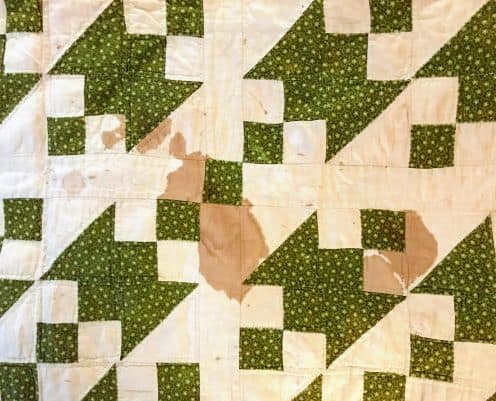
Bought a small lot of Puss-in-the-Corner quilt blocks today made with these
fabrics. I’d appreciate your folks’ take on their age:
Date: Sat, 17 Nov 2001 20:07:21 +1100 | From: “kate knight” <kateknight@>
Leigh,
Lucky you !!
That blue looks to me like a Prussian Blue. Eileen Trestain
describes it in
“Dating Fabrics” as a colour with a richness an depth that stand
out in
quilts of this period (1830-1860). The blue was probably first
produced in
America in the early 1830’s, but was known in Europe previously.
Prussian
blue was often used to create those lovely fabrics that were graded
from
light to dark and back again, known as rainbow or ombre prints. You
will
find that this blue was often printed with a light tan figure,
perhaps
enhanced by a black or white edge…”
Refer page 62 and 63 for some of her pics.
Kate
Date: Sat, 17 Nov 2001 06:33:32 -0600 | From: “Leigh Fellner” <hcquilts@>
Thanks so much! That date range or thereabouts does seem to be the
consensus of QHL folks so far 🙂 This has been great fun.
Date: Sat, 17 Nov 2001 16:46:38 -0500 | From: “Cinda Cawley” <lrcawley@>
The best job in the Guild is program chair. I’ve been sharing
that
position in Bayside Quilters with a friend for the last two years.
Getting
to choose the speakers is great fun and our proximity to Washington
and
Baltimore means that we have a great pool of teachers and speakers to
draw
from.
On Wednesday we had Kathryn Berenson, author of Quilts of
Provence and
Pique de Provence. I think it was one of the most successful
meetings we’ve
ever had. If you’ve seen her books you know how beautifully they are
illustrated. The slides she used in her talk were of the same
quality as
the gorgeous photos in the books. She also bought about 10 quilts
dating
from the early 18th to mid-19th century. The quilting on the
all-white
quilts was so close it looked like machine work. The earliest quilt
of all
had cutwork designs as well as cording. She even brought a
petassoun, the
traditional small piece made to protect the mother’s dress from
infant
messes on special occassions.
Pique de Provence is not available in English; I bought it anyway
for
the pictures. If I can scout up my Larousse I’ll try to revive my
college
French. The French tradition is very different from ours
(American/British)
which only adds to the interest.
Cinda on the Eastern Shore
Date: Mon, 19 Nov 2001 15:09:07 +0100 | From: Daniele Seyrig
Pique de Provence is the catalogue of an exhibition held last year at the Musee d’impression sur etoffes , where some of the boutis and quilted coverlets of Jean Andre Cabanel were on display and wich I wrote about at the time I think . There are several others wich contributed articles to the catalogue wich is very well made . I really like the way the quilts are documented .They study both the top and back fabric , the batting , the printing technique ,and the thread and quilting . I was lucky to see the exhibition twice and again part of it in Paris at the Musee de Jouy en Josas . I was really impressed by a first half of the 18th c pique de Marseilles wich was one of the finest work I saw . Boutis is now very much taught here and a lot of quilters are making marvelous piece of work . I always regret that obviously there is no interest in the US magazines for this very typical work wich would certainly appeal to a large number of quilters.But I was told that one of the very well known teachers was in Montreal for a workshop . There is hope …… BTW Cinda , if you need any help with French words or want a few titles of how to books (some with wonderful patterns wich can also be used for quilting without stuffing ),email me I will try my best VBG Daniele in Paris
Date: Mon, 19 Nov 2001 12:52:01 -0800 | From: “Catherine Kypta” <ckypta@>
Hello all! A good friend recently brought me a crib quilt top, Mother Goose with 4 nursery rhyme scenes, Jack and Jill, Humpty Dumpty, The piper’s Son, and a little boy fishing(?) to look at, and it looked like a kit to me, so I put it under the bright light and could barely make out – Bucilla, # 8470. I think that’s the right number. Could anyone out there help on a date? I do wish the book on Kit Quilts was published, any news in that area? Any help would be much appreciated! Thanks so much! Catherine in foggy Sacramento
Date: Mon, 19 Nov 2001 21:08:03 -0500 | From: “J. G. Row” <judygrow@>
<img align=”left” alt=”compass_on_bed.gif (133758 bytes)” border=”2″ height=”67″ src=”images/compass_on_bed_small.gif” width=”100″/><img align=”right” alt=”compass_closeup.gif (128912 bytes)” border=”2″ height=”66″ src=”images/compass_closeup_small.gif” width=”100″/>quilt top was made by J. G. Row. It is a reproduction of an antique quilt that sold at the Brick Auction in Crosswicks, NJ in October 2000 — This antique quilt has a sister quilt which is on the cover of “QUILTS AND COVERLETS from THE AMERICAN MUSEUM IN BRITAIN by Shiela Betterton republished in 1982. (ISBN:o950497142) Click on the thumbnails to see these up close.
This is the quilt I am making for my son and his fiancee as their wedding present. It is the compass quilt I’ve been talking about for over a year. No it isn’t done yet — I’ve got until June 2nd. I haven’t started quilting it yet, and just took a photo of the top on his old bed. Kris was kind enough to put the photos on the quilt history site. Click on the thumbnails for bigger photos. I am so proud of it — not one point is cut off! At least none that you can see in the photos! It is 100″ square. Judy in Ringoes, NJ judygrow@
Date: Mon, 19 Nov 2001 20:28:26 -0600 | From: “Avalon” <malthaus@>
I am enjoying watching the premier showing of “Century of Quilts”, a show produced by Wisconsin PBS to be used during pledge drives on PBS throughout the country. It is a great show highlighting some of the 20th century’s best quilts which were displayed at the Houston show last year. The show contains interesting interviews with contemporary quiltmakers and excellent close-ups of the quilts. Great documentation of the quilt artists thoughts re: their works. It is generating a LOT of phone calls during the pledge pauses. Be sure and check your programming guide during pledge drives in your area of the country. Mary in Wisconsin
Date: Tue, 20 Nov 2001 18:27:43 +1100 | From: Lorraine Olsson <sven@>
Daniele, I have been looking at any pictures I can find, relating to the French quilt or Boutis. I sometimes see them on eBay, but have not bid on any yet. My ambition is to have one in my collection (at least one :o}}) I would just like to be able to see one in person. I have seen pics of a stunningly fabulous gold cotton Boutis, but I could not see what was on the back. It was so stunningly quilted, it may have even had trapunto around the border. Otherwise I see a lot of Toile de juoy, in the beautiful reds and creams, or sometimes with three coloured fabric. I am not sure of all of the French terms. I am planning a trip to France in about 2 years and I will surely like to be able to see an array of these quilts in my travels. Lorraine in Oz
Date: Tue, 20 Nov 2001 16:35:45 -0500 | From: “Judy Kelius (judysue)” <judysue@>
The quilt rescue squad was busy again! My most recent find is an intricate red, white, and blue New York Beauty top, probably from the 20’s-30’s. It has a couple of condition problems since it was used as a hanger (shudder!) – still had a piece of wood attached to it when I bought it. As a result, the outer red border has some tears and needs to be replaced, and there are a couple of pieces with tiny holes that I will need to replace as well. But it is still strong and not fraying.
Also, a couple of the large white pieces have stains, the kind that were on the fabric before it was pieced into the quilt. I started taking these out last night and am washing them and sewing them back in place. So far, Biz took care of most of them, and the worst stain needed a touch of bleach, but it is nearly all out.
The stencilled lines survived the Biz but not the bleach. It wasn’t until I started working on this up close that I realized it was a kit! You can see very faint stencilled or pounced lines for the quilting pattern. Do any of you know what companies put out New York Beauty kits and when they would have been sold? I think of kits being mostly applique. This isn’t the Mountain Mist pattern – the spokes are much longer than those in that pattern, and there are 11 rays in each of the arced pieces, more than you normally see. There are 1000’s of pieces in this, and it is definitely salvageable! I sell old quilts and tops but this one is a keeper!! It is stunning and deserves to be restored and quilted.
I get a kick out of what some sellers on eBay describe as “patriotic” quilts – just a touch of blue or red! Now this one really is a patriotic quilt top especially today when New York has come to symbolize all that is good in our country!
Date: Tue, 20 Nov 2001 17:17:19 -0500 | From: “J. G. Row” <judygrow@>
Tell me about soaking in Biz. I bought 106 really dirty blocks, all different, this summer. Some have mouse nibbles on one side. I know they are late 19th, early 20th cent. The first ones I washed all had red solid and it ran like mad but didn’t stain the muslin. Washing also did nothing to remove the mildew stains. Right now I have a few blocks (no red in them) soaking in Biz. I washed them first in Orvus, and did lots and lots of rinses. Now I have them in a wide-mouth jar with a lid (a cue from Xenia’s post last week) soaking in Biz. I turn the jar every now and then. How long can they soak there? Should I change and renew the Biz every now and then? Will soaking for more than 24 hours make a difference in the brightness? Color? Strength of fabric or threads? Anyone can jump in here. Judy in Ringoes, NJ judygrow@
Date: Tue, 20 Nov 2001 18:19:52 -0500 | From: Kevin Champ <kchamp@>
Hi, My name is Val Champ, I live in Pembroke Ontario Canada. I have a few older quilts, mostly from the 30’s also some old blocks, and some old tops also from the 30’s. I have a fairly strict quilt budget but sometimes get some good buys. Anyway, I soaked the last set of blocks with Vintage Soak…that’s the name and it did a fairly good job. Most of the stains were gone, and any left were appreciably lighter. They soaked for about 3 days with me turning them and mixing them up a bit. Then I rinsed them and laid flat to dry. I don’t know if Biz is available here, but when you use bleach it must be diluted?? I am learning a lot, and its a pleasure to be here. Val
Date: Wed, 21 Nov 2001 03:26:52 | From: “Anne Copeland” <anneappraiser@>
Hi Judy, It is not surprising at all to me that it is a kit, and it should still have some value, as this type of kit is not as commonly found, usually because they were often quite difficult to piece precisely to make the pieces all fit quite accurately. As you have seen, sometimes the blue lines would end up showing despite best attempts. These kits were also often based on quilts or summer spreads that were in the museums, but not always. I had one called Sunflower, that was based on a summer spread that was in the Titus Geesey Museum. It must have been such a bear to work with all those tiny points (no foundation piecing then) and to try to make them all fit without having the blue lines showing. I know when I got it, even with better tools and methods available, I still found it way too difficult, and finally traded it to someone else. In reality, there were as many kit types as there are quilt types. Boag even sold quilt kits for candlewicking. So, no, applique was not the only type of kit. It was certainly probably the most popular, but Bev Dunivent and I have many photo examples of pieced kits for our book on the topic. Peace and blessings, and happy Thanksgiving to one and all, Annie
Date: Wed, 21 Nov 2001 18:38:09 -0500 | From: Newbie Richardson <pastcrafts@>
Judy, et all BIZ is an a laundry booster that incorporates the ingredients of all fabric bleaches ( non- chlorine types like Snowy/Clorox2) and lots of enzymes. Each type of enzyme is specific to one type of organic matter: grass, blood, egg, etc. Many of our common laundry detergents already combine some enzymes in their formula. The beauty of enzymes is that in and of themselves they are not harmful to fabric or dyes. They only go after the organic matter they like. If there is none, they “swim’ around with nothing to do!
My apologies to any of you more conversant in the science of this – I am trying to state this in very general terms. My favorite enzyme pre-soak is TRI-ZYM by Amway. I have used it for many years with great success. It is safe for historic whites, and cellulose fibers: cotton, linen. DO NOT USE ON PROTEIN FIBERS! (silk, wool) I have let things soak for as long as 6 weeks – I am not kidding. I just change the water when it starts to get cloudy. I am not an Amway dealer, and have no affiliation – but they started out as a soap company and the soap products are of good quality. A word of caution: the formula is harsh – effective but harsh. So if this is an historic piece, you risk shortening the life of the piece. Consequently UNDER NO CIRCUMSTANCES ARE YOU TO USE THESE PRODUCTS ON TEXTILES THAT ARE IN THE CARE OF A MUSEUM!
However, for personal items, for very dirty quilt blocks, and for those items for which aesthetics are important, then go for it! Remember two things: Patience; the enzymes need time to eat the organic matter that is coating the fibers. And sometimes the soil you are trying to get out is what is holding the weave structure of the fabric together! Enzymes do not always do the trick. Historic stains undergo chemical reactions over time and sometimes those stains can not be removed after 50 or more years! Happy Thanksgiving to all. Both my girls are home from college and I have the $300 grocery bill to prove it! (And I am not cooking Thanksgiving dinner this year!) I don’t mind the shopping – it’s putting it all away that is a pain! Newbie Richardson Past Crafts Studios Appraisals and Conservation of Historic Textiles Alexandria, Va.
Date: Wed, 21 Nov 2001 19:46:20 -0600 | From: “Ann G. Hubbard” <ahubbard@>
Thanksgiving to one and all. I’m sure we have had this discussion many times before. Is there anyway to get the blue lines from the old kits out of a quilt top? A friend and I are having a discussion about them and it is my understanding that the marking lines are permanent. TIA. Ann from Lake of the Ozarks, MO
Date: Thu, 22 Nov 2001 05:37:34 | From: “Anne Copeland” <anneappraiser@>
I wish for each and every one of you the very best of Thanksgivings, being surrounded by those you love. This is a very special Thanksgiving for me. Every so many years, my birthday falls on Thanksgiving Day, and this is the case this year. Furthermore, it is my Big 60 Birthday, and I am celebrating the wonder of having lived through 6 decades successfully (though it might not have always seemed like it at the time). I have many things for which I am thankful, but one of them is certainly the wonderful people on this list. I count my blessings that you are ALL intrinsically woven into the fabric of my life. Thank you for being who you are. You are all terrific people, and I absolutely feel wealthy because of knowing you. Love and light always, Annie
Date: Thu, 22 Nov 2001 05:47:53 +0000 | From: “Karen Bush” <karenbush11@>
Annie,I couldn’t have said it better. Here’s hoping all of you have a safe and happy Holiday 🙂 kb thank you for being who you are. You are all terrific people, and I absolutely feel wealthy because of knowing you. Love and light always, Annie http://www.karenbushquilts.com Karen Bush It only takes me One day to get a month behind :/
Date: Thu, 22 Nov 2001 09:23:39 -0500 | From: “Beth Garner” <garner@>
Morning – Happy Birthday to Anne – a terrific milestone and we wish you a most wonderful day and many, many more special Birthdays! What a great day and the sunshine is certainly a welcome sight in Kingston, Ontario. We have certainly been blessed with the weather and the opportunity to enjoy the outdoors more this fall! I had the opportunity to travel to Auburn, New York last Sunday for the Quilts=Art=Quilts show at the wonderful Art Centre on Genessee Street. A fabulous collection of new quilts, but certainly there are very historically significant quilts as well – we will surely see them in collections and museums in the future. A glorious reproduction Civil War Era quilt hangs straight ahead as you enter the hall. Next door at the Cayuga Museum is a great exhibit of Vintage Quilts and the home is a real tribute to the workmanship and talent of the craftspeople involved with the building of such a significant residence. Auburn is a beautiful city – please take time for a visit if you can! Thanks to everyone who contributes to this list! As a collector of vintage Canadian quilts since moving to Kingston in 1992, and with many family as well as collected quilts from my home state of Michigan, I appreciate all of the advise and information shared by this wonderful group. You have helped me solve many mysteries about my quilts and as I travel and teach others about the history of North American quilts and quilters, I think of all of you and your contributions. Have a wonderful, family-filled day… Lonely for our six children and five grandchildren all in Michigan and Indiana… Bethany Garner
Date: Thu, 22 Nov 2001 15:34:59 EST | From: Kittencat3@
Indeed and indeed. This year especially we should take stock and count our blessings. God grant us peace, joy, and love – but most of all love – this year and in the year to come. Karen Evans Easthampton, MA
Date: Fri, 23 Nov 2001 18:19:08 -0600 | From: “quilt97” <quilt97@>
The directions I have for tea dying say to dry in the dryer or iron the fabric dry, as the heat helps keep the color. After tea dying the fabric, should I wash it with Retayne to set the tea dye? If I don’t do that, will the tea dye wash out in the laundry? This is for the border of a wallhanging so probably won’t be washed that often. On the other hand, it is a memorial quilt and I don’t want it to fade. Thanks for any advice. EKarenbeth