November 24 – 30, 2001
These restored messages come from the Quilt History List, an online forum where quilt historians, collectors, researchers, appraisers, and enthusiasts discussed antique quilts and related textiles. The archive dates from 1996 through approximately 2016 and is being restored gradually. Sign up in the form at the bottom of the page if you want to know when a new page is added. Original spelling, opinions, formatting, and inactive links may remain unchanged.
Primary topics of this QHL Digest:
- Distelfink or Crow? — A long-running thread debates whether a stylized bird motif on a Pennsylvania Dutch-style quilt top is a distelfink or a crow, drawing on hex-sign iconography and folk-art symbolism.
- Lane’s American Needlework Reprint — Members discuss a Good Housekeeping-published needlework pattern book and where to find a reprint or original copy.
- Mystery Yo-Yo Quilt Construction — A member asks for help identifying an unusual yo-yo quilt that isn’t made from the typical gathered circles. (see the article on yo-yo quilts)
- Overdyeing for Preservation — A member recommends fiber-reactive dye as a way to stabilize and extend the life of a well-worn quilt rather than letting it continue to fade or wear. (see the article on repair, restore, or conserve)
- New Book: Quilts and Quiltmakers Covering Connecticut — Kris Driessen announces a newly published state quilt project book and members begin discussing where to find it.
- eBay Irish Quilt and a Mystery Fabric — Julie Silber and Leigh Fellner flag notable quilts and an unidentified fabric spotted on eBay for the group’s opinion.
- Welcoming New Members — Several new subscribers introduce themselves to the list, including one asking for help identifying a Depression-era-style hexagon patchwork piece.
Date: Sat, 24 Nov 2001 16:45:11 -0600 | From: “Steve and Jean Loken” <sandjloken@>
I don’t remember exactly where the discussion of Lane’s American Needlework book went, but today in antique browsing I found a copy, minus dust jacket and minus the pattern packet, for $7.00. I’d be happy to pick it up for anyone and send it along for the $7 and the cost of mailing . I have my original copy from back when I had no idea of who wrote it and what was in it and I don’t need this one. I found lots of other goodies today and bought some of them, but not quilt related. I did see a wonderful tea apron made from c. 3″ feed sack squares on point, which I’ll save for alerting a friend who loves that kind of thing. Jean in Minnesota, where we got over an inch of rain today; thank God it wasn’t snow!
Date: Sat, 24 Nov 2001 17:57:48 -0500 | From: “Judy Kelius (judysue)” <judysue@>
This is a hidden gem! I think a lot of people overlook it because it is Good Housekeeping, but this book is a wonderful review of early American needlework of all kinds. And if you can get the pattern packet, it contains hundreds of dollars worth of patterns (not just quilts, but sampler charts, knitting, crochet, etc. – literally – if you were to buy them individually today.
Date: Sun, 25 Nov 2001 00:10:14 -0800 | From: Gail Ingram <GIngram@>
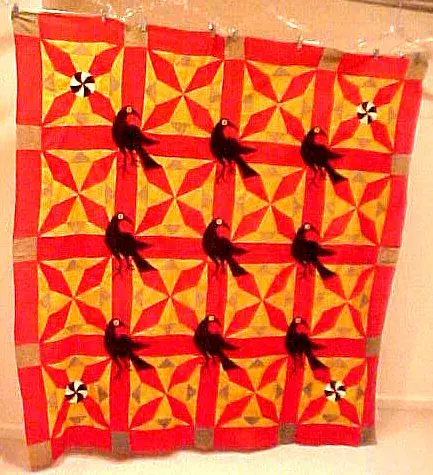
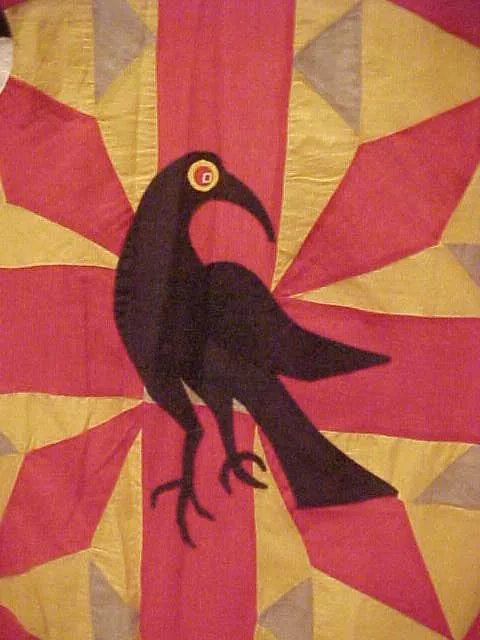
Re: the PA Dutch quilt top pieced in red, yellow, and green blocks punctuated by some of the most interesting crows I’ve ever seen—at EBay auction, listed by Judy Kelius.
Has anyone ever seen another quilt like this one, a pieced, non-scenic top onto which crows were appliqued? In fact, a quilt in which crows figured so prominently?
Is the maker’s identity or family known? any other information re provenance that might explain this unusual (to me, at least) top?
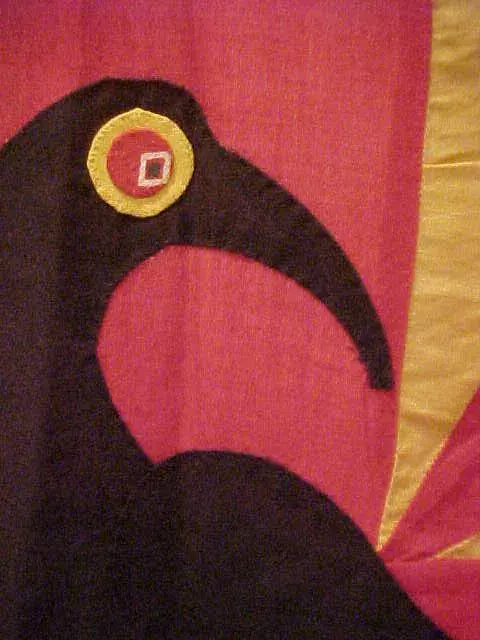
I printed the photos of the top and am fascinated by the presence of those crows that dominate the piece, especially their eyes, to which the maker gave much care. The quilt has driven me to my books on mythology, to bestiaries. I’ve discovered all sorts of things about crows (e.g., 9 crows–the number on the quilt top–symbolizes sorrow), but nothing accounts for this particular use of crows.
Since folk art emphasizes the repetition of cultural patterns, rather than the inventions of such patterns, I’ve wondered if there is some local tradition that would help explain this piece. Gail
Quilt owned by Judy Kelsius. Click on the thumbnails.
Date: Sun, 25 Nov 2001 11:35:36 -0500 | From: “Judy Kelius (judysue)” <judysue@>
Thanks Gail – it is indeed an unusual quilt top. (By the way, I have sold it.) The woman I bought this from had purchased it at one of the markets in Brimfield, MA, but the person she purchased it from said it came from Lancaster County. One of the local dealers in my area (I live in Lancaster County) who saw it said he had seen something similar at one time. But I’ve never seen anything else remotely like it.
Date: Sun, 25 Nov 2001 12:07:47 -0800 | From: Gail Ingram <GIngram@>
This quilt has been turning into a poem, an essay, a story in my head for a week now. When you see it, you will understand why. Look that crow in its finely worked eye and you will see what I mean.
In his “Ode on a Grecian Urn,” the English poet John Keats develops the idea that it is just such objects of art as this quilt top that lead us to true understandings of life. In the poem, the poet-speaker spies a new acquisition in the British Museum, an urn that was among the marbles and pottery that Lord Elgin had just brought to England from Greece. The urn and the scene it depicts captures the speaker’s curiosity and he yearns for specific details about its origin, for facts—where the scene took place, what was being celebrated, what group of people were depicted, etc.
Of course, he can discover no answers—for the vase was from as early as the 5th century B.C. and probably had been a rather ordinary piece for its time, a highly stylized piece of domestic art.
Yet, the longer the poet looks at the urn and tries to make sense of its depictions, something else happens—he begins to think about possible explanations (as I am now thinking about this quilt top) and his imagination takes over, leading him to realizations about the nature of life that the facts, had they been accessible, almost surely would have precluded. He thinks about the nature of love, the joy of the moments before romantic love’s consumation (our first loves), the meaning of community, the way art relates to life. In the end, he concludes that we discover Truth not through an act of the rational mind working on historical facts, but by an act of the imagination (literally the picture-making or sensation-creating faculty) that is stimulated by a beautiful work of art.
Thus, his famous conclusion: “Beauty is Truth, Truth, Beauty.”
Keats adds, “That is all you know on Earth/And all you need to know.” Well, yes, maybe. But me–I want to know some facts too. This strikes me as a piece that deserves the attention of historians as well as poets. I wish I had made this quilt top.
Gail
Date: Sun, 25 Nov 2001 11:33:27 -0500 | From: “Judy Kelius (judysue)” <judysue@>
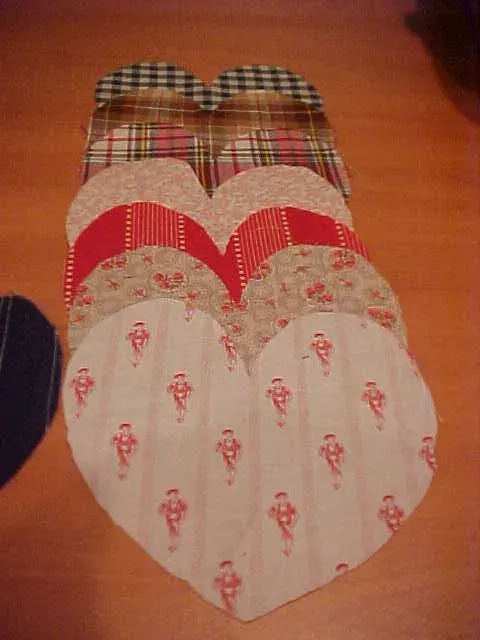
I think of quilts that have nothing but appliqued hearts as being a recent style – I don’t recall seeing any even from the 1930’s and certainly haven’t seen any from the 19th century. I’ve seen hearts in 19th century red and green applique quilts but none made of calicos like these. Any thoughts out there among other QHLers about the origin of these? Were diecut pieces even sold in the 19th century?
Date: Sun, 25 Nov 2001 21:24:01 -0600 | From: “Leigh Fellner” <hcquilts@>
Judy, considering that these were part of a lot of ’30s butterfly shapes, could it be possible that they may were cut out by the same maker(s) from some scraps Grandma had hanging around? I acquired a 20-lb. estate lot of vintage fabric awhile back- bless quilters who leave behind stashes like this! – and although most of it was early ’30s, there was a good lot of 1880-1920 mixed in there too, part of which had been cut to the same dimensions as the cut pieces of the ’30s fabric, and stacked along with it as if the intent had been to use it all mixed together. And inside a yucky (shudder) ’50s hap I found a really hideous coverlet of shredding ’30s upholstery – in which for “batting” the maker had used 6 perfect, hitherto unused yards of 24″ wide cadet blue calico – another example of, um, multigenerational fabric use 🙂
Any chance of a closeup of that conversational stripe? Looks interesting.
Date: Sun, 25 Nov 2001 23:29:27 EST | From: KareQuilt@
There is a quilt story buried in here, honest. <g> Back from my 3rd trip in 2 weeks, one of them a whirlwind 30 hours in NYC just before Thanksgiving, thanks to free tickets to Carnegie Hall to the first appearance in the USA of the International Youth Symphony. The weather was GORGEOUS and in the low 70s! This was only my 2nd time ever to visit NYC! We even sat in the Sheep Meadow (the quiet section of Central Park) for an hour and read after our feet got weary from walking all around Wall Street, Ground Zero, Lincoln Center and the American Museum of Folk Art. The day before we walked the 26 blocks from Penn Station to Columbus Circle to our hotel, just so we could experience the city at ground level. We passed Engine House #23 on our way down (up?) 8th Street and stopped to say “thank you.” It’s sidewalk and walls were overflowing with posters and cards and gifts from people all over the USA. (They lost 15 of their comrades on Sept 11.)
Had two unexpected treats while in NY. Fifteen art quilts were hanging at the American Museum of Folk Art! (They are featured in the latest issue of the AMFA magazine and are incredible!) I got to add my own “patchwork” to the huge banner honoring NYC that AMFA had rolled up on a worktable in the lobby. On the table was a box of scraps, needles and thread, scissors, etc so that anyone can contribute on the spot. The banner will hang at the opening of their new museum in December. (I even got permission to take a photo of my “patch” for my personal scrapbook.) I am unable at this time to make a quilt block to add to one of the many memorial quilts being made all over the country, so this opportunity really scratched my itch to let NYC know my feelings in fabric. Do stop by and add your “patch” if you happen to go to NY during the holiday season!
The 2nd unexpected treat was a wonderful multi-room tribute to textile designer Candace Wheeler at the Metropolitan Museum of Art, probably the first female textile designer whose life and work and studio is well documented. There was a symposium on her that same day but I learned about it too late to attend. Plus, there was a huge new book for sale…”only” $85! (Maybe Santa will bring it?)
Everyone we encountered was so friendly! Had a great time “talking” (“interviewing” my husband called it) everywhere I went. <g> We stayed at a hotel just off Columbus Circle across the street from where they are building the new AOL/Time Warner Building. Already reasonable rooms (for NYC anyway) that were usually $169-$199 were going for $109! And Broadway and Carnegie Hall were within easy walking distance! I am ready to go back anytime! It was a perfect trip, even though the train lost all electricity going and coming just this side of BWI! On the way up we actually had to wait until a train came to our rescue and climb down and climb up into the other train right in the middle of the tracks. On the way home we were “dead in the water” only about 10 minutes and then they got us going again. <g> At least we weren’t up in the air in a plane when the electrical system quit! The plane I was to have taken to Phoenix on Nov 7 also had electrical problems, but they discovered it before we boarded, and the flight was delayed 5 hours. Just got back from a trip to Tyler, Texas, this evening where they made us drink from our bottled water to prove that it was water before we boarded our flight and took a picture of us with our video camera (…just to prove we weren’t afraid of having it pointed at us with the “record” button pressed???!!) Travel is such an adventure in these unusual times. My next trip is Wednesday. Wish me luck! I wonder what the New Orleans security will require us to do?
Karen in Northern Virginia
Date: Sun, 25 Nov 2001 23:45:39 -0500 | From: “gb best” <vitale@>
> Hello, > > I am a new member and wanted to say hello to everyone. > > I think I might know the answer to the Crow quilt top question. What was the maker > thinking? > > A week ago when I was passing a field in the Lehigh Valley on my way to a > local sale, I noticed a bunch of crows in a field. The field was filled with > autumn leaves and left over corn stalks. It reminded me of Judy’s quilt top. > Maybe this PA Dutch lady was looking out her window and got the inspiration > for this top. It really looked like the quilt top with the same colors. > > The top is great and I haven’t ever seen one like it myself. > > Thanks for sharing Judy…. > > Donna Marie >
Date: Sun, 25 Nov 2001 23:40:42 -0800 | From: Audrey Waite <awquiltr@>
I didn’t get any responses the first time so I’ll try again.
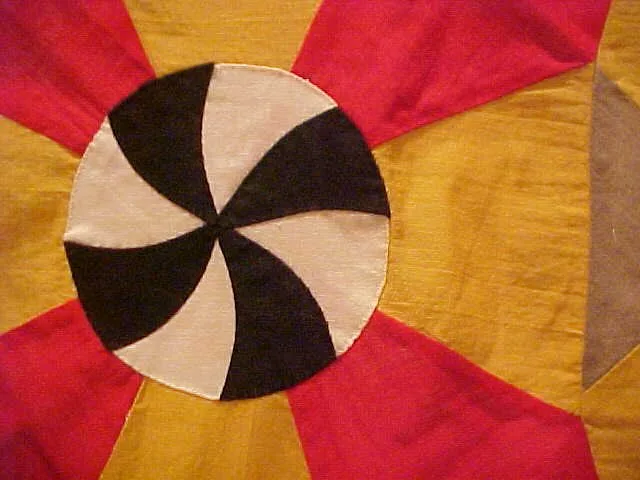
I recently purchased a yo-yo quilt that is not the usual gathered circles. Although circular in shape, the yo-yo units are pleated. Each yo-yo looks like 10 slices of pie – no stitches are visible. Isn’t this unusual? I have never seen one like it before. Other than the pleating it is assembled in the traditional way and made with pale solid fabrics from the 30’s. It reminds me of origami. Has anyone seen the instructions for making yo-yo’s like this?
Audrey Waite in cold but sunny Sedona, AZ
Date: Sun, 25 Nov 2001 22:43:26 -0800 | From: quilter@
after looking at the PA dutch site w/distlefinks, i don’t think that’s what is on the quilt. besides the tail being straight (more crowlike), the beak is too long and the clincher for me is that there is no type of top-knot feathers on the quilt. i think anyone trying to resemble the distlefink would at least have made those top-knot feathers. what gorgeous colors in the quilt, tho. i really enjoy seeing all of the treasures that people on this site refer to. dutchrose
Date: Mon, 26 Nov 2001 10:30:53 +0200 | From: Ady Hirsch <adamroni@>
>I think of quilts that have nothing but appliqued hearts as being a recent >style – I don’t recall seeing any even from the 1930’s and certainly >haven’t seen any from the 19th century. I’ve seen hearts in 19th century >red and green applique quilts but none made of calicos like these. Any >thoughts out there among other QHLers about the origin of these? Were >diecut pieces even sold in the 19th century? > Hi Judy In Patricia Herr’s excellet “Quilting Traditions’, fig. 52, p. 31, you can see a hearts crib quilt. Hearts cut from a single template were appliqued in circles on a white ground, forming a secondary star pattern. Fatter hearts were appliqued in betwen to form “flowers”. The quilt is dated to ca. 1840. Hop this helps Ady in Israel
Date: Mon, 26 Nov 2001 09:29:47 -0600 | From: Xenia Cord <xecord@>
On the matter of distelfinks and crows, I think Alan is right – they are distelfinks. Consider that these sorts of images cross from one medium to another, and the “rose and distelfink” border is common in 19th century coverlets by Pennsylvania jacquard coverlet weavers, and those with Pennsylvania origins who wove in states to the west.
The distelfinks in these borders are straight-backed with straight tails, no topknots, and posed in either side of a rose cluster (or rose tree in a pot), opposing, with heads turned. Resembling distelfinks or not, they are commonly described as being distelfinks, not crows. From coverlet border to quilt border in Pennsylvania is not much of a stretch, since neither textile was created in a cultural vacuum.
IMHO – Xenia
Date: Mon, 26 Nov 2001 09:38:49 -0500 | From: “Judy Kelius (judysue)” <judysue@>
Hi Xenia – this makes a lot of sense. There is a well documented relationship between the four eagles quilts which were made in Pennsylvania and similar coverlets*, so why not these as well? I never thought of the connection . . . thanks!
*See “Were There Thirteen Quilts in the Dowry Chest?” by Jeannette Lasansky in “On the Cutting Edge: Textile Collectors, Collections, and Traditions”, 1994.
Date: Mon, 26 Nov 2001 08:51:29 -0600 | From: “quilt97” <quilt97@>
I had totally forgotten about the effects of the tannic acid in tea dying. Thanks for the information of a safer way to tint the fabric — I appreciate it.
EKarenbeth
Date: Sat, 24 Nov 2001 04:43:04 -0600 | From: “Leigh Fellner” <hcquilts@>
If this is a quilt that you want to last, if I were you I’d pick up a jar of Procion MX fiber reactive dye (from e.g. www.dharmatrading.com ) in, say, tan or ecru, and actually *overdye* the quilt with a tea-like color. It won’t wash out, you can control the color, and it’s probably better for the fabric too.
Date: Mon, 26 Nov 2001 10:41:57 EST | From: JQuilt@
all of the distlefinks that i have seen from searches of hex signs…are brightly colored …sometimes with tulips surrounding…the bird on the quilt looks like the quilter’s rendition of a crow or raven, to me. jean
Date: Mon, 26 Nov 2001 11:22:43 -0500 | From: mreich@
I have saved up my submissions to the list because I always get bounced off. Kris has been most helpful in assisting me to adjust my settings
and I’m not computer illiterate but nothing has worked to date. Judy,
I’ll have to tap into to your expertise next.20 – After 9-11, I too, was drawn to quilting. I couldn’t bring myself to make a quilt to commemorate the horrific event that has catapulted our lives into disarray. My sister’s 38 year old friend was just with breast cancer so in an effort to bring joy some brightness and joy into her
life, I am making a quilt for her using the Quilt for a Cure fabrics in yellows and blues.20 – Judy wrote about Laura Thatcher Ulrich’s book “The Age of Homespun”. She is speaking this weekend at The Connecticut Historical Society at
One Elizabeth Street in Hartford. I have heard to speak twice once at
the Sturbridge Symposium “What’s New England About a New England Quilt?” and once in Litchfield, Connecticut, where she conducted some of her
research. (I was researching for our state documentation book at the
time and many of our references overlapped.) I strongly recommend this lecture which will be December 1 at 1:00 p.m. – On my way home from the Quilters’ Gathering show in New Hampshire,
two weeks ago, I stopped at the bookstore at Sturbridge Village. It is an excellent store for historical books about women, the New England
states, textiles and quilts. I found two reference books that I would
recommend for all textile enthusiasts. One is “Textiles For Colonial
Clothing: a Workbook of Swatches and Information” by Sally A. Queen,
published by Q Graphics Production Company of Arlington, Virginia in
2000 and “Textiles of the Early Republic. 1800-1850: A Workbook of Swatches and Information” by Lynne Zacek Basset, published by the same in 2001. Gone forever, will be your confusion about textiles with the
names of Sarsnet, Frocking and Lutestring, Drouguet, and Persian. Not
only will you be able to finger actual swatches but also read about the construction, dyeing and use of such materials. Both books are expensive, costing $34.95 each, However, they are great references!
Something to add to your Christmas wish list. – Who said that there isn’t a market for quilt history research, CQSP (the Connecticut Quilt Search Project) sold out of 1500 books in the
first three weeks. I know that I’m blowing our own horn but we truly
never expected such a response and are extremely grateful to all of you who supported our research and efforts. There is a show at the New England Quilt Museum of 25 CQSP quilts in the book. It runs until January 12th. Two weeks ago, a Japanese PBS crew was there to film the exhibit. Some of you may have seen them at Quilt Market in Houston. They were making the rounds of quilt places in the U.S. – To Carla in Fort Hood, it was good to hear from you again. I hope
that your husband will not be deployed. My son has been over there for two months now. He promises to be home by Christmas 2002. 20 – For those of your who have reached the bottom of this lengthy note, thanks. If any of you are going to NYC on Thursday, November 29 for
Merikay’s lecture at the American Folk Art Museum and would like to meet before for dinner, please email privately. sue reich
—
Date: Mon, 26 Nov 2001 11:47:03 -0500 | From: “Kris Driessen, QuiltBus.com” <krisdriessen@>
Sue didn’t mention the newest and greatest book to hit the Quilt History market: Quilts and Quiltmakers; covering Connecticut. I was fortunate enough to pick up a copy at the Quilters Gathering, and let me tell you, it is wonderful! Well researched and documented, the quilts are just amazing. This book should be at the top of your wish list for Christmas. You can order it through the quilt history page (http://www.quilthistory.com/top_twenty.htm) or through Sue (mreich@ ) I would imagine.
The two textile books she mentioned are also on our website, so you don’t NEED to drive to Sturbridge Village unless you want to;-))
Kris
Date: Mon, 26 Nov 2001 12:28:39 -0600 | From: cducey@
The International Quilt Study Center at the University of Nebraska-Lincoln would like to issue a special invitation to members of the QHL list. If your vacation plans include travelling this holiday season, plan on stopping in Lincoln, Nebraska to visit the International Quilt Study Center and see two stunning quilt exhibitions on the University of Nebraska-Lincoln campus! If you’re not planning to travel this way, take a “trip: to the IQSC website for a selection of quilts from each exhibition. Look under “Exhibitions, Current.”
http://quiltstudy.unl.edu
Reflections of the Exotic East in American Quilts Lentz Center for Asian Culture, University of Nebraska-Lincoln September 16?December 16, 2001 Tues.-Sat., 10 am to 5 pm; Sun. 1:30 pm to 4 pm; closed Mondays
Reflections of the Exotic East in American Quilts presents an historical overview of the profound influence of Asian design on American quiltmaking. It illustrates this influence through an examination of the use of Eastern motifs and materials in quilts made between 1800 and 1950.
Design ideas drawn from Asian sources and used in American quilts reveal both a strong interest in the East as well as a desire to portray it as a mysterious and romantic part of the world. Quilts made between 1800 and 1950 clearly reflect the ongoing Western passion for the “Exotic East.”
Quilts of a Feather University of Nebraska State Museum (Morrill Hall) University of Nebraska-Lincoln November 3, 2001 ? October 20, 2002 Mon.-Sat., 9:30 ? 4:30 pm; Sun. 1:30 ? 4:30 pm
Exotic birds adorned with brilliant irridescent feathers, common songbirds that feed in American yards, and waterfowl that follow the rivers of the United States on their migration routes flock together in the exhibition Quilts of a Feather. The exhibition highlights the changing images of birds in American quilts between 1820 and 1950.
Quilts of a Feather will be held in the Cooper Gallery of the University of Nebraska State Museum (Morrill Hall) for one year; a new selection of quilts will be exhibited after six months.
If you’d like more information contact Carolyn Ducey, 402-472-6301; cducey1@
Date: Mon, 26 Nov 2001 19:23:24 -0500 | From: “Alan R. Kelchner” <quiltfix@>
I had that problem too – do a search for “black distlefink”. If you brought up what I did on your search, it was a lot of tourist-y type websites selling hex signs. I somehow don’t think a black distelfink of this style would sell as well as the cute, colored version. But there was a myriad of variations, some looking more like the bird of paradise motif than anything. And black is definitely unusual. But a brightly colored bird would have clashed horribly on this quilt.
I also sent the pic to my folks, who grew up in Lancaster Co. I didn’t tell them anything but the fact that the quilt came from Lancaster Co., and they both saw the distlefink. Then they asked me if I’d bought it…….. I wish.
Not a real scientific survey, but it confirms my own immediate response for me.
Alan
—– Original Message —– From: <JQuilt@> To: <qhl@> Sent: Monday, November 26, 2001 10:41 AM Subject: Re: QHL: Entering the Fray…
> all of the distlefinks that i have seen from searches of hex signs…are > brightly colored …sometimes with tulips surrounding…the bird on the > quilt looks like the quilter’s rendition of a crow or raven, to me. > jean > >
Date: Mon, 26 Nov 2001 19:43:44 -0800 | From: Gail Ingram <GIngram@>
I’ve looked at distlefinks and read about crows all day, it seems. And I’m still wondering about both and the “crow” quilt. The one thing that I’ve observed in the rendering of the bird that seems to argue for a connection is the attention given to the eye. Aside from the obviously for-the-tourist-trade hex renderings, most of the distlefinks I’ve been able to locate seem to render the eye in some detail.
Allen’s postings also encourage the connection.
Yet, those on this quilt are mighty black and fierce looking.
And there is also the fact that these black birds are appliqued onto a pieced top. Is/was that a common practice?
There is another bird quilt on Ebay now—item #1487550909–that is all-applique and described as not “finely made,” but a “country” quilt. It has darning to support its everyday use. It is also said to be from Lancaster County.
Wonder if Judy would summarize the information in the text she mentioned (see below) for those of us less familiar with the regional and cultural context? (Click on the thumbnails below.)
Date: Tue, 27 Nov 2001 15:10:54 -0600 | From: “Steve and Jean Loken” <sandjloken@>
Me again. When I went back to buy the Lane book for Mary, I saw another that might interest anyone. Not as scarse as the Lane book, but still good for beginning researchers who don’t have a deep collection. Who knows, it might be still in print, but for $5? Check Amazon before you request it, but it looked like a very clean copy. A 1962 Dover reprint of Ruby McKim’s 101 Patchwork Patterns $5.00 Once again, let me know off the list and I’ll pick it up and mail it to you. Jean in very snow Minnesota
Date: Tue, 27 Nov 2001 17:04:43 EST | From: KareQuilt@
[I first posted this Sunday evening but it has not yet appeared on the list so I am posting it again.]
There is a quilt story buried in here, honest. <g> Back from my 3rd trip in 2 weeks, one of them a whirlwind 30 hours in NYC just before Thanksgiving, thanks to free tickets to Carnegie Hall to the first appearance in the USA of the International Youth Symphony. The weather was GORGEOUS and in the low 70s! This was only my 2nd time ever to visit NYC! We even sat in the Sheep Meadow (the quiet section of Central Park) for an hour and read after our feet got weary from walking all around Wall Street, Ground Zero, Lincoln Center and the American Museum of Folk Art. The day before we walked the 26 blocks from Penn Station to Columbus Circle to our hotel, just so we could experience the city at ground level. We passed Engine House #23 on our way down (up?) 8th Street and stopped to say “thank you.” It’s sidewalk and walls were overflowing with posters and cards and gifts from people all over the USA. (They lost 15 of their comrades on Sept 11.)
Had two unexpected treats while in NY. Fifteen art quilts were hanging at the American Museum of Folk Art! (They are featured in the latest issue of the AMFA magazine and are incredible!) I got to add my own “patchwork” to the huge banner honoring NYC that AMFA had rolled up on a worktable in the lobby. On the table was a box of scraps, needles and thread, scissors, etc so that anyone can contribute on the spot. The banner will hang at the opening of their new museum in December. (I even got permission to take a photo of my “patch” for my personal scrapbook.) I am unable at this time to make a quilt block to add to one of the many memorial quilts being made all over the country, so this opportunity really scratched my itch to let NYC know my feelings in fabric. Do stop by and add your “patch” if you happen to go to NY during the holiday season!
The 2nd unexpected treat was a wonderful multi-room tribute to textile designer Candace Wheeler at the Metropolitan Museum of Art, probably the first female textile designer whose life and work and studio is well documented. There was a symposium on her that same day but I learned about it too late to attend. Plus, there was a huge new book for sale…”only” $85! (Maybe Santa will bring it?)
Everyone we encountered was so friendly! Had a great time “talking” (“interviewing” my husband called it) everywhere I went. <g> We stayed at a hotel just off Columbus Circle across the street from where they are building the new AOL/Time Warner Building. Already reasonable rooms (for NYC anyway) that were usually $169-$199 were going for $109! And Broadway and Carnegie Hall were within easy walking distance! I am ready to go back anytime! It was a perfect trip, even though the train lost all electricity going and coming just this side of BWI! On the way up we actually had to wait until a train came to our rescue and climb down and climb up into the other train right in the middle of the tracks. On the way home we were “dead in the water” only about 10 minutes and then they got us going again. <g> At least we weren’t up in the air in a plane when the electrical system quit! The plane I was to have taken to Phoenix on Nov 7 also had electrical problems, but they discovered it before we boarded, and the flight was delayed 5 hours. Just got back from a trip to Tyler, Texas, this evening where they made us drink from our bottled water to prove that it was water before we boarded our flight and took a picture of us with our video camera (…just to prove we weren’t afraid of having it pointed at us with the “record” button pressed???!!) Travel is such an adventure in these unusual times. My next trip is Wednesday. Wish me luck! I wonder what the New Orleans security will require us to do?
Karen in Northern Virginia
Date: Wed, 28 Nov 2001 18:11:50 -0600 | From: “Leigh Fellner” <hcquilts@>
It’s back up at auction, with Valerie Wilson’s full commentary:
http://cgi.ebay.com/aw-cgi/eBayISAPI.dll?MfcISAPICommand=ViewItem&item=1491175479
Date: Thu, 29 Nov 2001 17:40:54 -0800 | From: Julie Silber <quiltcomplex@>
Hello All, Julie Silber here. I went to look at the Irish quilt on eBay. (Thanks for the heads-up — it’s great to see it.) It got me to thinking about a quilt I have, which just happens to also be up on eBay now. It’s an early medallion quilt with a wool batt. All I know of its origin is that it came to me from Ontario, Canada with no further history. Maybe someone out there can enlighten me. Our quilt is early (1840-50 I’d say). I wonder if it is Canadian in origin, or now I’m thinking maybe English or Irish or Welsh or ??? I’ll be checking my books on British quilts for clues, but thought someone out there might have information. Thanks. Julie
Date: Thu, 29 Nov 2001 17:53:21 -0800 | From: Audrey Waite <awquiltr@>
I recently purchased a yo-yo quilt that is not the usual gathered circles. Although circular in shape, the yo-yo units are folded to look like 10 slices of pie – no stitches are visible. It reminds me of origami.
Isn’t this unusual? I have never seen one like it before. Other than the folded pleats, the yo-yos are assembled in the traditional way to make a quilt. They are pale solid fabrics from the 30’s. Has anyone seen the instructions for making yo-yo’s like this?
Audrey Waite in snowy Sedona, AZ
Date: Fri, 30 Nov 2001 11:46:25 +1100 | From: Lorraine Olsson <sven@>
Hi, I have a piece (unfinished) of old Australian patchwork hexagons, that are foded over in a like manner, so that you can not see the papers. The look to have been stitched over the papers before being whip stitched together.
For the Aussies in the group it is 1900-20 and from Dubbo.
Lorraine in Oz
Date: 30 Nov 2001 00:47:56 -0000 | From: “Edward Fiondella” <safquilt@>
Hello, This is my first post to the list so I will introduce myself. My name is Susan Fiondella. I just moved from Connecticut to Florida. In Connecticut I was a member of the Connecticut Quilt Search Project and I am one of the co-authors of Quilts and Quiltmakers Covering Connecticut. I am a AQS Certified Appraiser and every aspect of Quilt and textile history interests me. If I remember correctly someone asked about square yo yo’s. In Easy Does it Quilts by Georgia Bonesteel, page 109 she has a square yo yo quilt. In the brief explanation, she states “From Scotland’s Isle of Arran comes this novelty block.” Sue
Date: Thu, 29 Nov 2001 19:09:47 -0800 | From: Julie Silber <quiltcomplex@>
Hi, I forgot to list the eBay number for my “mystery” quilt. It’s ebay #1491241150 . Thanks for any help you can give. Julie Silber – click on the thumbnails below
Date: Fri, 30 Nov 2001 06:18:58 -0600 | From: “Leigh Fellner” <hcquilts@>
Found this fabric on ebay which has me stumped:
http://cgi.ebay.com/aw-cgi/eBayISAPI.dll?ViewItem&item=1041287333
What do you think? Block print? Indian? 19th c.? Newer? (Click on the thumbnail.)
Date: Fri, 30 Nov 2001 10:15:16 -0900 | From: Greg & Dawn Church <church@>
Hello all,
I am relatively new to the list and have to say that I am impressed by all of the information everyone has. I guess in time and after much study I will someday be able to knowledgeably spout off answers to questions presented… at least I hope to!
Which leads me to my question… as a relatively new and young quilter, I am interested in compiling a library of quilt history type books. Which books are on your “must have” list? Please include any books both past and present, general interest, and specific era or type of quilting. I figure knowing what you all think will be a helpful start in my quest.
Thanks in advance, Dawn
Date: Fri, 30 Nov 2001 21:30:01 -0600 | From: Xenia Cord <xecord@>
This is my recommended reading list – there is plenty of variety here from which to pick & choose: Orlofsky, Quilts in America (dated but seminal) Kiracofe, The American Quilt Granick, The Amish Quilt Brackman, Clues in the Calico Trestain, Dating Fabrics Adamson, Calico & Chintz Montgomery, Printed Textiles 1700-1850 (O.O.P.) Warren & Eisenstadt, America’s Glorious Quilts (Museum of American Folk Art holdings)
any volume by Waldvogel any of the Symposia Papers edited by Jeannette Lasansky (Pieced By Mother-2 vols, On the Cutting Edge, In the Heart of Pennsylvania-2 vols, Bits & Pieces) any/all of the now 21 volumes of research papers of the American Quilt Study Group, in their annual journal Uncoverings, or Quiltmaking in America, Beyond the Myths, (selected AQSG writings, ed. Laurel Horton) Any/all of the state search volumes; some unevenness in quality, but each is a learning experience. A list of these can be accessed at: http://www.usd.edu/sdquilts/ There are also some recommended booklists on this site.
Read on! Xenia (the truly addicted join the American Quilt Study Group – you can reach them for information at: AQSG2@)