February 7 – 13, 2002
These restored messages come from the Quilt History List, an online forum where quilt historians, collectors, researchers, appraisers, and enthusiasts discussed antique quilts and related textiles. The archive dates from 1996 through approximately 2016 and is being restored gradually. Sign up in the form at the bottom of the page if you want to know when a new page is added. Original spelling, opinions, formatting, and inactive links may remain unchanged.
Primary topics of this QHL Digest:
- Home Ec, Sewing Education, and the Quilting Pipeline — The generational-trends thread continues with members recalling mandatory Home Economics classes and debating whether their disappearance from schools affected who takes up quilting.
- Yarn-Tufted 1930s-Style Quilts and Bedspreads — Members compare notes on Depression-era and Amish tufted (yarn-tied) bedspreads and quilts, including chenille bedspread traditions from the southern mountains.
- Dating a Lot of eBay Nine-Patch Blocks — A member posts photos of mixed hand- and machine-pieced nine-patch blocks and asks for help dating the fabrics, mixing turn-of-the-century homespuns with later prints. (see the article on dating quilts)
- Identifying a Feedsack-Fabric Quilt — A member follows up on documenting a quilt made with feed sack fabrics and thanks the list for help pinning down sources. (see the article on the feedsack story)
- Colonial Revival Medallion Quilts Research Call — A researcher asks list members with Colonial Revival or early-1800s medallion-style quilts to contribute photos for an article comparing the two styles.
Date: Thu, 07 Feb 2002 00:31:09 -0600 | From: Becky Sunderman <sewcarve@>
I have been reading the comments about quilts being sold on
eBay with interest, as I am auctioning some of my quilts there
now, and have had some up for auction that did not sell in the
last month. They were bought at an estate sale, along with
quite a bit of older fabric. While I’ve tried to date them by
their fabric content, using “Dating Fabrics“, “Clues in the
Calico” and other such references, and have tried to identify
the block patterns, using B. Brackman’s Encyclopedia, I would
welcome any corrections, suggestions, ideas or thoughts
contrary to what I’ve posted in the listings. I’d much rather
KNOW than guess, as it only benefit potential bidders who,
like myself, may not be as knowledgeable as others.
My seller ID is the same as my email address.
Thanks,
Becky Sunderman
Date: Thu, 7 Feb 2002 10:41:48 +0100 | From: “pittsace” <pittsace@>
One recent post on the list mentioned youngsters “find it [sewing] is
too
slow and
methodical compared to the rest of their world.”
My experience has been a bit different. The teens I’ve taught are
very
focused sponges. They :want: to sew only what interests them, be it
a pair
of pajama pants, a quilt block, or a CD holder as a first project.
Otherwise there will be no second project.
One teen made two machine-pieced, machine-quilted tops in eight
months, her
third and fourth sewing projects after elastic waist pants and a
quilted
pillowtop. Both quilts were “Attic Windows” blocks, not the usual
beginner’s pattern, but the one she chose.
When I asked if she had considered taking sewing as an elective at
school, she was horrified. Why?
An “A+” grade in a sewing class would LOWER her GPA (grade point
average).
She was competing for scholarships awarded to the class
valedictorian, and
could only stay in the running if
all her classes were honors classes, with the accompanying higher
points
earned.
How ironic that she couldn’t learn to sew at school… and how
fortunate we
are that she was determined enough to find another way to learn to
sew.
Best,
Valerie Taber
(currently living in S. Germany)
Date: Thu, 07 Feb 2002 06:39:24 -0600 | From: “Ann G. Hubbard” <ahubbard@>
I have read that when the eagle faces the direction of the arrows it
indicates war. I batiked some eagles last fall. The pattern was from
the
Woman’s Day Book of Needlework published in the early 60s. It was
originally meant to be a hooked rug pattern. I gave one to each of my
gds
at the time, with the Pledge of Allegiance printed underneath, banner
form.
They are both 5 and will be learning the pledge soon. I’m glad to see
our
country turn in a more patriotic direction. Ann from Lake of the
Ozarks, MO
Date: Thu, 07 Feb 2002 08:42:03 -0600 | From: Laura Hobby Syler <texas_quilt.co@>
Kathleen,
One remark I have heard much too often while presenting quilt history
lectures, mainly from older women, i.e.: post depression
homemakers…
“We had enough money to buy blankets. We didn’t have to make quilts.”
Quite a loaded statement as to the social views of the time as well.
Laura
Kathlash@ wrote:
>
> If you look at the styles popular during this time period, i.e.
boomerang
> tables, etc, everything had hard edges, even the upholstery fabrics
used at
> the time were not made for the tactile experience, I think this may
partially
> explain its loss of popularity at the time. Couple that with the
fact that
> our Moms, though “stay at home” was the choice of most I knew, were
busy
> making us “baby boomers” and “home making”. I remember my Mom
sewing
> curtains, making home made doughnuts, and fresh squeezed orange
juice, but no
> quilts. The style seemed to be matching curtains and bedspreads,
from my
> recollection, having been born in ’52.
>
> Kathleen Lashley
Date: Thu, 07 Feb 2002 09:31:06 -0500 | From: Newbie Richardson <pastcrafts@>
Dear all,
We have language in order to describe things and events. As in all
areas, not everyone is precise in their use of terms. Barring
regional
differences, those of us who do know the apropriate nominclature for
an
object should continue to correct the wrong use of vocabulary.
So: a counterpane is the top covering of a bed – regardless of the
style or technique used to create it. A coverlet is a woven “spread”
–
as in jacquard coverlet. Then there is a “comforter”: two or more
layers
of fabric joined by ties. A quilt is also two or more layers of
fabric
joined by a decorative stitching design. Is it properly refered to as
a
“quilt” if there is no batting? I am not sure. To me “quilt” is the
verb, the actual decorative stitching design. So that “quilt”, the
noun,
can either have batting or not, but it does have to have two layers
of
fabric: a top and a backing. The technique used to create the design:
patchwork or applique, or stenciling are the decorative features.
Needless to say language changes over time so that one does have to
be
aware of what the common usage of a word was at the time it was used.
That is why the Oxford English Dictionary is so valuable. A “quilt”
in
17th and 18th century inventories was more likely a quilted
petticoat.
A “bed” was the makings of the bed – feather mattress, etc. The term
did not refer to the bed stead – the furniture part. A bed “rug” was
a
very heavy top covering thatwas usually made by a hooking technique.
Today, we use the term “bed” to mean the whole package: mattress, box
spring, frame, head and foot.
Every generation has a group of people who speak in “generic”
terms.
It may be that I have my finger in the dyke – but I do believe that
it
is our responsibility to correct improper usage when it is polite to
do
so! And to note regional differences when they actually exist. TV
and
radio have done a good job of evening out some of the more colorful
regionalisms in the under 30 set who grew up with them.
Newbie
Date: Thu, 07 Feb 2002 09:59:01 -0600 | From: Laura Hobby Syler <texas_quilt.co@>
Newbie,
At least here in Texas, we call those “tops” that are backed with no
batting, but do have finished edges…”summer spreads”.
Laura
Date: Thu, 07 Feb 2002 11:39:00 -0500 | From: “Judy Kelius (judysue)” <judysue@>
I note that the seller of the 1970’s or so Eagle “Quilt” relisted it
since
it did not meet reserve the first time, but she took out the
declaration of
it being 19th century. I had written her telling her that it was not
antique and not hand-made, and probably other people did too. The
relisting
is at:
http://cgi.ebay.com/aw-cgi/eBayISAPI.dll?ViewItem&item=1511607364.
<img align=”left” alt=”eaglekit.jpg (67671 bytes)” border=”2″ height=”139″ src=”./02030_files/eaglekit_small.jpg” width=”100″/> By the way, in my stash of old quilt collectibles, I found an ad from Woman’s Day July 1956 for a kit very similar to this quilt, but with more detail. ( Click on the thumbnail)
This also came in other colors. I’ve seen the printed quilt like the one being sold on eBay often, but
don’t recall seeing one of the hand-sewn ones from this kit.
Date: Thu, 7 Feb 2002 09:12:14 -0800 | From: “Laurette Carroll” <rj.carroll@>
Hello QHLers,
Judy, thanks for posting a picture of that eagle quilt. I don’t think
I
have ever seen that particular kit/quilt.
The one I have seen many times is the eagle quilt kit put out by the
Paragon Pattern Co., American Glory, (see Twentieth Century Quilts,
Woodard and Greenstein). This is often mistaken for a 19th. C quilt
by
sellers.
Laurette Carroll
Southern California
Look to the Future with Hope
Date: Thu, 7 Feb 2002 12:13:51 -0500 | From: “Fran” <fjfitz@>
In response to recent question on 20th C definition.. having been
raised by
two Victorian ladies their vocabulary was somewhat dated for the 20th
C,
they always referred to white woven bedspreads, very similar to
Marseilles
as counterpanes, and so I think of them as that, not the woven
coverlets of
color which we see with names woven in them. Fran in dismal cold,
Frederick County
Date: Thu, 07 Feb 2002 12:10:13 CST | From: jocelynm@
On Mon, 4 Feb 2002 09:24:28 -0800 (PST) Judy Schwender wrote:
> I don’t think the level of employment has anything to
> do with it. I think the fact that so many women work
> outside the home period is a big factor.
Not to mention, there’s the women who have a ‘lunch hour’ that
they’re
expected to take every day, but they don’t want to go out to eat or
go
shopping every day (or work in an area where there’s no interesting
place
to go), so they bring needlework and do it over the lunchhour! Or
offices
where you can get by with doing needlework during a meeting, or while
on
the phone.
Jocelyn
Date: Thu, 7 Feb 2002 10:22:00 -0800 (PST) | From: Kris Driessen <krisdriessen@>
Poor woman probably can’t figure out why her visitor count is so high
but no one is bidding!
I do like that quilt, though.
Kris
— “Judy Kelius (judysue)” <judysue@> wrote:
> I note that the seller of the 1970’s or so Eagle “Quilt” relisted
> it since
> it did not meet reserve the first time, but she took out the
> declaration of
> it being 19th century. I had written her telling her that it was
> not
> antique and not hand-made, and probably other people did too. The
> relisting
> is at:
> http://cgi.ebay.com/aw-cgi/eBayISAPI.dll?ViewItem&item=1511607364.
>
> By the way, in my stash of old quilt collectibles, I found an ad
> from
> Woman’s Day July 1956 for a kit very similar to this quilt, but
> with more
> detail. If you’re interested in seeing it, I’ve posted a scan at
> http://home.@/~judysue/eaglekit.jpg. This also came in other
> colors.
> I’ve seen the printed quilt like the one being sold on eBay often,
> but
> don’t recall seeing one of the hand-sewn ones from this kit.
>
Date: Thu, 07 Feb 2002 19:36:39 -0500 | From: “Kris Driessen, QuiltBus.com” <oldquilt@>
I received this note from a teacher – can anyone help him? Please
respond
to the list as well as pmeinhold2000@, this is an
interesting topic.
Kris
Hello to fellow quilters,
I am a teacher in a Rochester, NY high school. To celebrate
Black
History Month our school has decided to create a quilt, where each
piece
commemorates a certain person, group or event in our local history.
We
hope to discover a lot of important “average” people, as well as
learn more
about Frederick Douglass, Harriet Tubman, and other
more famous people from our area.
Each person will write an essay about their subject – long or
short
– and then illustrate it via paints or computer generated transfer
images. We’ll caption each piece with some text, the person’s name,
and
then a small photo of the author.
We would appreciate any ideas and/or experiences that others
can
share with us, and especially hope to find other quilters or even a
“quilting circle” in the Rochester / Upstate area.
Thanks for any information and encouragement that you can
share.
Peter Meinhold,
Benjamin Franklin High School
1150 Hudson Ave, Rochester, NY , 14621
pmeinhold2000@
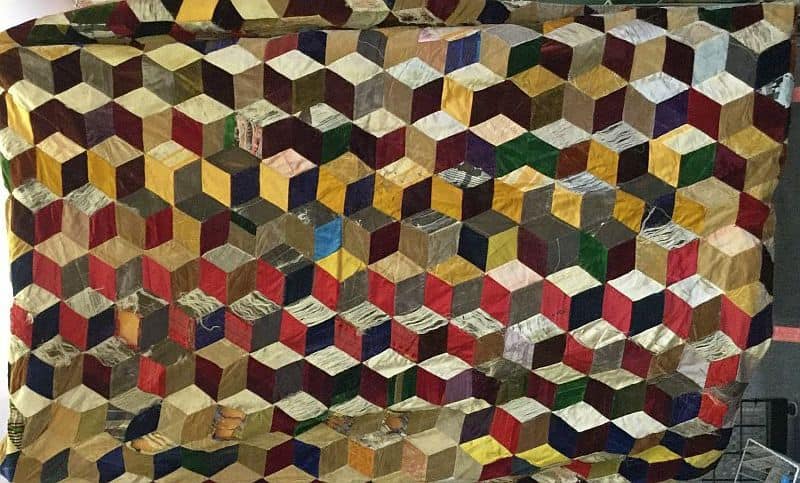
Date: Fri, 08 Feb 2002 07:01:51 -0500 | From: “Judy Kelius (judysue)” <judysue@>
Now this is the kind of quilt top that should NOT be finished . . .
much more valuable just as it is (and would probably fall apart if someone
tried to quilt it)! I’m drooling over these fabrics and love the design!
Bidding is way beyond what I would want to pay, thought the rest of you would
enjoy seeing it:
http://cgi.ebay.com/aw-cgi/eBayISAPI.dll?ViewItem&item=1511862786
Click on the thumbnails below
Date: Fri, 08 Feb 2002 08:06:30 -0800 | From: Gaye Ingram <GIngram@>
> When I asked if she had considered taking sewing as an elective at
> school, she was horrified. >
> An “A+” grade in a sewing class would LOWER her GPA.
> She was competing for scholarships awarded to the class
valedictorian, and
> could only stay in the running if
all her classes were honors classes,
>
> How ironic she couldn’t learn to sew at school… how fortunate
she was
determined enough to find another way to learn to sew.
>
While I appreciate the general concern, there are some valid reasons
for
this situation.
First, students today have room in their high school curricula for
few
electives, particularly if they take Advanced Placement courses.
These are
rigorous courses in core-curriculum subjects that are are comparable
in
difficulty and results to similar courses at the nation’s most
demanding
universities. Students enrolled in these take demanding, nationally
scored
tests in May, wherein they may earn credit at Harvard or State U.
Success in
these courses and on the May tests require significantly longer
hours’
preparation for each class. Given the difference in the costs of
college
tuition as opposed to the costs of the AP tests (around $70 for AP
tests),
success becomes an economic factor in the lives of middle-class
families.
The emphasis on AP and honors classes also is a tacit acknowledgement
of the
yawning gap between “real” courses that prepare students for
university or
serious vocational training and “holding tanks,” which keep students
in
school. Spend a week in nearly any non-academic magnet school in the
nation
and you will understand why universities consider for scholarship
and, in
many cases, admission only students who have taken honors’ courses.
They are
the ones who can be predicted to succeed.
Finally, most college-bound students have few electives of any kind.
In an
effort to improve educational achievement, state legislatures have
required
more and more core subjects in high school. Their goal has been to
improve
learning. The result has been to lower standards in the core
subjects, thus
forcing those students who aspire to selective admissions
universities and
serious learning into taking every AP course that is offered.
Recalling my own basic home economics class, which produced the sad
apron
and skirt someone else on the list mentioned—plus an aversion to
sewing
aprons and skirts—I suspect those youngsters who take sewing
courses in
their communities might be fortunate. Don’t worry about this girl:
congratulate her on her initiative.
Such instances argue for more community classes, more individual
outreach to
the young. Our president has asked each of us to donate more hours
public
service. Such classes and outreach might be a service quilters could
offer.
In North Louisiana where the sun is shining and once again, alas, the
snow
passed us by oh phooey!
Gaye
Date: Fri, 8 Feb 2002 09:08:42 EST | From: Kathlash@
You are so right, that quilt top is breathtaking! It’s amazing that
someone
created such an awesome piece of art and never finished it! If only
these old
quilts could talk!
Kathleen Lashley
Date: Fri, 8 Feb 2002 09:53:38 EST | From: Kathlash@
Hello All!
I am currently developing some historic quilting workshops to be
offered by
my museum. One piece of information I have not come across in all the
research I have done regards quilting hoops. Were these available in
the
nineteenth and/or early twentienth centuries, or was this a modern,
perhaps
1970’s when I started to use one, invention? I have always done my
hand
quilting in a hoop, and thought it would be a wonderful way to offer
“hands-on” opportunities in places where space does not permit
setting up a
frame. Our time span is 1845 through 1919.
Kathleen Lashley
Domestic Crafts Program Coordinator
Old World Wisconsin
Date: Fri, 08 Feb 2002 10:57:05 EST | From: Kittencat3@
My, things have changed since my youth…Home Ec was mandatory in
junior high (I got an A- because I sewed my hem by hand. ???). I took
four AP classes, three AP tests, and didn’t really have much more
homework in terms of time commitment than my friends in Track I. The
science and math AP tests were a different story, but in the humanities
it wasn’t that huge a leap.
[and for the curious, I got top grades on all the APs and could
theoretically have entered Smith as a sophomore. I didn’t because I
thought it was a silly idea and graduated with my age mates. Twenty years
ago. And the reunion is in May. *eewwwwww*]
Lisa Evans
Date: Fri, 8 Feb 2002 13:28:42 -0600 | From: “leigh/hcquilts” <hcquilts@>
> Hi Did she “do the right thing”? we all know it’s a mattress pad,
> contemporary, and some told her, yet she still has it listed as a
“quilt”
> with enough suggestive comments to encourage people into thinking
its a
> vintage quilt. she ought to just drop it! Laura
>
I can’t agree with with characterizing this as a “mattress pad”.
It’s far
too big for that purpose; a mattress pad would either be the
dimensions of
the mattress top (even in the case of a king bed, only 76″x80″) or
have
shaped corners like a fitted sheet, and it’s highly unlikely a
mattress pad
would have a design printed on it that would show through the
bedsheets. At
70″x90″ it is in fact just the right size for a twin bedspread with a
standard 15″ drop. It does, however, have “mattress pad” type
quilting –
as did virtually every quilted bedspread of that era: the choice
seemed to
be among wavy parallel lines (moving pads), diamonds (potholders), or
wavy
diamonds (bedspreads).
That aside, considering how many “crocheted quilts” and “antique”
quilts
made of polyester doubleknit I’ve run across on ebay, I’d say
cancelling an
auction for a “mid-19th-century antique quilt” and relisting it
merely as a
“quilt” is indeed doing the right thing, particularly as seller could
easily
have told us to take a hike and pocketed the $125 high bid.
Date: Fri, 8 Feb 2002 14:53:00 EST | From: Feedsackfanatic@
I bought a quilt top today at our monthly flea market in Atlanta, and
there
is a tag on it: 1985 – 1986 North Carolina Quilt Project, NC Museum
of
History #GE139. Does anybody know I I can find out more information
on this
top? It is hand-stitched red and yellow on white, and according to
my
“Collector’s Dictionary of Quilt Names and Patterns,” it is called
Whig
Defeat and/or Grandmother’s Engagement Ring.
Thanks in advance for any help I receive.
Paula in Georgia
Date: Fri, 8 Feb 2002 15:58:14 EST | From: KareQuilt@
>Is it considered a bad thing (or a violation of eBay rules) to warn
a
bidder that what they are bidding on is being misrepresented?<
<<It’s STRICTLY forbidden by ebay (“auction interference”), and with
IMHO good
reason: before the policy was introduced, …etc>>
Thank you, Leigh, for clarifying this! Though I had never contacted
an eBay
buyer to give them my opinion, I did not realize it was forbidden to
contact
a buyer and try to inform them. (Guess I need to read more of the
fine
print!) However, I soon gave up even contacting sellers unless I
intended
bidding on the item. I quickly learned that it simply took up too
much time
to try to inform sellers and I had better things to do with my time.
<g>
Karen Alexander
Date: Sat, 9 Feb 2002 00:45:39 -0500 | From: “judygrow” <judygrow@>
This came to me from another list I am on. It sure sounds
interesting!
Sure wish I could go! Many experts from all over the world will be
speaking! Including some names many of us know well (or should know
well).
It all depends! (That’s an “in” joke).
Judy in Ringoes, NJ
judygrow@
NATCC 2002 – Strengthening the Bond: Science and Textiles
Please Note: New location of reception, New name of Hotel, early
bird fee ($250) ends February 15th. Full registration is $300 by March 15 and $350
after March 15. Call 1-800-448-3883 to register. Questions? email: sreiter@
Schedule of Events and Speakers
Thursday, April 4
12:00 pm to 5:00 pm Registration at the Philadelphia Museum of
Art, West Foyer
6:00 pm to 8:00 pm Opening Reception and Registration
The Mask and Wig Club, 310 S. Quince Street
Friday, April 5 Philadelphia Museum of Art
8:30 am Registration, West Foyer
9:00 to 11:45 am Morning Session
Modern Materials in Costume Collections: A Collaboration between Scientist and
Conservator Chris Paulocik, Costume Institute Metropolitan Museum
of Art, USA R. Scott Williams, Canadian Conservation Institute, Canada
Characterization of Silk Deterioration Paul Garside, Department of Chemistry,
University of Southampton, UK Paul Wyeth, Textile Conservation Centre,
University of Southampton, UK Iron Gall and the Textile Conservator
Katherine Barker, Textile Conservation Workshop, USA
The Red Mantles: Arrabidaea chica in Archaeological Colombian Textiles
Beatriz Devia, Royal Institute for Cultural Heritage, Belgium
Marianne Cardale, Pro Calima Foundation for Archaeological Research, Colombia
Jan Wouters, Royal Institute for Cultural Heritage, Belgium
11:45 _ 1:45 Lunch/Conservation Lab Tours
1:45 _ 5:30 Afternoon Session
Studies on a Korean Painted Silk
Banner:
Identification of Layer Structure, Binding
Medium, and Pigments
Mika Takami, Textile Conservation Centre,
University of
Southampton, UK
Paul Wyeth, Textile Conservation Centre,
University of
Southampton, UK
Chemical Finishes on Indigo_dyed
Cloth:
Characterization of Miao and Miao_related
Costume from Guizhou, China
Lauren Chang, Textile Conservation
Centre,
University of Southampton, UK
Paul Wyeth, Textile Conservation
Centre,
University of Southampton, UK
Analysis of Soiling and Trace
Contaminants of
the
Star_Spangled Banner
Fenella G. France, National Museum of
American
History,
Smithsonian, USA
Suzanne Thomassen_Krauss, National Museum
of
American
History, Smithsonian, USA
Alberto Nuñez, U.S. Department of
Agriculture, USA
William N. Marmer, U.S. Department of
Agriculture,
USA
Characterization and Evaluation of a Synthetic Fabric: A Flag
Study Lorena Román Escuela Nacional de Conservacion
Restauracion y Museografia (ENCRyM), Mexico
Nicolas Gutiérrez, ENCRyM, Mexico
Abner Gutiérrez, ENCRyM, Mexico
Fernando Sánchez Guevara, ENCRyM, Mexico
Claudia del Fuente, ENCRyM, Mexico
A Fault in the Thread? Examining Fibers Taken from Laces of
the Sixteenth and Seventeenth Centuries Angharad Rixon, Australia
The Ardabil Carpet and Other Interesting
Collaborations
David Howell, Historic Royal Palaces,
Hampton
Court
Palace, UK
Chris Carr, University of Manchester
Institute of
Science and Technology, UK
Barry Knight, Collections Conservation,
English
Heritage, UK
SATURDAY, April 6 Winterthur Museum, Gardens and Library
8:00 Buses leave the Radisson Plaza Warwick Hotel
–
Philadelphia
9:15 to 12:30 Morning Sessions
Keynote Address: Science, Conservation
Science,
Conservation Research,
Conservation: Where do the Conservator
and
Scientist Meet?
Dr. Judith H. Hofenk de Graaff, The
Netherlands
Wash Water Quality Requirements for Textile
Conservation: An Overview of Canadian
Conservation Institute Research
Season Tse, Canadian Conservation
Institute,
Canada
Tapestry Cleaning: Characterization and
Removal of
Soils
Kathy Francis, Isabella Stewart Gardner
Museum,
USA
12:30 to 2:30 Lunch/Conservation Lab Tours
2:30 to 5:15 Afternoon Sessions
The Identification and Removal of
Deodorants,
Antiperspirants, and Perspiration
Stains from White Cotton Fabric
Melanie Sanford, University of Rhode
Island,
USA
Margaret Ordoñez, University of Rhode
Island,
USA
Beneath the Surface: Salt Movement in
Archaeological Textiles
Glennda Susan Marsh_Letts, University
of
Western
Sydney, Australia
Samuel B. Adeloju, University of
Western
Sydney,
Australia
An Investigation of the Effects of Borohydride Treatments of Oxidized Cellulose
Textiles Maj G. Ringgaard, The National Museum of Denmark,
Denmark
Conservation of the Wright Flyer III: Serendipity and
Substantiation Deborah Bede, Stillwater Textile Conservation
Studio, USA
5:30 Buses leave Winterthur to return to
Philadelphia
Date: Sat, 9 Feb 2002 17:34:48 +1100 | From: “Ruth in the Blue Mountains” <rathgarr@>
Having bought a couple of vintage tops from the US, I am wondering
how one
identifies feedsack fabrics as opposed to yardage. Were feedsacks of
a
markedly different weave or thickness or hand? I’ve seen a flourbag
in a
quilt, with the manufacturer’s logo, but I’m wondering about the
feedsacks
with printed designs (floral or whatever).
TIA for your advice. And thanks to those who point us towards
intriguing
quilts on eBay etc (for various reasons!).
Cheers
Ruth
Ruth in the Blue Mountains, NSW, Australia
at the humid end of summer, plenty of rain now the fires have gone.
Date: Sat, 9 Feb 2002 14:37:00 +1100 | From: “Archer” <Sherwood88@>
Hi all
I was very interested in Barb’s comments about there being two worlds
– the
people who do the shops and shows, and the people who are just doing
the
quilts, for babies and weddings etc. I am sure she’s right, as it
seems to
be true of quilting Down Under. I suspect these people are not
filling in
quilting surveys, getting involved in guild activities and so on.
They just
do it.
I’m also inclined to think the same is true of the younger quilters
whose
existence we were wondering about. They may not attend guild meetings
(family or work commitments) or be publicly involved in quilting, but
they
are quietly doing their own thing in quilting in between other
commitments.
I base this on a survey we ran on Southern Cross Quilters, the
largest of
the Australian and New Zealand internet quilting lists. We found, of
our
then 1000 members, the average age was 42. As we have some pretty
“long in
the tooth” quilters as members, much older than 42, it stands to
reason we
also have a goodly number of under 42s. Our youngest member was 14
and we
had a decent number of twenty-somethings vying for the position. So
perhaps
the future of quilting isn’t all that desperate after all.
Cheers
Nola in Sydney (a list newbie)
Date: Sat, 9 Feb 2002 07:50:49 EST | From: Midnitelaptop@
go to
http://www.quilthistory.com/feedsacks.htm
for lots of info about feedsacks..
jean l
Date: Sat, 9 Feb 2002 07:00:14 -0600 | From: “leigh/hcquilts” <hcquilts@>
What a stunner! Aside from the eye-popping calicos, I can just feel
the
texture of that gorgeous old muslin all the way over here in FL 🙂
I’m wondering about this never having been quilted. The inscription
states
that it’s a presentation piece, and that the recipient is the maker’s
grandson. I haven’t a clue on this – but how common was it to give
incomplete quilting projects as gifts? But it appears that the edge
of the
quilt is unfinished, so it doesn’t look like it was intended to be
used
as-is, as a coverlet. Just seems odd to me.
All I can think of is that the maker finished all this piecing, and
the
inscription, and then quit (or died!) from sheer exhaustion before
she could
get the quilt on the frame 🙁
Date: Sat, 09 Feb 2002 09:11:45 -0500 | From: Pat & Jim <jimpat@>
I have been following the thread about mandatory advanced placement
classes for astute high school students. This was the case, even in
the
1960s, when I was in high school. The “smart” kids were, in a sense,
segregated from other students who did not seem to have much
potential
for higher education. It is true that there was simply no time for
classes like Home Ec (now called Family Consumer Science?), nor
typing,
though I would have dearly liked to have taken either class.
It was not until reaching the University, that I took a one credit
class
in typing, one of the most beneficial classes I have ever taken in my
life. For a time, I worked as a word processor for the state, and
now
find that, as a writer, those those learned typing skills are
necessary
for what I am doing today.
What 18 year old knows what they really want to do in life? It would
be
amazing to see the results of a poll which would indicate which
profession any of us started out with, who are now professionals in
the
quilting world. It seems a shame that sewing in school has been
stereotyped as something for dummies. This kind of thinking is
archaic
and does everyone a disservice. The study and production of textiles
can involve a whole lot more than how to sew on a button, as you
know.
I like Gaye Ingram’s reiteration of the idea that sharing quilting
skills outside of a school setting might be the right way to pass the
art down to future generations. As curricula is now set up, there
simply is not time for college-bound students to engage in “leisure”
arts in school. The first step would be to find kids interested in
learning this sort of thing. 🙂
Pat Cummings
http://www.quiltersmuse.com
Date: Sat, 09 Feb 2002 09:54:57 -0800 | From: Judy Knorr <jknorr@>
I am usually a lurker who enjoys all of the historical opinions on
this
board. But, as a Home Economics teacher I think it is time for me to
speak up on this subject. Many students only have an opportunity to
learn the rudiments of sewing in a Home Economics class. Many of the
classes today have been included in the middle school curriculum due
to
the heavy overloading of AP classes and others at the high school
level.
You may not be aware that today’s Home Economics classes are not just
sewing and cooking! The curriculum includes Decision Making, Self
Esteem, Child Development/Parenting, and Nutrition, as well as some
basics of Cooking and Sewing. All of today’s youths will have to be
responsible for taking care of themselves for the rest of their
lives,
regardless of their level of education. I think you would all agree
that
a basic education in these areas could benefit everyone. I shudder
when
I read of young parents whose small children suffer because the
parents
have no parenting skills, and.nutrition knowledge helps us all! Some
basic sewing skills can save families many dollars in clothing
repairs
alone. The younger members of my Quilt Guild often mention that they
learned to sew in Home Economics classes. That they use their sewing
skills to make quilts makes this Home Economics Teacher very happy.
Any
use of the skills I teach makes my job worthwhile. Thanks, Lisa, for
pointing out that many of us took AP courses, graduated from college
and
are thankful to have our basic Home Economics class information to
use
in our daily lives.
I’m sorry if this sounded like a lecture, but as schools cut Home
Economics classes from their budgets all of our society will suffer!!
Quilters seem like perfect supporters for these programs. One of the
guilds in my area provides a college scholarship for a Home Economics
student!
Judy Knorr
Date: Sat, 9 Feb 2002 13:38:57 EST | From: Feedsackfanatic@
Thank you everybody that have responded to my questions about the
documented
quilt top. You can see a picture of it and a close up of one of the
blocks (click on the thumbnails)
<center> <table border=”0″ cellpadding=”0″ cellspacing=”0″ width=”100%”> <tbody><tr> <td align=”center” width=”50%”><img alt=”whigs1.JPG (67734 bytes)” border=”2″ height=”72″ src=”./02037_files/whigs1_small.JPG” width=”100″/></td> <td align=”center” width=”50%”><img alt=”whigs.JPG (86143 bytes)” border=”2″ height=”69″ src=”./02037_files/whigs_small.JPG” width=”100″/></td> </tr> </tbody></table> </center>
I think the quilt was definitely made years ago. The background
fabric is a
mixture of different muslin type fabrics. The piecing is done by
hand,
although the blocks are machine stitched together. The red applique
pieces
are stitched down by machine, but it could have been a treadle. The
bobbin
threads in the back are somewhat loose. Some of these pieces still
have
basting in them, where the quilter didn’t take them out.
The person that I bought the quilt top from is a quilter that lives
in the
Atlanta area, and she told me she bought it in NC at an antique flea
market.
I would think that if it were stolen, the documentation would have
been taken
off.
I’ve sent an e-mail to somebody that worked on the documentation and
will let
you all know if I am able to find out more information on the top.
Thank you
for all your help.
Paula in Georgia
Date: Sat, 09 Feb 2002 12:42:35 -0800 | From: Gaye Ingram <GIngram@>
Reflecting on my original posting re home economics classes in the
high
school curriculum, I recognize that my reference to my personal
experience
in such a class might have sounded condescending. Condescension was
not
intended. I learned nothing useful in that class for one reason—the
teacher was poor. I had the same teacher for sophomore English, where
I also
learned nothing. I had looked forward to the home ec class and was
disappointed.
I understand the expanded nature of such courses and appreciate their
value
in a person’s education.
Yet, I also recognize the compelling nature of the forces that have
caused
them and several other important electives to be dropped from most
public
high school curricula. It is a matter of prioritizing needs, not the
existence of needs.
First, there is the economic issue. Given a choice between providing
computers for classrooms, labs, and libraries and equipping science
labs, on
the one hand, and, on the other, providing cookstoves and sewing
machines
for home ec classrooms—and for most systems, this is a genuine
choice—schools provide the technology most fundamental to the needs
of
current society.
Second, there is the need to assure basic literacy. Educational
achievement
has declined precipitously in the past 25 years, so drastically that
the
nation’s testing agencies have revised (downward, I assure you)
college
board tests to make their scores of 1600 and 36 meaningful and, if
truth be
told, to obscure the drastically declining achievement they measure.
Every
revision of general high school texts I have seen has been made to
offer
fewer facts, simpler sentences, and a lowered vocabulary level. Many
ambitious schools today seek out older, discarded texts for their
classrooms.
I encourage everyone to discuss the issue of basic literacy with
local
employers and college faculty members. College teachers wrestle with
high
school graduates who have impoverished vocabularies, cannot write
complete
sentences, cannot read the simplest texts, and have no fund of
knowledge to
make meaningful reflection and judgment possible. And these are the
people
who took college-track courses in high school.
It is not to say there are not excellent students in college today,
it is
only to say these are increasingly unusual. In our area, which has
two state
universities and one of the higher literacy levels in the South,
retail and
service employers who seek to hire students straight out of high
school tell
the same story.
In an effort to improve educational achievement, legislatures have
required
more core subjects in high school. Their goal has been to improve
learning.
The result has been to lower standards in core subjects, a dilution
that
forces those students who aspire to selective admissions
universities and
serious learning into taking every AP course that is offered.
I suggest it is dangerous for us to extrapolate from our own high
school
experience if we graduated before the mid-eighties or, for that
matter, if
we graduated more recently from affluent or even well-funded suburban
schools.
Is everyone aware, for instance, of the move being implemented in
schools
across the nation to revise the history curriculum? The one required
course
in American history will begin AFTER the Civil War. No Madison, no
Federalist papers, no Declaration of Independence. No Washington and
Adams
and Jefferson, no Crossing the Delaware. No consideration of regional
and
cultural differences in American colonialzation. No rise of slavery.
The
reasoning is this: all this stuff is taught in seventh grade! The
survival
of a democratic republic with universal suffrage absolutely depends
on a
citizenry that understands its roots and the foundation of its
government.
And yet this curriculum revision is sailing through state departments
of
education unimpeded. No one seems to recall just how much he
remembers from
seventh grade or to consider the possibility of adding a second
American
history course to the high school curriculum.
In many cases, schools can employ existing mandated courses such as
health
courses to instruct students in information once limited to the home
economics departments. They can offer after-school electives. They
can make
common cause with community colleges and vocational colleges to
extend their
offerings. They can encourage teach-ins (remember those?) after
school. I,
for instance, am currently working with several of my students in an
independent studies course (most schools have these) to teach them
quilting,
quilt history, and quilt documentation. These students will conduct
documentation days in several area communities, report their results,
and
donate written and illustrated reports to regional libraries. Many
possibilities like this exist which have not been explored.
And, you are asking, what is the point of your sermon, Ms. Ingram?
This: we
cannot and must not depend on our school system to meet every
educational
need our children have. In fact, some things are best taught outside
regular
classrooms. Individual and private groups such as quilting guilds and
sewing
firms can reach young people in ways so meaningful they can alter
lives.
My original posting ended thus: “Such instances argue for more
community
classes, more individual outreach to the young. Our president has
asked each
of us to donate two years to public service. Such classes and
outreach might
be a service quilters could offer.”
It interests me that no one has responded to this part of my posting.
In every community there are young people of every socio-economic
group who
desperately contact with positive adults outside their homes. Girls
in
particular need mentoring. All need the example of adults who value
service.
Moreover, if we ourselves appreciate the personal dimensions of
quilting, it
seems to me we are obligated to pass those along to the rising
generations.
This discussion has inspired me to spend some of my service time
teaching
youngsters about quilting. I hope it has had the same effect on
others.
For those who haven’t tried it lately, I assure you this—hanging
out with
kids is rejuvenating!
One who sometimes has more rejuvenation than she can bear,
Gaye
Date: Sat, 9 Feb 2002 17:48:57 -0500 | From: “Pat Sloan” <pat@>
I just taught a class in Northern California and had a Freshman in
High
School in my class! Also at least one ‘under 30’ and one ‘just
over’….I
hope this is a trend! One of these gals told me she never learned to
sew
until 2 years ago when she took up quilting.
I’m one of those people who ‘needed’ to sew…I taught myself to hand
stitch
Barbie clothes in 5th grade and it just never stopped. I made my
first quilt
because I needed a bedspread in 1978…didn’t really quilt until
about 13
years ago when my friend ‘made me’ learn!
I too worked in an ‘office’ environment for over 20 years, in the
mostly
male oriented programming field. I loved that, but needed my creative
outlet
in fabric. Now I just do quilting, life is good!
Pat Sloan
Date: Sun, 10 Feb 2002 00:54:05 -0500 | From: “judygrow” <judygrow@>
>It was not until reaching the University, that I took a one credit
class
>in typing, one of the most beneficial classes I have ever taken in
my
>life. ………………
>What 18 year old knows what they really want to do in life? It
would be
>amazing to see the results of a poll which would indicate which
>profession any of us started out with, who are now professionals in
the
>quilting world.
In my high school (class of 1957) there were 2 tracks, college prep,
and
commercial. Only the girls in commercial got to take typing —
considered
necessary for their lives as secretaries. The college preppies
couldn’t
cross the line to take it. And wouldn’t have had the time because we
were
all into the extras that would get us into college — drama, and
orchestra
and sports, etc. But my mother was one smart cookie — and how I
hated her
for it at the time. The summer after my junior year she bought a
typing
book and an old Remington and forced me to put in 1/2 hour every day
before
I could leave the house to do anything. Senior year all my papers
were
typed, and I did them all by touch. I left for college with a small
portable typewriter, which is still up in the attic, I think.
I heard on some NPR show just this week that most folks go through 3
career
changes. I’m not a professional in the quilting world and never will
be (I
love quilting too much to ever be anything but an amateur) but I have
been
into my third career change for 23 years. I’m looking forward to the
4th
change — retirement.
Oh, and we had Home Ec in junior high too. Learned the food pyramid,
made a
skirt, or apron, and baked awful cookies. And I never heard the word
“quilt” until I was at least 30.
Judy in Ringoes, NJ
judygrow@
Date: Sun, 10 Feb 2002 08:49:21 -0500 | From: Pat & Jim <jimpat@>
Dear list members:
While browsing in an antiques store the other day, I happened to see
a
1930s Dresden Plate. The unusual thing about it was that it had
short
tufts of yarn, closely spaced, no more than an inch apart all over,
so
that it resembled a bedspread. I only vaguely remember having seen
bedspreads of this type, and it appears that the quiltmaker was
trying
to emulate some trend in vogue at the time.
Has anyone seen anything comparable to this? I must admit that I
didn’t
look too closely at it, knowing that it wasn’t something I was
interested in acquiring, so have no further details. Maybe I passed
up
a white elephant?
Pat Cummings
Date: Sun, 10 Feb 2002 10:02:03 -0600 | From: Xenia Cord <xenia@>
I wonder if the tufting fad wasn’t something from the Depression and
after? Does anyone remember the chenille bedspreads offered for sale
in
the southern mountains, where they were displayed on clotheslines
outside country homes?
I have a wonderful handwoven linen sheet, separated into two pieces
as
it was originally woven (in one long strip, cut and seamed on the
long
edge to make bed width). Short pieces have been cut off each piece
and
hemmed, and all 4 pieces are tufted in bright blue, in a Double
Wedding
Ring configuration. The small pieces were apparently dresser
scarves,
the long pieces curtains. Neatly embroidered in one corner of one of
the long pieces are tiny counted thread cross stitched initials and a
household inventory number, suggesting that the sheet was recycled at
least 100 years after it was used as a bed sheet.
I also have an Amish tufted bedspread and matching crib spread, same
configuration, in blue and pink yarns, from the mid-1930s. Got this
from the family, so I am pretty sure of the date and provenance.
Xenia
Date: Sun, 10 Feb 2002 14:55:47 -0800 | From: chrisa@
A few years back I bought a madders and double pink signature album
style
quilt (without any signatures unfortunately) in Arizona. It is filled
with a
very thick batting that appears to be wool and it is tufted heavily
with hot
pink and kelly green yarn. The ties are put on the front and cut very
short
so they almost look like little balls. This really ruined the quilt
at first
glance, as it is a beauty from the 1880s, unused and un washed
fabrics. Then
I bought it as an example of the fashion in the early 20th century.
Audrey Waite was with me and we placed it in the 1920s, but it was
just a
guess. Neither of us had not seen so many tufts in one quilt like
that
before! This lady must have thought the more the better. I wish she
would
have chosen brown and beige threads. Memory of the backing fabric
alludes me
as I write this, but I think it was unhelpful in dating.
Kimberly Wulfert, PhD
www.antiquequiltdating.com
Email: quiltdating@
Date: Sun, 10 Feb 2002 15:58:14 -0800 | From: chrisa@
To any QHLer who has a Colonial Revival medallion style quilt or an
early to
mid-1800s medallion style quilt –
I am currently writing an article on their
similarities and differences and need examples to go along with the
article
that
will be on my website. Please email me privately if you would like to
contribute a picture or scan for this purpose and include the credit
line
and description if you know it. I would sure appreciate it.
Kimberly Wulfert, PhD
www.antiquequiltdating.com
Email: quiltdating@
Date: Sun, 10 Feb 2002 21:20:16 -0500 | From: “Teddy Pruett” <Aprayzer@>
<<I’m wondering about this never having been quilted. The
inscription states
that it’s a presentation piece, and that the recipient is the
maker’s
grandson. I haven’t a clue on this – but how common was it to give
incomplete quilting projects as gifts? >>
Amazing that this subject should come up. I have just today bought
a perfect schoolhouse top, all TOC prints and discharge fabrics, and embroidered acoss the edge is:
“John Albert Southwick. Age 8. Dec. 25. 1924. from Grandma.”
Strange, too, that the periods I have indicated in the inscription
are there on the quilt, much as 19th C “bullets” would have been.
I suppose it is possible that if Grandma was in her 60’s, she would
have been born in the 1860’s – bullets may have been yet in use at that
time. Fun to speculate, anyway.
Poor little John – the kid would be 86 years old now, and the
blasted quilt still isn’t finished. Sad. I didn’t search for this top, BTW,
it found me by way of an e-mail. A group in FL had received it and
wanted $$ instead of the top. I was happy to oblige, and after seeing the
top this afternoon, I did inform the lady that it was worth much more
than she asked me to pay. But she was happy, and who am I to argue???
ALso, thrilled to death to report that I am now the owner of a
really beat-up, really ugly, but authentic linsey quilt. I don’t have time
to play with e-bay, but click in on occasion – usually when egged on by
this list to view some particular item. When doing so a week or so
ago, I happened to see a linsey quilt – JUSt listed – at a “buy Now for
$85″. I nearly broke my keyboard and my fingers clicking on that thing in
a mad rush to keep someone else from finding it. I mention making
linsey quilts near the end of my civil war program, and never dreamed I
would have one to show. I am so pleased. Funny thing, too – now I can
show a Southern quilt and a “Yank” quilt from the end of the war. I don’t
even have to mention who won — The Yank quilt is exquisite – the
finest in my collection – and the Southern quilt looks like it fought the
war single handed. Ah, what we do ( and buy) for the sake of quilt history!!
Teddy Pruett , Florida
Date: Mon, 11 Feb 2002 14:17:29 -0600 | From: “leigh/hcquilts” <hcquilts@>
Got this lot of ebay 9-patch blocks today and am utterly stumped as
to the
age of the fabrics. The blocks are both hand (tiny backstitches,
14/inch)
and machine-pieced; I don’t know whether a treadle was used or not 😉
Anyway, some of the fabrics (which I don’t show in my pics) are
c.1900
“homespuns,” indigos and chrome yellows. But intermixed with those
fabrics
are those which I’ve shown in the links below, all of which have IME
the
weave and hand of 19th century or early 20th century fabrics. (I
apologize
in advance for the pics poor quality!) Can you folks take a look and
see
what you think? All prints are shown just slightly larger than
actual size.
http://216.26.169.227/images/hcquilts/p.JPG
The vivid green/pink/black print is a twill weave.
The bright magenta on black is a satin weave with a brushed,
“flannely”
back.
http://216.26.169.227/images/hcquilts/r.JPG
The grey “bubble circle” print appears to be a percale.
http://216.26.169.227/images/hcquilts/B.JPG
The green/blue/white check is a sateen.
Any input would be very much appreciated. I can provide closeups and
reverses if you like.
.
Date: Mon, 11 Feb 2002 21:04:03 | From: “Ann-Louise Beaumont” <albeaumont@>
I too have noticed the split between the quilt-shop-and-show world
and the
world of quilters who “just quilt”. It seems to me that there is yet
a third
world of quilters who come out of the fine arts world. Many quilt
artists
that are part of the classes-and-show world have extensive
backgrounds in
fine art and their wonderful work shows it, but these are not the
ones I
have in mind. I recall a show in the Springfield, Mass. art gallery a
few
years back that was nice, but didn’t knock my socks off. The
technical skill
was mediocre compared to what you see in the big quilt shows. I also
recall
a quilt in the Charlottetown (PEI) art gallery that was pretty ho-hum
too. A
few years ago, I watched a TV programme by the CBC featuring artists
whose
work seemed rather lackluster too. The interviewer was Veronica
Tennant, a
Canadian ballerina, and the wearable art garments she wore were far
more
interesting than the quilts. I particularly found uninspiring an
artist just
out of art school or about to be, creating quilts of plastic bags,
yet she
was being talked up as being such a rebel. I had previously seen the
Drunkard’s Path quilt made of flattened beer cans at a show-and-tell
at the
Vermont quilt festival that I thought made a much stronger
statement.(Wish I
could correctly recall who made the Drunkard’s Path, so I’m not going
to
guess and be wrong). It seems to me that the art school folks have no
idea
of the quality of work being done by what I’ll call mainstream quilt
show
quilt artists. Perhaps this isn’t a widespread phenomenon at all and
I just
had the wrong impression, but the arrogance of the art world folks
rubbed me
the wrong way. Is this something anyone else has come across, or was
I just
being really cranky?
Best Wishes from Greeley, Colorado,
Ann-Louise
Date: Mon, 11 Feb 2002 16:22:19 -0600 | From: Xenia Cord <xenia@>
Hi, Leigh – IMHO all of the fabrics in your pics are from right
around
the turn of the 20th c. If you have Eileen Trestain’s book, see pp.
106-107.
Xenia
Date: Tue, 12 Feb 2002 07:35:11 -0600 | From: Laura Hobby Syler <texas_quilt.co@>
I agree with Xenia…FWIW, the “neon prints”… electric colors on
black
ground were referred to as “gaudies”…which at the time was a good
thing.
Laura
leigh/hcquilts wrote:
>
> Got this lot of ebay 9-patch blocks today and am utterly stumped as
to the
> age of the fabrics. The blocks are both hand (tiny backstitches,
14/inch)
> and machine-pieced; I don’t know whether a treadle was used or not
😉
>
> Anyway, some of the fabrics (which I don’t show in my pics) are
c.1900
> “homespuns,” indigos and chrome yellows. But intermixed with those
fabrics
> are those which I’ve shown in the links below, all of which have
IME the
> weave and hand of 19th century or early 20th century fabrics. (I
apologize
> in advance for the pics poor quality!) Can you folks take a look
and see
> what you think? All prints are shown just slightly larger than
actual size.
>
> http://216.26.169.227/images/hcquilts/p.JPG
> The vivid green/pink/black print is a twill weave.
> The bright magenta on black is a satin weave with a brushed,
“flannely”
> back.
>
> http://216.26.169.227/images/hcquilts/r.JPG
> The grey “bubble circle” print appears to be a percale.
>
> http://216.26.169.227/images/hcquilts/B.JPG
> The green/blue/white check is a sateen.
>
> Any input would be very much appreciated. I can provide closeups
and
> reverses if you like.
> .
Date: Tue, 12 Feb 2002 08:27:23 -0600 | From: “Vergamini, Linda” <lvergamini@>
I thought this was nice….not really quilt history but relating to
quilts.
My Quilt
As I faced my Maker at the last judgment, I knelt before the Lord
along
with all the other souls. Before each of us laid our lives like the
squares of a quilt in many piles. An Angel sat before each of us
sewing our
quilt squares together into a tapestry that is our life.
But as my angel took each piece of cloth off the pile, I noticed how
ragged and empty each of my squares was. They were filled with giant
holes.
Each square was labeled with a part of my life that had been
difficult, the
challenges and temptations I was faced with in
everyday life. I saw hardships that I endured, which were the largest
holes of all.
I glanced around me. Nobody else had such squares. Other than a tiny
hole here and there, the other tapestries were filled with rich color
and
the bright hues of worldly fortune. I gazed upon my own life and was
disheartened. My angel was sewing the ragged pieces of cloth
together,
threadbare and empty, like binding air.
Finally the time came when each life was to be displayed, held up to
the
light, the scrutiny of truth. The others rose, each in turn, holding
up
their tapestries. So filled their lives had been. My angel looked
upon me,
and nodded for me to rise.
My gaze dropped to the ground in shame. I hadn’t had all the earthly
fortunes. I had love in my life, and laughter. But there had also
been
trials of illness, and death, and false accusations that took from me
my
world, as I knew it. I had to start over many times. I often
struggled with
the temptation to quit, only to somehow muster the strength
to pick up and begin again. I spent many nights on my knees in
prayer,
asking for help and guidance in my life. I had often been held up to
ridicule, which I endured painfully, each time offering it up to the
Father in hopes that I would not melt within my skin beneath the
judgmental gaze of those who unfairly judged me.
And now, I had to face the truth. My life was what it was, and I had
to
accept it for what it was. I rose and slowly lifted the combined
squares of
my life to the light. An awe-filled gasp filled the air. I gazed
around at
the others who stared at me with wide eyes.
Then, I looked upon the tapestry before me. Light flooded the many
holes, creating an image, the face of Christ. Then our Lord stood
before me,
with warmth and love in His eyes. He said, “Every time you gave over
your
life to Me, it became My life, My hardships, and My struggles. Each
point of
light in your life is when you stepped aside and let Me shine
through, until
there was more of Me than there was of you.”
May all our quilts be threadbare and worn, allowing Christ to shine
through.
Please share this with someone you love, care about.
May God bless you today and Forever.
Date: Tue, 12 Feb 2002 11:58:40 -0500 | From: Pat & Jim <jimpat@>
In the interest of sharing some important historical information, I
would like to call your attention to a currently published article
which
I wrote for the March 2002 issue of The Quilter magazine. The topic
is
“The Gossips”, an appliquéd piece of American folk art, originally
done
by Eunice Cook of Vermont in 1830.
There have been many subsequent renditions in various mediums, from
watercolour and graphite to canvaswork embroidery. I have traced the
history of the use of this pattern, and there are four color photos
associated with the article, including a full page presentation of
this
design (from the National Gallery of Art), as rendered in the 1930s
by
Carmel Wilson, who participated in a WPA artist employment program
during the Great Depression. The agency’s intent was to save for
posterity, our national treasures of folk art.
This little quilt piece has fascinated me since I first laid eyes on
a
small photo of it in a book. You may see the interpretation I gave
it
in thread at my newly created website: http://www.quiltersmuse.com
For information about availability of the magazine in your area,
please
contact: www.thequiltermag.com
I hope this is not construed as a business ad. I just feel that
people
on this list would be particularly interested in the scholarship I
have
added to the topic and to see the original full page photo (which
cost
the magazine a bundle to include with the article).
Have a terrific day!
Patricia L. Cummings
Date: Tue, 12 Feb 2002 14:14:24 -0500 | From: Vivien Lee Sayre <vsayre@>
Leigh,
They look like late last quarter of the nineteenth century. The two
printed
fabrics look like the fabrics that were made in the New England area
during
that time. In particular the Lowell Mills in Massachusetts and the
Cocheco
Mills in New Hampshire.
Hope this helps.
Vivien Sayre
Date: Wed, 13 Feb 2002 12:39:22 -0500 | From: Nancy Manning <nemanning@>
Dear QHL Members:
I would appreciate any help you can give in determining the approximate age of a quilt top. I purchased a cross-stitched Paragon Quilt No. 01162 “Tulip Time” double-sized embroidered quilt top from a second-hand shop in 1993. I noticed on the original paperwork that it was featured in McCall’s Needlework & Crafts, but I have learned that this magazine has been out of print for about four years, and there are no archives. The kit was available with thread kits of Orange/Green or Red/Green Peri-Lusta Thread. Thank you.
Nancy
Date: Wed, 13 Feb 2002 09:36:05 -0800 (PST) | From: Ark Quilts <quiltarkmv@>
Hello all. While searching on the Internet, I found a web side that has several vintage quilting/needlework publicatons described on it. It would be a good site for research, but there are no links to the author or anything. Below is the link to the web page. Do any of you know about this website?
The title of the page is: “History of Blocks”. It is hosted by home.pacific.net.au but they do not answer inquiries.
http://home.pacific.net.au/~dawsie/botm/butterflys/historyofblocks.htm
Thanks-C. Ark quiltarkmv@
__________________________________________________ Do You Yahoo!? Send FREE Valentine eCards with Yahoo! Greetings! http://greetings.@
Date: Wed, 13 Feb 2002 13:53:23 -0500 | From: “Judy Kelius (judysue)” <judysue@>
Hi Connie – all you need to do when you find something like this is back up on the URL – if you go to http://home.pacific.net.au/~dawsie/, you will find the homepage of the person who put this on the internet.
Date: Wed, 13 Feb 2002 14:27:07 -0600 | From: “Rebecca Sunderman” <sewcarve@>
I’ve just sold a quilt that is in need of restoration. The buyer lives in Yardley, PA, and has asked if I could recommend a restorer. I trust the opinions of the members of this list, and would appreciate any leads I might pass on. Thank you. Becky in Arkansa
Date: Wed, 13 Feb 2002 23:19:51 -0500 | From: “mary voss” <voss@>
I have a couple of quilts that have feed sack fabrics in them as well as several feed sacks that are still intact, all of these fabrics are a bit coarser than the fabrics that were sold as yardage. If you would like to forward your address I can send you a sample. -Mary Voss, Holland, Michigan, USA