January 3 – 5, 2004
These restored messages come from the Quilt History List, an online forum where quilt historians, collectors, researchers, appraisers, and enthusiasts discussed antique quilts and related textiles. The archive dates from 1996 through approximately 2016 and is being restored gradually. Sign up in the form at the bottom of the page if you want to know when a new page is added. Original spelling, opinions, formatting, and inactive links may remain unchanged.
Primary topics of this QHL Digest:
- Natural Dyes: Pokeweed and Cochineal — A detailed thread on pokeweed (poke berry) dye and cochineal/cochinilla covers how each was historically used to color fabric and food. (see the article on natural dyes)
- Klan Imagery in Quilts and Regalia — A long, historically-framed discussion examines documented instances of Klan-related fabric and imagery, including questions about a Michigan museum piece.
- A Wartime “Campaign” Quilt — Members discuss an unusual quilt described as a political or military “campaign” piece, working to place it historically.
- New England Quilt Museum — Members share notes and questions about visiting or researching through the New England Quilt Museum. (see the article on quilt museums)
Date: Sat, 03 Jan 2004 | From: afn49416@
I think it’s Thom.
> >
Date: Mon, 5 Jan 2004 | From: Pat Kyser <patkyser@>
I’ll add my bit of trivia on poke weed. When I moved to Alabama from California in the summer of 1975, we bought a home on a mountainside. The yard was left natural and I was enchanted by a tall weed with gorgeous purplish berries. I had high school and middle school kids, bored, not knowing anyone, and to keep them occupied, we dyed plain muslin with the poke berries. I hadn’t a clue what I was doing, didn’t know about mordants, etc. We just boiled the stuff on the stove and got a wonderful bright pink color. I have no idea what happened to the fabric, don’t think we washed it. Later local blacks combed our woods picking the leaves of this plant for poke salat, and they told me the berries were poisonous to humans. I don’t know about drunk birds with them, but robins who ate our late season fermented pryacantha berries in Palo Alto, CA would get so drunk they could not fly. J. G. Row, thanks for the interesting info on the Hand Sewn exhibit. I’ve printed it out, may be in South Orange baby sitting next month and definitely will get into the city to see it. Pat in Alabama
Date: Mon, | From: “Carol’s Quilt Closet” <imaquilter2@>
Cinda,
would you mind sharing how Elly’s lecture was.
Date: Mon, 5 Jan 2004 11:42:45 EST | From: MSNeedleArts@
In a message dated 1/4/2004 4:56:00 PM Central Standard Time, jkip@ writes: I don’t know about blacks as this region was not a likely place for any to have settled; they were more to the WVA border and steelmines. But back to membership, my dad spoke of Hungarians, Germans, Quakers — New Philadelphia was mostly Quaker in outlook — and any other law-abiding male who wanted to join. **************************** I was absolutely not going to enter this particular debate, because although I am Jewish, my own grandfather was a Klansman. When I wrote my senior thesis in college on the lynching of Leo Frank, I spent months pouring over primary evidence in the Hargrett Memorial Library Archives at UGA. I read almost a decades worth of KKK newsletters from the turn of the century during the research phase of my paper. It makes me queasy to hear anyone refer to the Klan as a *civic-minded* organization. They explicitly denigrated Jews and Blacks and spent most of their print space railing about conspiracies. There were other more socially acceptable and upscale publications, such as Tom Watson’s magazine, but it was also filled with the same bigoted diatribes.
During the Civil Rights movement, many anti-segregationists formed neighborhood watch and *civic* groups. They may have done some good things, like clean up after a flood, but that does not make up for their origins or their intent, which was to bar blacks from white schools.
Just in case you are wondering, my grandfather never accepted the fact that his son married a )*(&$% Jew. When I was six, while visiting my grandparents, he told me I was *an abomination in the eye’s of G-d* and dragged me off to his church to be baptized.
Rissa
Rissa Peace Root, President Mississippi NeedleArts Chapter – EGA http://www.prettyimpressivestuff.com
Date: Mon, 05 Jan 2004 | From: jknorr@
Thought I would add a couple of comments on Pokeberries to those already discussed. I have them growing in my garden. I didn’t plant them, but allow a few to grow because their berries are such a pretty dark purple/black. I guard them carefully when children are around as I have heard the berries are poison. I remember growing up in Ohio that they were a source of dye for fabric. Jan Patek, a primitive folk art quilt designer from Missouri has a “club” called “The Girl Gang”. She designed a quilt for the club members and called it “The Pokeberry Quilt”. It was a block of the month project and was just completed in December. I have not yet made my quilt, but have all my patterns. The quilt has a LOT of pokeberries all over it and they are appliqued along a stem with several berries on each side and at the tip of the stem which is the way the berries grow. Guess pokeberries are still alive and well among quilters! Judy Knorr
Date: Mon, 05 Jan 2004 12:14:30 -0500 | From: Joan Kiplinger <jkip@>
Rissa — I understand your sentiments. But there are exceptions and in this instance Catholics and Quakers which made up the majority of membership would not have permitted acts against any man, woman or child. In fact these two religions themselves were targets of discrimination in many places. It was a benevolent society, maybe not even a legitimate chapter but capitalizing on the name.
Date: Mon, 5 Jan 2004 | From: “smcquistion” <smcquistion@>
Also, to speak of the KKK as a kind of Peace Corps (the Black Hand was not formed to protect Italian immigrants either) only bespeaks of the author’s ignorance of one of the most detestable social issues of our time during which many blacks were killed by the hands of their “benevolent” KKK neighbors. Watch the film “Mississippi Burning.” Yes, it’s a true story. Then go to your history books and do some reading, especially Civil War history. Read about Selma 1963. I am the daughter of Greek immigrants who had to leave their homeland because of the the Greco-Turk wars and they came to this country with just their handbags, a few drachmas, and zero command of the English language. My parents were horrified by the treatment they saw given to blacks at the time, especially since they came here to start a new life because of conditions they suffered in their homeland. Thank you, Rissa, for speaking up. I’m ashamed I waited this long. I love this list. I learn so much from you all, but strongly feel such skewing of ideas needs to be addressed. Thank you for your time. Sharon McQuistion
Date: Mon, 05 | From: Xenia Cord <xenia@>
Hoping to turn our attention from the KKK discussion, may I tell you about a quilt that sold last weekend in Lafayette, Indiana? It was in an auction by Doug Davies Auctions, where one is always sure to see high end American antiques, mostly from the 19th century, and to learn about unusual objects and the prices they can command.
The quilt that was sold was no different; it was a Touching Stars quilt with wide chintz border and appliquéd chintz figures in the setting squares. The quilt was given as a wedding gift to Indiana artist George Winter, who married August 5, 1840 in Ohio ( he apparently made a trip back there from his frontier home to marry, then returned to Indiana).
While the stars were well wrought and scrappy, it was the chintz appliqués that attracted the most attention. There was some indication that the figures had been chosen specifically for the recipient; in at least 2 blocks were cut out log cabins, possibly taken from the 1840 “presidential Campaign of 1840” chintz featuring William Henry Harrison, hard cider, and backwoods politics (see Montgomery, Printed Textiles, p. 142). Several blocks featured hunters on horseback, wild boars, and smaller figures of either children or “natives” with stick-like objects in their hands. There are several published hunt-related chintzes; see for instance page 294 in Montgomery. Other chintz appliqués were delicate flowers, floral baskets, and birds. The human and animal figures were mostly a faded brown and tan with some darker elements; the floral and avian figures retained their colors. The quilt appeared to be unwashed.
The border was a wide single fabric printed as a stripe, with a slight swag effect. The inner part of it featured delicate flowers, and the outer edge showed spaced large flower figures with background details and a “line” that separated it from the lighter segment. Good glazing was still evident.
I loaded my checkbook before New Year’s with the intent of making a strong play for the quilt. I had a 4 digit figure in mind for my high bid. So there I sat, unused bid card in hand and mouth open, as the bidding immediately raced past my highest expectation and ended at a spectacular $12,500!
This morning at http://www.dcwi.com/~davies/ (then click on Upcoming Sale) the images were still available, should you want to look.
Xenia
Date: Mon, 05 Jan 2004 | From: Sylvia Adair <piecethepastwi.@>
My husband’s grandfather joined the KKK in southern Indiana in the 1920s. I once saw his membership card. The wording was unmistakably racist, and spoke of the “pure” white race and the need to act against “blacks, Jews, Catholics, and other undesirables”. My husband’s family was ashamed of this, but said the grandfather had been forced to join to get a job. They also said he used to sneak around to date a Catholic girl. When I was growing up in the 1960s, a black family moved into a house on the highway, about 2 miles away. The klan burned a cross on their lawn, and they left. I think we need to take the KKK seriously, even in the present day. They still exist, although their numbers have decreased, and in most places they’re as evil as they ever were. Just my opinion. Sylvia Adair, librarian and quilter
Date: Mon, 5 Jan | From: candace@
I wans’t going to respond either, and I don’t want to sound cavalier, but most times things aren’t so black and white. We all know the horrors of the Klan. I think that the author of the email certainly never intended to comment that the horrors didn’t exist, or somehow trivialize them…but this was an organization that took different forms, depending on where it existed. I am sad to admit that my grandfather, a PA German who worked with black men and counted many as friends, was a member. And from what I understand (and I wish I didn’t) his membership was not about his feelings about African Americans, but was more about some other issues that I don’t want to think about. He was my grandfather, I think he was a very decent man, but he had the failings that many white men of the early 20th century had. No excuses, it’s just the way it was. Doesn’t make it right. Candace Perry
Date: Mon, 05 Jan 2004 12:40:10 -0500
In a message dated 1/5/2004 12:14:30 PM Eastern Standard Time, jkip@ writes:
> > > Rissa — I understand your sentiments. But there are exceptions > and in this instance Catholics and Quakers which made up the majority of > membership would not have permitted acts against any man, woman or > child.
That’s *very* unusual. The Quakers were strongly abolitionist, and I have a great deal of trouble seeing them joining the KKK, whether the local chapter was explicitly racist or not. And Catholics? The Klan is traditionally very *anti* Catholic, as well as anti-Semitic and anti-black.
Seeing this is like seeing a claim that a local Masonic lodge had a membership that was mainly Catholic. Very, very unusual, possibly unique. Do you have any idea of how it developed in such a radically different direction from most Klan chapters?
Karen Evans
Date: Mon, 5 Jan 2004 | From: MSNeedleArts@
I have been researching corded and stuffed quilting, ever since taking a class on Boutis Provencal. In my class, instructor was *insistent* that Boutis was not quilting, but French Whitework. Of course, I could not just take that at face value, since flat quilting *is* quilting…but that is a topic for another thread.
Well, after reading a dozen books on Boutis and Trapunto and rereading everything I had in my library that might shed some light on the topic…I stumbled on something that really caught my fancy. 🙂
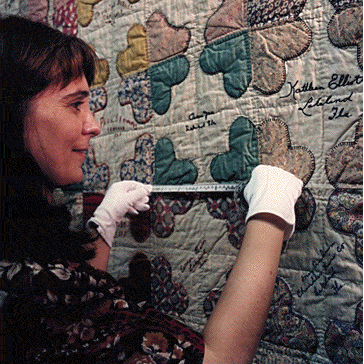
While rereading Elizabeth Musheno’s *Book of Colonial Needlework* I noticed a photograph of an Autographed Presentation Quilt that was made by a congregation for a pastor’s wife in 1847. I immediately fell in love. Oh, my, just what I need, something new! 🙂 Although I have donated blocks to many folks who were ill or bereaved, I had never considered the historical impact of such quilts.
I am sure that there are at least a dozen experts on Autographed Presentation Quilts and I wondered what your thoughts were on the subject. Are they most often applique? Are there any old examples of crazy quilts done this way? Are there already groups of people in block exchanges. LOL
Rissa
Date: Mon, 5 Jan | From: pepcory@
Hello friends-Hadn’t thought about this in a long time, but when I was a high school senior, the KKK around Sumter SC had a revival of sorts. Probably in reaction to MLK’s assassination and the Detroit and DC riots. I was dating a young man who was white but taught at a black school (he was a member of Teacher Corps) and here’s what we did–attended two Klan meetings and clandestinely tape-recorded everything. These meetings were terrifying–I remember drinking 120-proof rum in my Coke and trying to get sloshed but couldn’t–I was scared sober! Then along with my Mom (who was a remarkable person and had this idea-) we reproduced the tapes and gave them to teachers at all the local black schools. Unbeknownst to the Klan, their ‘secret’ message was being taught in social studies classes! Looking back, I wonder “Where did I get the guts to do this?” I can’t answer the question intellectually. All I know is that in my family where my Dad was a minister in both white and black churches and publicly spoke about civil rights from the pulpit (even when it was dangerous for him to do so) it seemed the right thing to do at that time. And there’s no need to apologize about your ancestor’s actions–that was then. What truly matters now is how we treat on another and respect each other. Peace. Pepper Cory from the foggy Carolina coast
Date: Mon, 5 Jan 2004 16:05:07 -0500 | From: <mreich@>
Pepper, you are my kind of woman!!! To go there even now, and share that episode of your life with this list and cyberspace is amazing!!! Might I suggest that your parents instilled in you a value system that knew right from wrong and gave you the guts to make a difference. That sounds rather simplistic, I know, however, taking that kind of chance then was a pretty courageous thing to do. sue reich
Date: Mon, 5 Jan 2004 | From: “Anne Datko” <datkoa@>
Growing up in South Carolina, I was very aware of pokeweed. Yes, young leaves were eaten by some and the berries were of a wonderful color. We were always warned, though, that old leaves (and, I think, the water the young leaves were cooked in) and the berries were poisonous. In later years I learned about the ‘poisonous principal(s). Here are definitions/descriptions found in a couple of medical dictionaries upon searching with Google: (1) Isolectin, pokeweed Proteins isolated from the roots of the pokeweed, Phytolacca americana, that agglutinate some erythrocytes, stimulate mitosis and antibody synthesis in lymphocytes, and induce activation of plasma cells. (2) mitogen (mi=B7to=B7gen) (mi=A2to-j[schwa]n) a substance that induces blast transformation; DNA, RNA, and protein synthesis; and proliferation of lymphocytes, e.g., concanavalin A, phytohemagglutinin, pokeweed mitogen, or lipopolysaccharide.
pokeweed mitogen, a lectin isolated from pokeweed (Phytolacca americana); it is a mitogen that stimulates both B and T lymphocytes. Abbreviated PWM.
Don’t ask me now (after several years away from the lab) what this means except that, yes, parts of the plant contain things that are bad when eaten!
AnneD
Date: Mon, 05 Jan 2004 16:37:30 -0500 | From: Joan Kiplinger <jkip@>
To all — there is no ignorance in what I have said, only what was. That you will have to accept as fact, like it or not. Perhaps an isolated incident in this terrible organization’s history. Perhaps Candace summed up my previous emails than I. I only offered this example of a group calling itself the KKK which in no way adhered to the oaths of other chapters. Certainly I am aware of the KKK; they have tried unsuccessfully to demonstrate in our area and were booed out, myself a booer. As to why this group differed, that was the town’s purpose at the time, how people regarded life and responsibility. As a young girl on visits back to the town, I remember many of the adults talking about help and kind deeds this group offered. It was the Depression when sharing and caring mattered to them. My mother was Italian, my father Quaker and while they were not affiliated were grateful for help received. I would be glad to respond privately to any other comments. I feel the subject has strayed from this list’s purpose.
Date: Mon, | From: Gail Ingram <gingram@>
While all of you are debating the KKK and I’m battling my computer until tomorrow when my techie comes acalling, I have some good news for those of us who will be in beeutiful downtown Ruston on February 7th, forming the Deep South Quilt Study Group.
Our meeting will be graced with the presence of our list mom, Kris Driessen! I’m so excited I believe I actually could touch that rattlesnake quilt with the appliqued head Marcia Kaylakie owns and that was shown in Dallas.
Well, maybe not touch it actually. But not close my eyes and stand waaaaay away from the table. Well, maybe close my eyes a little. But still, that’s a lot. I did a triple take when I first saw it and have been pondering the psychology of its maker ever since. A fearless woman, that one.
I told my cleaning lady the news about kris just now as we were drinking coffee (after all the entertaining we did over the holidays, our place is still clean).She said, “Oooweee! All the way from New York! Are we going to put those linen sheets on the guest bed? Are you making shrimp creole? You need to save some of those sugar cookies from your mama’s recipes.”
You can see how southern minds work. Linens, food=Love.
If those of you who have had bounced emails from my account will just remail after I delete all the viagra ads of the past 2 days, I think things will be all right.
Happy happy happy, Gail
Date: Mon, 5 Jan | From: Kris Driessen <krisdriessen@>
I am glad we discuss topics like the KKK without everyone getting all upset. Those that have been with us a while will remember the brouhaha caused by the word swast*ka and the fact it was once a good luck symbol. It evoked some terrible memories for members, but the use of that quilt block in quilts and what happened to those quilts was a valid discussion.
I am not sure how the KKK is a valid quilt discussion, though… but I am still glad we are mature enough to discuss it calmly. I learned something today.
And now, a slight change of subject: have y’all heard of the International Quilt Study Center’s Quilt of the Month? (http://quiltstudy.org/exhibitions/quilt_of_the_month.html) Each month there is a new little tidbit. It’s worth a look!
Kris
From: “Kathy Moore” <KathyMooreneb.@>
A word to the wise is called for here.
Before any of you are tempted to make poke weed salad, please let me advise you to thoroughly research this “delicacy”. I lived in Alabama for 13 years and had lots of it in my yard. I was informed by more than one native that it is poisonous unless cooked and washed several times. I was never brave enough to try it. Actually, I was never even tempted!
Kathy Moore Lincoln, Nebraska
Date: Mon, 5 Jan 2004 20:53:24 EST | From: JBQUILTOK@
It wasn’t many years ago that traveling thru one of the southern states, I saw signs that the section of road was kept litter free by the KKK. It was a major road if not interstate. What a shock! I thought they were an undercover group.
Janet
Date: January 5, 2004 | From: “Carol’s Quilt Closet” <imaquilter2@>
Cinda,
would you mind sharing how Elly’s lecture was.
Date: January 5, 2004 | From: “Quiltstuff” <quiltstuffoptusnet.com.au>
Thanks so much for posting that site. It was fascinating to see that quilt. Do you have any idea who bought it or if it will end up in a museum at all. It would be wonderful to see it published so many quilters could enjoy it. Suzy Atkins From: “Xenia Cord” <xenia@> To:
Date: January 6, 2004 | From: “Cinda Cawley” <lrcawley@>
Hi Judy, I won’t be able to join you this time. Thanks for the invitation. Cinda
Date: January 6, 2004 | From: “Judy Kelius (judysue)” <judysue@>
I don’t think that matters to most people over here. Nicole has been here so long that most people probably don’t even remember that she wasn’t born here. (And I assume she’s an American citizen by now?) Remember this is a country where an Austrian can become governor of an important state!
At 07:46 PM 1/6/04, you wrote: > I was just wondering something non quilt related about this. How do >Americans feel about a Aussie and Englishman playing the lead roles of >Southerners. . I know the brits were upset when Renee Zwellegger played >Bridget Jones.. Just wondering. >Suzy > An aussie who is very proud of our Nicole.