April 26 – 27, 2004
These restored messages come from the Quilt History List, an online forum where quilt historians, collectors, researchers, appraisers, and enthusiasts discussed antique quilts and related textiles. The archive dates from 1996 through approximately 2016 and is being restored gradually. Sign up in the form at the bottom of the page if you want to know when a new page is added. Original spelling, opinions, formatting, and inactive links may remain unchanged.
Primary topics of this QHL Digest:
- “Rare Black Figurative Baby Quilt” eBay Authenticity Debate — A contested eBay listing sparks extended discussion of fabric dating, treadle-stitch claims, and 1980s reproduction fabrics.
- Religious Vestments and Textile History — A member’s interest in Balkan religious art leads to a discussion of historic vestment textiles.
- Alliance for American Quilts National Sale — Members announce a fundraising sale supporting quilt history preservation efforts.
Date: Mon, 26 Apr 2004 05:26:57 -0700 (PDT) | From: Dana at Material Pleasures <danabalsamo@>
Hello all, I have a neighbor friend who from the day she learned I quilted has bombarded me with sewing alternations, split seams, and for the past 2 years a request to make a quilt for her King Sized Bed. I try to polite…you see…she has a huge chocolate labrador that she and her husband share the bed with…she is looking for something to protect her comforter. I had to eventually tell her she cannot afford me to make her a quilt…fabric alone will be $300-$400 and the time involved is huge and I charge more that a few dollars an hours. I told her to go to Macy’s or Penneys for the $40 ones…it would serve her purpose…she whined they don’t have what she wants…all well…she is not getting one from me…I was very insulted that she expected me to make a quilt only to have her dog lay all over it…I also do not make quilts for known smokers. Once you give a gift it is up to the person receiving it as to how it will be used…that doesn’t mean I have to give one to someone who I know may misuse it. So my mother has not gotten one, nor has my mother in law. And my husband’s 90 year old aunt, who he promised a quilt to, and which I made one for, will not get it, either…my last visit to their family made me realize that once his aunt passes away, it would be used as a moving blanket most likely. Let my husband make her the quilt! Maybe that is why today’s quilts last…we are so careful with them because we know what have gone into them. Careful planning, financial investment, loving stitches…. I have given away several quilts…many to new babies in the family (2 to a set of twins that I never even received a thank you for!), and one to my grandmother, so I don’t think I am a hoarder…well…maybe a little. My best, Dana
Material Pleasures Affordable Vintage Linens, Lace, Textiles, Buttons & More! www.material-pleasures.com
April 27th to May 2nd Auction Event at BondedSale.com Bid with Confidence My auctions at http://www.bondedsale.com/auctions.asp?74392,0,1
Date: Mon, 26 Apr 2004 05:29:05 -0700 (PDT) | From: Judy Schwender <sister3603@>
The first question I have is: how does the seller know it was sewn on a treadle machine? There’s been a lot about treadle machines posted lately, but I don’t remember seeing anything that indicated the stitch was so distinctive that it could be identified as treadle work. There are a lot of reproduction fabrics on the market now. Some of these look like Marcus Bros repros. But maybe that’s where Marcus got their designs, from pieces like this one. If anyone is familiar with the thousands of patterns marketed over the past 20 years, could they tell us if this was such a pattern? Judy in Lincoln
“Judy Kelius (judysue)” <judysue@> wrote: Do the rest of you agree with me that this is a fairly new piece made to look old with tea dying? I was just browsing closed auctions in eBay and found it, too late to notify the seller. Look at the price!!! Plus you can’t see who bought it to let them know.
Is there any possibility this really is old?
http://cgi.ebay.com/ws/eBayISAPI.dll?ViewItem&category=357&item=3717682142
Date: Mon, 26 Apr 2004 10:11:48 -0400 | From: Patricia L Cummings <quiltersmuse@>
Judy Schwender wrote:
The first question I have is: how does the seller know it was sewn on a treadle machine? There’s been a lot about treadle machines posted lately, but I don’t remember seeing anything that indicated the stitch was so distinctive that it could be identified as treadle work.
This is a good question. Seems that I’ve heard that some of the treadles created a chain stitch. Perhaps some treadle machine expert has a good answer for this question.
Judy also wrote:
There are a lot of reproduction fabrics on the market now. Some of these look like Marcus Bros repros.
I am pretty familiar with what is available for repro. fabrics. Most of these fabrics I do not recognize as being available.
She says: But maybe that’s where Marcus got their designs, from pieces like this one.
That may be exactly true.
Judy states: If anyone is familiar with the thousands of patterns marketed over the past 20 years, could they tell us if this was such a pattern?
I know that I have seen this pattern configuration before. I cannot remember where. I’ll continue to look through my print resources.
All in all, the quilt looks “believeable” to me. One of the edges is raveled. Things are not quite in alignment, and the edges are wavy. The time period seems within the realm of possibility, and the tiny calicoes “add up”. It seems that if this is a fake, someone would have had to go to a lot of trouble to try to make this look like authentic folk art.
I hope that others will offer their opinions, too.
Pat Cummings
Date: Mon, 26 Apr 2004 10:26:00 -0400 | From: Judy White <jawhite@>
The “brown-ness” looks pretty regular to me. But I want to know how someone can tell the quilt was made by a treadle machine?
Judy White
Date: Mon, 26 Apr 2004 10:28:40 -0400 | From: Barb Garrett <bgarrett421@>
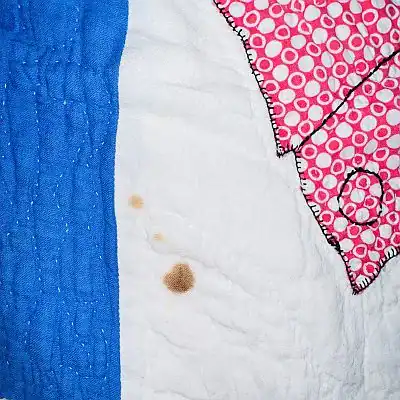
This looks to me like one of those 1980s “country look” quilts — tea or coffee dyed. The wicking along the seam lines in the close ups just doesn’t ring true for “real” aging. While I can’t see all of the shirt fabrics clearly on my monitor, the first close up is identical to fabric I bought at SoFro during that time to make the country crafts I made for sale — name on the selvage was Kessler — she had many nice “country look” fabrics. While the “Uncle Sam” design looks very familiar, I can’t identify it “for sure” as something I’ve seen before. It just looks like it’s from the 1980s — my opinion only — and that if I saved everything, and kept it organized, I’d have a picture of it, snipped from a magazine ad. .
http://cgi.ebay.com/ws/eBayISAPI.dll?ViewItem&category=357&item=3717682142
Barb in rainy southeastern PA
Date: Mon, 26 Apr 2004 08:01:53 -0700 | From: “Christine Thresh”
Treadle machines sewed lovely straight stitches. Some machines (both hand crank and treadles) sewed a chain stitch but they were not popular for everyday sewing. Toy machines often sew chain stitches because these little machines do not need bobbins.
Christine Thresh http://www.winnowing.com
Date: Mon, 26 Apr 2004 11:31:26 EDT | From: DDBSTUFF@
Home
Date: Mon, 26 Apr 2004 12:41:44 EDT | From: Midnitelaptop@
why would saying it was “sewn on a treadle machine” necessarily imply that the quilt was “old”?…people own treadle machines today and are able to sew on them if they choose to do that….. it’s like saying something sewn by hand would make it old..maybe not…
have many of you purchased “stuff” from ebay? have you been satisfied with it/them?…. jeanL
Date: Mon, 26 Apr 2004 12:43:33 -0400 | From: “Judy Kelius (judysue)” <judysue@>
I don’t think there is any way to identify treadle stitches from those sewn on an electric machine. After all, sometimes the machines were identical and around here our sewing machine shops still sell treadle machines for the Amish or Mennonites who don’t want to use public electricity.
If I have a machine-stitched top dating to the 19th century, I will sometimes say it was stitched on a treadle (or handcrank) but that is an assumption based on dating the piece, not by looking at the stitches. According to ISMACS, although electric machines were patented by the end of the 19th century, they weren’t sold domestically until the early 20th century. Electric machines didn’t catch on until the 1920s and treadles and handcranks still outsold electric machines until the end of World War II.
Date: Mon, 26 Apr 2004 11:55:52 -0500 | From: “Laura Syler” <texas_quilt.co@>
Barb, That fabric would be a Concord, from the 1980’s….sold a TON of it in my shop. Joan Kessler was the designer. She is also the one responsible for Concord’s line of Micro Dots 1980-85ish that we started using as “solid prints”. Last selvage that I saw with her name on if had both her and her daughter’s names, though I can’t remember if she was still designing for Concord. Once THE premium 100% cotton line, I seem to find them in JoAnn’s and Wal-Mart now.
To Pat’s comments, it does seem to “add up” though….but still feels a little off………at least to my eye.
Laura Syler —– Original Message —– From: “Barb Garrett” <bgarrett421@> To: “Quilt History List” <qhl@> Sent: Monday, April 26, 2004 9:28 AM Subject: [qhl] Re: Black figures “antique” crib quilt on eBay for $600+!
> This looks to me like one of those 1980s “country look” quilts — tea or > coffee dyed. The wicking along the seam lines in the close ups just > doesn’t ring true for “real” aging. While I can’t see all of the shirt > fabrics clearly on my monitor, the first close up is identical to fabric > I bought at SoFro during that time to make the country crafts I made for > sale — name on the selvage was Kessler — she had many nice “country > look” fabrics. While the “Uncle Sam” design looks very familiar, I > can’t identify it “for sure” as something I’ve seen before. It just > looks like it’s from the 1980s — my opinion only — and that if I saved > everything, and kept it organized, I’d have a picture of it, snipped > from a magazine ad. . > > http://cgi.ebay.com/ws/eBayISAPI.dll?ViewItem&category=357&item=3717682142 > > Barb in rainy southeastern PA > > > — > You are currently subscribed to qhl as: texas_quilt.co@. > To unsubscribe send a blank email to leave-qhl-1514145N@
Date: Mon, 26 Apr 2004 10:03:48 -0700 (PDT) | From: Dana at Material Pleasures <danabalsamo@>
Hi Jean,
I have bought and sold on ebay and am 95% satisfied. As a seller you have to be as descriptive as possible, as honest as possible, and answer all questions that come up. As a buyer, you HAVE to ask questions, many sellers are not knowledgeable about what they are selling so it may not be big deal to them if that quilt top doesn’t lie flat, or the binding is starting to fray. Ask about shipping costs or payment options. You have to look at all aspects of the transaction, not just what you are buying. And always check a seller’s feedback rating.
Good luck, Dana
Material Pleasures Affordable Vintage Linens, Lace, Textiles, Buttons & More! www.material-pleasures.com
April 27th to May 2nd Auction Event at BondedSale.com Bid with Confidence My auctions at http://www.bondedsale.com/auctions.asp?74392,0,1
Date: Mon, 26 Apr 2004 10:05:43 -0700 | From: “Alan”
I’ve been asked many times to make someone a quilt for the bed. And my immediate response is to determine the intentions of the asker, after one or two nearly fainted at the cost. Do you want an heirloom or a bedspread ? At this point, *all* inquiries wanted a bedspread, so I’ve automatically suggested Penney’s. They’re inexpensive, easy to acquire – and about the time you’re ready to change the bedroom decor, it’s time to replace the thing anyway.
I remember being absolutely shocked that people would buy commercially made quilts. No longer. I would much rather have these people use a quilt made for their purposes, then expect that they would all have my sensibilities for fine workmanship.
Besides, I then have a better chance of acquiring the good stuff !
Alan
Date: Mon, 26 Apr 2004 12:12:26 -0500 | From: Sylvia Adair <piecethepastwi.@>
As a sewing machine collector and user, I had to chime in on this discussion. As many of you have said, there is absolutely no way to tell stitches made on a treadle or a hand crank from stitches made on an electric machine. Even chain stitch machines were electrified in the 1920s and sold as electrics for at least another 20 years. Most people aren’t fanatics (like me!) about these old machines, and they may think that machine stitching on a quilt means a newer quilt. I make all my quilts on treadles and hand cranks, and when I tell people that, they look closely at the stitches. They’re often surprised to find no difference. Occasionally I’ve seen a seller on ebay identify stitching as made on a treadle because the stitches look bad (poor tension, etc.) but we all know that can happen on any machine. Treadles are often exactly the same as electric machines, it’s just the power that’s different. Some Amish women actually use modern fancy machines (with lots of built-in stitches) but make them work with treadle or battery power instead of electricity. Well, I’ll climb back down off my soapbox now. Have a lovely day, all. Sylvia Adair Germantown, Wisconsin
Date: Mon, 26 Apr 2004 13:52:18 -0400 | From: Patricia L Cummings <quiltersmuse@>
Hi there:
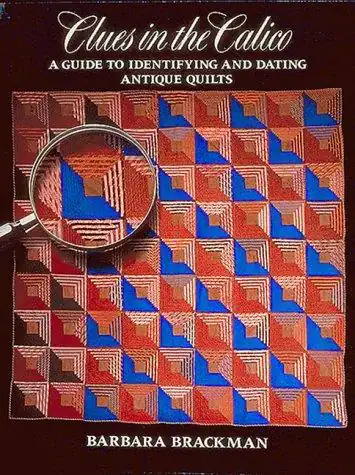
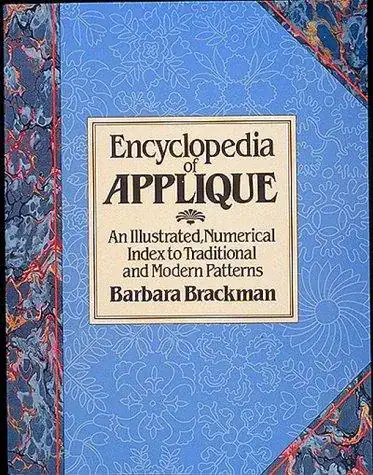
This has been driving me nuts all day so I am jubilant to have tracked down the name of the block. It is Oklahoma Boomer, entry #218.2, Encyclopedia of Pieced Patterns, by Barbara Brackman. The block was published by the Ladies Art Company, 1898.
Many of the prints used in the ebay version look to be scrap bag retrievals from before the turn of the (20th) century.
Pat Cummings
Date: Mon, 26 Apr 2004 15:01:40 -0400 | From: “Judy Kelius (judysue)” <judysue@>
The block is very similar to the Oklahoma Boomer, but not exactly – the LAC block has a pointed hat (like a tin man) but the one on eBay had an Uncle Sam type top hat.
It is still my opinion that the quilt on eBay is of recent vintage. The ties are also another characteristic of similar quilts sold in countryish gift shops. Plus I still have some of that star and whirl indigo fabric (1980s or 90s) in my stash. You could probably make a quilt like this in half a day or less.
At 01:52 PM 4/26/2004, you wrote: >Hi there: > >This has been driving me nuts all day so I am jubilant to have tracked >down the name of the block. It is Oklahoma Boomer, entry #218.2, >Encyclopedia of Pieced Patterns, by Barbara Brackman. The block was >published by the Ladies Art Company, 1898. > >Many of the prints used in the ebay version look to be scrap bag >retrievals from before the turn of the (20th) century. > >Pat Cummings
Date: Mon, 26 Apr 2004 20:07:55 +0000 | From: “jocelynm@” <jocelynm@>
> have many of you purchased “stuff” from ebay? have you been satisfied wit h > it/them?…. Jean, Keep a list of sellers. Some are scrupulously honest, and you can rely abso lutely on their estimates of age, and descriptions of damage. OLDQUILTS and FRENCH72 come to mind here. Others don’t give a hoot, so long as they can find a gullible buyer. They’l l label something with hot pink and lime green fabric in it as ‘1930s’- bec ause 1930s sells better than 1960s. Still others don’t know anything, so they post any old description that see ms alluring….including copying them from another quilt’s description.
Spend some time looking at the descriptions and making notes of whom seems honest and knowledgeable, and don’t deal with the others, unless you WANT a1960s acid-trip quilt. <G>
Date: Mon, 26 Apr 2004 16:25:24 -0400 | From: Patricia L Cummings <quiltersmuse@>
Judy Sue Kelius wrote:
The block is very similar to the Oklahoma Boomer, but not exactly – the LAC block has a pointed hat (like a tin man) but the one on eBay had an Uncle Sam type top hat.
It is still my opinion that the quilt on eBay is of recent vintage. The ties are also another characteristic of similar quilts sold in countryish gift shops. Plus I still have some of that star and whirl indigo fabric (1980s or 90s) in my stash. You could probably make a quilt like this in half a day or less.
Hello again on this rainy day:
Okay, the hat is different. Let’s call the block “Oklahoma Boomer” variation!
I don’t see anyone else stepping forward with an exact pattern match from an antique source. At least, finding this block places the date of 1920 within the realm of possiblity. From a construction viewpoint, it would be easier to make a square hat. This block looks like a good candidate for paper piecing and fairly simple to do, however I would estimate more than one afternoon to make it. 🙂
As far as tying, I have quilts in my antique collection that date from both before and after the time period stated on the quilt (1920s), so I think that the act of tying a quilt, in and of itself, is not a good indicator of time period. Ties only demonstrate the individual quilter’s preference or in some cases, their lack of skill in hand quilting, or a deficit of time or ambition. Certain quilts, particularly small quilts, lend themselves well to tyeing as a finishing treatment.
Judy Sue, you asked our opinions. Several of us have given our thoughts, based on our own experience, knowledge, and observations. If you are looking for a universal consensus of opinion, you probably will not find it here. It seems that, among other things, you are questioning the integrity of the seller, and this, based on low-resolution digital images on the internet? Somehow it just doesn’t seem very fair. I do not know the seller or the buyer.
I enjoyed seeing the ebay auction and I thank you for posting it. I will not, now or ever, be a part of a witch hunt that seeks to discredit someone or to alert the buyer that he/she may have bought a “fake”, especially when there seems to be lack of compelling evidence that definitively proves this. In fact, I would bet that anyone bringing false accusations of this type could be sued for libel. Just a word of caution.
I have shared what I know, to be the best of my knowledge. I seek the truth at all times. I hope that others will do the same.
Pat Cummings
Date: Mon, 26 Apr 2004 16:46:02 -0400 | From: Bob Shaw <shaw.bob@>
I am pleased to announce that the The Alliance for American Quilts’ first National Society of the Daughters of the American Revolution (NSDAR) interview has been posted on The Alliance’s website (www.centerforthequilt.org). The interview is the result of a unique partnership between The Alliance for American Quilts and the NSDAR to record the stories of living quiltmakers around the United States through Quilters’ S.O.S. – Save Our Stories, a project of The Alliance for American Quilts.
The interview of Betty Ellen Hathaway Madry was conducted by Frances Price of the NSDAR’s Samuel Johnston Chapter in Raleigh, North Carolina. Betty, who is 75, has produced 58 quilts, and her humor is evident. When asked if she was a native North Carolinian, she replied, “No but I tell people I got here as quickly as I could.” Betty took up quilting after her granddaughter came to live with them.
I’m sure you will enjoy reading this interview or any of the other 235 interviews with American quiltmakers that have been posted to The Alliance’s Center for the Quilt Online to date. The interview with Betty can be accessed directly at: http://www.centerforthequilt.org/qsos/show_interview.php?pbd=qsos- a0a2y7-a
Be sure to paste in the entire url.
Robert Shaw Executive Director The Alliance for American Quilts Tel//fax: 802/985-0737 shaw.bob@ www.centerforthequilt.org
Date: Mon, 26 Apr 2004 16:52:48 -0400 | From: “Ilene Brown” <ilene3@>
Yes, I have bought too much from Ebay. It is addicting. I am 99% happy with everything I have received. I have bought Sewing Machines, fabric, books, quilt tops, quilts (unfinished), sewing assessories, thread, and art prints (sewing related). Only 2 times out of over 100 have I been disappointed. And one of those the seller let me send back. I am planning on selling soon. Ilene of Raleigh, NC
> [Original Message] > From: <Midnitelaptop@> > To: Quilt History List <qhl@> > Date: 4/26/2004 12:44:05 PM > Subject: [qhl] Re: “sewn on a treadle machine”? > > why would saying it was “sewn on a treadle machine” necessarily imply that > the quilt was “old”?…people own treadle machines today and are able to sew on > them if they choose to do that….. > it’s like saying something sewn by hand would make it old..maybe not… > > have many of you purchased “stuff” from ebay? have you been satisfied with > it/them?…. > jeanL > > > — >
Date: Mon, 26 Apr 2004 16:51:47 -0400 | From: “crossland_n_j Crossland” <crossland_n_j@>
I put off saying anything about treadles as they are one of my addictions. I used to have 13 of them but I have pared down to five. They are so much fun. When I would bring one home, the first thing I would do is clean and oil. Be careful of the decals as they can be removed with cleaners. I then put on a new belt. I get my treadle belts from my local sew & vac. There is a large type staple on one end. The other end is cut the length needed and a hole is placed to put the other end of the staple into. I use an awl or an ice pick to put a hole in my belts. Of course, a new needle and you cannot get a better stitch. I’ve seen redwork embroidery done on the chain stitch machines. That’s fun too. Julie from Hudson, NH
Date: Mon, 26 Apr 2004 17:35:45 EDT | From: Laurajbr@
I too have spent lots of time (and money) on Ebay and have always been satisfied with my purchases. I’m careful to purchase from sellers with good reputations and good feedback. I bought the most fabulous quilt on Ebay a few years ago–one that was brought to my attention by this group: a red and green berry quilt from the mid 1800’s. I paid more than I have ever paid for a quilt in my life and was very nervous until it arrived. It was even more spectacular than I could have imagined.
Right now I am redecorating a mountain cabin and was using some of my old Laura Ashley bedding. I needed more and found everything I needed, and more, on Ebay, even though the pattern was discontinued years ago.
The thing to do is to check out the seller carefully, read the comments from other buyers in the feedback section, and ask questions before you bid. Read the descritption of the item also–looks alone can be deceiving. Try not to get caught up in the last minute bidding frenzy. Put what you want to pay for the item as your highest bid. If you are desperate to win the auction, hold off on your final bid till the very end of the auction–and hope your computer is in its high-speed mode.
It also helps when you have a friend like Yvonne, who calls my attention to every red and green appliqued quilt that shows up for sale. Thank goodness she’s been too busy to do that lately.
Date: Mon, 26 Apr 2004 18:11:24 -0400 | From: Barb Garrett <bgarrett421@>
I just had a chance to check Brackman’s book, and I would have to disagree with you Pat — I don’t think the ebay quilt is Oklahoma Boomer, entry #218.2. The hats are different — one is made of 3 triangles, the other 4 rectangles. Boomer doesn’t have any hands, which the other one does, and the proportions of the torso and legs are very different. I think whoever designed the ebay quilt may have been inspired by boomer, but they are different blocks to me. Keep in mind I’m a retired geometry teacher, so I look at blocks differently than some people <grin>.
I was able to find my piece of the sashing fabric — it says MARCUS BROS. TEXTILES INC. on the selvage, and is from my “early 80s” accumulation. My husband and I held it up to an enlargement on the computer, and the orientations of the star points and crescents match this fabric. When I discovered how to “double enlarge” the pictures, I was able to identify 3 other fabrics that look like stuff I used for crafts back then. These are more indicators to me that the quilt has a 1980s creation date — again, just my opinion, based on many indicators.
The method of joining the front to back is also indicative of the crafts era — it was called pillowcase construction and described and taught as a “quick way to finish a quilt without having to put on a binding”. The lack of batting and the location of the ties are also “gut indicators” to me of it’s age.
Just my thoughts, since Judy asked. This is a quilt I’d have to feel the texture of the fabric before I could say it’s 1920s or 1980s — which of course we can’t do on computer.
Barb in still raining southeastern PA
Date: Mon, 26 Apr 2004 18:28:37 -0400 | From: Jo Horsey <jhorsey@>
I am not an expert either. However this is similar to a new quilt I bought in a gift shop about 15 years ago. Mine also has black figures (mine are women with aprons) and the placement and number of the blocks and unusually elongated piecing of the figures looks a lot like mine, but that doesn’t mean anything. Mine is not tied or quilted at all. I saw one identical to mine that was offered on ebay, and went for a price that didn’t seem even “imagineable”, but I didn’t know whether I should contact the seller about the age or not. While I dithered, the auction ended. In this case, since the seller guarantees the item to be authentic as described, they must intend to stand behind it, or perhaps it was represented to them as authentic before *they* bought it, and they believe it to be so. We all see and learn interesting things *every* day on this list! thanks, Jo, in Newnan
Date: Mon, 26 Apr 2004 18:39:20 -0400 | From: Patricia L Cummings <quiltersmuse@>
I have written to the seller with a request for more information. I will let you know if I get any answers.
Pat
Date: Mon, 26 Apr 2004 18:18:34 -0500 | From: Gail Ingram <gingram@>
Here I am, down South where spring has come and is on its way out, just shocked as anyone could possibly be that Barbara Garrett, girl geometrician, is old enough to have fabrics on hand from the ’80’s! Let alone can double and triple-zoom in on them I thought all the Ringo Gang members were still in pinafores and rompers then. Barb, you get to be the dorm mom.
<g> Gail
Date: Mon, 26 Apr 2004 20:15:06 -0400 | From: Patricia L Cummings <quiltersmuse@>
I asked the seller if she knew when, where, or at what time, specifically, the quilt was made. She replied that with doubts as serious as mine, she would be happy if I passed on bidding on the auction. Since the auction had already ended, I found this remark to be a little bit odd. She also stated that the quilt was from a San Francisco estate.
With no further information forthcoming, it seems that we are left with nothing more than our own guesses, suppositions, and observations.
I thought that it couldn’t hurt to at least ask for more clarification.
Pat
Date: Mon, 26 Apr 2004 22:33:59 -0400 | From: Barb Garrett <bgarrett421@>
Actually, Gail, the 80s fabrics aren’t the “furthest ones back in the stash” — I have piles of 70s fabrics — those bright crayon colored cotton and poly/cotton small florals. That’s all I could find when I first started quilting — plus a nice pile of 36″ wide Ely & Walkers <grin>. My pinafore and rompers days are a bit before the 80s <grin>. Then there’s the stacks of 90s repros. Now, if I really was as organized as the above sounds <grin> — then I’d be able to find things <grin>.
Barb in spring/summer southeastern PA
Date: Tue, 27 Apr 2004 08:31:30 EDT | From: DDBSTUFF@
Black figures “antique” crib quilt on Ebay
I agree that this piece is not very old. There were a lot of these floating around about 10 years ago. Well, I guess they have a little age but are they worth the price? Apparently, some 24 bidders thought so. I have several blocks from the 1880s of a similar but more interesting pieced image which I bought at a flea market in Danbury Conn. back in the late 70s or early 80s. They are the only old version of this I have ever seen. If I can find the time, I’ll put them on the eboards for all to see.
Come to think of it, there may have been a complete quilt pictured in one of the early Quilt Engagement Calendars. Does anyone remember that one?
Darwin
Date: Tue, 27 Apr 2004 10:11:40 -0400 | From: “Karen”
I was recently looking through a little book on Balkan religious art, and saw several frescoes and icons depicting what appear to be vestments pieced in cross patterns (including one that looks amazingly like Single Irish Chain). These frescoes and icons all date from the 14th to 16th centuries.
Does anyone know more about this? Or if contemporary Orthodox vestments are pieced or woven? I’m working on a class on pieced clothing of the late Renaissance and would love to use these pictures as an example of liturgical patchwork, but am a bit worried about whether these vestments were actually woven.
Thanks in advance. The good people on this list are a wonder.
Karen Evans Easthampton, MA
P.S. – Sally – the booklet arrived safe and sound. Eternal thanks!
Date: Tue, 27 Apr 2004 10:18:11 -0400 | From: Sandy7827@
Morning, I do alot of lurker on this list but I read everything, I think learning about antique quilt is priceless, but right now I’m like to get in contract with Anne Johnson about a article her did on Tobacco Premium Quilt. Could anyone help with this. I would greatly appreciate.
Keep the discussions going, enjoy evry bit.
Sandra
It is difficult to experience moments of happiness if we are not aware of what it is we genuinely love.” — Sarah Ban Breathnach
Sandra Nichols Assistant Librarian/LRC Rosalind Franklin University of Medicine and Science (formerly Finch University of Health Sciences/The Chicago Medical School) 3333 Green Bay Road North Chicago, IL 60064 847-578-8344 Fax: 847-578-3401 nicholsjfinchcms.edu
Date: Tue, 27 Apr 2004 15:29:58 +0000 | From: “jocelynm@” <jocelynm@>
On April 27, 2004, Karen wrote:
> I was recently looking through a little book on Balkan religious art, and > saw several frescoes and icons depicting what appear to be vestments piec ed > in cross patterns Karen, Are you familiar with tablet weaving? It was used historically to make broc aded vestments. However, it tended to be used for texture contrast not colo r contrast (like patchwork).
Date: Tue, 27 Apr 2004 10:36:31 -0600 | From: “Vernon Farms”
Hi, I made a quilt for my father-in-law. It took months of hard work. I took old family pictures of all the family, (10 children, many many grandchildren)and put the photocopies on fabric. I then quilted it by hand. When I gave it to him at his 90th birthday party with all the families there. His fourth wife (he has outlived all the others) said “Oh it’s so pretty it shouldn’t be put over the end of the couch,” so she proceeded to put it on the wall. She wouldn’t listen to anyone or let anyone help her. She used 3 NAILS, 2 SCREWS, and 3 THUMBTACKS to put it on the wall! Everyone was aghast! We all knew that you didn’t say anything that what she was doing was wrong as my father-in-law would rather disown a child than make any of his wives feelings hurt. So I sat there stunned. Many of my husbands sisters and brothers and even the grandchildren (who had kids of their own) came to me and apologized for what she had done. We all felt terrible. It is still hanging on the wall. II’m pretty sure that the screws were rusty! When we got home I immediately got all the fabric that I had used for the binding and the other pieces of fabric and put them in a box so when my father-in-law passes away and the quilt comes back to us I can repair what she did. AND THAT QUILT WILL COME BACK TO US. I am very careful of who I give a quilt to now.
I’m glad I made the quilt for him as it is a type of genealogy of the family but boy, she put a whole new light on the word mother-in-law.
On a lighter note I do use those cheap quilts from Walmart on my bed. We have 4 cats and 1 dog that jump on our bed all day, and I prefer to wash those cheap things than put my appliqued Whig Rose on the bed. I just make sleeve holders for my precious ones and hang them properly on the wall.
Thank for letting me spill my feelings Su Vernon
Date: Tue, 27 Apr 2004 13:12:27 -0400 | From: “Karen”
I was wondering whether it was woven or not…these particular patterns were all over, and didn’t look like they’d been tablet woven. It was very striking and looked amazingly like patchwork, to the point that the only reason I’m not sure is that Orthodox art is so stylized that one has to be careful about taking the forms at face value.
*argh* There’s so much coming out of Eastern Europe these days, and we know so little about it in the West…would you believe that some of the very best preserved examples of Ottoman brocades were found in Orthodox cathedral treasuries?
And to think I stupidly signed up to teach pieced clothing as a class at Pennsic…*bangs head repeatedly against desk*…
Karen Evans —– Original Message —– From: <jocelynm@> To: “Quilt History List” <qhl@> Sent: Tuesday, April 27, 2004 11:29 AM Subject: [qhl] Re: Question about vestments
On April 27, 2004, Karen wrote:
> I was recently looking through a little book on Balkan religious art, and > saw several frescoes and icons depicting what appear to be vestments pieced > in cross patterns Karen, Are you familiar with tablet weaving? It was used historically to make brocaded vestments. However, it tended to be used for texture contrast not color contrast (like patchwork).
Date: Tue, 27 Apr 2004 17:19:22 -0400 | From: “Newbie Richardson” <pastcrafts@>
Karen and list, Vestments are a secret a passion of mine. The Western European ones are a wonderful source of early damasks and brocades. In the 16th, 17th and 18th c wealthy noble families routinely donated “out of style” fabrics to the Church to be recycled into vestments and altar hagings. Many of the ones I have seen frequently are made with two, if not three, different patterns of silk to create a cope ( cape) or chasuble, (the shield shaped garment worn by priests), as well as altar frontals, etc. This applies to the Roman Catholic Church, (those that escaped both the ravages of the Reformation and of Vatican II) the Anglican Church in England (because of the Oxford movement), and some of the older, southern Anglican Episcopal churches in the US, and the Eastern Orthodox churches. In this case, I am not sure the term patchwork is accurate. It is not so much a deliberate use of piecing to create a pattern, but rather a clever way to recycle several different precious pieces of fabric into a uniform whole.
see ‘High Fashion in The Church’ by Pauline Johnstone published by Maney in 2002 ISBN#1 902653 60 9 (paper) & ‘Soieries Sacristie’ by Christine Aribaud catalog of an exhbit at the Musee Paul-Dupuy, Toulouse, 1998 ISBN 2-85056-337-4 Newbie Richardson The Costume and Textile Specialists Appraisals, Conservation, & Exhibition Alexandria and Richmond, VA
Date: Tue, 27 Apr 2004 16:48:58 -0500 | From: “Larry Wohlgemuth”
My question is why is it near impossible to get out of a new quilt what went into it? Why is the value of the whole not worth the sumof it’s parts? hear the frustration?
A little back ground. I am a quilter, scholar, I have been eavesdropping on your wonderful list for a while now. I also teach quilting at the local vo tech and to whoever wants to drop in at my home. It is frustrating to know that I can’t sell a new quilt and hope to get anything for my time and talent. Thank you wal mart for importing that junk from china. I’m done now. Sherrie
—– Original Message —– From: <alanalankelchner.com> To: “Quilt History List” <qhl@> Sent: Monday, April 26, 2004 12:05 PM Subject: [qhl] Re: Longevity of Quilts (long)
> I’ve been asked many times to make someone a quilt for the bed. And my > immediate response is to determine the intentions of the asker, after one or > two nearly fainted at the cost. Do you want an heirloom or a bedspread ? At > this point, *all* inquiries wanted a bedspread, so I’ve automatically suggested > Penney’s. They’re inexpensive, easy to acquire – and about the time you’re > ready to change the bedroom decor, it’s time to replace the thing anyway. > > I remember being absolutely shocked that people would buy commercially made > quilts. No longer. I would much rather have these people use a quilt made for > their purposes, then expect that they would all have my sensibilities for fine > workmanship. > > Besides, I then have a better chance of acquiring the good stuff ! > > Alan > > > — >
Date: Tue, 27 Apr 2004 18:09:44 -0400 | From: “Newbie Richardson” <pastcrafts@>
The failure of intricate hand work projects to sell for their true value is an historical truth. It probably comes from the days when labor was negligible in the calulation of value: the cost of a garment or bed hangings in the 18th c was in the fabrics not the labor. Then we had that period when women’s contibution to the economy was deingrated – starting in the 2nd quarter of the 19th century when manufacturing got going. As many of you on the list know, I smock childrens clothing. Only once have I gotten full market price for an outfit: when it was a flower girl. People are used to “outrageous” prices in bridal! Newbie
Date: Tue, 27 Apr 2004 18:52:38 -0400 | From: “Karen”
Ooo, sounds like fun. Thanks for the tip, Newbie!
Karen —– Original Message —– From: “Newbie Richardson” <pastcrafts@> To: “Quilt History List” <qhl@> Sent: Tuesday, April 27, 2004 5:19 PM Subject: [qhl] patchwork vestments
> Karen and list, > Vestments are a secret a passion of mine. > The Western European ones are a wonderful source of early damasks and > brocades. > In the 16th, 17th and 18th c wealthy noble families routinely donated “out > of style” fabrics to the Church to be recycled into vestments and altar > hagings. Many of the ones I have seen frequently are made with two, if not > three, different patterns of silk to create a cope ( cape) or chasuble, (the > shield shaped garment worn by priests), as well as altar frontals, etc. > This applies to the Roman Catholic Church, (those that escaped both the > ravages of the Reformation and of Vatican II) the Anglican Church in England > (because of the Oxford movement), and some of the older, southern Anglican > Episcopal churches in the US, and the Eastern Orthodox churches. > In this case, I am not sure the term patchwork is accurate. It is not so > much a deliberate use of piecing to create a pattern, but rather a clever > way to recycle several different precious pieces of fabric into a uniform > whole. > > see ‘High Fashion in The Church’ by Pauline Johnstone published by Maney > in 2002 ISBN#1 902653 60 9 (paper) > & ‘Soieries Sacristie’ by Christine Aribaud catalog of an exhbit at the > Musee Paul-Dupuy, Toulouse, 1998 ISBN 2-85056-337-4 > Newbie Richardson > The Costume and Textile Specialists > Appraisals, Conservation, & Exhibition > Alexandria and Richmond, VA > > > — >
Date: Tue, 27 Apr 2004 18:56:09 -0400 | From: “Karen”
Not to mention all the unpaid but expected labor involved in cleaning, cooking, childcare, home maintenance, and shopping that the average woman faces in her lifetime. It would cost a typical family something on the order of $30-35,000 per year to purchase such services, especially the childcare. And that at, childcare workers and teachers are dramatically underpaid considering their impact on our children.
It’s enough to make me vote for Emma Goldman, even though she’s been dead for a long, long, long time….
Karen Evans —– Original Message —– From: “Newbie Richardson” <pastcrafts@> To: “Quilt History List” <qhl@> Sent: Tuesday, April 27, 2004 6:09 PM Subject: [qhl] womens work has always been undervalued
> The failure of intricate hand work projects to sell for their true value > is an historical truth. It probably comes from the days when labor was > negligible in the calulation of value: the cost of a garment or bed hangings > in the 18th c was in the fabrics not the labor. Then we had that period when > women’s contibution to the economy was deingrated – starting in the 2nd > quarter of the 19th century when manufacturing got going. > As many of you on the list know, I smock childrens clothing. Only once > have I gotten full market price for an outfit: when it was a flower girl. > People are used to “outrageous” prices in bridal! > Newbie > > > — >