October 19 – 21, 2004
These restored messages come from the Quilt History List, an online forum where quilt historians, collectors, researchers, appraisers, and enthusiasts discussed antique quilts and related textiles. The archive dates from 1996 through approximately 2016 and is being restored gradually. Sign up in the form at the bottom of the page if you want to know when a new page is added. Original spelling, opinions, formatting, and inactive links may remain unchanged.
Primary topics of this QHL Digest:
- Quilt Exhibits Roundup — Members share news of current exhibits, including the Packwood House quilt show and “Art of the Quilt.”
- Quilts in Movies, TV, and Literature — A lighthearted tangent thread on quilts spotted in films, television shows, and novels.
- Kansas City Star Pattern History — Discussion of the historic Kansas City Star newspaper quilt pattern column, “Folksways.”
- Welsh Wholecloth & PA Quilt Museums — Members trade information on Pennsylvania quilt museums and a “Gathering the Jewels” Welsh quilt exhibit. (see the article on quilting in Europe)
Date: Tue, 19 Oct 2004 06:23:35 -0700 (PDT) | From: Judy Schwender <sister3603@>
Modern Marvels: Quilts Made from Kits, 1915-1950 was a 2003 exhibit curated by Deborah Rake, University of Nebraska-Lincoln graduate student that covered this topic. You can read more about the exhibit at http://www.quiltstudy.org/exhibitions/past.html?past_item891&db_itemlistitem Deb’s master’s thesis should be in the library at UNL.
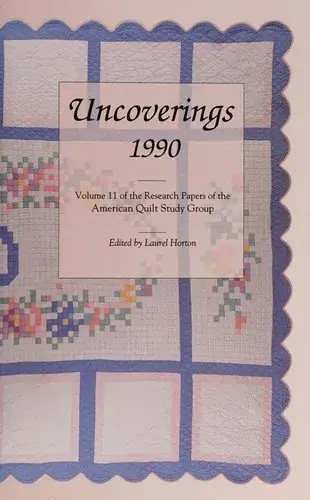
chrisa@ wrote: Rosie, There was a paper given on Hubert Van Mehren’s Home Art Studio company at last years AQSG. The Uncoverings 2003 would have it.
I believe a friend of mine has the scrapbooks by Edna too. I have asked her to take a look- they are packed away, but she’ll be able to find out in Nov. when she moves. They were simply given to her with no information. There were written in the 1970s- right? Are produced on a typewriter and include xeroxed pages of older newsletters and newspaper articles etc? She sent them through the mail to subscribers it seems. The ones I saw were filled mostly with 20th century quilting info, but there were so many I didn’t see them all. When I first saw them I had never seen or heard of them either. I have looked and asked for a few years now but have never found out anything about these newsletters.
Kim Wulfert www.antiquequiltdating.com
From: “Candace Perry”
In central PA not far from my alma mater, Penn State, is a charming museum called Packwood House that just happens to have about two dozen quilts on long term exhibit. They are part of a larger collection that is going to be documented in the near future…right now they’re just gearing up to examine the collection. Please visit if you’re in the vicinity, or want a nice jaunt (and State College, in Happy Valley — home of Penn State — is always a great place to visit! Good restaurants and that marvelous college town atmosphere) Particularly pleasant at the moment since the leaves are changing.
http://www.packwoodhousemuseum.com/exhibits.html
Candace Perry Schwenkfelder Library & Heritage Center
Date: Tue, 19 Oct 2004 11:03:02 EDT | From: RBCochran@
Two of my quilts are included in the Art of the Quilt Exhibit at the Morris Museum in Morristown, New Jersey. Here is the website if you’d like to see o ne of them, and read more about the exhibit.A0 http://www.morrismuseum.org/Exhibitions/The%20Art%20of%20the%20Quilt.htm –Rachel www.fiberrevolution.com www.stitchocag.homestead.com
From: Mary Persyn
For those of you doing research, I pass on the following website and description. I just tried the search “quilt history” and it came up with 369 entries.
I’ll add it to the handouts I passed out at the mentoring session in Vancouver which I am sending to Judy Buss at AQSG to put on the website.
FYI – RLG is Research Libraries Group. They have a database which is much like OCLC.
Mary
REDLIGHTGREEN.COM Go right now to RedLightGreen.com, which was created by our friends at RLG to help everyone who ever has to find books in libraries, either close by or anywhere in the world. A pleasure to use, it searches 120 million books to find the best matches to what you’re looking for. If you ever do research you need this. Go to <http://www.redlightgreen.com> and type in ‘hemingway’ or ‘wittgenstein’ or ‘rumpelstiltskin’ or anything you want. Do it now, so you’ll know it’s there.
— Mary G. Persyn 219-465-7830 Associate Dean for Library Services School of Law Library Valparaiso University 656 S. Greenwich St. Valparaiso, IN 46383 Mary.Persyn@ Fax: 219-465-7917
Date: Tue, 19 Oct 2004 09:04:07 -0700 | From: <chrisa@>
Rosie- Time Flies- turns out the presentation about Ver Mehren, given at the conference in Nebraska, UNL is in the Uncoverings 2000, Vol. 21! it seems like last year to me. It is titled “Herbert Ver Mehren/Home Arts Studio” by Susan Price Miller. It is a very good paper, with lots of detail and pictures and notes.
I skimmed the paper version and the names Wheeler did not come up. The primary name assoc. with Herbert is Hope Winslow. Gertrude May and Aunt Dinah were among many other names he placed on his pattern book covers, but none of them were actual people. Nancy Lee is another that has become assoc. with him, but in fact, the newspaper simply put her patttern info close in proxsimity to his and people jumped to this conclusion.
The known quilt pattern designer that was assoc. with him is Carly Sexton, but it does not appear she worked for him, but for the newspaper.
Kim Wulfert www.antiquequiltdating.com
Date: Tue, 19 Oct 2004 15:41:57 | From: KareQuilt@
When my husband learned from our new neighbor that she was planning to atten d the IQF in Houston and that it was taking place right before a business trip to New Orleans and a QHF Board meeting in Indiana, he asked me why I wasn’t going: “Can’t you just go a few days early and take it on? I know you have talked about it for years. “Well, you could have knocked me over with a feather!!A0 So, though I don’t plan to take any classes, I am now trying to book a three-legged flight!! This being my first time attending, I just plan to imm erse myself in the exhibits, the merchant mall and probably work some hours at th e AQSG booth.A0 I’ve never been before so this is pretty darn exciting! (I generally go for the research conferences which are much smaller. <g>) Anybo dy have some helpful advice about attending this mega-event? Do QHLers generally hav e a meeting place at Houston? If any of you are going, let me know privately.
Karen Alexander from the Pacific Northwest – where the sun sets more slowly and the misty ai r fractures the light into a thousand kaleidoscopic colors
Date: Wed, 20 Oct 2004 06:12:53 +1000 | From: “Karen and Paul Fail” <kfail@>
Hi Karen, I am usually a very silent member of this list, but felt I had to write and encourage you to have the best time in Houston. I will be going for the 8th time this year from Australia. I have been lucky enough to work in the quilting industry here in Oz and have been sent for my work each year. This is even more wonderful as I have a daughter in Oklahoma who I visit after Houston each time and some times she has even been able to join me. But not this year as she is about to give birth to her second daughter. When I go to Houston, I go to the Husqvana Viking Art Quilts and just enjoy these incredible quilts from all over the world and of course check out the Aussie ones as well. In fact I return to this special area of the Quilt Show every day – they are just wonderful quilts. Then I take in the IQA show and look at the winners. Last year was the year for Aussies as 8 girls entered the show and 8 prizes were won including Best of Show – just a fabulous buzz. I rarely do classes but love to attend as many lectures I can especially those with old quilts on display. This year I am taking in Pepper Cory’s lecture. I aslso love to browse through all the antique quilts on sale even the cutter quilts (there are more of these at Market though). The stands selling antique quilts are an exhibit in themselves for us Aussies starved for wonderful antique quilts. In fact, the first year I went to Houston, the hall was decorated with hundreds of antique quilts hung from the rafters. There were more antique quilts in that one hall than in all Australia. You can check up on our quilts on the National Quilt Register site at amol.org.au/nqr/ This year I am heading a tour from Australia – 18 gals who love to shop – and after Houston we go to Denver, Seattle, San Fran and then home. But not me, I head to Bartlesville OK to seem my new granddaughter. Hope you enjoy your first Houston experience. Karen Fail
—– Original Message —– From: <KareQuilt@> To: “Quilt History List” <qhl@> Sent: Wednesday, October 20, 2004 5:41 AM Subject: [qhl] Houston IQF
When my husband learned from our new neighbor that she was planning to attend the IQF in Houston and that it was taking place right before a business trip to New Orleans and a QHF Board meeting in Indiana, he asked me why I wasn’t going: “Can’t you just go a few days early and take it on? I know you have talked about it for years. “Well, you could have knocked me over with a feather!! So, though I don’t plan to take any classes, I am now trying to book a three-legged flight!! This being my first time attending, I just plan to immerse myself in the exhibits, the merchant mall and probably work some hours at the AQSG booth. I’ve never been before so this is pretty darn exciting! (I generally go for the research conferences which are much smaller. <g>) Anybody have some helpful advice about attending this mega-event? Do QHLers generally have a meeting place at Houston? If any of you are going, let me know privately.
Karen Alexander from the Pacific Northwest – where the sun sets more slowly and the misty air fractures the light into a thousand kaleidoscopic colors
Date: Tue, 19 Oct 2004 15:38:25 -0500 | From: “Merry Endres” <merrymenetnet.net>
> > http://cgi.ebay.com/ws/eBayISAPI.dll
Date: Tue, 19 Oct 2004 18:27:28 -0500 | From: Gail Ingram <gingram@>
I am scared to death of serpents, though they are a fact of life here in lush Louisiana, just as they were in the Garden of Eden.
When discussing Greek and Roman myth, I skip Medusa.
Marcia Kaylakie’s pieced Rattlesnake quilts that have heads appliqued make me shiver, and I could not get a wink of sleep under one of them.
Nor could I sleep under the quilt from Cub Run, KY. But oh my word, it’s a terrific quilt! I wish I had made that one.
Those cannot the be long snake commonly called Blacksnakes in the South, for they are pit vipers (see those nasty little triangular heads?). No rattles on their viperous tails, however. So, moccasins? Stylized (because moccasins are coppery-brown color?) and perhaps symbolic with the black.
Are the nasty rascals appliqued?
It tells a lot about a person that she could handle these snakes. I imagine she could handle anything else.
George Orwell once wrote that had William Wordsworth grown up in the American South, where there were poisonous snakes, he could not have believed in the basic benevolence of Nature. I suspect the maker of this quict was no Idealist.
Gail
Date: Tue, 19 Oct 2004 19:51:32 -0500 | From: “Andi Reynolds” <andi0613@>
Hi List,
One of my long time favorite activities has been to spot quilts as background or accent pieces in movies and tv shows. I’ve never kept track or anything – just enjoyed them when I saw them and loved hollering “SCORE” to startle my DH :-). Watching “Seven Brides for Seven Brothers” tonight, and looking up details on the Internet, I found the following:
“For the brides costumes, designer Walter Plunkett went to the Salvation Army, found old quilts and turned them into dresses.”
I can’t begin to import the graphics from the various sites that showed the brides wearing quilt dresses, but if you search, you’ll see them.
My question: Has anyone ever tabulated or documented the use of quilts in movies and TV? I assume we all know about the crazy quilt that backed Granny on the opening sequence of “The Beverly Hillbillies.” I sure hope someone somewhere IS tracking this use of quilts for posterity.
Andi in Keota, Iowa
Date: Tue, 19 Oct 2004 23:09:28 -0400 | From: “Karen Evans”
I remember howling with laughter when Dr. Quinn, Medicine Woman, was given a Double Wedding Quilt for a wedding gift. Nice trick, considering that the show was set in the 1870s….
Karen Evans
Date: Wed, 20 Oct 2004 07:26:26 EDT | From: Midnitelaptop@
if you go to http://www.uq.net.au/~zzdmcana/SevenBrides/7b47b.html you’ll see a picture of jane powell in a quilted dress.. jeanL
Date: Wed, 20 Oct 2004 04:40:08 -0700 (PDT) | From: “ElizaBeth L. Haubold” <eliza1057@>
When I was 13, I remember begging my parents to let me stay up and watch that movie, it was one of my favorites. My daughter just gave it to me on DVD. It’s an excellent movie. That dress is wonderful. I doubt if I could’ve withstood all the challenges they faced at that time.
Midnitelaptop@ wrote:if you go to http://www.uq.net.au/~zzdmcana/SevenBrides/7b47b.html you’ll see a picture of jane powell in a quilted dress.. jeanL
From: “Monica MacDonald”
I always get excited when I unexpectedly find references to quilts in books. My daughters and I are reading Anne of the Island by L. M. Montgomery and I was delighted to find the following passage in which Anne and her college roommates are setting up housekeeping at a little cottage called Patty’s Place:
“Diana had given Anne a pine needle cushion and Miss Ada had given both her and Priscilla a fearfully and wonderfully embroidered one. Marilla had sent a big box of preserves, and darkly hinted at a hamper for Thanksgiving, and Mrs. Lynde gave Anne a patchwork quilt and loaned her five more. ‘You take them,’ she said authoritatively. ‘They might as well be in use as packed away in that trunk in the garret for the moths to gnaw.’ No moths would ever have ventured near those quilts, for they reeked of mothballs to such an extent that they had to be hung in the orchard of Patty’s Place a full fortnight before they could be endured indoors. Verily, aristocratic Spofford Avenue had rarely beheld such a display. The gruff old millionaire who lived ‘next door’ came over and wanted to buy the gorgeous red and yellow ‘tulip-pattern’ one which Mrs. Rachel had given Anne. He said his mother used to make quilts like that, and by Jove, he wanted one to remind him of her. Anne would not sell it, much to his disappointment, but she wrote all about it to Mrs. Lynde. That highly-gratified lady sent word back that she had one just like it to spare, so the tobacco king got his quilt after all, and insisted on having it spread on his bed, to the disgust of his fashionable wife.”
Anne of the Island was originally published in 1915. I would love to know what LMM had in mind when she described the red and yellow tulip-pattern. Monica
Date: Wed, 20 Oct 2004 08:45:53 EDT | From: Midnitelaptop@
in my book 849 traditional patchwork patterns…the block on the quilted dress is listed as many pointed star…does anyone know of another name for this block? jeanL
Date: Wed, 20 Oct 2004 08:28:11 -0500 | From: “Karan Flanscha” <SadieRose@>
I looked in BlockBase, and found 2 similar blocks: #2538 “Star of Many Points” (center square is smaller than the quilt in the photo) #4041 “Lotus Star” (extra half square triangles around the middle). Same numbers as in “Encyclopedia of Pieced Quilt Patterns” by Barbara Brackman. Karan
Date: Wed, 20 Oct 2004 10:55:32 -0400 | From: “Lucinda Cawley” <lrcawley@>
Jan, What’s the story on the Massachusetts documentation? Is there a book in our future? Cinda on the Eastern Shore
Date: Wed, 20 Oct 2004 11:57:44 -0400 | From: “Pepper Cory” <pepcory@>
Re:the snake quilt on ebay. I looked at that thing as soon as it came on the list since I use the search term “snake quilt.” Snake in the Hollow is a legit curved seam pieced pattern-I own three of them. However, the realistic heads of the snakes point to A) a quilter’s joke B) some underlying symbolism or C)a ritual object. Remember that Kentucky is the home of the serpent handlers’ church, a Pentecostal-type Protestant off-shoot that advocates handling poisonous snakes during the ecstasy of the religious experience. In church services when the believers are in a kind of trance, the preacher gets snakes out (usually rattlers) and handles them. As people are “gripped by the holy ghost” they come up and touch or handle the snakes also. Occasionally someone is bitten and if they survive (usually do) that’s seen as a miracle and strengthens their faith. Might this quilt originally been made as a gift to a snake handling minister? Not quite so bizarre–ministers were, and are, often given quilts as gifts. But if I was the preacher’s wife, I’d likely draw the line at sleeping under said quilt! As a teenager in South Carolina, I used to have snakes as pets (non-venomous King Snakes) and thought I might be a herpetologist. My father hit the roof (he hated snakes) but my Mom thought whatever I wanted to do was fine. Talk about support! Meanwhile getting ready for Market and Festival and going nutz in NC- Pepper Cory
Date: Wed, 20 Oct 2004 12:39:25 -0400 | From: “Karen Evans”
Pepper – I was wondering if snake handling came into it. Does anyone know whether the quilter was a Primitive Baptist or a Pentecostal?
Karen Evans
Date: Wed, 20 Oct 2004 12:50:59 EDT | From: MargaretFahey@
We just had our quilt show here in Rochester NY and in the consignment shop was a quilt with twirling tulips, yellow and red on a white ground. The maker Barb Stoner sold it to another member. I had gotten an old Australian magazine, several actually, that day for 25 cents each. As I leafed through an issue, I came across an article about Marie Webster and her quilt patterns, and there was the pattern. It turned out to have been published in January 1911 in the Ladies Home Journal. I gave the issue to the member who now owns the quilt. Might that answer your question re quilt source?
( I had been enraptured by this quilt. At home I mentioned how much I would love to purchase it, perhaps as an early Christmas present?? The answer was, “How many early presents have you gotten this year so far?” I had just purchased a new Bernina Artista! But when I got there the next day, it had been sold. Ah, me!)
Margaret
Date: Wed, 20 Oct 2004 14:43:44 -0400 | From: “Anne Datko” <datkoa@>
I’ve been tasked to seek your advice re the above topics. The Foksways patterns were being discarded by a friend moving to assisted living. They are Gaza Dress (#101,1975), Roumanian Blouse (#103, 1975), Japanese Kimono (#113, 1977), Vests from Greece and Poland (#126, 1981). Do these have value as ephemera and suggestions as to their disposal?
The President of my quilt guild has been given a large box of Kansas City Star patterns cut from the newspaper between 1928 and 1936. We’d like to realize as much as possible from these for the benefit of the guild. According to the paper there apparently are no copyright issues. One suggestion has been that we photocopy the patterns for sale at our show. Another, that we copy and make a CD of them for sale, also at our show. The venue for both of these could be broadened. A last possibility is that we try to sell the collection, recognizing that this is a one-time event.
I’d appreciate hearing, off list, suggestions and reactions to these issues.
Thanks. AnneD
Date: Wed, 20 Oct 2004 14:47:27 EDT | From: MargaretFahey@
I guess off list is okay, but I’d like to hear the responses too. Could it stay on list?
Margaret
From: “Karen Evans”
The Folkwear patterns very definitely have value among wearable art folks. In fact, I wouldn’t mind having that vest pattern myself, as my own copy disintegrated years ago….:)
Seriously, I’d try posting them on Ebay or seeing if someone in a local re-enactment group is interested.
Karen Evans
From: “Sharon in NC”
I am sure I have heard about midwives using snakes at one time. I tried a search but only found one reference and it is not the one I remember. Next time I talk to my MIL I will see what she remembers or can find out through papers she has. Her grandmother was a well known herbalist and midwife in her area. Luckily she left her herbal books with all her hand written notes in them. Unfortunately the son who got them didn’t pass them on in his will and the wife is hard to reach.
Sharon in NC
From: “Sharon in NC”
The Kansas City Star patterns have recently been reproduced in book and CD form by Harold and Dorothymea Groves of Kansas City. You might want to recheck the copyright on reprinting before doing anything. There have been issues with others concerning reprints.
Groves Publishing Company P.O. Box 33068, Dept. QBD Kansas City, MO 64114 (816) 361-1505 or 888-983-4945
They advertise with Debby Kratovil http://www.quilterbydesign.com/kansascitystar.html
Sharon in NC
Date: Wed, 20 Oct 2004 20:50:23 -0600 | From: Xenia Cord <xenia@>
Hi, Karen – I hope you will find time in Houston to come by my booth – 924-26-28 in the 900 aisle – and visit, stash packages, rest your feet and so on. My advice to anyone going to Houston for the first time is to wear very comfortable shoes, divide the show floor into chunks for viewing/shopping, and take time to stare at a white wall and defuse the visual overload from time to time!
Xenia
Date: Wed, 20 Oct 2004 18:36:52 EDT | From: RAGLADY@
I had posted the URL for the eBay snake quilt to my CQ list. One of the members followed up with the following information……..I’m reposting it with her permission. Linda Brannock has a website page at Homespun-peddler.com. The book referenced by Becky is shown, but only the front cover. http://www.homespun-peddler.com/cat_sqc/sqc-0000.htm
Gloria raglady@ ~ Becky’s message below..
Becky wrote: This conversation sparked my memory of a quilt pictured on the back cover of a book, so the hunt began. Sure enough, there is a quilt named “Adam’s Snake Quilt” on the back of “Mrs. Jump’s Favorites” by Linda Brannock.
This is the same book whose cover quilt, “Galaxy” was so popular a few years ago, rather like the bull’s eye, but with a star, and not raggy. I don’t know if the book is still in print or not – it was published in 1998.
The snake quilt itself is graphically pleasing to the eye, unless you look close enough to see the snake heads and tails. There are only 2, so it wouldn’t be too difficult to just leave them out altogether, and still have a great quilt! LOL
Good luck to the sellers of the quilt on eBay. I love folk art, even more so if there’s a credible story behind the piece, as there appears to be with this one, but this one’s subject matter leaves me cold!
Snakes give me the creeps. Not even for a favorite grandchild would I ever make a quilt with them on it! As for snake handlers, well, let’s just say, I will defend their right to do it, but I don’t care to be within two hollers of ’em while they do it.
Date: Wed, 20 Oct 2004 20:52:09 EDT | From: RAGLADY@
This website may be known to the list… but it was new2me and I found it fascinating. Particularly beautiful are the wholecloth quilts. The site is dedicated to Welsh cultural history and has other items of historical interest. Most of the quilt pictures have a large image view .. it’s wonderful to see details of these beauties.
http://www.gtj.org.uk/search/simpleSearch.php?langen&srchquilt&pg1
Gloria raglady@
From: Karen Evans
It’s a great site. Welsh wholecloths don’t get nearly the attention they deserve…I wonder how far back they go?
Hm….
Karen Evans
From: CarylSchuetz@
> Subject: Re: Houston IQF > From: Xenia Cord <xenia@> > ….. My advice to anyone going to Houston for the first time is > to wear very comfortable shoes, divide the show floor into chunks for > viewing/shopping, and take time to stare at a white wall and defuse the > visual overload from time to time! > > Xenia >
From: “Pam Weeks Worthen”
Dear friends,
Would those of you who have connections with quilt or local history museums in Pennsylvania please contact me off-line? I have an appraisal client who would like to donate two family quilts, particularly to a museum in the Allenstown area.
Thanks!
Pam Weeks Worthen Durham, NH
From: “J. G. Row”
http://www.allentownartmuseum.org/gallery/textiles/home.html
It just so happens that the Allentown Museum has a collection of textiles and quilts.
Judy, aka the Ringoes Kid judygrow@
From: “Lucinda Cawley”
Pam, The Lehigh County Historical Society (Allentown) has just built a wonderful new facility. It’s not even open yet. They own one of the fraktur quilts included in my study. http://www.lehighcountyhistoricalsociety.org/ Cinda
Date: Thu, 21 Oct 2004 | From: Hazelmacc@
Regarding books to the Quilters Hall of Fame. If you have books to donate, please send a listing of your books. Our mission is preserving the history of the Honorees so those are the books we seek…..Hazel Carter, Pres.
From: “Lucinda Cawley”
You certainly don’t go there for the weather, but there were wonderful quilts to see in the Rochester area last weekend. Five different museums cooperated to exhibit quilts in conjunction with the Genesee Valley Quilt Club show. It was a wonderful opportunity to see many, many antique quilts of the area and to get a sense of how different they are from the PA and Tidewater quilts which we usually see at FVF and The Dating Club. My impression is that the area in the 19th century was “New England West” as far as quits are concerned. Our first stop was Genesee Country Village and Museum. We only went to the exhibit in the gallery because we were determined to get to all six locations. The first quilt (c. 1860) we saw was an original design, medallion style red and green machine appliqued, reverse appliqued and pieced quilt that is phenomenal. A second, crib-sized, version was almost certainly made by the same person. A lovely circa 1830 wholecloth red and yellow floral chintz with a large lotus-type flower is quilted along the pattern of the fabric (I saw this on a number of early quilts in different locations).
There were two chintz appliques: a summer spread with the most striking border print of giant gold feathers around a rather off-beat collection of cutout chintz motifs and a more conventional basket and bough arrangement with a machine applied dog tooth border that probably covers a worn edge. There is a whole gallery full of yardage–a bird of paradise on a purple fondue background (gasp!), a quilted corset, doll clothes, children’s dresses. Catherine Bell’s Mariners Compass (1850) with a graceful stuffed border of grapes, flowers and leaves finished off by a scrappy dog tooth hangs next to Catherine’s 1841 sampler and her picture. A circa 1820 Hearts and Gizzards quilt was pieced of a single chintz (not a pretty pattern, but the fabric is lovely) with a border of a lily of the valley chintz. There is a room full of blue and white quilts. Most of there look as crisp as the day they were made. I noticed repeated use of a simple border of paired leaves (like half a pumpkin seed design) that seems peculiar to the area. One 1856 signature quilt, stars (made of tear drop shaped pieces) on point, sashing, no borders, looked like a refugee from New Jersey. We met Beth Davis, a QHLer, who was docenting and got lots of great insights from her. The only disappointment of the weekend was the Susan B. Anthony House which is totally empty (undergoing renovation) and had five quilts in the carriage house (three of them contemporary). To paraphrase Susan B. “Failure was possible.”
The Landmark Society was light on quilts but had wonderful vintage clothing, some nice quilts and two extraordinary Greek Revival houses. The Genesee Valley Quilt Club has been working with the Rochester Museum and Science Center to document and rehouse the quilt collection. They have done a marvelous job that reflects credit on the club and the museum. The quilters have raised money to pay the expenses of the project (all the supplies for storing the quilts). Linda Parrett has posted to QHL about this project and it was great to see it first hand. The curator Brian Nagel showed us the museum storage facility and the quilts on display (an 1847 Rochester album with great eccentric designs was my favorite). They have a case dedicated to showing at least a few quilts all the time. We met Linda, Carolyn Maruggi and Margaret Fahey. It’s always great to hookup with people on the List. At the quilt show itself there were 16 antique quilts displayed, dating from a Mosaic chintz coverlet (1st quarter) to a 1940s Mariner’s Compass. It was one of the nicest quilts shows I’ve been to in a long time. There was a great boutique shop, interesting vendors and the members of the Guild were delightful. Last stop was the Historical Society of Rochester absolutely chock full of gorgeous quilts, needlework, clothing, laces, shawls–amazing.
A Fleur de Lis, unusual in that scraps were used rather than one color, dated Jan. 1, 1847 went to South Africa with a missionary and was returned to Rochester after her death. A single green fabric was appliqued in diagonal Laurel Branches with Flying Geese sashing and exquisite quilting (1850). A circa 1840 Uneven 9-Patch used quilting designs to create an inner border. My favorite (1840) alternated 7-1/2 variable stars (sometimes every piece in the individual star was a different fabric) in browns, blues (indigo and Prussian), pinks with setting squares of a small scale brown plaid and a zigzag border–a feast for the eyes. Altogether a fun weekend with my old friends from Scranton, a visit with my daughters, a walk beside Lake Ontario (a really Great Lake) and Dinosaur Barbecue. Cinda on the Eastern Shore
Date: F | From: “sue reich” <suereich@>
Yesterday, in conjunction with the quilt exhibit at the Litchfield Historical Society “The Ties That Bind: A Sampler of Litchfield County Quilts” featured in “Quilts and Quiltmaking Covering Connecticut” by the Connecticut Quilt Search Project, I lectured on Signature quilts. My lecture was titled “The Mystique of Signature Quilts: Finding the Stories They Tell.” The purpose of the lecture was to tell the stories of the eight Connecticut signature quilts on display but also to share the methodology I used in researching those quilts, others in “Quilts and Quiltmakers” and signature quilts in my collection. We all learned from Pam Worthen, Lorie Chase, Cinda Cawley and others who spoke about signature quilts at AQSG this year; researching these signed textile documents takes you to many places that are not traditionally considered in the world of quilts. The quilt history books become a secondary source of information. Genealogy sources take front stage and center importance; census records, family genealogies, journals and diaries, newspaper archives, local town historians, graveyards, church records, immigration records, SSI, Beer’s Atlas maps, libraries, historical societies and most important feet on the ground.
Yesterday, a gentleman in the audience, ask me this question. It was the same question that I have pondered from the beginning in researching signature quilts. “What caused the first signers to place their signatures on quilts?” In essence, way back in the 1830s, just why was the first signature quilt signed. Many of us are in search of that first signature quilt. There are many theories to their origin. I have my own ideas about the first impulses to sign quilts but I would also love to hear from those of you in QHL land. I’ll start the discussion but I hope that my theory will not side track any of you who have pondered this same question from expressing your own opinion. We all know about the technologies of ink and just how that contributed to the ability to successfully sign quilts. Certainly, this contributed to the timing factor. I also think it has something to do with this facts.
1. the Second Great Awakening – a religious revival that began at the beginning of the nineteenth-century. By the 1820s this renewed evangelicalism had become a dynamic cultural force in American life. Here in New England, people like the Rev. Lyman Beecher (Harriet Beecher Stowe’s father) were in the forefront this movement with its emphasis on spiritualism, conversion and collective prayer. Temperance meetings were taking place. Missionaries supported by these religious organizations were traveling the world. Women were now viewed as the vehicles for the bearing, nurturing and moral development of the next generation of male leaders, commonly referred to as “The Republican Mother” role. Here, in New England, they were allowed and encouraged to belong to religious and temperance organizations, and to attend town meetings, however, the only voice at these meetings came from the males.
I have records from meetings Prudence Crandall attended in Coventry, CT. Women were not permitted to speak. Instead, they passed their comments and questions on to a male in attendance if they wanted to be heard. Also, early records from Benevolent Society meetings record that both men and women were in attendance. The women prepared items to be packed into barrels to be sent to the missions. They quilted and engaged in other forms of needlework at the meetings. These meetings also involved readings from scripture, or issues of their society like temperance. The minutes record that this was the responsibility of the males.
2. Petitioning – became a very important tool of political expression from post-Revolutionary times on. This activity began to reached increased popularity around 1830. There are many women’s history books and some quilt related articles that have already addressed signing documents or quilts to make a political or societal statement.
3. Quiltmaking was historically an acceptable way for women to express themselves artistically and socially. If you live in a society that prevents you from speaking out publicly, the next logical step would be to find a medium in which you could express yourself. I feel that this was one of the strong motivational reasons women began signing quilts. And sign them, they did! I can’t even begin to imagine all the signature quilts that just the New England states could account for! Don’t we all wish that first signature quilt with its maker’s journal revealing the reason the quilt was made, and signed could be uncovered! Until then, we can only speculate about the mystique of signature quilts. sue reich from beautiful orange, yellow, red, gold, and brown Connecticut in all of its autumnal splendor.
From: “Sharon in NC”
Sue I was always under the impression, and I am not sure where I received the impression from, that the first signature quilt names were most likely soldiers or family members who had passed on. I have it in my head that ladies would make remembrance quilts and add the persons name to whom they were creating the quilt in honor/memory of. Then later it expanded to whole families or groups of veterans. I am sure I have seen a Revolutionary war quilt with names of soldiers listed that would predate the 1800’s. Later it became not just “In memory of” but also “In honor of” which may be the precursor to signature quilts.
I will have to see if my Mom knows where we got this impression from since we just discussed this very thing recently.. It may be from something I have read or a quilt I have seen.
Sharon in NC
From: “Pepper Cory”
Hello Sue et all, Susan McKelvey, in our book The Signature Quilt, lists a number of factors. In addition to your own musings, she talks about the Cult of Sentimentality, a Victorian reaction to societal changes. Plus the growing role of women in politics, the improvement of tools (the ink and the steel point pens), the emphasis on penmanship instructions many girls receieved in school, and quilt signing as a natural development of marking domestic objects with stencils.I think it’s not any one factor but a combination of all these that led to the popularity of signature quilts. And then there’s the fad: “I want to do a quilt like that because Cousin Edna did one like that…” And frankly owning or being given a signature meant a group of people thought highly of you. That quilt is a visible sign of respect and affection. Just thoughts from the NC coast- Pepper