July 6 – July 8, 1997
These restored messages come from the Quilt History List, an online forum where quilt historians, collectors, researchers, appraisers, and enthusiasts discussed antique quilts and related textiles. The archive dates from 1996 through approximately 2016 and is being restored gradually. Sign up in the form at the bottom of the page if you want to know when a new page is added. Original spelling, opinions, formatting, and inactive links may remain unchanged.
Primary topics of this QHL Digest:
- The Living-Wage Debate Continues — The discussion of fair pay for overseas quiltmakers sharpens with specific wage figures cited for garment workers in Vietnam.
- Is the Buttermilk Recipe a General Brightener? — A member asks whether the buttermilk-and-lemon-juice soak works for everyday brightening or is best saved for stain removal.
- Fiestaware’s Lead and Uranium Glazes — Talk of classic red Fiestaware turns to concerns about its lead content and radioactive uranium-oxide glaze.
- Sourcing Trapunto Needles — A first-time trapunto quilter asks where to find six-inch trapunto needles, prompting supplier suggestions.
- An Emergency Response Tool for Collections — A member shares a new Emergency Response and Salvage Wheel resource for protecting textile collections from disaster.
- Never Date a Quilt by Color Alone — A cautionary story makes the case against assuming a quilt’s age purely from its fabric colors. (see the article on dating quilts)
Date: Sun, 6 Jul 1997 20:23:36 -0700 (PDT) | From: Mary Cross <mbcquilt [at] web-ster [dot] com>
In #164, you asked about other quilts with the same set as the one
on p. 107 in Treasures in the Trunk. The only other one I’ve seen was in the
Missouri Quilt Project book that I footnoted. There it was Railroad and
Depot, a swonderful name for a migration-era quilt I thought. I was really
sorry there wasn’t more documentation in that book because my maker also
lived in Missouri so I was wishing I could find a regional connection. B.
Brackman also noted it her Encyclopedia which I footnoted where it was
called Spider Web, another wonderful name. Let me know what you learn about
the quilt and pattern you have. Mary
Date: Mon, 7 Jul 1997 00:21:48 -0400 (EDT) | From: Quilt97 [at] aol [dot] com
When someone says women and children in other countries are earning only
$1.60 a day for quilting, that could be actually quite a bit of money in
their local economy.
Elisabeth
Date: Mon, 7 Jul 1997 00:40:18 -0400 (EDT) | From: Quilt97 [at] aol [dot] com
RE the recent conversations about quilts made from afar, all of the
thoughtful comments did get me to thinking. I have a friend who makes her
living selling antiques used in households. No furniture or large items.
She sells linens and dishes, mostly. No feedsacks. The demand for Fiesta
ware is extremely high. Do any of you fellow older folk remember Fiesta
ware. It was included as a bonus in oatmeal, one piece at a time. It was
given at some gas stations if you filled your tank or bought a certain dollar
amount. >>
Do I remember Fiesta ware? You bet! After a family dinner one Thanksgiving
many years ago in RI, I “helped” by carrying the Fiesta ware plates (the
larger size) from the dining room to the kitchen. Dropped the entire stack!
Guess which one survived? — Mom’s least favorite – the oatmeal colored one.
It is now in my china cabinet. Even thought Mom always hated it when she
broke any dishes; I don’t remember even being yelled at, — I’ll have to ask
my elder sister.
Elisabeth in south TX
Date: Mon, 7 Jul 1997 07:45:34 -0400 | From: godzilla [at] ns1 [dot] uconect [dot] net (Robinson)
Hi QHL:
Susanne’s Buttermilk recipe sounds interesting — is it a general quilt
brightener, or to be used to remove specific stains?
I’ve just purchased some vintage conversation print fabric –a
“greyed-blue” background with little roly-poly toys and bead doll toys
printed on it. The whole piece is slightly brittle and very yellowed (kind
of like curtains get in a heavy smoker’s house). Do you think a buttermilk
bath would help? I also bought some fabric with a white background that has
litle powder blue watering cans on it. It’s in pretty good shape, except
for discoloration where it was folded. Ditto the buttermilk bath?
Thanks.
Sue Robinson
godzilla [at] ns1 [dot] uconect [dot] net
Date: Mon, 07 Jul 1997 07:43:00 +0400 | From: Xenia Cord <xecord [at] netusa1 [dot] net>
Hi, all: Just an addition to this discussion of the pattern shown by
Mary; I also have this pattern in antique pieces, with a variation on
one. I have a plain red and green top, set on muslin, from Indiana
about 1930-40, and I have a finished quilt, ca. 1900, where the blocks
are set into circles, and the circles are set against a red ground
calico.
The quilt has muslin “arrows” in the triangle strips, set with mixed
late 19th century calico triangles, and is bound in cadet blue calico
over a natural muslin back. It is also from Indiana.
I have always identified this pattern as Odd Fellows Star, but I can’t
document where I learned the name.
Xenia
Date: Mon, 7 Jul 1997 08:25:43 -0500 (CDT) | From: Phil & Lee Spanner <philspan [at] bucky [dot] win [dot] bright [dot] net>
>the same premis, but NOW they do have SEWING NEEDLES AND THREAD instead
>of knitting needles.
>
>Little did they know that we are such a force to be recogned
>with!!!<VBG>
I think that at the same time, we quilters are also kind and courteous. I
propose that all of us who sent complaints also send a thank you to them now
showing that quilters are also appreciative people.
Just my .02, what do the rest of you think?
Happy Quilting!
Lee :^)
Date: Mon, 7 Jul 1997 10:19:43 -0400 (EDT) | From: JQuilt [at] aol [dot] com
It was GREAT reading the article and seeing the pictures in the Pittsburgh
Trib about feedsacks and the feedsack club…I loved the Cinderella Fabric
picture.and the pictures of the Feedsack Femmes…
*********************************************
Re: quilts from China
.Let’s take a trip to the 30’s,40’s and early 50’s…
America was the leading MANUFACTURING country in the world…Workers were
unionized and making decent wages and consumers bought ONLY what they could
afford …the only items bought on the “Installment Plan” were items like
washing machines, refrigerators, cars and houses..
No one bought toys, accessories or FOOD on credit… People either MADE
things they couldn’t afford to buy…. or accepted the fact, that they might
live their whole life taking “snaps” with their Brownie camera and never own
a Leica…There was an acceptance of “not having everything one wanted”
Then came the Credit Card…..now nothing is out of reach …except the debt
of the Credit Card…
After the corporations broke most of the unions in this country, by moving
their factories to so called “third world” countries…they, then realized
they could, charge outrageous prices and underpay the labor of these
countries…So now they not only didn’t have to pay decent wages…they could
make astronomical profits for themselves and their stock holders….
“The fault, dear Brutus, lies not in the stars but in ourselves”
If we weren’t CONSUMED with satisfying EVERYONE of our needs…workers and
consumers would benefit.. and still have a satisfactory life…
I am retired and live in low income housing….One son gives me his used car
and his used computer, when he upgrades(for my birthday and Mother’s Day
presents)… ..My other son, pays for car insurance(for my birthday and
Mother’s day presents)
I sew my own clothes and quilts, on an old Montgomery Ward sewing machine..
True, I am not able to go to a lot of shows in far off places and I very
rarely take a class or workshop…but I can afford to buy books and fabric…
And for the most part I am truly content…Sure I daydream and fantasize
..but I know that they are daydreams and fantasies…and that’s O.K.
My chief concern is keeping moderately healthy(harder to do, the older I
get)..
Please, the next time you use your Credit Card to buy the latest toy, gadget
or accessory….try to remember all of the factories and factory workers in
the USA that no longer exist…
Jean Laino
jquilt [at] aol [dot] com
Date: Mon, 7 Jul 1997 11:02:52 -0400 (EDT) | From: Quilt97 [at] aol [dot] com
I can’t remember where I first read about the following two books, but
ordered them through interlibrary loan and rec’d them recently. They are
excellent for beginning young quilters, for teachers, for crafts, etc.
Excellent books.
I’ll Teach Myself – Step Into Patchwork (Dreamspinner Discovery Series) by
Nancy Smith & Lynda Milligan, ISBN 1-880972-09-3, pub. Possibilities at
303-740-6206, intorduces children to sewing maching patchwork – step-by-step
jprojects, games and puzzles, using paper and/or fabric. Ages 7 and up. The
pages are cardboard and there are plastic templates in the back.
There is also Book 1 – Sewing machine fun, and Book 2 – More Sewing Machine
Fun.
Patchwork Math 1, addition and subtraction reproducibles, by Debra Baycura,
Scholastic Professional Books, “provides worksheets to reinforce addition and
subtraction skills. Also introduces historical background about the name of
each quilt design.” (There are 100 quilt designs in this book.) “The
challenge activity at the bottom of each page is an extension activity that
involves language arts, social studies, or math.” Each worksheet is a quilt
pattern.
Sorry Kelli – horses are one of the few things not in this book! 🙂
Elisabeth in south TX where it’s still hot and sunny
Date: Mon, 07 Jul 1997 11:33:52 -0400 | From: “Miklos B. Lukacs” <mlukacs [at] dns1 [dot] webbernet [dot] net>
What Jean says is so true of lots of people(Jean’s basic premise seems
to me to be-sure go ahead and dream, but don’t let dreaming spoil today)
Of coarse Jean also grew up in the times when I did and the times in
which you grew up shape your outlook on life. Hence my mother, 84 years
old, grew up in hard times, has a comfortable bank account now, but will
not spend an unneccesssary penny. She can’t because it upsets her too
much to do so. I am rambling. Have a good day. Connie L.
p.s. I also read the Tribune article. One more face to put with a
name. You look to be a very pleasant person to know, Baglady. CL
Date: Mon, 7 Jul 1997 11:00:40 -0500 (CDT) | From: Cynthia A Wall <wallcyn [at] mail [dot] auburn [dot] edu>
I’ve been catching up on my QHL digests & ran across the web address for
the KC Star quilt patterns. SO, I called them. Spoke with Dorothymae
herself! She said that they’ve had the collection since October, but not
much business until last month.
I’ve ordered the entire set, and she’s thrilled. They accept credit card
orders. She’s got a new batch coming out next week, with a cost increase,
but if you say that you say it “on-line” then she’ll give you the old
price and the new printing.
Just thought ya’ll want to know.
Cindy
+++++++++++++++++++++++++++++
Cindy Wall +
wallcyn [at] mail [dot] auburn [dot] edu +
Auburn, Alabama, USA +++++++++++++++++++++++++++++++++++++++++++++
“I’ve got a neat house. It’s neat the way all of my fabric brightens up
the floor. It’s neat that I’ve got 3 quilt tops draped over the
furniture. It’s neat that each of my pets have their own quilt. It’s
neat that each of my family is getting (optimal word here is GETTING) a
quilt. My house may not be clean, but it sure is NEAT!”
—–original—–
Date: Mon, 7 Jul 1997 17:16:22 -0400 (EDT) | From: Quiltfix [at] aol [dot] com
Well, you get the moral of the story first:
NEVER assume the age of a quilt purely by it’s colors.
The auction gods have hated me for a few months. I wasn’t finding
*anything* that interested me, quilts or otherwise. It’s really frustrating,
because I love the auctions. Anyhow, last Saturday it happened again. No
quilts, and nothing else worth bidding on. Went home and planned on visiting
an antique mall the next day.
Went to the antique mall. I came out of the bathroom and saw a rather garish
quilt, Album block, c. 1800’s. Gave it the once-over, really quickly, and
then returned to where I had left off looking. Came back to it after a
while, and I took it down to look at. Saw a black mark on it, looked closer,
and about fell on my keester. “Fanny Maria (D?)arion, Charleston, October
20, 1852″ is what I mistook for a black stain!!!!!!
Needless to say, I was thunderstruck. I don’t normally see quilts that old
here. I opened it up, and it was in excellent condition. The blocks are
made of a white cotton, using a red-with-yellow pattern fabric, two different
“bouton d’or” fabrics (using chrome orange in the manner pink was used for
double pinks). Antimony orange, both plain and with a turquoise leaf pattern
(I’m guessing it’s not chrome orange because there’s no crocking). Also a
tan block print, with a blue dot (poor registration). The outside border is
a pink print that resembles, but isn’t, a seaweed-patterned double pink.
Lots of quilting, not tiny stitches tho’. The reason I’m feeling so certain
about it’s authenticity is that I went home and researched the time periods
the fabric styles were made. They all would have been relatively new and
maybe still stylish, which might explain their being used together.
There’s only one other signature on the quilt. Can’t make out the name , but
it’s “Mrs. (?), Charleston, October 20, 1982”. Two separate handwritings
(correct for the period), and their placement is intentional on the quilt
(one at top center, the other bottom center. Has anyone ever seen a quilt
with so few signatures on it? I briefly considered it might be a forgery,
but then why go to all that trouble and then sell it as a depression quilt?
The quilt’s price tag labeled it as a 1930’s era quilt! I really have to
wonder about the dealer – I mean, good gravy, didn’t they at least look at
the quilt before hanging it up to sell?
Better yet, it’s price reflected the local rates for “ugly” depression era
quilts!
One other question, then I’ll shut up. Someone told me about an old
Mennonite trick to remove small spots from a quilt. She was told to rub
chalkboard chalk on the spot and leave it. It might take six months, but the
stain would be gone, even really old (decades) stains. I don’t disbelieve
that it works, but does anyone know what longterm effects the chalk might
have on a quilt? I don’t have any handy, and have no idea what is used as a
binder to hold it in the cylinder shape.
Gloatingly,
Alan
Date: Mon, 7 Jul 1997 17:19:49 -0400 (EDT) | From: Quiltfix [at] aol [dot] com
Kris re-posted a message describing a quilt with a diamond-shaped marking on
it’s back.
There are similar marks on the back of late-1800’s porcelain. I’m not
certain how it works, but the mark tells you, to the day, when the piece was
made. The person who owns the quilt may want to explore this in case the
maker actually dated her quilt in this way (go to the library and look for
value guides – this is pretty standard stuff). The way you use the mark to
date is not obvious (i.e. 10 for october, etc.). The letter was normally on
top of the diamond.
Let us know if this is what was done. It would be a really unique way to
date your quilt. Hey, maybe the quilter worked in a porcelain factory?
Alan
Date: Mon, 7 Jul 1997 18:12:16 -0400 (EDT) | From: KBoxmeyer [at] aol [dot] com
Awhile back, there was some discussion about the Pennsylvanina Dutch. If
you are interested in this distinct ethnic group of people and their
ways, you may wish to attend:
Goschenhoppen Historian’s 31st Annual Authenic Pennsylvania Dutch Folk
Festival.
Friday & Saturday, August 8 & 9, 1997
New! Goschenhoppen Park
East Greenville, PA
Rt. 29, Montgomery County
Hours: Friday: 12n-8p; Saturday: 10a-6p
Donation: $6.00 adults, 12 and under free
Donation for parking
If you require further information, call (215) 234-8953
An article in the July/August 1997 issue of PENNSYLVANIA magazine says
this:
>> “Goschenhoppen (pronounced Gush’n hup’n) refers to ‘a geographical
>>region [long] established in the folk mind’ and encopmpasses the northern
>>half of the Perkiomen Creek and its tributaries in Montgomery County. The
>>area was settled in the early 18th century by Mennonite, Catholic,
>>Lutheran, Schwenkfelder, German Reformed, and Dunker farming and crafting
>>families. At that time a center of the Palatine German language and
>>culture, it has retained the influences of those early settlers and many
>>of their descendants live there today.
>> “The festival is sponsored and enacted by the Goschenhoppen
>>Historians, Inc., which was formed in 1963 to preserve the folk culture of
>>the area — food, dress, and practices — in its purest form. The society
>>shares and demonstrates these in its festival held every August in the New
>>Goschenhoppen Park in East Greenville.”
In the early 1990’s, this region also completed a Quilt Roundup in which
there were more than 1500 items documented. Nancy and Donald Roan wrote
a wonderful book describing and showing some of the beautiful quilts that
were documented in this round up. It is called, “Lest I Shall Be
Forgotten”; published by the Goschenhoppen Historical Society; copyright
1993. I found this jewel at my local library and don’t really want to
return it. I AM still reading it, though! <G> (Kris, do you sell this
book? I’ve got to put this on my wish list and need to know how much to
save for it!)
I am 1/4 PA Dutch and my great, great grandfather grew up in this region.
I excitedly anticipate attending this festival. Might I perchance meet
any of you there?
Hoping your day is not too busy to quilt something today!
Kimberly
Date: Mon, 7 Jul 1997 18:35:04 -0400 (EDT) | From: HPQuilting [at] aol [dot] com
What wonderful wisdom! Thank you so much for your insight, Jean. I heartily
agree with every word. I often wonder how many children would have their
mothers at home if the family was willing to do with less materially. I think
the kids are better off with someone investing in their lives rather than the
stock market.
For those of you single parents that don’t have a choice, please read this in
context and don’t take it in any way as criticism. You have all my sympathy.
Thanks again!
Penny
Date: Mon, 7 Jul 1997 15:49:39 -0700 | From: suewho [at] juno [dot] com (Susanne Ellenberger) (by way of Quilting Heritage
ListServ <qrs [at] mail [dot] albany [dot] net>)
I am looking for people who are going to the Michigan Quilt Weekend in
September. If you are interested in going and need a ride, I have a van
and I am already registered to go. The weekend sounds really fun-filled
with lots of activities. E-mail me at suewho [at] juno [dot] com if you would like
a ride from the Ohio-Pa area.
Happy stitching.
Susanne Ellenberger
One Stitch At A Time :>)
In Ohio, where we have lots of wonderful quilters.
Date: Mon, 07 Jul 1997 19:53:36 -0700 | From: Kathy D <DeSchuit [at] ix [dot] netcom [dot] com>
Here is the Buttermilk Recipe:
Dear All,
I�m sure Susanne would not mind me posting her Buttermilk Receipe for
you all to try too. I am posting the notes Susanne attached as well as
they certainly are helpful.
Susanne wrote:
” Had several thoughts. Instead of washing in Orvus, have you tried the
Buttermilk Recipe. You could cut down the number of washings to get it
clean the first time, or maybe, even the second. There is something
that magically happens when you mix buttermilk, water, and lemon juice
together. It all works naturally together with no damage to materials.
Susanne Ellenberger�s ala Suewho�s Buttermilk Recipe
1 Gallon Water
1 Quart Buttermilk
1 Tablespoon Lemon Juice
Let the quilt soak in mixture and then wash either with Orvus or mild
detergent. The brilliance of the restored colors will amaze you. “
Hope this helps,
Hiranya a la Chilly Willy from Down Under where its still cold & rainy.
—
Date: Mon, 07 Jul 1997 21:18:12 -0400 (EDT) | From: JOCELYNM [at] delphi [dot] com
On 7-JUL-1997 00:24:37.6 Quilt97 said to JOCELYNM
> When someone says women and children in other countries are earning
>only $1.60 a day for quilting, that could be actually quite a bit of
>money in their local economy.
Elisabeth,
I posted that number re: Nike workers in Viet Nam. $3 is considered
a living wage in that area.
Jocelyn
Date: Mon, 07 Jul 1997 21:36:01 -0400 | From: Diane McGuire <dianemcg [at] ici [dot] net>
Elizabeth in south TX mentioned Fiestaware dishes. I heard that many of
those early dishes had a high lead content in the brightly colored
glazes. Most antique collectors here tell us not to use them for food
for that reason. I know you can buy a test kit to determine if there is
lead in the glaze. My advise is to use them for decoration or serving
cold, dry foods (like crackers) or for underplates. Also be careful
about putting older dishes in the microwave. We sometimes forget what
life was like before all these modern conveniences.
I know this is off the quilt subject, but I use these dishes to
compliment my “feedsack” reproduction quilts, and I thought the health
risk was worth mentioning.
Diane in southeastern Massachusetts
Date: Mon, 07 Jul 1997 22:05:24 -0400 | From: Diane McGuire <dianemcg [at] ici [dot] net>
Alan mentioned using chalk board chalk to get an old stain out of
quilts. I don’t know if it works, but I have a TON of chalk. All of our
schools have been changing over to dry markers on white board and they
can’t get rid of the old chalk. If anyone wants to try some, I will be
glad to mail you some.
Diane in Southeastern Massachusetts
Date: Mon, 7 Jul 1997 23:41:17 -0400 (EDT) | From: “Carol L. O’Neill” <coneill [at] CapAccess [dot] org>
Diane and Elizabeth wrote about the high lead content in Fiestaware. I
happened to watch a show on HGTV yesterday where a Fiestaware expert said
the RED dishes should not be used because of the lead content, but he
didn’t say anything about the other colors being unusable.
BTW, also saw on TV that most calcium pills (for those of us in that age
group!) have an amount of lead ok’d by the US Government but considered
way too high for California health standards.
To make this a little quilt-related…would old-time natural dyed red
fabrics have had any lead residue?
–Carol in VA
(coneill [at] capaccess [dot] org)
Date: Mon, 07 Jul 1997 23:50:35 -0700 | From: Arlene Goldberg <arlenegg [at] icanect [dot] net>
Alan, congratulations on your find! Was it a typo, or are the dates
really 1852 and 1982? If those are the dates, perhaps this is the
scenario: The top was made in 1852 and it was quilted in 1982. The
dealer, having acquired from someone who said she quilted it, may have
assumed it was made in the 30’s.
If the dates were both 1852, perhaps both women worked on the quilt or
one gave it to the other (i.e. mother and daughter or sisters.) *Or*,
maybe it’s the same person and that was her wedding day (maiden and
married names).
I hope you will investigate further and let us know what you find out.
This is really fascinating!
Arlene
arlenegg [at] icanect [dot] net
>… Came back to it after a while, and I took it down to look at. Saw a black > mark on it, looked closer, and about fell on my keester. “Fanny Maria (D?)arion, > Charleston, October 20, 1852” is what I mistook for a black stain!!!!!!
>There’s only one other signature on the quilt. Can’t make out the name , but
>it’s “Mrs. (?), Charleston, October 20, 1982”. Two separate handwritings
>(correct for the period), and their placement is intentional on the quilt
>(one at top center, the other bottom center. Has anyone ever seen a quilt
> with so few signatures on it?
Date: Mon, 7 Jul 1997 21:46:48 -0700 (PDT) | From: Mary Cross <mbcquilt [at] web-ster [dot] com>
1. Today, my mail brought the Emergency Response and Salvage Wheel
from the National Task Force on Emergency Response: Safeguarding our
Culutral Heritage. Probably if I got one, so did many of you. Anyway, I
found it an interesting resource to have available. Plus, it was funded in
part by the National Endowment for the Humanities and the St. Paul
Companies. Clever, I thought. It’s geared to collections management and
historic homes, museums, etc. Every category is mentioned from textiles to
photos to books and paper.
Included with it was the toll free number for ordering
1-888-979-2233 with prices for profit organizations at $9.95 each for 1-9
and $8.45 for 10 or more and non-profit,governmental at $5.95 for 1-9 and
$4.95 for 10 or more.
2. Booksignings – Remember the luck Kathryn Cole had sending her
husband off to the “Padacuh of the gun world”. You could be next to get a
signed copy of Quilts and Women of the Mormon Migrations. I’ll be in
Evanston,Wyoming on July11, SLC at ZCMI Center on July 12th, Orem on July
18th at the Barnes and Noble, SLC at This is the Place State Park on July
22nd, Pioneer Memorial Museum on July 23rd, Ketchum,Sun Valley at Chapter
One on July 27th, and Boise on July 29 at the Book Shoppe.
If any of you are lurking in the area of Salt Lake, a special open
house reception is being held at the home of artist Cloy Kent in Bountiful
on July 12th from 7-9. Cheryl Doty is calling the quilt people. It would be
really to meet someone from the QHL there.
3. I have just received a vote of support for a Quilts of Methodism
exhibit and symposium next May at First United Methodist Church here in
POrtland. The symposium will be a first focused look at these quilts from
across the country. Plans are to have Ricky Clark present her work on quilts
as social history and Lee Porter to present her paper on the Baltimore Album
Quilts at the Lovely Lane Methodist Church Museum in Baltimore. This is a
really exciting opportunity for those of us in the West to hear these
outstanding students of quilt history present papers and to have the link
made between activity in the East in the 1840s to that of the West in the
similar time period -quiltwise, churchwise, and community developmentwise.
The symposium is scheduled for May 30th.
I’m continue to seek information about quilts made by and for
members of the Methodist Church across America. I seek documentation and a
good slide, if available.
Please email me directly because I’m checking off the list for the
next three weeks.
Thanks so much, Mary
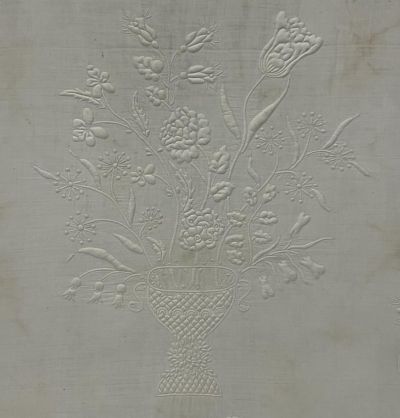
Date: Tue, 08 Jul 1997 23:23:13 -0700 | From: nomad1 [at] ibm [dot] net
Hi Lynn in NC,
Sorry for taking centuries to reply to your question re my Tree Of Life
coverlet. Have been flat chat with kids sick, DH away etc etc. Trying to
catch up now with my emails etc.
From your email address, I gather you too are nuts about this design &
am thrilled that you have actually done research on it. Could you please
share it wih all of us on QHL, as I am sure many would find it
fascinating.
I got hold of mine from an English Company called Past Times that
basically reproduce things past. The huge panel came in either blues or
reds. I went for the reds which had smidgens of blue here and there &
also a beige sort of colour. There is alot of detail & its hard to
describe it fully without going on for ages. So if interested I am happy
to take a pic for you. Also I can give you the address of Past Times if
interested, so you can request a catalogue too. They sell all sorts of
gorgeous stuff, from jewellery to furniture to ceramics to needlwork
etc. Gorgeous, but all priced in pounds.
Hope this answers your question a little,
Hiranya from Sydney, Australia
Date: Tue, 8 Jul 97 13:28:46 UT | From: “Brian Stewart” <JBCStewart [at] msn [dot] com>
Please send us all the address for the Past Times catalog. Sounds
fascinating! Jeannette in cool Colorado where the temperature when I got up
at 6AM was 38 degrees.
———-
From: nomad1 [at] ibm [dot] net
Sent: Wednesday, July 09, 1997 12:23 AM
To:
Hi Lynn in NC,
Sorry for taking centuries to reply to your question re my Tree Of Life
coverlet. Have been flat chat with kids sick, DH away etc etc. Trying to
catch up now with my emails etc.
From your email address, I gather you too are nuts about this design &
am thrilled that you have actually done research on it. Could you please
share it wih all of us on QHL, as I am sure many would find it
fascinating.
I got hold of mine from an English Company called Past Times that
basically reproduce things past. The huge panel came in either blues or
reds. I went for the reds which had smidgens of blue here and there &
also a beige sort of colour. There is alot of detail & its hard to
describe it fully without going on for ages. So if interested I am happy
to take a pic for you. Also I can give you the address of Past Times if
interested, so you can request a catalogue too. They sell all sorts of
gorgeous stuff, from jewellery to furniture to ceramics to needlwork
etc. Gorgeous, but all priced in pounds.
Hope this answers your question a little,
Hiranya from Sydney, Australia
Date: Tue, 8 Jul 1997 10:04:52 -0400 (EDT) | From: JQuilt [at] aol [dot] com
>
When you say “that’s the living wage in that country,so WE aren’t really
exploiting them”…Is what you really mean … THEY, like living in crowded
dorms and working 12 hours a day and sending home the money to their families
who live in primitive conditions?
And I guess the sweat shops in this country, that employ illegal aliens for
less than minimum wage are really benevolent organizations… who help the
poor remain poor.
Years ago there was a folk singer Tennessee Ernie Ford who sang a song “I Owe
My Life to the Company Store”…The folk song was all about the poor southern
tenant farmer who never got out of debt, because he/she had to buy all of the
family food and sundries at the company store on CREDIT…
Just substitue Visa and Master Card for the Company Store… and you will
begin to realize that you buy EVERYTHING at the Company Store, not always
through necessity but by choice… and just how in debt you are to the
company store..
I know people who owe the amount of, almost a full year’s salary, to
Visa/Master(not including the exorbitant interest) and they think that poor
tenant farmer was just poor because he/she was dumb.
I am not unsympathetic to all of the debt-ridden people in our society(my
suburban children included)…we are programmed daily, mostly by TV, to
Consume, Consume, Consume..
We have already been convinced that we don’t want to listen to music on
cassettes..what we really want/need are an expensive CD player and CD discs.
Have to go now I am off to the library to borrow–not buy–some
books,magazines and tapes..
Jean
jquilt [at] aol [dot] com
P.S the next time you say “he/she is so hard to buy for ..she/he has
everything” think and wonder about what you have just said…
Date: Tue, 8 Jul 1997 10:46:26 -0400 (EDT) | From: AMDOODAH [at] aol [dot] com
This is textile, if not quilting, related. There were special table linens
made to use with Fiesta ware – woven multi-colored tablecloths, placemats,
napkins, runners, etc. Most people have seen these in antique shops but most
people don’t realize they are “Fiesta Linens”. They are all the correct
colors.
Joan Stevens
Date: Tue, 8 Jul 1997 10:50:38 -0400 (EDT) | From: LAnder1051 [at] aol [dot] com
When is the quilt get togethor, and where in Michigan??
Linda in Illinois
Date: Tue, 8 Jul 1997 13:49:50 -0400 (EDT) | From: HPQuilting [at] aol [dot] com
I am desperately trying to locate a place to order the 6″ trapunto needles.
This is my first effort at trapunto. Are the trapunto needles sharp or blunt
at the point? Nancy’s Notions appears to have a 5″ weaving needle that I
might be able to make work. I’ve searched all my catalogs and I can’t find
anything. Help!
By the way, I loved the Pennsylvania Dutch History that was posted.
Thanks!
Penny(HPQuilting [at] aol [dot] com)
Date: Tue, 8 Jul 1997 14:55:34 -0400 (EDT) | From: JKusnitz [at] aol [dot] com
Jane, I was visiting my sister in Tucson, AZ a few weeks ago. We stopped in
a Safeway supermarket, walked down the baking aisle, and there on the bottom
shelf were fabric bags of flour. I think they were were 10 or 20 lbs. they
were huge and heavy and written in Spanish. Only had a quick glance because
with two kids and an infant in tow I couldnt stay too long. THe bags were
white. One had a blue floral design and the other was the same but in pink. I
couldn’t tell what type of fabric it was. But I was really surprised to see
them. Do you or anyone else know anything about them? I have to send my
sister back to take a closer look.
Helene
Date: Tue, 8 Jul 1997 17:20:02 -0400 (EDT) | From: HPQuilting [at] aol [dot] com
I would love to have any catalog/histories from the Mormon/Methodist quilts.
Actually any quilt history is a passionate interest of mine. If you could
email me information as to how I might obtain such information, I would
greatly appreciate it.
I tried to email the lady who posted this and the email was returned.
Date: Tue, 8 Jul 1997 17:45:47 -0400 (EDT) | From: Quilt97 [at] aol [dot] com
The article about Feedsacks and Jane C. Stapel in the Pittsburgh Tribune
Review in the features section, will be transferred to the archives in a week
and remain there for approx 1 year.
Dennis Woytek
Date: Tue, 8 Jul 1997 18:29:46 -0400 | From: “Phyllis Twigg” <ptwigg [at] radix [dot] net>
Some of you who visit the eBay auction site may have noticed the “1927
Holcomb Ladies Aid Quilt” containing 291 names. I was the top bidder on
that quilt and I have been trying to determine the origin of it. The
seller bought it at a small country auction in Lavon, Texas,( population
about 200), outside of Dallas She had no other information. My guess is
that the quilt was once a fund raiser for a church. The quilt is signed in
embroidery, “Made by the Holcomb Ladies Aid 1927-28.” I am also guessing
that the church was (is) located in a town named Holcomb. I have found 9
states containing a town named Holcomb: Mississippi, Georgia, Missouri,
Kansas, West Virginia,Illinois, Oregon, Washington, and New York. If anyone
reading this post is from an area near a town named Holcomb, I would
appreciate any feedback.
Of course, the church or group could have been named Holcomb for another
reason. I remember my mother and my aunt being members of the Ladies Aid
Society at church. We were Lutheran. Later that same group called itself
the Missionary Society. I don’t know if other denominations used the name
Ladies Aid for their women’s group. Please pass along any information that
would help me check this out.
Thanks !
Phyllis
Date: Tue, 8 Jul 1997 20:40:07 -0400 (EDT) | From: QuiltCat26 [at] aol [dot] com
“Susanne Ellenberger’s ala Suewho’s Buttermilk Recipe
1 gallon water
1 quart buttermilk
1 tablespoonful lemon juice
Let the quilt soak in a mixture and then wash with either Orvus or mild
detergent. The brilliance of the restored colores will amaze you.”
Nancee-Jane