March 15, 2005
These restored messages come from the Quilt History List, an online forum where quilt historians, collectors, researchers, appraisers, and enthusiasts discussed antique quilts and related textiles. The archive dates from 1996 through approximately 2016 and is being restored gradually. Sign up in the form at the bottom of the page if you want to know when a new page is added. Original spelling, opinions, formatting, and inactive links may remain unchanged.
Primary topics of this QHL Digest:
- Blue Marking Chalk on Antique Quilts — An extended discussion of carpenter’s chalk and blue marking-powder methods historically used to mark quilting lines, including Appalachian and Turkish (yorganci) quilting traditions.
- Turkey Red Fabric Identification — Members compare samples and characteristics of historical turkey red fabric. (see the article on identifying Turkey Red)
- Home of the Brave Quilt Project for Wounded Veterans — A New Hampshire coordinator seeks materials, including turkey red fabric, for a veterans’ quilt project.
- Maryland Institute Quilt Database Project — A researcher compiles a database of quilts entered in the Maryland Institute’s historical exhibitions.
- Steamboat Arabia Museum, Kansas City — Members recommend the Steamboat Arabia Museum to a visitor asking about Kansas City antique sources. (see the article on quilt museums)
From: Ronda McAllen
I am compiling a database of the quilts which were entered into the Maryland Institute for the Promotion of Mechanical Arts fairs from 1848 – 1858 in Baltimore, Maryland. I have come across a quilt name, which seems to be fairly popular at the time, called Job’s Trouble quilt. Does anyone have any info on this quilt or know of one in existance today? Also, what exactly would a “Fancy Quilt” be considered?
Thanks for your help.
Ronda McAllen
From: <chrisa@>
Trish and Newbie
If you have an opportunity some time, perhaps could you ask one of these ladies if it is chalk, rather than indigo that they used. Pat H. describes the bluing as liquid indigo. Perhaps the Amish heard about this and could comment on that process.
Since the quilt I referred to originally had lines not dots, it would appear a straight edge and stick mark the line Could this describe the blue marks on yours Newbie? Are they a strong medium shade of blue?
Thank you both for your input!
Kim Wulfert www.antiquequiltdating.com
So, is it possible that the blue powder you found Trish, was used to 3D make the bluing into a liquid? Perhaps it dries like powder on paper 3D (the stencil) after time, but not on fabric, the quilt or burlap fiber 3D for rugs.
In response to your question about the blue powder, or chalk, we found, I do believe it was used by the Amish women in a dry form as I mentioned. We have interviewed a number of older ladies in the Amish community about this and also when you look at the brown paper patterns it is obvious that the chalk was dusted or pounced on. By the way the stuff is extremely fine and very blue gets into and on everything. Don’t know where they obtained it however.
Trish Herr 717.569.2268 2363 Henbird Lane Lancaster, PA 17601
From: <chrisa@>
Near Kansas City KS there is quite a bit of Civil War and the Oregon trail history. There are museum houses to tour, parts of the trail and areas related to the CW. Sorry I can’t be anymore specific, but he should be able to easily find out about these places. They are not a secret.
They boast many great restaurants there and antique/vintage shops and flea markets. There are artier sections of the town. He would need a car or taxi to really take it all in.
Once when I was there I lucked into an antique quilt exhibit at one of the CW leader’s homes, curated by Terry Clothier Thompson!
Kim Wulfert www.antiquequiltdating.com
From: Lucinda Cawley <lrcawley@>
I don’t intend to get into competition with Sue Reich (I know I’d lose), but I was delighted to find this bit about a Lehigh County, PA (center of the fraktur inscribed quilt phenomenon) woman. Cinda on the Eastern Shore
AN INDUSTRIOUS WOMAN
Mrs. John SCHEIRER, of Macungie, made fourteen cushions, patched five quilts, quilted ten quilts and stamped seventeen white quilts in a year, besides doing her housework.
From: k-poneil@
Trying to reach Barb Garrett for a question involving quilting and the Brethren. Please e-mail me off-list.
Thanks you!
Patt O’Neil Olympia, WA —
From: Barbara Burnham
Rhonda, I would think a “fancy quilt” could be applique such as the Baltimore Albums that were popular in Baltimore during that era; certainly not made for everyday use! Now you have piqued my curiosity about your database, and I would love to know more… Barbara Burnham Ellicott City, MD
Ronda McAllen <quiltdesign@> wrote: I am compiling a database of the quilts which were entered into the Maryland Institute for the Promotion of Mechanical Arts fairs from 1848 – 1858 in Baltimore, Maryland. I have come across a quilt name, which seems to be fairly popular at the time, called Job’s Trouble quilt. Does anyone have any info on this quilt or know of one in existance today? Also, what exactly would a “Fancy Quilt” be considered?
Thanks for your help.
Ronda McAllen
From: Midnitelaptop@
here’s a little info don’t know how current it is.. think i saw something on a list that was bgarrett421@ then there’s listing for teachers
Barbara Garrett 1571 Old Ridge Rd. Pottstown, PA 19465 610-469-6048 bgarrett@
jeanL
From: jocelynm@
On March 14, 2005, ELEANOR MALONE wrote:
> Twin Oaks Apartments is in Kansas City, Missouri.
There’s also a Twin Oaks in Lawrence, Kansas. If he’s here, there’s a quilt guild meeting tonight at 7pm, Plymouth Congre gational Church, in the 900 block of Vermont Street.
From: <chrisa@>
Thansk Jocelyn- this made me realize I meant KC, MO, not KS, when posting about the CW and OR trail suggestions.
Kim Wulfert
From: Newbie Richardson
Well, the mystery deepens. I showed my newly acquired embroidery to my friend, Mary Doering, Mary is an authority on 18th and early 19th century European and American textiles and costume. She had the same reaction as I did, that the piece is c1785-1810. Even when I pointed out the obvious ( to me) blue markings, she did not budge in her opinion. She has a collection of over 100 18th century men’s waistcoats – many of them embroidered. Several of them have what are clearly embroidery marking lines showing through where some of the embroidery has desintegrated, however, none of those marks is blue. Newbie
From: Xenia Cord
I have no clear-cut answer to the blue marks, just a possibility: carpenters often used blue chalk or blue chalk pencils, and had a lump of blue chalk with which to coat the string on a plumb line. When the chalked string was snapped, it left a blue plumb line in its wake. Might this be a source of the embroiderer’s blue marking tool and the quilter’s pouncing chalk? It wouldn’t be the first time a woman adapted tools to her own use <g>!
Xenia
From: Karen Evans
Yorganci, or professional quilters in Turkey, *do* use a chalk line to mark their quilts. I can’t see any reason why such a thing wouldn’t have been used, especially in a professional setting where a quilt could be set up and left in the frame without fear of interruption.
Karen Evans
From: Sally Ward
I’m not sure how relevant it is, but in the V&A book ‘Historical Fashion in Detail (17th and 18th centuries)’ there is an illustration of a woman’s jacket of linen embroidered in silk, silver and silver-gilt thread, English, dated 1600 -1625. Part of the embroidery was never completed and the text says ‘..to the left of the seam can be seen traces of the original design left unworked. The fine yet solid line indicates that the pattern was drawn in ink on the linen with a fine-nibbed pen’.
Its hard to see on the illustration whether the lines are blue or black. But if this was a traditional way of marking for embroidery, could the piece in question have been marked with blue ink and a pen?
Sally W
From: J. G. Row <JudyGrow@>
What is that blue chalk made of? Is it powdered indigo in a compressed chalk base?
Does laundry blueing have the same indigo coloring in some non-active carrier?
And how did Cinda’s Mrs. John SCHEIRER of Macungie stamp seventeen white quilts in a year, and in what year did she do that. Did she “stamp” or “pounce” and where ARE all those white quilts from the Macungie area?
Judy, aka the Ringoes Kid judygrow@
From: Jackie Joy <joysbees@>
What I know about dyeing with indigo (and this isn’t much) is that it comes out of the dye bath an icky green color and only turns blue when exposed to the air (oxidizes?). I tried this at PIQF one year.
Jackie in Reno
J. G. Row <JudyGrow@> wrote: What is that blue chalk made of? Is it powdered indigo in a compressed chalk base?
From: Sandra Millett <smillett@>
Dear Joan: It was my question. I’m working on a new book and using the JoAnn fabric called Egyptian cotton–love the tight weave and high sheen. No, I’ve been unable to get a hard answer on what company makes it. Will call the JoAnn corporate office to see if they will share the info. Thanks for your imput.
Sandra Millett Quilting the Savory Garden.
Joan Kiplinger <jkip@> wrote: I accidently deleted the email concerning the first post about Egyptian cotton at Joanne’s. This morning I had a chance to see it; it is a fine broadcloth [double filling]. Bolt says Made in USA and the asst. store manager thought it more than likely came from Springs but had no way to verify that. The mystery is the origin of the cotton. Egyptian cotton by itself means nothing except cotton presumably from Egypt. The country grows short and medium staples; its top long-staple strains are those blended or enhanced mostly from American top strains such as Pima or Sea Island now mainly from Brazil. Unless the words combed, Pima or long staple accompany Eygptian cotton, then that cotton is only mediocre quality. Not that there is anything wrong with that but too many are fooled by the Egyptian cotton stamp thinking they are getting top drawer. So if this fabric is made in USA, either cotton is imported [raw? spun?] or else the hybrid strain is grown here. Or fabric is woven overseas and converted or “made” in this country — the textile industry has a saying that fabrics are made in the finishing. An interesting exercise in global relations.
I remember that the person who first brought up this subject had asked her store manager about origins — have you heard from her about this??
From: Kris Driessen <krisdriessen@>
These are not my rooms, this comes from an E-mail that was sent to me. If you are interested, please contact her directly.
“Due to an emergency in our small office my friends and I are unable to attend the AQS show in Paducha. We have 2 days the Ramada Inn April 20,21 and 2 days at the Executive Inn April 22, 23. The only thing we want out of them is what we have in them. 740*774-1396 or jn7101@ Thanks”
Wish I could go, but I am already booked for those dates.
Kris
From: Gail Ingram
> I have come across a quilt name, which seems to be > fairly popular at the time, called Job’s Trouble quilt. Does anyone have > any info on this quilt or know of one in existance today?
Rhonda,
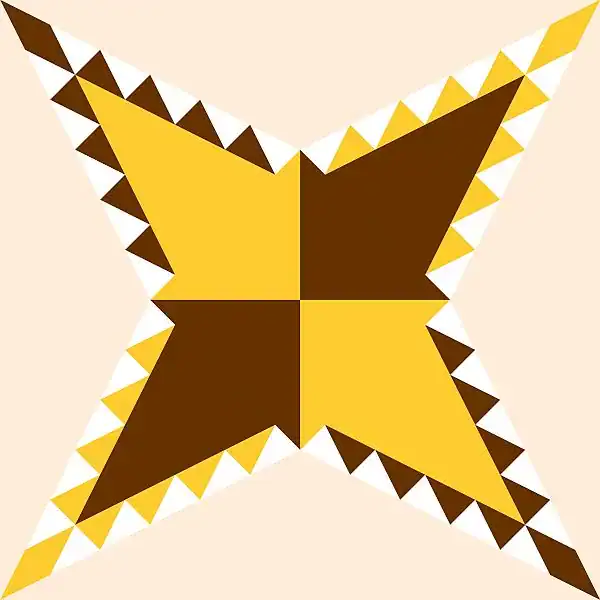
The pattern often called Periwinkle or sometimes Snowball is what was always called Job’s Troubles in this area, the idea being the unending line of Job’s troubles/star points.
In North LA, Gail
From: <chrisa@>
As a matter of fact, the Appalachian women did use this method to mark quilts in the 20th century. not certain about earlier then that. There are oral histories about it online and also through the Smithsonian I believe, that has the oral histories of women. A brief version of this is at http://www.quiltprofessionals.com/quiltdirectory/quiltmarking.htm I have run across this method used by mid-western quilters too.
But this is clearly chalk, and the blue lines on the c.1850s quilt is not chalk.
Kim Wulfert
I have no clear-cut answer to the blue marks, just a possibility: carpenters often used blue chalk or blue chalk pencils, and had a lump of blue chalk with which to coat the string on a plumb line. When the chalked string was snapped, it left a blue plumb line in its wake. Might this be a source of the embroiderer’s blue marking tool and the quilter’s pouncing chalk? It wouldn’t be the first time a woman adapted
tools to her own use <g>!
Xenia
From: Gail Ingram <gingram@>
Hirayna,
Your friend is in quilt heaven, wherever he is in Kansas. If he has access to a rental car, I suggest he take to the roads and see the county quilt museums, but certainly that he visit the Beach Museum (a gorgeous, fits-the-terrain structure) in Manhattan and the Spencer Museum in Lawrence.
And while he’s behind the wheel, just go on up to Lincoln to U.NB. Galleries and local museums and shops. Drop-dead gorgeous land, where you can see storms coming for miles and miles. Our nation’s “heartland” in more ways than one.
Encourage him to visit local art galleries (Vivian Knechel-sp? And others in K.C.) and enjoy the exceptional landscape paintings produced in the area as well as other works of realism. My senior students just returned from 4 days’ museum tour of a large city to the north of KS City, and after some of their reports of shows they saw in contemporary galleries and museums there, I wanted to put them back on Amtrack and send them to KS City and the KS and NB universities. The landscape paintings I saw there on my first visit to the Midwest gave me an insight into the culture and history of the plains and Flint Hills sections I don’t think I could have had otherwise.
Gail
From: Linda Heminway
Greetings! As you may know, I am the NH coordinator of the Home of the Brave Quilt project. I am pleased to report that we are well on our way to making a quilt for the families of those who have given their lives in the war on terror. Pam Weeks Worthen and I had an interesting discussion yesterday about Turkey Red and it prompted me to ask here, as you all might be exactly the right people to know! Have to admit that I have been one who obsesses over Turkey Red solid fabric for years now. I tend to carry scraps with me and whenever I go to any shop that carries fabric, I look for “just the right shade” of red. Most reds I find are just “off” a bit too orange or purple, etc. A local quilt shop here in NH recently closed, sadly, and that owner would stock bolts of it for me and took my scraps to market with her. She was wonderful, but closed the shop to take care of her family. For the Home of the Brave quilt project, we are making reproductions of civil war era quilts, see Pat Cummings web site at: http://www.quiltersmuse.com At any rate, I’ve used up about all my Turkey Red stash of fabric on this project, I just felt that the red of this exact shade was just the right thing for these quilts. I have no regrets and donated my fabric willingly. However, now I am faced with my own personal dilemma…. where can I get more of this exact color to suit my own personal desire to hoard this stuff for my own future projects???? I have two or three more quilts to make, as well, for the Home of the Brave project and would appreciate donations of some yardage of this fabric towards this project, but in addition to that I really would like to buy another several yards to replenish my own dwindled supply. I do plan on making a red and white feathered star quilt in my “leisure” time (in my next life?) and truly want to keep the exact shade on hand for this. Plus, I find this shade very pleasing in other projects, particularly the Baltimore Album repro quilt I am working on and want to do red and white sawtooth sashing and borders for. At any rate, I just “need” to know some good information. So, do you all have any sources? In case others are looking as well, might be grand if you posted your sources here for those who might have the same interests? Thanks if you can help! Linda Heminway Home of the Brave Coordinator Plaistow NH
From: Kathie Holland
Linda, I just happen to have a collection of turkey red solid fabrics, can you send me a good size swatch ? If I have any I can donate to you I would be happy to do that. I will return the swatch as well. Kathie in NJ
Date: Tue, 15 Mar 2005 07:04:51 -0500 | From: Joan Kiplinger <jkip@>
Sandra — I also noticed a slight sheen and soft finish which only added to the mystery why there were no more adjectives about this fabric. Normally broadcloths have a harder surface. I also spotted that on the shelf below were bolts of sateen in Egyptian cotton; some of those bolts were mixed in with the broadcloth above where I was looking. This could be confusing to buyers not realizing there were two different cloths on the same shelf. The sateen had exceptional luster. Re your book — can you tell us more about it and its relationship to Egyptian cotton. Sounds quite interesting.
From: Barbara Burnham
A few years ago I sent a sample of turkey red to Keepsake Quilting (Center Harbor, NH). They matched it perfectly with new fabric. Barbara Burnham Ellicott City, MD
From: Gail Ingram
> I do plan on making a red and white feathered star quilt in my “leisure” > time (in my next life?) and truly want to keep the exact shade on hand for > this. Plus, I find this shade very pleasing in other projects, particularly > the Baltimore Album repro quilt I am working on and want to do red and white > sawtooth sashing and borders for. At any rate, I just “need” to know some > good information.
Linda,
I smiled when I read the passage above, as, I am sure, did many other fabric savers. It called to mind a story a friend recently told me. The people in her Sunday School class are in their mid- to late-fifties. Recently the teacher used the term middle-aged, somewhat to the chagrin of one of the members who announced that he did not consider himself middle-aged. The teacher replied, “Well, how long are you planning to live, Frank?” The fellow was 55.
I hope you will let the list know when (for I am hopeful) you locate sources for the solid Turkey red, for many of us are in your situation, though perhaps for less altruistic reasons.
Gail Ingram
I found Job’s Trouble in Brackman’s Encyclopedia of Prieced Quilt Patterns. It is a six pointed star within a six sided block with sashing between which requires triangles at the intersection of the sashing strip. She found it in the magazine Modern Priscilla and as a Kansas City Star pattern 1937.
Fancy Quilts — I read an article once that termed those early 1800s one-patch quilts constructed in silk as Fancy Quilts. I have searched everywhere for a copy of the article but cannot find it.
Hazel Carter No. VA
From: Daniele Seyrig
> We have > interviewed a number of older ladies in the Amish community about this an d > also > when you look at the brown paper patterns it is obvious that the chalk wa s > dusted or pounced on. By the way the stuff is extremely fine and very blu e > gets > into and on everything. Don’t know where they obtained it however. In a film about Lesage , the professionnal haute couture embroiderer , I saw this technique still in use . The blue powder was still in use here in France I am told by a friend who was a theater seamstress in the 60/70’s . My friend said it could be bought in all the places where they sell threads etc… In the catalog of the embroidery exhibition in Strasbourg ( wich BTW was extended until the 4th of April )theyd describe the different ways that where used to transfer an embroidrery pattern to the cloth . One of them is to rub a perforated pattern with a blue powder wich is before dilluted and then fixed by ironning it . they do not say what the powder is made of nor what is used to dilute it . (FYI p27 of the catalog : Les modeles perfores ou poncifs )In the same chapter they say that the templates could be ordere d in shops . I bought some of those very thin metallic embroidery templates from a factory remnants and they look like they were used in this manner to o . While I am writting , I would like to let any of you who might be in Paris this spring or summer that there is a wonderful exhibition at the Jouy en josas musuem . It shows the garments collection of a unique ( and lucky ) owner and all theses dresses and suits shoes , games , of all kinds all from the 18th c are shown on mannequins in different rooms and windows wit h the furnitures and settings of the time . It is really wonderful and not t o be missed if in the area . No catalog unfortunately , the museum is town owned and not rich enough I guess . Daniele
Daniele Seyrig Les theories passent , la grenouille reste (Jean Rostand )
From: laurel@
According to the experience of a friend who is a needlework historian, “fancy work” generally seems to refer to work done on silk during the early- to mid-nineteenth century.
Laurel Horton
From: Bonnie Dwyer <bonniedwyer@>
Xenia beat me to it. The blue carpenter’s chalk is exactly what I was thinking. BTW, carpenters still use this to snap a line! Bonnie Dwyer In Maine with lots of snow that’s melting!
Date: Tue, 15 Mar 2005 19:35:45 -0500 | From: Sharon in NC <patchworksecrets2@>
There are two different kinds of carpenters chalk. One is washable, one is permanent. I can remember trying to use Dad’s in the 70’s and he warned me then to be careful which one I picked up or I would run my quilt I was working on. As I recall it didn’t stay on very good because it laid on the top of the fabric vs being somewhat embedded in the fibers temporarily like a chalk marker does.
Sharon in NC
From: Mary Voss
We were in Kansas City last year and really enjoyed seeing the Steamboat Arabia Museum. In September 1856 A steamboat paddlewheel fully loaded with over 200 tons of merchandise was headed down the Missouri river for the frontier town of Council Bluff, Iowa to re-supply the trading post there. The ship hit a snag ( a sunken log) and sunk into the mud with all it’s merchandise on board. The cargo consisted of gold, silver, wiskey, clothing, food, dishes. building supplies, tools, guns, and sewing supplies. All the typical things you would need to set up a home on the frontier. in 1977 Two men began the task of digging up this ship and it’s cargo. Their story and the items that were dug up is what the Steamboat Arabia Museum in downtown Kansas City is all about. You can find out more on their web site. Just google Arabia Steamboat Museum. – enjoy! We sure did. – Mary
From: Charlotte Bull <charlou@>
Hi… re the Steamboat Museum in KC —
A recent book from Kansas City Star Books (no relationship etc!) features this steamboat museum! And it is about Basket Quilts so you can get double excitement! Evidently the museum exhibit includes pins, needles, thimbles, scissors & buttons. Sounds like a great place to visit! A guy would love the tale of recovery of the cargo.
Check out “Baskets of Treasures” by Edie McGinnis www.TheKansasCityStore.com
I also enjoy this series of books because of the photos of examples of quilts made from the patterns in the KC* in the 30’s. I have family quilts made by my KS Grandmother using these patterns. If I was ever offered a “WISH” I’d choose to go back in time to visit her and to discuss quilting instead of going with my Grandfather to a John Wayne movie.
Unfortunately my Quilt Genes did not surface until after she had passed away and my own mother had no appreciation for quilting. She said “Ladies embroider or crochet.”!!! She and my mother-in-law were 2 of a kind. Both left tons of afghans, pillowcases and tea towels!
Charlotte from the Ozarks, where Winter & Spring are on a see saw! But Spring is Winning!
From: Kris Driessen
I can’t figure out what this page refers to, but it can’t be good.
http://www.doe.state.in.us/olr/grantprojects/codesincolorslides/
Kris
From: EdithIdleman@
Gail, would you please repost the information about the symposium in Nashville in September. Thank you, Edie Idleman Bella Vista, AR
From: <chrisa@>
Your input is intriguing, regarding the dilution of the blue powder and ironing in order to fix it. I was wondering if they provided an approximate time period this method was used? If not, did they show it on a dated piece of clothing?
<<In the catalog of the embroidery exhibition in Strasbourg ( wich BTW was extended until the 4th of April )theyd describe the different ways that where used to transfer an embroidrery pattern to the cloth . One of them is to rub a perforated pattern with a blue powder wich is before dilluted and then fixed by ironning it . they do not say what the powder is made of nor what is used to dilute it . >>
Thanks, Kim Wulfert www.antiquequiltdating.com
Gettysburg Compiler Gettysburg, Pennsylvania July 26, 1820
From the Plough Boy. Mr. Southwick.– I am a housewife, and my husband a farmer; we have some pretty warm debates upon the subject of managing the farm: I want him to raise more flax and less rye; his excuses are that flax requires too much labour — to much expense for the seed — is uncertain, and exhausts his land too much; and that he can buy India muslin cheaper. I say all this is downright folly; my house is furnished with these India cobwebs; and my children clothed with cotton rags; my husband in debt for this trash; and his rye wont pay his debts, even if he could raise ever so much; year after year he will persist in this fatal practice; and every year our stock of sheep and cows diminishes, and we grow poorer and poorer; my girls are idle for want of wool and flax, and I do verily believe we shall want a farm and a house ere long, if some change does not take place in our economy. I tell him, when I was a girl, I and my ten sisters would have been ashamed of ourselves, and our mother would have been ashamed of us, if we did not spin our 300 knots per day of wool, cotton, or flax, besides doing our chores; and my father took pride in supplying us with the raw materials, and was delighted to see us clothed in the fabrics of our own industry, and his house furnished with substantial homespun in abundance. Look, Moses, says I, at our house, and our six daughters – idle – hardly decent in dress; trigged off in flimsy calico and India muslin: and our beds and clothes presses almost empty! — why wont you raise flax? It was not so in my father’s house! Hush, Dorothy, hush I say; don’t scold; I can buy India cottons cheaper. Now, Mr. Southwick, I say this is enough to provoke the patience of apathy itself. I will scold and fret, to see my girls idle, hardly decent in dress, my house furnished with cotton cobwebs and rags, and all going to loss and ruin for want of flax, and wool, and wheels, merely for want of materials; for I do say, that my girls, if they had a chance would do themselves credit in any branch of housewifery, and it is cruel to deny them the means. I wish you would, in your next Plough Boy, give my husband and his neighbors a good lecture of the subject. You will do a most acceptable service to us wives, as well as daughters, and particularly yours, &c. Dorothy Thrift
Ontario, N.Y. May 1820.
I have to say that I actually prefer quilting on linen or silk to cotton at this point…and linen is much sturdier than cotton. I’d say she had a point. 😀
Karen Evans
From: Lucinda Cawley
Office of Learning Resources
Codes in Color: The Underground Railroad
Posted by: Judy R. Williams williams@
You’re right Kris. It’s not good. A video and lesson plan about how to teach gifted students about the dreaded “quilt codes.” How about deluging this lady with the “right stuff”? Cinda on the Eastern Shore
From: Xenia Cord
I sent a message to the names connected with the infamous “codes” website at the Indiana Dept. of Education. Who knew that we were harboring the serpent?
Xenia
More on Job’s Trouble — yes, in Brackman’s book was Job’s Troubles but the pattern was as Gail described it — the snowflake.
In Baltimore until March 20 — must hurry — to see this exhibit that is “American Fancy, Exuberance in the Arts. Sumpter Priddy curated the exhibit and he gives the dates from 1790 – 1840 for “fancy” decor. This exhibit includes maybe six quilts but also furniture, glas, art work, etc. Very interesting exhibit.
Hazel in No. VA
From: Barb Garrett
Kris –
I backtracked the address and found this page — it’s even more scary than the pictures — this project is very involved — http://www.doe.state.in.us/olr/grantprojects/codesincolor.html
Barb in southeastern PA
From: Sandra Millett
Dear Joan:
Thanks for your info. I’d love to tell about my new book, but since the proposal is about to be sent in, I hesitate to say anything specific until I’m under contract. However, I was contacted by the publisher and asked when it would arrive–she having remembered my samples when I pitched it at Quilt Market last Oct. It is about ready to be sent off. Keeping my fingers crossed. Will keep you posted both on the book and the Egyptian cotton. The cloth is such a smooth, tight weave that it lends itself to what I’m doing better than anything I’ve tried. And that’s a teaser if I’ve ever heard of one!
Sandra Millett
From: Judy Schwender
There is an “Inquiry Chart” on pg 2 of the lesson plan. One of the steps on the Inquiry Chart says “Read/Research, Share/Question”. The bibliography is not bad. But once you have examined it and other aspects of the teaching unit, it is plain that HIPV is the fulcrum for the whole thing. I wrote to Taylor and Williams, and one of my pargraphs is below:
“My undergraduate degree is in art education. I can appreciate that teachers wish to integrate history, social studies, art, music, and math into a single unit. After all, life is not partitioned into math for 35 minutes a day, history for 40 minutes. All these skills are interwoven on a daily basis, so it does make sense to create interdisciplinary lesson plans. However, if the lesson is based on fiction presented as fact, what have we really taught? That it doesn’t matter what spin is put on a topic, that as long as it gets the point across it is OK? How can we possibly teach critical thinking skills when educators will not apply them to their sources? For the fabric of education to work for our children in the future it must be woven with truth today.” Judy Schwender