March 18 – 24, 2006
These restored messages come from the Quilt History List, an online forum where quilt historians, collectors, researchers, appraisers, and enthusiasts discussed antique quilts and related textiles. The archive dates from 1996 through approximately 2016 and is being restored gradually. Sign up in the form at the bottom of the page if you want to know when a new page is added. Original spelling, opinions, formatting, and inactive links may remain unchanged.
Primary topics of this QHL Digest:
- Kansas City Star Pattern Copyrights — Members trade what they know about who owns the Kansas City Star patterns and how easy it is to claim rights to a design.
- Nitrile Gloves for Handling Quilts — A member asks whether nitrile or latex gloves can replace cotton gloves, and conservators weigh in.
- The Stolen Quilt and eBoard Help — The missing Nashville quilt story continues, along with tips for posting photos on the QHL eBoard.
- The Underground Railroad Legend Spreads — Members react to websites and writers repeating the quilt code story and discuss why the legend is so persistent. (see the article on Underground Railroad quilts)
- Calendered Fabric on 1930s Quilts — A member describes a stiff, crackly finish on conversation prints, and others explain hard permanent calendering.
- Books and Fairs of 1893 — Members swap references on the Columbian Exposition and mention a Civil War diary quilt book.
From: Pat Cummings
Dear Mitzi:
It is pretty easy to copyright a book or other design item that you want to claim as your own work. The forms are fairly short and concise, and you can download them from your home computer.
To copyright a book, one sends $30.00 and a completed application to the Library of Congress. Then, wait for about six months to receive approval, if everything has been filled out correctly.
To learn everything you need to know,just visit: http://www.copyright.gov/
Best,
Pat Cummings
From: “Judy Anne”
I got the impression that Kansas Star people do have the copyright to their patterns. I asked about it concerning Brackman’s Block Base on the EQ5 list and was told I should not publish any patterns attributed to the KC Star but most others are public domain. I suspect KC Star has a more recent copyright on them even though the patterns are old.
If you do write them let us know what they say. It’s wise to write to them to be sure.
Judy Anne
From: Maggmalone@
as I mentioned in my previous post, most of the patterns that appeared in the column were old at the time of publication. Many of them also appeared in other publications about the same time. II did extensive research for my book, “5500 Quilt Block Designs” and have listed as many of the publications these blocks appeared in as I could find, so I don’t think any one publication had copyrights to the patterns. If a pattern is in the pubic domain, you cannot copyright it.
More recent blocks or the contest blocks they have run, may be copyrighted.
Maggie–
—
A few years ago, I was in contact with the Kansas City Star about the possibility of doing a book of the patterns. We didn’t reach an agreement, but I was told that the patterns themselves are not copyrighted, but the name The Kansas City Star is, and you have to have their permission to use the name The Kansas City Star. Most of the patterns that appeared were old at the time they were printed in the paper and were already in the public domain, meaning uncopyrighted. I believe it was in the 1970’s that copyright protection changed. Prior to the changes, copyrights ran for 17 years and unless renewed, became public domain. Since the change, the copyright is good for the life of the owner of the copyright and can be renewed by his heirs.
Date: Mon, 20 Mar 2006 04:30:42 -0800 (PST)
A question, is it alright to use nitrile gloves or even latex gloves instead of cotton to examine quilts while documenting or appraising? Does anyone know of any concerns? I personally like the way they fit better than cotton ones. Stephanie in NH
Date: Mon, 20 Mar 2006 04:46:41 -0800 (PST) | From: Pat Cummings <pat@>
Dear Stephanie:
Nitrile gloves are mentioned in my book, Straight Talk About Quilt Care. I like them because they do form a nice bacteria to any surface contaminants, and they are also disposible.
Latex gloves, like any latex product, can cause severe allergic reaction in some people. Even people who are not initially allergic to them can develop an allergy with use, over time. I break out in hives when I try to use them for handwashing dishes, but am only recently having this reaction. Some reactions are life threatening and can be brought on by simply inhaling the vapors that this kind of material emits.
Cotton gloves are in constant need of washing and I have been told that a different pair should be used with each quilt handled. That becomes a bit problematic. Cotton gloves can also be abrasive to the quilt, doing more harm than good.
Lots to consider.
Hope this helps.
Pat Cummings www.@
— stephanie drake <gsadrake@> wrote:
> A question, is it alright to use nitrile gloves or > even latex gloves instead of cotton to examine > quilts > while documenting or appraising?
Date: Mon, 20 Mar 2006 07:15:18 -0600 | From: louise-b <vlbequet@>
Paula Nadelstern’s Kaleidoscopes & Quilts, has a brief history of the kaleidoscope, pp. 138-140+ that Sir David Brewster invented the kaleidoscope in 1816. They were being sold by 1818 in America. She believes that these items were the basis for the Kaleidoscope (1869) quilt pattern.
Of minor interest, I have a clipping of a Laura Wheeler pattern, Circling Swallows, that to me has a modified Kaleidoscope center with additions. I have been playing with this pattern using Marti Michell’s small Kaleidoscope ruler and some of her other templates to make this block – which shall be a table runner some day soon.
Louise Bequette — in mid-Missouri
Date: Mon, 20 Mar 2006 09:40:56 -0500 | From: Sandra G Munsey <munsey@>
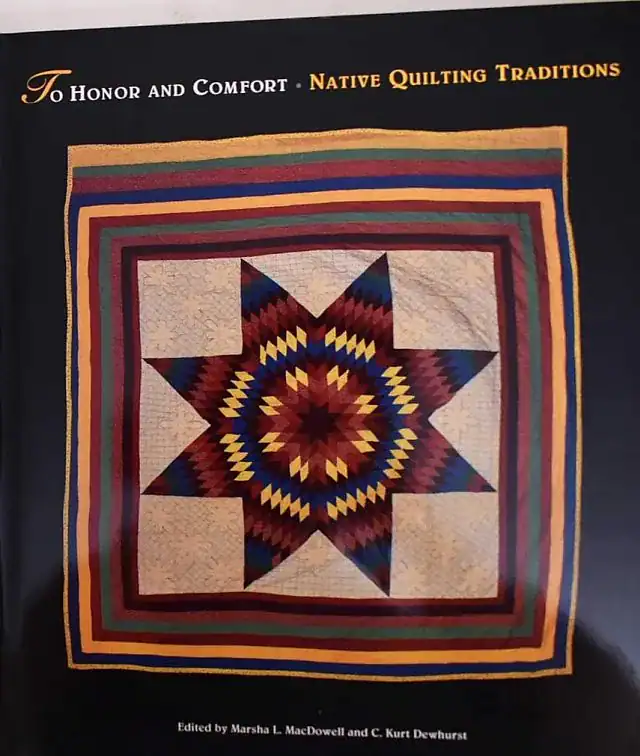
Thank you, Sue, for posting the information about the Mashantucket Pequot Museum show of quilt from “To Honor and Comfort: Native Quilting Traditions”. My husband and I decided to drive over on Saturday. We had seen the original showing of the exhibit in NY City, but thought the museum would make an enjoyable break. Our “efforts” were rewarded with a talk by Dr. Rayna Green, poet, storyteller, teacher, and Cherokee woman, in which she discussed the evolution of the perception Native women – the things that fourth grade and graduate history classes never presented. Next we visited with Mohawk quilter Alice Olsen Williams in the Mashantucket Gallery among the To Honor and Comfort quilts and two bulging suitcases and a equally stuffed photo scrapbook of Alice’s quilts. Her quilts are alive with flowers, loons, moose, birds, lakes and trees, and her own variations of traditional quilt patterns. Two of her quilts – one a very strong political statement on the relationship between the Canadian government and the native peoples – are in the exhibit. Before long, Dr. Green and some of the museum staff drifted into the room and an impromptu sharing blossomed.
Although I check the Mashantucket Pequot website occasionally, I had not done so lately. But, I do check QHL every day. Most event announcements are beyond my range of travel. Here was one in my back yard. Thank you, Sue. We are in your debt for a lovely, informative day at one of New England’s outstanding museums.
Sandra on Cape Cod
Date: Mon, 20 Mar 2006 06:09:31 -0800 (PST) | From: Private Private <trail_junky@>
I can’t really answer your question, but I can tell you a bit about nitrile gloves.
Nitrile is a non-allergenic, non-reactive plastic product. Unlike latex, it is a synthetic product. It was originally developed for chemists who handle solvents because it was highly resistent to the solvent. Latex becomes porous instantly with exposure to many solvents. Nitrile became widely used in the medical industry in the past 10 years because of the growing awareness of latex allergies.
I don’t know if this information helps, but I would expect nitrile to be better than latex for allergy reasons, and I would expect any glove to be better than none to prevent skin oils getting on the quilts.
Annette in CA
Date: Mon, 20 Mar 2006 10:51:00 -0500 | From: mgmooney <mgmooney@>
Good morning, QHLers – Meg gives two (nitrile-covered) thumbs up for nitril e gloves whenever you are touching/handling quilts. They come in all sorts of great colours, too. Do get the powder-free ones. Regards, Marg aret (Meg) Geiss-Mooney Textile/Costume Conservator Professional Associate, AIC mgmooney@
<<A question, is it a lright to use nitrile gloves or even latex gloves instead of cotton to examine quilts while documenting or appraising? Does anyone know of any concerns? I personally like the way they fit better than cot ton ones.<<
Date: Mon, 20 Mar 2006 09:46:04 -0800 (PST) | From: Laura Fisher <laurafisherquilts@>
Thanks everyone for the helpful info on where to report a missing quilt. I contacted those with booths near the quilt hung to see if anyone noticed anything suspicious. I imagine it “walked” during pack out of the show, when those dismantling the exhibition had their backs turned. So sad–John Sauls, its owner, loooooooooooved that quilt and planned to have it placed in his coffin when the time comes. This is so sad.
Hopefully it will surface again, like two others i know about. A colleague found a quilt she had bought and paid for, but was stolen from Skinner’s Auction before she went to pick it up. The thief tried to sell it on eBay, she spotted it, notified authorities, and got it back!! I got back–some three years later– a 1930s Broken Star quilt missing from my shop. The young thief was a former messenger who evidently cased everywhere he delivered to. He tried to sell it to a colleague downtown. with my price tag still on!!, which she recognized.. She had the thief leave it so she could contact “a possible buyer” (me) I notified the police, who arranged an elaborate sting operation in my store, with a detective posing as the shop owner, police in unmarked cars outside waiting to grab him, pretty elaborate remedy for a $ 595 quilt. i sold it the next day to a dealer client from Germany, who got a quilt with some provenance to passs along with it!
Laura Fisher
Date: Mon, 20 Mar 2006 10:04:09 -0800 (PST) | From: Laura Fisher <laurafisherquilts@>
My nephew’s bride is a patent examiner in the scientific technology field, so I asked her about patenting a technique, Yes it is absolutely possible Companies patent techniques all the time–i.e. new or improved methods of doing something– not just products or inventions.
Even if a technique was in common usage and known about forever, it may never have been patented, as is probably the situation recently discussed. So, the clever marketer can patent a version, though it may not be her original discovery.
It is possible that a new patent should not have been issued and can be rescinded either because there was one already long ago, or the recent technique is too similar. Such awareness will result when someone files claiming patent infringement. The Patent Office has few inspectors and overwhelming caseload, allowing new submissions just a few hours review.
So, curious as it seems to experienced sewers, it is possible to patent that technique.
Laura Fisher
Date: Mon, 20 Mar 2006 13:21:11 EST | From: RAGLADY@
Thanks for the informative reply, Laura. As you said, all it takes is a clever person to think about the patent idea, even for a technique that has been used for many years. Someone also wrote me to say that most of those similar techniques related to hand sewing/quilting and the “Cotton Theory” technique involves stitching/quilting using a sewing machine. Still seems strange to me – but so do many other things in life. <grin>
Gloria raglady@ laurafisherquilts@ writes: > So, curious as it seems to experienced sewers, it is possible to patent > that technique. > Laura Fisher
Date: Mon, 20 Mar 2006 11:40:37 -0800 (PST) | From: Laura Fisher <laurafisherquilts@>
First, I want to apologize yet again for the typos__I just refuse to put on my strongest reading glasses to read the computer screen, which means acknowledging my eyes are getting worse, and I will have to up my glasses’ prescriptions yet again. Plus, I need a light on my computer work area.
Anmd now I hjave a window and sunlight, and my back is to the window and the light glaring on the screen, aarrrrgh….
Re the lost/stolen quilt, the format is actually a center squarish panel framed by four large Eight Point Stars that are outlined in red embroidery; all the silk disintegrated. One the center panel is Good Mornin,g Good Night, Rest for the Weary, etc.eBoard here I come…..
thanks, Laura Fisher
Date: Mon, 20 Mar 2006 15:30:06 -0500 | From: “Laura Fisher” <laurafisherquilts@>
Want to post pictures of stolen quilt. Don’t recall how to do so, I know you posted instructions, how do I access them. what is eboard address? thanks again and agAin and again!! laura fisher
Date: Mon, 20 Mar 2006 12:43:04 -0800 (PST) | From: Kris Driessen <krisdriessen@>
Well, this gives me a good opportunity to remind everyone that their questions can be answered at http://www.quilthistory.com. Look on the subscribe page.
One thing I do want to point out: those of you still posting in MIME, *please* change your settings. Most mail clients can read and interpret MIME (or HTML) but the digest cannot, so people on the digest get pages of gobbledegook. If you don’t know what I mean, I would be glad to put you on digest so you can see for yourself:-))
I can’t give specific advice on how to post in Plain Text as each mail client is different, but your ISP should be able to help you. If not, try the help button or do a google search.
Kris
Date: Mon, 20 Mar 2006 15:36:13 -0600 | From: “Karen Musgrave” <KarenMusgrave@>
The Alliance for American Quilts (www.centerforthequilt.org ) eBay auction this week has lots of out-of-print books inlcuding “Always There: The African-American Presence in American Quilts,” “Mosaiques d’etoffes a la recherche de l’hexagone” (Mosaics In Search of the Hexagon), “Kentucky Quilts 1800-1999” and signed copy of “Abstract in Design in American Quilts, ” great vintage c1890 mourning dresses and skirts, wonderful quilts and much, much more! You can check it out by going to http://search.ebay.com/_W0QQfgtpZ1QQfrppZ25QQsassZalliancequilts or search by our seller’s name- alliancequilts.Your purchases also benefit a great organization which is doing incredible things for quilts. New auctions are posted every Sunday. Happy bidding and thanks for the support.
All the best, Karen Musgrave Join us! Become a member and get advance news on our auctions AND help preserve our great quilt heritage. www.centerforthequilt.org
Date: Mon, 20 Mar 2006 16:32:11 -0600 | From: “Andi” <andi0613@>
Hi all,
I’m on digest so would appreciate a private email reply to andi0613@. What is the correct way to describe the fair held in Chicago 1893-1894:
Columbia Exposition
Columbian Exposition
World’s Fair, 1893-94
World’s Fair, 1893-94, Columbian/Columbia Exposition (or Expo?)
Or other variations thereof.
This is going into print and I’m quite confused, having seen several versions.
Thanks in advance,
Andi in Keota, Iowa, where, apparently, we’re going to get some snow in Spring! Hooray!
Date: Mon, 20 Mar 2006 14:50:03 -0800 | From: “Leah Zieber” <leah.zieber@>
Hi all, just an fyi – a dealer I regularly purchase from is selling a book some may be interested in:
Item Number 7015571883 DESCRIPTION – The Lady of Godey’s: Sarah Josepha Hale Finley, Ruth E. Book Description: J. B. Lippincott Company, Philadelphia, PA, USA, 1931. Cloth. 1st ed. Printing. 8vo – over 7¾” – 9¾” tall. 318 pgs; beige/tan cloth covering with red/black decorative design and black lettering to front board, decorative color illustrations to end papers; fore edges are yapped (rough cut);
I have no connection, it just looked like a fun book for the collectors.
Enjoy
Leah
Date: Mon, 20 Mar 2006 18:34:29 EST | From: RAGLADY@
Hi Laura What I found was the easiest way to remember for accessing the Eboard is to just use the Quilt History website address: http://www.quilthistory.com Then in the left side menu, select Gallery – and there you are. 😎 I can’t help with how to upload pictures there; but I know you’ll get replies on that part.
Gloria raglady@ laurafisherquilts@ writes: > Want to post pictures of stolen quilt. > Don’t recall how to do so, I know you posted instructions, how do I access > them. what is eboard address? thanks again and agAin and again!! laura fisher
Date: Mon, 20 Mar 2006 15:24:49 -0800 | From: Karen Alexander <karenquilt@>
If there is a QHL member that uses Entourage as their mail system and address book, could you please contact me off list.
Thanks.
Karen Alexander In the sunny San Juans!
Date: Tue, 21 Mar 2006 08:41:45 -0500 | From: “Newbie Richardson” <pastcrafts@>
Dear List, I have had an inquerry from an antiques dealer in Charlottesville, VA. She has acquired a group of 35 or so late 19th c & early to mid 20th c ‘unspectacular’ quilts that she needs to have evaluated. If any of you are in the Charlottesville, Virginia area, please email me privately and I will forward her email to you and you can decide from there. This is a legitimate job – but I doubt she has much in the way of funds to pay. Newbie Richardson
Date: Tue, 21 Mar 2006 08:53:05 EST | From: Palampore@
I have been quiet on the “palampore topic” because I had a basal cell taken off of my nose last week. I am fine. It is gone. BUT, I did get 30 stitches in my nose and 2 black eyes from it ,so I looked like I tangled with Rocky and LOST big time. Three days later I did quilt evaluations for National Quilt Day at our library. Needless to say, we didn’t encourage the local newspaper to come over for photos! The best quilt was a pictorial quilt done of Beatrice Potter animals and characters. There was also an 1850’s Album Quilt with a heavenly blue floral print. I am a 1st time great aunt as of yesterday (Baby is a boy and lives in Raleigh, NC.). AND—- I have another niece in labor right now. We are all going kinda crazy!!! We are soooo excited….. (Ashley is in labor is Arlington,VA. Any Arlington baby nurses in the group?) Now on to palampores (Indian bedcovering is what the word means)….. I have been doing extensive research on palampores since 1992. I bought a quilted palampore in the fall of ’92, It was being nailed to a wall at a quilt show where they were using white gloves to hang their new quilts. I rescued it, and became very good friends with the owner of it. It had been an “old room divider” in her family for years. She said her aunts had lots of quilts, but they were all brown tones that she didn’t like, so she sold them. She only kept the crazy quilt. The palampores that won the most favor were the tree of life design. It was more to the taste of the English and Dutch. In fact the English and Dutch liked the 1st palampores brought to them by their spice trading husbands, but they really wanted them to have more of the flora and fauna they were familiar with, so they sent to India drawings of English and Dutch plants and animals. Well, since the Indian designers had never seen these things they improvised with their designs. That is why you have “fanciful/creative license” with flowers especially in home decor fabric. Paisley also mingles in with this. The bedcovering Sharon sent pictures of has lots of paisley. This topic fascinates me so much that I have a “trunk show” lecture that I do showing the evolution of textile design from the paisleys, kalamkaris and palampores of India. I do a time line with fabrics. It really is lots of fun! So yes, this covering Sharon has is a palampore because it was made as a bed covering, but it is not the traditional tree of life that is, and was, the most popular. I have several that were made in the 20th century. They vary in quality. Some are loosely woven, and others are a fine woven slick sheeting type fabric. The ones we bought in “head shops” in the the late 60’s and 70’s are of varying quality and the color palettes run the gamet. I bought a tree of life palampore in a “head shop” in Lawrence, KS in about 2000. It is almost comical looking the proportions are so out of whack. But I bought another later on that is very good….. Back to waiting by the phone for baby news…. Lynn Lancaster Gorges Historic Textiles Studio New Bern, NC palampore@
Date: Mon, 20 Mar 2006 22:45:29 -0800 | From: Karen Alexander <karenquilt@>
The Lady of Godey’s: Sarah Josepha Hale by Ruth E. Finley
This is a fascinating read! Ruth Finley is one of the Honorees in The Quilters Hall of Fame.
Karen Alexander In the sunny but chilly San Juans
Date: Tue, 21 Mar 2006 20:21:40 EST | From: Palampore@
This quilt is filled with names…..
_http://cgi.ebay.com/Friendship-Quilt-1932-High-School-Raffle-Corbin-KY_W0QQit emZ7399538786QQcategoryZ63634QQrdZ1QQcmdZViewItem_ (http://cgi.ebay.com/Friendship-Quilt-1932-High-School-Raffle-Corbin-KY_W0QQitemZ7399538786QQcategoryZ636 34QQrdZ1QQcmdZViewItem)
This is a research dream. This quilt needs to get back to Kentucky. I have no connection to it. I just want it to go home because quilts like this tug on my heart. Lynn Gorges
Date: Tue, 21 Mar 2006 22:21:53 EST | From: Palampore@
I just stumbled onto a book — Civil War Diary Quilt. Is this a good book? And is it good for teaching children? Thanks, Lynn Gorges, New Bern, NC
Date: Wed, 22 Mar 2006 08:19:15 EST | From: Palampore@
This is absolutely not quilt related….but you need to know because of my post yesterday. We now have a little girl residing in Arlington, VA. So we got a baby boy and a baby girl within 15 hours! So exciting…. My mother’s 1st grandchildren were a set of twins a boy and a girl (mama of the new boy). The mamas are first cousins, who are one year apart and were college roomies. Now Mama is a 1st time great grandmama to these precious ones —- Its like having twin babies in our family again. Just wish my mama could react to all of this. She had a severe stroke, so we don’t know what registers. But my sister did say that as soon as she told her “You have new grandbabies!” — Mama’s eyes popped open very wide and she didn’t stop watching her the whole time she talked about them. Off to get something done in a constructive manner. Yesterday I ran around catching my tail and thinking about babies! Thanks for letting me share our joy. Lynn in New Bern, NC
Date: Wed, 22 Mar 2006 12:59:50 -0500 | From: “J. G. Row” <JudyGrow@>
On 3/21/06 at Studio Quilt Study Group we saw a Yankee Puzzle quilt from the late 1800’s. Used throughout this quilt was a light brown fabric, a conversation print we usually see in black on white. In every patch it was this uniform light brown color, and it had a different feel from the other fabrics — slightly stiff and crackly — but it didn’t seem to be disintegrating. We thought it might have been a chemical reaction with something else, but none of us had ever seen this before. Any ideas?_NAMEÞstination&BOARD_NAME=VintagePictures&SESSION_ID=n6rlpc0bz7xvtw6368&TAB_ID=165431
Or, go to Quilt History.com, click on gallery and look under “Fabrics.”
J. G. Row
Judy, now in Flemington NJ aka The Ringoes Kid judygrow@
Date: Wed, 22 Mar 2006 11:52:59 -0800 | From: <suereich@>
I have a book called “Report of the Commissioners from Connecticut of the Columbian Exhibition of 1893 at Chicago, also Report of the Work of the Board of Lady Managers of Connecticut” published by the Case, Lock wood & Brainard Company of Hartford in 1898. On the outside of the cover is the title “Connecticut at the Columbian Exposition, Chicago, 1893.” Thus the confusion. Hope this helps. sue
Date: Wed, 22 Mar 2006 22:38:01 EST | From: Palampore@
I stumbled on this site tonight. It is filled with the UGRR Legend. I know that this collection of quilts is presently an exhibit at the NC Museum of History. Has anyone seen it? I think I will try to get there within this month. I have been to the church where the quilts were originally displayed. It was an old church that was no longer used that was turned into a gallery for quilts and pottery. The quilts were all utilitarian. The door was always unlocked and no one attended to the building as staff. It was a very eclectic collections. Just putting this out there for those who are studying this topic.
_http://www.antiquelynx.com/Articles/ArticApril03/Jamesquilts0304.html_ (http://www.antiquelynx.com/Articles/ArticApril03/Jamesquilts0304.html)
This “legend” has certainly spread like wild fire. Lynn Lancaster Gorges New Bern, NC
Date: Wed, 22 Mar 2006 22:24:13 -0800 | From: “Alan”
I don’t know what the cause is, but I have a quilt top made of converstion prints, and it has a strange crackly feeling too. I’ve always figured it was the way the fabric was finished.
Alan
In every patch it was > this uniform light brown color, and it had a different feel from the other > fabrics — slightly stiff and crackly — but it didn’t seem to be > disintegrating. We thought it might have been a chemical reaction with > something else, but none of us had ever seen this before. Any ideas?
Date: Wed, 22 Mar 2006 16:44:35 -0800 (PST) | From: karenquilt@
This is from another list. Thought some on this list might live nearby. No affilation.
Karen Alexander
FOR THOSE OF YOU WHO MIGHT BE IN PHILADELPHIA, JUDITH PLOTNER WILL BE INCLUDED IN THE 7TH ART QUILTS AT THE SEDGWICK RECEPTION: FRIDAY APRIL 7 5:30-8:30 PM EXHIBITION: APRIL 8- MAY 21 GALLERY HOURS: TUESDAY-SUNDAY 11-5 GUIDED TOURS THURS & SUNDAY 2 PM
PLEASE NOTE NEW LOCATION THIS YEAR PHILADELPHIA ART ALLIANCE 251 S 18 STREET PHILADELPHIA, PA
On Saturday April 8 there will be a brunch and lecture THE QUILT IDEA – REBECCA STEVENS Consulting Curator, Contemporary Textiles The Textile Museum, Washington DC
Stotesbury Mansion 1923 Walnut St Philadelphia, PA
Brunch: 11 am / Lecture 12:30 PM $20 per person / lecture only $8
Reservations, information 215 840-8778 www.aqats.blogspot.com
Date: Thu, 23 Mar 2006 08:33:00 -0500 | From: joan kiplinger <jkip@>
Alan — I also think it is the type of finish, a hard, permanent calendering. I have several vintage [1930s-pre-war] and some 1970s fabrics with hard surfaces; the latter which keep getting stiffer with each washing and are at the cardboard stage currently. Probably the type of storage or care this quilt had would account for the cracking — dampness could have affected a heavy starch-based pre-calendering or even the quality of calendering per se.
Alan wrote: I don’t know what the cause is, but I have a quilt top made of converstion prints, and it has a strange crackly feeling too. I’ve always figured it was the way the fabric was finished.
Date: Thu, 23 Mar 2006 09:22:55 EST | From: Mitzioakes@
In a message dated 3/22/2006 10:39:17 P.M. Eastern Standard Time, Palampore@ writes:
http://www.antiquelynx.com/Articles/ArticApril03/Jamesquilts0304.html
Talk about legends and myths (and big, big, words!!) this takes the cake (or the quilt). I’m sorry, it doesn’t fit with my history education. Sorry! Mitzi from Vermont
Date: Thu, 23 Mar 2006 09:45:35 EST | From: JLHfw@
In a message dated 3/23/2006 8:24:18 AM Central Standard Time, Mitzioakes@ writes:
http://www.antiquelynx.com/Articles/ArticApril03/Jamesquilts0304.html
The myth is growing and growing and growing. Janet in Fort Worth
Date: Thu, 23 Mar 2006 07:35:39 -0800 (PST) | From: Pat Cummings <pat@>
To hope that the Underground Railroad Myth would transform itself into true history is like wishing on a star. Unfortunately, no matter how hard we wish, it will never be true.
There seems to be two camps: those who have read the book upon which all of the “theory” is based; and those who are “dyed-in-the wool” believers who have not gone to source material, understood it, or processed it. Their belief is based on word of mouth, or shall we say “hearsay”?
In a desire to get caught up in the current trend of faux history, and to be politically correct, certain people feel the need to blindly repeat verbally the rhetoric of what they think they have learned.
The most unfortunate part of all of this is that some “scholars” have been involved in the dissemination of incomplete and inaccurate information. The myth has just spiraled out of control, and no one wants to recount their claims. How could they? To do so would be to expose their own flawed reasoning before peers, sometimes in an academic setting. Due to the ethnic backgrounds of some of these individuals, it is convenient to claim that those who disagree with the myth are just racially prejudiced, a weak come-back and an untrue one.
The other day, I received an e-mail from a schoolgirl who was desperate to get more historical information about the “Shoofly” block. At first, the question did not ring a bell. I must have been hungry because my mind wandered to that great Pennsylvania delight, “Shoofly Pie” and then to the song, “Shoofly, Don’t Bother Me” which, to me, is in the same category of, “Jimmy Crack Corn and I don’t care.” But, I digress. Of course, the reason she wanted to know more about the block is because it is included in the “secret quilt code.” Realizing that, I told her what I could.
In the past, I have written voluminous explanations about the UGRR. I no longer have the time to answer children in as great a depth as I once did. In the case of this little girl, I was compelled to write more than I normally would, these days.
Based on what I told her, she will either get an “A” on her paper, or an “F”, depending on the orientation of her History teacher.
As I said a while ago, we can only deal with the situation by trying to enlighten folks, one person at a time.
Re: the latest article: If there had been an e-mail link available to contact the publication cited, I would have been tempted to write to the collectors, or to the publication mentioned below.
Alas, as we already know, the UGRR myth has taken on a life of its own, and continues, much to the disgust of those of us who care about the truth.
Off my soap box for now,
Pat Cummings, on Cloud Nine because of the nice reviews of my books in three major publications this week! www.@
> Mitzioakes@ writes:
http://www.antiquelynx.com/Articles/ArticApril03/Jamesquilts0304.html
Date: Thu, 23 Mar 2006 08:49:31 -0800 (PST) | From: Kris Driessen <krisdriessen@>
What is so very disappointing in all this is that the real heros of the UGRR are being pushed aside in favor of this myth. The last two times I have been exposed to the myth (most recently at a play called Seven Quilts for Seven Sisters), it has been very clear that the participants are aware of the controversy and so they couch their words and actions in vagueness. Lots of “mights” and “maybes” and no real information.
Lots of people are delighted with the myth. Why should they want to give it up when it is making them so much money? Actually telling documented stories would involve work {{shudder}} wouldn’t it?
Kris
Date: Thu, 23 Mar 2006 17:35:34 -0800 | From: Julie Silber <quiltcomplex@>
Hello Friends,
One sign (of many, I fear) of my diminishing brain cell volume is that I am forgetting names of patterns. Please check the eBoard for one I can no longer name (Pine Burr variation, or Pickle Dish variant both came to mind, but “NO” !). And I can not track it down in Brackman either – though I am sure it is there. Help if you can, please!
Thanks! Julie Silber
Date: Fri, 24 Mar 2006 02:34:41 -0800 (PST) | From: Pat Cummings <pat@>
Has anyone heard of the Maria Hanks quilt made in 1857 in Illinois? I am told that it has basket motifs. Where might one see a photo of this quilt? Thanks for any help in this matter.
Pat Cummings