August 28 – September 4, 1999
These restored messages come from the Quilt History List, an online forum where quilt historians, collectors, researchers, appraisers, and enthusiasts discussed antique quilts and related textiles. The archive dates from 1996 through approximately 2016 and is being restored gradually. Sign up in the form at the bottom of the page if you want to know when a new page is added. Original spelling, opinions, formatting, and inactive links may remain unchanged.
Primary topics of this QHL Digest:
- “Skivvy” and “Straight Skinny” Word Origins — Members trace the etymology of “skivvies” and debate whether the phrase is really “straight skinny,” a Depression-era term for the unvarnished truth.
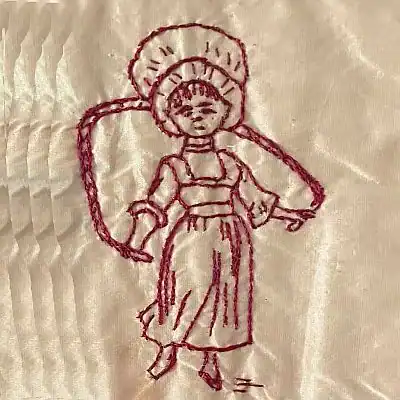
- Authenticating a Suspicious Redwork-Style Quilt — A member questions a quilt sold as antique Redwork, and others date it instead to the later 1930s based on its construction. (see the article on redwork and outline embroidery)
- Dating Fabric by Tan Dye Shifts, 1830s-1880s — A detailed answer walks through how the tans used in quilts changed between the 1830-1860 and 1860-1880 periods. (see the article on natural dyes)
- Re-examining the Saltonstall Quilt’s Age — Members discuss new findings that call into question the Saltonstall Quilt’s status as the oldest known American patchwork.
- Preserving Family Papers and Textiles — Advice on archival, acid-free storage for old letters and clippings, plus a caution against letting a quilt or textile touch the glass when framed. (see the article on repair, restore, or conserve)
- Utah Quilt History and Guild Resources — Members share history and contact information for the Utah Quilt Guild to help a researcher starting a Utah quilt museum project.
Date: Mon, 30 Aug 1999 22:29:29 -0400 | From: “Judy Grow” <Judygrow@>
In case our redwork people have missed this one. It ends tomorrow (Tuesday).
Gone With The Wind – Unusual Vintage Quilt (item #152246116) http://cgi.ebay.com/aw-cgi/eBayISAPI.dll?ViewItem&item=152246116 Do you think this is one-of-a kind, or have you seen it before?
Judy in Ringoes, NJ judygrow@
Date: Mon, 30 Aug 1999 22:56:27 -0400 | From: Alan Kelchner <quiltfix@>
Growing up, guys’ underwear were/was called “skivvies”, and my dictionary uses mens’ undergarments for the definition of skivvy. I do seem to remember that “straight skivvy” meant the unvarnished truth, more or less.
Alan
Date: Mon, 30 Aug 1999 22:59:03 -0400 | From: Alan Kelchner <quiltfix@>
I can’t vouch for it’s worth, but there is a program on the History Channel we may be interested in seeing. Thursday, 09/02, they are playing “Empires of IndustryTextilesBirth of an American Industry”, at 6p.
Alan can you tell I just got the History Channel today?
Date: Sat, 28 Aug 1999 16:53:28 -0400 | From: Alan Kelchner <quiltfix@>
I’ve come across some suspicious quilts here and have a question or two for someone who may have a response.
I was talking to a local auctioneer regarding quilts at auction locally (mainly the lack thereof). He was telling me he’d laugh to himself because people would bid $$$$$$$$ for the Chinese knock-offs, and then I’d step up and get the decent old ones for nothing (this was when he worked for another auction house). Just because the old quilts weren’t the “right” color for home decor.
Anyhow, he described to me a company that asked if they could send quilts to the auction he worked for, for West Virginia women trying to sell their quilts. The auctioneer agreed, and a box of quilts came. But they looked like imports, and didn’t go for much, so along with the check they sent a note stating their intention to NOT sell anymore. The company, West Virginia Quilters Exchange, then sent another box. In this box was a quilt with a DO_NOT_REMOVE label. This box was sold as new quilts and went for very little money, and the next box was returned.
>From what I understand, this company says they are selling quilts for
West Virginia quilters. Yet the checks you send back are made to the Ladies International Quilt Association, rather than the West Virginia group that sends them. Sounds suspicious to me.
This also explains a dealer at the Beaches who has West Virginia quilts – they look like imports.
Anyone know of them?
Alan
Date: Sat, 28 Aug 1999 17:03:34 -0400 | From: Alan Kelchner <quiltfix@>
Not as exciting as HGTV, but I will be lecturing at the local show here on Antique Quilts and Restoration. This will be at Quiltfest, Jacksonville, FL, Sunday, September 19 at 1100 a.m., following the brunch (the caterer is to die for). An opportunity to see some of my collection, if nothing else <g>. The show itself will be Friday – Sunday.
Alan nervous and exciting – people travel from several states away just for this show
Date: Tue, 31 Aug 1999 06:35:30 -0400 | From: “Judy Kelius (judysue)” <judy@>
Thanks for pointing this one out – it’s really neat. I wonder if she could have used a coloring book for the patterns? It will be interesting to see if it sells – IMHO, the price is too low right now. Wish the photos were clearer!
Date: Tue, 31 Aug 1999 06:31:04 -0500 | From: Karen Bush <Birdsong@>
Good morning all! I realized how far behind I was in my digests and ‘the rest of the world’ yesterday when I managed to leave the house long enough to visit my local quilt shop (Liberty Quilt Shop) and they were reading the e-mail from the Kirk’s on their skirmish with their potential quilt thieves. Or, whatever they ‘thought’ they were going to rob. It put the shop owner in a totally different frame of mind as to her shop and security. I had several quilts there that I was using in my classes and for display, so, I brought them home from the shop and they (the owners) are taking a Lot more precautions on their shop’s inventory and security. ]
This is mainly directed to the Kirk’s, I was wondering if you would mind if I used your post to the list to forward to other digests and lists that I’m on. This type of thing happened in our Kansas City area not too long ago. An award winning quilt was on display in the Crown Center area (near the Kansas City Plaza I believe) and the quilt was ripped right out of the showcase window. Right there on the main street. BUT, notices were posted all over the newspapers and magazines country-wide (before internet)…..AFTER the Internet, and people’s previous information on this quilt, it was FOUND and Returned to the owner! it took a while, but, it was found!
When I quilted for clients, this was always a concern of mine, even with a special ‘rider’ on my home-owners, it was always a fear of mine. That and tornados/fire. The normal ‘drill’ around here,if tornado warnings were given was “quilts first, children and pets second” ! ahaha…we had a ‘bucket/quilt bag brigade’ at the basement door. Handing off quilts from trunk (packed in large plastic bags) to basement to an old over-sized dryer downstairs. They all went in the dryer. I figured, they were safer in there, dryer in case of flooding, and if you’ve ever noticed, the pictures After a tornado, refrigerators and washer/dryers “Usually” were left standing. Fires- they went outside and run to the neighbors. LUCKILY, neither of these were necessary, but, used on several occassions, Once with a potential fire in the house, and SEVERAL times with tornados. There just isn’t any way to replace someone’s quilt. Insurance or not.
This post is a LOT longer than I planned on (of course), but to get to the initial question, …about posting the original post from the Kirk’s, I’ll wait for permission, but, will Gladly circulate this ‘warning’ and, hopefully, it will remind everyone just what treasures they have in the shops and homes. o kb
—
Ebay Seller, User namekarenbush
Date: Tue, 31 Aug 1999 05:38:02 -0700 (PDT) | From: Kelle Perreault <kelle_p@>
I am not an expert on the subject… but I was informed that the new featherweight is going to have metal parts. It is supposedly not the same as the last “new” featherweight they tried to come out with – which had plastic parts. I heard this by a few sewing machine dealers and they are excited about it. I am a little skeptical about it but will wait to see it before I decide whether or not it is worth buying. I would never trade in a 221 for it. But it might be a nice little machine and inexpensive.
Kelle from MI
Date: Tue, 31 Aug 1999 08:20:11 -0500 | From: Laura Hobby Syler <texas_quilt.co@>
My recollection is that the phrase is straight “skinny”…… a term that came out of the depression meaning no fat, no excess, no additions….just the bare bones truth…….at least that’s what my 95 YO grandmother tells me.
Laura (she says that skivvies refered to underwear in the military ….. strip down to the skivvies)
Date: 31 Aug 99 09:27:40 EDT | From: PATRICIA KELLER <pat/keller@>
Hello QHL-ers —
I’m usually just a lurker on this list, but I thought you all might be interested in the following information concerning an oral history project I’ve been involved with planning that is starting up at this year’s Houston quilt Festival in October —
There is some information about this project in the large brochure for Festival (page 14)
If you are interested, to register for the training/workshop, please contact Marsha Edington at marshaed@; or telephone Marsha at 713-781-6864, ext. 116; fax is 713-781-6887.
Patricia Keller
Date: Tue, 31 Aug 1999 09:49:24 -0400 | From: laurel horton <kalmia@>
>My question is how do you tell the difference between the tans of the 1830-1860’s and the tans of the 1860-1880.
Dear Sheri,
Your question was specifically about dating the _fabric_ in the quilts you saw, but there are many other factors to consider. The chintz borders caught my eye. Where were these quilts thought to have been made? And how big are they? Are they square or rectangular? In the southeast, quilts from: the first half of the 19th century are more likely to be large and square, while those from the second half are more likely to be smaller and rectangular. Also I suspect that the tan or brown in the border originally might have been green. Also, if the batting is very thin, that would point to the earlier part of the century. And what are the quilting designs? To me, the combination of all these visual and tangible clues would communicate more than specific fabrics. But maybe if I was more knowledgeable about fabrics, I’d use a different approach!
Laurel Horton
Date: Tue, 31 Aug 1999 13:37:17 -0400 | From: “John Cawley” <cawley@>
I am going to the AQSG Seminar in East Lansing, MI in October. I’ll be spending a few days in Ann Arbor before the conference. Does anybody have any suggestions about quilt-related stuff in that area? TIA.
Cinda on the Eastern Shore
Date: Tue, 31 Aug 1999 00:49:42 EDT | From: QuiltFixer@
This is a very interesting quilt but not Redwork I believe. Later, although made like a Redwork Quilt. Probably later 1930s. I have not seen one like it either.
Toni B.
The Redwork Lady
QuiltFixer@
Date: Thu, 2 Sep 1999 22:18:00 EDT | From: Kittencat3@
In a message dated 9/2/99 95635 PM Eastern Daylight Time, QHL-Digest-request@ writes
<< When did they start using wood pulp in paper >> Not sure of the exact date, but definitely not in 1705. Wood pulp paper came into widespread use in the 19th century, which is why 19th century books deteriorate more quickly than 18th century books. Rag paper (now usually cotton) is still better quality and lasts longer, which is why most legal documents are printed on at leas 25% rag paper (says the former legal secretary ) ).
Lisa Evans
Date: Thu, 2 Sep 1999 23:24:01 EDT | From: AlineMcK@
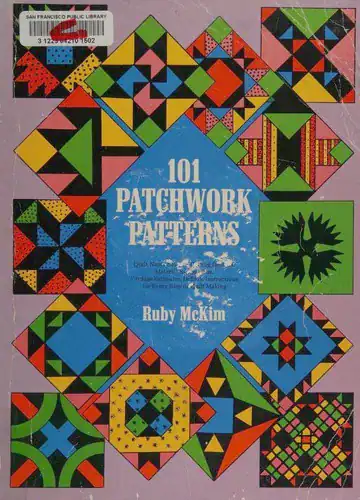
I got my grubby little paws on what looks like a 1930ish booklet on quilt patterns from Kansas City. Just 16 pages, stapled, printed in black, red & green. Title is “Quilts 14 Quilt Patterns Plus Borders and Quilting Designs, No. 3614.” Back cover has imprint of “Colonial Patterns Inc, Kansas City,
Missouri 64105. “
Wait a sec…ZIP codes didn’t come into use until the 1960s, IIRC. So forget the bit about the 30s. But the patterns are still very 30ish…dogwood, pansy, baskets, “indian plume,” etc. And the illustrations show feed-sack-looking fabric in all the examples. Maybe they just never updated it.
Anyway, I got it, and it’s in OK condition. Swap someone for a fat quarter!
Aline
Date: Thu, 02 Sep 1999 23:36:15 -0500 | From: Jennifer Perkins <qltrstore@>
I have recently come into posession of an incredible amount of family history papers…a deed dated 1805, letters from the mid 1800’s, newspaper clippings from the late 1800’s on…what should I do to preserve these things??? The newspaper clippings are the ones in the worst shape now and I’m wondering if laminating them is a good idea? I know I do that with modern newspaper to preserve it. What about the old letters that are crumbling on the edges?? I just know someone on this list can help! I’m looking forward to seeing some of you at QRC in Omaha next week! Do you know that we’ll have a celebrity (another one -)) with us?? Brenda Papadakis, author of the Dear Jane book will be joining us for the entire conference! She is really a neat person, you’ll like her!
See you soon!
Jennifer in Iowa
Date: Fri, 3 Sep 1999 00:55:38 -0400 | From: “Judy Grow” <Judygrow@>
>The Saltonstall Quilt, previously credited as the oldest American
patchwork,
>has been recently examined; its supposed 1704 date is in doubt. Ann Farnham, curator of the Essex Institute in Salem, Massachusetts, where the quilt is now preserved, believes it to date from somewhere between the late eighteenth and the mid-nineteenth centuries, despite the date of 1701 on
the
>papers basted behind the pieces. Although the pattern and style are consistent with eighteenth century quilts, the fabrics appear to be from
the
>mid- to late nineteenth century.”
In the early 1970’s while doing reasearch for my book, “Creating Historic Samplers,” I had access to the storage facilities of the Essex Institute. I was led through the original stone foundation basements to a room hidden in the back with a long and tall blond wood drawer unit, with literally thousands of samplers stored flat, any number to a drawer, separated from the ones above and below by sheets of tissue (acid free, I presume.) Upstairs, on exhibit, were exactly 3 samplers, including the earliest one done in America.
We walked through rooms of metal shelving with hundreds of leather fire buckets stored thereon. And there was probably only one upstairs on display.
I hope in the intervening 25 years the Essex Institute has added some sort of de-humidifying and climate control system in their storage areas. Even then, before I knew anything about conservation, I sensed that something was not right!
I don’t remember seeing any quilts then, in storage or on display, but you must remember, I had a publisher and a due date, and I was kind of single sighted!
Judy in Ringoes, NJ judygrow@
Date: Fri, 3 Sep 1999 01:09:51 -0400 | From: “Judy Grow” <Judygrow@>
JuLee,
Go to the bookstore. There are at least 2 books on Utah quilts, maybe more. The state quilt search has already been done.
“Gathered in Time. Utah Quilts and Their Makers, settlement to 1950.” By Kae Covington, and published by the University Of Utah Press in Salt Lake City in 1997. It is a paperback, 154 pages, with lots of wonderful color photos.
Also look for “Quilts and Women of the Mormon Migration” by Mary Bywater Cross, published by Rutledge Hill in Nashville Tenn. in 1996. It is a paperback of 251 pages with lots of color and black and white photos, and costs $24.95.
I am sure that in both of these books the names of Utah quilt historians and other interested parties with whom you could ally yourself can be found. Volunteering at the Utah Pioneers Museum would be a good way of learning about museums and getting to know the people who are interested in quilting history.
Judy in Ringoes, NJ judygrow@
>There is not quilt museum in Utah. The daughters of the Utah Pioneers Museum has a wonderful collection of quits but they are not displayed very
well. >They are always folded in cases. We never have quilt shows here. We never
>get wonderful seminars by so many of you who do them. There is no research library that I can find. There’s no Utah Quilt project going like the ones in Tennessee or Rhode Island. Am I just missing all this stuff? Is there someone who knows more than I do about what’s going on?
Date: Thu, 02 Sep 1999 22:41:47 +0000 | From: Audrey Waite <awquiltr@>
Hi JuLee
I have a brochure from the Utah Quilt Guild and they were formed in 1977. They have an annual meeting in the fall which includes a show, workshops and merchants mall. Why don’t you contact them to see if you can attend a local chapter; once you get known there, then you might approach the state guild to see if they would be interested in helping you. Their address is P.O. Box 17032, Salt Lake City, UT 84117. They have chapters all over the state. Good luck!
Audrey Waite in Sedona, aZ
Date: Thu, 02 Sep 1999 22:50:06 -0700 | From: Barbara <qwhiltr@>
> I once interviewed a quilter in
> Lewiston, Idaho, who said her mother’s brother had worked in Warner Bros.? wardrobe. He had sent home leftover scraps of costume fabrics and some were from Scarlett’s/Vivien’s dresses from the movie, from which her mother had made a quilt. T or F? I guess we believe what we want to believe.
—————–
I don’t see why it wouldn’t be possible. Almost ten years ago, when I began teaching sewing and needlearts classes for adult education, I had a retired lady in class who had worked at the studios and saved the scraps. She was making a gorgeous crazy quilt out of the most expensive lush velvets, satins, etc. She told me she had helped make costumes for some of the major productions of the ’50s and ’60s, such as My Fair Lady and The King and I. Even folks in Idaho have relatives in the biz! <g>
Barbara Black in southern California
Date: Fri, 03 Sep 1999 05:44:23 -0400 | From: “Judy Kelius (judysue)” <judy@>
When I first took up quilting around 1970, I found some of these pattern books (new) at our local farmer’s market and such places – they appeared to be reprints from an earlier time. I still have them somewhere! I remember at that time there was very little available – I subscribed to QNM, which was very quaint and set up on a typewriter – the quilt revival was just starting. I was buying everything I could get my hands on. (Now if my father would have just listened to me and bought that $3,000 quilt we saw at an auction that several years later sold for $100,000+!)
At 1124 PM 9/2/99 -0400, AlineMcK@ wrote
>I got my grubby little paws on what looks like a 1930ish booklet on quilt patterns from Kansas City. Just 16 pages, stapled, printed in black, red & green. Title is “Quilts 14 Quilt Patterns Plus Borders and Quilting Designs, No. 3614.” Back cover has imprint of “Colonial Patterns Inc, Kansas City,
>Missouri 64105. “
>Wait a sec…ZIP codes didn’t come into use until the 1960s, IIRC. So forget the bit about the 30s. But the patterns are still very 30ish…dogwood, pansy, baskets, “indian plume,” etc. And the illustrations show feed-sack-looking fabric in all the examples. Maybe they just never updated it.
>Anyway, I got it, and it’s in OK condition. Swap someone for a fat quarter!
>Aline
Date: Fri, 03 Sep 1999 07:26:50 -0500 | From: Laura Hobby Syler <texas_quilt.co@>
The feedsack books were snatched up very quickly. I may be able to acquire some more. I’ll check. If I can I’ll let you know.
Don’t forget to mark your calendars……
HGTV…….(the Home and Garden Channel on your cable dial<G>)
November 5…..10PM Eastern
November 25 10PM Eastern (Thanksgiving Day)
Quilts Threads of our Heritage
Don’t miss the opening 15 seconds, I’m the one in the navy dress<G> If you need press releases for your guild newsletters let me know. They are working on flyers for Cindy and me to take with us when we lecture and appraise and I’ll have them in Houston. I might be able to send a couple of those to you….will have to wait and see what they look like.
Enjoy the holiday weekend, and be safe!
Laura
Date: Fri, 03 Sep 1999 09:00:24 -0400 | From: “jawhite@” <jawhite@>
Somewhere in my files I have a brochure on how to archive old paper and companies that sell supplies, etc. I collect old newspaper quilt patterns; KC Stars, Alice Brooks, etc. Mind you I’m not suggesting you do this – I’m only telling you what I have done. Once upon a time, someone gave me an old account journal from the early 1900’s. In this journal, someone had kept accounts from a general store and the writing was still visible. Somewhere along the way, old newspaper quilt patterns had been pasted over these pages and were stuck tight. Wilene Smith suggested that I ‘wash’ the paper and told me how to do it. The patterns came unstuck and are perfectly fine today and the old journal pages were still readable. So I know for a fact that old paper is much more substantial than new paper. If I find the brochure I’m looking for, I will email you the info. Good luck.
Judy White – Ct
Date: Fri, 03 Sep 1999 09:37:58 -0400 | From: “jawhite@” <jawhite@>
I found it. I knew I had a source for archival supplies. In a newsletter from the Thornton Burgess Book Collectors, Oct. 1996, the museum curator, Kristine L. Hastreiter, listed some suggestions for preserving collections and she gave me permission to pass them along to whomever. There are 8 very good points, quite long, which apply not only to paper but to old books as well. Anyway, it says, “if you want to keep clippings from a newspaper for the ‘long term’, have them photocopied onto acid=free buffered paper, (e.g. Howard Permalife). The copy will outlive the original.”..
“Letters, clippings and other documents you may want to preserve should be shored unfolded in buffered folders or flat boxes. Folding and unfolding breaks paper (and textiles) along the fold lines. Standard office manila folders are a source of acids.”
These suggestions were adapted from The Northeast Document Conservations Center’s _General Preservation Technical Leaflet_.
Sources for Archival Supplies
University Products, 517 Main St., PO Box 101, Holyoke, MA 01041-0101, 1-800-628-1912; Light Impressions, 439 Monroe Avenue, PO Box 940, Rochester NY 14603-0940, 1-800-828-6218; Hollinger Corporation, 3810 S. Four Mile Run Drive, PO Box 6185, Arlington, VA 22206, 1-703-671-6600.
Judy White – Ct
Date: Fri, 3 Sep 1999 17:07:18 EDT | From: Chyral@
The Dublin Seminar article on “Early American Silk Patchwork Quilts” by Deborah E. Kraak focuses on the four known extant quilts of this type and of documented America provenance. They are the Saltonstall quilt, (1800-1810, made in Mass., in the collection of the Essex Institute) the Abercombie quit top (1780-1800, probably made in Mass., in the collection of SPNEA), the Martha Agry Vaughn quilt (ca. 1805, made in Maine, in the collection of Winterthur Museum) and the Posey quilt (ca. 1810, made in Virginia, in the Dumbarton House Collection, Headquarters of the National Society of the Colonial Dames of America, Washington, D.C.) She remarks that despite the wide-ranging geographic origins of these four quilts, they are “remarkably similar in style and construction,” each being a framed center (or medallion) quilt; with origins that can be traced to late 17th and early 18th century English quilts. (5 of the 6 extant 18th century English made quilts are also medallion style; the earliest being the 1726 McCord Quilt.) On the subject of the materials of the Saltonstall quilt she writes, “The Saltonstall quilt is unusual for having few recognizably English silks; most appear to be European.” Footnote “The silks in the Saltonstall quilt are very puzzling and defy easy categorization, either for places of manufacture or date – particularly since the quilt pieces are so small, and the patterns are fragmentary. The author examined the quilt in April 1997 and February 1998; the silks appear to be mostly 18th century, but few patterns are ‘typical’ of 18th century styles. Eighteenth century textile scholar Natalie Rothstein (former Keeper of Textiles and Dress at the V&A Museum) studied detailed photographs of the quilt. According to Rothstein, a few textiles appear to be late 17th century, and some may even be early 19th century. Because of strong eastern (design) elements in many of the silks, it is possible that a large percentage of the silks were woven in the Orient for the western market.”
The quilt has been rebacked with modern fabric, and it was not possible to determine if an original backing had been removed or had never been there originally. Several threads were used for the piecing, including linen, and other fibers that defied visual identification.
“The paper templates in the Saltonstall quilt were cut from three different copies of the 1700 Harvard graduation broadside… In 1934 these templates were removed from the quilt, and donated to the Mass. Historical Society. The 1700 broadsides illustrates the danger of using dated templates to assign a date of completion for the quilt. For many years, on the basis of the templates’ dates and family tradition, the Saltonstall quilt was considered to be the earliest example of a dated American quilt. However, even though there are examples of silk which may have been woven at the end of the 17th century, the majority of the silks were made in the 18th century. A few even date to the early 19th century. Remaining ion the Saltonstall quilt are templates with inked inscriptions in a yet unidentified language, which may even be a type of shorthand. If the templates can ever be deciphered, they may contribute more to our understanding of the quiltmaker’s environment.”
My additions
The Martha Agry Vaughn quilt is fig. 126 in “Plain & Fancy”, and fig. 78 in “A Winterthur Guide to American Needlework”, both by Susan Burrows Swan.
Date: Fri, 03 Sep 1999 20:08:21 -0400 | From: “jawhite@” <jawhite@>
John Cawley wrote
> The Kansas site, in discussing how the Saltonstall quilt was
originally
> dated, states “at one time it was a common technique to cut the quilt
pieces
> out of paper and piece them together before starting in on the fabric.” Ouch!
> This is from a newsletter, published by Emporia State University,
intended
> for history teachers.
> Cinda on the Eastern Shore
I just clicked on the Emporia site and read the above statement. I believe they got their info from the Orlofsky book, _Quilts in America_. On p. 19 of that book, it says, “The period of the making of the quilt has been confirmed ingeniously. A common technique used in piecing a quilt involved cutting the quilt pattern out of paper–newspapers, letters, scraps of whatever was available–over which the material was basted and then sewn together or to a set. The paper interlining was frequently left in the quilt to serve as an added layer of insulation against the cold. When the textile covering becomes worn, or is pushed back, the paper will show through. The Saltonstall Quilt reveals such an interlining of paper bits of a Harvard College catalog of 1701.” I would say that whoever wrote the Emporia description maybe is not a quilter but a historian and when she put it in her own words, she left out or did not understand the sentence, “overwhich the material was basted” and thought the whole quilt was first made out of paper and then the quilt top basted to the paper foundation. Just an observation.
Judy White – Ct
Date: Fri, 3 Sep 1999 22:53:29 -0400 | From: “Judy Grow” <Judygrow@>
>I have recently come into posession of an incredible amount of family history papers…a deed dated 1805, letters from the mid 1800’s, newspaper clippings from the late 1800’s on…what should I do to preserve these things??? The newspaper clippings are the ones in the worst shape now and I’m wondering if laminating them is a good idea? I know I do that with modern newspaper to preserve it. What about the old letters that are crumbling on the edges?? I just know someone on this list can help!
Jennifer,
My suggestion is NOT to laminate the crumbling old papers. Like Hippocrates, we in the picture framing business try not to do anything that cannot be totally reversed. Laminating is a permanent process, like using a fusible on a fabric. And we all know that once fused, always fused. If the smaller documents, like the letters, will fit in top loading, acid free 3-hole punched sheet protectors that you can buy by the box at Staples or Office Max, please use them instead. That will keep them preserved and protected from handling.
The larger papers, including the newspaper clippings should be encapsulated. I do this all the time at the frame shop with very fragile older papers that will not stand ( really) being framed as they are.
Step 1. Go to the art supply store and buy a roll of MYLAR (not acetate) and a roll or two of 3/8″ adhesive transfer tape. The mylar should be at least 4 inches wider than the widest document you will be working with. Step 2. Cut 2 pieces of mylar for each document to be encapsulated. If your document is 11 by 14 be sure to cut the mylar at least 15 x 19. Tape one piece loosely down to your large cutting mat. You should be able to see the inch markings on the mat through the mylar.
Step 3. Lay down a line of the adhesive transfer tape on the line at least 1 inch larger than the item to be encapsulated, e.g. at 13 and 16. Do not remove the carrier paper until all four lines are laid down. Step 4. Carefully place the document on the mylar, centered in the open space. Be sure not to let it touch the tape.
Step 5. Carefully roll the 2nd piece of mylar down over the first, and press to adhere them to each other.
Step 6. Using your rotary cutter and ruler, cut the excess mylar away just outside the tape.
You now have a fully encapsulated document, perfectly preserved. Last year a NJ state trooper came into the store with a handful of newsprint broadsides taken from the basement of the Trooper headquarters in Trenton. These were part of a trove that had been stored in a cardboard box in the damp basement, and were being thrown out. He saved a few that had been on the top of the pile, and didn’t absolutely crumble when he picked them up. What they were were lists of the serial numbers of the bills paid out in the Lindberg baby kidnapping. These handbills were sent all over the country hoping someone would identify the money and the kidnapper would be caught. These were the leftovers. We encapsulated at least 3 of them for him, and one for me! I served on the committee that got the Lindberg house placed on the State and National Historic Registers, so this was special . I framed mine so that it looked as though it was floating. There were 2 mats, one on the front and one on the back, with the openings cut 1/2″ larger than the document itself. With glass on the front and the back, it truly looked as though it was suspended in mid-air. I donated this to the township as a momento of our committee’s work and it hangs in one of the meeting rooms.
Judy in Ringoes, NJ judygrow@
Date: Fri, 3 Sep 1999 23:32:51 -0400 | From: “Judy Grow” <Judygrow@>
>Anyway, it says, “if you want to keep clippings from a newspaper for the ‘long term’, have them photocopied onto acid=free buffered paper, (e.g. Howard Permalife). The copy will outlive the original.”..
It probably will, if it is not folded and unfolded and handled and stored in inappropriate places. But it won’t have the emotional importance to future generations that the original will have — if properly handled and protected and stored. JG
More on encapsulation — including a sheet of buffered paper the same size and shape as the document to back it in the enclosure can slow the inevitable rate of deterioration. JG
>”Letters, clippings and other documents you may want to preserve should be stored unfolded in buffered folders or flat boxes. Folding and unfolding breaks paper (and textiles) along the fold lines.
Human oils from hands aren’t good for any paper. The sheet protectors and mylar encapsulation, besides protecting from oils, also add support so that the documents don’t bear their own weight. JG
>These suggestions were adapted from The Northeast Document Conservations Center’s _General Preservation Technical Leaflet_.
Early this summer I took a 4-week free internet course on basic paper preservation offered to small collections-holding institutions and historical organizations from NEDCC. The focus was on preventive preservation, and gave basic information and practical solutions to help improve storage, care, and handling, and addressed environmental issues. JG NEDCC’s address is
100 Brickstone Square
Andover, MA 01810-1494
Tel 978-470-1010
Fax 978-475-6021 http://www.nedcc.org
Instructions for encapsulation are in technical leaflet Conservation Procedures, Section 6, Leaflet 5 which can be seen at www.nedcc.org/tleaf65.htm
Many more of their technical leaflets are on line. In fact, if you go to their web-site and print out everything, and follow their links, and actually read and study everything, you too can become an easy expert on basic conservation procedures. I have filled two very large binders with all the information I gleaned from their web site. JG
>Sources for Archival Supplies
>University Products, 517 Main St., PO Box 101, Holyoke, MA 01041-0101, 1-800-628-1912;
info@ http://www.universityproducts.com a source for polyester film
> Light Impressions, 439 Monroe Avenue, PO Box 940, Rochester NY 14603-0940, 1-800-828-6218;
> Hollinger Corporation, 3810 S. Four Mile Run Drive, PO Box 6185,
Arlington, VA >22206, 1-703-671-6600.
Let me add
Archivart
7 Caesar Place
P.O. Box 428
Moonachie, NJ, 07074 phone 201-804-8986
Fax 201-935-5964
Gaylord Bros.
P.O. Box 4901
Syracuse, NY, 13221-4901
1-800-448-6160 help line 1-800-428-3631 http://www.gaylord.com
Talas
568 Broadway
New York, NY, 10012 phone 212-736-7744 fax 212-219-0735
Conservation Resources International
8000-H Forbes Place
Springfield, VA, 22151 phone 703-321-7730 fax 703-321-0629
A source for Polyester Film
Judy in Ringoes, NJ judygrow@
Date: Sat, 4 Sep 1999 07:33:36 EDT | From: JBQUILTOK@
I bought several of these books – can’t remember the date, but didn’t start really buying pattern books till about 1989. Mine came from Hancock Fabric & were priced $1.75. A couple have stickers from Ben Franklin @$2.25. Quilt Lover’s Delight – Patterns for Cutting Guides with Complete Directions (7 applique 10 pieced) No 3540
Quilts – 14 Quilt Patterns Plus Borders and Quilting Designs No 3614 Patchwork – Plain and Simple No 3779
Quilts Modern – Colonial (15 Pieced 4 Applique) No 3333 Easy Quilts (12 Pieced 4 Applique) No 3500
Quilt Designs Old Favorites – and New No 3175
Quilts Heirlooms of Tomorrow No 3780
Bold and Beautiful Quilts No 3778
Aunt Martha’s Favorite Quilts (17 Quilt Patterns Pieced and Appliqued) No 3230
The backs of these advertise the other booklets & some transfer patterns. I think I have the entire set. Anyone know of any others? Anyone seen these in stores lately?
In a message dated 9/3/99 44437 AM Central Daylight Time, judy@ writes
<< When I first took up quilting around 1970, I found some of these pattern books (new) at our local farmer’s market and such places – they appeared to be reprints from an earlier time. I still have them somewhere! I remember at that time there was very little available – I subscribed to QNM, which was very quaint and set up on a typewriter – the quilt revival was just starting. I was buying everything I could get my hands on. (Now if my father would have just listened to me and bought that $3,000 quilt we saw at an auction that several years later sold for $100,000+!)
At 1124 PM 9/2/99 -0400, AlineMcK@ wrote
>I got my grubby little paws on what looks like a 1930ish booklet on quilt patterns from Kansas City. Just 16 pages, stapled, printed in black, red & green. Title is “Quilts 14 Quilt Patterns Plus Borders and Quilting Designs, No. 3614.” Back cover has imprint of “Colonial Patterns Inc,
Kansas
>City,
>Missouri 64105. “
Date: Sat, 04 Sep 1999 09:59:48 -0500 | From: Laura Hobby Syler <texas_quilt.co@>
Judy, not to put you out of business or anything,<,G> but if people don’t have a framer in their area that they know or trust, The Container Store <G> has a wonderful “Clip Frame”….2 pieces of glass with little brass clips that hold them together. Comes in standard photo sizes …up to 11×14 (I think) you can order these by mail or by phone….1-800-733-3532 I’ve used these to frame vintage fabrics and blocks…..really neat!
Laura who in a weak moment decided to take a part time job at The Container Store….and how hasn’t seen much of her paychecks since then <G>
>I framed mine so that it looked as though it was floating. There were 2 mats, one on the front and one on the back, with the openings cut 1/2″ larger than the document itself. With glass on the front and the back, it truly looked as though it was suspended in mid-air. I donated this to the
Date: Sat, 4 Sep 1999 11:57:50 -0400 | From: “Judy Grow” <Judygrow@>
Laura,
It’s never a good idea to smack any artwork, textile or paper, right up against the glass. Glass, being hygroscopic attracts moisture, which condenses on the inside surface. If your “art” is right up against the glass it will grow mould (textile) or fox (paper). Notice, I said I put a mat on the front and the back of the encapsulated art before I put the 2 pieces of glass on. Those mats formed an air space, keeping the art (encapsulated or not) away from the glass. I don’t think there is room in your Container Store clip frame to add 2 mats. But I could be wrong. I know there isn’t that kind of space in the clip frame that we sell.
Judy in Ringoes, NJ judygrow@
Date: Sat, 04 Sep 1999 11:45:52 -0500 | From: Laura Hobby Syler <texas_quilt.co@>
Judy,
Thanks for the clarification. I know that there is one mat, and I havn’t used it when I did my display….but then I change them out periodically, so they are not perminant. I’ll check and see if there is room for 2 mats tomorrow when I work and report back.
That’s what I love about all of my friends on this list! We are constantly learning from each other !
Laura
At 1157 AM 09/04/1999 -0400, Judy Grow wrote
Date: Sat, 04 Sep 1999 16:12:57 PDT | From: “JuLee King” <piecingitogether@>
Thanks everybody for your support. I saved all of your messages so that I can re-read them when I get discouraged. I am not giving up on opening a museum. I am volunteering at the Daughters of the Utah Pioneers Museum. No one gets paid there, it is all volunteers. They are wonderful ladies. The LDS church has a museum with quilts and other textiles but nothing exclusive. I am going to get in touch with the Utah Quilt Guild. Thanks again for all of your help. I will let you know how it goes or if I need advice. Could someone please e-mail me privately with Jeanne Fetzer’s e-mail address? Perhaps she would like an apprentice.
Love you all,
JuLee in Utah