February 23, 1999
These restored messages come from the Quilt History List, an online forum where quilt historians, collectors, researchers, appraisers, and enthusiasts discussed antique quilts and related textiles. The archive dates from 1996 through approximately 2016 and is being restored gradually. Sign up in the form at the bottom of the page if you want to know when a new page is added. Original spelling, opinions, formatting, and inactive links may remain unchanged.
Primary topics of this QHL Digest:
- The Australian Prison Quilt Auction — Lorraine in Oz questions a “Prisoners’ Quilt” listed for online auction, pointing to shifting dates, quilting added in 1996, and convict transport that ended well before 1880.
- QuiltCollector Auction Site — A press release announces a new online auction site just for quilts, with the prison quilt as an opening feature.
- Hidden in Plain View, Seen from Copenhagen — A Danish historian who works with oral traditions explains how she weighs sources and why weak scholarship bothers her.
- The Happy99 Worm and Missing Posts — Members report digests with missing messages and thank the list owner for handling the virus scare.
- Log Cabin Origins — An English member wonders whether the Log Cabin pattern echoes the strip fields around medieval British villages.
- Quilt Heritage Foundation and a Quilters’ Tour of Britain — Nancy Kirk explains what her foundation sponsors, and a member promotes a small-group quilting trip to Britain.
Date: Tue, 23 Feb 1999 00:00:05 EST | From: KareQuilt [at] aol [dot] com
Dear QHL,
The last two QHL Digests that I have received (#51 & 52) contained a long list of posts in the table of contents, but as I scrolled down to read them, I realized I only received about four posts each time out of all those listed in the T of C. Can someone from QHL respond to me privately. I cannot read all the posts when I open the Digest. Is this the “worms” doing? What a mess.
Karen
Date: Tue, 23 Feb 1999 00:02:21 EST | From: KareQuilt [at] AOL [dot] COM
When I say I cannot “read” all the pots, I really mean they don’t even appear following the table of contents. Only maybe the first four posts on the list appear in the” body” that follows. Is anyone else experiencing this problem!! I have “missed” all kinds of posts I would love to read! What has happened?
Karen
Date: Tue, 23 Feb 1999 01:24:56 EST | From: Kathi2174 [at] AOL [dot] COM
From Mark Kriss mkriss [at] quiltcollector [dot] com
Dear Charter Members and Friends of QuiltCollector,
For your information and reference, I’m enclosing below a press release about the new QuiltCollector auction website which will be on the PRNewswire tomorrow morning.
Feel free to forward, copy or post this release to your friends, colleagues, news groups or guilds who may have an interest. Thanks in advance for helping to get the word out about our new auction website!
Best regards,
–Mark Kriss, Director
Rare Australian “Prison Quilt” to be Auctioned on the Internet; New Online Auction Features Quilts of Great Historic Value PALO ALTO, Calif., Feb. 23 / PRNewswire / — A rare 120-year old Australian “Prisoners’ Quilt” is one of many quilts of historic value to be offered on the new QuiltCollector.com auction website.
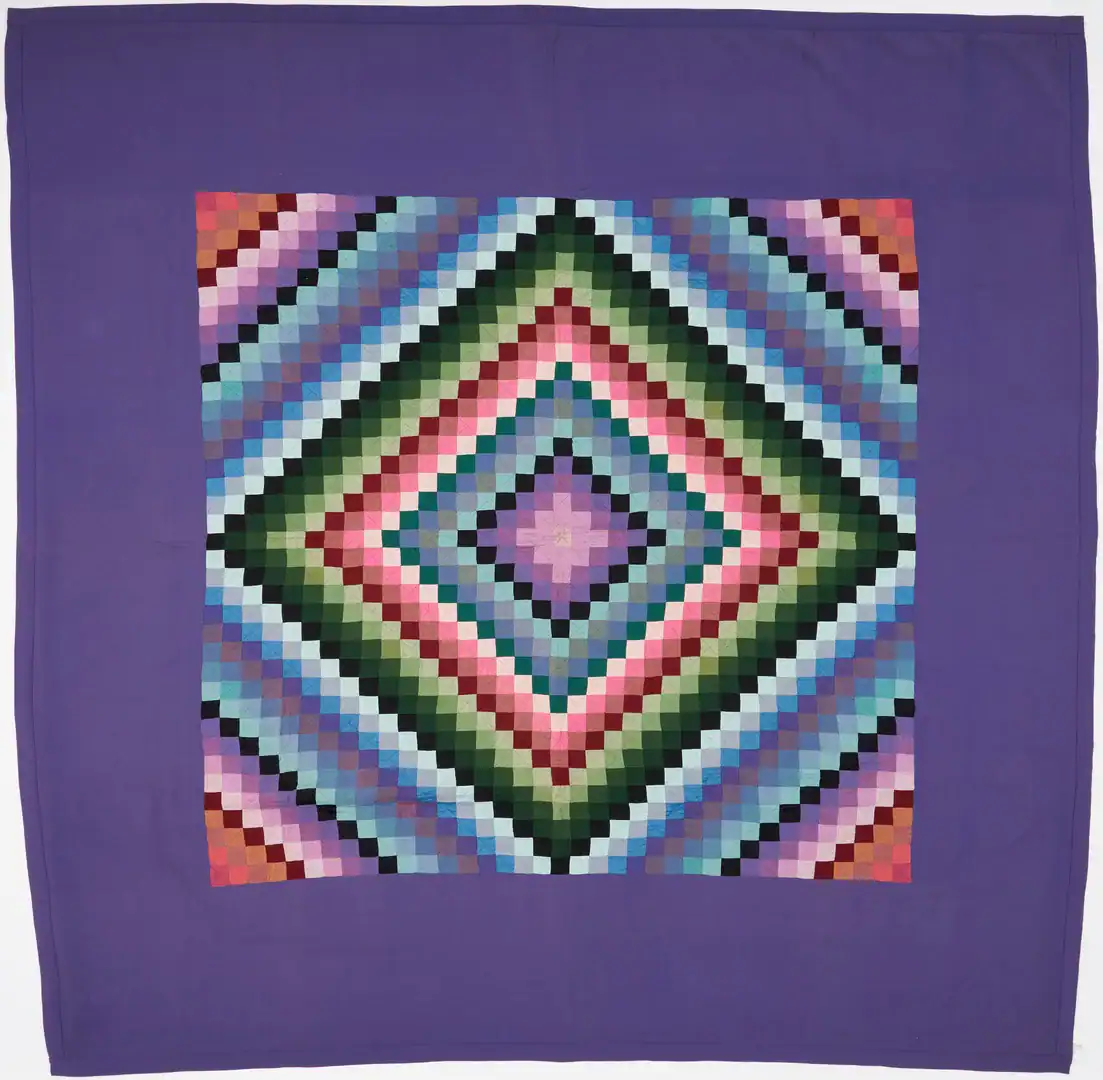
See photo at http://www.quiltcollector.com/prisoner300dpi.htm The museum-quality “Prisoners’ Quilt” is one of probably only two or three in existence. It is among the quilts to be in the Opening Auction (date to be announced April 5) on the new website which gives collectors and home/office decorators the opportunity to easily purchase antique quilts of great historic value. See http://www.quiltcollector.com “This quilt was made by women prisoners while on board a ship en route from England to Australia circa 1880,” says Mark R. Kriss, managing director of QuiltCollector. “The women, who were being sent to become wives of Australian settlers, were each given three pieces of fabric to cut and sew into small triangles. These pieces were then combined into the single Prisoners’ Quilt.”
QuiltCollector is the only online trading community just for quilts, Kriss says. Unlike “flea-market” online auctions that offer dozens of different categories of goods for sale, QuiltCollector buyers can select from over a dozen quilt-specific sub-categories, Kriss says. “The timing of this new service is excellent,” says Diana Leone, a distinguished quiltmaker, author and owner of a large antique quilt collection that includes the Australian “Prisoners’ Quilt”. “Quiltmakers and quilt owners need an outlet for their pieces, and a friendly quilt-centric place to shop, learn and meet people.”
Categories of quilts to be available include abstract–traditional and non-traditional patterns; African-American; Amish; applique; collage; coverlet; crazy; Hawaiian; patchwork; whole cloth; as well as antique & toy sewing machines, quilt books, and quilt memorabilia.
All listings include photographs, and are keyword searchable. A “Certificate of Authentication” service is available to help reassure buyers of the authenticity and value of the antique quilts on auction. Submissions for QuiltCollector’s Opening Auction are due March 31. See http://www.quiltcollector.com.
SOURCE Sandhill Arts (parent company of QuiltCollector) CONTACT Mark R. Kriss, Sandhill Arts, 650-857-9035 or email mkriss [at] sandhillarts [dot] com
– – – – – – – – – – – – – – – – – – – – – – – – – – – – – – – – – – + Mark Kriss mkriss [at] quiltcollector [dot] com
Date: Tue, 23 Feb 1999 10:00:37 +0100 | From: “Tilde Binger” <binger.hougaard [at] get2net [dot] dk>
First, thank you to all who responded to my question re. Hidden in Plain view.
I am not going to write an answer any of the specific comments made here (or to me privately), but only to give a more general comment, mostly because I need to. I work, professionally, with history and the writing of history, with oral traditions and with evaluation of sources. I am NOT, however, a quilt-historian, and my knowledge of US-history is very basic. Also – belive me – in my specialized field the black vs white “fight” (and I am not referring to anything as immaterial as colour of skin here -) is far worse than most of you can imagine. Since this is the case, it is very, very important, that one’s method is sound, and that the data is solid. It is the existence of data that makes your case. To argue with “we might not have found yet” or “this might concievably have happened…” is shoddy method. To argue from what is not there is a definite no-no in scholarly history writing (but still it happens). If data is what shows (proves) a thing to be so absense of data can never do the same. If it did, anything would be or could be true, and everyone could write the history s/he would like. Since this be-lies the purpose of (scholarly) history-writing, arguments from silence are strictly forbidden.
History and the writing of history can also never depend on whether one likes the results or not (again, it is frequently presented as such, but this is also shoddy worksmanship). If one is committed to the writing of history, one has to work with the data, the solid data, that is there, and to work with it all. No more, no less. If this leads one to conclusions that are different from what one expected or which one does not like, there isn’t a whole lot one can do about it (well, not publish it, but then someone else will, eventually -). If no data exists, the history is no longer history, but story.
Since this is the case, and from what I have been told so far, “Hidden in Plain View” is story, and thus folklore. Folklore is interesting, IMO very interesting, but it is not history or history-writing in the sense we in the late twentieth century percieve history-writing (i.e. as reports of fact and reconstructions of the past from the extant data).
Oral tradition is part of folklore and of folklore studies, and is also a mighty interesting thing. But Oral tradition is …. not to be relied on when one wants accuracy of data (anyone interested can write me and get the title of the long, very high-brow, very longhaired and very, very boring basic study on this). Oral tradition can be profound, can carry important nuggets of “historical data” and can even have a “kernel of fact”. Problem is, it is impossible to discern from the tale itself, what is fact and what is fiction. One has to have access to other sources in order to falsify or verify any given oral tradition with regard to its historicity (that is, how reliable it is in the facts dept -).
Now, imagine (and this is fairly recent history) that there are no written sources. No-one can read, no-one can write. Unless you are of an age where you were an adult in 1950, how would you discern between the Korea-war and the Vietnam war ? Same general area, same general problem, far away from where you are and were living. Anyone under the age of 40 would -without written sources – have great difficulties discerning between the two, and a good number would not even know they happened at all. Now, move back a bit. If there were no written records, how much would you know of something that happened 100 years ago ? 150 years ago ? 200 years ago ? Some information would stay in certain circles, particularly if it was tied up with specific items, but in general, the third generation is where oral traditions disappear. If history-writing depends on data in order to show that things happened in a certain way, oral tradition is not valid data. When all this is said. I will say that I find the story that quilts (and, for that matter any other type of inconspicuous household items) could be used as signals, very believable (this is mostly based on data from the various european “undergrouds” that existed during WW2, where the placement of a vase of flowers could mean the difference between life and death). Finding it believable, however, is not the same as it being true. It is a wonderful story. It is believable. We might as well get used to it. However, from what you all have told me, I also do not believe that the story which is told is factual. “True” perhaps, but hardly factual. I hope I have not stepped too much on anyone’s toes, it’s only that history in all its aspects is important to me, and shoddy works(wo)manship gets my hackles up.
Thank you for your time
Tilde
In Copenhagen
Date: Tue, 23 Feb 1999 09:59:44 -0000 | From: “Sally Ward” <sward [at] t-ward [dot] demon [dot] co [dot] uk>
The Happy 99 worm has indeed been a troublesome episode, but it is the first in my many months on the list and there have been so many warnings about it that it should not have been a surprise that it turned up eventually. Kris maintains the list voluntarily and I am sure has many other things to deal with in her life. As we (should) all know not to open unsolicited files, I am happy to screen my own mail in return for the enjoyment and education QHL gives me. (even the Garden of Eden had worms….)
Sally
Date: Tue, 23 Feb 1999 15:05:04 -0000 | From: “Audrey Cameron” <audrey.cameron [at] virgin [dot] net>
Hi Everyone,
How is everyone feeling after the happy” excitement? I hope that’s the end of it but I suspect not.
Anyhow for some information on the origins of “log cabin”. There is a strong feeling that it may be British in origin & brought to the New World by Scotish & Irish emigrants.
If one looks at old medieval maps you will see that the characteristic makeup of small farms was in a long, narrow strip & a medieval village would be surrounded with a “log cabin quilt pattern” of these strip fields. Several strips scattered all over could beheld or be worked by one farming family. Could this be the origin of the pattern? There is no evidence one way or the other but it is interesting.
One of the earliest uses of this pattern was on an English perfume bag dating to 1650. The first known full quilts date from Victorian times probably about 1850 & are quite common in Scotland. Averil Corby, the veneranted English quilt writer, attests to a women from Stirlingshire (Scotland) who had log cabin quilts made from patterns handed down in the family from the “Forty Five.” ( The Jacobite Uprising of 1745 – Bonnie Prince Charlie & all that.)
The earliest example of a log cabin quilt was made of shirting fabrics in 1860 & is in the Bowes Museum, Barnard Castle in County Durham. The above information is from Janet Rae’s book The Quilts of the British Isles which I believe is out-of-print.
Audrey Cameron on a beautiful sunny, but cold day in England audrey.cameron [at] virgin [dot] net
Date: Tue, 23 Feb 1999 11:14:06 EST | From: KirkColl [at] aol [dot] com
1) The Quilt Heritage Foundation is the non-profit (501-c-3) corporation we formed two years ago to sponsor the Quilt Restoration Conference and the Crazy Quilt Society and Conference and other educational activities relating to quilt history and preservation. Since then we have also added The Dead Quilt Society, which is an effort to preserve old quilt patterns from quilts that are too fragile to restore.
The Quilt Restoration Society is separate from the Foundation. Camille Cognac, the founder of the Restoration Society, decided not to bring it under the auspices of the Foundation. She is keeping it as a private enterprise. The Foundation is coordinating the appraisals at the NQA. We are co- sponsoring Quilt Heritage Days at Trinity Cathedral across the street from the auditorium. The church will be holding an antique quilt exhibit downstairs and luncheons and Victorian teas Thurs-Sat., and we will offer lectures and appraisals upstairs.
Jan Sears is the lead appraiser — she is from Nebraska and NQA always asks a local appraiser to serve as the main appraiser. However, we expect more work than she can handle, so if there are other AQS appraisers out there who plan to be in Omaha and would like to do some work while you are here, let me know. The lectures will be offered by Jan, Cindy Brick, a staff member from the Ford Conservation Center and me. We are dividing up the lectures right now, so I can’t tell you who will be be doing which for another couple of weeks. If you have any other questions about NQA or the Quilt Heritage Foundation, give me a call at 1-800-599-0094 or drop me a note to QuiltHF [at] aol [dot] com.
Thanks,
Nancy Kirk
Date: Tue, 23 Feb 1999 11:21:43 -0500 | From: Diane Seamans <dsigns [at] cyberportal [dot] net>
I have been lurking for several months and enjoy this list very much. I saw a listing this week which included information about a retreat including a registration form. I didn’t know this could be done on this list.
So since one has been submitted, I’d like to let all of you know of a trip which has been designed with quilters in mind. I asked the travel service, “Britain Before You..and beyond”, to design a trip that would be of interest for quilters. There are openings for up to five more people. This is a small group trip, up to 15 people with individual attention and suggestions from us if you wish to explore on your own during “free time”. I hope you can join us!
(Ann of “Britain Before You” is an American woman who lives most of the year in London).
Leave Boston on Sept. 23, arrive on Friday morning 24th 10 nights, 2 meals daily
London-Festival of Quilts
V&A Museum, theater ticket
Liberty of London – More than just a visit to the store! Greenwich-boat ride on the Thames, weather permitting Bath-guided city tour includes Royal Crescent where Jane Austen lived.
Avebury, Stone Circle
Cotswolds
Dartmoor-visit with Devon Guild of Craftsmen
Hampton Court Palace where we will stay for three nights with free access to palace and 60 acres of gardens;
Entry fees and buttons for group events
Train transportation, minivans and London travel pass Cost $2339. per person, double occupancy, single supplement per hotel. Airfare not included (This past fall airfare at this time of the year was approximately $450. from Boston)
For a free packet of information and registration form, send e-mail to Diane at dsigns [at] cyberportal [dot] net
Date: Tue, 23 Feb 1999 11:27:41 EST | From: ZegrtQuilt [at] aol [dot] com
A friend is moving to Tucson later this Spring and has asked if I know a resource for stretching and installing a quilt in the Tucson area. I would appreciate any information I might pass on to her. Thank you Shelly Zegart
Date: Tue, 23 Feb 1999 15:37:43 -0400 | From: sven [at] pnc [dot] com [dot] au
I am having difficulties with the description of the Australian Prison quilt that has been placed for auction on the new Quilt Collectors site. I have been corresponding with the owner of this site and we now have been given two dates, 1860 and 1880, at two separate occasions. I was also told that it was just a TOP until very recently and was quilted within the past three years.
Transportation of convicts to Australia ended way before 1880!!! The value placed on the quilt is quilt extrordinary. The following is what I recieved from my query to Mark Kriss. Here’s what I’ve learned from Diana Leone about the Australian Prison Quilt
“The Prisoners’ Quilt, from my understanding when I exhibited the quilt in
Melburne in 1997, is that this rare piece was made by the prision women who were being transported from England to Australia while on board the ship.
The women were being sent to become the wives of the early settlers of Australia. Each person was given 3 pieces of fabric. Each person worked with the 3 pieces of fabrics, cutting and sewing the small triangles together into a larger section probably 1′ to 2′ in size. The many different sections were put together and the top was finished. The early “Medallian” style with the center area formed and the rows and sections raidiating out from this center area is familiar to historians as early English, possible 1860’s. I can do further research dates to be more exact.
If you know more about these please contact me. From what I heard this piece is extremely rare, one of possible 2-3 in existence. This piece is museum quality, one center piece of fabric was weak and has been replaced. (This top was quilted by an expert in 1996.) The hand quilting is approximately 12 or more stitches to the inch. The piece is very stable and should withstand proper archival display for many years to come.
The minimum auction price will probably be about $5-6,000. I have it appraised at $12,000 and could be much higher with more research.
(Shipping and insurance to be paid by buyer. Add approx $120.) It really should be purchased by an Austrailan and some day donated to the
History Museum. Thanks for the interest.” — Diana Leone As an Australian I am extremely interested in this quilt, (though I will certainly not be the one to buy it.) Is there anyone on the list who would look at the photos and give me a small opinion? Hiranya is also very interested.
Lorraine in Oz