May 21 – 25, 2003
These restored messages come from the Quilt History List, an online forum where quilt historians, collectors, researchers, appraisers, and enthusiasts discussed antique quilts and related textiles. The archive dates from 1996 through approximately 2016 and is being restored gradually. Sign up in the form at the bottom of the page if you want to know when a new page is added. Original spelling, opinions, formatting, and inactive links may remain unchanged.
Primary topics of this QHL Digest:
- Defining “Folk Art” vs. “Outsider Art” — An extended debate over the boundaries between folk art, outsider art, and visionary art, prompted by a museum visit report.
- What Counts as a “Summer Quilt” or “Summer Spread”? — Members compare regional terms and construction methods for lightweight, low-loft summer bedcoverings, a thread that continues into the next digest.
- New York City Quilt and Folk Art Shop/Museum Visits — Members report on visits to Laura Fisher’s shop and the newly opened American Museum of Folk Art. (see the article on quilt museums)
- An Oral History Interview with a 90-Year-Old Seamstress — A member shares notes from interviewing an elderly former clothing-company seamstress about her working life.
- Cindy Brick’s Hanky Panky Quilts on Simply Quilts — A rerun television appearance is announced twice, in slightly different wording, by the same member.
Date: Wed, 21 May 2003 20:46:17 -0400 | From: Barb Garrett <bgarrett@>
Candace forgot to mention that our very own listmom Kris will be at the Schwenkfelder Museum this Saturday — May 24 — with John and their Quiltbus. The Museum is having a festival that day featuring not only the 2 quilt exhibits but many craftspeople. I know several of them and their work is excellent. The website for information about the festival is
http://www.schwenkfelder.com/Flyer2003.jpg
It’s a fabulous Library and Heritage Center and I recommend any of the exhibits and activities that they have. Easy access from the PA Turnpike and I will gladly give directions if you need them.
Barb in southeastern PA
Date: Wed, 21 May 2003 21:38:19 -0700 | From: “Karen Housner” <texasthunder@>
Hi All,
Just FYI, our own Cindy Brick is on Simply Quilts again on May 23rd, with her Hanky Panky Quilts. I want to see it again, and I thought some of you might not have seen it yet.
Karen Housner, Gilbert, AZ
Date: Wed, 21 May 2003 | From: “Karen Housner”
Hi All,
Just FYI, our Cindy Brick is back on Simply quilts with her Hanky Panky Quilts on May 23rd. This is a rerun but I figured some of us might want to catch it again, or for the first time.
Date: Thu, 22 May 2003 11:55:59 +0000 | From: “JG Kane” <jgkane84@>
Hello Joan In 1347 an Act of Tonnage & Poundage was introduced in England, which allowed for taxes to be collected on goods, both imported and exported.The book of Rates was a guidance for the customs officers who collected the duty. Tonnage was on imported wines and spirits: poundage on every pound of merchandise imported or exported.
I beliieve there are copies of the 1675 Book of Rates in University libraries in Liverpool and Glasgow. I saw one for sale at a bookstore of antique/rare books for not much less than £iooo!..Didn’t buy it!
It is referred to in Halliwell’s” Dictionary of Archaic words”.
Jill, in wet,( for weeks) Leeds.
Date: Thu, 22 May 2003 12:01:47 +0000 | From: “JG Kane” <jgkane84@>
I have no experience of fire proofing quilts, but recently bought an expensive, new, mattress! It smelt dreadful when unpacked from its plastic packaging, and continued to reek for days. When contacted, the manufacturers said this was the fire retardent and the smell “would wear off”. I hate to think what the chemicals have done to the mattress, and our lungs.The mattress is,however, insured and is a ‘thing’ . I hate to think of quilt treasures receiving the same treatment. Jill
Date: Thu, 22 May 2003 09:14:59 -0400 | From: Joan Kiplinger <jkip@>
Jill – thanx for information. A nice book to have for reference.
Looking forward to this coming Tuesday when Linda Learn of Class Act Fabrics and myself will at the Schwenkfelder display. Bonuses are that we will be meeting Barb Garrett and Sharon Stark if all goes well. Plus Candace Perry will let us take a peek at some of the 19thC clothing collection. Always nice to put faces to names Hope your holiday weekend will be as enjoyable as mine in Pennsy Dutch country.
Date: Thu, 22 May 2003 09:35:06 -0400 | From: “Candace Perry” <candace@>
Thanks Barb…that was dumb of me! We’ve got food and music and a used book sale too, so if you’re looking for a nice cheap outing (we’ve got tents if it rains, and lots of events are indoors) come one, come all! Free Admission! Candace Perry Schwenkfelder Library & Heritage Center
Date: Thu, 22 May 2003 17:35:19 -0400 | From: “Laura Fisher” <laurafisher@>
HI QHL MEMBERS –
HOPE YOU CAN HELP. MY SEGMENT CONCERNING PATRIOTIC QUILTS AIRED THIS MORNING ON MARTHA STEWART LIVING.
i HAVE HAD SEVERAL QUESTIONS ABOUT THE STATE BIRDS QUILT, SOME OF WHOM WOULD BE MORE APPROPRIATELY COUNSELLED BY A QUILTMAKER RATHER THAN A QUILT DEALER.
WOULD ANY OF YOU BE ABLE TO GUIDE MS. ALEXANDER?? IT WOULD BE SO KIND IF YOU COULD REPLY TO HER DIRECTLY.
INCLUDED HERE IS A COPY OF HER LETTER AND MY REPLY.
Ms. Alexander:
I am going to post your letter to the Quilt History Chat Line (QHL) and hope that some of their members can answer your questions and advise you on how to proceed.
I believe that several companies produced a similar state bird design,. I don’t have the info at hand, but probably one of their members would.
Good luck with your project.
Laura Fisher
—– Original Message —– From: “Tonya Alexander” <tkpalexander@> To: <laurafisher@> Sent: Thursday, May 22, 2003 5:11 PM Subject: question from the 05/22/03 Martha Stewart Show
> I was watching the Martha Stewart Show (05/22/03). You were on showing some > antique quilts, when you showed the embroidered state bird quilt. I > believe I have those stamped blocks I bought at an estate sale. I was > wondering how old are they? Also, I have thought of embroidering these > blocks and wondered if you have suggestions on how to do them, do I need a > state bird book or outline them in one color, or would it be better to not > do anything with them. It seems like a big undertaking. Thank you for > taking the time to read my e-mail. I was surprised to see these blocks done > of M.S. show. > > Tonya Alexander > tkpalexander@ > > _____________
Date: Thu, 22 May 2003 22:10:26 -0400 | From: “Cinda Cawley” <lrcawley@>
I was in New York City this week and stopped in to see Laura Fisher. All of us who have been lamenting the demise of the Quilt Engagement Calendar, take heart. Laura will be bringing it back to life with Barnes and Noble. She and Stella Rubin are supplying the quilts and commentary for a 2004 version of our favorite desk accessory. I trust that Laura will give us info on availability. Something else to look forward to is the completion of Laura’s website which will have images of her wonderful quilts. Google Laura Fisher and check it out (under construction at the moment, but promises to be a favorite). I asked Laura to show me the best quilt she had. She showed me three early chintz beauties, but the number 1 is the frontispiece of the 1998 Quilt Engagement Calendar. You can all go and look at it, but it is even more exquisite than the picture. It was found in Kentucky, but the overall circular design reminds me of quilts from upstate New York, see pp. 60-61 of the Smithsonian Treasury of Am. Quilts. I’ve seen two other similar quilts: one at Rose Hill in Geneva, NY, the other still in the family which traces the origins of the quilt to the Finger Lakes area. Laura’s quilt has a basket of flowers framed with a circle of scallops, a circle of flowers, another scalloped circle, more flowers, baskets in the corners, a frame of scallops, a meandering border of flowers; the edge of the quilt is a red and green swag. All this is complimented with incredible stuffed quilting. Sigh! Cinda back on the Eastern Shore
Date: Thu, 22 May 2003 22:30:35 -0400 | From: “Cinda Cawley” <lrcawley@>
While in NYC I stopped at the new American Museum of Folk Art. The largest block of space was devoted to drawings by a Swiss madman who spent 35 years in an asylum after molesting several young girls. Most of these works were pencil on newsprint. Many consisted of photos from newspapers or magazines pasted to blank pages which are then covered with letters and numbers written in a large hand. I was reminded of John Nash covering his walls with numbers in “A Beautiful Mind.” Other drawings were vaguely like Medieval manuscripts, but without life or color. I had the distinct feeling that I did not want this guy or his images inside my head. A couple of years ago there was a major folk art exhibit at the Philadelphia Art Museum. It seemed to me that about 60% of the artists were described as mentally ill or institutionalized. I believe this is called outsider art, but it seems to be playing a very large role in museum presentations of folk art. I think of folk art as work produced by people without formal art training. The charm, to me, is in spontaneity, human emotion and joy. I’d appreciate hearing what others think about this. Don’t jump on my face; I have no pretensions to special knowledge about art. I do, however, spend a lot of time looking. How about some of you museum people out there? I have pretty catholic (small c) tastes, but I do believe in truth in labeling and that words should have meaning and distinctions need to be made. Cinda on the Eastern Shore
Date: Fri, 23 May 2003 00:47:43 -0400 | From: “judygrow” <judygrow@>
Cinda,
I think that there are two styles of art that are often cross referenced but are totally different from one another. The folk arts we usually think of are by people who may be aware of artistic traditions but are untrained in the techniques. Like oil and watercolor painters and even quilters, they may use the traditional tools of the art. Folk artists often hope to be recognized, either by the public at large or by small groups within their sphere of reference. Think of Grandma Moses, and you have a naive folk artist.
Although sometimes spoken of as folk art, what you saw is more often called “Outsider Art.” As the title intimates the people who practice these arts usually are recluses, or criminals of one sort or another, and do the art only to fulfill their own fanciful desires. By no stretch of the imagination could they be called “naive.” They usually have no background in western artistic traditions and work with materials at hand to satisfy their own often convoluted passions. I can’t think of his name, but I remember the big brouhaha a number of years ago over a NYC or Brooklyn recluse who turned out enigmatic shadow boxes filled with all sorts of objects. The trendy NYC galleries jumped on him as the next new big thing. It was all about dollars.
All quilts used to be considered folk art. Nowadays the Gees Bend quilts are probably considered by all to be true folk art. But beyond them, I think we’d have to look long and hard to find real “folk-art” quilters. There are books, and books, and books nowadays about how to turn out quilts in the folk art style, and millions of contemporary quilters are following the directions to the letter.
In the mid 19th century there were a finite number of fine quilts made in Baltimore that were at one time considered the epitome of American Folk Art. Now we know that many of them were designed by professionals. Have they lost their folk art status? And what shall we say of the hundreds of copies of those quilts being turned out today.
There was only one “Dear Jane.” She was a true folk artist, and her masterpiece quilt true folk art. What will we call the hundreds (thousands?) of copies of that one quilt being made today? I saw one at study group on Tuesday. It was magnificent. Absolutely breathtaking — craftsmanship, design, colors. But I’m not sure it can be called folk art. And it certainly wasn’t outsider art. };>)
A thorny problem!!
Judy in Ringoes, NJ judygrow@
Date: Thu, 22 May 2003 20:47:40 CST | From: jocelynm@
Cinda, Gotta agree with you, I think of folk art as being art created by non-professionally-trained artists. I guess one could say that non-trained artists who are psychotic are folk artists, just as their non-psychotic comrades are. But it seems to me that ‘folk art’ isn’t a very accurate description here. I’ve worked in psychiatric hospitals, and some patients ARE trained artists, but the artwork they create while out of touch with reality is more similar to that created by ‘folk artists’ who are out of touch, than the artwork both groups create when they’re IN touch with reality. There’s a sort of delusional quality to it that takes precedence over whether the artist is trained or not. Sounds like the debate about ‘African-American’ quilts- whether it’s a style or if the term has to be a descriptor of the quilter (if a white person makes a quilt that looks like an AA quilt, can it be called such? Or is it an AA-style quilt?).
Jocelyn
Date: Fri, 23 May 2003 08:13:53 EDT | From: Bluecrookedtooth@
to respond to “What is Folk Art”….Folk art is mostly done by those without education, and they are not all Scizoids! Or done by those with Mental Illness. For starters. I am an Artist and know it takes more than an education to be an Artiste..it takes an inner ability, a GOD given talent to be one. But not all artist get published or known, and theya re generally Folk Artist with a talent for selling their work, that i do know. Many artist become Quilters too. Its just a byproduct of being an Artist.
And saying all Quilters are insane is quite disgusting dont you think? What I feel is that many become folk artist out of a need to sell their work, and many become paid professional artist. But not all painters/ drawers or quilters become professional Artist..Professional Artist are just paid Artist. And Fold Artist are just that becasue they are forced to make a business from their art. It ahs nothing to do with mental illness or Art to begin with, but they love to dabble and do things to get recognition..soemone told them they were good at it, so they sell what they are good at…and many do have a talent towards the arts. Its basically somehting they do thats just good enough to sell. And many go on to be come great artist. But basically Folk Art is by accident and not design. Its something they do to express themselves.
And art is in the eyes of the beholder. You may not like Folk Art, becasue it is raw talent, but it is art nonethe elss, becasue soemone is expressing themselves. Its just a means to express themselves. Some folk artist are just manufacturers at heart, but art is a medium of expression, but not necessarily AR T perse..becsue many times Folk Art takes on many mediums. One may be a basket weaver another could be a Quilter, but not necessarily an Artist (Painter or Drawer), but theyw ill express themselves in what they produce, which is an Art to them, becasue it is the expressions they convey, which is a medium for their “ART” so…I hope I cleared it up, becasue basically Folk Artist are those in it for the money, and not necessarily in it to express their artistic but to support themselves. and Art just happens to be apart of that.
Most Folk artist are using art as a added feature, to sell an item, but it is not their sole expression. I hope I cleared that up. But there are many people who have talent, but are not as educated to know that they have an artistic ability, but becasue of their production of items, they do incorporate their artistic ability in what they produce, but it is not their sole desire to express art as much as it is to produce soemthing to sell. Many who are schizoid/schizaphrenic are also able to be artist, But not all Artist are schizoid. But an artist is able to communicate to those who are. I have not only studied art, but have studied mental illness ( art is a medium )to reach out to those who are mentally ill. And I do quilt and am an professional artist also. (because I have sold my art). But find it hard to sell my quilts. lol
Date: Thu, 22 May 2003 20:25:38 CST | From: jocelynm@
On Thu, 22 May 2003 17:35:19 -0400 “Laura Fisher” wrote:
> > antique quilts, when you showed the embroidered state bird quilt. I > > believe I have those stamped blocks I bought at an estate sale. I was > > wondering how old are they?
Probably the easiest way to get an idea of the age would be to see if Alaska and Hawaii are included.
Jocelyn
Date: Fri, 23 May 2003 09:36:47 -0400 | From: “Candace Perry” <candace@>
Cinda, I love this message! Our fraktur exhibit just ended at the AFAM, and it was shown in tandem with Woelfi’s (the madman)work. I am not an expert in folk art in general, but I do think there is a dividing line between “visionary” art (like Woelfi’s)and folk art, such as our fraktur, painted furniture, textiles, etc. I guess this art was once called outsider, which in my mind also has a divider of “visionary” and dare I say, normal. Much of the visionary art has disturbing sexual components also…like Darger’s stuff at the AFAM…very unsettling, makes you feel that you looking at pornography sometimes.
I wonder, these are not men any of us would have invited into our homes, yet people (like Robin Williams’ wife, I understand) are plunking down bankrolls for their work. Don’t get me wrong, I think it has its place…look at van Gogh, he was mentally ill. The AFAM tries to present a balanced view of the whole realm of folk art, and I guess that’s why you’ll see traditional stuff, like ours, and the non-traditional. We have wonderful, very thoughtful associate director who is also a very distinguished religious scholar — he very much enjoyed Woelfi …perhaps because it is an expression of the man’s soul with everything stripped away. Personally, I get my kicks from our David Kriebel fraktur, painted furniture, and quilts, also! Candaca Perry
Date: Fri, 23 May 2003 08:26:37 -0700 | From: Gaye Ingram <gingram@>
To discuss folk art to any purpose, one must resort to definition. The Ameican Folklife Center contains a wealth of informtion on folk lore, folk life, folk arts and crafts and makes the basic distinctions necessary for clear discussion. The Smithsonian offers a variety of materials, generally free of charge, to aid in the understanding, collection, and preservation of the materials of folklife and its products.
Folk art grows out of a traditional culture—i.e. out of folklife. It includes the traditional arts and crafts, customs and traditions that a culture passes along informally from one generation or group to another. It includes the traditional skills, customs, and ways of doing things which are passed down through families and communities without the aid of formal, academic training. Folk life and art are concerned more with the repetition of traditional ways than with invention or innovation.
In our region, there are still a surprising number of quiltmakers who fall within the definition of folk artist: they work within a family tradition and their knowledge of printed materials and other formal means of teaching quiltmaking is, at best, hearsay.They know about books, have even seen them, but demonstrate no interest in them. They use patterns and techniques passed down from preceding generations of quilters, make quilts for purposes similar to those of past generations, learn from other members of the group and not from reading or formal study. For instance, in our region many African-American women still quilt “on the bed”—i.e., they use no frame, but instead lay the “sandwich” that becomes the quilt across a bed (usually a single bed) and quilt sitting in a chair at bedside. No doubt this tradition arose from lack of space and funds for a frame, but it persists in a time when neither issue is a strong influence. And even though they can afford fabric specifically designated for quilt making, they persist in using scraps from dressmaking.
The keys in definiting folk life and art are the means of transmission of knowledge and skills and the informal nature of that transmission. And, again, the emphasis on repetition rather than invention.
The work of Clementine Hunter, a well-known African-American “folk artist” from Natchitoches, LA,, does not, for instance, really meet the criteria for folk art because she worked in a medium foreign to her group and, to some extent, was instructed in the use of paints. One might see in her work some methods of folk quilting and her subject matter and approach to it is traditional. But she is, as Judy Grow names such artists, a naieve (sp?) painter. Some of her quilts, on the other hand, are folk art.
One more week of school to go where I live and then all of us who spend our years in classrooms will be freeeeeeeeeeeeeeeeeeeeeeeeeeeeeeeeeeeeeee, Gaye
Date: Fri, 23 May 2003 10:36:04 -0400 | From: “Laura Fisher” <laurafisher@>
Hi – I don’t know if any company has reproduced the state birds quilt patterns, but I will forward your inquiry to the Quilt History List in case anyone there can direct you to a source.
Laura Fisher
Date: Fri, 23 May 2003 11:00:05 -0400 | From: “Laura Fisher” <laurafisher@>
On July 2 Martha Stewart Living television will air a segment done with Judy Knorr on creating a memorial day quilt.
They filmed Judyand her patriotic material, and she showed Martha how to assemble the blocks.
Hope Judy will fill you in here with more info on her experience there!. Thanks to those of you who replied when they asked me to put them in contact with a group undertaking a memorial day project.
Laura Fisher
Date: Fri, 23 May 2003 17:43:41 EDT | From: Midnitelaptop@
having been a victim of a child sex offender…i am really saddened and angry, by the display and or purchase of any of this “art” by these criminals insane or otherwise… would we display or buy the art of the criminals that committed heinous deeds against any other vulnerable defenseless humans?…let’s say concentration camp guards or commandants? i don’t think so… so why the fascination with sexual predators…do the purchasers get excited by the images? just this very discussion brings by horrific memories… jeanL
Date: Fri, 23 May 2003 21:24:52 -0400 | From: “pepper cory” <pepcory@>
Hi all QHL members-For those who don’t have plans for Memorial Day weekend and find themselves sorting their quilt books….I am trying to flesh out my set of Quilt Engagement Calendars. Still need 1976, 1980, 1987, 1989, and 1999. I have a mint-in-box 1991 and an excellent condition (minus box-)1994 to trade. Anybody interested? Pepper Cory
Date: Sat, 24 May 2003 00:39:56 -0400 | From: “judygrow” <judygrow@>
The fifth meeting of the Studio Quilt Study Group met at the home and studio of Judy Grow in Ringoes NJ on May 20th, 2003. Fifteen quilt fans attended.
An announcement was made that two of our members of our group, Dawn Heefner and Sue Reich, successfully passed their qualifying tests and are now quilt appraisers certified by the AQS. Congratulations to them both.
Judy Thompson’s first place quilt from a previous year at Paducah is in the permanent collection of the quilt museum. An interview she gave about the quilt aired on the continuously running Quilt Channel several times during Quilt Week. Sue Reich saw it and reported it to us. Kudos to Judy!
Barb Garrett’s segment on the TV show “Simply Quilts” with Alex Anderson has recently aired again. Barb and Nancy Roan have some of their quilts hung at the Schwenkfelder Museum for their special folk weekend.
After announcements and other business we got down to viewing quilts. There were so many that my descriptions will be brief.
1. Cigar Ribbon “crib sized” quilt with embroidery and ribbons as fringe. This quilt was mostly varying shades of gold with some red and pale blue. Herringone stitch in gold pearl cotton covered the fine seams. Color placement was very organized and the golds shaded from light to dark on the outside edges.
2. Red and white chimney sweep quilt possibly of World War I into the 30’s era.We discussed the timings of straight grain versus bias binding, trends before and after 1900, then during the 1950’s and 60’s.
3. An indigo blue and white basket quilt was hung thoughout the meeting . This quilt had a “purposeful” mistake in the handle of the basket in the 2nd block from the right, 2nd row from the top.
4. Grandmother’s flower garden quilt with blue trails.
5. A Pink and Green summer spread. Applique done in button hole stitch. Four large Rose-of-Sharon type flowers.
**************************************************************************** A question for QHL——–Is the term/concept “summer quilt/summer spread” an east coast thing? Are they found in the midwest, west or south?Is the same term used? ****************************************************************************
6. Basket quilt from upstate NY. Cheddar sashing. 1870’s – 1880’s.
7. Pieced Baskets quilt. The very first whole quilt the owner ever bought. She calls this quilt “where it all began.” Interesting set.
8. Strippie basket top – huge.
9. Scrap baskets top. Brown baskets and rust alternate blocks.
10. Baskets with applique handles and cheater cloth used as alternate blocks.
11. Red/white/blue crib quilt with small baskets.
12. Vermont, 6 baskets, knotted crib comforter with a wool batt, from the early 20th century.
13. Very high applique handles on pieced baskets, red baskets crib quilt.
14. 1863, red baskets with green pieced spacer blocks in a crib quilt. Three pieced borders, 1 plain. Great study of greens changing color.
15. “Find the Baskets.” Penna. An unusual setting with sashing the same fabric as the baskets, in rust, green, and butterscotch.
16. Sweet cactus baskets. Tiny baskets with double purple spacer blocks.
17. And 18. Two quilts made from old blocks.
19. Doll quilt top with 6 baskets.
20. Tiny pink baskets doll quilt with an edge of fine tatting. .
21. Nancy Kerns and Barb Garrett did a fabric study of a single yellow print, comparing the same print done in 1890, 1970’s, by Marcus Brothers in the 1990’s and Michael Miller in 2003.
22. Basket quilt from Maine. 1860, in browns and pinks. One basket is pieced from a political fabric. Fremont – Dayton in the election of 1856.
23. A reproduction Dear Jane quilt, complete with the triangular pieced border. The maker is at work on a second Dear Jane quilt, so that her children won’t fight over them.
24. Applique reproduction Mary Simon Baltimore album blocks.
25. Pink and green cactus basket top.
26. Pieces of yellow iris kit quilt which was partially completed. We were trying to figure out how the corner pieces would go on because there was no seam either straight or bias. Both sides of each corner were part of a big block.
27. Assorted basket blocks and Carolina lily blocks.
Somewhere about this time we broke for lunch. Pizza was delivered and we were able to eat outside on the deck. In addition, Donna brought a spinach salad with a magic dressing. Nancy S. brought a fruit salad – (will summer ever arrive?). Judy Thompson brought incredible cinnamon chip cookies from the Judy Martin book, half with nuts, half without. Nancy Hahn brought a wonderful coconut cake with strawberries and whipped cream. We ate very well, all agreed it could have been nap time, but then we went back to the studio for more quilts, forgoing sleep for more excitement..
28. Applique 4 baskets top. Buttonhole stitches. Folksy, cottagy, ’40’s.
29. A collection of dressmaker trims from England, done in tambour work on fine net. probably 1930’s.
30. Grandmother’s flower garden top.
31. Unusual basket quilt.
32. Bias tape Carolina Lilies in a basket, summer spread with an attached ruffle. Constructed on 4 feedsacks, with joining seams hidden by bbias tape. The flowers and basket were traditional in shape and style, but were constructed using machine applied bias tape. The original writing on the sacks, though no doubt washed out by the quilter, were reappearing as ghost-like images.
33. Whole cloth summer spread with appliqued tulips.
34. 1930’s appliqued bowl of flowers quilt, with buttonhole stitch accents.
35. Cheater grandmother’s flower garden quilt , plus a feedsack in the same print and coloring but a more coarse weave.
36. Tulip in pot quilt top. Made as a copy of a picture on E-bay of a 1930’s quilt.
37. Flowers in brown pots from the midwest. 1930’s.
38. Nancy Page vintage birds/flowers in orchid vases with squared off handles, quilt top. The newspaper patterns used to construct the top were with it.
39. Reproduction applique quilt in progress, using African Indigos.
40. Poppy kit quilt.
41. Dogwood kit quilt.
42. Pieced baskets quilt. Very pastel, using pink quilting thread.
43. 1900 dated redwork crib quilt..
44. Pieced baskets top in indigos and black/white prints, with white print sashing, circa 1915 . Baskets go every which way.
45. Nosegay or Bride’s Bouquet quilt. Bought as a top from the 1930’s, outer yellow border added, and then hand quilted.
46. Pieced Sunflowers top bought in Colorado. Not blocks construction, and with many set-in seams. Some outer elongated hexagons had to be added to complete the top.
47. Pieced top from the early 1940’s of tiny stars with green paths.
48. Old business (last meetings emphasis was green) – cheddar and green pieced top, using two greens and two cheddars. Since it is mine, I can assure you that it is singularly UGLY!
49. Summer spread, wholecloth, with buttonhole stitch applique, flowers in an urn and butterflies. Design at pillow top as well. bound in blue bias. Probably 1940’s or 1950’s.
50. Nine-patch top from third quarter 19th century, sashed with red print, with enough of the red as yardage for the backing..
51. 30’s wheel of fortune.
52. Pastels wedding ring.
53. Red and green drunkard’s path.
54. Other assorted quilts for sale.
Can you believe we saw over 50 quilts? What an incredible day!
Thanks to Barb for being our note taker! I don’t know how she could tear her eyes away from the quilts to write her notes!
I mentioned that the studio isn’t air conditioned and perhaps we might have to skip the July meeting. But, I heard a lot of “oh, no’s” and a few alternate suggestions were thrown out, so one way or another we will probably have our meeting. Since the house is air conditioned we could meet there, but obviously neither the dining room or the living room is large enough to accomodate 15 or so people and large quilts. So, the suggestion has been made that we only bring very small quilts and sewing notions and accessories that we can pass around. I really like that idea.
However, if this weather pattern keeps up, we probably won’t have to worry about air conditioning until well into August! I had to dig out a winter sweater today. Brrrr!
I am also going to look into seeing if we can meet at a small local museum to view their quilts. I don’t have high hopes for that happening — I’ve been turned down for that once before. But, I’ll try again.
So, the next meeting will be Tuesday, May 15th, here or someplace else. Mark your calendars, and don’t plan to be away on vacation.
I’ll be in touch.
Judy in Ringoes, NJ judygrow@
Date: Fri, 23 May 2003 22:29:51 -0700 | From: Anne Copeland <anneappraiser1@>
I wish you all a peaceful and safe Memorial Day holiday. Peace and blessings, Annie
http://www.artquiltconsultant.com http://www.fiberartsconnsocal.org
Date: Sat, 24 May 2003 06:34:28 -0600 | From: Xenia Cord <xenia@>
<A question for QHL——–Is the term/concept “summer quilt/summer spread” an east coast thing? Are they found in the midwest, west or south?Is the same term used?>
Judy, for the purposes of discussion, can you define “summer spread” as you understand the term?
Xenia
(Great review, BTW – as always!)
Date: Sat, 24 May 2003 08:34:28 -0400 | From: “Candace Perry” <candace@>
oh, dear, Jean. I am very sorry I brought up that reference, but you are absolutely right. Candace Perry
Date: Sat, 24 May 2003 08:46:27 EDT | From: Bluecrookedtooth@
Folk art Definition background:We agreed at the Consortium meeting in Washington on August 24, 1994 to define “folk art” to help each of us select items of folk art for use in Project CHIO. We discussed the problems in defining “fol k art”, such as cultural and academic biases. The resulting CHIO definition is a “broad brush” attempt to label this challenging artistic form with its wide range of styles, materials and techniques and many levels of sophistication.
Defining folk art is tricky and difficult. What some want to label as folk art, others want to call “craft” or “ethnic” or “products from primitive, untrain ed people”. Provincial art, especially in North America, often falls under the label of folk art.Because there is so much debate in the Art Historical fiel d about the definition of folkart, it was important that the CHIO project have agreement on what it defines as folk art. All participants in Project CHIO w ere asked to submit definitions for review. The definition of folk art for CHIO incorporates CHIO participants’ ideas together with M. Sander’s research on the “meaning of Folk art”. M. Sander wrote the definition and asked Dr. Kenneth Ames, well-known authority in the field, to review the definition.
Folk Art Definition for Project CHIO:Folk art is a form of artistic expression made b y people in a culture that also has a “high” art tradition carried on by train ed, professional artists. People who create folk art typically learn their skill s in a non-academic setting from relatives, other members of their community or a re self taught.Folk art is the creative expression of ordinary people making utilitarian objects that are often extraordinarily beautiful and convey mean ing and significance to their owners and others about a specific culture. The applied ornamentation or design of the object itself is derived from a recog nizable group of patterns, motifs, techniques and materials used over and over by th e particular community producing the objects. The artist makes an individual statement and also reveals a feeling for form through her/his choice and arrangement of patterns, colours and techniques.
Functional objects such as: furniture and accessories, dress, personal adornment, toys, domestic utensils and tools, architectural details, living spaces and signage are elevated to “Fol k Art” when someone makes an object special with applied decoration. Ornamentation and design are executed in an endless variety of media including wood, metal , textiles, glass, clay, found objects and by many techniques including scratching, sculpting, carving, piercing, painting, applique, embroidery, we aving, and knotting. Some cultures focus on using one or two types of media and techniques, making their art distinct from others, such as the Hmong embroid ered pillows.
Paintings with characteristics such as flatness or two dimensionalit y, improper perspective, and questionable draftsmanship are often labelled as ” folk art”. The artistic skill range is vast, from little academic awareness to considerable attention to detail and nuances. In contrast to academically-tr ained artists who painted the upper class, these artists were not academically tra ined, painted the middle class and were often itinerant. Portraits of people, belongings and animals have a function as a document of a particular subject in a place in time and as interior decoration. However, there is still debate abo ut whether naive or primitive styles should be considered as folk art or as specific painting genres.
Contemporary folk art is not confined to a particul ar set of patterns, rather it uses familiar aesthetics, patterns, designs, material s and techniques in new ways. Inspiration may come from one specific community ‘s traditions and may combine those traditions with another community’s techniques. In addition, the artist may use modern colours and materials.
In summary, there are several characteristics that define a work as the “folk art” style : Both traditional and contemporary folk art must relate to some type of ethni c tradition through appearance, applied ornamentation, technique, design or material and, although created by individual artists, the work must have a connection to a larger cultural heritage and other objects produced by that culture. Folk art is never the art of the elite. Other terms in the genre include “ar t populaire” and “naive painting”. Folk artists know what they are doing and receive training in a variety of ways, including self-teaching. Folk art elevates an everyday object from the ordinary to the special.
Date: Sat, 24 May 2003 12:47:39 -0400 | From: “judygrow” <judygrow@>
Xenia,
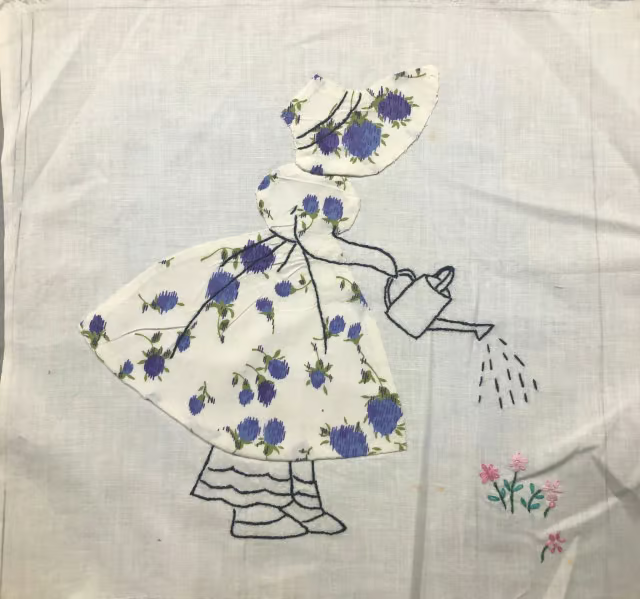
I think a summer spread is usually appliqué, unlined, unquilted, with finished edges, used as a lightweight bed covering in the warmer months. Often these are whole cloth, and bought as commercial designs.
Barb G. showed her bias appliqué Carolina Lilies summer spread, which even had a long pink ruffle applied to the edge. Definitely not a commercial pattern.
My flowers in an urn with butterflies was appliquéd and embroidered on a heavier weight whole cloth fabric, muslin colored, with 5/8″ bias tape binding, and was obviously pre-printed.
I’ve seen some pieced tops with edges turned back used as a summer spread, but they usually don’t survive the first washing intact.
Perhaps Barb has a better definition.
Judy in Ringoes, NJ judygrow@
—– Original Message —– From: “Xenia Cord” <xenia@> To: “Quilt History List” <qhl@> Sent: Saturday, May 24, 2003 8:34 AM Subject: [qhl] Re: Studio Quilt Study Group
> <A question for QHL——–Is the term/concept “summer quilt/summer spread” > an east coast thing? Are they found in the midwest, west or south?Is the > same term used?> > > Judy, for the purposes of discussion, can you define “summer spread” as > you understand the term? > > Xenia > > (Great review, BTW – as always!) > > > — > You are currently subscribed to qhl as: judygrow@. > To unsubscribe send a blank email to leave-qhl-1441754M@ >
Date: Sat, 24 May 2003 09:49:24 -0700 | From: “Laurette Carroll” <rl.carroll@>
>A question for QHL——–Is the term/concept “summer quilt/summer spread” an east coast thing? Are they found in the midwest, west or south?Is the >same term used?
Judy, out here in California I have heard the term “summer spread” used for a quilt with no batting, and also for an edge finished, one layered, appliquéd or pieced top.
Thanks for the description of your quilt study group meeting.
Laurette Carroll Southern California
Look to the Future With Hope
Date: Sat, 24 May 2003 11:57:37 -0700 | From: “ChrisA” <chrisa@>
Thanks for the run down Judy. Enviable as always.
I ‘ve seen summer spreads here in southern CA. Sometimes they have a backing fabric, but not batting, especially when they are pieced blocks. I’ve seen appliqué, backless, ones with bound edges and hemmed edges, although less frequently. I call them summer spreads. In spite of our warm weather, I don’t see very many come into documentation events or at museums or local exhibits or shows.
Kimberly Wulfert, PhD www.antiquequiltdating.com Email: quiltdating@
Date: Sat, 24 May 2003 15:59:06 EDT | From: Midnitelaptop@
just to clarify the butter… i think of folk art as primitve art…done by untrained artists using many media (fiber, paint,clay, stone, wood, metal, cardboard, hardware, etc.)
then there’s the stuff marketed…that’s done by the insane, criminally insane and socio pathic criminals… this stuff might have some interest to pyscho therapists, and psychiatrists… but what baffles me… is anyone who wants to buy stuff by jeffery dahmer, charles manson, or any other psychotic sociopath just to take it home to hang on walls…
and just to clear up the van gogh subject…he had quite a bit of art training and was a manic depressive not a criminally insane predator…harmful mainly to himself
but i guess since the advent and success of “chainsaw murder” and “friday the 13th” type movies…. the victims of these psychotics will have to revisit old nightmares, after seeing the ads for exhibits by the criminally insane murders and predator beasts…… jeanL
Date: Sat, 24 May 2003 12:00:45 -0400 | From: Jane Hall <jqhall@>
Hi — I am not an expert BUT I disagree strongly that “outsider art” is tha t made by those outside the law or outside sanity. It has never been considered to be made by criminals, etc….there may well be some who aren’ t in touch with reality doing outsider art, as there are with “insider” art too I’d dare say. To me, outsider art is folk art, usually quite naEFve, using materials (shingles, bits of wood and metal, etc) that are not ordinarily considered as media for art. Untrained artists to be sure, but not on the fringes of society. Jane Hall
Date: Sat, 24 May 2003 16:13:24 -0600 | From: Xenia Cord <xenia@>
<just to clarify the butter… i think of folk art as primitive art…done by untrained artists using many media (fiber, paint,clay, stone, wood, metal, cardboard, hardware, etc.)>
To refine even further, folk artists, those who work in many media (much of it highly practical) are artisans who are not formally schooled in what they do, but who may even so be experts within the area in which they work. The man who handcrafts chairs or cabinetry, the woman who weaves, the people who make tight, decorative, useful baskets, the ironmonger who fabricates decorative wrought iron gates with images of corn stalks or sunflowers, the craftsman who makes face jugs are examples of people highly trained in the folk art they do, but often without any formal schooling or training except for that obtained by tutelage and observation within the folk culture.
One of my favorite folk artisans is the Amish craftsman who designed and made the built-in bookshelves, media center, and lower cabinetry holding printer, file drawers, cameras etc. in our family room addition. The man is a personal friend, and he came to my house, measured the raw walls, did some little sketches, and returned 6 weeks later with the entire 40 feet of cabinetry. He came into town on a huge tractor, unprotected in very cold weather, pulling a covered trailer. He and his wife carried the parts into the unfinished room, put them into place, and put up a trim strip over the 1/2″ gap remaining along the wall. And this is a man with an 8th grade education, who does sums and drawings with a carpenter’s pencil!
My folklore education rises up…
Xenia
Date: Sat, 24 May 2003 16:19:16 -0700 (PDT) | From: Kris Driessen <krisdriessen@>
OK, I am starting to get paranoid. On the way to PA this morning, we hit construction and the QuiltBus took a bad bump and dropped it’s muffler. DH repaired it with the ever helpful duct tape, but we still had a stinky ride back home. Two vehicles down, two to go…
Fortunately, The Textile History Forum is close to home for me. The fourth annual meeting will be held Friday, August 8th, and Saturday, August 9th, 2003, in Cooperstown, New York, at the New York State Historical Association’s Fenimore Art Museum and Farmers’ Museum.
Here is a blurb from there brochure: The Forum is a lively open meeting of textile curators, textile technology enthusiasts, antique textile collectors, and textile, costume, and clothing historians. The Forum includes presentations of juried papers and works-in-progress sessions that use textiles and other objects to illustrate the research.
Presenters include: Dr. Jenna Tedrick Kutruff, “Exploring the Textures of Prehistoric Textiles”; Jay Ruckel, “Knitted Handwear Preserving Cultural Identity in Hand Stitches”; Katherine Dirks, “Airplanes, Balloons, and Cartridge Bags: A Few Fabrics of World War I”; Virginia Gunn, “Regional Preferences in Fancy Coverlet Designs: An Ohio Study”; Dr. Richard Candee, “Circular Sock Knitting and Home Production”; Judith Rygiel, “Homespun Myths: Middle-class Values Meet the Market Place”; Sharon Steinberg, “The Barrett Sisters of Connecticut”; Michael Smith, “A Look Around: Scholarship and America’s Textile History”; Jill and Jonathan Maney, “The Ithaca Carpet Factory: Fancy Weaving, Home Production, and Superior Design”; and Nancy Boulin Golden,”19th-Century Use of the Corset.”
The two-day registration fee of $165.00 includes admission to the New York State Historical Association and Farmers’ Museum, all the sessions, two lunches, and a copy of the Proceedings. One day cost: $100
This year the Textile History Forum has added hands-on workshops to its schedule. The workshops include: “Spinning on the Great and the Low Wheel”;
“Indigo Dyeing”; “Circular Knitting Machines”; “Textile Identification of 18th and 19th Century Woven Fabrics”; “Reading Weavers Manuscripts”; “Professional Weavers’ Tools of the 19th Century”; and “Pennsylvania Bedding Textiles”.
Workshops are held at the same time as the Presentations and cost an additional $25 each.
Thursday August 7th, will be a tour day, with behind-the-scenes tours
of the collections at the NYSHA storage facility, Glimmerglass Opera House, Hyde Hall, and Thistle Hill Weaving Mill. (Appears to be free.)
On Sunday, August 10th, the New York State Historical Association will host a “textile road show” discovery day open to the public and forum participants. ($7) For a small fee participants can have their textiles examined and discussed.
The annual dinner and auction will be held Saturday evening, August 9th, at Thistle Hill Farm in Cherry Valley. The auction is a great opportunity to acquire rare and unusual textile treasures and sell items that may be of interest to others in the group. Participants also bring interesting, unusual, and unidentified objects to light at a “show-and-tell” session, a regular part of the Forum. The brochure says this costs $1200, but that is because the decimal is in the wrong place. It is really $12.00.
Cooperstown, New York, is the home of the Baseball Hall of Fame, and Glimmerglass Opera. Located at the south end of picturesque Otsego Lake, Cooperstown and the surrounding area provides an excellent weekend playground for the entire family.
Registration information is available at the Textile History Forum site at www.rabbitgoody.com or by writing to the Textile History Forum, 101 Chestnut Ridge Rd, Cherry Valley NY 13320, E-mailing rabbitg@ or by calling 518-284-2729.
Dormitory housing is available for $45 single/$56 double in relatively nearby Oneonta. Of course, being Oneonta, there is no shortage of hotel rooms! For those that don’t mind a bit of disorganization and about an hour ride can come and stay with me. I have a couple of beds still available (two are taken) and there is always the couch:-))
Kris
__________________________________ Do you Yahoo!? The New Yahoo! Search – Faster. Easier. Bingo. http://search.@
Date: Sat, 24 May 2003 14:52:01 -0700 | From: Gaye Ingram <gingram@>
re question of terminology “summer spreads”:
I have never heard the term used in Louisiana, where the quilts went off the bed come late April in the pre-AC days of my childhood. One slept beneath a sheet and nothing more.
The “spreads” or top or decorative bed dressings were changed in the summer, but to lightweight Marseilles work spreads or the popular chenille spreads.. And for those who used quilts as decorative coverings, shifts were often made to lightweight quilts made in pastel colors. But in the 50’s no one but people my grandparents’ age still consistently used quilts as coverlets or “spreads.” I never saw an unlined summer spread until 5 or 6 years ago and that was in Nebraska.
In the literature of the South, I do not believe I’ve ever encountered “summer spread” as an unlined or lined-with muslin and unstuffed object.
Gaye
Date: Sat, 24 May 2003 18:54:30 -0400 | From: Barb Garrett <bgarrett@>
Summer quilts in southeastern PA documentations are of several types, but the overall umbrella is that they provide no warmth because they have no batting. They also “usually” have no raw edges and were used as we would use a bedspread — just for pretty, not for sleeping under. Beyond that basic definition, they can take several different forms —
1. Whole cloth applique — edge is often turned to the front and a band of solid fabric is appliqued along the edge to encase the raw edge. These are one layer of fabric thick and give a “finished” appearance. Very 1930s.
2. Appliqued flowers on feedsacks, then joined. There’s an example of a 4 sack summer top on page 31 of the York Documentation Book — Quilts The Fabric of Friendship (a book I highly recommend <grin>). Note the red appliqued fabric over the seams and along the edge — covering all raw edges. These spreads are usually only one layer of fabric thick.
3. Pieced or applique top and plain fabric back, with finished edge — either knife or binding — I’ve seen both. No batting and no quilting — just 2 layers of fabric, again giving a “finished” look. Often seen with sashed applique blocks and bound edges.
4. Hemmed top — definitions get a little fuzzier here — if it is a top (either pieced blocks or joined applique blocks) with raw seam allowances still visible on the back, with the edges turned back in a small hem, we refer to it as “a hemmed top, possibly used as a summer spread”. The main thing that turns it into a summer spread for us is a “finished edge”.
Barb in rainy southeastern PA where I visited the Schwenkfelder Museum Festival today — their needlework and quilt exhibit are worth the trip — more later on that
Date: Sat, 24 May 2003 21:58:12 EDT | From: JBQUILTOK@
Content-Type: text/plain; charset”US-ASCII” Content-Transfer-Encoding: 7bit
I bought Aunt Martha hot iron transfers for these a few years ago.
Janet
Date: Sun, 25 May 2003 06:03:45 -0500 | From: “Barbara Vlack” <cptvdeo@>
I don’t have a direct answer about the state bird embroidered quilt, but I think I have something related to offer, FWIW.
I purchased, in a lot, from an antiques store in Bloomington, IL, embroidered blocks of the state flowers. All 48 of them. They were together in a box along with all the newspaper clippings that provided the patterns. Apparently the lady who made these cut all the articles about these blocks out of The Star (I’m assuming the Kansas City Star) and glued them to 2-holed paper and kept them in a notebook. All of the blocks were copyrighted by the McKim Studios (I know that Ruby McKim designed blocks that were published in the KCS). One page of the notebook has the hand written date 1932. But one of the patterns has the printed line, “Note – Pattern No. 24 Is Reprinted Because of Omission From One Edition Friday, Dec. 4.” A check into calendars from the 30s led me to find that Friday, Dec. 4th was in 1931 (this is nifty — go to http://www.hf.rim.or.jp/~kaji/cal/cal.cgi?1931). The outline drawing for each pattern is pasted to a page along with some of the description. These were cut out of the newspaper, but because they are glued to the notebook page, I cannot read what is on the back. The lady who collected all this hand wrote instructions for colors for embroidery. The style in which these were written leads me to think they were copied from part of the pattern article.
There is one page that shows the layout for the entire embroidered quilt.
I have put all the embroidered blocks and the notebook pattern pages into individual plastic protector pages and put them into a notebook. I had purchased the blocks originally with the idea that I might put them into a quilt, but I’m thinking now that they may be more “historically valuable” in this notebook. I have no idea of what to do with them from here.
I did another interesting research check with these blocks. The flower used in this collection as the state flower for Illinois is the rose, which I know to be inaccurate. I checked on the Internet and found one source that said that in 1907 school children voted on the Native Violet as the state flower for Illinois. Then I got into more convoluted research and found that Wisconsin’s state flower is the Violet (I knew that), but it wasn’t adopted until 1949. This led me to discover a web site at http://www.netstate.com/states/index.html where it has a chart for each state giving all the state symbols and their dates of adoption.
Barb Vlack cptvdeo@
Date: Sun, 25 May 2003 08:04:29 -0500 | From: “Ellen Lessmann” <lessmann8@>
I have two “summer spreads”, both are similar. One appears to have been worked on an existing light weight cotton spread, with a vertical pattern of stripes woven in the fabric. The other is a piece of cotton which could have started in this world as a muslin sheet. Both are embroidered with a large gauge pearl cotton in a pastel floral motif with scrolling ribbons etc, to cover the top of a twin size bed. The one which looks like a light weight cotton spread has a purchased cotton fringe attached. Both were purchased in Nebraska. Ellen in Omaha
Date: Sun, 25 May 2003 12:54:29 EDT | From: Crm793@
I recently talked with a 90+ year old woman about her sewing life (she had a small company that made clothing for stores, mainly Neiman Marcus.) She didn’t begin to make quilts until retirement when in her 60’s. She said that of course she did make her bedspread when she was a young girl. This was a sheet which she appliqued flowers, etc., on. She said all her friends did this. This would have been late 1920’s in north Texas. I guess the term “summer spread” was not used then.
Carolyn
Date: Sun, 25 May 2003 12:44:15 -0600 | From: Xenia Cord <xenia@>
I also have an interesting summer spread or bedspread. I found it at a garage sale in South Bend, Indiana, about 20 years ago – a sale I only went to because my hostess wanted to stop there on our way to the quilt show. In a box under a table I spied some grayish-white fabric with blue overlapping circles chenilled (is this a word?) onto it. Close investigation revealed a spread, a pair of curtains, and 2 dresser scarves, cut from the lengths of the curtains. The worked design resembled Double Wedding Ring, in medium blue.
The spread has a center seam, and the entire ensemble is made from two handwoven linen sheets, center seamed, with tiny cross stitched initials in red at the seam at one end of each set. There are also inventory numbers done in the same redwork, over one thread!
Recycling, indeed!
Xenia
Date: Sun, 25 May 2003 14:19:28 -0400 | From: Pat and Jim <jimpat@>
Summer Coverlets are pretty intriguing. I have been collecting them for awhile and each other is constructed in a different manner.
The one I like the best is a crib size coverlet that appears to have been a kit. The puppy and kitten image is just adorable and it looks as though that motif was printed onto the fabric, and then, embroidery was added to it. There is a photo of it (and most of the other coverlets I have), in the January 2003 issue of The Quilter magazine, still available from their website as a back issue.
My article was entitled, “What Makes a Coverlet a Coverlet?”. If you are not in the mood to buy the issue, there is always the option of interlibrary loan. However, you might forfeit the color, which in this case, is an integral component of the article.
There is another large kit quilt (I presume) that has a colonial lady motif. The lady in her bonnet is standing amidst hollyhocks. The edge has a wide fringe added.
Then, there is the VERY large scale butterflies covelet which feature a unique fabric that is also found in a second smaller motif butterfly coverlet that I collected in the exact same shop the year before. I wondered if they could have been made by the same person.
The one with smaller motifs of butterflies uses a sheet as the base for the appliqués. That one is truly a scrap quilt and for that reason, tons of fun! I also enjoy looking at the edge which is a hand crocheted lace done in variegated thread.
Another favorite is the Depression Era pansy coverlet. That one has unfinished seams and is in fine condition because apparently, it has never been washed. In fact, the side setting triangles and the corner triangles are a lighter color muslin and look as though they may have been added recently, in an attempt to finish the blocks into a coverlet. In that case, the edges are rolled twice, and therefore, the corners of the on-point pansy blocks do not sit squarely on the edge. Again, it has a variety of 1930s/1940s prints, so it is a delight for the fabric enthusiast and quilt historian….like me!
After writing my book, Redwork Renaissance, and stating that, though I had read of Greenwork, I had never personally seen any examples, I found a Greenwork Coverlet. That one is interesting because of the variation of workmanship. It seems that the maker was much more skilled at embroidery than she was at cutting and sewing the sashing squares and borders. This was a two layer coverlet, secured only by the edge sewing (no ties).
I don’t know if the backing shrunk, with use and washing, but when I got the coverlet, the backing was so much tinier than the front, it was distorting it and the thing would not even lay flat. In an attempt to remedy the situation (or so I thought at the time), I carefully “reverse stitched” (don’t you just love it?) the edges. There were two lines of top stitching, and an interior line of sewing. The edges were not “right”, but she had made them for eternity!
Now, I am left with a coverlet without a backing, though I constructed a new one, a monochromatic Victorian print in green with flowers, birds, etc. Very nice. Now, in looking at the durned thing, I can’t see wasting the beautiful print fabric. Everything is cattywampus. The sashings are wrinkled, puckered, and overstitched, etc.
That said, I have decided to do nothing, which is something I usually do, when in doubt. I traced off the ten different flower designs which are lovely! I had to chuckle when we photographed this coverlet in a vertical position. For the first time, I could see that a lot of the flowers are upside down. She was quite whimsical in her final layout. We will have to call her Mrs. Any WhichWay!
Well, that is my story and I’m sticking to it. I was ambitious this last week and posted information to my website about the pansy coverlet and the greenwork one. Photos are accessible from the links on the first page.
Pat Cummings, www.quiltersmuse.com a proud mother who just got the news that son, James, will be receiving honors along with his master’s degree in English Literature from Northeastern University in Boston, in a couple of weeks.
Date: Sun, 25 May 2003 14:39:13 EDT | From: KareQuilt@
Does the Textile History Forum publish their papers in some format so that those who cannot attend at least can read some of what was presented?
Also, could someone remind me how one views the photos of the Quilt Study Groups that Kris has posted. I can’t find my instructions. Thanks.
Karen Alexander Northern Virginia
Date: Sun, 25 May 2003 13:52:22 -0700 | From: Gaye Ingram <gingram@>
Pat,
Couldn’t help but notice the final part of your posting, re grandson.
Does he have plans/a job/etc?
Always on lookout for teachers, Gaye
Date: Sun, 25 May 2003 14:38:08 -0400 | From: Barb Garrett <bgarrett@>
I sent this last evening but it hasn’t appeared, so if both copies finally show, please accept my apologies for the double post. I actually went to an exhibit before Cinda <grin>, so had to report — and encourge others to attend also.
Today I enjoyed viewing 2 exhibits at the Schwenkfelder Library and Museum in Pennsburg, southeastern PA — easily accessible from route 309 and the turnpike. List member Candace Perry is the curator at the museum and has done a wonderful job mounting the 2 exhibits.
The first is an exhibit of 37 quilts made by local ladies since 1983. This exhibit is on until Saturday, June 7, and is very very nice and well mounted. As you enter the exhibit, you receive a packet with a short comment about each quilt, written by the quiltmaker. Quilts include 2 Perkiomen Valley quilts, a self portrait of the maker on a John Deere Lawn Tractor, a flannel log cabin quilt with fussy cut flowers in the centers, American-Danish friendship flowers from a guild exchange, PA Dutch applique, pineapple, copy of a mid 1800s brown and teal star quilt from the Shelburne collection, copy of the Mariners Compass quilt shown in Homage to Amanda, folk art angels drawn by the maker’s grandchildren, J. Everett & Friends applique picture by the Variable Star Quilters of Souderton, applique Tree of Life kit quilt, Schoolhouse and stars quilt plus many more.
The other exhibit is needlework of the Schwenkfelder women — and it’s beautiful, and will be on display until Sept. 1. While there are 4 antique quilts on display, including a red and green floral applique with the matching paper pattern, a pieced PD quilt whose block is a large S, and a PD Courthouse Steps, the other types of needlework are amply displayed. Along one wall are many beautiful early cross stitch samplers — tiny stitches, beautiful motifs. Several show towels with cross stitch work and drawnwork, some wool needlepoint on canvas pictures and bags made using Irish stitch (similar to bargello) and Queens stitch complete this beautiful exhibit. All of the items in this exhibit are from the museum’s collection and of Schwenkfelder origin, while the quilts in the first exhibit are quilts from the community at large.
One quilt not in either exhibit but also on display is a log cabin variation made from scraps from a local flag company — it’s very patriotic with white stars on a blue field in the center and red and white logs made from the flag stripes. It’s folded over a quilt rack, and my only disappointment was that I couldn’t view it full out (sorry Candace, but I do understand about space <grin>). A beautiful and interesting museum to visit.
The website for further information is http://www.schwenkfelder.com/
Barb in southeastern PA who is very glad she lives close to so many great quilts <grin>
Date: Sun, 25 May 2003 17:33:52 -0400 | From: Barb Garrett <bgarrett@>
One of the things I love about QHL is that we become aware of and can study regional differences — both in quiltmaking and in vocabulary.
The first thing I noticed in Pat’s email was that she changed the subject line — to coverlet. In searching your site to find out where you are from I found one mention of New Hampshire. Are you from New England? Is this typical in New England, to refer to an unbatted/possibly unbacked quilt as a coverlet? Or just New Hampshire? Have other’s encountered the phrase “summer coverlet”?
One reason I’m curious is that in this area, southeastern PA, a coverlet is a heavy woven blanket type bed covering — usually wool, linen, and/or cotton — with beautiful designs and often names and dates included in the weaving. When people bring them into documentation days, we tell them we can’t do anything except tell them how to conserve it. It’s an entire area of study, books have been written on them, and exhibits mounted by museums. What are those heavy woven bedcoverings called in New England?
Carolyn’s note reminded me that I used to put a “spread” on the bed in the 50s — it was a chenille (sp?) spread — no quilts in my family history <frown>. I must ask some older ladies <grin> what they called their appliqued covers — summer spread or summer quilt is probably a new phrase.
Barb in southeastern PA
Date: Sun, 25 May 2003 16:15:22 -0700 (PDT) | From: FRANK <bulawa@>
I have always been under the impression that it wasn’t a quilt unless there were three layers; some kind of backing, batting and the top. Are unlined summer coverings now being refered to as ‘summer quilts’? Pauline –0-955113682-1053904522:84728–
Date: Sun, 25 May 2003 18:53:57 -0700 (PDT) | From: Kris Driessen <krisdriessen@>
The study groups are at http://www.quilthistory.com/study/ You can get there from a link on the front page of http://www.quilthistory.com
Kris
Date: Sun, 25 May 2003 21:29:29 -0700 | From: Gaye Ingram <gingram@>
Like Barb and Frank, I find myself interested in the terminology used to describe “summer spreads.”
Xenia, pull your OED out.
In the Deep South, I think the term “spread’ or “bedspread” would have included the handworked kits of the Art Deco/Art Nouveau period, the popular Normandy Lace bed covers of the early 20th century, the chenille covers that originated in the southern Appalachians and led to the machines that produce current carpeting, and all the later machine-quilted synthetic fabric covers of the ’70’s and later. The term was also applied to the Marseilles and/or matelasse (sp?) covers, both old and new, which were the most popular all-year spreads in most of the Deep South, I think. Part of “making up the bed” was “spreading the spread” smoothly over the sheets and blankets and/or quilts.
The term “quilt” would have been used only for three-layered, quilted covers. If the quilt were made to be used primarily as a decorative covering for a bed, its batting would be so light that with repeated washings through the years, it would make one wonder whether a batting existed. But it would be called a quilt. And valued to high heaven.
The term coverlet was and is used here to describe woven wool covers. I believe a relative few of those were made in North Louisiana, and most of those that made it here from the upper South, fell prey to moths and climate. The first heirloom whose “rescue” I undertook was just such a coverlet (or “coverlid”), made one of my young husband’s ancestors in the Edgefield District of South Carolina. My mother-in-law and I snatched it from the floor of an uncaring relative’s closet. It was in such terrible condition that it had to be cleaned, and the professional cleaners refused to touch it. So we bought a long galvanized tub and on a sunny day tried our hands at washing it outside. We gingerly attacked a small corner section, using all the care and passed-down cleaning wisdom we had. In the end we were able to save only a corner section which bore the maker’s name and the date. Most of the piece simply disintegrated in water. Looms were brought to Louisiana north of Alexandria, certainly, and especially in German settlements, but few woolen coverlets made on them remain.
In the prairies of Southwest Louisiana, the Acadian immigrants adapted their weaving knowledge to the brown and white cottons available locally and produced a variety of textiles, including a garment-weight textile called “cotonnade,” known for its sturdy durabiity. Today much of what is known of cotonnade comes from cotonnade quilts, generally made of large and undesigned pieces of this fabric. The Acadians also wove coverlets from local cotton. (see 1998 Uncoverings)
Gaye