January 11, 1997 – January 22, 1997
These restored messages come from the Quilt History List, an online forum where quilt historians, collectors, researchers, appraisers, and enthusiasts discussed antique quilts and related textiles. The archive dates from 1996 through approximately 2016 and is being restored gradually. Sign up in the form at the bottom of the page if you want to know when a new page is added. Original spelling, opinions, formatting, and inactive links may remain unchanged.
Primary topics of this QHL digest:
- Quilt dating and authentication — a running debate about whether an unfinished quilt top should be considered “dated” to when it was originally pieced or to when it’s finally quilted, plus practical tips for dating fabrics, tops, and blocks (indigo prints, feedsacks, Indian Head fabric, campaign fabric from the 1872 Grant presidential race).
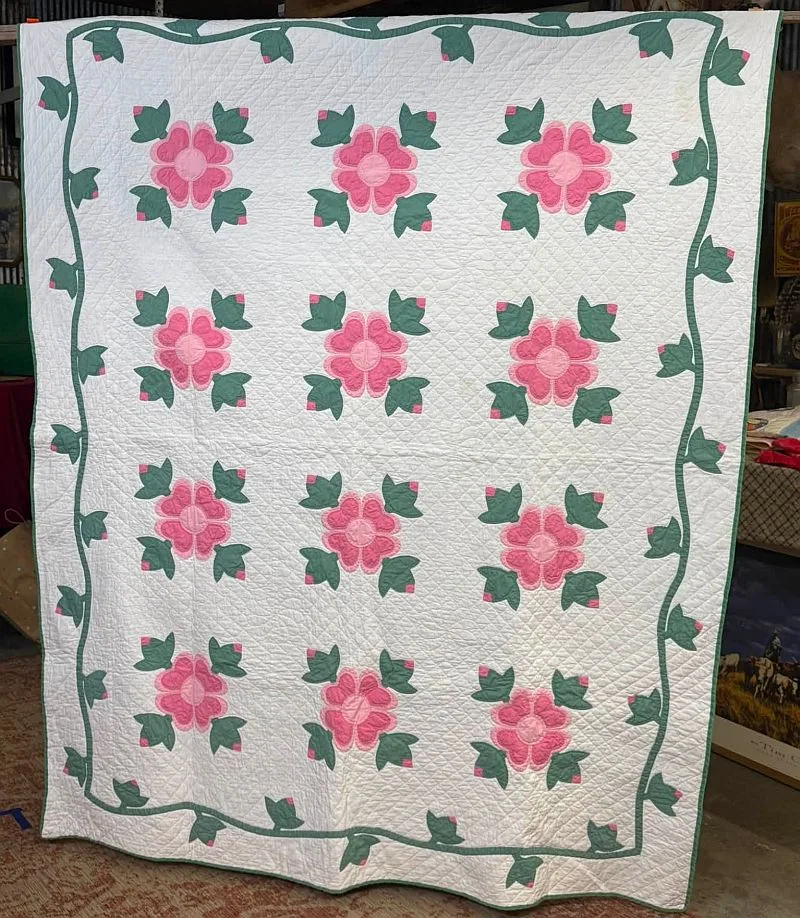
- Red and Green applique quilts — multiple posts about historic red/green applique exhibits (Seattle, Lexington MA), the chemistry of the aniline dyes and Turkey Red that made the style possible, and how those greens sometimes faded to blue or tan over time.
- Restoration vs. conservation ethics — a long-running, sometimes pointed exchange over whether old quilt tops and damaged antique quilts should be finished/repaired/used, or preserved as-is as historical artifacts.
- Book recommendations and sourcing — heavy traffic around quilt history reference books (Barbara Brackman’s encyclopedias, Camille Cognac’s restoration guide, Jeannette Lasansky’s series, The American Quilt by Roderick Kiracofe), plus where to buy them (Quilting Books Unlimited) and a group bulk-book-buy offer.
- Museum exhibits and travel reports — member accounts of visiting quilt shows and museum exhibits (Newark Museum, Zimmerli Art Museum, Smithsonian’s Calico and Chintz show, Amish quilt exhibits, Shelburne Museum).
- Practical technique questions — batting types (wool, poly-cotton, cotton), waxing thread for applique (beeswax vs. paraffin), sewing with fur/leather, and quilt cleaning/washing methods.
- Member introductions and community chatter — several new subscribers sharing bios, plus lighthearted personal updates from list regulars (this was an active 1997 listserv digest for the Quilt History List, QHL).
Date: Sat, 11 Jan 1997 20:54:08 -0700
From: ayjones [at] tacoma [dot] nwrain [dot] net (Yvonne Jones)
To: QHL [at] cue [dot] com
Subject: QHL: Red and Green
Message-Id:
Content-Type: text/plain; charset=”us-ascii”
Dear quilt friends,
I went to In The Beginning today, it is a quilt store in Seattle. There is
a display of the owners Red and Green Applique Quilts, plus a wonderful
antique Ocean Waves quilt. I’m not sure how long the quilts will be up, I
was told they were part of the Christmas display.I would call them first as
I did. I am happy to report how nice they were when I asked if they minded
if I took pictures of the quilts. Absolutely was the responce! Wow! I sent
DH running back to the car for the camera.Sorry to all of you that live so
far away, but I appreciated being told about the display, so just maybe I
will inform a Washington State QHL member and make their day.
Happy quilting to you!
Yvonne
QUILT-R
ayjones [at] tacoma [dot] nwrain [dot] net
The Quilt-R 🙂
Date: Mon, 13 Jan 1997 08:25:02 -0800
From: Chris Smith
To: QHL [at] cuenet [dot] com
Subject: Re: QHL: Amish Exhibit in L.A., CA
Message-Id: <9701131625.AA11766
Content-Type: text/plain; charset=”us-ascii”
Please someone, let me know what I missed. We went to San Diego, CA for
Christmas and left the day after. Weren’t able to go the the Visions Quilt
Exhibit there because of their hours (or lack of) so decided to find out
where the Amish Exhibit was in Los Angeles and stop there on the way home.
However, DH got really paranoid driving in all the LA traffic (can’t blame
him a bit – we live in a town of about 4,000 people) so we never did make
the exhibit. Can someone please tell me what I missed? I love Amish quilts
and would have dearly loved to see them “up close and personal”, so to
speak, instead of in books.
Chris Smith (csmith [at] mail [dot] coos [dot] or [dot] us)
Coquille, Oregon
=================**=
Date: Sun, 12 Jan 1997 11:54:20 EST
From: debatqps [at] juno [dot] com (Deborah A Welch)
Subject: QHL: Ami Simms
MYou can reach Ami Simms by calling her at 1-800-278-4824. I don’t
remember any thimbles on her order form tho . . .
Debbie in NJ
Date: Sun, 12 Jan 1997 11:50:40 -0800 (PST)
From: Michele Weise
TSubject: QHL: San Diego visit
To Chris Smith–Since this is my neck of the woods I should be informed but
I’m sorry to say that I did not make the Amish show at LACMA.in spite of
everybody hounding me to. I just couldn’t get away. But I heard it was
fantastic. I did spend a lot of time in the Visions show in S.D. My
miniatures and antique blocks are in the Gift Shop there. That show closes
the end of this month and is a beautiful show of “art quilts” with I think
about 80 entries. You can see some of the samples on David Walker’s home
page.(kris has his site on her site referrals) Too bad you just didn’t hang
around Balboa Park…there is so much to do thereand almost always wonderful
exhibits. I checked LACountyMuseumofArt has a home page:
[link removed] btw your DH is right, that’s the lousiest drive in the
world so you didn’t miss anything there.
Date: Sun, 12 Jan 1997 13:34:43
From: “MARY PERSYN”
To: QHL [at] cue [dot] com
Subject: QHL: Fabric Identified! and other things
Message-ID: <66171253E5 [at] wesemann [dot] law [dot] valpo [dot] edu>
Last week I posted a question asking for help in identifying some
fabric in a honeycomb quilt that a guild member had recently
purchased. Well, it’s been identified.
The part of the fabric that we could see the most of has
HAVEPEACELETU on it. Turns out it is campaign fabric from the 1872
presidential campaign of U.S. Grant and Henry Wilson and it does say
LETUSHAVEPEACE over and over.
How did I identify it? Following a suggestion, I looked at Julie
Powell’s article on campaign fabrics in ON THE CUTTING EDGE: Textile
Collectors, Collections, and Traditions, by Jeannette Lasansky,
(Lewisburg, PA: Oral Traditions Project of Union County, 1994). On
page 29 in Julie’s article is a picture of THE fabric! Talk about
serendipity. Of all the campaign fabric, Julie chose to use as
illustrations pictures of the fabrics from the Grant campaign of 1872.
When I told Jan (the quilt’s owner) that I’d identified the fabric
(luckily she also owns the book), she asked how I knew to look there.
When I told her from a response on QHL, she said “I’ve been telling
my husband we need to get a computer.”
Thanks to the lurker who put me onto the answer.
Now that I’m able to send e-mail again (we’ve been having some MAJOR
computer problems), I also want to comment on the Calicos and Chintz
exhibit that is ending today at the Renwick. It was absolutely
spectacular. I can’t wait for the book to finally come out (maybe
around April 1).
Following up on a thread of several weeks back about Grace McCance
Snyder and her book, NO TIME ON MY HANDS . . . . When NQA was in
Lincoln, Nebraska in 1991, the local arrangement folks talked various
organizations around the state into have a “500 mile quilt show.”
Museums, etc. mounted shows during the time period of NQA in various
cities and towns along I-80 across Nebraska. (I had a Wyoming
quilter tell me that it was the first time she’d enjoyed the drive
across Nebraska).
Anyway, at North Platte, Neb, at the Buffalo Bill Ranch they had an
exhibit of Grace McCance Snyder’s quilts. The evening we were there
Nellie Snyder Yost was “holding court” on the second floor. We had a
wonderful time talking with her about her mother and the quilts. The
quilts are just incredible. The Nebraska Museum on the Univ. of
Nebraska-Lincoln campus owns the quilt with the design that came from
the dishes. It was on display the last time I was there.
Nellie Snyder Yost has died since that exhibit in 1991. I wonder
where all of Grace’s quilts are now?
Sorry for all the bandwidth. It’s just so nice to be able to send e-
mail again. (I could read it, but not reply. Very frustrating).
Mary
Mary G. Persyn mpersyn [at] wesemann [dot] valpo [dot] edu
Law Librarian (219) 465-7838
School of Law Library FAX: (219) 465-7917
Valparaiso University
Valparaiso, IN 46383
Date: Sun, 12 Jan 97 16:41:33 PST
From: John & Cinda Cawley <cawley [at] epix [dot] net
The Zimmerli Art Museum at Rutgers University in New Brunswick is open
Tues.-Fri. from 10a.m. to 4:30 p.m.; Sat-Sun. noon to 5 p.m. It is at the
corner of George and Hamiltn Sts. I got very good directions from a human
being when I called (908) 932-7237. There is a small parking lot or park on
the street.
The Newark Museum is open Wed.-Sun. noon to 5 p.m. The Museum is at 49
Washington St. I got very poor directions from a recording when I called
(201) 596-6550. I know they were bad directions because we got lost (G).
We found the Museum on our own without too much trouble. There is a parking
lot adjacent which charges $4.75 per day.
Admission to both exhibits is free and let me say again they are wonderful.
Hope lots of you can get there; it only takes about half an hour to get from
New Brunswick to Newark (this does not count getting lost).
Cinda in Scranton
Name: John & Cinda Cawley
E-mail: cawley [at] epix [dot] net
Date: 1/12/97
Time: 4:41:34 PM
This message was sent by Chameleon
Date: Mon, 13 Jan 1997 02:02:59 +0000
From: Rayna Gillman
To: John & Cinda Cawley , QHL [at] cue [dot] com, quiltart [at] quilt [dot] net
Subject: Re: QHL: Newark & Zimmerli quilt exhibits
Message-ID: <19970113020253.AAB28709 [at] LOCALNAME>
Content-Type: text/plain; charset=”us-ascii”
Linda, I’m delighted to hear that you visited both of these exhibits —
aren’t they wonderful?? Too bad you didn’t get to meet Lois Griffin, the
artist-in-residence at Newark this month. (Lois, did you hear this?? Nobody
there seemed to know about you??!!) She’s working upstairs in the studio
and has the most fabulous quilts-in-progress: her Brooklyn Bridge series.
Lois also gave a great slide show/lecture (plus “show & tell”) at the museum
last Thursday.
Anybody else out there — both exhibits are a trip!
Rayna Gillman in NJ
RG2 [at] worldnet [dot] att [dot] net
Date: Mon, 13 Jan 1997 03:51:05 -0800
From: nomad1 [at] ibm [dot] net
To: QHL [at] cue [dot] com
Subject: QHL:Bio etc
Message-ID: <32DA21A9.656C [at] ibm [dot] net>
Content-Type: text/plain; charset=iso-8859-1
Content-Transfer-Encoding: 8bit
Hi All!
o.k ,here goes my Bio-My name is Hiranya Loder and I am 35 year young.I
originally came to Australia from Sri Lanka in 1973 when the Socialists
were pushing for power.
As my family are from the “old” world and were pro-British plus
Christians,and my parents didnt care a hoot for running after the
favoured political types-our lives were in danger.Hence for the sake of
their children-my parents left their tropical paradise with all their
luxuries,servants etc and came to yet another paradise.
Australia is home to us-a beautiful country of great contrasts in
people,landscape,cultures etc.My teenage years were greatly influenced by
Australian culture-which kept my parents on their toes!!! At University
where I majored in Industrial Relations,Sociology,
Anthropology and French I met My DH John(a Scotsman) who is an Electrical
Engineer.
He is a wonderful man who is usually very patient with my quilting and
bookworm habits.
We have been married for 12 wonderful years,though it feels much
less-even with all the
catastrophies that have touched our lives.We have a 9 year old son John
Frederick who is
going on 90 and a 20 month old daughter Anika who is also known as
typhoon for the mayhem she brings to our alrady chaotic household.I have
a small buisiness at home named Quilting Treasures of Old,selling
antique and old quilts,tops and blocks.Besides
reading Sci-Fi,Histories of different cultures,books on nature etc my
passion is quilting
and all aspects of it.I adore red and green applique,crib quilts and
quilts with nature
themes.All this makes it very hard to be a good buisiness woman as I want
to keep everything I buy!!However my DH can be a BH by putting a stop to
this due to a trifle such as the economics!!
We live in Parramatta-a city in Sydney which was a frontier town where
experimentation with crops and stock saved the feeble new colony from
starvation.Here the first wheat was harvested and the wool industry was
nurtured. Parramatta-the Aboriginal word meaning
“head of the river” greatly influenced Australian history.
Quilts that are unique to Australian history,besides the famouse one made
on the ship
Raj;are Waggas.This name is derived from the country city
Wagga,Wagga-where quilts were made from discarded fabric such as cut
down clothes and flour bags.
I think I have yakked long enough! I’ll tell you guys more about flour
sacks here next time.
Thank you to all you lovely people for sharing all your knowledge and
yourselves-you
make my life richer with your presence.Big Hug to Kris for starting this
list :>
So bye for now-
Hiranya Loder
Quilting Treasures of Old
e-mail nomad1 [at] ibm [dot] ne
phone:(02)9630-5839
Date: Mon, 13 Jan 1997 05:06:58 -0800
From: nomad1 [at] ibm [dot] net
To: QHL [at] cue [dot] com
Subject: QHL:Saving Online Time
Message-ID: <32DA3372.619F [at] ibm [dot] net>
Content-Type: text/plain; charset=us-ascii
Content-Transfer-Encoding: 7bit
Hi all you lovely people,
My DH has been complaining loudly of general neglect,the children are
running amok,our lovely dog a Labradoodle named Boots is rioting and no
wife in bed even by 1a.m-all because she is at the computer reading all
what you guys say etc.Hence the huge computer bill etc.
So,I have found the perfect solution that I thought might help you guys
as well.I print out
the lists and I carry them with me wherever I go.At every opportunity I
am reading,while
my husband drives I read or sew,I read in the garden while keeping an eye
on my 20 month old.I manage to stop her drinking from the bird bath and
dog bowl most of the time,
if I manage to tear myself away from what you guys are saying.
Also DH has found a way to cut down on line time-you guys probably are
not computer
illiterate like me-but just in case I thought this might help you too.
We download all mail in the morning then go offline.Compose all letters
offline-hence
interruptions are not costly;also people can actually get you on the
phone.At night download again and then send all mail in one hit-takes
about 2-5 minuites!!
Bye for now
Hiranya from Sydney Australia
Date: Mon, 13 Jan 1997 06:35:30 -0500
From: quiltmag [at] mindspring [dot] com (Jean Ann)
To: QHL [at] cuenet [dot] com
Subject: QHL: Fabric Identified! and other things
Message-Id:
Content-Type: text/plain; charset=”us-ascii”
Mary, thanks for this valuable information. I am trying to learn about a
very unusual fabric in an antique quilt that i discovered recently. I am
going to see if i can find this book, or at least something like it. I just
wish public libraries carried more of these books. but at least, by living
in Atlanta, i can try some university libraries.
Jean Ann Eitel
Editor, QUILT magazine
[link removed]
Let’s Talk Quilting: dal.net IRC – /join #quilttalk
[link removed]
Date: Mon, 13 Jan 1997 12:43:23 -0800
From: nomad1 [at] ibm [dot] net
To: QHL [at] cue [dot] com
Subject: QHL:Wool Batting
Message-ID: <32DA9E6B.2BC [at] ibm [dot] net>
Content-Type: text/plain; charset=iso-8859-1
Content-Transfer-Encoding: 8bit
Dear All,
First of all an apology for the weird way my mail printed-I’m still
trying to learn all about this wretched machine.I think I’m a closet
Amish as I think we are too dependant on instant results brought about by
Man’s inventions.Mind you, I would not give up some of these gadgets
however,-like e-mail for one!
Carol in VA-Thanks for your lovely mail.Yes,many Aussies use wool for
batting and for stuffing.Besides being home grown and produced,wool has
many qualities to promote it.For example it is a natural,durable fibre
that retains it’s shape in the quilt due to it’s natural crimp.A small
percentage of Polyester is blended to prevent bearding.The battings are
also sanitised and treated for dust mites,easy care due to shrink
resistent treatment and is washable in warm water.Last but not least it
is also fire resistant,non flammable and self extinguishing;besides
having excellent insulating qualities.
Other battings like cotton and Polyester are also used-like everywhere
else it depends on the quilter.
You asked what I was working on at present-well its a memory quilt for
myself of the many who have enriched my life.I was sick this year and
time on this lovely earth seemed very short.Hence I wanted to honour some
of my family and friends ranging from age 20 months to 99.I am doing alot
of the work myself from their ideas or memories as some are unable to sew
due to many reasons.
Phew! I have blabbed too long.Bye for now and keep warm!
Hiranya Loder-Parramatta Sydney Australia
Date: Mon, 13 Jan 1997 09:56:20 -0500
From: Ricki Maietta
To: QHL [at] cuenet [dot] com
Subject: QHL: NQA in ’91
Message-Id: <199701131446.GAA03219 [at] orbital [dot] cue [dot] com>
Content-Type: text/plain; charset=”us-ascii”
Mary – thanks for reminding me of the NQA show in Lincoln in 1991, & the 500
miles of quilt shows. We were on our way to California for vacation (a trip
we make every couple of years), & I talked DH into stopping for the show in
Lincoln. Well, we got there at 4:45 (show closed at 5)!! I begged &
pleaded, & they let me in free for 15 minutes – good thing – I had jumped
out of the car so fast I didn’t even have my purse with me – DH & DS sitting
at curb with bewildered looks on faces. I literally jogged through the
ailes – saw approximately 400 quilts in 15 minutes, remember nothing but the
guard telling me I HAD TO LEAVE!
We did visit 2 other shows across the state the next day, in towns I don’t
even remember. At one an ancient lady served DH coffee & called him “sir” –
he was so impressed. I will always remember the quilts displayed over
folding chairs that were on top of long tables. Also, stopped at one
location & the show was closed, even though the literature I had said it was
open.
I thought the whole thing was a great idea – quilt shows along route 80,
just for us travelers. Someone should do that again. . . .
Ricki in PA
Date: Mon, 13 Jan 1997 10:29:41 -0500 (EST)
From: PAMIAM6 [at] aol [dot] com
To: QHL [at] cue [dot] com, QHL [at] cuenet [dot] com
Subject: QHL: Re:Use of indigos fabrics?
Message-ID: <970113102939_1418750914 [at] emout07 [dot] mail [dot] aol [dot] com>
I have a questions for those of you who know about old fabrics. I just
returned from the antique mall where I purchased 30 long blocks which were
pieced for the flying geese pattern. It is made up of shirtings and indigos.
The indigos are about 25 different patterns. Now the shirtings I can
understand are probably scraps, but who would buy 25 different indigos. I
find this alot in the midwest where I am always buying old quilt tops. It is
almost as if one half yards of indigo was given with a grocery order…..I
have seen quilt tops made from fabric sample books where there will be 6
pieces of the same print in different colors, but there is too much of each
of these patterns to be something like this. Does anyone know what used to
be made from these indigos??????????? Thanks for all the information, I love
readings all your posts. It would be nice if this old fabric could talk to
me…I would ask so many things. Pam in Springfield Il where the temperature
is 2 below zero which is a good excuse to stay inside and quilt.
Pam I Am6
Date: Mon, 13 Jan 1997 09:09:22
From: “MARY PERSYN”
To: QHL [at] cue [dot] com
Subject: QHL: Book Source
Message-ID: <79ABE547CB [at] wesemann [dot] law [dot] valpo [dot] edu>
Karan (SadieRose) asked me if I had a source for the book I mentioned
yesterday, ON THE CUTTING EDGE by Jeannette Lasansky. She also
suggested that I post my answer to the list because others of you
might be interested.
I got the book from Quilting Books Unlimited in Batavia, Il. I
don’t have their address and phone number with me, but they advertise
in most of the quilting magazines. (I’ll post the address and phone
number when I can get home and get them). QBU is an excellent source
for quilting books. You may have seen them at some of the national
shows. They have a great display of books at their store (and some
really nice fabrics, too).
In case you aren’t familiar with Jeannette Lasansky’s books, I think
they are great. Following is a list of the titles that I know.
BITS AND PIECES: TEXTILE TRADITIONS (1991).
A GOOD START: THE AUSSTEIER OR DOWRY (1990) Not strictly quilting
if I remember correctly.
IN THE HEART OF PENNSYLVANIA: 19TH & 20TH CENTURY QUILTMAKING
TRADITIONS (1985).
IN THE HEART OF PENNSYLVANIA: SYMPOSIUM PAPERS. (1986).
ON THE CUTTING EDGE: TEXTILE COLLECTORS, COLLECTIONS AND TRADITIONS
(1994).
PIECED BY MOTHER: OVER 100 YEARS OF QUILTMAKING TRADITIONS (1987).
PIECED BY MOTHER: SYMPOSIUM PAPERS (1988).
All of the above titles are from the Oral Traditions Project of the
Union County Historical Society.
I believe I’ve purchased almost all of them from QBU.
Mary
Mary G. Persyn mpersyn [at] wesemann [dot] valpo [dot] edu
Law Librarian (219) 465-7838
School of Law Library FAX: (219) 465-7917
Valparaiso University
Valparaiso, IN 46383
Date: Mon, 13 Jan 1997 10:47:52 -0500 (EST)
From: RBCochran [at] aol [dot] com
To: QHL [at] cue [dot] com
Subject: Re: QHL: Book Source
Message-ID: <970113104751_1560008287 [at] emout20 [dot] mail [dot] aol [dot] com>
On The Cutting Edge, edited by Jeannette Lasansky is available from the
Oral Traditions Project, at the Union County Court House, South Second
Street, Lewisburg, PA 17837, phone 717-524-8666, FAX 717-524-8743. Cost is
$24.95, plus $2.50 handling and shipping (.75 for each additional title).
I have this info because I helped with one of the articles.
–Rachel in NJ
Date: Mon, 13 Jan 1997 09:18:53 -0700
From: ayjones [at] tacoma [dot] nwrain [dot] net (Yvonne Jones)
To: QHL [at] cue [dot] com
Subject: QHL: Antique quilts
Message-Id:
Content-Type: text/plain; charset=”us-ascii”
Dear Quilt Friends,
Ooooooops! The quilts that are being shown at “In The Beginning” quilt
shop, in Seattle, are ANTIQUE Red and Green quilts!
Sorry,
Yvonne
QUILT-R
ayjones [at] tacoma [dot] nwrain [dot] net
The Quilt-R 🙂
Date: Mon, 13 Jan 1997 17:04:28 -0500
From: Kathy
To: MARY PERSYN
CC: QHL [at] cue [dot] com
Subject: Re: QHL: Book Source
Message-ID: <32DAB16C.3B79 [at] ix [dot] netcom [dot] com>
Content-Type: text/plain; charset=us-ascii
Content-Transfer-Encoding: 7bit
When looking for any kind of books try checking the following web site:
[link removed]
I tried checking for the title “On the Cutting Edge” and came up with
the book. It had to be special ordered however. I am not affiliated
with them just know them to be a good and reliable source.
A friend in quilting,
Kathy in NH
DeSchuit [at] ix [dot] netcom [dot] com
Date: Sat, 11 Jan 1997 22:18:29 -0700
From: kmccoy [at] glenerin [dot] com (Kay McCoy)
To: QHL [at] cue [dot] com
Subject: QHL: stitches/inch
Message-Id:
Content-Type: text/plain; charset=”us-ascii”
On Sat. Jody wrote:
deemed that anything LESS than 10-12″ per inch was NOT acceptable and
heaven forbid any machine piecing, let alone quilting! LOL! Being the
rebel that I am, I didnt get deterred by her opinions, but always
wondered how many potential good/great quilters we were scaring off
when she ponificated about her “standards”.
And I presume she was born with a needle in her hand that automatically did
12 stitches per inch.
I was told by my aunt that you weren’t a “real quilter” until you did 12-14
stitches/inch but that didn’t stop me either. I guess I should call myself
an “unreal quilter” because my usual is about 9/inch and it’s taken me
years to get there.
Katie in Colorado
“A Quilting Sew & Sew”
kmccoy [at] glenerin [dot] com
Date: Tue, 14 Jan 1997 13:23:28 +1000
From: Sven Olsson
To: QHL [at] cue [dot] com
Subject: QHL: Stitches/inch
Message-ID: <32DAFC30.3729 [at] pnc [dot] com [dot] au>
Content-Type: text/plain; charset=us-ascii
Content-Transfer-Encoding: 7bit
Hello All,
This is my first note to you all, but I have been reading your comments
for a few days now, and watching the U.S. weather with interest, while
we in Australia are basking in warmth.
My name is Lorraine Olsson and I live about 100 kilometers west of
Sydney.N.S.W. in the Beautiful Blue Mountains, 1000 meters above sea
level. My home is in Katoomba. My husband is a Veterinarian, and I am in
partnership with my daughter and her chef boyfriend in a small
restaurant called The Whistle Stop Cafe. In the upstairs of the cafe we
have a small quilt gallery showcasing quilts made by local women. I am
also an avid quilter and collector of Americam Antique Quilts.
Now Back to the original topic. If I had been discouraged by the thought
that I had to produce the “perfect” patch or hand quilt in the “perfect”
way, I would not be talking to you now. Fortunately for me I have the
most wonderful and Best Friend a person could have (Lynne) who told me
that my work is to make me happy and no-one else. Good advice hey!
Talk to you all later
Lorraine
Date: Tue, 14 Jan 1997 11:45:54 -0500
From: Betsy Szymanski
To: “‘qhl-digest [at] cue [dot] com'”
Subject: Textile Conservation
Message-Id: <01BC0210.8048FAD0 [at] NTEMS>
Content-Type: text/plain; charset=”us-ascii”
Content-Transfer-Encoding: 7bit
In a recent issue of Ladies Circle Patchwork Quilts magazine there’s
an article about a collector of crib quilts. The article mentions that
the collector has had some of her quilts restored by “The Textile
Conservation Workshop” in South Salem, NY (914-763-5805).
I have an old (mid 1800’s) needle work sampler that I would like to
have cleaned and re-framed. I called the Workshop to talk to them
about it. They were very nice, and said that they do that kind of work
all of the time. They sent me a brochure that describes some of the
conservation techniques they use. They said that I could send them
the sampler and they would evaluate its condition and make some
recommendations about what they could do to clean or restore it and
tell me how much it would cost. The evaluation would cost $75, and
any additional work would cost $50 per hour.
Has anyone ever sent any textiles to them before? Are there other
such workshops? Are any in the midwest (especially in SE Michigan)?
Does anyone have any other suggestions on who I should contact
about cleaning and framing my sampler? Any comments or help
would be very much appreciated.
Betsy Szymanski, Ann Arbor, Michigan
ems [at] fame [dot] com
Date: Mon, 13 Jan 1997 23:27:38 -0500 (EST)
From: MamaBear76 [at] aol [dot] com
To: QHL [at] cuenet [dot] com
Subject: QHL: Fwd: QHL: Fabric Identified! and other things
Message-ID: <970113162704_1075746261 [at] emout07 [dot] mail [dot] aol [dot] com>
Received this by mistake.
Forwarded message:
From: quiltmag [at] mindspring [dot] com (Jean Ann)
Resent-from: QHL [at] cue [dot] com
To: QHL [at] cuenet [dot] com
Date: 97-01-13 06:33:57 EST
Mary, thanks for this valuable information. I am trying to learn about a
very unusual fabric in an antique quilt that i discovered recently. I am
going to see if i can find this book, or at least something like it. I just
wish public libraries carried more of these books. but at least, by living
in Atlanta, i can try some university libraries.
Jean Ann Eitel
Editor, QUILT magazine
[link removed]
Let’s Talk Quilting: dal.net IRC – /join #quilttalk
[link removed]
Date: Tue, 14 Jan 1997 13:42:33 -0500 (EST)
From: Quiltfix [at] aol [dot] com
To: QHL [at] cue [dot] com
Subject: QHL: Re: QHL- what makes a quilt/ Books
Message-ID: <970114134230_679885352 [at] emout16 [dot] mail [dot] aol [dot] com>
As to what makes a quilt, well, in my book it only requires that someone puts
loving work into it. It doesn’t have to be quilted or even tied (what would
you do with some of the untied Crazy Quilts?). A good quilt is just that –
good. The seaming, color choices and placement, method to attach the layers
together all need to be done well. There doesn’t even have to be 3 layers.
I have a tied Postage Stamp, c 1930 kit, and I never considered that it
might not be a “quilt” until this came up in the QHL. As for the 10-12
stitches per inch …… bah! The quilting must be regular. Personally
I prefer itty bitty stitches (I average 10 – brag, brag), but the quilting
must be an integral part of the entire piece.
Re: Camille Cognac’s restoration book vs Barbara Brackman’s pattern book,
you ought to get both. Camille’s book has more historical information – the
pattern book lists patterns in a myriad of ways and gives you lots of
differing names for the same pattern (no history on the pattern other than
origin – ie: Ruby McKim pattern). If you want some history and help with
restoration, get Camille’s book. If you want to I.D. quilt patterns, get the
other. You actually should have both, because even if you don’t restore,
you’ll have an idea into the processes that restoration professionals use.
Alan
Date: Tue, 14 Jan 97 11:01:00 EST
From: “Bayha, Marty” <450002P8 [at] smtp-mmail [dot] oucom [dot] ohiou [dot] edu>
To: QHL post
Subject: QHL: Fabric
Message-ID: <32DBB245 [at] mail [dot] oucom [dot] ohiou [dot] edu>
I was lucky enough to be at the right place at the right time on Sunday.
I have purchased a partial bolt – actually 15 yards – of fabric that was
manufactured by Indian Head. I was told that this company went out of
business before World War II. I was also told that this was 1930s fabric.
When I took it off the bolt to see how much fabric I had purchased, it has a
date stamped on a small white sticker that says patented 1922. Anyone
familiar with this company or what the date might mean? Does it mean when
the fabric was manufactured?
I also purchased a quilt top (16 patch on point with alternating plain blocks
- scrappy) that has the date 1872 embroidered on one of the blocks. It is
hand and machine pieced. The thread used to embroider the date is also used
some in the hand piecing. It is a thicker thread than used for most of the
piecing of the quilt. I’m hoping to be able to identify some of the fabrics
in the quilt to authenticate the date but haven’t had luck so far. Any
suggestions?
Hope you all are having a great day!
Marty Bayha
mbayha1 [at] ohiou [dot] edu
Date: Tue, 14 Jan 1997 08:39:33 -0500 (EST)
From: QuiltAlive [at] aol [dot] com
To: qhl [at] cue [dot] com
Subject: QHL: Red & Green Applique Exhibit in Lexington, MA
Message-ID: <970114083932_912405772 [at] emout14 [dot] mail [dot] aol [dot] com>
I’ve been enjoying this list for weeks now. I’m thrilled to see the
excitement about quilt history topics. My name is Merikay Waldvogel,
Knoxville, TN. I’ve been deep into quilt history topics since 1980. This
type of on-line networking is incredible. Thank you Kris for doing this. My
current research interests are about 20th century quilts (especially the
1930s, feedsacks, and the Sears Quilt Contest). I have a collection of
mostly 19th century quilts and lots of books and vintage patterns.
I want to announce an exhibit of Red and Green Applique quilts that runs
January 19 – March 23 at the Museum of Our National Heritage in Lexington,
MA. The thirty quilts (1845 – 1895) are from the Collection of Robert and
Ardis James. I curated the exhibit. The Jameses and I will be at the museum
on Sunday, Jan 19 for opening festivities, informal gallery tours, etc.
Please come. We’re also doing a quilt dating workshop ($5.00 fee) from 2-4
pm–bring a quilt.
The applique exhibit does not have a catalog, but there is a free color
brochure available at the museum. I’m recommending Ricki Clark’s book
Quilted Gardens: Floral Quilts of the Nineteenth Century, which is available
at the museum shop, bookstores, AQS, and Rutledge Hill Press (800-234-4234).
Museum Admission is free. Hours are Mon-Sat 10 am to 5 pm, and Sunday, noon
to 5 pm. Museum is located at 2A and Mass. Ave in Lexington, which is right
off I-95.
Call the Museum at 617-861-6559 for further information.
Date: Tue, 14 Jan 1997 08:47:24
From: “MARY PERSYN”
To: QHL [at] cue [dot] com
Subject: QHL: Quilting Books Unlimited Address Etc.
Message-ID: <914EFF4509 [at] wesemann [dot] law [dot] valpo [dot] edu>
Here’s the information that I promised to post when I located it.
Quilting Books Unlimited
1911 W. Wilson St.
Batavia, IL 60510
phone orders (800) 347-3261
business (630) 406-0237
FAX (630) 406-0238 (anytime)
Hours: M-F 10 am – 5 pm
Sat. 10 am – 4 pm
Sun. noon – 4 pm
Batavia is a far out Chicago suburb so the times are Chicago times.
Their area code recently changed to 630 from 708.
They publish a catalog on an irregular basis. You might want to ask
to be placed on their mailing list.
Not affiliated with QBU. It’s just a place where I have left LOTS of
money over the years.
Mary G. Persyn mpersyn [at] wesemann [dot] valpo [dot] edu
Law Librarian (219) 465-7838
School of Law Library FAX: (219) 465-7917
Valparaiso University
Valparaiso, IN 46383
Date: Tue, 14 Jan 1997 18:49:14 -0500 (EST)
From: JQuilt [at] aol [dot] com
To: QHL [at] cue [dot] com
Subject: QHL: quilt show
Message-ID: <970114184512_2022778299 [at] emout16 [dot] mail [dot] aol [dot] com>
Come and celebrate National Quilt Day, March 15, 1997..
Bring yourself and your camera to the Bi-annual quilt show of the HAVQG(
Hands Across the
Valley Quilt Guild) Quilt Show…Quilts, Vendors, Quilt Appraisals
When…the weekend of March 15 &16, 1997
Where…. In the LeFrak Gymnasium of Amherst College,on Pleasant St. in
Amherst
Massachusetts
Hours : Sat & Sun 10:00 a.m. – 4:00 p.m.
Admission $4.00 Adults… $1.50 for children 12 yrs and under
If you would like a small flyer with printed directions to the show…send a
SASE to
My Favorite Quilt Shop
65 University Dr.
Amherst MA 01002
Date: Tue, 14 Jan 1997 18:50:56 -0500
From: Diane McGuire
To: QHL [at] cue [dot] com
Subject: QHL: no need to be “perfect”
Message-ID: <32DC1BE0.72A3 [at] ici [dot] net>
Content-Type: text/plain; charset=us-ascii
Content-Transfer-Encoding: 7bit
Lorraine Olsson of Katoomba in the Beautiful Blue Mountains,N.S.W.
noted that she was discouraged at the thought that her quilts had to be
perfect. I would like to share with all of you my thoughts about making
quilts.
I have been making patchwork since the early 1970ties, before the
revival. No one I knew made quilts, so I had to guess and teach myself.
Fortunately, Mom taught me how to sew and I was making my own clothes
by the time I was in high school in the early 1960ties. I have made over
one hundred quilts in sizes from wall hangings to bed quilts, and I have
taught quilting classes so I have met lots of quilters. I feel that
quilting is the one area of my life that I can control. No one can tell
me what fabrics to use or what colors I should choose. I decide on
pattern, making many of them myself. I stopped selling my quilts because
I fussed too much about their “perfection.” The ones for me or the few I
give away are parts of me. I am not perfect, but I am pretty good. I am
warm, loving, colorful, and comfortable to cuddle up with, just like my
quilts.
One of the best experiences I had was at Lisa’s baby shower. It was held
at the home of Maureen, another long-time friend, and I had made a quilt
for the expected arrival. Imagine my delight when Maureen’s ten year old
daughter, upon seeing the new quilt, raced up to her room to get the
quilt that I had made for Maureen’s shower. It was faded and soft, and
obviously so much loved! That love is what quilting is all about.
They are our personal expressions. Whether they express hope, love,
grief, anger, rememberance, or the joy of living, they show who we are,
and we should celebrate that expression.
Don’t worry about perfection! Have a good time and savor the fabrics and
the process. And best of all, wrap yourself in your own warm quilt and
enjoy.
Diane in cold, snowy Massachusetts, USA
——————————
Date: Tue, 14 Jan 1997 08:41:48 -0800
From: nomad1 [at] ibm [dot] net
To: QHL [at] cue [dot] com
Subject: QHL: RE:Fur quilts
Message-ID: <32DBB74C.1B78 [at] ibm [dot] net>
Content-Type: text/plain; charset=iso-8859-1
Content-Transfer-Encoding: 8bit
Dear All,
The other day I came across a bag full of sheepskin scraps that I had put
away years ago.They have been dyed a soft grey and years ago I had
planned to make a fun quilt out of it;much to the horror of my family.
As you all probably know wool is one of Australia’s chief exports.We
have quite a few shops that sell
“Ugg Boots”,jackets,slippers etc. So I was able to buy a bag of scraps
for $5.
We have a wonderful Patchwork & Quilting magazine here called “Down Under
Quilts”.In the Winter issue
there is an article discussing cloaks of animal skin.Basically when the
European explorers came to Australia some of the Aborigines (or Koori
people as they prefer to be known) here had made cloaks -where squares
had been cut from fur,sewn together and decorated with designs. Each
design was different and had a meaning identifying the wearer.Some
squares were coloured with ochre. The European settlers began to copy
these cloaks and also made warm rugs which were used like quilts.
So,I am not too far out afterall-though the despair of my Quilting
teacher who is cross that I do not conform!!
Have any of you seen such a quilt? We have such a cloak in the Museum of
Victoria,Melbourne. I
would appreciate any advise re how one would sew the furry wool
together,bind it ,back it etc. Or is it too
weird afterall?
Bye for now
Hiranya from Parramatta-Sydney-Australia
e-mail nomad1 [at] ibm [dot] net
Date: Wed, 15 Jan 1997 09:05:20 -0700
From: kmccoy [at] glenerin [dot] com (Kay McCoy)
To: QHL [at] cuenet [dot] com
Subject: QHL: Thread for applique
Message-Id:
Content-Type: text/plain; charset=”us-ascii”
I’ve just come into possession of what I think is about a 1940-50s??? old
quilt top but not really sure how to tell how old it is. A friend of mine
found it in the back of a closet in a house she bought and can’t contact
the former owner to return it. It’s all basted for applique but not
appliqued yet. What thread would be best to do the hand appliques
with–machine embroidery thread or 100% cotton (or something else)?
TIA
Katie in Colorado
“A Quilting Sew & Sew”
kmccoy [at] glenerin [dot] com
Date: Wed, 15 Jan 1997 13:39:09 -0400
From: tkorpita [at] titanic [dot] cs [dot] umass [dot] edu (Terrie Korpita)
To: QHL [at] cuenet [dot] com
Subject: QHL: Re: France/Paris quilting
Message-Id:
Content-Type: text/plain; charset=”us-ascii”
Welcome!
Years ago I spent a semester studying in Paris. Actually I lived in a town
named Marcousis to the south and commuted in every day. I really loved
living in France, though I learned that I don’t like commuting. The metro
is not too bad for a subway, but I just don’t like being underground all
the time.
Just last month my boss was traveling to Paris and asked if I wanted
anything. I said “Go to the Opera district, then a bit to the west,
beneath the Church on the hill, (whats the name? Sacre Coeur?), there
should be several fabric stores and other shops with sewing stuff. Bring
me cotton or silk.” She couldn’t find anything! I know the city must
have changed, but where are the fabric stores now? Even my school was in
that neighborhood. I studied dressmaking. I cannot remember the
arrondisement number.
I will look forward to your input on this list. I was once fascinated by
the copper roller printed fabric made in Jouay in, I think, the 19th
century. I’ve seen it used on old American bed curtains of that time.
Maybe gowns as well. Do you know if it was ever quilted? Either for bed
quilts or for petticoats?
I was also fascinated by the bobbin laces made in Brittany/Normandy and to
the north. You are in a wonderful area – so rich in textile history!
I visited your web site, and like your quilts very much. Soon I will have
a color monitor and will visit it again 🙂
Terrie in Massachusetts where perhaps there will be snow tomorrow.
tkorpita [at] cs [dot] umass [dot] edu
on 4 Jan, Inge wrote:
Hello everyone,
We’re all supposed to introduce ourselves when joining this list, and I
guess that it’s time that I get it done.I’m living in France, more precisely in Saint-Germain-en-Laye which is a
suburb 16 km (10 miles) west of the Eiffel tower in the heart of Paris –
so, for short, I usually refer to Paris as my town.Living in Paris is, however, not synonymous with being French. Actually,
I’m a Dane and have been living in France for the last 8 – 9 years.I’ve joined this list in particular for learning more about old quilts and
the history of quilts, which I find interesting. At this point in time, I
should be considered a greenhorn in these matters;-)I am so fortunate to have a small quilt museum in a small village,
Barneville, 1.5 hours drive further to the west. The museum is called
“Musee du Patchwork et de la Courtepointe” and is situated next to a
quilting shop run by one of the finest quilters in France, Nadine Rogeret.
Date: Wed, 15 Jan 1997 14:19:28 -0600
From: R D
To: QHL [at] cue [dot] com
Subject: QHL: Book Thank you!
Message-ID: <32DD3BD0.3C91 [at] mail [dot] execpc [dot] com>
Content-Type: text/plain; charset=us-ascii
Content-Transfer-Encoding: 7bit
Many thanks to all of you who responded to my questions about Barbara
Brackman’s Encyclopedia of Pieced Quilt Patterns, and Camille Cognac’s
book – Quilt Restoration A Practical Guide.
I ordered the Quilt Restoration book today — and now I have to wait
patiently for it to be delivered.
Thank you so much for helping me spend money — wisely! 😛
Donna in Wisconsin
Date: Wed, 15 Jan 97 14:50:18 PST
From: Sharon Harleman Tandy
To: Quilt History Listserve
Subject: QHL: Quilt History Bibliography
Message-ID:
Content-Type: TEXT/PLAIN; charset=US-ASCII
Fellow QHLers, At last I’m ready to follow through on my promise to list my
almost 100 QH books. Planned to do it last week, but I forgot how much work
it is to have a 6 yr old boy and a 13 yr old girl for nine days. Not much
on my schedule got done!
In the interest of saving my hook-up time and your downloading time, I have
divided them into 13 categories. Smaller ones may get ganged together, but
the largest and, IMHO more significant, will be alone. The categories will
be on the subject line so that you can choose which lists to copy/save. I
will not be recommending nor dis-recommending since everyone has diff.
interests and tastes. Information will be standardized on all lists except
the state books, which will be alphabetized by state. That’s it for now, I
hope; do e- me with queries, I will disconnect between categories. Signing
off now but 1st category coming right up. Appreciate your interest, Sharon.
Date: Wed, 15 Jan 97 14:57:18 PST
From: Sharon Harleman Tandy
To: Quilt History Listserve ,
Betty on QHL has Q Hy bk list on web
Subject: QHL: QHBx.list: pattern and textile ID
Message-ID:
Content-Type: TEXT/PLAIN; charset=US-ASCII
Brackman, Barbara. Clues in the Calico. McLean, Virginia: EPM
Publications, 1989.
Brackman, Barbara. Encyclopedia of Applique: An Illustrated, Numerical Index to Traditional and Modern Patterns. McLean, Virginia: EPM
Publications, 1993.
Brackman, Barbara. Encyclopedia of Pieced Quilt Patterns. Paducah:
American Quilter’s Society, 1993.
Khin, Yvonne M. The Collector’s Dictionary of Quilt Names & Patterns.
(orig.) Washington, D.C.: Acropolis Books, 1980.
(an incidental) no author/editor. Photographs of Fabrics in 19th & 20th Century Quilts: 26 Accurate Color Plates Identified by quarter century.
Paducah: American Quilter’s Society, n.d.
End/list
Date: Wed, 15 Jan 1997 17:03:34 +0000
From: “The Garretts”
To: QHL [at] cue [dot] com
Subject: Re: QHL: Book Thank you!
Message-Id:
Content-type: text/plain; charset=US-ASCII
Content-transfer-encoding: 7BIT
Donna wrote
Many thanks to all of you who responded to my questions about Barbara
Brackman’s Encyclopedia of Pieced Quilt Patterns, and Camille Cognac’s book –
Quilt Restoration A Practical Guide. I ordered the Quilt Restoration book today
— and now I have to wait patiently for it to be delivered. Thank you so much
for helping me spend money — wisely! 😛 Donna in Wisconsin
My comments –
I am personally very frustrated when someone asks a good quilt history question
and then ends the post with “please respond privately.” I feel this is very
inconsiderate and not the purpose of this list. I would like to have quilt
history questions answered to the list so that we all could have profited from
the MANY people who responded to Donna’s question. If this trend continues,
this list will dwindle to a list of questions followed by a list of thank yous,
with no information in between. I can’t speak for everyone, but I think many
of us joined so we could learn about quilt history and things relating to that.
While I own Barbara’s book, I am not at all familiar with Camille’s book, and
was looking forward to information about it. Please consider posting quilting
history answers to the list in the future. I was a math teacher and I always
told my students that if one of them had a question, at least 5 others wanted
to hear the answer. I think the same analogy holds true here, except if one
person asks a question there are probably 200 people who want to hear the
answer because of the type list. Thank you for reading my opinion.
Barb in southeastern PA
Date: Wed, 15 Jan 1997 19:22:08 -0500
From: Kathy
To: Quilting Heritage List
Subject: QHL: Off the Subject but on Time
Message-ID: <32DD74B0.7954 [at] ix [dot] netcom [dot] com>
Content-Type: text/plain; charset=us-ascii
Content-Transfer-Encoding: 7bit
I know this isn’t quilt related but sometimes we have conversations
about the time we posted and the time it shows up and I thought that
this web site was helpful.
[link removed]
—
Kathy in NH
DeSchuit [at] ix [dot] netcom [dot] com
Date: Thu, 16 Jan 1997 10:26:09 -0800
From: nomad1 [at] ibm [dot] net
To: QHL [at] cue [dot] com
Subject: QHL:Red and Green Quilts
Message-ID: <32DE72C1.3EF [at] ibm [dot] net>
Content-Type: text/plain; charset=iso-8859-1
Content-Transfer-Encoding: 8bit
KENNETH K REGAN wrote:
>
Dear Hiranya,
I enjoyed reading your bio. Can you please tell me what Red and
Green quilts are? Thanks, Tiffany -a native Texan living in Oklahoma.
Hi Tiffany,
Thanks for your mail-its always lovely receiving mail.I wasn’t sure
whether to post this to you or the list,but as you asked -here goes.I am
no expert but from what I have researched Applique from the mid-1800’s
were predominantly stitched using red and green fabric on a white or off
white background and there was only one or two accent colours such as
yellow,pink and at times blue. Different areas had different trends of
different backgrounds.The reason for the red and green theme is not fully
known.Possible reasons are that in about 1850 a new aniline dye was
discovered which produced a more colourfast green and red.Though the
green did change colour in time it was an acceptable change.
Turkey Red(referring to the Mediterranean area of the world)was far
superior
in colourfastness than other red fabric of that time.It was also very
expensive and sold for as much as three times the price of ordinary
calico.Another possible reason is that roses were favoured for applique
at that time,hence they used the natural colours.Also the fads of that
time for interior decorating were green and crimson colour themes.
Tiffany,there is heaps more information on this theme.If you are
interested I can hunt up my list of books o.k?
I do not want to bore your eyes off too much!!
Bye for now’Hiranya
Date: Thu, 16 Jan 1997 06:38:26 +0000
From: “The Garretts”
To: QHL [at] cue [dot] com
Subject: QHL: Terrific History Book
Message-Id:
Content-type: text/plain; charset=US-ASCII
Content-transfer-encoding: 7BIT
Hi all –
I wanted to let people know about a book that may not be familiar to them
because of the regional nature of its distribution. If you have not gotten to
PA recently or don’t order books from Dover Booksellers – which was sold and I
don’t know what is happening – you might not have seen this really fantastic
book on PA quilt history.
“Lest I Shall Be Forgotten – Anecdotes and traditions of quilts” by Nancy and
Donald Roan is the result of the Quilt Documentation done by the Goshenhoppen
Historians in 1990 to 1992. A large exhibit was held in June 1993 and this
book was in conjuction with the exhibit.
The book is paper bound, has 96 full-color pages, and is full of color pictures
of quilts typical of this watershed area of southeastern PA. Quilts are
pre-1940 and the area is primarily, but not exclusively, Pennsylvania Dutch.
The PA Dutch include Mennonites, Brethren, Schwenkfelders, and Reformed, but do
not include the Amish as they did not live in this area, but further to the
southwest.
The author, Nancy, is a wonderful quilt historian and has spoken at several
symposiums, including one held at the Smithsonian 2 years ago. She is a
stickler for detail and accuracy and likes to have first hand documentation for
her statements, as in journals, diaries, etc. These are quoted in the book.
The book was published by the Historians, and they get all proceeds. My only
connection is that I helped alot with the documentation and the exhibit, so my
name does appear in a list in the book, but I just believe it is a wonderful
book.
Books can be ordered by sending a check for $15 plus $3 postage and handling to –
Goshenhoppen Historians, Inc.
P. O. Box 476
Green Lane, PA 18054
Thanks for your time, and I hope you enjoy the book
Barb in southeastern PA
Date: Thu, 16 Jan 1997 08:35:26 -0500 (EST)
From: QuiltAlive [at] aol [dot] com
To: QHL [at] cue [dot] com
Subject: QHL: Re: 1940s-50s Applique Top
Message-ID: <970116083521_1691238643 [at] emout09 [dot] mail [dot] aol [dot] com>
Katie in Colorado, you wondered how to date an applique a quilt top (c.
1940s-40s) your her friend found. You said the top was basted for applique,
but not sewn down. Would you please describe the design, colors, etc.? You
might have a top from the 1930s when companies would sell applique quilts in
various stages–as a kit with fabric stamped, as a basted applique top, and
as a completed quilt. Anne Orr, Mary McElwaine, and even Ruby McKim sold
such products. I have catalogs from these designers, and we might be able to
establish a date for the quilt top if you describe it to me. –Merikay
Waldvogel
Date: 16 Jan 97 09:04:38 EST
From: Rabbit Goody <75444.1037 [at] CompuServe [dot] COM>
To: “INTERNET:QHL [at] cue [dot] com”
Subject: Re: QHL: Quilting Books Unlimited Address Etc.
Message-ID: <970116140437_75444.1037_FHQ51-2 [at] CompuServe [dot] COM>
unsubscribe
Date: 16 Jan 97 09:04:37 EST
From: Rabbit Goody <75444.1037 [at] CompuServe [dot] COM>
To: “INTERNET:QHL [at] cue [dot] com”
Subject: Re: QHL: Quilting Books Unlimited Address Etc.
Message-ID: <970116140436_75444.1037_FHQ51-1 [at] CompuServe [dot] COM>
subscribe digest
Date: Thu, 16 Jan 1997 09:33:21 -0500 (EST)
From: HKnight453 [at] aol [dot] com
To: QHL [at] cue [dot] com
Subject: Re: QHL: Thread for applique
Message-ID: <970116093300_1758354132 [at] emout15 [dot] mail [dot] aol [dot] com>
I like all-cotton general purpose thread for applique which is
available from Coats and Clark in a reasonable range of colors. It is
strong, especially when waxed. I use ordinary paraffin sold for sealing
jelly jars; its much cleaper and better than beeswax. As I thread the
needles, I run the thread across the wax. I know people who dip whole spools
in melted wax, but have not tried this yet.
Date: Thu, 16 Jan 1997 09:39:06 -0500 (EST)
From: HKnight453 [at] aol [dot] com
To: QHL [at] cue [dot] com
Subject: Re: QHL: Thread for applique
Message-ID: <970116093901_172886149 [at] emout11 [dot] mail [dot] aol [dot] com>
I like to use all cotton general purpose thread from Coats and Clark
for allpique. It comes in a reasonable range of colors, and would be fairly
authentic. As a child of the 70s, I fear synthetics. I wax all thread for
hand work by running it across a cake of parrafin as sold for sealing jelly
jars. Then again, I also use #9 or 10 embroider neddles or sharps for hand
piecing, so I tend to go against THE RULES.
Also, can anyone help me in finding a book with patterns for doing a
penny square quilt. My DB saw one in an antique shop in Brimfield MA for
several hundred beyond our price range, and I would like to make a replica,
and include some squares with sketches of places significant to our
relationship. This would include the MBTA station at Riverside, where we
met. Bust wishes from Rhode Island where it is (thankfully) only raining.
Heather (AKA HKNIght453 [at] AOL [dot] com)
Date: Thu, 16 Jan 1997 10:08:43 +0000
From: “The Garretts”
To: QHL [at] cue [dot] com
Subject: QHL: Penny Square Applique
Message-Id:
Content-type: text/plain; charset=US-ASCII
Content-transfer-encoding: 7BIT
Heather wrote –
Also, can anyone help me in finding a book with patterns for doing a
penny square quilt.
Willa Bee Studio has a wonderful selection of patterns for 1900s Penny Square
redwork embroidery. I have spoken with Willa (I hope that’s her name) at the
Lancaster Quilt Show and she is delightful, has scrapbooks of quilts she has
photographed and is really specialized in this area. She has drafted patterns
for full size and wall hanging size quilts. Her pattern says, for more
information send a LSASE to –
Willa Bee Studio
269 Woodland Drive
Orchard Park, NY 14127
I have no connection to her, just found her very knowledgeable, willing to
share, and delightful to talk to. She is located at the “extras” merchant mall
across route 30 from the Heritage Quilt Show. I think she does a lot of shows,
so may have a schedule that puts here near you.
Barb in southeastern PA
Date: Thu, 16 Jan 1997 10:51:55 -0500 (EST)
From: KirkColl [at] aol [dot] com
To: QHL [at] cue [dot] com
Subject: QHL: Re: Indian Head
Message-ID: <970116105154_2023016040 [at] emout02 [dot] mail [dot] aol [dot] com>
Somewhere in our archives is a brochured from the manufacturer abotu Indian
Head fabrics, They are (were) made in Nashua, NH and were definitely
available through the 50’s because my mother’s uniforms were made from indian
Head. The name is always printed in the selvage in the later years. Their
logo is an Indian Chief whose image appears on the bolts and labels. They
made both plain and printed fabrics. I’m not sure if they are still
manufacturing. Maybe someone near Nashua can check it out.
Nancy Kirk
The Kirk Collection
Antique Fabrics & Antique Quilts
High Quality Reproduction Fabrics
Conservation & Restoration Supplies
1513 Military Avenue
Omaha, NE 68111
1-800-398-2542 (U.S. and Canada)
(402) 551-0386
Email: KirkColl [at] aol [dot] com
FAX (402) 551-0971
Web site: [link removed]
Date: Thu, 16 Jan 1997 08:04:47 -0800 (PST)
From: Michele Weise
To: QHL [at] cuenet [dot] com
Subject: QHL: yo yos
Message-Id: <199701161604.IAA28467 [at] acme [dot] sb [dot] west [dot] net>
Content-Type: text/plain; charset=”us-ascii”
Can anyone give me information on yo yo’s? What time frame were they
made in and what was the height of their popularity. How were yo yo quilts
used? I wonder about that because they are a little fragile because they
catch on things and obviously it wouldn’t be a quilt for warmth. Were they
designed for use in any special way? Who “invented” the design? anonymous
maybe? Any and all info would be greatly appreciated. Michele in MoorparkCA
Date: Thu, 16 Jan 1997 09:49:01 -0700
From: kmccoy [at] glenerin [dot] com (Katie McCoy)
To: QHL [at] cue [dot] com
Subject: QHL: Re: Old quilt top
Message-Id:
Content-Type: text/plain; charset=”us-ascii”
The response regarding the old quilt top given to me and what thread to
applique with has been wonderful. At the suggestion of Kris, I will be
taking photos and several people have offered to help me date the top. I
will examine it more closely this weekend while taking the photos and will
post a description next week. This group is fantastic–caring, giving, and
helpful.
My gratitude to you all…….
Katie in Colorado
“A Quilting Sew & Sew”
kmccoy [at] glenerin [dot] com
Date: Thu, 16 Jan 97 16:52:27 GMT
From: osborne [at] iinet [dot] com
To: QHL [at] cue [dot] com
Subject: QHL: Re: QHL-Dating quilts
Message-ID:
Hi, This is my first time writing to this list. I have a question I hope
you can help me with. I was
told by a quilt appraiser that if you buy, say a quilt top made in 1920 and
you finish the quilt, the
quilt is than dated by the time you finished it, 1997. What are you ideas
about this? Is it better
to leave the top a top? The same was said about just repairing a quilt, say
replacing the
tattered binding. Thanks for any info you can share.
—
Karen Osborne Quiltabeast in Murrieta, CA
osborne [at] iinet [dot] com
Date: Thu, 16 Jan 1997 13:39:32 -0500 (EST)
From: Quiltfix [at] aol [dot] com
To: QHL [at] cue [dot] com
Subject: QHL: Re: Intro and question
Message-ID: <970116133705_273135596 [at] emout04 [dot] mail [dot] aol [dot] com>
I was thinking that I’ve put my two cents in several times in the last two
weeks and not given y’all an idea of who I am. My name is Alan. 35 yo male
living in sunny Florida (don’t get jealous, it’s supposed to go down to the
low 20’s this weekend!). Even though I have a real job to pay the bills, I
am a quilt restoration professional by choice. I have a family history of
quilting – we come from the Lancaster Co., PA, area, but are not Amish.
Rather, my family is PA Dutch. I hold a BA in Painting, which I don’t do
any more, in lieu of needlework. I am very entranced by quilts, but also
tat, am learning bobbin lace, and do the standard needle arts that are out
there. I also collect antiques and am fascinated with history in general.
Oh, I’m not married and have one cat and eleven fish.
My question is this – I’m working on a hanging that has the poly-bonded
cotton batting (20/80). I’m having the devil of a time getting the needle
through the stuff, and I know it’s not extra layers of fabric. Is this
normal? I noticed the poly seems to be in layers on the outside of the
batting.
Thanks.
Alan
Date: Thu, 16 Jan 97 16:46:22 PST
From: Sharon Harleman Tandy
To: Quilt History Listserve ,
Betty on QHL has Q Hy bk list on web
Subject: QHL: Glitch gone, OK now?
Message-ID:
Content-Type: TEXT/PLAIN; charset=US-ASCII
While sending third book list a monster glitch cut me off, both
incoming and outgoing. Would someone let me know what got throuh
(and if this goes also)? First: there was a note explaining how I’d
do the list; second was 1st list, pattern/textile ID; third was 2nd
list, general American QH; and last was all 22 state books. Just
tell me the last to make it completely. Thnx, Sharon in sunny, blue
skyed Boise.
Date: Thu, 16 Jan 1997 18:48:32 -0500
From: Kathy
To: KirkColl [at] aol [dot] com
CC: QHL [at] cue [dot] com
Subject: Re: QHL: Re: Indian Head
Message-ID: <32DEBE50.670F [at] ix [dot] netcom [dot] com>
Content-Type: text/plain; charset=us-ascii
Content-Transfer-Encoding: 7bit
I live in Manchester, NH and we used to have an Indian Head factory
outlet in the 1960’s maybe into the 70’s but it is not around anymore.
I don’t believe they are in Nashua but I will see if I can check it out
tomorrow.
—
Kathy in NH
DeSchuit [at] ix [dot] netcom [dot] com
Date: Thu, 16 Jan 1997 20:09:27 -0500 (EST)
From: RLHlink3 [at] aol [dot] com
To: QHL [at] cue [dot] com
Subject: QHL: Re: Sharon’s book list
Message-ID: <970116200831_101756706 [at] emout18 [dot] mail [dot] aol [dot] com>
Hi Sharon!
Am I glad (I guess) to hear there was a glitch. –I thought it was just my
faulty understanding of what was intended. whew 🙂
I got one list which ended with “Photographs of Fabrics in 19th & 20th
Century Quilts:” …..Paducah:
Hope all glitches are cleared up. (Boy have we had a lot on our end!) I
really enjoy this group.
Good evening to everyone.
Linda in Redding CA
Date: Thu, 16 Jan 1997 20:28:24 +0000
From: gilsons [at] voicenet [dot] com
To: QHL [at] cue [dot] com
Subject: QHL: Quilt Restoration Book
Message-Id: <199701170131.UAA04816 [at] mail3 [dot] voicenet [dot] com>
Content-type: text/plain; charset=US-ASCII
Content-transfer-encoding: 7BIT
Barb in Southeastern asked about Camille Cognac’s book “Quilt
Restoration, A Practical Guide”. Here’s what I think after using for
over a year.
It’s the best book I’ve found on the subject. Topics covered are the
difference between restoration and conservation, major kinds of
damage, holes, flaking, and applique. She also discusses things to do
with unfinished quilt tops and squares, borders, and bindings. What I
like best are the pictures which illustrate the text. The advice is
straightforward and practical. There is also a section on TLC for old
quilts.
Camille’s second book will be devoted to Crazy Quilts and is due out
sometime this year. I’ve seen her lecture on repairing Crazies; she
has developed or refined a number of techniques specific to that
style of quilt. Quilt restoration is how she supports her family, so
the techniques need to be well researched and executed.
Peg G. from cooooold South Jersey
Date: Fri, 17 Jan 1997 00:03:17 -0500 (EST)
From: RLHlink3 [at] aol [dot] com
To: QHL [at] cue [dot] com
Subject: Re: QHL: Quilt Restoration Book
Message-ID: <970117000317_979947071 [at] emout17 [dot] mail [dot] aol [dot] com>
Hello, Peg!
This is Linda, responding to your note re: Camille Cognac’s book and next
book. I like what I am “hearing” in your book report. I wasn’t in the market
for such, but now I think I would like to look for it. Would you be so kind
as to mention the publisher for me? –I am one of those people who likes to
go “armed for bear” when I shop. 🙂
Thank you so much.
Linda/Redding CA
Date: Fri, 17 Jan 1997 02:27:01 +0000
From: Rayna Gillman
To: gilsons [at] voicenet [dot] com, QHL [at] cue [dot] com
Subject: Re: QHL: Quilt Restoration Book
Message-ID: <19970117022652.AAC22068 [at] LOCALNAME>
Content-Type: text/plain; charset=”us-ascii”
I have Camille’s book but I also have — and love Becky Herdle’s book,
“Time Span Quilts.”
Rayna
Rayna Gillman in NJ
RG2 [at] worldnet [dot] att [dot] net
Date: Fri, 17 Jan 1997 00:52:33 -0500
From: SadieRose [at] aol [dot] com
To: QHL [at] cue [dot] com
Subject: Re: QHL: Re: Intro and question
Message-ID: <970117005233_302054575 [at] emout02 [dot] mail [dot] aol [dot] com>
In a message dated 97-01-16 Alan writes:
<< My question is this – I’m working on a hanging that has the poly-bonded cotton batting (20/80). I’m having the devil of a time getting the needle through the stuff, and I know it’s not extra layers of fabric. Is this normal? I noticed the poly seems to be in layers on the outside of the batting. >>
You might try either changing to a new needle, the finish can wear on a
needle making it pull or snag more. Or running the needle along your
hairline. (The latter is a trick my Mom taught me for making diaper pins
penetrate more easily…the oil at your hairline ‘lubricates’ the needle).
Same with running the needle through a thin bar of soap.
You might also try a smaller needle- although these sometimes will break
if the batting is dense. I used a #8 Sharp needle the one time I hand
quilted the “old” version of Warm & Natural, about 5 years ago. (The product
is different now, a less dense version that is easier to hand stitch, note
that I said easier….not as easy as poly batting, though). My stitches were
not as small with the larger needle…but it didn’t break and I could take a
couple at a time.
If you are not happy with this batting, try one of the new all cotton
batts for your next project. Addy at Pinetree Quiltworks could share info
from her testing on the various new batts on the market.
(pinetree [at] quiltworks [dot] com) (No afilliation, just a happy customer). Good
Luck!! Karan (SadieRose [at] aol [dot] com)
Date: Thu, 16 Jan 1997 23:37:16 -0700
From: lv2quilt [at] frii [dot] com (Heidi Hoff Wurst)
To: QHL [at] cuenet [dot] com
Subject: QHL: waxing thread
Message-Id:
Content-Type: text/plain; charset=”us-ascii”
Heather talked about using paraffin for waxing thread. When I first started
quilting I tried the same thing and mentioned my ‘discovery’ to a friend,
who owns a quilt shop in town. She cautioned me that paraffin was petroleum
based and may not good for quilts in the long run, but the beeswax was
fine. I figured that she knew more about quilting than I did, but neglected
to get any specific information. Anyone have any FACTS about paraffin vs.
beeswax?
Heidi in Colorado
Date: Fri, 17 Jan 1997 06:52:54 -0600
From: R D
To: QHL [at] cue [dot] com
Subject: QHL: Re: Book Review
Message-ID: <32DF7626.77AE [at] mail [dot] execpc [dot] com>
Content-Type: text/plain; charset=us-ascii
Content-Transfer-Encoding: 7bit
Dear Barb and all,
I apologize for not sharing the description of the two books that I had
asked about. I didn’t feel that I asked a quilt history question. I simply
wanted a brief description of the two books so that I could pick
(somewhat quickly and sight unseen) to use a up a store credit from another
state. As these books have been lightly mentioned before on our board, I
didn’t want to waste other people’s time with my question. Only one person
privately emailed me to ask what people had responded with.
Both of these books are available from the lending library. I just didn’t
have time to borrow them and look them over. This is another reason that I
didn’t feel I should use the QHL time this way.
A description of the Restoration book has since been posted to the board by
Peg G.
I do understand what you are saying, Barb, and you do have a good point —
however I WAS trying to be considerate!
Donna in Wisconsin
RE: I am personally very frustrated when someone asks a good quilt history
question and then ends the post with “please respond privately.” I feel this
is very inconsiderate and not the purpose of this list. I would like to have
quilt history questions answered to the list so that we all could have
profited from the MANY people who responded to Donna’s question. If this
trend continues, this list will dwindle to a list of questions followed by a
list of thank yous, with no information in between. I can’t speak for
everyone, but I think many of us joined so we could learn about quilt
history and things relating to that. While I own Barbara’s book, I am not at
all familiar with Camille’s book, and was looking forward to information
about it. Please consider posting quilting history answers to the list in
the future. I was a math teacher and I always told my students that if one
of them had a question, at least 5 others wanted to hear the answer. I
think the same analogy holds true here, except if one person asks a question
there are probably 200 people who want to hear the answer because of the
type list. Thank you for reading my opinion.
Barb in southeastern PA
Date: Fri, 17 Jan 1997 08:25:56 -0500 (EST)
From: AJSNGS [at] aol [dot] com
To: QHL [at] cue [dot] com
Subject: QHL: Book List
Message-ID: <970117082555_1657847501 [at] emout14 [dot] mail [dot] aol [dot] com>
Hi All,
Maybe I’m missing something….but I never received a copy of Sharon’s list
of books. She mentioned that there was a major glitch, but that it had been
worked out. I never received ANY of her list!
Help! Any suggestions?
Nancy in VA
Date: Fri, 17 Jan 1997 08:31:50 -0500
From: RBCochran [at] aol [dot] com
To: QHL [at] cue [dot] com
Subject: Re: QHL: Book List
Message-ID: <970117083149_1419373685 [at] emout02 [dot] mail [dot] aol [dot] com>
Yes, I’d like to know where to find the list, too. Thanks.
Rachel in NJ
Date: Fri, 17 Jan 1997 10:48:32 -0500 (EST)
From: JQuilt [at] aol [dot] com
To: QHL [at] cue [dot] com
Subject: QHL: Quilt Restoration
Message-ID: <970117104830_815968115 [at] emout15 [dot] mail [dot] aol [dot] com>
This month’s issue(Spring 97) of American Quilter has a short article about
quilt restoration and an address for….
The Quilt Restroation Society
P.O. Box 337
Hillsdale, NY 12529
518-325-4502
On the following page is another short piece on storing quilts.
Jean Laino
jquilt [at] aol [dot] com
Date: Fri, 17 Jan 1997 11:15:51 -0500
From: Ricki Maietta
To: QHL [at] cuenet [dot] com
Subject: QHL: medevial quilts & new project
Message-Id: <199701171606.IAA14678 [at] orbital [dot] cue [dot] com>
Content-Type: text/plain; charset=”us-ascii”
Hi everyone. Was very interested in Lisa from Springfield, MA who said she
made replicas of medevial (sp?) quilts. I’d like to know more about that
time period of quilts. I have seen pictures of the 14th C. Italian quilts,
one in Italy & one in Britain (Quilter’s Newsletter, don’t ask me when), but
have no knowledge of what was in vogue then in quilting, & where do you find
sources for what they looked like?? Lisa, you out there. . .?
On another subject – I just took in another restoration job yesterday, & it
should be fun. It’s a Sunbonnet Sue quilt, with a small amount of many
different kinds of damage. I will get lots of practice with this one, but
not so much of one thing to get bored. The border is flapping off on one
corner, there is some embroidery missing here & there, there are two very
small holes, a little quilting needs replaced, the binding is shot, & it
needs a bath! (It has been laundered many times before according to the
owner, so I think this one won’t fade!) My only concern is that the woman
wants to give this to a 3-year-old who was named after her. My concern is
that this quilt will not be treated properly after it’s repaired. I am
gently trying to get the message across that, on the bed for every day use
would not be a good idea, & gave her one of my “care of old quilts” sheets.
Ricki, making headway in PA
Date: Fri, 17 Jan 1997 08:09:33 -0800
From: lrobins [at] cclink [dot] fhcrc [dot] org (laurarm)
To: QHL [at] cue [dot] com, lrobins [at] cclink [dot] fhcrc [dot] org (laurarm)
Subject: QHL: unfinished quilt tops/dating quilts
Message-ID: <2dfa5a30 [at] cclink [dot] fhcrc [dot] org>
Content-Type: text/plain; charset=US-ASCII
Content-Transfer-Encoding: 7bit
Content-Description: cc:Mail note part
Someone posted a message about using old quilt tops and how their age
and value change when quilted later (e.g. if a 30s top is quilted in
the 90s, it is considered to be a 90s quilt).
I think this brings up an interesting point about whether old tops
should be finished in a quilt. I personally advocate that many
times they should be preserved in their original state. We have to
get away from the notion of “unfinished” quilt and think of these as
“completed” quilt tops. Many times they have intrinisic and
historical value just as a top, especially when you can see the
workmanship or methods used which might not be as apparent in a
completed quilt. I really cringe when I hear of someone finding an
old English-paper-pieced top with the papers still inside and then
they want to remove the papers and make a quilt. Such a piece is
valauble “as is”, because it shows the technique, and even the old
newspaper pieces are interesting.
When we find a 1930 top, it frequently is a family piece and we think
we’re just completing what grandma started. And the piece has family
value. But we should start thinking of those as historical artifacts.
If you had a lady’s gown from 1730, would you alter it to fit and wear
it?? If you had some textile from 1530 would you make a quilt with
it? If we found an incomplete Rembrandt, would we “finish” it?? I
know these are extreme examples and not exactly the same as finding a
1930 quilt top, but the older these quilt tops become, the more they
are like the 1730 gown or the 1530 textile.
And I think some of this also applies to repairing quilts — there’s a
difference between preserving an old piece and actually replacing
parts of it. And perhaps we should think twice or three times before
doing anything (including washing). Maybe we should think how we
would approach a quilt from 1800, and use some of that same reverence
for a 1930’s quilt, because if cared for, that 1930s quilt will
someday also be 200 years old, and the original parts might be much
more valuable (historically and monetarily) than a 30s quilt with 90s
replacement parts.
I’m not criticizing people who want to create a family heirloom by
quilting grandma’s top or repairing Great Aunt Hortense’s quilt (yes I
had a Great Aunt Hortense!). And certain old tops are very simple,
run-of-the-mill patterns and don’t seem to be worth much alone. I’m
just suggesting that we start seeing the intrinsic value in old tops
and blocks, and maybe sometimes they should be preserved as they are.
Sometimes we should see ourselves as stewards of these pieces of
history and preserve them rather than using them up.
My 2 cents worth.
Laura Robins-Morris, Seattle, whose only family heirloom is a double
pink Drunkards Path quilt made by Great Aunt Flo (Hortense’s sister!)
Date: Fri, 17 Jan 1997 11:22:42 -0500 (EST)
From: QuiltAlive [at] aol [dot] com
To: QHL [at] cue [dot] com
Subject: QHL: Re: QHL-Digest Digest V96 #14
Message-ID: <970117112125_2090295222 [at] emout12 [dot] mail [dot] aol [dot] com>
Re: Cotton carding of batts From: Merikay Waldvogel
While doing research for my book on Depression Era quilting, I interviewed
80-year old women (from E. Tennessee) who quilted during the 1930s. Several
women mentioned hand carding batts for their quilts. Large scale cotton
growing was not prevalent this far north, but these women planted a few
cotton plants in their vegetable gardens especially for their quiltmaking.
They had childhood memories of picking the seeds from cotton bolls during
the long winters. Their mothers would hand card the cotton and pile up the
cotton batts (about six inches square). When the quilt was ready for the
frame, the quilter would stretch the backing on the frame, and then
distribute the cotton batts over the surface overlapping them slightly.
Next, the top was put on, etc. etc.
Date: Fri, 17 Jan 1997 12:52:01 -0500 (EST)
From: HKnight453 [at] aol [dot] com
To: QHL [at] cue [dot] com
Subject: Re: QHL: medevial quilts & new project
Message-ID: <970117125200_713913235 [at] emout05 [dot] mail [dot] aol [dot] com>
I have to agree with Ricki that using old quilts for everyday use
is probably not a good idea, especially around children and pets. That’s one
of the advantages of making ‘replica quilts”. With the reproduction fabric
and Warm & Natural batting around, one can make a quilt hat feels ‘old’, but
can better bear everyday use. I have a 40’s Crazy Quilt does in scraps from
the Fuit of the Loom men’s underwear and pyjama factory in Cranston RI by my
grandmother’s Aunt Ree. I used it for several years, and it is too worn now
to be used. I keepy it fold over a chair, changing the folds frequently
about 1/2 rthe year (fal and winter) and store it in the cedar closet in a
white all-cotton pillowcase in the summer.
Heather (H knight453 [at] AOL [dot] com)
Date: Fri, 17 Jan 1997 13:23:18 -0500 (EST)
From: RLHlink3 [at] aol [dot] com
To: QHL [at] cue [dot] com
Subject: QHL: Re: research by Marikay
Message-ID: <970117132143_1143448149 [at] emout09 [dot] mail [dot] aol [dot] com>
Your conversations with the older women re: their quilting during the
depression years sounds fascinating. Is your book finished? Is it available?
Thank you for sharing the anecdote about growing your own cotton batting. As
a gardener and quilter in VA, that is something that had never entered my
mind. However, now that I am transplanted to rocky Redding CA, I don’t think
I will try it. 🙂
Linda
Date: Fri, 17 Jan 1997 13:22:58 -0500 (EST)
From: Laurajbr [at] aol [dot] com
To: QHL [at] cue [dot] com
Subject: Re: QHL: Quilt Restoration Book
Message-ID: <970117132258_1624005829 [at] emout19 [dot] mail [dot] aol [dot] com>
Hi
After reading the description of this book, I realize I definitely need to
add it to my collection. Can any of you tell me where I might find it?
Borders? Barnes and Noble? Thanks, Laura
Date: Fri, 17 Jan 1997 17:37:18 -0500 (EST)
From: Quiltfix [at] aol [dot] com
To: QHL [at] cue [dot] com
Subject: QHL: Re: QHL-Red and Green Quits
Message-ID: <970117173716_1959075027 [at] emout04 [dot] mail [dot] aol [dot] com>
A couple of thoughts on red/green appliques……
First, about the analine dyes. If memory serves me, lavender was the first
color produced in the mid 1850’s. When the other colors came along, well, I
don’t know for certain. No one really ever seems to address anything but the
fact that the first dye was lavender.
Red and green quilts are neet, but don’t ignore other color combinations from
that period, because they may actually be a former red/green quilt! Because
so many dyes were not really color fast, you get some strange color
combinations in 1997. I own a quilt dated 1880 that is made of 9 blocks with
no setting. Each block is made of a cross in tan with blue leaves on each
branch. What I beleive happened here was that this was formerly a red /green
quilt. The red appears to have faded to tan. Greens were often hard to make
and were often created by dying the fabric blue then green. I think that the
green fabric originally used lost it’s yellow over the past century, which
ended up leaving me with a blue/tan quilt. It’s still pretty and quite a
steal, so I was lucky to get it.
Date: Fri, 17 Jan 1997 17:45:01 -0500 (EST)
From: QRestore [at] aol [dot] com
To: QHL [at] cuenet [dot] com
Subject: QHL: Re:Unfinished Quilt Tops/Dating
Message-ID: <970117174417_1657925648 [at] emout10 [dot] mail [dot] aol [dot] com>
In response to Laura Robins-Morris, first let me say, I do appreciate and
respect your point of view, just thought I’d provide another.
Not all quilts or quilt tops are Dior quality and to lump them all together
as equally of great value is to deny reality. True restoration considers the
historical value and importance, the date the quilt/top was made, what if
anything should be done with the quilt/top and the “as is” value of the
quilt/top. Not many of us on this ListServ and certainly no self respecting
restorer would treat a “30’s quilt with 90’s replacement parts,” as described
in your post. Research is a key factor in any restoration project.
My we quilters seem to have alot of “shoulds” and “shouldn’ts” in our
vocabulary. I hate to sound like a broken record on this subject, but “Who
owns the quilt/top?” We all have the same goal in sight and that is to
preserve, protect and in some cases rescue quilts, tops, and textiles from
the landfill, etc. There is room for both the conservator and restorer and
plenty of quilts, tops and textiles to be saved. Those items of historical
importance have their place in a museum setting but the majority are not of
museum quality and can be enjoyed and protected by those who love and/or own
them.
One of the very reasons for this QHL is to share and educate others about the
proper methods of preserving, restoring, cleaning and storing quilts, tops
and textiles. There is no one answer which can satisfy every quilt/top
dilemma, only after careful research and consideration can one determine the
best choice for their particular situation. Value can be a very subjective
thing, what you or I value as important may not be the same as someone
else’s.
No one is suggesting you cannot enjoy the “intrinsic value” of
quilts/tops/blocks in their “as is” condition, however, who are we to flatly
tell others what to do with their family heirlooms and/or found treasures?
Lets provide good choices and let them decide without the “shoulds and
shouldn’ts.”
Victoria Montgomery
QRestore [at] aol [dot] com
Boise, ID
Date: Fri, 17 Jan 1997 17:49:33 -0500 (EST)
From: QRestore [at] aol [dot] com
To: QHL [at] cuenet [dot] com
Subject: QHL: Sharon’s Book List
Message-ID: <970117174933_302151970 [at] emout14 [dot] mail [dot] aol [dot] com>
To the Group;
Sharon Harleman Tandy is still having computer problems (gremlins) and is
unable to receive or send e-mail at the moment. She’s trying to correct the
problem and will be back online with the book list ASAP. She sends her
apologies . . .
Date: Fri, 17 Jan 1997 21:27:27 -0500 (EST)
From: Quilting Heritage ListServ
To: QHL [at] cuenet [dot] com
Subject: QHL: Book Order
Message-Id: <2.2.16.19970117212524.2e5f28ec [at] mail [dot] albany [dot] net>
Content-Type: text/plain; charset=”us-ascii”
I spent some time on the phone today and made arrangements for a bulk buy on
several of the more popular books on the list. I arranged to buy Textile
Designs for $55 a book (this is an $85 book in the store), Clues in the
Calico for $25 (this is a $40 book in the stores), Textile Bags by Anna Lue
Cook for $10 (this is $13 book, not available in stores.) I am going over
to Camille Cognac’s house on Monday, I’ll ask her for some books, too,
(Quilt Restoration: a Practical Guide) although the last time I talked to
her she couldn’t offer too much of a discount because she herself doesn’t
get one. I can get her to sign them, though:-)) I can accept credit cards
through Hickory Hill Antique Quilts, so if anyone would like one of the
above books, please let me know at oldquilt [at] albany [dot] net. You could also fax
me at 518-875-9141.
I would like to point out that we have several other authors on the list. I
don’t want to volunteer anybody, but if anyone wants to offer their books
for sale (with or without a discount), please let me know and I will add it
to the list. Are there any other books you would like me to look into getting?
Kris
Date: Fri, 17 Jan 1997 22:14:29 -0500 (EST)
From: QuiltLine [at] aol [dot] com
To: QHL [at] cue [dot] com
Subject: QHL: Fwd: QHL-Digest Digest V97 #15
Message-ID: <970117221428_680434980 [at] emout06 [dot] mail [dot] aol [dot] com>
Content-Type: text/plain; charset=unknown-8bit
Content-Transfer-Encoding: 8bit
In a message dated 97-01-16 22:27:56 EST, QHL-Digest-request [at] cue [dot] com writes:
<< Hi, This is my first time writing to this list. I have a question I hope you can help me with. I was told by a quilt appraiser that if you buy, say a quilt top made in 1920 and you finish the quilt, the quilt is than dated by the time you finished it, 1997. What are you ideas about this? Is it better to leave the top a top? The same was said about just repairing a quilt, say replacing the tattered binding. Thanks for any info you can share. — >>
Dear Karen,
The appraiser was right. The quilt cannot be dated any earlier than it was
completed. After all, it is not a quilt until it has a top and a bottom.
What is normally done in this situation, is on an appraisal form the
appraiser would make a note that the quilt is a c. 1920 top, recently
completed – 1997. Then it would be noted if it were completed as traditional
to 1920 (vintage fabrics, repro fabrics, etc.) or if the back were a 1997
print. In most instances if the top is made into a quilt, and the
workmanship is excellent, and the style of finishing does not detract from
the top, this will increase the value. The same is pretty much said for
restoration or repair. Does the restoration or repair detract from the
quilt? Was the restoration done in such a way as to enhance the quilt? Is
the restoration noted on the quilt? Was the restoration done as traditional
to the period and style of the quilt? These are just a few questions we
consider when appraising a quilt. When dating a repaired or restored quilt,
the circa date remains as it was when the quilt was first made, However, an
ethical restorer will label the back as to when repair was done, and what
was done.
To be very honest, I must say that I have seen quilt tops that were made
into quilts that went down in value because of poor quality of workmanship
and poor selection of fabrics, etc (c.1910 top with c.1970 edge and back),
but have seen beautiful and valuable quilts recently made from an antique
top. Be very careful however, when making the top into a quilt, that the
top’s fabric is not too fragile to handle the abuse of the needle and thread.
I hope this answers your question.
Deborah Roberts – certified quilt appraiser
Date: Fri, 17 Jan 1997 23:47:30 -0800
From: Jody Bordner
To: Quilting Heritage ListServ
CC: QHL [at] cuenet [dot] com
Subject: Re: QHL: Book Order
Message-ID: <32E08012.1CBC [at] gte [dot] net>
Content-Type: text/plain; charset=us-ascii
Content-Transfer-Encoding: 7bit
Kris,
Yes! I just discovered this one in Barnes and Noble yesterday! It is
lovely, and I would be interested in knowing if anyone has it/and their
opinion of it…. Title: The American Quilt by Roderick Kiracofe. I
forgot to get the publishers name, but it is a large size book, lots of
beautiful pictures and history (my first impression, briefly went thru it
in the store) The list price was $60.
Thanks!
Jody
Date: Sat, 18 Jan 1997 00:45:38 -0500 (EST)
From: QRestore [at] aol [dot] com
To: QHL [at] cue [dot] com
Subject: QHL: Re:Roderick Kiracofe Book
Message-ID: <970118004537_781905411 [at] emout20 [dot] mail [dot] aol [dot] com>
Jody;
The American Quilt by Roderick Kiracofe is excellent. It’s definately one of
those “must have” books, full of history and beautiful colored photos. If
your budget wont allow it, try the local library or your local quilt quild
library. Maybe someone on the QHL (book list) has a copy they’d be willing
to lend. (?)
Just borrowed it from a friend of mine to preview and have decided to order
my own.
Highly recommend it!
Victoria
QRestore [at] aol [dot] com
Date: Sat, 18 Jan 1997 06:44:00 -0500 (EST)
From: Baglady111 [at] aol [dot] com
To: QHL [at] cue [dot] com
Subject: Re: QHL: Book Order
Message-ID: <970118064359_72481729 [at] emout09 [dot] mail [dot] aol [dot] com>
Kris, I’ll be interested in Camille’s book..let me know when available. Am I
correct that it gives the history of the patterns? Tells why they are called
“Variable Star? Log Cabin? etc??” Jane
Date: Sat, 18 Jan 97 19:06:00 GMT
From: l.evans5 [at] genie [dot] com
To: qhl [at] cue [dot] com
Subject: QHL: Medieval quilts
Message-Id: <199701181916.TAA19442 [at] relay1 [dot] geis [dot] com>
Content-Transfer-Encoding: 7bit
Content-Type: text/plain; charset=”us-ascii”
Diane & Ricki –
Sorry it took so long for me to write back – I hurt my left arm and have
been trying not to strain it (it’s much better, thank goodness).
Good places to look for medieval and Renaissance quilts are Averil
Colby’s book =Quilting=, which is pretty much the standard work on the
subject to date. She has a good picture of a 1390’s bedquilt in the
Victoria & Albert Museum in London, a couple of German quilts from about
a hundred years later, and much information on the early quilt trade
from India.
There are also pictures of early quilted objects in Jill Liddell & Yuko
Watanabe’s book =Japanese Quilts=, including a quilted shoe from the
ninth century, an elaborately quilted war jerkin from the 15th century,
and a patchwork kimono from the 16th century. Liddell co-authored a
book on ecclesiastical patchwork, =The Patchwork Pilgrimage=, that
includes two photos of very early European patchwork (a 13th century
cope in Toledo cathedral and a 16th century English chasuble owned by a
descendant of the maker).
Beyond these, good places to look are old books on heraldry (patchwork
and applique herald’s tabards), and as many books of contemporary
paintings as you can find. There’s a very fine representation of a
trapunto coverlet in a 1450 painting by Bartolomeo Bermejo, =The Death
of the Virgin=, showing the Virgin lying on a cream trapunto coverlet.
I’ve also recently found several Slavic frescoes and icons showing
saints (especially Saint Sava) in patchwork vestments, including
one where the seam lines between the patches are very clearly
painted. Most of these are in the former Yugoslavia and I have no
idea if they survived the Bosnian civil war, but they were intact
and photographed within the last ten years.
The problem with researching early quilting is that very, very few
people have done so. Right now I’m aware of another amateur out in New
Mexico, and a professional named Janine Janniere in Toulouse. She
tracked down a boasting letter by a French tailor in the early 16th
century about how he had made a patchwork banner of 8,000 pieces and
exhibited it in Metz on St. Martin’s day. But to my knowledge there is
no comprehensive guide to pre-colonial quilts available in English. I’m
working on writing something along those lines myself, but most of the
research has to be done from scratch.
It’s fascinating stuff, though; I started doing it because someone told
me that quilts weren’t made in the Middle Ages, and I was determined to
prove him wrong. Amazing, how something can start from a trivial
remark!
Two more things: the first aniline dye was Prussian blue, I believe,
and was synthesized from coal tar. The early ones were harsh and ugly,
but very fashionable because they were largely shades you can’t get from
natural dyes. And yes, you can get lavender from natural dyes. I did
it myself, completely by accident, by preparing an indigo dyebath in a
pot with a tiny bit of cochineal residue left around the rim. The
cochineal seeped into the indigo bath and dyed the thread a lovely light
purple. I made it about six months ago and it shows no signs of fading,
so it seems to be reasonably colorfast.
Finally, when it comes to beeswax v. parafin, I’d stick to beeswax.
It’s basically the same reason why I mark my quilt tops with pencil
instead of those high tech fading pens – I know the pencil marks will
wash or fade out without damaging the fabric, but I have no idea of what
the long term effects of the ink will be. Beeswax won’t hurt the thread
or cloth in the long run, so I’d go with that.
Hope this helps –
Lisa Evans
Date: Sat, 18 Jan 1997 16:14:08 -0500 (EST)
From: BBMorris [at] aol [dot] com
To: QHL [at] cue [dot] com
Subject: QHL: carding cotton batts
Message-ID: <970118161408_240305734 [at] emout09 [dot] mail [dot] aol [dot] com>
Just this past week I was talking to a friend at church and the subject of
quilts came up. She said that she had never been interested in making a
quilt as she remembered them as being “work”. She is in her mid 50’s in the
area about 30 – 40 miles north of Atlanta. She helped her mother card cotton
for quilt batting when she was about 9 or 10 years old. She didn’t remember
where the cotton came from as her parents had quit farming by then and moved
into town. She was a “late in life” baby so her parents were older than her
friends parents. So, cotton was still being carded for batting in parts of
the south as late as 1950.
As to washing old quiltls, sometimes it is necessary in order to even take
them in the house for them to be washed. I inheirited one of my
Grandmother’s quilts that had been stored in an old wooden refrigerator crate
in the upper floor of an old unheated farm house for years. The lower rooms
had fireplaces. The upper rooms didn’t. It is in an area that is very
humid. The quilt even felt damp to touch and smelled awful. It had never
been used. I aired it on my deck for two weeks and still could not stand to
be in the same room with it. So washing it was my only choice.
Unfortunately, one of the fabrics had been home dyed a dark green. Now the
entire quilt has a green glow. But, at least, I now have my grandmother’s
quilt and the baby grandchildren love to lay on it and look at all of the
different prints and colors in it. It is not a museum piece, but it is
special to me.
Barbara in GA
Date: Sat, 18 Jan 1997 17:30:40 -0500 (EST)
From: Susieh [at] aol [dot] com
To: QHL [at] cuenet [dot] com
Subject: QHL: cleaning quilts
Message-ID: <970118173038_1177163272 [at] emout15 [dot] mail [dot] aol [dot] com>
I am trying to find out how to clean an antique name quilt. All of the
quilters signed their names on the quilt. I don’t know if the ink is
permanent. The quilt is red and white. It is over a hundred years old. There
is a little mildew on it, too. Any info will be greatly appreciated :o)
Date: Sat, 18 Jan 97 23:34:00 GMT
From: l.evans5 [at] genie [dot] com
To: qhl [at] cue [dot] com
Subject: QHL: Cleaning quilts
Message-Id: <199701182347.XAA14491 [at] relay1 [dot] geis [dot] com>
Content-Transfer-Encoding: 7bit
Content-Type: text/plain; charset=”us-ascii”
If I had an antique quilt, I’d first take it to the nearest museum with a
textile conservation department and have them take a look at it. It might
be too fragile to clean, or it might be best cleaned by being gently
vacuumed through a scrim. With something old, it’s best to make sure.
If it can be washed, test whatever soap you’re planning to use on a
small section on the back, to make sure there won’t be a chemical reaction
that dissolves the fabric. Also, test every fabric for color fastness by
wetting a cotton swab and gently rubbing to see if any of the color comes
off. If it does, even if only one fabric, don’t wash the quilt.
If the quilt is strong enough and color fast enough, soak it in cold
water in either a laundry tub or your bathtub. Use the mildest soap
possible (I’ve had good luck with Dr. Bronner’s sal suds – the guy who
makes this soap is a lunatic in California whose wrappers spout a mixture
of what he claims is Essene Judaism and some very odd political theories,
but the soap is great) and let the quilt soak for a while. When it comes
to rinsing, squeeze the suds out as gently as possible and rinse until the
water is clear.
When the water runs clear, spread the quilt out flat to dry – do NOT
put it in the dryer! I’ve had good luck spreading a wet quilt out in
my backyard on a clean sheet, with another clean sheet over it to protect
it from bird droppings and squirrels. Let it dry on a clear, sunny day.
This has worked well for me; I know there are booklets out there on
caring for old quilts. Any suggestions?
Date: Sat, 18 Jan 1997 20:49:42 -0500 (EST)
From: QuiltFixer [at] aol [dot] com
To: QHL [at] cue [dot] com
Subject: QHL: 1930’s baby quilt kits?
Message-ID: <970118204941_879547844 [at] emout15 [dot] mail [dot] aol [dot] com>
I recently went through some things that were my mothers that she had saved
for a long time. In the box were two quilt tops. They were baby quilt tops
with embroderie and applique. The material is obviously 1930’s and the base
if very rough muslin. much like the “flour sack” dishtowels my grandmother
used to have. When I asked Mom about them she was a little hazzy about their
history, only that “Aunt May” had made them for me, but they had never been
tyed. Were these kits? Did they come with the design stamped on and perhaps
the material included? Would the muslin soften up if I washed them and then
used softner? I was born in 1934 so the time would be right. Anyone know
more about the history? Would like to do something with them. They are in
very good condition.
Toni Baumgard
QuiltFixer [at] aol [dot] com
Date: Sat, 18 Jan 1997 21:31:24 -0500 (EST)
From: Baglady111 [at] aol [dot] com
To: QHL [at] cue [dot] com
Subject: Re: QHL: 1930’s baby quilt kits?
Message-ID: <970118213123_1277828167 [at] emout16 [dot] mail [dot] aol [dot] com>
In re” to the baby quilt kit, it is possible the fabric IS feedsack. I was
surprised to find various items polular today that were made back then
also..the dolls/animals that come in a panel with a front and back..cutting
lines..sew them together leaving a small hole..stuff the doll/dog, then sew
small hole closed..well, they had them back in teh 40’s and 50’s as
well..also, a would have a pattern on the back with full details as tohow to
embroider/sew it, and wash out the directions..mine is a pinafore..some of my
members have small tot’s dresses, blouses, etc..so it is very possible you
have feedsack fabric..and one thing for sure..the more it is washed the
softer it gets..If you would like a few sqs of feedsacks to try to identifly
yur fabric, I would be happy to send them,,is it a white or off white in
color? Jane of THE FEEDSACK CLUB
Date: Thu, 16 Jan 1997 09:49:25 -0700
From: kmccoy [at] glenerin [dot] com (Katie McCoy)
To: QHL [at] cuenet [dot] com
Subject: QHL: Old quilt top
Message-Id:
Content-Type: text/plain; charset=”us-ascii”
Hi Merikay (love your name),
Thanks so much for your response and offer to help. I’ve just posted to the
list that I will be taking photos this weekend. Will have an extra set made
to send you if you send me your snail mail address.
This quilt top is doing something strange to me! (I’m new to this idea of
preservation of all quilts.) When my friend first showed it to me, I said
I wasn’t interested in finishing someone else’s work (barely have time to
do the ones I want to create as it is), but just before she was going to
ditch it, a quilt teacher helped me realize the error of my thoughts and I
quickly contacted my friend. Now it’s calling me and I’m getting excited
about it. Could it be haunted?
Again, I sincerely appreciate yours and everyone’s interest,
Katie in Colorado
“A Quilting Sew & Sew”
kmccoy [at] glenerin [dot] com
Katie–I read your message on the quilt history list. I’ve posted a message
to you on the board because I, too, agree we ought to be responding to each
other’s questions on the board so others can hear (and learn). But . . . I
wanted to also ak you directly to tr to describe the quilttop you mentioned.
If you take a photo and send it to me, it would be even easier to date and
identify. I have lots of 1930s-1950s catalogs for quilt patterns and kits.
I might be able to identify the top–the date, patern name, and company.
Please e-mail me and answer on the list. Thanks. Merikay Waldvogel
quiltalive [at] aol [dot] com
Date: Sun, 19 Jan 1997 07:43:43 -0500 (EST)
From: Quilting Heritage ListServ
To: QHL [at] cuenet [dot] com
Subject: QHL: Off to Lexington
Message-Id: <2.2.16.19970119074134.2e37451c [at] mail [dot] albany [dot] net>
Content-Type: text/plain; charset=”us-ascii”
Dear Gang,
I talked DH into letting me take him on a romantic weekend – visiting the
Red and Green Antique Quilts in Lexington MA:-)) He just loves it when I
take him on these educational excusions. Don’t worry, I’ll take lots of
pictures!
But I will be away until Monday night as we are sight seeing and visiting on
the way back. Be good, now! (Gee, do you think I have too many kids?)
Kris
+++++++++++++++++++++++++++++++++++++++++++++++++++++++++++++++++++++++++++++
To subscribe or unsubscribe, send a request to: QHL-request [at] cuenet [dot] com with
only the word subscribe in the body of the note. To subscribe or unsubscribe
from the digest version, send the request to: QHL-Digest-request [at] cuenet [dot] com.
To post to the list, you should send your note to QHL [at] cuenet [dot] com.
Visit our members web page at [link removed]
This is YOUR page, we can put anything on it that you like.
++++++++++++++++++++++++++++++++++++++++++++++++++++++++++++++++++++++++++++++
Date: Sun, 19 Jan 1997 14:08:12 -0500 (EST)
From: MHerron4 [at] aol [dot] com
To: QHL [at] cue [dot] com
Subject: QHL: Subject: QHL: Penny Square Applique
Message-ID: <970119140810_1419692190 [at] emout03 [dot] mail [dot] aol [dot] com>
Dear Heather et al. January 18, 1997
I just recieved the new Spring Keepsake catalog and they sell a book in it
with penny square patterns. You can request a catalog be sent to you at
their web site which is [link removed]
I love their catalogs as they always give me lots of ideas. Their website is
new and under construction so at this point about all you can do there is
request a catalog.
Good luck with your quilt, hope this has been useful. Mary H.
Date: Sun, 19 Jan 1997 14:59:32 +0000
From: “The Garretts”
To: QHL [at] cuenet [dot] com
Subject: QHL: NJ Museum Shows
Message-Id:
Content-type: text/plain; charset=US-ASCII
Content-transfer-encoding: 7BIT
A thank you to QHL, with special thanks to Rayna and Cinda, for posting about
the wonderful quilt shows in Newark and New Brunswick, NJ. Were it not for
this list, I would not have known about these shows, which I was fortunate to
see on Saturday. Please continue to post about local museum shows in your
area. Neither of these were advertised in my papers, and I was only 2 hours
away from each. Museums have low budgets, and we need to network so many
can enjoy the quilts.
An additional note about the Newark Museum. They have in their gift shop a
book of postcards published by Dover Books which pictures most of the quilts on
exhibit. Also, if you ask at the information desk and sign a waiver saying you
will not publish nor profit in any way, you can take pictures, nonflash. I was
glad to find both of these benefits.
The Lancaster County Amish Quilts at Rudgers in New Brunswick were not able to
be photographed, and there were no flyers or anything about the show. But
intense viewing of 30+ quilts is an overwhelming experience. Some observations
for those unable to attend —
I knew that Lancaster Amish quilts were machine pieced. I have seen bindings
that were applied by machine also. But there was a quilt in the exhibit with
machine quilting — a double nine patch on point with spacer blocks. The
blocks and spacer blocks were machine quilted around the edge, and the inside
edge of the inner border was machine quilted. Everything else was hand
quilted. Has anyone else seen quilts with machine quilting? Is this unusual,
or more typical than we have been led to believe? This is the first I have
seen, but I have not studied traditional Amish quilts first hand. The date on
this quilt was 1900, and had initials embroidered on the back.
There also was a double Irish chain, with the corner squares in the spacer
blocks appliqued on by machine. Since wool is thicker than cotton, these
squares really laid on top of the quilt surface, instead of what we usually
see in cotton Irish chains were those corners tend to lie flat. This quilt was
dated 1920.
Two wonderful exhibits that I was able to attend because of QHL. Thanks for
the information.
Barb in southeastern PA
Date: Sun, 19 Jan 1997 20:22:08 -0500 (EST)
From: SadieRose [at] aol [dot] com
To: QHL [at] cue [dot] com
Subject: Re: QHL: 1930’s baby quilt kits?
Message-ID: <970119202207_615793038 [at] emout18 [dot] mail [dot] aol [dot] com>
Toni,
I would suggest you contact Shirley McElderry about your quilt kits. She
has been researching patterns from this era for childrens’s quilts….maybe
she can help. If you have photos of them, you might mail those to her for
more definite info. Here is her address:
Shirley McElderry
3655-91st Ave.
Ottumwa, IA 52501-9136
ph 515-684-7483
Shirley does quilt restoration – doesn’t have a modem yet, though. Good
luck!! Karan
Date: Mon, 20 Jan 1997 10:33:56 -0700
From: kmccoy [at] glenerin [dot] com (Katie McCoy)
To: QHL [at] cue [dot] com
Subject: QHL: Old quilt top
Message-Id:
Content-Type: text/plain; charset=”us-ascii”
On 1-1697 Merikay said:
you wondered how to date an applique a quilt top (c.
1940s-40s) your friend found. You said the top was basted for applique,
but not sewn down. Would you please describe the design, colors, etc.?
The top is lavender background blocks, but interestingly enough, some of
the blocks are pieced as though they were not cut large enough the first
time. Basted onto background blocks are calico sunflowers, flowers are all
different fabrics & colors, centers all yellow, stems “poison green” and in
flowerpots of varing colors. Blocks are machine sewn together, applique has
edge turned with basting and then whole flower & pot basted onto block. Top
is twin size, blocks don’t all meet well in the corners but the edges seem
to be even which makes me think that if I measured each block I would find
all different sizes! A few of the yellow centers have already been
appliqued already in a fairly visible fashion but the edge turned basting
hasn’t been removed. Some of the centers look completely round and well
turned, others look poorly rounded and turned. The flowers seem a bit
stiff, not sure if it’s starch or age. Blocks seem softer though. I’m quite
certain all fabrics are cotton. Some of the basting threads are coming out
and I have re-basted things down to keep them in place. Would hate to lose
a leaf or flower pot.
I plan to finish the quilt. I’m not concerned that it be an heirloom, but
would like to keep it from deteriorating further. What would you suggest as
a backing and quilting pattern to remain at least as true to it’s times as
possible?
Thanks for your help,
Katie in Colorado
“A Quilting Sew & Sew”
kmccoy [at] glenerin [dot] com
Date: Mon, 20 Jan 1997 13:47:33 -0800
From: harleman [at] micron [dot] net
To: QHL [at] cue [dot] com
Subject: QHL: Glitch gone, I’m baaaack!
Message-ID: <32E3E7F5.76FF [at] micron [dot] net>
Content-Type: text/plain; charset=us-ascii
Content-Transfer-Encoding: 7bit
QHListserve, Thnx for your patience. Maybe the problems are over; then
again, maybe not. In the meantime, I have a full day today (in addition
to reading 71! messages) so will have to wait til Tue or Wed to resume
list. So many are saying they did not receive any of them, so I guess
I’ll have to start over. ? Any more input on what was recived? By the
way, I had better plans for today than hanging on a tech line for over
two hours in three calls; it just happens to be my and DH’s 34
anniversary. Sharon in gray, gray (and it just stopped snowing HUGE
flakes, but it only snowed for about 15 minutes) Boise. PS The last time
it snowed like that we ended up with over 1 1/2 ft of snow and I was in
John Flynn’s workshop on Arabic Lattice. Fun day.
Date: Mon, 20 Jan 1997 16:59:41, -0500
From: LWKB50A [at] prodigy [dot] com ( KENNETH K REGAN)
To: QHL [at] cuenet [dot] com
Subject: QHL: bio and old blocks
Message-Id: <199701202159.QAA37304 [at] mime3 [dot] prodigy [dot] com>
Hi to all. I’ve been enjoying QHL for a week or so, and just found
out how to post a note. I became interested in the history of
quilts after 2 separate sets of quilt blocks were given to me. One
set of blocks was done by my great-grandmother, the other set by my
DH’s gr. grand-m. I like the book reviews and have ordered several
that were reccomended on QHL. I’m anxious to learn more about dating
quilts. I’ll describe the blocks that I have. The first set is 9
blocks about 18″ on a rough off white muslin. Each block has 4
butterflies hand-appliqued on. They are all different fabrics. In
the center of the blocks are embroidered flowers. They were made in
the 30’s. I made it into a quilt for my mom. If anyone has heard of
a pattern like that, I would like to hear any info. you can offer.
The second set of blocks (20 of them) are in the pattern Mosaic. The
colors are blue, gold-yellow, and white. I’m guessing these were
done in the 40’s. The blue almost looks like a polished cotton,
since it’s rather shiny. I washed them in ORVUS, and are piecing
them together by hand. Again, any info would be great! Thanks!
Tiffany
Date: Tue, 21 Jan 1997 06:40:24 -0500
From: quiltmag [at] mindspring [dot] com (Jean Ann)
To: QHL [at] cue [dot] com
Subject: QHL: Brackman Book
Message-Id:
Content-Type: text/plain; charset=”us-ascii”
I am not familiar with Camille’s book on quilt restoration.
I use Barbara Brackman’s book every day.
It is simply block illustrations of over 4,000 pieced blocks. Each one has
every source that Barbara has researched and found for the block…that is
every place that it was printed. Newspapers, magazines, books. etc.
They illustrations of the blocks are in categories (four patch, nine patch,
etc) and numbered. The index at the back of the book has an alphabetical
list of every block in the book.
Many of the blocks have several names. There are often more than one block
design for a single name.
I use the book to identify blocks, by looking at all the pictures in a
certain category.
I use the book when i want to make a new quilt and want to find a block to use.
It is a great reference book.
No text to speak of….just 4,000 plus illustrations and sources.
Jean Ann Eitel
Editor, QUILT magazine
[link removed]
Let’s Talk Quilting: dal.net IRC – /join #quilttalk
[link removed]
Date: Tue, 21 Jan 1997 07:59:21 -0500
From: quiltmag [at] mindspring [dot] com (Jean Ann)
To: QHL [at] cuenet [dot] com
Subject: QHL: missing QHL emails
Message-Id:
Content-Type: text/plain; charset=”us-ascii”
well…i did wonder about the silence of this group…..everyone was so vocal!
I only got the occasional message from the list in the past ten days.
I am glad the glitches are worked out.
I love this list.
Jean Ann Eitel
Editor, QUILT magazine
[link removed]
Let’s Talk Quilting: dal.net IRC – /join #quilttalk
[link removed]
Date: Tue, 21 Jan 1997 08:06:48 -0500 (EST)
From: Tubeywooby [at] aol [dot] com
To: QHL-Digest [at] cue [dot] com
Subject: Donkey quilts
Message-ID: <970121080647_441782096 [at] emout17 [dot] mail [dot] aol [dot] com>
Dear Quilters,
I have been listening in for about a month, thoroughly enjoying all the
quilt chat.
I meant to respond earlier to a requset for any info on a donkey quilt that
someone had found. I have a GREAT book called Great Little Quilts by Eleanor
Levie (published 1990 by H.N. Abrams, Inc.,N.Y.). There is a whole section
describing elephant and donkey quilts which were campaign related, pattern
originally published (June 6, 1931 for elephant and July 22, 1931 for donkey)
in the Kansas City Star. They are mosaic pictorial small quilts.
Thanks for letting me eaves drop for the last month. I’m glad I could get
my two cents worth in!
Quilting in warm Houston,TX., Melissa
Date: Tue, 21 Jan 1997 08:15:37 -0500 (EST)
From: Tubeywooby [at] aol [dot] com
To: QHL [at] cuenet [dot] com
Subject: QHL: Donkey quilts
Message-ID: <970121081535_1110440924 [at] emout15 [dot] mail [dot] aol [dot] com>
Dear Quilters,
I have been listening in for about a month, thoroughly enjoying all the
quilt chat.
I meant to respond earlier to a requset for any info on a donkey quilt that
someone had found. I have a GREAT book called Great Little Quilts by Eleanor
Levie (published 1990 by H.N. Abrams, Inc.,N.Y.). There is a whole section
describing elephant and donkey quilts which were campaign related, pattern
originally published (June 6, 1931 for elephant and July 22, 1931 for donkey
- named Giddap) in the Kansas City Star. They are mosaic pictorial small
quilts.
Thanks for letting me eavesdrop for the last month. I’m glad I could get my
two cents worth in!
Quilting in warm Houston,TX., Melissa
Date: Tue, 21 Jan 1997 09:08:42
From: “MARY PERSYN”
To: QHL [at] cue [dot] com
Subject: QHL: New Books (to me)
Message-ID: <139AE8837F2 [at] wesemann [dot] law [dot] valpo [dot] edu>
I paid another visit to Quilting Books Unlimited in Batavia, IL
last Saturday and dropped another bundle of money. (They like to
see me coming ). I thought some of you might be interested in
my latest purchases. I’ll give a short description based just on
a scanning of the books. Haven’t had time to read them all yet.
Oliver, Celia Y. ed., 55 FAMOUS QUILTS FROM THE SHELBURNE MUSEUM IN
FULL COLOR. New York: Dover, 1990. ISBN 0-486-26474-2
This is a Dover book that I had not seen before. Unusual for a
Dover publication, it has color pictures of 55 absolutely
gorgeous quilts from the Shelburne. Makes me want to take a
trip to Vermont. (Pat Lyons, how far is it from Syracuse to
Shelburne, VT?)
Kraybill, Donald B., Herr, Patricia T., Holstein, Jonathan, A
QUIET SPIRIT: AMISH QUILTS FROM THE COLLECTION OF CINDY TIETZE
& STUART HODOSH. Los Angeles: UCLA Fowler Museum of Cultural
History, 1996. ISBN 0-930741-53-6
This is the catalog from the show that was at the Fowler Museum
at UCLA. I can’t remember whether the show was discussed here
or on Quiltnet. The book has three essays as well as pictures
of the quilts in the exhibit. The essays are: Quiltwork of
Amish Culture by Kraybill; Quilts within the Amish Culture by
Herr; and In Plain Sight: The Aesthetics of Amish Quilts by
Holstein. I can’t wait to read this one.
von Gwinner, Schnuppe, THE HISTORY OF THE PATCHWORK QUILT:
ORIGINS, TRADITIONS AND SYMBOLS OF A TEXTILE ART. West Chester,
PA: Schiffer Publishing Ltd., 1988. (Translated from German.
Original title Die Geschichte des Patchworkquilts). ISBN 0-88740-136-8
I was reminded of this book when reading yesterday’s message
about “really old” quilts. (I don’t have access to my legacy
mail’ at the moment so can’t look up who sent the message).
Anyway, this books has pictures, some black and white, some in
color, of quilted items from many different time periods. For
example, it contains pictures of a Sicilian wall hanging c.
1395; a quilted linen blanket from Germany from the 16th
century; and a saddle blanket from the Altai Mountains, 5th
century BC. It looks really interesting.
Freeman, Roland L., A COMMUNION OF THE SPIRITS: AFRICAN-AMERICAN
QUILTERS, PRESERVERS, AND THEIR STORIES. Nashville, TN: Rutledge
Hill Press, 1996. ISBN 1-55853-425-3
The author traveled around the United States interviewing and
taking pictures of African-American quilters. Many of the
pictures are of the quilters with their quilts.
The following book didn’t come from QBU. I got it at the museum
shop at the Museum of American History (part of the Smithsonian)
in Washington DC. It has wonderful closeups of the Harriet
Powers’ Bible Quilt.
Perry, Regina A., HARRIET POWERS’S BIBLE QUILT. Rizzoli Art
Series. New York: Rizzoli International Publications, 1994.
(Distributed by St. Martin’s Press). ISBN 0-8478-1653-2
Sorry for the bandwidth, but I thought some of you would be
intrested in these titles. I don’t work for either QBU or the
Smithsonian, but I support them with my purchases.
BTW, Rob Roberts from QBU told me Saturday that CLUES IN THE
CALIO is not out of print, but that some distributors
find it difficult to get ahold of. He doesn’t know why.
Mary from finally warming, and now slushy, Valparaiso, IN
Mary G. Persyn mpersyn [at] wesemann [dot] valpo [dot] edu
Law Librarian (219) 465-7838
School of Law Library FAX: (219) 465-7917
Valparaiso University
Valparaiso, IN 46383
Date: Tue, 21 Jan 1997 10:19:51 -0500
From: Ricki Maietta
To: QHL [at] cuenet [dot] com
Subject: QHL: Irish Chain
Message-Id: <199701211509.HAA04882 [at] orbital [dot] cue [dot] com>
Content-Type: text/plain; charset=”us-ascii”
Barb mentioned the corner squares of an Irish Chain being appliqued on top
(by machine?). My grandmother did hers that way – but she wasn’t Amish.
She made a beautiful Irish Chain in blues & grays on white – one of her
better quilts. I actually liked the appliqued corner squares, as it
eliminates the seam necessary if you would piece those squares in. I go to
great lengths to eliminate seams. Hate quilting over them. BTW, my
grandmother did her by hand.
Ricki in PA, granddaughter of the wild & crazy quiltin’ Jessie Mae Watson
Cremer of Mt. Orab, Ohio, who mixed colors with abandon & wore way too much
jewelry (is that where I get it?)
Date: Tue, 21 Jan 1997 15:04:01 +0000
From: “Kathleen Duvall”
To: QHL [at] cue [dot] com
Subject: QHL: Old Fabric
Message-Id: <20064697620312 [at] kong [dot] gulfnet [dot] com>
Content-type: text/plain; charset=US-ASCII
Content-transfer-encoding: 7BIT
DH is miraculous at finding me old quilts. He brought home two
last weekend ($5 each!). One is an intricately pieced and quilted
star that I put on display, and the other is definitely a utility
quilt. It consists entirely of sewn-together squares forming no
pattern and is not quilted very expertly, but I fell in love with it!
I threw it on the back of the couch and have already taken a nap
under it.
Beautiful weather today and I took the opportunity to wash all the
bedding, including this quilt. It fared very well except that one
patch has disintigrated. I was very fortunate to have a stash of
30’s fabric and patched it with a piece of that and you couldn’t tell
now which one it was.
Which brings me to my question. I was very lucky to come across this
fabric at a garage sale recently. There are yards and yards of it!!
Some of the fabric still has the tag attached (5 yards for 59
cents!!!). There are some solid colors like green and blues and a
lot of prints. I was thinking of making a quilt from this fabric —
maybe just a simple 9-patch — but was wondering if I should preserve
the fabric as is.
There are so many knowledgable people on this list, perhaps you can
advise me. Would it be heresy to cut up this fabric? If I do,
should I wash it first, and how should I wash it? Should I seek out
some particular pattern to do it justice?
Thanks in advance for your help!
Kathleen in Florida
Date: Tue, 21 Jan 97 22:44:00 GMT
From: l.evans5 [at] genie [dot] com
To: qhl [at] cue [dot] com
Subject: QHL: Old Quilts
Message-Id: <199701212305.XAA02443 [at] relay1 [dot] geis [dot] com>
Content-Transfer-Encoding: 7bit
Content-Type: text/plain; charset=”us-ascii”
Mary – thanks a million for the tip on the von Gwinner book. I think I
know all three pieces you mentioned (the 1395 one is actually a wedding
quilt, done in trapunto), but I don’t have good pictures of most of them.
Is it still in print? And was it terribly expensive? (gulp)
Thanks!
Lisa EVANS
L.EVANS5 [at] GENIE [dot] GEIS [dot] COM
Date: Tue, 21 Jan 1997 23:15:15 -0500
From: mrbill [at] magicnet [dot] net (Bill Wohlfart)
To: QHL [at] cue [dot] com
Subject: QHL: Vermont
Message-Id: <199701220414.XAA08534 [at] magicnet [dot] magicnet [dot] net>
Content-Type: text/plain; charset=”us-ascii”
I was lucky enough to get to Vermont last year and really enjoyed the quilts
at the Shelbourne Museum. Well worth the trip.
Also loved the Renwick Show. I Think it closes next week. Really nice to
see the really old fabrics and the tiny hand work that was done.
Waiting for the book to come out!
Jeanann in Orlando
Date: Tue, 21 Jan 1997 22:53:43 -0500
From: Ricki Maietta
To: QHL [at] cuenet [dot] com
Subject: QHL: “black” cotton?
Message-Id: <199701220343.TAA23064 [at] orbital [dot] cue [dot] com>
Content-Type: text/plain; charset=”us-ascii”
Hi everyone. Big question here. Have any of you ever heard of “black
cotton”? Reason for the question – there is an interesting old, old quilt
in our local history museum, The Lycoming County Historical Museum in
Williamsport, PA. This quilt, at some point in history, had it’s back
removed! Yep – all the quilting stitches were clipped, some still hanging
in the fabric, but the back is gone. What’s even more interesting is that
the batting is still stuck to the back of the quilt top! The batting is not
completely white. There is a large portion of the batting that is very
dark, but still appears to be cotton – very long fibers. I was puzzled by
this, but while reading Sandi Fox’s “Small Endearments” last night, saw a
reference to “black cotton” in a diary quote. Anyone else familiar with this?
Also, wondered if I should put a layer of netting on the back of this quilt
so that is doesn’t come apart with time. BTW, this quilt is probably 1840s
& in extremely fragile condition. Any comments?
Ricki in PA
Date: Wed, 22 Jan 1997 06:00:19 -0800
From: nomad1 [at] ibm [dot] net
To: QHL [at] cue [dot] com
Subject: QHL:Fur Quilts
Message-ID: <32E61D73.5E98 [at] ibm [dot] net>
Content-Type: text/plain; charset=us-ascii
Content-Transfer-Encoding: 7bit
Hi, Hiranya,
I think your idea sounds really neat! I tried making rabbit fur mittens
many years ago. What I learned from sewing those and sewing fake-fur
material is that you should try to stitch through the backing/skin and keep
the fur out of the way. Then the fur covers up the seamline on the front.
You may even have to trim a little of the fur away in the seam allowance
area. I had to purchase a special needle used for sewing leather and I had
to sew by hand because my machine was not powerful enough to sew through
the leather. I do believe, however, that you can purchase machine needles
specifically made for stitching leather. As for backing, thinking back to
when I was a youngster and my mom had a mink-stole — I think just backing
with a nice satin fabric would be lovely. You wouldn’t have to “quilt” it
necessarily and you definitely wouldn’t need any batting! The satiny feel
would be a delightful contrast in texture/feel to the fur on the other side.
Maybe you could start out small and just make a pillow or something. My
stepmom bought a mink-stole at a yard sale once for only $25 and carefully
took it apart and made a teddy bear out of the fur. It’s gorgeous!
Have fun! Good luck!
Susan Crown
Springfield, Ohio
where the temps are dropping to 10 farenheit and the wind chill is -25!!
scrown [at] wittenberg [dot] edu
Date: Wed, 22 Jan 1997 06:24:07 -0500 (EST)
From: Baglady111 [at] aol [dot] com
To: QHL [at] cue [dot] com
Subject: Re: QHL: “black” cotton?
Message-ID: <970122062406_135037148 [at] emout12 [dot] mail [dot] aol [dot] com>
Ricki, I have a friend and member of THE FEEDSACK CLUB who is an expert on
cotton. She does on-going research and is going to be very interested in
your post. I would like to send it to her and have her contact you with
input. Her name is Anna Lue Cook and wrote the bible on feedsacks..she
herself picked cotton as a child. Jane
Date: Wed, 22 Jan 1997 07:00:50 -0500
From: quiltmag [at] mindspring [dot] com (Jean Ann)
To: QHL [at] cuenet [dot] com
Subject: QHL: Use of indigos fabrics?
Message-Id:
Content-Type: text/plain; charset=”us-ascii”
Pam…i can give an explanation from my family who were early Michigan Pioneers.
My aunt, who was not a pioneer…, but who was born in 1906 on a dairy farm
in Michigan says that the blue indigo fabrics were used to make the work
shirts for the men and the work aprons for the women. It was as common as
muslin and being a darker color suited to the hard work. They were
purchased in abundance and by the bolt. remember that fabric on the bolt
was narrower and there were not as many yards per bolt as we use today. So
a large farm and large family would use a lot of blue indigo.
The little strawberry pink prints were also purchased by the bolt to make
pinafores for little girls. They wore the pinafores over all their dresses
as it was easier to sew and wash a pinafore than it was to sew and wash a
long dress.
I have a quilt made by my great grandmother out of lots of pink and blue
fabrics that were leftovers from sewing the shirts and the pinafores. She
had 15 children, 6 boys, 9 girls.
Jean Ann Eitel
Editor, QUILT magazine
[link removed]
Let’s Talk Quilting: dal.net IRC – /join #quilttalk
[link removed]
Date: Wed, 22 Jan 1997 23:09:52 +1000
From: Sven Olsson
To: QHL [at] cue [dot] com
Subject: QHL: Re Use of indigo fabrics
Message-ID: <32E611A0.3304 [at] pnc [dot] com [dot] au>
Content-Type: text/plain; charset=us-ascii
Content-Transfer-Encoding: 7bit
Jean Ann
I am trying to gather information pre 1900 fabrics so your note really
interested me.
The little strawberry prints that you mentioned, are they also known as
double pinks?
Date: Wed, 22 Jan 1997 07:40:15 -0500
From: quiltmag [at] mindspring [dot] com (Jean Ann)
To: QHL [at] cue [dot] com
Subject: QHL: another point of view
Message-Id:
Content-Type: text/plain; charset=”us-ascii”
i purchase old tops and blocks and i do finish them. I feel very
comfortable doing this. they are everyday quilts blocks/tops as my budget
wont allow me to buy anything that is of museum quality. or even close to.
however, i do recognize and respect museum quality quilts and if one ever
fell into my hands i would treat it with the utmost respect, as a curator
would want.
i like to think that the women who started the quilts would be happy that
they are finished. they are just every day quilts. i am finishing one very
nice 1930 Rose Wreath quilt now and i will be using it as my summer quilt
on my own bed.
i vote for choices….at 55 i have had too many oughts and shoulds in my life.
Jean Ann Eitel
Editor, QUILT magazine
[link removed]
Let’s Talk Quilting: dal.net IRC – /join #quilttalk
[link removed]
Date: Wed, 22 Jan 1997 08:25:53 EST
From: debatqps [at] juno [dot] com (debra a welch)
To: QHL [at] cue [dot] com
Subject: QHL: Re: QHL-Digest Digest V97 #19
Message-ID: <19970122.082017.6470.2.debatqps [at] juno [dot] com>
Hi everyone, I went a little crazy when I placed my last book order for
the shop and ordered some of the books on the list and a few others I
came across. I sold two already that I didn’t get a chance to look at
before they went : ( but I did snag one that I haven’t seen posted yet.
PIONEER QUILTMAKER, THE STORY OF DORINDA MOODY SLADE 1808-1895 by
Carolyn O’Bagy Davis. One of the ones that sold was QUILTS FROM THE
THIRTIES by Sara Nephew. That one I did peek at, it had copies of old
newspaper ads for sewing machines, fabric and copies of the old quilt
pattern columns that appeared in the papers in the 30s. There was also
an anthology of short quilt stories that looked really neat but I didn’t
get to do more than page through it before it sold. I have the name of
that one at the shop and will look it up if anyone is interested. I can
still get Clues in Calico, one came in yesterday, so I know its still
available.
Debbie in NJ
Date: Wed, 22 Jan 1997 08:50:28
From: “MARY PERSYN”
To: L.EVANS5 [at] GENIE [dot] GEIS [dot] COM, QHL [at] cue [dot] com
Subject: QHL: von Gwinner Book
Message-ID: <151611D7E5F [at] wesemann [dot] law [dot] valpo [dot] edu>
I don’t know whether the book is still in print, but it IS listed in
QBU’s latest catalog and I just bought a copy of it there on
Saturday. The amazing thing is that it costs $16.95!
You might want to give Quilting Books Unlimited a call at 800-347-3261.
Yes, the Sicilian piece is a trapunto wedding quilt. Some of the
pictures in the book are black and white, others are color. I think
the Sicilian one is a b & w.
Glad to be of help.
Mary
Mary G. Persyn mpersyn [at] wesemann [dot] valpo [dot] edu
Law Librarian (219) 465-7838
School of Law Library FAX: (219) 465-7917
Valparaiso University
Valparaiso, IN 46383
Date: Wed, 22 Jan 1997 12:19:59 -0500 (EST)
From: DReyno3650 [at] aol [dot] com
To: QHL [at] cue [dot] com
Subject: Re: QHL: Re Use of indigo fabrics
Message-ID: <970122121204_980743967 [at] emout07 [dot] mail [dot] aol [dot] com>
Hi:
Just curious, but were the double pink fabrics for pinafores made of
dimity? Dimity was a thinner fabric than percale that had thick and thin
weft(? the lengthwise of the fabric threads) that made it almost transparent
in the thin parts.
a lurker: Willa Dean Reynolds,
Soquel CA
Date: Wed, 22 Jan 1997 12:23:54, -0500
From: LWKB50A [at] prodigy [dot] com ( KENNETH K REGAN)
To: qhl [at] cuenet [dot] com
Subject: QHL: new book
Message-Id: <199701221723.MAA49458 [at] mime3 [dot] prodigy [dot] com>
Hi to all! I just got a notice from Amazon books that a new book is
available: Above & Beyond Basics: A Medley of Quilted Memories by
Karen Buckley, pub. by Collector Books, $17.06. Has anyone heard of
this one or read it? I’m trying to be very selective on books that
I purchase for “budget” reasons, so I would appreciate some feedback.
Thanks! Tiffany
Date: Wed, 22 Jan 1997 13:54:55 -0500 (EST)
From: Quiltfix [at] aol [dot] com
To: QHL [at] cue [dot] com
Subject: Re: QHL: Old Quilts
Message-ID: <970122124513_173800756 [at] emout12 [dot] mail [dot] aol [dot] com>
Well, I finally caught up reading all the QHL from the weekend. Whew!
I read today (Wed) that Kathleen in Florida found 30’s yardage. First off,
I’m so thouroughly green with envy it isn’t funny! It is hard to find
yardage here where I am in Florida. I always seem to have to go out of
state. But regarding using it, well, it depends on whether you have quilts
that need rescuing or if you want to start a fabric collection. While others
will agree with me regarding this, there is no rule stating you can’t cut up
yardage. You did, however, describe tags and such still attached, which
indicates that the fabric has never been washed. That means a buildup of 60
years’ dirt. Dirt is abrasive and the fabric should be washed very gently if
your going to use it (I’m ambivalent about washing it and removing tags if it
is for a collection – collectibles are usually more valuable if the item is
as intact as possible as it was at the original point of sale). When I wash
an old quilt, I am ALWAYS amazed at the dirt that comes out of seemingly
clean pieces. But if you want to use it, I’d say go for it.
As for restoration in general, I’ve come through a long evolution in my
opinion of it. There is always a time and a place for everything. Not every
piece should be restored. But then not every piece should be conserved.
About 10% of my collection (45+) is truly a piece that I will donate to a
museum eventually (probably over my – literally – dead body!). The rest are
lovely and worthy of being kept, but you can’t treat them all alike. My silk
baby-block quilt, if not restored, will someday get thrown away because of
its condition. That’s not to say it isn’t stunning now, but the main black
silk is disintegrating and won’t be around a long time. It must be restored
so that it will continue to be loved. But then, I have another 1871 star
quilt in nearly perfect condition but for one block where the black stripes
are going. I won’t touch this, because I know this will be donated
eventually and is important to the history of qulting.
We have to go beyond over-sentimentalizing the quilts and understand that not
all are important. The 1930’s quilts I’ve restored all are lovely, but many
seem to have the same problems of poor fabrics and hard use/washing. The
better ones need to be restored.
There is also another problem with saving the quilts as they are. In my
business, I often come across people who love the quilts, but for whom it
doesn’t matter if the quilts are intact. They want to fix them and use
whatever fabric is most cost effective (of course, some want vintage). They
want to be able to put them on the bed and sleep under them. I am always
truthful in my opinions on the use the quilts should experience (I turn away
business if the proposed restoration is not appropriate).
I’ve gotta stop. I’m beginning to lose the train of thoughts. Thanks for
the pointers on the poly/cotton batts. I changed the needle (how obvious can
you get) and it has helped, but I am going back to cotton – I rarely use
man-made materials).
Alan
Date: Wed, 22 Jan 1997 15:16:08 -0500
From: quiltmag [at] mindspring [dot] com (Jean Ann)
To: QHL [at] cue [dot] com
Subject: QHL: not dimity
Message-Id:
Content-Type: text/plain; charset=”us-ascii”
the pinafores are definitely not dimity. they are cotton, they were used
for everyday wear so sturdy fabrics were needed. it was definitely cotton
🙂
Jean Ann Eitel
Editor, QUILT magazine
[link removed]
Let’s Talk Quilting: dal.net IRC – /join #quilttalk
[link removed]
Date: Wed, 22 Jan 1997 12:12:02 PST
From: psiera [at] juno [dot] com (Pam D Siera)
To: QHL [at] cue [dot] com
Subject: QHL: Re: American Quilter
Message-ID: <19970122.124719.9566.23.PSiera [at] juno [dot] com>
When you’all talk about American Quilter you aren’t refering to American
Quilting and Patchwork are you? I picked up a copy of that and while I
enjoyed all the quilt recipes I don’t think it’s what you are referring to.
Could you enlighten me and share a way of obtaining a copy? TIA Pam
Date: Wed, 22 Jan 1997 12:21:47 PST
From: psiera [at] juno [dot] com (Pam D Siera)
To: QHL [at] cue [dot] com
Subject: QHL: Re: QHL-Digest Digest V97 #16
Message-ID: <19970122.124719.9566.24.PSiera [at] juno [dot] com>
Thanks Victoria for you comments on the shoulds and should-nots,
I don’t know why my mother’s cedar chest hasn’t stained her
Sunbonnet Sue quilt but it hasn’t, perhaps it’s the fact that the chest
is only 10 years younger than the 60 year old quilt. After my daughter
put in about 10 hours fixing the appliques I sent it off to college with
her. I did tell her not to have all her friends sitting on it on her bed
and to keep it out of direct sunlight so that she wouldn’t have more
hours of repair work to do. This DD is the one who treasures all the
dumb quilts I’ve made over her lifetime including the replica I made her
to go off to college with. She took her Strawberry shortcake comforter
with her too! I used this quilt myself as a young child on my bed and
it’s sat in the cedar chest ever since. It’s not a work of art by any
means while I hope DD passes it on I want her to enjoy it because I know
she will more than the cedar chest.
Pam in Santa Rosa
Date: Wed, 22 Jan 1997 16:43:02 -0800
From: harleman [at] micron [dot] net
To: QHL [at] cuenet [dot] com
Subject: QHL: cedar chests and dimity
Message-ID: <32E6B415.3C4A [at] micron [dot] net>
Content-Type: text/plain; charset=us-ascii
Content-Transfer-Encoding: 7bit
Regarding the reasons for taking stored and valued textiles out of cedar
chests, they are: it’s not the stains (never saw any caused by cedar)
it’s the resins in cedar. Cedar has far more acidic resins than most
other woods which cause deterioration of textiles (including laces,
etc.) I think it is ironic that so many of our treasures from the past
were kept safe for us in cedar chests, but perhaps they would have
lasted much longer had they not been in cedar.
As to dimity vs cotton: “apples to oranges”? : dimity is a type of
weave, cotton is a fiber. Sharon in half gray/half blue-skyed Boise.
Date: Wed, 22 Jan 1997 18:29:02 -0500 (EST)
From: HKnight453 [at] aol [dot] com
To: QHL [at] cue [dot] com
Subject: Re: QHL:Fur Quilts
Message-ID: <970122173158_681128006 [at] emout11 [dot] mail [dot] aol [dot] com>
One can buy special needle made for leather from a German concern whose name
I can’t recall, but the quality is excellent. Also, the Vogue Sewing Book
has some useful tips on sewing with fur. In my experience, sew by machine
and use a large darning needle to pick the plush out from the seams.
However, this was with faux fur. Also, cut from the back.
Heather from warm and drizzling RI
P>S> If other members of the Quilt Heritage Usenet Group are planning to
attend the Hands Across the Valley Show 15-16 March, would others be
interested in meeting for dinner Saturday night? If so, contact me
HKNight453 [at] AOL [dot] com.