January 3 – 4, 1999
These restored messages come from the Quilt History List, an online forum where quilt historians, collectors, researchers, appraisers, and enthusiasts discussed antique quilts and related textiles. The archive dates from 1996 through approximately 2016 and is being restored gradually. Sign up in the form at the bottom of the page if you want to know when a new page is added. Original spelling, opinions, formatting, and inactive links may remain unchanged.
Primary topics of this QHL Digest:
- Turkey Red Fabric and Color Bleeding — A warning about turn-of-the-century claret/turkey red fabrics that can bleed or stain unexpectedly, with advice on testing using a wet Q-tip. (see the article on identifying Turkey Red)
- Turkey Track, Chicken Scratch, and Cross-Stitch Identification — Members untangle the names and techniques behind Turkey Track, Chicken Scratch on gingham, and counted cross-stitch embroidery, with discussion of color placement traditions.
- The Quilt Collector’s Philosophy — A lively exchange on whether a serious collection should include samples from every era — even double-knit and 1950s ‘tacky’ fabrics — and what makes a collection complete.
- Roxanne Thimble Reviews — Hands-on feedback on the Roxanne thimble, including fit advice and comparisons to other quilting thimbles.
- Mystery Textile with Umlauts — A member’s embroidered piece with foreign-language text and umlauts sparks a search for its origin — Turkish is ruled out, and German or Hungarian emerges as a likely candidate.
Date: Sun, 03 Jan 1999 22:51:39 -0200 | From: susan silva <woody [at] ior [dot] com
Happy New Year to all!
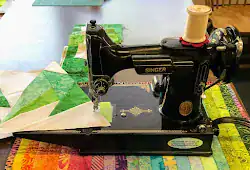
Hope everyone has resolved to finish us some of those UFO’s.You know I looked back on my list from last year and I REALLY did accomplish alot. Seems like we alway feel like so much work is ahead of us and don’t really give ourselves credit for all that we do finish. I was wondering if any quilters out there use treadle sewing machines. I’m looking at a couple of machines and while they are beautiful I really do want one that I can use. Hey when all flops with Y2K I’ll be sewing away on my treadle,using kerosine lamp, and cooking dinner in the fireplace with my cast iron pot. Sounds like heaven,no t.v. phone, oops, no computer either. Anyway if anyone has any input as to what I should/shouldn’t look for in a machine please let me know. This beauty that I’m seriously looking at is a Singer model 27. Cabinet has been refinished but is beautiful. The shuttle bobbin is there, decals gorgeous, and the drawers on the cabinet have a cute little key that locks the drawers. There is an attachment box with all kinds of stuff and a cute little book showing actual examples of the ruffles, stitches etc. $180.00 is the price and I think it is a bit high. I’ve chatted with Capt. Dick and he gave me some good info. His site is great. thanks for any input!
Susan in sunny Spokane Wash.
Date: Mon, 4 Jan 1999 01:53:08 -0500 | From: “Judy Grow” <Judygrow [at] blast [dot] net>
Lauri wrote:
>I am sewing through some fabulously unfaded claret pieces on it… and
I’ve
>noticed that any time I encounter that color, it is hard to sew by hand.
It
>seems to have a much higher thread count– it’s about as easy as sewing through a bedsheet. I have three different claret patterned fabrics and
each
>one is the same.
Lauri,
Do be careful with that turn of the century claret. Even without using steam some pieces I have of that color stained my ironing board cover — orange of all things. I’d be scared to death to let water touch it. Do test those fabrics for running by wetting a q-tip in water and just pressing onto the fabric. If it stains the q-tip, I’d stop quilting before finding out what else is going to happen.
Anybody else have any experience with this color? Would Synthrapol or Retayne help with this sort of thing?
Judy in Ringoes, NJ judygrow [at] blast [dot] net
Date: Sun, 03 Jan 1999 23:48:37 -0500 | From: Anthony <ajones2 [at] tampabay [dot] rr [dot] com>
>Someone mentioned collecting books. I had not thought of my books as a collection, just a necessary part of life, but I find I have shelves of books in every room except the bathroom
If I didn’t leave the latest quilt mags in the bathroom, when would I ever get them all read?
Date: Mon, 04 Jan 1999 02:09:47 -0500 (EST) | From: JOCELYNM [at] delphi [dot] com
On 2-JAN-1999 21:09:53.3 robertsn said to JOCELYNM
> I caught just the tail end of a Howard U.professor speaking on quilts and the UGRR on this evening’s (Sat. Jan 2) NBC Nightly News. I think the segment was entitled “In Their Own Words.” I tried unsuccessfully to research the text of it on the NBC website. Did anyone catch this presentation? Nancy
Nancy,
I did. At first, I thought he was making sense…saying that SAMPLER quilts were used as clues. Then he started pointing out individual blocks, saying ‘Monkey Wrench- a reminder to take the tools you would need for the trip. Flying Geese– these go in all 4 directions so they were a clue to go north, south, east, west. Crossroads– This was Cincinnati.’ First of all, I’m not sure that anyone would need to look at a quilt block to be reminded to pack a bag before leaving. Secondly, I’m skeptical about packing TOOLS. Did slaves actually own tools? It seems to me that they might have been owned by the masters, and leaving them behind might have helped to obscure an escape (he’s around here somewhere…..) The FG block that was being shown was a strip of FG going around the 4 sides of a block. Again, I don’t see how that would convey useful information. Go north, south, east or west? Well, where else WOULD you go? Likewise, how a Crossroads block could help people know whether the city up ahead was Cincinnati, or another city…..
He was adamant, though, that the quilts were NOT taken on the journey, but were memorized at home.
Early on, I thought he was saying that the sampler was used as a matching tool, in that they would go til they saw a quilt that was made entirely of block 1, which was out airing on a fence in a particular order among other quilts. Then the next safe house would have a quilt made entirely from Block 2, and so forth. I could see that as a workable plan. But then he went off on the symbolism of the patterns…… I’m also curious as to whether the pattern names would have been the same at that time. For example, I’ve seen people call Monkey Wrench, Hole in the Barn Door. So what would THAT symbolize? <G> FWIW, yesterday on Eleanor Burns’ program, she was talking about the Civil War and the Underground Railroad as occurring at the same time……
I’m interested in reading more about the idea of sampler quilts, since that seems to be a workable plan.
Jocelyn
Date: Mon, 04 Jan 1999 08:07:05 -0500 | From: Nancy Roberts <robertsn [at] norwich [dot] net>
With all the discussion of collections, I wonder if any thread collectors among you might be interested in this. I’m doing some serious cleaning in my sewing room and came across a bag containing wooden spools of thread (marked 15 cents a spool!). I don’t plan to keep them, but don’t want to toss them either. I’d be happy to trade them for fabric. E-mail me privately for a list of the number of spools and futher info. Hope someone can use them. Nancy Roberts
Date: Mon, 04 Jan 1999 08:20:30 -0500 | From: quiltfix [at] mail [dot] jax [dot] bellsouth [dot] net
> Yes, Alan – you do have to own a SB Sue and a Colonial Lady – I have several!!
> Lisa
So.
I should suffer too? <g>
Alan
Date: Mon, 04 Jan 1999 09:00:36 +0400 | From: Xenia Cord <xecord [at] netusa1 [dot] net>
IMHO, if you are going to own one of every quilt type ever made, you really need to own a Grandmother’s Flower Garden or Dahlia in doubleknits! (I blush to admit I own 2 “craft-type” crib quilts in cut doubleknit hexagons – one is in browns and has a teddy bear in the center, and the other a basket).
Xenia, in frigid Indiana
Date: Mon, 4 Jan 1999 09:26:17 EST | From: JQuilt [at] aol [dot] com
This is what the Howard Univ site turned up…Dobard is an art professor.
Howard University
Faculty/Staff Directory Assistance
Last Name: DOBARD
First Name: Raymond G
Position: PROFESSOR
Department: ART DEPARTMENT
Building Name: LULU VERE CHILDERS HALL
Telephone: (202) 806-7076
Email Address:
jean jquilt [at] aol [dot] com
Date: Mon, 4 Jan 1999 11:04:41 EST | From: QuiltFixer [at] aol [dot] com
Need your help on this one. Anyone ever heard of Turkeytrack/Red and White work?
This is a form of embroidery and I have had a request for information and patterns. I cannot find it in my resources. Would appreciate your help. Do not know if this was used in quilts or other forms. Toni Baumgard QuiltFixer [at] aol [dot] com
Date: Mon, 4 Jan 1999 10:40:27 -0600 (CST) | From: Nancy Evans <nevans [at] nebnet [dot] net>
At 11:04 AM 1/4/99 EST, you wrote:
>Need your help on this one. Anyone ever heard of Turkeytrack/Red and White work?
>This is a form of embroidery and I have had a request for information and patterns. I cannot find it in my resources. Would appreciate your help. Do not know if this was used in quilts or other forms. Toni Baumgard QuiltFixer [at] aol [dot] com
Toni: Isn’t Turkey Track a counted cross stitch?? I think it was being done some in the 1970’s-80’s on gingham and that type of fabric (aprons, tablecloths, etc.) Instead of being just an “x”, it has 8 points, so it’s more like a “+” superimposed on top of the “x”
someone please correct me if I’m off here – but back about that time I was doing “Creative Circle” parties, and I think this was one of the ones we taught??
Nancy Evans
Forever’s Treasures Quiltery
Date: Mon, 4 Jan 1999 11:47:22 EST | From: Tmauvlus [at] aol [dot] com
In a message dated 1/4/99 8:47:34 AM Eastern Standard Time, xecord [at] netusa1 [dot] net writes:
<<
IMHO, if you are going to own one of every quilt type ever made, you really need to own a Grandmother’s Flower Garden or Dahlia in doubleknits! >>
My collection must be complete – I own both of the above!!!
Teddy Pruett
Date: Mon, 4 Jan 1999 12:21:36 EST | From: JQuilt [at] aol [dot] com
just a quick alert about a scam…If you call the 800 # for the free Arthur S DeMoss Foundation Power Book…your name and demographics will be sold to lots of mailing lists(one of which is the Pat Robertson “get out the god vote”
list)…
jean
Date: Mon, 04 Jan 1999 11:25:44 -0600 | From: Jocelyn <jocelynm [at] sw1 [dot] socwel [dot] ukans [dot] edu>
> Toni: Isn’t Turkey Track a counted cross stitch?? I think it was being done some in the 1970’s-80’s on gingham and that type of fabric (aprons, tablecloths, etc.) Instead of being just an “x”, it has 8 points, so it’s more like a “+” superimposed on top of the “x”
Nancy and Toni,
I’m familiar with this as ‘Chicken Scratch’. Chicken Scratch is a kind of counted-thread embroidery that uses the squares of gingham to make different patterns. It does use the double cross stitch (X superimposed on a +) but there are other stitches used as well.
However, I have no idea if this is the same as Turkey Tracks.
<G>
Jocelyn
Jocelynm [at] delphi [dot] com
Date: Mon, 4 Jan 1999 11:28:07 -0600 (CST) | From: Nancy Evans <nevans [at] nebnet [dot] net>
[red face] — Oh, yeah, of course it was!!! Chicken scratch!! I knew it was “fowl” embroidery of some sort!!! Thanks for the correction! Now, then, so what is the turkey track? nan
At 11:25 AM 1/4/99 -0600, you wrote:
>> Toni: Isn’t Turkey Track a counted cross stitch?? I think it was being done some in the 1970’s-80’s on gingham and that type of fabric (aprons, tablecloths, etc.) Instead of being just an “x”, it has 8 points, so it’s more like a “+” superimposed on top of the “x”
>Nancy and Toni,
I’m familiar with this as ‘Chicken Scratch’. Chicken Scratch is
>a kind of counted-thread embroidery that uses the squares of gingham to make different patterns. It does use the double cross stitch (X superimposed on a +) but there are other stitches used as well.
However, I have no idea if this is the same as Turkey Tracks.
><G>
>Jocelyn
>Jocelynm [at] delphi [dot] com
Date: Sun, 03 Jan 1999 01:39:31 -0800 | From: Denise Clausen <nadyne [at] oregoncoast [dot] com>
Dear friends of the QHL
I have a piece of red work that a friend gave me a couple years ago. It is lettered in a language that neither I nor any friends that have seen can identify. The picture is of a lady preparing a meal. There are steaming pots on a stove and a roasting pan sitting on the edge of an oven waiting for the goose that the lady is beheading on the chopping block. She is wearing a 1920’s dress, apron, and hair style. The scene is circled by a wreath of cherries and then the following lettering (the best that I can decipher)……..
“Iz en konyheim tiikrom nekem, (the double i could be a u with 2 dots over it)
Tisztasaga boldogga t’esz engem.”
(The first letter could be an “A”. The are also slanted dashes over several but not all “e”s and there are 2 dots over one o). We do have relatives with the last name Engeman…. will have to see if they know what nationality the name comes from.
Thanks in advance for any help on this one…..
Denise Clausen
Date: Mon, 04 Jan 1999 11:36:07 -0600 | From: Jocelyn <jocelynm [at] sw1 [dot] socwel [dot] ukans [dot] edu>
> If I recall correctly, sometimes the placement of colors on a specific block style would be the clue that the slaves were looking for. For example the hearth square of the log cabin block….traditional: red; safe haven: black.
Betty,
Also on Saturday, Eleanor Burns was displaying a Log Cabin quilt, saying it was a UR quilt because it had one black center block. I knew that was where she was headed from the minute she said UR….but honestly, I couldn’t see the darned thing until the camera zoomed in. When it was far enough back that her entire body was in the shot, I couldn’t tell red or black.
Personally, if I were trying to run for my life, and I was as instantly recognizable as a fugitive slave as those slaves were (both from skin color and from dress: there’s documentation that one of the first things done by conductors in the North was to re-dress the ex-slaves, because free blacks dressed like whites in the North), I wouldn’t want to have to go that close to a quilt to find out if it were black-centered or red-centered!
I want to read the book, since it appears that others here got different interpretations from the newscast than I did. But I think it’s more likely that a signal of ‘look for the house with a log cabin quilt second from the right in a group of four’ would be visible at enough of a distance that fugitives could be pretty sure that before they left cover, they were headed towards a safe house, and that sort of clue may well have been used.
I liked your idea about how color could have been used in the FG. That makes sense.
Jocelyn
Jocelynm [at] delphi [dot] com
Date: Mon, 4 Jan 1999 12:34:04 EST | From: JQuilt [at] aol [dot] com
Turkey red is the name of #304 DMC embroidery thread…and it was used to embroider penny squares in the 30s…
this embroidery was called red work…it was on white or unbleached cotton…
jean jquilt [at] aol [dot] com
Date: Mon, 4 Jan 1999 12:50:41 EST | From: QuiltFixer [at] aol [dot] com
In a message dated 1/4/99 9:35:06 AM Pacific Standard Time, JQuilt [at] aol [dot] com writes:
<< Turkey red is the name of #304 DMC embroidery thread…and it was used to embroider penny squares in the 30s…
this embroidery was called red work…it was on white or unbleached cotton..
Jean, the person asking for the information says that it is not the regular penny square type of embroidery. I think Chicken Scratch may be closer to what she is looking for. If this turns out to be the case, does any one still have patterns for this. I have not done it in years! Toni B
Date: Mon, 4 Jan 1999 12:59:45 EST | From: QuiltFixer [at] aol [dot] com
From your description, this is a Splash which was hung on the wall behind the area where dishes were washed up and was used to keep the wall from being soiled. Hence, splash. I know it seems silly today, but many people in the 1900 did not even have a sink, but washed things in a bowl or some other container. If they were lucky, they might have a pump close for the water. Count you blessings when you load and unload that dishwasher. I do not know about the language, but this type of Redwork was very prevalent in the German American parts of our country in early 1900. Forgive my ignorance, but a wild guess, could it be Amish? Toni B.
QuiltFixer [at] aol [dot] com
Date: Mon, 4 Jan 1999 13:14:27 EST | From: QuiltFixer [at] aol [dot] com
Well, my husband Charles just woke up (the old sleepy head) and took a look at this. He is of the opinion that I am way off base on the language and he is betting on one of the Balkan Countries: Yugoslavia, Bulgaria, Albania, Greece, Romania, or Turkey (European Part). Guess we have a mystery going here. 🙂
Toni B.
QuiltFixer [at] aol [dot] com
Date: Mon, 4 Jan 1999 12:23:07 -0600 | From: “Lisa Erlandson” <erland [at] cooke [dot] net>
Xenia, and others,
Several years ago in Paducah, one of the instructors (I think it was Bobbie Aug) said that a “true” collector would have samples from each era – ie – double knit, tacky fifties fabrics, etc.
So, I now own a double knit yo-yo quilt, as well as some nine-patch ones – but don’t have a double knit grandmother’s flower garden – yet! At least if you collect these types of quilts so that you have a “full and complete” collection, you can find bargains!!
Lisa
Date: Mon, 4 Jan 1999 12:30:05 -0600 | From: “Lisa Erlandson” <erland [at] cooke [dot] net>
I need your help – I am still looking for your favorite quilt – to write an article for the VQTS newsletter.
I would love to have a really good description of your favorite quilt and why it’s your favorite.
Thanks!
Lisa
Date: Mon, 4 Jan 1999 13:36:33 EST | From: SudaNim [at] aol [dot] com
I’m posting this in case any collectors in the area want to take a look at the item. While visiting my brother in southern NJ over the holidays, I came across a vintage quilted petticoat in an antique store. Looks like black silk that’s turned greenish with a heathery-brown lining. Very nicely done quilting; not too plain, not too fancy. Condition was good. I forget the price, but think it was around $100. If anyone’s interested, I can get the name of the store from my brother. It was in the Lumberton area.
Date: Mon, 4 Jan 1999 14:40:49 EST | From: Xroadclown [at] aol [dot] com
Hello All: I’ve been a lurker for a couple of months, and finally have a question i would like to pose to the group: I’m a new quilter of about a year. I thought that before i develop any bad habits, I’d take a couple of different classes on hand quilting. We have a terrific quilt shop, owned and operated by 5 quilters, here in Ithaca, NY. They will be doing a class and technique clinic on using the Roxanne Thimble. the class is nominal, but the thimbles are about $40.00. Before i invest that in a thimble ($40.00 could buy some pretty nice fabric), I’d like some feedback from all of you!.
thanks, Melanie in COLD NY.
Date: Mon, 04 Jan 1999 14:51:19 -0600 | From: Laura Hobby Syler <texas_quilt.co [at] mail [dot] airmail [dot] net
Melanie, I own one of the original Roxanne’s thimbles (prior to the lip being added) actually, I have 3 and have quilted with them for 15 years. I teach quilting myself and demonstrate the method that I developed long before Roxanne “went on the road with hers”. If you can afford it, and will make the commitment, it is the best thimble that I can recommend. The dimples are deep enough that they will hold the eye of the needle and allow you to rock the needle to a true perpendicular plane with that of the quilting surface so that you can indeed get a tiny stitch. My partner in VQTS, Lisa (who’s asking for favorite quilt stories for our newsletter) can’t use hers, but I panic every time I think I’ve lost mine. If I ever do…I’m up a creek!!!
Good luck. I think you’ll be happy with it.
Laura
At 02:40 PM 1/4/99 EST, Xroadclown [at] aol [dot] com wrote:
>Hello All: I’ve been a lurker for a couple of months, and finally have a question i would like to pose to the group: I’m a new quilter of about a year. I thought that before i develop any bad habits, I’d take a couple of different classes on hand quilting. We have a terrific quilt shop, owned and operated by 5 quilters, here in Ithaca, NY. They will be doing a class and technique clinic on using the Roxanne Thimble. the class is nominal, but the thimbles are about $40.00. Before i invest that in a thimble ($40.00 could buy some pretty nice fabric), I’d like some feedback from all of you!.
>thanks, Melanie in COLD NY.
Date: Mon, 04 Jan 1999 16:39:23 -0500 | From: Bill Wohlfart <mrbill [at] magicnet [dot] net
Anyone in the Orlando/Central Florida area:
Don’t forget the make plans to attend the January 23 and 24, 1999, Quilt Show in Orlando.
“Gems and Jewels” Presented by the Florida Cabin Fever Quilters
Quilt Show and Sale, VEndors, Quilt Appraisals by Teddi Pruitt, antique Quilt Display, Demos, Door Prizes and more.
Location: Central Florida Fairgrounds, 4603 W. Colonial Dr., Orlando, Fl. Directions: I4 to Colonial Drive/ Amelia Ave. exit. West on Colonial Drive about 3 miles to the Fairgrounds
Info: Enid Ackbarali 407-294-7823
Hope to see you there
Jeanann in Orlando
Date: Mon, 04 Jan 1999 13:54:55 PST | From: “Kim Heger” <kheger [at] hotmail [dot] com
Chicken Scratch on gingham….really popular in the early 70’s. There’s an apron on Ebay right now. I still have a UFO from then. It was so popular it was taught in school to boys and girls to make gifts for Mother’s Day!
Roberta
Date: Mon, 04 Jan 1999 17:23:55 -0500 | From: Kathy <deschuit [at] mediaone [dot] net>
Turkish was a dead-end. The description of the piece and the umlauts would lead one to believe it is a form of German. A wild guess would be Amish and perhaps a dialect of German. My DH speaks German and is familiar with Afrikaans and says it is not either of them. He also eliminated Spanish,Swahili,Norsk,Portugese….those are the only languages he reads. And some Italian.
We need a trained linguist! <grin>And don’t look at me..I speak Boston English. <big grin>
Sorry…wish I could have helped…
Roberta