December 1 – 8, 2001
This page contains affiliate links. If you buy through them, I may earn a small commission at no extra cost to you. As an Amazon Associate I earn from qualifying purchases. Learn more
These restored messages come from the Quilt History List, an online forum where quilt historians, collectors, researchers, appraisers, and enthusiasts discussed antique quilts and related textiles. The archive dates from 1996 through approximately 2016 and is being restored gradually. Sign up in the form at the bottom of the page if you want to know when a new page is added. Original spelling, opinions, formatting, and inactive links may remain unchanged.
Primary topics of this QHL Digest:
- Connecticut and Wisconsin State Quilt Books — Extended discussion of two newly published state quilt project books — where to buy them, praise for their quality, and tracking down the Wisconsin book’s publisher. (see the article on state quilt documentation books)
- Dating the Weighting of Silk — A member asks for an exact historical date for when silk fabric weighting (a period dating clue) began, prompting several replies on textile history. (see the article on dating quilts)
- Virgin Mary at the Spinning Wheel — A tangent grows out of the silk-weighting discussion into the historical accuracy of depicting a Biblical-era Virgin Mary using a spinning wheel.
- New Member’s Inherited Unfinished Quilt — A new member, introduced via a cross-post from another mailing list, describes an embroidered flower-garden quilt top inherited from her aunt and asks for help identifying the intended picket-fence border layout.
- Auburn, NY Quilt Exhibit — A member asks the list for more information about a previously mentioned quilt exhibit in Auburn, New York.
- Recommended Reading on Textile History — Xenia Cord shares a curated recommended-reading list covering a range of textile and quilt history topics.
Date: Sat, 1 Dec 2001 07:27:03 -0800 (PST) | From: Kris Driessen <krisdriessen@>
Years ago a very active member, Nancy Cameron Armstrong wrote an article for us on the most important quilting books published to date, called The Top 10 Titles for the Study of Quilts from Seven Quilt Historians. You can find the article at http://www.quilthistory.com/resources.htm. I added Xenia’s posting as an Ed note at the bottom. It’s an excellent list!
We also have a list of articles various members have written at http://www.quilthistory.com/articles.htm. Here you will find answers to lots of your Quilt History questions, so feel free to peruse;-)) If you would like to contribute an article to this page, just send it to me and I will upload it with full credit to you.
Thanks!
Kris, list mom
Date: Sat, 1 Dec 2001 16:17:59 -0500 | From: Lesters <jeanlester@>
I have 5 blocks with the famous blue lines on them. They are orphans so I thought I would use 4 of them and make 5 blocks for a small quilt. Since I had an extra, I decided to spend the day doing scientific experiments–seeing what kind of chemicals might lessen the blueness. I went from K2R to ammonia, with everything in between. NOTHING did lessen their brightness. I will turn them wrong side up and quilt with blue thread.
I knew they were permanent but just had to try!!
Has anybody found anything to modify the color?
Jean
Date: Sun, 02 Dec 2001 12:09:28 +1100 | From: nomad1@
Happy Reading, Hiranya Loder from Oz : >
Date: Sat, 1 Dec 2001 20:20:40 EST | From: LeahZieber@
Hi all, Just a quick question to set the record straight for my husband. In the December issue of Antiques Magazine on page 795 there is a picture of a painting by John Rogers Herber titles “Our Savior Subject to his Parents at Nazareth” dated 1847. In the picture, Mary is shown with a spinning wheel.
Does the spinning wheel date to the days of Christ?
My encyclopedia is ambiguous as to when it dates to, but does say that it “was probably invented in India” and “that it reached Europe via the Near East in the Middle Ages.”
Ask Jeeves states that the spinning wheel was invented about 1200 years ago in India.
So, just for my husband’s sake (as I am convinced that there was no spinning wheel during the time of Christ and that the artist was just adding something for esthetics) can anyone confirm the date of the first known spinning wheel?
Appreciate your input L.Zieber (who is up to her eyebrows in the drywall dust from a room addition)
Date: Sat, 1 Dec 2001 21:23:55 -0500 | From: “Cinda Cawley” <lrcawley@>
I’m reading Quilts and Quiltmakers Covering Connecticut from the Connecticut Quilt Search Project. It’s gorgeous! Schiffer Publishing does beautiful books. For you BQHLers their European distributor is: Bushwood Books 6 Marrksbury Ave. Kew Gardens Surrey TW9 4JF Bushwd@ Free postage in the UK
I’ll just whet your appetites. The names alone are captivating: Content Newton, Asenath Rising, Bethankful Wells. There are lots of pictures of very early quilts: how about signed 1759! the best photos I’ve ever seen of glazed wholecloth quilts, most of them in the indigo New Englanders seem to have loved; the Presidents Quilt made from the Andrew Jackson toile (a quilt made from the same fabric belongs to Winterthur and is on p. 9 of the Threads of Persuasion catalogue from last year’s exhibit at the Brandywine Museum); a two patch composed of chintz squares set askew because they are separated by white diamonds (I’ve never seen anything like it); a strip-set Variable Star from the 1820s handed down in the female line with the instruction that it must never be used; a Lone Star surrounded by 15 borders!!! These Connecticut women must have loved really hard piecing. There are so many circular patterns: Mariner’s Compass, Sunburst, Sunburst in a Garden Maze; even the humble Fundraising Quilt, usually so boring, is made in circular blocks. One quilt has what appears to be a chintz border of birds and flowers on a flowing vine; actually it’s applique. There are some great close-ups of fabric and many of the early quilts are accompanied by woodcut prints from an 1836 history of Connecticut showing the towns in which the quilts were made. Cinda on the Eastern Shore
Date: Sun, 2 Dec 2001 10:59:24 EST | From: RBCochran@
In a message dated 12/1/2001 4:18:38 PM Eastern Standard Time, jeanlester@ writes:
<< Has anybody found anything to modify the color? >>
Jean– I had this problem years ago: a show deadline was looming, the binding was finished, and I was ready to wash/spritz out the blue lines. But they didn’t all come out–particularly those on a purple fabric with metallic stars. When I reviewed the history of my quilt, I figured exposure to sunlight was partly at fault, and maybe that purple fabric in particular. In any case, I decided to embellish the heck out of that quilt: used yarn, beads, and pastel pencils to “rework” the non-disappearing lines. Needless to say, the quilt didn’t make the show deadline that year, but was ready for the next. And I think it was greatly improved. Another example of a disaster turned into a design opportunity! –Rachel
Date: Sun, 2 Dec 2001 18:55:02 -0500 | From: mreich@
Many thanks for your kind words about this labor of love called Quilts and Quiltmakers Covering Connecticut written by my group, the Connecticut Quilt Search Project. When you are involved in a project such as this; you always wonder if you have something special or if in reality, it has all been seen before. I believe that we were driven by the spirits of Connecticut’s women, always overlooked historically, to tell their stories through the quilts they left behind. All of us on the book committee have a new respect for anyone who has published. After the documentation, there are countless months and hours of research and writing that does not make it to the book stage. Your expectations always have to be altered somewhat, however, our publishing house, Schiffer Publishing, LTD was honest and supportive. They helped us to meet our goal, to produce not just a pretty quilt book but also to tell the stories of the women who made them and their contribution to our state’s history.
It is so wonderful that quilt enthusiasts, historians and quiltmakers, today, are taking the time to connect with these women. Many of the quilts in our book were made during other tragic times in our Country’s history. I, myself, find it comforting to know that like the quiltmakers of our past, we, too, will persevere and through our quiltmaking set our place in history. An FYI. We believe that Schiffer did a 5,000 print for the first printing. We have a few of our 1,500 book commitment left to sell after that they should be available through Schiffer and also on Amazon and Barnes and Noble.com. Hopefully, some bookstores will continue to carry them, also.
Again thanks for your support, sue reich
Date: Mon, 03 Dec 2001 10:10:00 -0500 | From: “Kris Driessen, QuiltBus.com” <oldquiltalbanyweb.com>
We have had two new articles contributed recently. Please check out A Short Introduction to Period Quilting and The Alliance for American Quilts: Partnerships Launching Quilts onto Center Stage, both reachable from the Articles page at http://www.quilthistory.com/articles.htm.
If you would like to contribute something – even something small, like a picture – just send it to me at this address. You never know when your tiny bit of information may be just the confirmation a researcher needs.
Kris (List Mom)
Date: Mon, 3 Dec 2001 07:57:21 -0800 | From: “Laurette Carroll” <rj.carroll@>
Hello,
Does anyone have a reference for an *exact date* for the beginning of the weighting of silk fabrics.??
We know that it was before 1880 because of the many dated Crazy Quilts with shredding silk fabrics, but I can’t find a reference for an earlier date.
Thanks, Laurette Carroll Southern California
Look to the Future with Hope
Date: Mon, 3 Dec 2001 10:17:02 -0600 | From: “quilt97” <quilt97@>
Does anyone know who is the author of the following poem?
Thanks.
EKarenbeth
Little bits of fabric sewn into a quilt Form a warm and loving blanket from which memories are built. And when you seek peace and comfort in the quiet of the night. It will keep you warm and snug until the morning’s light. (Author: unknown)
Date: Mon, 03 Dec 2001 17:03:07 -0600 | From: Xenia Cord <xecordnetusa1.net>
With regard to the painting of the Virgin Mary shown with a spinning wheel, I can only say – whoops! Anacronisms can creep in, especially when the creator is operating in a field in which he/she is not well versed.
That said, how were threads for woven textiles made? My understanding is that most early thread (I’m talking BC here) was created by hand spinning. Consider, for instance, the fine linen drapings of the early Egyptians, and the fabrics used to wrap mummies. The principle is the same whatever technique is used: the fibers are twisted together to make a continuous strand. “Thigh spinning,” hand spinning, and wheel spinning all rely on the same action – the twisting of the fibers. Thigh spinning was practiced by the early Greeks, according to Whiting (Traditional Toys & Tools of Needlework). Workers protected their thighs by wearing a leather or terra cotta shield that curved over the thigh, and the fibers were rolled by hand and friction against the guard.
Other spinners used a drop spindle. Same techique: the tool consisted of a weighted “whorl” of wood or rock, with a hole drilled through the center. A stick or spindle (see where the word comes from?) fitted through that hole and allowed the weight to rest at the bottom of the stick. A spin of the spindle would create the twisting motion needed to
twist the fibers held in the spinner’s hand. When she had spun a length
that allowed the spindle to drop from her hands to the ground, she stopped, wound the finished thread on the spindle, and began again.
Flax wheels and wool wheels are more elaborate versions of the drop spindle, and do the same thing. The use of a wheel for this activity dates in Europe from the 1500s, according to Whiting, and from about 500
AD in India.
Discussion, please <g>. Xenia
Date: Mon, 3 Dec 2001 20:07:46 EST | From: Trimble4@
Whew, Xenia!! I’m impressed!! You are just a WEALTH of information!
Well done! <g>
Lori in NE Mass.
Date: Mon, 3 Dec 2001 20:17:23 EST | From: Trimble4@
I just want to second Cinda’s comments about this book. It IS gorgeous. Even better, I had the privilege of spending a lovely Saturday afternoon last weekend with Pam Worthen (of this list) and I got to see some of these fine quilts in person. We also took in the hat exhibit at the Textile Museum (quickly though, the quilts were waiting!). The Connecticut exhibit is ongoing at the New England Quilt Museum in Lowell, MA, and is worth taking the time to see. Many of the quilts are just perfect…even now. My absolute favorite was the Star with Baskets by Henrietta Smith Glover…beautiful! Lori in NE Mass…but not for long!
Date: Tue, 4 Dec 2001 17:17:50 -0800 | From: “nms” <nmsjps.net>
Sorry for the late post regarding the American Needlework book and patterns. I have an extra copy of this book complete with the patterns I would be willing to part with. Anyone interested, please email me privately. Nance Searle
Date: Tue, 04 Dec 2001 20:06:50 -0800 | From: Gail Ingram <GIngramtcainternet.com>
I wish to give the state project books from Conn. and Wisconsin as gifts. Amazon lists WS book as a “hard to find” item and the CT one as not yet available.
Any suggestions?
Gail Ingram
Date: Tue, 4 Dec 2001 22:27:14 -0500 | From: “J. G. Row” <judygrowrcn.com>
Many painters in all ages clothed their subjects in their contemporary clothing and set them in their contemporary landscapes. It is not unusual to see Herod’s soldiers in medieval armor with turreted castles in the landscapes behind them. Seeing the Virgin pictured at a spinning wheel is in the same tradition. Women who spun were always protrayed as good and virtuous. What better way to portray Mary?
http://www.joyofhandspinning.com/HowToDropspin.html almost everything you ever wanted to know about spinning, with videos.
http://www.monroehistoricsociety.org/spinning.html another nice site that shows how a drop spindle was used.
I am reading Laurel Thatcher Ulrich’s “The Age of Homespun,” a recent book. In it, she states that it took 8 to 10 spinners to keep a weaver in yarn, and that spinning was learned very early in childhood. In New England, where “any man might own land, cloth-making was an extension of farming.” Since very few could afford (though many lusted after) imported textiles, spinning for the greedy loom was a constant occupation.
In the pre-Revolutionary period in New England over 20 % of families had looms, but almost 75 % had spinning wheels. Which meant that (usually) the daughters of the households spun and then the weaving of that yarn was often done by an artisan neighbor.
Many New England women met in spinning meetings as a way to protest the English stamp tax and as part of their boycott of imported goods. Besides demonstrations there would be contests to see who could spin the most yarn, and then the yarn would be given to the local pastor for the support of his family or the local poor. Many of these were like quilting bees in that they were groups of people who worked to benefit a single person or household.
The 1810 census told that all classes except “transient or marginal” persons wove. In Topsham, Maine, 88 percent of households made cloth, although only just over half owned looms. This held true throughout New England. Most families did not produce much more than they could consume themselves, although many used their homespun and woven textiles to purchase finer imported textiles. In the year before the revolution, in New London, Conn., locally woven unfulled wool called flannel could be brought to the local store and traded for printed calico, lace, broadcloth. One woman brought in 9 yards of flannel she had woven as a down payment on copperplate bed curtains which put her more than 4 pounds in debt.
The American Museum of Textile History, in Lowell, MA has a most amazing collection of spinning wheels, beautifully displayed! I wondered at the number of them there, (hundreds) but after reading Ulrich I understand how so many survived to be displayed. They were in almost every home!
Judy in Ringoes, NJ judygrowrcn.com
Date: Wed, 05 Dec 2001 07:55:23 -0500 | From: Newbie Richardson <pastcrafts@>
I echo Xenia’s recommendation of Elizabeth Wayland Barber’s “Women’s Work: The First 20,000 Years/Women, Cloth, and Society in Early Times,“
It is the story of archaeology from a woman’s (weaver) point of view! It reads like a novel. It does for archaeology what “The Mists of Avalon” did for the Arthurian legend – a very fresh point of view!
I know that spinners used whatever was at hand for their craft. In Eastern Europe, girls used a turnip, a beet, or a potato as their “weight” in drop spinning way through the 19th century in the undeveloped countyside. Spinning wheels were “high tech”!
Another good read on this topic is: “A Midwife’s Tale” by Laura Thatcher Uhler. She narrates the late 18th century diary of Martha Ballard from Maine. You get a very true sense of how women had a parallel economy that relied on bartering of skills and tools. For instance one gal would trade warping a loom ( a really ornerous task) for use of the neighbor’s brick oven. Drop spinning did not stop with the invention of the spinning wheel, as it was so very portable!
Date: Wed, 05 Dec 2001 08:57:28 -0500 | From: “Jan Drechsler” <quiltdoc@>
Gail, Did you check our list mom for the Connecticut book? If not, you should go there first for all your history book needs before feeding the book giants Amazon, etc.
OK Kris, you can send me my free lollypop for the PR <grin>. Kris has a great collection of books at www.HickoryHillQuilts.com/heritage.htm — Jan Drechsler in Vermont Quilt Restoration; Quilting teacher www.@/~bobmills
Date: Wed, 5 Dec 2001 06:35:53 -0800 (PST) | From: Kris Driessen <krisdriessen@>
Thanks, Jan. I do have the CT book in stock – it’s $29.95 – and worth twice as much, quite honestly.
I put my husband in charge of looking for the Wisconsin Quilt Search book today. Ironically, he is from the same area as the author, but he doesn’t know her:-((
Anything else y’all would like us to look for? I don’t mind giving my husband something to do, other that putting up Christmas lights. The weather has been gorgeous for this time of year, and he has dragged out and put up every light we ever bought and even bought more! UFO’s could use our house as a landing guide. It’s kinda nice, though.
Kris
Date: Wed, 5 Dec 2001 11:44:26 -0500 | From: mreichattglobal.net
The Wisconsin book is being published by Howell Press from Virginia. I think they are online. If not Joan Knight at the Virginia Quilt Museum in Harrisonburg, VA can give you their number. Other than the publisher of Quilts and Quiltmaker Covering Connecticut, Kris may be the only source right now for purchasing it. About 5,000 books were printed. It is going out in the spring catalog of Schiffer. CQSP was able to make the first 1500 copies available earlier. Good luck, sue reich
Date: Wed, 5 Dec 2001 11:37:46 -0500 | From: “Teddy Pruett” <Aprayzer@>
<<With regard to the painting of the Virgin Mary shown with a spinning wheel, I can only say – whoops! >>
Oh yez, oh yezz……..I know we all were just dying to spin a few hundred yards of thread within hours of childbirth……….Teddy Pruett
Date: Wed, 5 Dec 2001 13:03:05 -0500 | From: “Cinda Cawley” <lrcawleydmv.com>
A few days ago somebody mentioned the quilt exhibit in Auburn, NY. I’d like to know more about it (name, location, dates, a contact). Thanks. Cinda on the Eastern Shore
Date: Wed, 5 Dec 2001 11:54:33 -0800 (PST) | From: Kris Driessen <krisdriessen@>
QHL@
We did track down the publisher – Howell Press, just like Sue said:-)) Apparently they took over EPM three years ago. I ordered the Wisconsin book so if you would like one, please give us a call at 888-817-6577. If there are any left, I will put it on the website tonight.
Kris http://www.hickoryhillquilts.com/heritage3.htm
Date: Wed, 05 Dec 2001 16:50:49 -0800 | From: Gail Ingram <GIngramtcainternet.com>
How could anyone be a Scrooge and a member of QHL?
To everyone who replied to my query re the WS and the CT quilt books, merci beaucoup!
Most especially for the educational reminders about shopping the listmom’s store first!
Gail
Date: Wed, 5 Dec 2001 18:36:36 EST | From: JQuilt@
in the december 2001 issue of New England Antiques Journal there a center fold layout in color of quilts…i don’t even want to mention what is written in the article about the pictured blocks and quilts…but suffice to say…the myth grows and grows…if you go to http://www.antiquesjournal.com/ and look at the cover of the issue… in the bottom right hand corner is the title and sub title of the article about quilts… jean
Date: Sat, 5 Jan 2002 14:13:24 -0500 | From: “pepper cory” <pepcorymail.clis.com>
After last week’s round of computer viruses that compelled me to employ a computer-literate friend to clean out my machine, I was inspired to also shovel out the studio. Came across a legal box full of reprints of Little Dutch Girl Publications. They begin with her initial offering in December 76 and goes through at least four months of 83. Little Dutch Girl was Edna Van Das, who, judging from her ediorial stance and slap-dash writing and editing style, must have been quite a character. Anyone out there familar with Little Dutch Girl? Am wondering if there were publications after 83 or if I’ve got the set. They were given to me by Dar Roberts, since deceased, of Quilting Books Unlimited years ago. Pepper Cory
Date: Thu, 6 Dec 2001 21:06:35 -0800 | From: “Christine Thresh” <christinewinnowing.com>
Fabric is woven from spun threads so it’s been around a long time. I am not a bible scholar, but I have been a spinner. In Proverbs 31: 19 it says “She layeth her hands to the spindle and her hands hold the distaff.” Spindles (pointed sticks) are used for spinning thread (wool, cotton, and flax). They were and are mounted on spinning wheels so both hands are free to pull on the fiber. A distaff is a holder for hackled flax and sometimes mounted on a flax wheel (the sit-down type with a treadle). I don’t think a distaff was used with a wool wheel (the stand-up type large wheel). I don’t know when the translation was done for the King James Bible so dating this activity is beyond me. Perhaps it read differently in the original language. I can’t picture the “virtuous woman” holding both a drop spindle and a distaff to spin her thread, she would need a third hand.
Christine on an island in the California Delta http://www.winnowing.com
Date: Fri, 7 Dec 2001 08:17:05 -0600 | From: “quilt97” <quilt97@>
Thanks to Judy and Newbie who wrote about Elizabeth Wayland Barber’s “Women’s Work: The First 20,000 Years/Women, Cloth, and Society in Early Times,“
Another good read on this topic is: “A Midwife’s Tale” by Laura Thatcher Uhler. She narrates the late 18th century diary of Martha Ballard from Maine. You get a very true sense of how women had a parallel economy that relied on bartering of skills and tools. For instance one gal would trade warping a loom ( a really ornerous task) for use of the neighbor’s brick oven. Drop spinning did not stop with the invention of the spinning wheel, as it was so very portable!
Date: Sat, 8 Dec 2001 10:57:03 EST | From: SadieRose@
Brenda posted this note on the Info-EQ list today. I wrote & suggested she join us (she is going to), and offered to post her question here, as I think we might have someone who can help her out….she really doesn’t need BlockBase (which is a wonderful program) for this quilt.
Subject: Question Regarding BlockBase From: “Brenda Josselet” <bjosseletaustin.@> Date: Fri, 7 Dec 2001 09:15:45 -0600
Hi everyone,
My name is Brenda, and I am new to this group as well as to quilting. I have done many, many other crafts in my lifetime (including sewing), but never quilting until now. I am hoping I can get some input from all of you on Block Base.
What I want to know from those of you who have this cd is — does it contain ONLY blocks or does it also have borders. Here’s the reason I am asking:
The reason I decided to give quilting a try is because I inherited an unfinished quilt from my aunt. My mother embroidered quilt blocks when she was 17 years old while recuperating from a broken leg (my mother is about to turn 78 so you can quickly figure out how old these embroidered blocks are). Anyway, the pieces to this quilt have a long family history. My aunt started working on a quilt that these blocks were to be set into but never finished it. It was to be a present to me when I graduated from high school (which was in 1971). Since I didn’t get it then, I was then supposed to get the finished quilt when I got married — never did receive that finished quilt and I’ve now been married for 28 years.
To make a long story short — I got the unfinished quilt when my aunt died. It would mean a great, great deal to me to finish this quilt and give it to my mother to keep until it comes back to me at her death. It would also mean a great deal to my mother who has been wanting that quilt finished since I was in high school.
Anyway, here’s my problem — I know how the embroidered flower blocks are supposed to be put together, but I don’t know how the border is supposed to look. I know it’s a long shot, but I am really hoping that someone on this list will recognize the description of the border and be able to either point me in the right direction for finding a picture of it or might, by some miracle, know something more about this quilt. So, here goes:
The name of the quilt is “Mother’s Old Fashioned Flower Garden Quilt.” The copyright on the color chart for the embroidered flower blocks is 1931 and was published by Home Art Studio, 531 Waterbury Circle, Des Moines, Iowa.
The “directions” for completing the quilt are from Household’s Quilt Block Service in Topeka, Kansas. Here’s an excerpt from the directions:
“To make you flower quilt even more realistic, we suggest you use our picket fence border pattern. An old-fashioned picket fence surrounds the four sides of the embroidered posy garden. A little gate at the center of one side stands ajar so one may enter and enjoy the beauty and fragrance of the hand-stitched blossoms.”
My aunt did finish quite a bit of the picket fence. She even cut out and put together the gate and stepping stones. The problem I have run into is that there is a corner post and two side corner posts for the picket fence and I cannot, for the life of me, figure out how they are supposed to go together. Since I don’t have any kind of picture of what the finished quilt is supposed to look like, I also don’t know if the gate is supposed to go in the center or one of the long sides or one of the short sides.
Like I said earlier, I know it is a long-shot that someone will be able to help me out, but you can’t even imagine how much it would mean to me and my mother to see this quilt finished.
Thank you all in advance for any help you might me able to give me.
Brenda J.
Date: Sat, 8 Dec 2001 10:46:54 -0600 | From: “Junior/Peggy McBride” <jlmpamnetins.net>
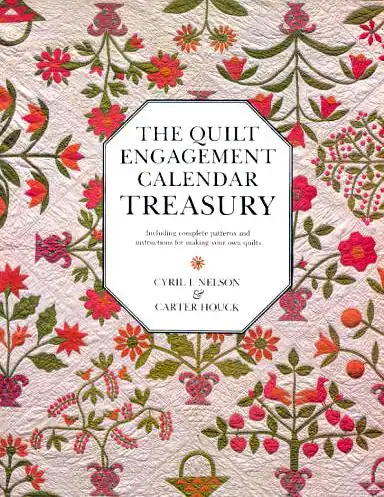
Am I remembering correctly, The calendar by AQS is Quilt Art 2002. The Quilt Engagement Calendar was published for years by someone else, whose name escapes me, and I thought the discussion was a while back that it was not to be published any more. They published mostly antique quilts and you got to see quilts that were in museums and private collections. I hope I am wrong, but don’t think I am.
Peggy Mc
Date: Sat, 8 Dec 2001 10:51:41 -0600 | From: “Brenda Josselet” <bjosseletaustin.@>
Hi everyone,
My name is Brenda, and I am new to this group as well as to quilting. I have done many, many other crafts in my lifetime (including sewing), but never quilting until now. I am hoping I can get some help from someone on this list.
The reason I decided to give quilting a try is because I inherited an unfinished quilt from my aunt. My mother embroidered quilt blocks when she was 17 years old while recuperating from a broken leg (my mother is about to turn 78 so you can quickly figure out how old these embroidered blocks are). Anyway, the pieces to this quilt have a long family history. My aunt started working on a quilt that these blocks were to be set into but never finished it. It was to be a present to me when I graduated from high school (which was in 1971). Since I didn’t get it then, I was then supposed to get the finished quilt when I got married — never did receive that finished quilt and I’ve now been married for 28 years.
To make a long story short — I got the unfinished quilt when my aunt died. It would mean a great, great deal to me to finish this quilt and give it to my mother to keep until it comes back to me at her death. It would also mean a great deal to my mother who has been wanting that quilt finished since I was in high school.
Anyway, here’s my problem — I know how the embroidered flower blocks are supposed to be put together, but I don’t know how the border is supposed to look. I know it’s a long shot, but I am really hoping that someone on this list will recognize the description of the border and be able to either point me in the right direction for finding a picture of it or might, by some miracle, know something more about this quilt. So, here goes:
The name of the quilt is “Mother’s Old Fashioned Flower Garden Quilt.” The copyright on the color chart for the embroidered flower blocks is 1931 and was published by Home Art Studio, 531 Waterbury Circle, Des Moines, Iowa.
The “directions” for completing the quilt are from Household’s Quilt Block Service in Topeka, Kansas. Here’s an excerpt from the directions:
“To make your flower quilt even more realistic, we suggest you use our picket fence border pattern. An old-fashioned picket fence surrounds the four sides of the embroidered posy garden. A little gate at the center of one side stands ajar so one may enter and enjoy the beauty and fragrance of the hand-stitched blossoms.”
My aunt did finish quite a bit of the picket fence. She even cut out and put together the gate and stepping stones. The problem I have run into is that there is a corner post and two side corner posts for the picket fence and I cannot, for the life of me, figure out how they are supposed to go together. Since I don’t have any kind of picture of what the finished quilt is supposed to look like, I also don’t know if the gate is supposed to go in the center or one of the long sides or one of the short sides.
Like I said earlier, I know it is a long-shot that someone will be able to help me out, but you can’t even imagine how much it would mean to me and my mother to see this quilt finished.
Thank you all in advance for any help you might me able to give me.
Brenda Josselet
Date: Sat, 08 Dec 2001 12:20:49 -0600 | From: Xenia Cord <xecordnetusa1.net>
There will probably be several replies to Sadie’s post, and the forwarded one from Brenda, but here is some preliminary information:
The pattern (“Embroidered Flower Garden”) was created by Ruby Short McKim of Independence, Missouri, and was used as a contest series in syndicated newspapers in 1929-32, and perhaps later (The Indianapolis Star used it over the winter of 1929-30). There were 25 nine inch blocks to be embroidered, plus a quilting pattern that resembles 4 dandelion puffs, and the picket fence border. In McKim’s “Designs Worth Doing,” Fall-Winter 1931-32, the design is on page 15. McKim was selling the stamped blocks and completion fabrics as a kit at that time.
The picket fence was a problem, because if the quiltmaker decided to put it on all 4 sides of her quilt as called for in the description (the illustration shows it just at top and bottom), no information was provided on how to turn the corner. Some quiltmakers put a gate on the diagonal in the corner block, others repeated the quilting motif, and some left the corners empty. I have seen a lot of variation in the fence border treatment, since lots of these quilts were made in Indiana in response to the Star contest.
The description that accompanies the little illustration suggests that Ruby McKim was dealing with competitors who had copied her designs – but poorly, according to her. (“They in no way compare with cheap, amateurial drawings where some [designs] are scant and spindly and other blocks are crowded and ugly.”)
Hope this helps! Xenia
Date: Sat, 8 Dec 2001 17:33:18 -0600 | From: “Leigh Fellner” <hcquiltspeoplepc.com>
The auction just closed at $6,128! 🙂
http://cgi.ebay.com/aw-cgi/eBayISAPI.dll?ViewItem&item=1491175479
Date: Sat, 8 Dec 2001 20:38:32 -0500 | From: “deb” <debquiltingposs.com>
I just bought some stamped applique quilt blocks – just like the stamped kits but in block form from the Marvil Art Needlwork Co. St. Louis MO. Can anyone provide any information on this company?
Thanks, Debbie Bayville, NJ