August 26, 2004
These restored messages come from the Quilt History List, an online forum where quilt historians, collectors, researchers, appraisers, and enthusiasts discussed antique quilts and related textiles. The archive dates from 1996 through approximately 2016 and is being restored gradually. Sign up in the form at the bottom of the page if you want to know when a new page is added. Original spelling, opinions, formatting, and inactive links may remain unchanged.
Primary topics of this QHL Digest:
- Teal Dye in 19th-Century Quilts — Members discuss where and when the color teal appears in antique quilts, including Indian-print sources. (see the article on natural dyes)
- Fulling and Waulking Wool Cloth — A discussion of historical wool-fulling (waulking) methods, sparked by a UK television segment recreating the process.
- Plymouth Notch, Vermont Travel Recommendation — A member recommends Plymouth Notch, Vermont as a worthwhile historic-site visit regardless of any quilt exhibit.
- A Civil War Soldier’s Journal — A member shares a chance discovery of a Civil War-era marine’s journal with quilt-related references. (see the article on a Civil War quilt)
From: “Maureen” <maureen@>
Hi Carolyn:
I have a wonderful little book from the Brooklyn Botanic Gardens called “Dyes From Nature”, published in 1990 as part of the BBG Record. Trudy Van Stralen has an article on page 57, “Using Cochineal and Indigo in Dye Combinations”. I quote from her article on page 58 and 59:
Using Saxon Blue Indigo. This is not a traditional method of using indigo. Instead, it is an old industrial recipe, used in Europe just before chemical dyes were discovered. Compared to dyes from an indigo vat, this method gives a more royal blue color with neutral water and a more turquoise color with acid water.
Her article continues with a recipe for making the Saxon Blue solution and also aqua-turquoise from indigo and queen-anne’s lace.
In the past I have seen a number of other natural dye books both historical and contemporary, but have sold them quickly. This one I’m keeping!
There are lots of titles available on Amazon or ABE if you search “natural
dyeing”
Best,
Maureen Battistella In Ashland, Oregon.
color”
Hi Gail,
Do you have the book ‘Florida Quilts’ by Charlotte Williams? On pages 60 and 63 are pictures of quilts with this ‘teal, orange’ combination. One of these is dated 1871 in the quilting and the other is said to be made in 1869. Both said the fabric was home dyed with tree barks. What tree would have produced this teal color? I have a stacked bricks quilt in the 2 colors of teal and orange. It is from a family in West Texas.
If these were made with home dyed fabrics then what were the furnishing fabrics made from that showed up in magazines. Also if we knew what
tree or plant was used maybe it was something that was just grown in the south.
Just questions, Carolyn
From: “Steve and Jean Loken” <sandjloken@>
I remember reading a long English novel that took place in the Middle Ages, and went into lots of detail about fulling cloth. Alas, the name escapes me. Fulling was done to make cloth more water-proof. It’s a similar process to our new craze of felting. I searched the internet under “fulling cloth” and pulled up a lot of British and Irish sources. They suggest that the practice dated at least to the Bronze Age. I didn’t see the term “kicking bee” but there were mentions of stomping the cloth. Jean in MN
From: “Libby Wallis” <lwalliskc.@>
I was the presenter on “Who Was Maggie Randall?” at the MOKA meeting in Wichita earlier this month. I joined the QHL after that and this is my first posting.
Eleanor, That was a wonderful summary of our wonderful weekend. Thank
you!
Carol, What a find! I would leave the needle and thread right where it is in the quilt.
My research methods were similar to what a genealogist would do but were the result of lots of classes and seminars related to quilt history. I suggest that you start at your church. Ask if they have records from the 1920’s-30’s such as membership lists or minutes of women’s group meetings. HTC may be an acronym for the name of a club with C for Club. My grandmother belonged to a group about the same time period and they called themselves the
Jolly Housewives Club. I have the records they kept of their meetings. At least once they had an article in the local paper (Sand Springs, OK) about
their meeting. They didn’t quilt but I am doing quilt in their honor.
Libby Wallis
Quilt Collector and Historian
And sometimes Quilt Maker
Overland Park, KS
From: “Andi Reynolds” <andi0613@>
I remember reading a long English novel that took place in the Middle Ages, and went into lots of detail about fulling cloth. Alas, the name escapes me.
The book probably was Ken Follett’s “Pillars of the Earth.”
Andi
From: DDBSTUFF@
As long as you’re discussing “teal” again, I have a question.
Over the years, I have had numerous early appliqued quilts that used a teal in place of the more common green for the vines etc. These have usually been from the latter part of the 1st half of the 19th century, c.1840-50. Many of them had a brown stain-like area around the teal that seemed to have radiated out from the teal appliqued fabric. I was always able to wash it out but I was wondering if any of you have seen this as well and if anyone knew what caused this. I’m sure it has something to do with the dye or mordant but have always wondered just what it was.
Also, I have had lots of 19th century quilts that have had a teal that faded to a beige. These were usually c.1880-90. Would you all agree to this dating? I know it was teal because several of them were not completely fades out.
Thanks,
Darwin
From: “BOBBIE A AUG” <qwltpro@>
I may have missed the original question, so if I’m off topic, disregard. But, the Teal color that I thought was being referred to would not be confused with aqua, etc. It’s very dark and almost dark green – more
green than blue. If that’s the case, then the 4th quarter 19th century would be a very popular period. Circa 1900 would not be out of the question. Oftentimes on poor quality greige goods and fugitive to brown in spots. Aqua, in the lighter colors – popular much, much earlier.
And again in the 1920’s and so on. I am referring ONLY to solids and
not prints, and when found in quilts. Also, popular is the key word.
Trends, fads, etc.
For example, I’m still wearing Prairie skirts….
Bobbie
Bobbie A. Aug Author, lecturer, teacher, AQS Certified Quilt Appraiser
From: “weemsjm” <weemsjm@>
I have a Grandma’s Garden quilt top made by my Grand Mother around 1930.
It is really my Mom’s, I am just helping with it.
The fabric seems to be in good shape and my mother would like it backed and quilted.
Neither of us are hand quilters and I think it would be fool hearty for me the quilt it on my machine.
The lady at my local quilt shop told me to quality quilt it ( tie ). I think it is just to nice to tie.
I have been thinking of having it quilted by a long arm machine. I have a shop in mind but thought I would ask before having it done.
I would not put a batting to limit stress from the weight.
What do y’all think?
The man seems to do really good work I have talked to a friend who had a small piece done by him. I will attack his web site maybe someone has used him before.
http://www.qdstudio.com/
Thanks for any help.
Jeff
Bobbie,
The very dark color is, in fact, the color to which the discussion has referred.
Three basic questions arise about its popularity at the time. First, did it arise from a popularity of the color in contemporary (Victorian) home decorating or clothing?
Second, what was the source of the natural dye to which some sources refer (see “Florida Quilts,” e.g., where it is said to be derived from “tree bark.”)?
Third, proportionally, is the teal, cordavan brown, and cheddar/orange color combination more popular in southern quilts than in quilts from other areas? For some reason, a number of Southerners associate it with the South, perhaps incorrectly.
Thanks for addressing this question.
Gail
From: Judy Kelius <quilts@>
I think you are right not to tie it . . . it puts stress on the fabric, and tied quilts (actually comforters) never look as good or hold up as well as a quilted quilt. One wash will often mean the end!
I think a long-arm would be fine, but you could also send it out to have it hand quilted.
Definitely use a batting! It will not put stress on the fabric if you use a thin COTTON batt (never use poly with an antique quilt – some poly battings act like thousands of tiny brillo pads, scratching away at the old cotton fabrics and eventually popping through . . . I’ve seen too many good antique tops destroyed with poly batting). In fact, I think cotton batting strengthens the old fabrics, stabilizing them and giving them a soft base to lay on. Whether you choose hand or machine quilting, also be sure they use 100% COTTON thread – poly threads are stronger than the cotton fabrics and can actually cut through them. I don’t even like the coated cotton thread many quilters use – I prefer a regular cotton thread since it is softer. Most of the best antique quilts have a thin cotton batting. Some people actually separate a cotton batt in two to use with an antique quilt top (this doesn’t work with all battings, but Mountain Mist Blue Ribbon separates easily).
From: Judy Kelius <quilts@>
>Third, proportionally, is the teal, cordavan brown, and cheddar/orange >color combination more popular in southern quilts than in quilts from >other areas? For some reason, a number of Southerners associate it with >the South, perhaps incorrectly.
I often see a dark blueish green, which I think is what you are referring to, in SE PA quilts as well, but rarely in combination with a solid brown. I often see it with red and cheddar. It was also used frequently for borders on scrap quilts and in applique quilts, and is very prone to fading. I’ve seen it fade to a blue color and I’ve also seen it fade to a more tan (yellow) hue. (I’ve even seen it disappear completely, leaving just the white fabric . . . at least, I thought the original color was some shade of green!) I’ve always assumed the different fading characteristics were related to the dying process and the mordants used.
From: Jackie Joy <joysbees@>
I’ve heard fulling referred to as waulking. See this for a description with illustrations. They also mention foot waulking. http://www.houseofscotland.org/waulking.html
Jackie Joy
From: Anne Copeland <anneappraiser1@>
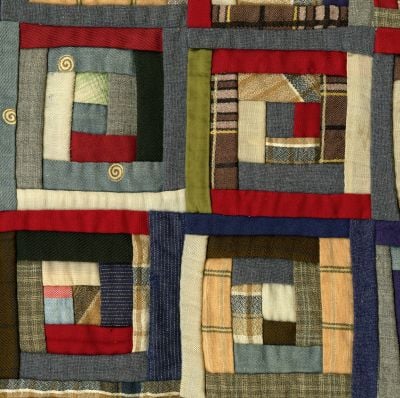
Wow, had the coolest experience yesterday. I have been driving by this little thrift store everyday in my own neighborhood, just a couple of blocks away. I kept noticing what I thought was fabric in the window, but I was always on my way to work and they were closed, etc., so never got to stop there. Yesterday in the late afternoon, I was on the way to take the dogs for a walk in the park when I passed the store and it was open, and so I stopped. I looked closer in the window and lo and behold, it was the coolest Log Cabin in the courthouse steps configuration with blacks and medium colors and red or orangy centers.
My heart was pumping at a high level, but I went inside and cooly asked about the “tapestry” in the window. The lady went in the window for me and told me it was $39! Well, that did it. So of course it came home with me. She and her hubby are missionaries and she spends time traveling to and from Africa, and this lady told me the quilt came from Africa. She might be (or someone else might be) teaching the ladies over there how to quilt. It had 4″ blocks and is very graphic. The logs are approx. 1/2″ (little variance). Some bit of damage on some of the logs from using silk or some other fabric that is shattering as those oftendo, but it is great graphically. It is clearly made from all kinds of clothing scraps including some velvet. It has a felt-like material someone appears to have “fused” onto the back so that it will hang very straight. I would try to take the felt stuff off because I could probably get it off then, but the fusing stuff is still there. Oh yes, the fusing stuff looks rubbery, and it DOES peel off a little, but not sure I could get it ALL off. And it is foundation pieced. I don’t believe it is an old piece at all from the fabrics used. The colors and prints are very well placed.
I was so excited I didn’t really stay, but I will go back and ask her more about its history. What a great day! Peace and blessings, Annie
From: Teri Klassen <teresak@>
Regarding the color teal in 19th century quilts, I have seen it in several Indiana quilts, including one from southern Indiana in the late 1840s, another from central Indiana dated 1858 I believe. often it is used instead of green on a red, “green” and white floral style quilt. I have heard people suggest it was a green that wasn’t fast, but I always suspected it was an intentional alternative. Teri
From: “Kathy Moore” <KathyMooreneb.@>
I was an office administrator at a Presbyterian Church for a few years and can testify that there may be a treasure trove of information in your church records. Membership rolls, births, deaths, committee activities and member lists, annual reports, women’s association reports, and financial reports on a year-by-year basis can yield some very interesting information and verify facts you get from other sources or lead you to ask leading questions from the appropriate people. Good luck and good hunting.
Kathy Moore
From: Joan Kiplinger <jkip@>
The names for quilt patterns never cease to amaze me. Found some more new ones [to me] on Pat Cummings new column regarding her recent visit to the Calvin Coolidge Museum.
ttp://www.quiltersmuse.com/Calvin%20Coolidge%20quilt%20exhibit.htm
From: Gail Ingram <gingram@> I cannot forebear joining Pat Cummings in commending Plymouth Notch as a place to visit—quilt exhibit or no quilt exhibit.
As a lifelong traveler of backroads in the company of a historian husband, I’ve had the opportunity to see many wonderful and generally unvisited places that remind me of the opportunities available to one in the U.S. Few, however, have impressed me the way Plymouth Notch impressed me.
This is not a place one goes “by.” It is well off the beaten path. One winds along country roads that follow creeks and mountain hollows. You think you’re lost. Then, there is a little settlement, looking much as it did when Coolidge lived there, I imagine, except for what it sells. Beside the General Store that has been remodeled a narrow road turns upmountain and the traveler drive under ancient maples.
If you stop, get out of your car, and take in the vista before you—the valley with the low mountains beyond—and you realize that a President of the U.S. was born and reared there, you have to believe in the potential which this country has. That a boy growing up in such a hamlet (for it is not even a village) could become president seems imposible. And the story we all learned in history 101– that when, as Vice President, he received the news of the President’s death and his own rise to that position, he took the oath of office from his minister father in the middle of the night, and then went back to sleep—seems entirely plausible when you stand in Plymouth Notch.
Pat, is there a catalog of this little exhibit? Postcards of the quilts represented in it?
Gail
From: Patricia L Cummings <quiltersmuse@>
Dear Gail:
As far as I know, there is no exhibition catalog available. The beautiful little gift shop does have some postcards, but the only quilt related ones, as I recall, are Calvin’s “Tumbling Blocks” quilt top, and his sister Abbie’s (similar) piece. The shop also carries books, jewelry, a neat puzzle of Calvin’s quilt, and other small items.
Loved your description of the place, Gail, and the recollection of Coolidge being sworn into office in the middle of the night when word came that President Harding had died. Someone asked Calvin’s father why he felt that he had the right to do that and he replied that no one had told him he couldn’t do it. I believe he was a Justice of the Peace or Notary Public (I’d have to check).
I wanted to bring this exhibit to public awareness by writing about it because after October 17, these precious textiles will be re-packed, and will not be seen again for a very long time (I was told).
Pat www.quiltersmuse.com
From: “Christine Thresh” <christine@>
I stumbled upon this site:
http://www.ancestralfindings.com/freea6052.htm
I read the story called Friendship Quilt (it is rather long and contiues on another page). Some recent postings on this list (QHL) have talked about tracing the origins of signature quilts.
Christine Thresh http://www.@
From: Judy Kelius <quilts@>
Fabulous story! Thanks for the link. It sent chills up my spine to read about finding the quiltmaker’s diaries. If you go to: http://www.quiltstudy.org/search/index.html Type in “Blair” as keyword and you can see the quilt (third one in the search results)!
From: “Barbara Vlack” <cptvdeo@>
Jeff asked for some advice about quilting a GFG, and I have some ideas to offer.
A GFG is not traditionally tied. Frankly, I think it would detract from this kind of quilt to tie it.
Traditional hand quilting for a GFG outlined the hexagons within the seam allowance. The GFGs from the 30s that I have collected have 3/16″ seam allowances, not quite 1/4″ and a little more than 1/8″. So the quilting is not quite 1/4″ inside the seam allowances.
A focus question might be: do you want it machine quilted with a traditional or contemporary look?
A dedicated long arm quilter _could_ machine quilt within the hexagons. I have seen successful results when the machine quilter did a continuous line looping around the inside of the hexagons. It takes a bit of studying to get the rhythm of how to do this without breaking the continuous line, but it comes off looking very much like the traditional hand quilting.
Mountain Mist has a White Rose batt that could be used here very successfully. I love this batt! I did a 30s-style quilt with it and machine quilted it a lot. Once washed, it has a very 30s “antique” look to it. Just what I wanted. I would want a thin batting such as this one in a GFG quilt.
Another way that a long-arm quilter might quilt a GFG is with continuous line concentric petals in each flower. It would not be traditional quilting, but it could be very effective and lovely.
Barb Vlack cptvdeo@
From: Gail Ingram <gingram@>
Last night, I accidentally ran across the journal of a marine who had been among the U.S. forces in Iraq. While the rest of the world was watching the Olympics, I was glued to my computer screen, unable to stop reading This compelling human account of what life is like for the ordinary military man in Iraq.
In an election year that encourages cynicism and sometimes makes us Forget there are among us those who do not talk of patriotism and duty, but who act on it with a simplicity that touches my heart, this piece is salutary.
I read its closing scenes through tears.
It’s not the glitze of the Olympics, but it’s better. Makes you proud to be American.
I read the final installment first and recommend it as an entrance to the other installments. It is found at the following site:
http://www.opinionjournal.com/columnists/btaylor/?id110004726.
Gail
From: Midnitelaptop@
does anyone know of an organization that is collecting and sending quilts to the innocent iraq citizens(especially children) who have been bombed out of their homes? jeanL
From: “Gibson, Nancy” <ngibson@>
This story of researching the genealogy of a signature quilt is wonderful. This is the kind of research the curators do on every object at the DAR Museum. We are fortunate to have a fabulous genealogical library 2 floors below and we make good use of it. Putting together the material evidence (quilt) with the genealogical data many times allows you to almost recreate a life. It is very rewarding research, but takes a lot of tenacity and sometimes I think those of us who thrive on this type of research probably have OCD! I know I do. A great example of this type of research is found in the book Gloria Allen and I wrote on Maryland quilts, A Maryland Album: Quiltmaking Traditions 1634-1934.
Five years of obsession!
Nancy Gibson (formerly Tuckhorn) Media Relations Manager
From: “Charlotte Bull” <charlou@>
I have a friend who works in a Thrift Shop. She brought me a top she’d bought for $5. It was a unique Princess Feather in teal, red, brown & orange. Very old. I feel it was 1860 to 1880. We are in SW Missouri, but many early settlers came from NC & VA as well as PA & OH. So? Who knows! But I loved the colors. The Cheddar Orange alternating “tusks” or “antennae”, not big & curvy feathers, blew my mind! However, it ALSO had those faded brown colors in the areas of the background white that touched the teal. Strange. I’m sure that I wrote about this to you, back in the first Cup of Teal. (ok, bad pun, sorry!)
By the way, I owned, until a future granddaughter begged it away from me, a Princess Feather with what appeared to be alternating red and white feathers. But, on a white background? So you’d look closer. It had a white appliqued narrow strip down the center of the red feathers and also the white feathers. So you’d look again. Then you’d see that those so-called white feathers were appliqued perfectly with green thread! AH HA!!! What was white was once green!!! So I suggest that sometimes we are fortunate to find that the real color of the fabric will be revealed in the thread! No good quilter would use white thread on red or green feathers! If the inside white feather strips were appliqued with white then they’d have used white thread on the outer feathers, if they were white! Just a quilter’s logic. Those feathers were GREEN – Once Upon a Time.
Oh yes, this new quilter we are welcoming into the family has no chance – between me and her future MIL, my daughter, she will be a quilter. Probably a member of this List!Otherwise, why did she fall in love with this amazing faded & worn, mouse chewed, weird old rag of a quilt, when there were pristine perfect pieced quilts from the late 1800s through the 1940s in the same pile?
oh yes, somehow about 15 yards of a grayed mauve to dark purple assortment of fabrics, solids & small prints, perfectly co-coordinated with a lovely 1990s Hoffman metallic Leaf pattern fabric, managed to move to CO with her too, as did at least 6 old books and maybe a dozen magazines (I had second copies begging for a home). My dear grandson went home fully satisfied with about 50 board feet of well cured black walnut lumber from his grandpa’s stash so he can make a dining room table like his grandpa did – we do have a black walnut orchard!
So, I think this is the kind of thing that happened years ago when quilts, made in one area of the country, moved to new places “out west”. We take real memories with us when we move or we take pieces and make new things in areas where we settle. And the grandparents will cherish the thought of sending some of their stash with the youngsters! My guy would have been so happy to know that his love of woodworking is in the genes. The young man also made a small quilt for his baby sister on my sewing machine when he was only 6 years old. I forgot to tell his lady that! She’ll love knowing it! And I truly know they’ll be good custodians of the quilt my mother started at 9 years and finished 60 years later! They even had UFOs in 1903! I actually gave it to them & felt GOOD about it! And she took some of my UFOs to finish for me!
PS: Thanks for report on M.O.K.A. meeting in KS. I missed it due to these two visiting me. If I’d known she would become one of us I would have insisted on meeting them in Wichita! The moral of the tale is that you need to check out the girls your grandsons will marry. But don’t give up on your granddaughters. Quilting is a genetic art!
From: “Laurette Carroll” <rl.carroll@>
That was interesting, and thanks for the link to the quilt, Judy. There seems to be conflicting information though? In the story of the quilt being researched Melissa is quoted as saying there was no date on the quilt, yet the information from the museum’s IQSC says the quilt is “Dated 1855-1863”. ??
[Melissa began her research by analyzing the 100 cotton and woolen fabrics in the quilt. “We didn’t have a date on the quilt,” Melissa says. “From the fabric analysis I was able to pin the fabrics down to 1845-1865.” These dates were consistent with the friendship block pattern used in the quilt. The time bracket would be useful in tracing the names on the quilt, which in turn would tie down the quilt’s provenance.]
From: Sally Ward <sallytatters@>
Can someone with an index to Uncoverings help me please? There is an article about Red Cross quilts sent to Europe during WW1, but I’ve lost my note of which volume it is in.
Thanks
Sally W
From: “Julia D. Zgliniec” <rzglini1@>
Dear Sally , I have a copy of the index, saved from a web source that I can no longer locate.
Rowley, Nancy J. “Red Cross Quilts for the Great War.” In Uncoverings 1982, ed. Sally Garoutte, Vol. 3, 43-51. Mill Valley, CA: AQSG, 1983.
Is this the article you are looking for?
Regards, Julia Zgliniec
From: “Pilar Donoso” <quiltpdmi.cl>
Dear Friends:
We are very close to have our First Chilean Quilting Show. It will be September 11 to 13, 2004.
As part of a cultural information, we will be showing and talking to a group, about the 3 movies: The Quilts of GeeB4s Bend Hearts and Hands Quilts in WomenB4s Lives
The movies are in English and most of the people speak English, but for the ones that are not easy with the language I would like to have more information and background about the movies and prepare myself for questions.
Could you please guide me where to look for this information? I know I have seen the subject many times in this digest, but of course it is
when you need it that you cannot find it.
Thank you for your help Pilar
Pilar Donoso Illanes-
From: louise-b
Melissa Jurenga (not Woodson) presented this research at the AQSG meeting in Rockford in 2002. This website has summarized her story but not given credit to the AQSG Uncoverings. I was program chair in 2003-2003 for the evening chapter in our guild and asked her to tell us about this research the next summer. It was a wonderful presentation!
I am sure I was not the only one in tears listening to the connections that she had made. I was reminded of the first reading of Alex Haley’s story in the NY Times Magazine many, many years ago when he found the griot that told him about the ‘prince who had gone out to get wood for a drum and never came back’ which was the story that had been handed down in his family. You can get lucky sometimes when doing family research!
The MOKA presention on the Signature quilt found in a Kansas shop was along those lines also.
Louise Bequette
From: “Suzanne Cawley” <quiltdigest@>
Jackie Joy wrote: “I’ve heard fulling referred to as waulking. See this for a description with illustrations. They also mention foot waulking. http://www.houseofscotland.org/waulking.html “
Thanks so much Jackie for sending the link to this site. I really enjoyed the article. It appears that folks have been gathering together to full cloth for centuries. I checked out the article references and discovered a CD called “Waulking Songs from Barra
The music is very unusual. It reminds me of other groups who used acappella music during cooperative work (gandy dancers, etc.) to keep everyone on track. I have already ordered the CD and a booklet from: http://www.musicscotland.com
I think I will play this music when I cut, clean, and “full” thrift shop items for my wool folkart quilts. Perhaps I can also share this at the FVF and Dating Club study groups in the future. It will be like “break-dancing” for antique quilt lovers!
Thanks, Suzanne Cawley In wild, wonderful Keyser, WV
From: “Kathy Moore” <KathyMooreneb.@>
Could it be “Red Cross Quilts,” by Rowley in the 1982 copy of Uncoverings?
Kathy Moore