February 26 – March 2, 2006
These restored messages come from the Quilt History List, an online forum where quilt historians, collectors, researchers, appraisers, and enthusiasts discussed antique quilts and related textiles. The archive dates from 1996 through approximately 2016 and is being restored gradually. Sign up in the form at the bottom of the page if you want to know when a new page is added. Original spelling, opinions, formatting, and inactive links may remain unchanged.
Primary topics of this QHL Digest:
- Documenting the Lives of “Ordinary” Women — Members discuss the importance of preserving everyday women’s stories and family history alongside quilt provenance.
- Historical Fabric and Thread Color Names — A wide-ranging thread traces period color names such as “cheddar,” “caca dauphin,” and various shades of yellow.
- Repeated eBay Relisting of a Disputed Album Quilt — Members track a repeatedly relisted “Baltimore Album” quilt whose description they consider misleading.
- Critique of a Hawaiian Quilt History Book — A member flags factual errors in a published book’s chapter on the history of Hawaiian quilting.
Date: Sun, 26 Feb 2006 12:11:10 -0600 | From: Gail Ingram <gingram@>
To what Alan, Phyllis, and Karen have said, may I add a couple of suggestions?
First, you might also want to obtain the Smithsonian’s “Guide to Folklife Research” (probably not the exact title, but almost). Copies are free and will awaken the person new to research in material history to the variety of meanings these objects have and the ways in which the objects might be researched and documented to discover and preserve these meanings. I’ve used this guide with students so young as ten years old and so old as university graduate students in Southern Literature. This booklet contains a documentation form that can be copied.
Second, may I suggest Laurel Horton’s most recent book, “Mary Black’s Family Quilts: Memory and Meanings in Everyday Life” as a model or example of what a family collection can reveal about the family and about the objects collected? It too will open new vistas. It also will remind you of the importance of careful research, both into items in the collection and into the varied contexts which reveal their meaning. Available from Amazon at surprisingly low cost.
Finally, the American Folklore Society has an excellent web site that should prove useful to the neophyte or the old hand who wants to deepen her understanding of folklore and research in material culture. Go to www.afsnet.org/aboutAFS/aboutAFS.cfm.
So, you go, Linda.
Gail Ingram
Date: Sun, 26 Feb 2006 09:30:05 -0900 | From: mopalka <mopalka@>
In my humble opinion, documentation of everyday life is quite important. Think of the book “Legacy, ____Gilbert Bottoms and her Quilts”. I wish I had enough information and documentation to write about my Grandmother and Great-Grandmother. But, sadly I waited too long, there is no one left to ask questions of. (I know, I ended that sentence in a preposition.) Susan(in Alaska with -5 and sunshine)
Date: Sun, 26 Feb 2006 13:56:23 -0500 | From: Barb Garrett <bgarrett421@>
It’s a quiet afternoon here, so when Gail suggested the Smithsonian’s Guide to American Folklife, I went googling to see how one would get a copy — and there it was!! The Guide is available to download as a pdf file — I assume you can read it (as I did) or print it. This is the site that will take you to the “download PDF version” page.
http://www.folklife.si.edu/explore/Resources/InterviewGuide/InterviewGuide_home.html
I found it very interesting and informative — thanks Gail.
Barb in cold southeastern PA
Date: Sun, 26 Feb 2006 17:53:51 -0500 | From: “Pepper Cory” <pepcory@>
Hello all, Like Leigh I am a collector of textile history nuggets and currently on the path, like Buddha going to enlightenment, of the colors gold and orange as used in quilts. Any pejorative terms for orange and yellow that you’ve heard? If they’re particularly offensive, please reply off-list-but I still want to learn them! Thanks for your time, Pepper
Date: Mon, 27 Feb 2006 07:42:17 -0600 | From: “Charlotte Bull” <charlou@>
Hi … Thanks for reference to the show of “art quilts” in FL. I even found other interesting articles to read. Hey, I am a compulsive reader! But I must tell you that I got a kick out of the “turtles” on a red background. That pattern was recently in a Fons & Porter magazine. A small group in my town used the block for several big quilts for boys at a home for needy kids. Everyone made blocks. The turtles were amazing! But we never thought about using a red background! Just the same old WOW fabric. (White on White) So I guess we were “just quilters”, not “Folk Artists!” : ))) LOL
Thanks also for the other neat references. i.e.. Copyrights – I guess we sometimes “infringe” when we copy articles to send to each other? I sure know of one very famous quilt historian who totally copyright infringed on my Set of Workshop Directions & Original Pattern that I’d used to teach a state guild class. She took it and published it in a magazine under her name and never mentioned the source.
I still teach my class every now & then and I gave a friend permission to use my handouts BECAUSE she asked nicely and I did not want to travel to her guild to teach it. I let it slide, but I have lost faith in the famous lady who has written books and still did not appreciate copyright laws – I had noted on the handout that it was copyrighted in the name of my small “quilt pattern business”.
I also downloaded the free folk lore booklet. Now that was a generous gift! But I will not make copies & sell them!!! I’ll read it slowly & apply it to a family history notebook. Maybe we should each write our own “memoirs”? I sure know my kids won’t take the time to interview & write mine, but they all say they want to read it!
Now, after giving the heirloom family quilts to them, they suddenly want written histories of each quilt! So, what do you think, should we become our own “Interviewer”? Could we dispassionately separate ourselves from our personal history and write it all down as if we were a third party? Not out of self-pride, but in an effort to record a family story before it’s too late.
We all write well enough, as proven by our letters to each other, so we really could DO IT! We ought not wait until someone else gets “A Round Tuit”. (Do you recall that joke? There used to be a wooden circle, or coin, with those words on it!)
And, yes, I too loved those 2 books about Talula Gilbert Bottoms by Nancilu Butler Burdick. Another good one is Pioneer Quiltmaker: the Story of Dorinda Moody Slade by Carolyn O’Bagy Davis.
Like others have said, our daily digest is amazing compilation of information. THANKS. Charlotte of OZ
Date: Mon, 27 Feb 2006 09:04:10 EST | From: Mitzioakes@
I remember the round tuits – in fact I have a paper-pieced pattern of one which I periodically make up and sell at small quilt shows! They sell well! I too am enjoying all the info and facts, plus personal comments on this site – it makes my day! A cold quilter from Vermont!
Date: Mon, 27 Feb 2006 06:33:18 -0800 (PST) | From: Judy White <whitey06029@>
Hello everyone. I had a bad experience this past week that not only cost me some money but lots of time as well. I discovered that I had lost two very important books – Eileen Trestain’s Dating Fabrics – 1800-1960 and Textile Designs:Two Hundred Years of American Designs by Mellor and Elffers. I loved the small book because it was so handy and the large book had many vintage fabric samples that I had stuck on many of the photos and pieces of fabric between the pages.
Both books had my name in them in many places. I had taken them somewhere to help a friend date a quilt. You’re probably wondering how I could misplace a big book like the M&E and not know it – well, it was around Christmas and they were in a tote bag, again with my name on it, and the only thing I can think of is that the bag either didn’t get in the car with me or got thrown in the trash or perhaps went to the Salvation Army with a load of clothes. I even went to the town library to make sure that I hadn’t given it to them for the book sale.
Anyway, I replaced the books this morning. I was able to find first editions of both but of course all my notes are lost – I have a tendency to write in my books. I must say that all my closets are now cleaned out – I even had my son to up into the attic where the Christmas decorations are kept to have a look around.
Just be careful where you take your precious books, what you do with them and make sure you get home with them. It wasn’t until I got ready to use one of these books, that I realized they were gone and by then it was too late to do anything about it. Just a note of caution.
Judy White in c-o-l-d CT
Date: Mon, 27 Feb 2006 10:01:07 EST | From: Mendofleur@
Good Morning All, I am not familiar with round tuits. Can someone describe this to me? Thanks in advance.
Phyllis de Vries (rain in Portland,OR)
Date: Sun, 26 Feb 2006 10:56:49 -0600 | From: “Kathy Moore” <kathymoore@>
Relevant to the current discussion of documenting the lives of ordinary women: if you want a meaningful perspective in this subject read the book, Good Wives: Image and Reality in the Lives of Women in Northern New England 1650-1750 by Laurel Thatcher Ulrich. Her book, A Midwife’s Tale, is another example of how much documentation of an ordinary life can help illuminate our understanding of past as well as current circumstances. I highly recommend both.
Just another perspective.
Kathy Moore Lincoln, NE
Date: Mon, 27 Feb 2006 11:20:04 EST | From: TEXTIQUE@
Hi all;
Fell down the steps twice in the last few months spraining and then re-spraining my working right wrist. (Duh!) Maxed out my mailbox at a 1000 so I’ve had to just delete ad nauseam. So, if someone has posted this already, forgive. My husband and I went to see “Nanny McFee” a few weeks back and it was one of the most adorable movies I’ve seen in a while. There were several quilts used for the children’s beds and on a table. I urge you to check out the movie when you can; if not for the wonderful story line, then for the mismatched collection of blankets and quilts.
Jan in Colorado Springs
Date: Mon, 27 Feb 2006 08:39:43 -0800 | From: “alan” <alan@>
Flat circular piece of rubber, with a surface texture. Used to grip jar lids when opening. For some reason, the name comes from “when I get a round to it”.
Alan
> Good Morning All, > I am not familiar with round tuits. Can someone describe this to me? > Thanks in advance.
Date: Mon, 27 Feb 2006 08:36:52 -0800 | From: “Christine Thresh” <christine@>
I saw this while surfing: http://www.spectrum.newmilford.com/story.php?id654575
Christine Thresh Bethel Island, CA http://www.@
Date: Mon, 27 Feb 2006 11:40:41 -0600 | From: “Karen Musgrave” <KarenMusgrave@>
The Alliance for American Quilts (www.centerforthequilt.org ) eBay auction this week has lots Kansas City Star original clippings from 1928-1939, many OOP books including “Always There: The African-American Presence in American Quilts,” and “Vintage Designs Work Doing” by Ruby Short, and a great c1920 wool 9 patch quilt in browns and rusts, lots of vintage fabric and much more! You can check it out by going to http://search.ebay.com/_W0QQfgtpZ1QQfrppZ25QQsassZalliancequilts or search by our seller’s name- alliancequilts.Your purchases also benefit a great organization which is doing incredible things for quilts. New auctions are posted every Sunday. Happy bidding and thanks for the support.
All the best, Karen Musgrave Join us! Become a member and get advance news on our auctions AND help preserve our great quilt heritage. www.centerforthequilt.org
Date: Mon, 27 Feb 2006 9:55:46 -0800 | From: <suereich@>
Three weeks ago, I presented a lecture to the Mountain Laurel Quilt Guild in the next town, New Milford, CT. The title of the lecture was “Quiltmaking That Saw Us Through The War Years.” It Power Point style talk is about quiltmaking from 1941-1945 with a few WWII era quilts for show. It had been scheduled about 18 months ago. The Mountain Laurel Quilt Guild is a guild of about one hundred. I know some of these ladies from quilt activities in the area, frequenting the same two local quilt shops, and appraising at their very first quilt show last year. When the War of Terror started they collected patriotic blocks from their members to piece a quilt for families who lost soldiers in the War. They never expected that they would know the family so well or that this would happen to a member of their quilt community. The sampler, patriotic quilt was presented to me at the end of my lecture, thank goodness. It is an overwhelmingly bittersweet experience when something like this happens to me. (My own guild gave me a quilt last autumn.) My first instinct is to clutch it close to my heart and feel the love and support that the quilt represents. Never, did I believe that I would be on the receiving end of a quilt for a fallen soldier. The photo was taken that night. sue reich
Date: Mon, 27 Feb 2006 10:10:24 -0800 (PST) | From: Private Private <trail_junky@>
You can surf in the delta?
Sorry for that very bad joke but I couldn’t resist.
> Christine Thresh > Bethel Island, CA > http://www.@
Date: Mon, 27 Feb 2006 16:40:47 EST | From: Meandle217@
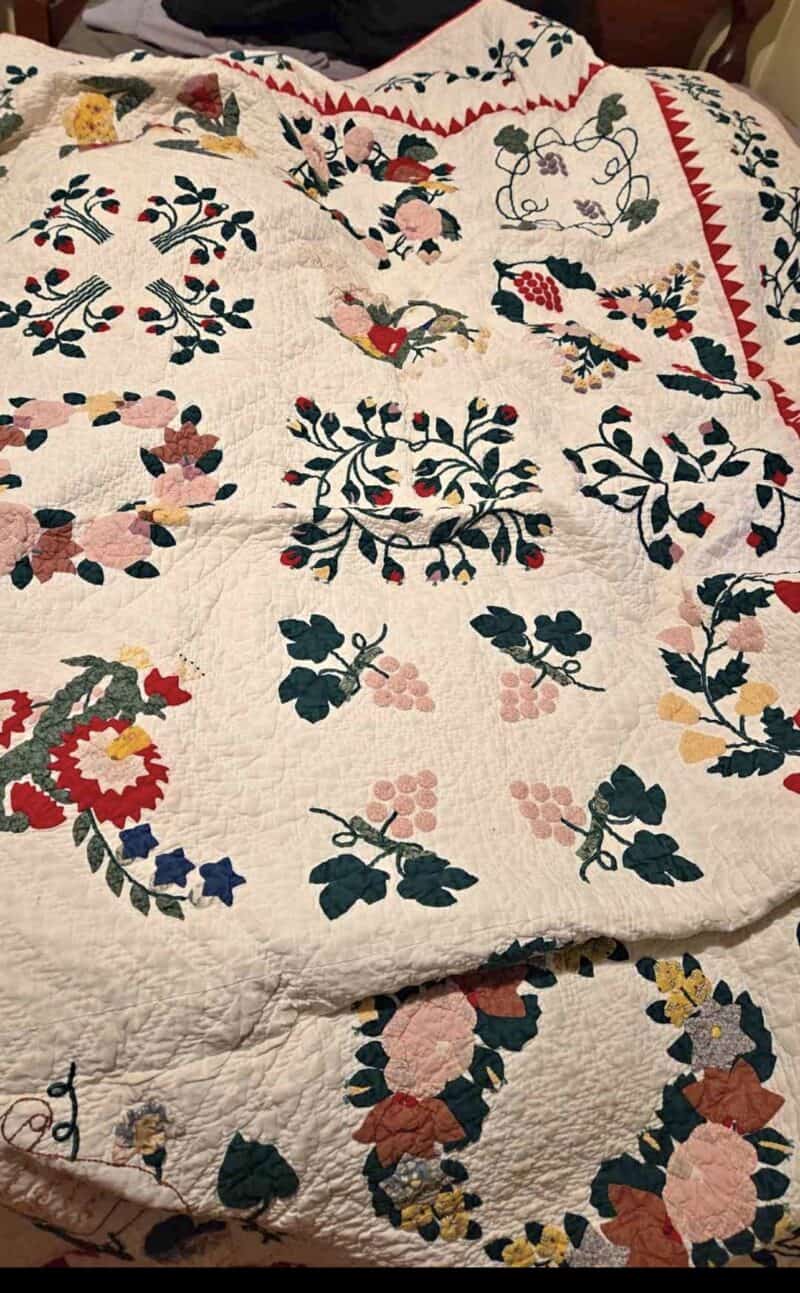
I cannot believe it – goodies-from-grandma has again listed a “1900 Antique Baltimore Album Applique Quilt” on ebay #7394122215 with the same description, pictures, etc.as the previous listings. Is this the third or fourth time the seller has listed this quilt??
Marilyn
Date: Mon, 27 Feb 2006 18:52:15 -0500 | From: “Teddy Pruett” <aprayzer@>
Hi yall – Two friends and I attended the exhibit Nancy mentioned. ( Hi again, MA and JA) – and Nancy, we looked for you there! We attended the opening lecture. I am happy to report that the UGRR was mentioned – but, thankfully, the use of quilts in same was not. Oh, Hallelujah!!!!!!! One huge brownie point for the guest speaker.
If you read the article online, you will see this cryptic description: <<Another example of this technique is a quilt that has black, diamond-shaped accents on top, instead of behind, the bold tapestry pattern of the quilt.>>
May I elucidate? It was actually a yo-yo quilt. The yoyos were placed backward from the way we usually see them, bottom out, and those that were not perfectly round – and there were many – did appear as diamonds. They were tacked over a printed fabric of some type. It was actually a very nice look – all yoyos were black, many of them velvets of various textures, and it produced a very intriguing effect.
The three of us did have one or two eye-rolling moments. The major moment was when the speaker described some AA quilts that had been purchased at a yard sale for $5 or so, then resold for $5,000,000.00 each. Yes, that is five mill-yun apiece. My friends looked at me so fast I thought their necks would snap – seeking validation of the figures, I suppose, because I do appraisals. My jaw dropped, my mouth hung open, and my eyes felt like steel balls in a pinball machine.
I am the first to tell folks that I do not know everything. I have worked long and hard and studied diligently for 15 years in my appraisal work. But i think I am secure in my knowledge of the few very high- end quilts that have ever been turned in the marketplace. I think I know the descriptions of most every quilt over five figures that has ever been made public. BUT FIVE MILLION DOLLARS????? I DON’T THINK SO. The part of this that puts a little bit of barbed wire under my skin is that the how-ever-many- people-everywhere that hear this lecture will not understand that it is inaccurate. Erroneous. Or major B.S. I just hope that none of the people hearing that value bring their AA quilts to me to appraise. ANd I am certainly open to correction – if anyone knows of sales such as this, please advise me and I will stand corrected and better informed. But I.m not holdin’ my breath while I wait for that info. I told my friends that I wasn’t going to mention this to the list – Nancy, see what you’ve done? LOL
My favorite quilt was a snake’s trail. The little paths that ran across the quilt in the quarter-circle format were perhaps an inch across, and made up of teensy slivers of fabric. Great quilt! Oh, no – wait – my fave was the dark quilt hanging in the foyer as you arrive – I think the image is on the cover of the catalog. It is a wonder to behold – I loved it!
Okay, I am in enough trouble for one post. Teddy
Other than this heart stopping moment, it was a pleasant exhibit and a very pleasant lecture by an African Aerican art quilter.
Date: Mon, 27 Feb 2006 20:18:02 -0500 | From: “Teddy Pruett” <aprayzer@>
Every time this thread comes up, I think of answering, and don’t. But as it continues to surface, I can tell you that one movie quilt was pivotal in my quilting life.
In 1980, Goldie Hawn and Chevy Chase were in a movie called “Seems Like Old Times.” On the bed was a lavender quilt – just a bunch of huge squares, various lavender prints and gingham, but in my mind’s eye – (hey – 1980 was along time ago – I’ve slept since then) the quilt was fat and squishy looking. Anyway, I was inspired to try to make one myself. As opposed to lavender, however, I used the very happening colors of the late 70’s/early 80’s: orange and brown. I was extremely economically challenged back then – a single mother working two jobs and sometimes three. I found a mill-end poly blend sheet for one dollar, and put it with poly gingham checks and something else. Put in a fattttt batt and tied it. I was so proud, I even photographed it. It is a horrid thing, of course, and I have to be forced to even look at it today. I recently built new shelves for my quilts, and had to move the quilt and refold it. I took it out and was going to send it to someone – perhaps to a Katrina relief box or our local homeless shelter. But decided, for now, to keep it to keep me humble.
In yet another movie, when “Sommersby” came out in 1993 with Richard Gere and Jodi Foster, I was ready to spot all the incorrect quilts. I was pleasantly surprised, however, to see her bed made with a quilt that appeared to be 1840’ish. It would have been perfect – an old quilt at the time. I wa so pleased with the props department. Teddy
Date: Mon, 27 Feb 2006 18:05:29 -0800 | From: Julia Zgliniec <rzglini1@>
Dear Teddy and All, KEEP that first quilt – it is a record of your journey!!
One of the best guild programs I ever attended was when our guild decided to have a “Sharing of Your First Quilt” evening. Many of our members had gone on to teach on a local and national level. The laughter brought the house down!! It was also very inspiring for new quilters to see how we had grown in our craft
My sharing for the evening was a tied quilt – strippy style of alternating blue flowered drapery material left from making the bedroom drapes and blue brushed nylon with a sheet back ( why would anyone piece a backing?) I got tired of trying to tie the darned thing by myself so my husband and I would sit in bed in the evening and do a few ties before we went to sleep. We had to use pliers to get the yarn through the layers.
Of all the quilts I have made – that one was the one most often dragged into the family room to be a tent, a fort, a blanket for the dog,a mattress, and what ever else the imagination of three boys made of it. I still have it in a wad in the back of the linen closet – the drapes were stolen by renters while we lived for a year in Fresno.
Not every quilt is a masterpiece.
Julia Zgliniec, Poway, CA – where it is raining this evening.
Date: Mon, 27 Feb 2006 18:27:22 -0800 (PST) | From: “Pat L. Nickols” <patlnickols@>
Pepper in reply to your question about additional names for orange and yellow, other than the current cheddar and lemon, I stumbled across some information of interest. It is always a surprise to me to read and re-read a book and then find relevant information to a question at hand.
Berry Yellow – Sometimes called ‘Persian’ or ‘French’ berries, fruit of the Rhamnus Infectorius, giving bright, rich yellows or drabs, according to the mordant used.
Chrome yellow – Chromate of lead. The first of the chrome dyes was invented in 1819 by Koechlin of Mulhouse. Chrome orange and green followed. John Mercer produced a chrome yellow in England in about 1823.
Quercitron – Bark of the yellow oak, native to North America. When mordanted, it made yellow with alum, drab with iron, olive with a mixture of the two. An American chemist, Edward Bancroft, patented its use in October 1775, and printers must have used it under licence from him. In 1779 a sale of paintworks in Surrey advertised “a large Quantity of American bark which, if not superior, is an excellent Substitute for Wold”(weld). When patent restrictions were lifted at the end of the 18th century, the general use of quercitron helped to promote the drab style.
Shrumac (Sumac) – An astringent agent assisting the dying process like a mordant, and also adding yellowish tone.
The above information: The Victoria & Albert Museums’s Textile Collection – Design for Printed Textiles in England from 1750 to 1850 Glossary, p153-4
Additional: Oberkamp had a dressing gown with a yellowish ground in 1788. Can look up the reference if you want.
Getting some rain but we need more – in sunny San Diego.
Pat L. Nickols
From: “Karen Evans”
There was also a color on silk that was popular for a while called “caca dauphin,” named after the baby Dauphin had a rather public accident, but that’s another story.
And then there’s the Renaissance hue charmingly known as “dead Spaniard”….
Karen Evans
From: Mitzioakes@
I leaned about TUITS when I was given a round potholder and the giver called it a TUIT~
—
Sue – you certainly deserve a quilt, having you speak at our guild (Champlain Valley Quilter Guild (VT) a bit ago, after your loss, made a very deep impression on our members. I thank you for all of us for a unforgetable lecture and show. Mitzi Oakes from VT ps – I am loving this site with all the info and etc. on quilts. I am still a riled about the AA and UGRR articles that abound. Guess my white heritage shows a bit!
From: RAGLADY@
The “turtle” subject line threw me off… but decided to open and read Mitzi’s message. Surprised to find it was about “Tuits”… So this may have been posted already… http://www.paperpanache.com/guests/atuit.htm Paper pieced patterns for a 3.5″ and 7.25” for “round-tuit”. My brother is a contractor and his business cards say: If you can’t get “Round-Tuit It”, I can – then he lists his specialities.
Gloria raglady@ Mitzioakes@ writes: > I leaned about TUITS when I was given a round potholder and the giver > called > it a TUIT~
From: RAGLADY@
Ratz…. forgot to mention that his business card is round as well…. I think his card message would be great for those who do professional quilting ..
Gloria RAGLADY@ writes: My brother is a contractor and his business cards say:A0 If you can’t get “Round-Tuit It”, I can – then he lists his specialities. Gloria raglady@
From: Mitzioakes@
My first quilt, a baby quilt for my grand daughter in 1981 just went thru the NO flood! It was a poly cotton with fat bat and tied. Of all the wallhangings I made for Deb over the years, the only one that could be washed and saved after 7 feet of water sat in their first floor for 3 weeks was that first quilt! So that one has a history of its own. It is now being saved for the great grand daughter due in July. Mitz
From: Anita Loscalzo <aloscalz@>
Hi, all,
Thanks to all who bid on last week’s offering. The New England Quilt Museum has another non-accessioned donated quilt up on eBay to benefit our conservation fund: item #7392985672 — A pastel Pinwheel, c. 1930
Bid early, late, and often!
Thanks,
Anita
Anita B. Loscalzo, Curator New England Quilt Museum 18 Shattuck Street Lowell, MA 01852 ——– email: Curator@ telephone: 978-452-4207 Ext. 11
From: Ark Quilts <quiltarkmv@>
I have 3 different times that GoodiesFromGrandma listed the Baltimore Album Applique Quilt. Somewhere in the articles about the Smithsonian Collection Quilts there is a reference about the number of quilts made in each pattern and I THINK they reported that 23,000 Baltimore Album quilts were made in China…….this eBayer might have more than 1 to sell or they might have had a seller that did not pay, etc. These are circumstances we will probably NEVER find out about because eBay does not permit anyone other than the seller or the buyer to file a complaint for fraud ….and in addition….if they continue to sell these with “User ID Kept Private” status no one can contact the buyer to inquire.
The Federal Trade Commission does permit third party complaints for fraud. https://rn.ftc.gov/pls/dod/wsolcq$.startup?Z_ORG_CODEPU01 You can identify the complaint as “Direct Marketing-Telemarketing/Mail Order”. The current bedding laws specifically say that imported bedding must be identifed properly as such in any Print or Internet advertising. The bedding labeling laws are located online in an article called “Textile, Wool, Fur and Apparel Matters” at: http://www.ftc.gov/os/statutes/textilejump.htm. eBay may not be interested in your complaint, but you can complain to the FTC.
Just an update…..I am still waiting to receive permission to reprint the original ads for the Smithsonian Collection quilts that appeared back in 1992-1993. I expect to have a commitment from all 3 sources in the next week or so & will let you know. I am still compiling information about this. Thanks-Connie Ark, NW Ohio
Meandle217@ wrote: I cannot believe it – goodies-from-grandma has again listed a “1900 Antique Baltimore Album Applique Quilt” on ebay #7394122215 with the same description, pictures, etc.as the previous listings. Is this the third or fourth time the seller has listed this quilt??
Marilyn
From: Sylvia Adair <piecethepast@>
Hi, I’m a volunteer for the Wisconsin Quilt History Project. We’d like to be able to sell items on Ebay, and we’ve looked into MissionFish. Apparently you have to be registered as a nonprofit in all 50 states. For those of you who have done this, is this a lengthy, expensive process? Is it worth it? We are a registered nonprofit in Wisconsin. Any help you can give us will be greatly appreciated. Thank you!
Sylvia Adair piecethepastwi.@ Restore, repair, recreate, remember.
—
Bravo! You certainly took great advantage of the opportunity provided to tell everyone about AQSG. Good job. I didn’t realize the board meeting was this weekend. Have fun.
I love the fact that you only get on the list when you have something worth saying.
Joyce
From: “Newbie Richardson”
Dear list, I was asked about a book available through Amazon which I was not familiar with – History of the Patchwork Quilt: Origins, Traditions, and Symbols of a Textile Art by Schuppe Von Gwinner 1988. It lloks like the English translation of a German publication. I thought it might be a useful referrence for Western European quilting influences. Can anyone give me a mini review? The only problem with “virtual bookstores” is that you can’t really flip through the pages! Thanks Newbie
From: litwinow@
Good Morning, My e-mail will be changed as of this afternoon. Catherine Litwinow’s new e-mail Please change it I love hearing from you. litwinow62@
Date: Wed, 01 Mar 2006 09:52:12 -0500 | From: “Newbie Richardson” <pastcrafts@>
Dear Karen and list Karen asked about the Small Museum Association where I was just at a conference. I think it would be of interest to many of you. SMA has been around for at least 30 years. It was originally a spin off of the American Association of Museums (AAM)as outreach to their smaller institutions. They have been variously successful and not so successful depending on who was volunteering and how much energy they had – as is true of any volunteer staffed group. Right now they have lots of energy! Due to location it seems to be mostly Mid-Atlantic based museums ( Delaware, maryland, Rhode Island, Pennsylvania, etc.) They meet annually the last week-end in February ( Sunday, Monday, & Tuesday morning)in Ocean City, MD. As this is off season – they get GREAT deals on the hotel ( our room was $45 a night!) It is a great group of fun, dedicated professionals. I learned a lot! Look them up on their new and nifty website: www.smallmuseum.org At the AAM annual meeting in Boston, April 27 – May 1, they will be hosting the third annual “Small Museum Day” on April 27th developed in collaboration with the AAM’s small museum administrators committee. I think they will have information on that website as well:www.aam-us.org. Newbie
Date: Wed, 01 Mar 2006 07:37:10 -0800 | From: Julia Zgliniec <rzglini1@>
Dear Newbie and All, I remember being pleased with the book History of the Patchwork Quilt: Origins, Traditions, and Symbols of aTextile Art by Schuppe Von Gwinner 1988. at the time – I bought it right when it came out. None of the topics were in depth but it did give a global view and a different perspective. The sections on early European origins and the close relationship to clothing techniques was interesting to me.
It’s worth a read.
Julia Zgliniec
Date: Wed, 1 Mar 2006 7:47:26 -0800 | From: Sue Reich <suereich@>
Hi, Newbie! I’ve had the von Gwinner book for several years, mainly because it gives information on older quilting and patchwork traditions in Europe. It’s very definitely a translation, which creates some problems (see below), and as far as I know it’s the only book of its type published by Schiffer.
Strengths: lots of information about European quilting and patchwork traditions. Pictures of artifacts that have been photographed nowhere else (check out the 14th century Jesse Tree applique, for instance). Good information on pre-1800 patchwork.
Weaknesses: the biggest flaw in the whole book *may* be the fault of the translator, not the author. Throughout the book, “patchwork” and “quilt” are used interchangeably. I can’t tell if this was in the original text or is due to a bad translator, but it needs to be kept in mind. Also, from what I can tell, much of the information on early quilting (as opposed to early patchwork) depends on Averil Colby, but then again, that’s hardly a surprise.
Beyond that, I’ve found the book useful. It has a global and European perspective that’s quite refreshing, and there’s much good information. I still rely on Averil Colby for basic information on early quilts, but this is a good supplemental volume.
Hope this helps –
Karen Evans
Date: Wed, 1 Mar 2006 10:16:29 -0500 | From: “Pepper Cory” <pepcory@>
Thanks Pat. I have the chrome yellow and quercitron reference and in looking up the other, have decided not to pursue it as relating to “my” yellows and oranges. ‘Persian or Parisian’ berries ( whichever sounded the most exotic-) were from the buckthorn tree and most yellow dyes produced were fugitive. It was mostly used for paper products in England rather than cotton fabric dyeing large-scale. Thanks for your time and I appreciate your scholarship. Pepper From the dried berries, a series of rich but fugitive colours is obtained; the berries used to be sold under the name of ‘French berries’ and imported with those of Rhamnus infectorius from the Levant. If gathered before ripe, the berries furnish a yellow dye, used formerly for staining maps or paper. When ripe, if mixed with gum-arabic and limewater, they form the pigment ‘Sap or bladder green,’ so well known to water-colour painters. The bark also affords a yellow dye.
Date: Wed, 1 Mar 2006 21:23:33 -0500 | From: “Sharon in NC” <patchworksecrets2@>
I thought some of you who collect info on imports might want to save a copy of this. http://www.fingerhut.com/productgroup.aspx?offergroupxid17992&categoryxid148&source&hgc0 I ran across it while searching for star quilts.
There are several on LTD and that other wholesale to the public place(can’t recall the name of it right now) that are very similar to patterns I have seen out by well known quilts designers that might be worth adding to your files also. .
Sharon in NC
Date: Thu, 2 Mar 2006 09:39:38 -0600 | From: “Charlotte Bull” <charlou@>
This is not scientific or vintage info, but I just saw an ad for a yellow that was named “School Bus Yellow”! It is a color I see twice daily! At 7:35 a.m. & 3:20 p.m.! cb
Date: Thu, 2 Mar 2006 07:51:50 -1000 | From: Loretta Woodard <Lwoodard@>
The chapter on Hawaiian quilts begins with no less than three factual errors related to Hawaiian history in the first sentence. He also presents as fact, the myth that “the [Hawaiian applique] technique . . . was introduced in Hawaii only around 1860 by the Pennsylvania Dutch, when they set up mission schools there in which needlework was taught.” He concludes the chapter stating: “Today [1988] the tradition of Hawaiian quilts is maintained only by professional seamstresses. They sew quilts chiefly to sell to tourists. The mythos of the old applique quilts thus seems to have died out.” Now, where on earth did he come up with that??? Laurie Woodard
Date: Thu, 2 Mar 2006 13:52:42 EST X-Message- | From: Mitzioakes@
Just to add my 2 cents – here in the NE there is a color called SKI DOO YELLOW – and it has been around for a looonnnngggg time! Happy Day to you all! Mitz from VT
Date: Thu, 2 Mar 2006 16:40:38 EST | From: Jccullencrew@
Then there’s sunshine yellow, canary yellow, lemon yellow, buttercup yellow, and lemon-ice yellow