April 14 – 22, 2006
These restored messages come from the Quilt History List, an online forum where quilt historians, collectors, researchers, appraisers, and enthusiasts discussed antique quilts and related textiles. The archive dates from 1996 through approximately 2016 and is being restored gradually. Sign up in the form at the bottom of the page if you want to know when a new page is added. Original spelling, opinions, formatting, and inactive links may remain unchanged.
Primary topics of this QHL Digest:
- Quilt Events for a Trip to Florida — Members suggest shows, guild networks, and news sources for a May trip.
- Kindness of Strangers in Europe — Stories from Belgium and elsewhere recall thanks given to Americans and other WWII memories. (see the article on quilting in Europe)
- The Crazy Corset Quilt — A program planner asks about a corset quilt, and members recall a Gossard corset connection.
- The Blucher-Wellington Quilt — Pat Cummings and Gail Ingram discuss a quilt with fabric that refers to the Duke of Wellington and General Blucher.
- Copyright Renewals and Library Digitizing — Members share copyright renewal search sites and library practices.
- Documenting Quilts in Kent County, Maryland — A group plans to update a state project and asks for advice.
Date: Fri, 14 Apr 2006 18:53:07 +0200 | From: Ann Van Roy <ann.quilten@>
I grew up in a Belgian village were there are two military graveyards from WorldWar II Each Summer, there were summercamps for German youth, who spend their Summerholidays tending the graves. The organisation was called ‘Versöhnung über den Graven’ (Reconciliation over the graves)…
— Ann from Belgium
—
Although this is not quilt related I want to share with you an example of the kindness of strangers
Hi Cinda, My DH was in the Battle of the Bulge and also helped liberate Belgium many years ago. The people there were very grateful and have erected many monuments to the men who died there during the war. DH became acquainted with a man from the town he liberated, and exchanged photos taken 60 years ago. Lo and behold, the man identified the people the soldiers encountered during their time in the village and then sent photos taken in the same spot where several of the men had been injured. The town hadn’t changed at all in 60 years. Since then, they have corresponded and we helped raise money for a monument for the men lost in the Malmady’s Massacre.
People in Belgium also adopt a soldier and look after their graves which are well kept all year round. It saddens me that our former soldiers’ graves are not cared for as well here any more. My DH just finished writing a book about his war years, and I was editor-in- chief and typist. What an eye opener to see what these 17-18 year olds went through. Now I understand why the Belgium people were so grateful to the American soldiers. Blessings on all the troops who ever served their countries. Carol Grace
From: kldev@
My husband and I will be in the western to southwestern area of Florida in May, are there any quilt activities or exhibits in the state that we should see? We will be there from May 10 to May 24, flying in and out of Tampa.
Thanks for any suggestions,
karen
Karen Dever Stitches Through Time Quilt Appraisals 101 S. Lincoln Ave. Moorestown, NJ 08057 856-234-6631
From: “J. G. Row”
Rats!! I thought you’d plan your trip around NJ’s Studio Quilt Study Group meeting, which is on the 16th of May.
Anyone on the list want to warm Karen’s chair for her?
Judy, now in Flemington NJ aka The Ringoes Kid judygrow@
> We will be there from May 10 to May 24, flying in and out of Tampa. > Thanks for any suggestions, > karen
From: AG32040@
The NQA group of MIAMI OCEAN WAVES has their annual show then.It’s held in Coral Gables,Fla. on the east coast of course.But we have a lot of interesting things over here. Amy G. in the Miami area.
—
On this warm and beautiful Passover weekend and Easter Sunday, I would like to put in a word on behalf of Sweetness and Light, to borrow Matthew Arnold’s terms.
While I was not lucky enough to be at the New England Regional AQSG meeting, I know the work of some involved in its organization and implementation. Based on their intellectual integrity and organizational skills, I find some of the criticisms made by the writer-reporter of that meeting questionable. I was hurt for the leaders of the seminar, frankly, when the piece first ran. Yet, I thought perhaps the writer was just in a hurry and did not take time to reflect on how her remarks would sound to the people who had invested their time in the enterprise. As one who sometimes writes before she thinks, I could appreciate that.
When it ran again, however, as part of another message and almost in toto, I again felt uncomfortable being party to what was properly a personal discussion between the writer and the organizers. If one really wants to change something, she must speak directly to those with authority to change it.
Knowing Sue Reich and her cohorts, I am certain the organizers were not trying to discourage open dialogue in their choice of theme of ‘no experts here.’ That theme would have assured me that all voices were welcome at the table and all were encouraged to participate in the day’s discussions.
Of course, a day could be given the study of quilt storage, and those present knew that. But there was only one day. I’m sure the leaders knew the effects plastic boxes have on textiles. Yet many of them also know the quilts Kris Driessen had stored in those heavy plastic boxes were the only ones Kris was able to save when a fire destroyed her house. Unfortunately, most of us lack the proper space and facilities to store our quilts as they would be stored in a good museum. To belabor such a point seems specious and uncharitable.
Clearly Anita considered the meeting a free exchange of ideas, for she spoke to the issue. In such meetings everyone is responsible for seeing that good information is exchanged.
I am also sure Lori East, in assuring the group “anyone can write,” was indulging in a little hyperbole in order to encourage more serious research and sharing of information by AQSG members. Writing is simply thinking on paper, and if one is a disciplined thinker and diligent researcher, she can write. One of the beauties of AQSG is that the organization supplies mentors to anyone who is researching a topic and asks for one. I asked and Sally Ambrose was my reward.
I know this–and I suspect it was what the person meant: anyone who is willing to learn can be taught to write. I have spent a professional lifetime verifying that generalization.
Perhaps the writer would be more generous with those responsible for the seminar if she used a syllogism to test the logic of one of her own paragraphs: “I was determined to not say much of anything, but to just listen, lest I appear to ‘know more than’ and offend anyone. Consequently, quite a bit of misinformation was passed along in the course of discussions, much to my distress.” Even Homer nods…
If the names of Wellington and Blutcher were printed on a toile fabric (I could not be sure that was what was meant) to identify the scene, that would have been enough to make the day worthwhile for me. In fact, just to see how the Iron Duke and his Prussian ally were represented would have been enough. I am wondering even now whether the toile were produced in England, what is depicted (Belgium was also represented in that battle, which took place on the doorsteps of Brussels) etc. Inquiring minds would like to know.
In other words, this writer obviously learned something at the day’s event, and sometimes that one something is worth a three-day meeting.
You folks who live in the mid-Atlantic and New England states are lucky. Most of us on this list lack the opportunities to see such a wide variety of quilts as you see or to share knowledge and raise questions with like-minded people. I’d be grateful that folks took the effort—and it is a big effort, believe me—to organize such a day as the New England AQSG meeting.
Maybe if you grow up in Louisiana, you just see the half-full glass. A gift of a beneficent Creator, no doubt.
Gail Ingram
From: Pat Cummings <pat@>
Good morning, all!
To answer Ms. Ingram’s question, the Blutcher/Wellington fabric that I mentioned on a different list other than qhl, is NOT a toile. Certainly, have studied toile, and having just written about it in an article for The Quilter magazine, I would know the difference.
The pieces of fabric appeared in the border of a quilt that was offered for study in a session at the AQSG N.E. Regional Meeting, and yes, it was the high point of the day to discover “writing” on that fabric and to have another member call her historian husband who gave us an immediate rundown on the names and their historical association.
As for those who were not at the meeting, they can feel free to sit in judgement from afar and make broad pronouncements as to who is good and who is bad, etc., etc.
My goal in writing about quilt writing and what is involved is to provide food for thought, especially in light of a recent guild newsletter that was so full of misinformation, it was mindboggling.
Switching gears, at no place, in my online essay, any names mentioned, nor the specific meeting, in which related remarks about writing were made. However, I guess that any interested party would have to read the file on their own. It serves no purpose to name names when the intent is not to personally discredit someonee, but to perhaps disagree with the statements made. Why can’t people agree to disagree, with being disagreeable and calling names or slamming the next person and turning it into a personal attack?
I am a quilter. I see things from a quilter’s point of view, and share that vision with those who care to read what I have to say. I appreciate any feedback, positive or negative. It shows that you are thinking about what I said. Isn’t the goal of good writing to help people to formulate how and what they think about a subject?
I do not know most of you, personally, and most likely will never meet you. In a few instances, I should consider that a blessing.
Pat Cummings, target of the recent criticism offered for a post to a list other than this one, and somehow tangled in with that, one of two new files I just wrote for my website, under the umbrella category of “Musings,” at www.@
From: Pat Kyser <patkyser@>
I’ve been away several weeks and am trying to catch up on the list. The kindness of Europeans mentioned in several emails reminds me of an incident of my own. It is sort of quilt related.
Some years ago I arranged part of a U.S. tour for a group of German quilters led by my friend Ginie Curtze. As a part of their Huntsville visit, I took them to Lynchburg, TN to eat at Miss Bobo’s boarding house and tour the Jack Daniels Distillery.
One of the women came to me, asking about prisoner of war camps in TN during WWII. One of the hostesses at the lunch had been a secretary at such a camp in Tullahoma, TN and was able to tell her about the experience. Inge was in tears, saying over and over how nice everyone had been to her father when he was a prisoner there during WWII. Later when I visited Germany myself, she insisted I come to dinner with her parents, who then lavished gifts on me in appreciation for her father’s treatment in Tennessee back in the 1940’s. I am moved by the memory as I write.
Pat Kyser
From: joan kiplinger <jkip@>
Hopefully someone on this list can come to the rescue. I’ve just posted to the eboard the back of a c1890-1910 quilt. www.vintagefabrics.eboard.com Is anyone familiar with this name? As explained in the message board, a cursory run through of a 1911 Davison’s Blue Book turned up no Chauncey town or textile facility. Possibly this is a manufacturer’s or catalog’s house name. And the use of LL — sometimes seen as longer length in bedding sections of old catalogs or as part of a famous name sheet used by Montgomery Ward. Does anyone know the origins and actual meaning of these initials?? Any help would be appreciated. This has also been posted to the vintage fabrics list.
> >
From: joan kiplinger <jkip@>
The eboard url should be www.vintagepictures.eboard.com Sorry for the goof-up.
From: Kris Driessen
We have enough of our own.
I’d like to add my two cents, though – the more informational articles published on quilt history, the stronger our niche becomes. Quilting is still a “soft” topic. If we as a group expect to be taken seriously, we need to continue research and publication.
In the interest of publicizing our own site, http://www.quilthistory.com, there is a list of articles written by members and non members on the articles page. If you would like me to add a link to your article(s), just send me the URL. I will add it as soon as I can.
Kris
From: Gail Ingram
Pat Cummings mentioned a quilt that somehow had references to The Duke of Wellington and Gen. Blucher, the Prussian commander for the allies at Waterloo. Would someone at the New England AQSG meeting describe that, please?
Pat, personal invective and argumentum ad hominem are simply not worthy of any of us on this list. While you did not call names, most who keep up with AQSG and this list knew the major organizers of that seminar. It would be like my referring to “the President” and claiming I was conferring anonymity because I did not call his name. I addressed no issues that were not clear from your posting. And I addressed issues, not people.
As for my inference the fabric was “toile,” I was just that: an inference, based on your statements and my knowledge of historical toiles. I could not discern from your reference whether it was a toile, an historical scene, or just a quilt that had the names written on it of the British and Prussian leader at Waterloo. How in the world could you infer an insult from my question?
Would someone who was at that meeting describe the quilt in question? Was it a British quilt?
Thanks, Gail
From: “Nancy Roberts” <aquilter@>
A good source of exhibits and acitvities in Florida is Mary Jean’s Florida Quilt Network – Newsletter at www.FloridaQuiltNetwork.com. Happy travels. Nancy Roberts
From: “Andi” <andi0613@>
Florida’s statewide quilt guild, the Sunshine State Quilters Association, maintains this website: www.ssqa.org <http://www.ssqa.org/> . You can find shows, classes and retreats there for every part of the state and much more.
And in Keota, Iowa, SSQA co-founder
From: “Arlene Marin”
I have an avid reader of this list for several years. I am hoping that there are some experienced quilters who might help me avoid some of the pitfalls I am sure to face as a novice in a group I lead. I am afraid that I am in over my head. Several years ago, I organized a quilting group at my church. Our first quilt 50×70 was tied to finish it and raffled off to the tune of $840 donation to the church. After that we decided to try to hand quilt our next effort.
Our second quilt is a blue and white log cabin queen sized quilt. It is 76×95 without border assembled in straight furrows…any recommendations on width of border? The blocks were designed to have 2 inch center and 1 inch strips and finally finished at 10 inches raw. We have scheduled a quilting bee for 4/28 thru 4/30 to hand quilt this on an Edmunds frame I bought several years ago on Ebay. It’s been assembled but never used and I don’t know anyone with experience in this part of the project.
Thanks in advance for any advise. Off-list communications can go to batwoman522@.
Arlene Marin at the Unitarian Church of Montclair, NJ
From: jocelynm@
>One of the women came to me, asking about prisoner of war camps in
Pat, My father served briefly in a POW camp (I don’t believe it was in TN, tho ugh). One of his memories was of singing with the prisoners, and having t hem beg him not to, for they were sure that any guard who showed them any kindness, much less sang with them in German, would surely be severely p unished. He would reply that this was America, and he could sing in Germa n if he wanted to. Now, I’m not sure if this were absolutely true (it see ms to me his CO might have taken exception to having an American singing in German with the prisoners), but at any rate, he didn’t get in trouble,= and I’m sure that for many of the prisoners, it was a powerful contradic tion of propaganda they’d heard about America. Which, of course, was why he was doing it…
From: Pat Cummings
What a great story, Jocelyn! Reminded me of a song I really love, “Christmas in the Trenches.” Here is a link to the words:
http://www.worldwar1.com/sfcitt.htm
Pat Cummings
From: TEXTIQUE@
Working on a program for the Rocky Mountain Quilt Museum. Someone told me some time ago (anything more than 2 days doesn’t seem to stick) about a ‘crazy quilt style’ corset quilt. I know there is a series of newer ones with that title but I’m remembering that this one is 19th century…?. Can anyone set me straight on this?
Jan Thomas
From: “Janet O’Dell”
Pat C wrote:>>> What a great story, Jocelyn! Reminded me of a song I really love, “Christmas in the Trenches.” <<<
By the look of the verses, it was sung to the tune of ‘It was Christmas Day at the Workhouse’. My dear DH has been known on occasion to serenade all and sundry with this ditty (an old UK army song not for the genteel).
Cheers Janet O’Dell Melbourne Australia
From: Gail Ingram <gingram@>
I apologize for cross-posting, responding on QHL to something on the AQSG list. I did not realize the original had been posted to the latter list. Just not paying good attention. I’ve come to assume w/o thinking that quilt items come almost always from QHL. The AQSG list is not nearly so active as this one. I will be more attentive in the future.
Gail Ingram
—
Joan, could that light brown fabric on the back of the posted quilt possibly be a polished cotton or chintz? It looks a bit shiny and appears to have that chintz texture. Marilyn Maddalena Withrow Professional Quilt Appraiser, Judge, Historian, Designer and Lecturer www.marilynquilts.com
From: “Catherine Litwinow”
Good Morning, It is spring in Iowa, i.e. tornado alley. Fortunately the quilts are still safe. Some of the loveliest quilts from the Midwest made their way to the IIQSG meeting March 31 and April 1st. Baskets were the study topic. The Kalona Quilt and Textile Museum hung both Amish and English baskets. I chose the following to be my favorites, 2 Marie Webster Baskets, there was a turn of the century scrap basket that just danced with its plaids, and of course the richness of the Amish baskets. My own contribution was double pink setting squares and brown baskets (From Sara Miller- of doll quilt fame). The pictures will be posted at www.quilthistory.com<http://www.quilthistory.com/> very soon!
We are please to announce that the newest quilt history magazine was born.
“Pieces of Time” A Quilt and Textile History Magazine, edited by Andi0613@<Andi0613@> contains articles on Iowa/Illinois Redwork, Mary Wolf, Virginia Snow Studios, The Kalona ( the largest Amish settlement west of the Mississippi) Historical Village. General Categories: editorials, book review, biographies of quilters, and Iowa/Illinois quilt history news. For information contact Andi! My buttons are popping due to the wonderful quilt history from the IIQSG. Thank you QHL! Catherine Noll Litwinow ——=_NextPart_000_02D8_01C662A5.090423F0–
From: joan kiplinger <jkip@>
Marilyn — this is not my quilt so I have no idea the type of fabric, just helping out an inquirer. The owner is interested in the name more than anything else. So far we’ve determined with some degree of accuracy that the LL stands for long[er] length, a popular term of days gone by for longer sheets, and that this piece of cloth is either from one bolt end or a cut piece of the cloth stamped and used for packing and shipping purposes. The stamping made IDying much easier in unpacking. As for the name, that is a research nightmare. Many mills named each of their various plants after a relative, town or region; most of these plants during their lifetime were combined, traded, sold or shut down resulting in a variety of name changes and utter confusion. I was hoping some of the historians and collectors on this list might have run across the name.
Marilyn Withrow wrote:
Joan, could that light brown fabric on the back of the posted quilt possibly be a polished cotton or chintz? It looks a bit shiny and appears to have that chintz texture. Marilyn Maddalena Withrow Professional Quilt Appraiser, Judge, Historian, Designer and Lecturer www.marilynquilts.com
From: “Sarah Hough”
Catching up on back e-mails. Another good source for quilting news in Florida is www.FloridaQuiltNetwork.com
Sarah
From: Dana Balsamo
I think I know this dealer. She had a store on another antique mall that I still have my store on. She emailed me a few pics of a couple of quilts and this was one of them. Her other was a red and white quilt in a depression era pattern, that in my opinion was Depression Era. This one I told her:
“Now, your 2nd one looks newer. It looks more 1970s. Log Cabin pattern with appliqued floral centers…I can’t tell if the applique is by hand or machine. If you want to send a close up of one of the flowers I will try to tell…I’ll also be able to grasp the fabric dating better. I am going by the general look and impression.
Hand made can mean a few different things. Hand made by machine means it was not commercially made. Hand pieced means that the quilt was actually pieced by hand and not by a sewing machine (even a home one), whereas machine pieced means a machine was used…it’s not taboo, by any means. Machine stitches will be closer together than hand stitches. if you gently pull at the seam between two fabrics you can check. Hand quilted means the quilting was done by hand, vs machine quilted, and hand applique vs machine applique. Then look at the binding…hand or machine. All pieces of info a buyer might want to know.”
She never did email the close ups. It looked to me like it was something out of those 1970s-80s Better Homes and Garden Magazines.
BUT if you read her description, it doesn’t seem like she is describing the quilt in the pictures…do you see the hearts she is referring to?
I didn’t realize she had a shop at goantiques, I know she is at other online malls. I found the listing on one of her malls and the description is different, but still says “This handmade quilt is believed to be from the 1930s”.
Looks like I am going to have to pay more attention to import quilts besides the ones posted on this list.
My best, Dana
From: “Roberta (Bobbe) Benvin”
This is in response to Jan Thomas’ inquiry regarding info about a 19th Century Crazy Quilt, which, I’m assuming, contained a corset.
Perhaps you saw or heard about the gorgeous quilt that was registered in the York Co.(Pa)Quilt Documentation Project. It can be seen on page 148 of the book “Quilts: The Fabric of Friendship” (published by Schiffer). This quilt was also part of the Paducah(Ky) Rotary Club’s Antique Quilt Exhibit in 2003, that was curated by Joan Hamme and myself.
We used to refer to it as the corset quilt until it was found that the beautiful green silk medallion in the quilt was actually from a bustle. We were fascinated that something that might be described as “intimate apparel” would be so boldly displayed in Victorian times.
Perhaps this information might tie in, somewhat, with your exhibit.
Roberta Benvin
From: “Kathy Moore”
Here’s an interesting and informative website about copyright renewals:
http://onlinebooks.library.upenn.edu/cce/
It lists dates of periodical renewals for hundreds of periodicals and has a section on books as well.
Best wishes and happy reading,
Kathy Moore Lincoln, NE
Date: Wed, 19 Apr 2006 18:46:53 -0500 | From: “Kathy Moore” <kathymoore@>
Recently there was a request for information on library practices regarding digitizing documents for web access. Below is the answer I got from a UNL librarian:
Kathy,
The source for the information I am sending is the Online Dictionary for Library and Information Science. [Reitz, J.M. ODLIS: Online dictionary for library and information science. Retrieved April 17, 2006, from www.lu.com/odlis]
Digitization – “the process of converting data to digital format for processing by a computer. In information systems, digitization usually refers to the conversion of printed printed text or images (photographs, illustrations, maps, etc.) into binary signals using some kind of scanning device that enables the result to be displayed on a computer screen.”
I also like this explanation on digital libraries.
Digital library – “A library in which a significant proportion of the resources are available in machine-readable format (as opposed to print or microform), accessible by means of computers. The digital content may be locally held or accessed remotely via computer networks. In libraries, the process of digitization began with the catalog, moved to periodical indexes and abstracting services, then to periodicals and large reference works, and finally to book publishing.”
It is correct that many digitized works are protected by copyright and not freely available on the Internet.
Hope this helps!
Mary Cassner University Libraries University of Nebraska-Lincoln
—
Good evening all,
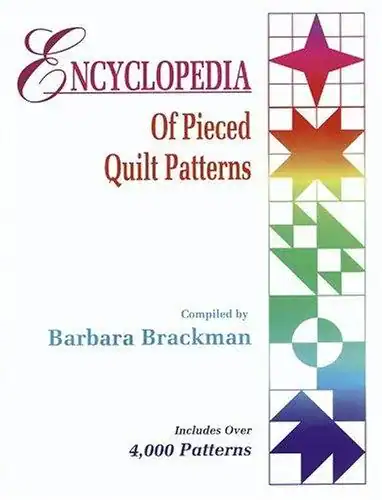
Doing some shoveling and somehow I have purchased 2 copies of the Brackman book- Encyclopedia of Pieced Quilt Patterns.
I know many on this list are affiliated with quilt musuems and libraries- so if one of you can use this book in those non-profit capacities, please email me and I will mail the book to you as a donation (within the US only please- international mail would cost me quite a bit as the book is very heavy.)
Take care,
Tom Reddick.
—
I am probably much too late on your offer of the Brackman book, but I am affiliated with the Shelburne Museum (VT), and the State quilting guild (Green Mtn. Quilt Guild – I am President) and the Champlain Valley Quilters Guild – all are 501(c)3 groups. I would love to have your donation to use within our guilds and use as reference at the Shelburne Museum where I volunteer all season as a quilt demonstrator and authority (not 100% but trying). I also am putting on a special display in November at our local guild (Champlain Valley) for their show in November – this is on the History of Quilts – and I am looking for anything and everything I can to make this an instersting display – your book might just add to my collection of books on quilt history. Hope I am not too late, Miriam E. Oakes 48 East Terrace South Burlington, VT (802) 863-2160 (802) 660-0423 _mitzioakes@_ (mitzioakes@) _stubswede@_ (stubswede@)
From: “Karen Musgrave”
The Alliance for American Quilts (www.centerforthequilt.org ) eBay auction this week has an incredible quilt is for the discerning collector! The overall picture does not reveal the extraordinary stipple quilting throughout this quilt, make sure to check out the detailed pictures. This quilt is hand sewn and cotton wholecloth. It is c. 1890 and from Eastern, PA. It measures 70″ x 80″ and is in excellent condition. You can also find The Quilt Engagement calendars from 1997, 1999 and 2000 that are still in the shrink wrap and more! You can check it out by going to ttp://search.ebay.com/_W0QQfgtpZ1QQfrppZ25QQsassZalliancequilts or search by our seller’s name- alliancequilts.Your purchases also benefit a great organization which is doing incredible things for quilts. New auctions are posted every Sunday. Happy bidding and thanks for the support.
All the best, Karen Musgrave Join us! Become a member and get advance news on our auctions AND help preserve our great quilt heritage. www.centerforthequilt.org
Ark Quilts <quiltarkmv@> wrote:If there are any members on this list who are also eBay members, please help me by encouraging “goantiqueslive” to correct their description of this item: ebay# 6622085221. They are calling it a “Depression Era Handmade Quilt w Floral Applique #868206”. This was actually sold in 1994 and advertised for $29.99 by Target Stores. I have emailed the information to them 2 times & they do not reply. There is no doubt about the identification. I have 3 different 1994 Target ads that are an exact match to the fabrics & pattern in the quilt. Please email them & ask them to correct their information.
Thank you– Connie Ark in NW Ohio
From: Ark Quilts
Would the list serve member who emailed me about the New York Beauty quilt they bought on eBay please contact me privately? I might have some information for you. I misplaced your original email information. Thank you- Connie Ark
From: Ark Quilts <quiltarkmv@>
A few weeks ago, I posted a note about a quilt that was listed on eBay for $1,500 and later relisted at $2,000. Please compare these 2 items on eBay.
#6271722411 from mmyesterday at $8.09 and #7505232679 from goonies*never*say*die at $2,000
We collectively decided that the $2,000 quilt was most likely an import.
C. Ark in NW Ohio
From: TEXTIQUE@
Thanks to those who responded to my post. Contacts have been made with your help.
Jan Thomas
Date: Thu, 20 Apr 2006 18:56:10 EDT | From: RAGLADY@
http://community.webshots.com/photo/1110602284050739132JhfStt
http://community.webshots.com/photo/1110602565050739132CrYqxw
Similar to a Glorified Nine Patch – but only a four patch.
Gloria raglady@
Date: Fri, 21 Apr 2006 10:21:20 -0400 | From: “Teddy Pruett” <aprayzer@>
I wasn’t going to say anything, but since this corset quilt question has not yet been entirely settled, I must tell you that I own a quilt top made of corset materials from the Gossard factory at Logansport, IN. Xenia – is that info correct? SHe was the owner before passing it along to me.
It is a dresden plate, spokes alternate between this beautiful blushy colored damask and solid white. All set into a white ground – very subtle, and actually very beautiful. Nice workmanship, lies flat. SO, even though this is not the corset crazy that is being so heavily sought, it is an example of corset fabric. It goes right along with the one I have that was made from seersucker pajamas cutaways – some have the labels attached, and one says “easy on – easy off.” Oh, I do love the suggestiveness of that…….
Teddy Pruett I wanna be Superwoman when I grow up – and live in Colorado. www.teddypruett.com
Date: Fri, 21 Apr 2006 10:56:14 -0600 | From: Xenia Cord <xenia@>
Teddy has it right, of course – the woman has a phenomenal memory <g>! There was a Gossard Corset Factory in Logansport, Indiana, and apparently the women who worked there could take home the offcuts. the fabrics were jacquard weave in different designs, and usually of a soft, peachy, “flesh” color. I have had 2 of these pieces; Teddy has one, and I sold the other to a woman in Texas for her bedroom! (Actually, she said her husband had insisted on a fireplace in the bedroom and she was not fond of it, so she was going to hang the piece over the stonework.) It was a Nine Patch.
Xenia – ready for Paducah on Monday!
Date: Sat, 22 Apr 2006 00:01:01 +0100 | From: Sally Ward <sallytatters@>
Not the quilt you’re looking for, but on page 11 of Quilt Treasures, published by the Quilters Guild of the British Isles, is a glorious crazy quilt made in the 1930s of scraps of pink satin from a corset factory and according to the text decorated with green embroidered feather stitches. The different rotations of the pieces meant the light relection changed all over the top. Curiously the description also says ‘the quilt was backed with Argentinian sugar sacks’ (?).
A second quilt is described, but not pictured. It was made of elongated hexagons set in rows and had been stitched by an elderly lady whose friend worked in a Spirella factory in Wrexham. That contained may different pinks of corset fabric.
Waste not, want not <G>
Sally W
From: “Beverly Birkmire”
We are preparing to document quilts here in Kent County, Maryland, to update the 1988 state project, and a question has arisen on the topic of state projects. Perhaps some of you can shed light on the issue. The Maryland project was initiated in 1988 by the Maryland Association for Family and Community Education (formerly known as Maryland Homemakers Council and affiliated with Cooperative Extension) in connection with their 50 year anniversary. Are you aware of any other state documentation projects that were begun by Homemakers groups? Thanks for your input!
Beverly
From: kldev@
Thanks for all the help in finding out what is going on in Florida next month!!
Karen
Karen Dever Stitches Through Time Quilt Appraisals 101 S. Lincoln Ave. Moorestown, NJ 08057 856-234-6631
From: “Newbie Richardson”
Good evening QHLers. I have been catching up on over 100 posts! – so I hope I am not hopelessly out of date. I really enjoyed the discussion about the Quaker Signature Quilt from NJ. To add my 2 cents to some of the questions: Remember that ALL commercially available detergents now have optical brighteners as part of the formula – thus anything washed in Tide/Cheer/ Ivory Snow, etc will glow in the dark.
There was a question about the bright purples and how they were still bright – I once turned down an exquisite ( very cheap) Quaker quilt c 1845 that was mostly purple. It had been hidden away in the family attic as the maker had died shortly after making it and the family could not bear to look at it. It was cheap because the dealer knew ( and hoped that no one else would) that the minute the quilt was out in the open, the purple would fade to brown……. I don’t buy beautiful things to keep them hidden away! When I lecture, I refer to such problems as “inherent vice”. Newbie Richardson