October 26 – 28, 2003
This page contains affiliate links. If you buy through them, I may earn a small commission at no extra cost to you. As an Amazon Associate I earn from qualifying purchases. Learn more
These restored messages come from the Quilt History List, an online forum where quilt historians, collectors, researchers, appraisers, and enthusiasts discussed antique quilts and related textiles. The archive dates from 1996 through approximately 2016 and is being restored gradually. Sign up in the form at the bottom of the page if you want to know when a new page is added. Original spelling, opinions, formatting, and inactive links may remain unchanged.
Primary topics of this QHL Digest:
- Quilt marking tools and techniques — A long thread comparing marking pens, chalk, masking tape, freezer-paper templates, and water-soluble/disappearing markers for quilting lines.
- Fusible adhesives revisited — The earlier UNL adhesives study prompts further debate about fusible webs, battings, and long-term effects on heirloom-quality quilts.
- AQSG Dallas conference recap — Members who attended the AQSG seminar in Dallas share highlights, recommended reading, and reflections on the event.
- Cloth of Gold fabric identification — A discussion identifying “Cloth of Gold” as a type of lawn/nainsook fabric, prompted by a wool petticoat find.
- A grandmother’s 1896–1954 diaries as research source — A member offers access to decades of handwritten family diaries as a potential source for quilt-history research.
Date: Sun, 26 Oct 2003 10:03:29 | From: EMetcalfe@
Recently there was a good discussion on basting sprays for quilts, and I have a question about marking implements for them. I have been using either the water erasable or air erasable pens to get my design on the borders.. does anyone have any idea if these methods of transferring the template designs are detrimental to the quilts in the long run?
Any advice is most appreciated. My quilts are not museum quality, but certainly family treasures and I am seeking safe ways to mark them. On this particular quilt, white chalk pencils or lead pencils don’t give me a marking that is clear enough for me to see.
thanks in advance, Schultz in Ga.
Date: Sun, 26 Oct 2003 | From: aol.com
I always use either pencil, chalk, or (God help me) masking tape. I have heard far too many horror stories about disappearing ink marks returning once the quilt is washed or exposed to sunlight. If the fabric is very dark, I’d suggest something like a silver pencil or a sliver of white soap.
Good luck!
Karen Evans
Date: Sun, 26 Oct 2003 | From: “batwoman522 aka arlene marin”
I am a recent quilter and found masking tape to be very useful (and I thought I made it up myself LOL). What are the risks associated with this method? Thanks.
Date: Sun, 26 Oct 2003 | From: “Cinda Cawley” <lrcawley@>
Sue Reich knows everything! (G) Question about comfortables. I think of cheesecloth as the stuff one uses to tie up bouquet garni (bet you never thought I was into French cuisine)–very thin, almost net-like. What do they mean by cheesecloth in the directions for comfortables. Cinda on the Eastern Shore
Date: Sun, 26 Oct 2003 15:35:37 -0600 | From: “Jocelyn” <jocelynm@>
> I have a cat with for want of a better way to describe > her, brain abnormalities. I did not think of her or myself for that matter. > She had at least three Grand Mal type seizures in one day.
While I hope you’ve found the cause, stay vigilent because it could just be coincidence. That’s how my Kelsey’s seizure disorder first revealed itself. She continued to have petit mal seizures for the rest of her life (she was 18 when the seizures started). My vet said that old cats will have seizures after a stroke. She did nicely on 1/4th of the average dose of phenobarbitol daily. If your cat is walking around howling, especially in the evenings, be concerned, as that was how Kelsey would announce that she was having a seizure aura.
Date: Sun, 26 Oct 2003 | From: aol.com
I’m not aware of any, but then again I wash my quilts after I finish them. However, masking tape seems relatively safe; there’s virtually no residue on the quilt, it can be removed easily, and it’s made of paper. I’d trust it over anything but lead pencil.
Karen Evans
Date: Sun, 26 Oct 2003 | From: “judygrow” <judygrow@>
Here I go again with my experience as a picture framer and how it relates to quilting.
There are only two types of masking tape. That which won’t come off, and that which won’t stay on. Even the stuff that gets dried out and peels off easily leaves its yellow adhesive behind.
My advice: If you are going to use masking tape for marking, only use it to mark as much as you can get stitched in one sitting, and then take it off of the fabric immediately. Do not lay it out over the entire quilt and leave it there for 6 months.
You’ll be sorrrrryyy!
Judy in Ringoes, NJ judygrow@
Date: Sun, 26 Oct 2003 | From: “Karan Flanscha” <SadieRosecfu.net>
Here is my 2¢ worth on marking quilts: The water eraseable and disappearing pens were developed for manmade fabrics (polyester, for example). I don’t make quilts with these fabrics, I prefer 100% cotton, which is a natural fiber. I have heard/read horror stories of quilts with holes where the ink from these pens were. Have not had that happen, but I had enough bad experiences with the pens that I seldom use them. The most important thing to remember, if you do use them, is to completely submerge the finished quilt, and soak and rinse it several times, to be sure all the chemicals (ink) are completely removed from the quilt.
The ink can reappear when the quilt is drying, as many just wipe with a washcloth or spritz with a spray bottle. This will push the ink into the batting, and it can reappear later, sometimes as watermark rings, not a line. The ink can also turn brown later (even if you can no longer see it), if you wash it with the wrong kind of detergent (sorry, don’t know which ones cause it, but have seen this happen). The color from the pens can be permanently set by heat (yes, have had this happen personally).
The ink can also “disappear” if you are in a humid area (East coast or even Iowa summers!). I had a student who marked a whole quilt with the blue water eraseable pen, to take on vacation & quilt on the beach…. she was quite upset when she pulled it out after they had been at the resort a few days & all the lines were gone. I cautioned her, that although she could not see the lines… the chemicals were still sitting there on her fabric… and not to forget the quilt needed to be soaked to remove them. I also find the fabric harder to needle, if you are stitching through the line on the fabric.
Re: Masking tape – J. G. Row mentioned the problems with adhesive residue on the fabric, which is one concern… I tell students only to put the tape down right where they are going to quilt, and remove it if they get up & leave the quilt. I don’t like tape, as it stretches, tends to not want to stick where you want it, and if you stitch too close to the tape, you will pick up the adhesive on your needle, making it very hard to stitch. This is also true of Contact paper (which has an adhesive backing), and some template material I have bought that is like Pellon interfacing with an adhesive backing. If you stitch about 2 needles-widths away, you will avoid getting the goo on your needle (hand or machine).
I prefer the “Quilter’s Ultimate Marking Pencil” and the silver and/or white pencils (Roxanne’s markets these), or the Clover white marking pen (which is completely different from the other chemical pens). Sometimes you can quilt following a design in the fabric, without having to mark, or even mark on the back of the quilt, if you really can’t see the markings on the front. Probably more than you wanted to hear VBG!! Happy Stitching!! Karan
Date: Sun, 26 Oct 2003 | From: Charles Woodford <haqgalenalink.net>
Dear Jill in Leeds,
I am very interested in the OLD woven Marseille coverlets because I also have a very thick one. Since these were made as early as the late 18th century with the special hand looms, I’ve been wondering if there is any way to date them. The newer late 19th and early 20th century coverlets are very thin and can obviously be attributed to machine powered looms. These must be the ones that those on the East coast have told me “they’re a dime a dozen”. But, stubbornly, I know that the coverlet I have was made very early, and has to be more of a rare antique, similar to the early quilts of 1820-40. Am I too stubborn?
Barbara Woodford in Illinois
Date: Sun, 26 Oct 2003 19:51:33 -0500 | From: “batwoman522 aka arlene marin” <batwoman522@>
Thanks Judy, Actually I make a template in tape and move it around as I complete each section.
Arlene also in NJ —–
Date: Sun, 26 Oct 2003 | From: “Ruth Cattles Cottrell”
I don’t mark. I cut out the quilting shape with freezer paper, press it on and quilt around the outline, then remove it. I reuse the shapes until they won’t stick anymore. This doesn’t work for everything, but I sure hate to see a quilt in a show that still has the marking lines on it.
Ruth Cottrell
Date: Mon, 27 Oct 2003 | From: “Pilar Donoso” <quiltpdmi.cl>
Trying different marking pens, I came across an Erase a Gel pen from Pilot (Japan). It comes off very fast when I washed, but of course I am worried about it. What kind of test do you recomend doing before using a pen in a Quilt?
Thank you, Pilar Donoso I. Santiago, Chile quiltpdmi.cl
Date: Mon, 27 Oct 2003 | From: “Karen Erlandson” <quiltercooke.net>
Sorry to bring back up the fusible/adhesives topic. I don’t remember the comments about the use of “glue” – such as Roxanne’s glue – does anybody have any info about the possible damage it could cause to fibers/fabrics? (assuming, of course, it is washed out)
Thanks, Karen
Date: Mon, 27 Oct 2003 | From: Eileen Doughty <ef.doughty@>
Harriet Hargrave has said that she uses the wash-out markers. She recommends it as long as you remove it EXACTLY as the directions say. I trust her recommendations – she has been machine quilting for ages and does lots of tests!
She did *not* recommend the air erasable kind, as they can leave chemicals behind in the fabric.
eileen doughty http://www.DoughtyDesigns.com
Date: Mon, 27 Oct 2003 | From: <mreich@>
Not everything!!! I just have some great primary source references to share. If I crump tomorrow my DH will be tossing it all in the trash bin. So you all had better descend upon my house and retrieve it before the garbage man arrives. I don’t know what “cheesecloth” refers to but haven’t you ever seen quilts from that era with really gauzy fabric? sue
Date: Mon, 27 Oct 2003 | From: “Ellen Lessmann” <lessmann8@>
I have been following the line on marking quilts with interest. I have been using the “blue” painters tape for marking quilts–I just mark as I go, then remove the tape. I find the blue tape has less adhesive, my thinking (?) was that it was less apt to leave a residue. Any ideas about this, anyone? Ellen in Omaha
Date: Mon, 27 Oct 2003 | From: Joan Kiplinger <jkip@>
Sue and all– just a thought. In days of old cheesecloth was an airy cloth, slightly gauzier than gauze, often found in a leno weave for added strength, stability and body. It was used primarly for straining in the production of cheese and butter, but a finer grade was also made for underlining waists. It was not the flimsy fabric we call cheesecloth today which is more like tobacco cloth, a netting used over tobacco plants and other sundry uses. The old style cheesecloth is being reproduced today in plain weave and called lining muslin.
Date: Mon, 27 Oct 2003 | From: “Karan Flanscha” <SadieRosecfu.net>
I was looking at the new “American Quilter” magazine(s) that arrived last week, and found an article by our fellow QHLer Addy Harkavy!! American Quilter has launched a sister publication, “Ultimate Projects” which came along with the AQ magazine. The editorial column says this is the premier issue of a new “project” magazine, although it doesn’t say if this will come quarterly as the AQ magazine does. It does say that the projects were “created by some of the best teachers and quiltmakers in the world” and I would have to agree that Addy belongs in that company!! Her article/project/pattern is for a traditional design, ‘Hearts and Gizzards’, adapted for a new approach that combines machine piecing with simple applique that could be done by machine. She also offers a more masculine version called ‘Kites and Gizzards’. She says that although this design may make you think of 1930s quilts, it has been documented back to the 1850s. Linda Carlson also has a bar quilt with a neat appliqued border, done in Laurene Sinema’s “1850s & Beyond” fabric line, that was made as a baby quilt for her granddaughter, Emma Kate. Several of the other projects, although shown in contemporary fabrics, could easily be done in reproduction prints for an entirely different look!!
Another QHLer I have seen ‘in print’ this month is Jo Morton… her “Rebecca’s Baskets” (aka Double Handle Basket) design, taken from an antique baby quilt, is shown in the December 2003 issue of Better Homes & Gardens “American Patchwork & Quilting”. I had the pleasure of taking this class from Jo at the Nebraska State Quilt Guild convention in July 2002, and had a great time in the class & absolutely love my little blocks, done in DaGama Indigos and shirting prints… just need to find time to make a few more of these adorable little blocks!!
Any other QHLer’s appearing ‘in print’?? Maybe this would be a good thing to share/recognize on the list!! Happy Stitching!! Karan
Date: Mon, 27 Oct 2003 | From: “Sherry” <smasseyok-history.mus.ok.us>
I tried using the blue tape and found that it wouldn’t stick at all. I am currently using masking tape and also adhere to the philosophy that it should be used only in small sections and removed immediately. I have had varying results with the blue water soluble pens. Sometimes it rinses out beautifully and then sometimes, as in the case of the current top I am quilting, it reappears repeatedly after spritzing, but only on particular fabrics. Coincidentally, the fabrics it refuses to leave are the fabrics that shrunk and ravelled horribly when I pre-washed them. I don’t like the air soluble pens because the marks don’t stay on long enough and definitely leave a residue that you can feel when you try to quilt on the line. I have had good luck with the white pencils, seem to be easy to remove (also have to remark some places), but don’t know what long term effects may be indicated. I don’t use lead pencil because I never have any luck removing it. I guess nothing is perfect and anything you put on the surface has a potential of leaving behind a residue, so we use the trial and error method and use what works best for each individual quilt. Happy quilting all!!!
Sherry Massey
Date: Mon, 27 Oct 2003 | From: “Maurice Northen”
Hi all, I have my grandmother’s hand written diaries from 1896-1954, The 1st 10 years are what she called her annuals, remembrances. As a quilter, she was careful to document the sewing activities. I n 1912 she notes the cheap condition of the “wallpaper canvass” fabrics sold, but the cost was also cheap. “I want my children and grand-children to know how poor these fabrics were in the beginning, when I bought them.”
Date: Mon, 27 Oct 2003 | From: “Julie Silber” <quiltcomplex@>
Julie Silber here.
BACKS of Amish quilt QUESTION of last week:
We have a most interesting back on a 1940s Holmes County, Ohio Amish Ninepatch quilt. E-mail me for photos. quiltcomplex@
Can someone tell me how to enter a link for a photo on our own website?
Thanks!
Date: Mon, 27 Oct 2003 | From: Palampore@
Here! Here! to all of the reviews of Dallas. It was truly a hyacinths for the soul experience…. While in Dallas I consulted with many about the interest in quilts made up of teal/brown/cheddar fabrics in the last quarter of the 1800’s, which show up the most (put not only) in the southeastern US. A woman from Texas (tall, pretty, long hair) suggested a book on historic home decorating colors. This took place on Friday night in Bunny’s room. Unfortunately I didn’t get the name of the book. Does anyone remember? I looked up historic home decorating color palettes, etc. on the Internet and came up short. Are we talking Wm Morris, Arts and Crafts Movement???
I just purchased a NC Lily quilt in those colors on Ebay yesterday(#2566453238). It was inaccurately called “Civil War Period”, and the owner said that the brown had once been red. It was never red in my most humble opinion. I think it is interesting that I am seeing many of these quilts (but not all) in the applique style of the red, white, and green quilts of the 1850’s. I do like the idea of looking at the decorating colors of that time period. People used colors that were available in the stores, and popular among their friends. Who made the choice of colors to be put in the stores then?
I remember one of the most annoying times in my life was at a conference of CW reenactors. The speaker stood up and showed a color wheel to the group. She said that every color seen there was available to the people of the 1860’s. She said they could use any color they liked when choosing cloth. It was all I could do to keep from jumping up and screaming. Yes, all of those colors of the color wheel were in production in the late 1960’s too, but we were mostly being offered by the retailers—avocado green, harvest gold, and bright orange. Therefore, that is what people used to decorate their homes. We were being told by magazines and retailers that they were lovely colors!!! ….and that shag carpet was the perfect carpet.
Now, if I could just get my hands on a book with those period colors in them. Amazon has some, I think, but I am first going to look at free books in our library. Let’s talk eras of color in decorating, and how it affected how we date quilts. I know there are surely some scholars on this topic. I think I was told that now the decorating color palette changes every 7 years, but prior to the 1950’s it was more on a 20 year rotation. Is this correct? Off and running. Lynn Lancaster Gorges www.textilepreservation.com New Bern, NC
Date: Mon, 27 Oct 2003 | From: “Mary Persyn” <Mary.Persyn@>
The books mentioned in Dallas were:
Katherine C. Grier, Culture & Comfort: People, Parlors & Upholstery, 1850-1930. Strong Museum, U. of Massachusetts Press, 1988 ISBN: 0-940365-01-4
And
Date: Mon, 27 Oct 2003 | From: “Judy Kelius (judysue)” <judysue@>
3M puts out correction tape made of the same stuff they use for the notes – it comes in 1/4″ and 1″ widths and has the sticky back on the entire piece. I have used this a couple of times to mark quilting lines instead of masking tape since it doesn’t seem to leave a residue. Does anyone else know if this product is safe? It doesn’t stick quite as tight as masking tape but you can use it several times.
Date: Mon, 27 Oct 2003 | From: Gail Ingram <gingram@>
Dear QHL members,
Please pardon this if this is the second time you have rec’d this message.
Friday night I lost all my email—all, blank screen, gone with the wind.
That noted psychic quilter, Judith Kaman Grow, had warned me when she was visiting here before the Dallas confab. She said (and I quote), “Do you know you have OVER 10,000 messages in your Email account?!!!” I made a mental note to back them up, then delete. Then didn’t. God or the Outlook Express genie got me.
I would appreciate those of you with whom I have corresponded privately emailing me so I may reconstruct my address book. Until I have done that, I am doomed to deleting pages of viagra, xanax, and sexkitten (NOT to be confused with Kittencat of our list) advertisements.
Prayers and good thoughts are welcome.
Rueful in Ruston, Gail
Date: Mon, 27 Oct 2003 | From: Gail Ingram <GIngram@>
Dear QHL friends,
This past Friday, everything in my email account vanished—lock, stock, and barrell. All my sav ed messages, my addresses—everything
Overload, I think.
The psychic quilter Judith Kaman Grow had predicted it when she was visiting and noted that I had over 10.000 messages (in and out) in my Outlook Express folder. “WOW!” she said. “You’ve got over 10,000 messages in your mail folder!”
Since the former had been my saved correspondence with QHL, I am still grieving. Today, a Mac doctor came, tested, sought high and low, and gave me the bad news: start over, hon.
So I am rebuilding my address book. I would be sincerely grateful if those of you with whom I have corresponded personally would email me so I can start rebuilding my address book. Until I get it rebuilt, I am doomed to get all those #%*^&! viagra advertisements.
Let me be a warning to all.
mourning in North Louisiana,
Gail
Date: Mon, 27 Oct 2003 22:35:55 | From: aol.com
Just so long as you don’t get those nice letters from the nice Nigerians asking you for your bank account number in exchange for $20,000,000. I get about five of those a week at work, usually from my close personal friend Chukwu Nbumbe, former minister to the government of Laurent Kabila in the Congo….
Karen Evans recipient of far too much spam in her tiny little life
Date: Mon, 27 Oct 2003 | From: Gail Ingram <gingram@>
Oh, Karen, but I do, I do. And there are times when my bank account is so low that I am tempted to give it to them, just so I can sue the little rascals.
Thanks for responding.
You are now among the Found
Date: Tue, 28 Oct 2003 | From: “judygrow” <judygrow@>
Gail,
I was rewarded tonight for spending 2 fruitless hours this afternoon trying to get my Tahoe re-registered in the company name and then inspected. This was my second trip to the DMV offices. The first try had me going home and writing a letter on company letterhead, which of course I printed on my computer, stating that as president of Hessenhenner Inc., T/A Frames & Framers, I was authorized to buy, sell, and register any vehicle for the company — and then having the letter notarized. NJ Motor Vehicles has got to be the lowest ring of the damned. Anyway, after all the waiting and bonding with others in the same predicament, I failed inspection for windshield wipers and hood release! Last year it was for the gas cap. Does LA have regular inspections? Are the offices staffed by morons as ours are?
My reward tonight was the second subscription concert in Princeton this year. Our artist was Lang Lang, the newest star in the firmament of great pianists. He was born in 1982. Do you remember what your kids were like at the age of 21? Boy! Do I ever, and they were nothing like this prodigy!
We’ve been going to these concerts for 25 years, and we’ve never heard a Princeton audience so absolutely still during the music, and so quickly on their feet for a standing O after. The program was Schuman, Haydn, Schubert, Dim Sum (really Tan Dun, I think — he won an Academy Award for the music for Crouching Tiger) Chopin and Liszt/Mozart. The Schubert was perfection, The Liszt/Mozart pure brilliance from the first note, and the Chopin Nocturne — there was actually silence in the audience at the end. They let the last note die out before starting applause. That has been one of my pet peeves in concert halls — The silence at the end of music is as important as the sound, and too many people want to prove their enjoyment by being the first to applaud. In this instance I think everyone was stunned by the perfection of what thay had just heard.
If LangLang ever comes to a town near you, get your tickets early — tonight’s performance was sold out!
Tomorrow is busy day. Study group in the AM, Whitaker Auction and Newbie Richardson in the afternoon, another concert in the PM, and Newbie as house guest for the evening.
Do you need anything from me? I’ve got our entire correspondance saved too. I’ve got to send you a CD of Dallas, I’ll copy this as well.
Judy in Ringoes, NJ judygrow@
Date: Tue, 28 Oct 2003 | From: Debby Kratovil <kratovil@>
You asked and here I am. I usually lurk except to ask the more experienced historians how to find examples of the old patterns I am redrafting by computer. I am one of the editors of Quilt Magazine and while I’ve been in print quite a bit, lately I’ve been in print with historical quilts. The last issue of Applique Quilts showed a contemporary remake of the Memory Bouquet quilt (patterns from Eveline Foland from 1930). We used fabrics from Darlene Zimmerman (Chanteclaire) in faithful renditions of the 1930’s solids.
The next issue of Applique quilts will feature the Garden Bouquet quilt from Nancy Page (Florence La Ganke). We located an antique full size quilt that we photographed and I made a 5 block quilt in contemporary colors. (This is the quilt with the urn, flowers and two birds perched on the urn, on either side of each flower). I’ve computerized the 27 Stencil patterns from the KC Star and the Roly Poly Quilt embroidery patterns. These are NOT scans, but computer drawings. I’ve also done the Happy Childhood Quilt. The next projects are The Magic Vine Quilt and the Laurel Wreath. I was so delighted to see a beautiful rendition of this quilt in the Quilt Study Group’s online quilts – http://www.quiltstudy.org/includes/photos/quilt_database/large/1997_007_0864.jpg.
I am not a very good historian but I am good on the computer when it comes to recreating any pattern. The applique patterns from the first third of the last century have never been accurately redrafted so that quilters can print the patterns from a computer. Up until recently we could only get photocopies of newprint patterns, many of them so poorly done that you can’t read the original text. I don’t believe Electric Quilt has done any of these applique patterns and I know that Quilt Pro hasn’t. What I do is not meant to get every “i” dotted and every “t” crossed when it comes to the original – except to make an accurate pattern with accurate templates and to make sure the original text is there.
You can see the latest patterns at my website. I will go back to lurkdom and read every post on QHL and resurface when we run another antique quilt in our magazines that I’m working on. Have a good day! Debby — Debby (with a “y” and not “ie”) Kratovil http://www.quilterbydesign.com http://www.ipriority.com
Date: Tue, 28 Oct 2003 | From: The Lesters <jeanlesterntown.net>
Since we are the subject, I have a friend… no really!! Anyway, she doesn’t remember if she pressed the piece, or not, but she has about 1 1/2 inches of the tape residue. Does anyone have a way of getting it off? I suggested acetone but she said it didn’t work.
Jean
Date: Tue, 28 Oct 2003 | From: “Sherry” <smasseyok-history.mus.ok.us>
Gail,
I don’t know if you need my address or not, but I think your’s is the place the new study group will be meeting at some point and I would hate to miss out on any announcements in that regard, so please add me to your address book. Much appreciated, Sherry Massey —–
Date: Tue, 28 Oct 2003 | From: “Sherry” <smasseyok-history.mus.ok.us>
Jean,
Well, if she was willing to try acetone, she might as well try mineral spirits or – and this may sound wierd – try some Avon Skin So Soft. It works to get tape residue off of hard surfaces. Of course, I don’t know what ironing may have done to set it. No matter what she tries, I’m sure she knows to make sure she removes all the solvent from the quilt when she is through. Good luck!! Sherry Massey
Date: Tue, 28 Oct 2003 | From: “Candace Perry”
I just received the most wonderful wool petticoat/underskirt for the collection. I’ve never seen anything quite like it. It dates from sometime between 1860-1900 (has a brown cotton print partial lining and cotton striped waistband). It’s made out of a red, very heavy wool felt, with a really neat PRINTED black design of large circles and dots at the hem. Printed wool felt? Anybody ever hear of it? Looks like it could be European, almost has a Scandanavian look about it, but the skirt is definitely Montgomery County,Pennsylvania. I love the museum biz!
Candace Perry Schwenkfelder Library & Heritage Center Pennsburg PA
Date: Tue, 28 Oct 2003 | From: “Julia D. Zgliniec” <rzglini1@>
Dear Jean and All,
I have had excellent success with a product called Goo Gone for removal of adhesive tape and “stickers” from glass, doors, and other surfaces when we cleaned up my son’s room after he moved out.
I have no idea of what longterm effect it might have on fabric. It is a solvent and may totally rinse out after the adhesive is removed.
Spot test first!
Julia Zgliniec
5 miles from the fires in Poway, CA – San Diego County. Most of the fire is out – the area is a disaster – 800+ homes lost, 13 dead, 200,000+ acres in our county burned. Our cars were packed in case of evacuation – I will tell you that one sure finds out what is important to take in a hurry!
Date: Tue, 28 Oct 2003 08:30:11 -0800 | From: “Julie Silber” <quiltcomplex@>
HI, I’m not sure if this has already come up on this list.
I just saw this offered on eBay: Underground Railroad Quilt Code POSTER, #3634339601. Check it out.
Date: Tue, 28 Oct 2003 | From: <gingram@>
Dear QHL friends,
Thank all of you who have taken the time to write me, thus restoring your name to my address book and making it possible for me to set up a screen by which I might delete all those viagra and xanax ads (though I have thought of purchasing xanax in the wake of my e-mail crash). Thanks especially to Karen Fransca, who took the time to send me all of Sue Reich’s wonderful postings of writings about quilts taken from newspapers and journals.
As I said in my earlier post Ms. Judith Grow of our list had forewarned me that such could happen, and being a suthen gull and Mac user who believed herself impervious to the fates, I paid my wiser New Jersey friend no heed. Alas for me.
This morning I received the following post from Ms. Grow, which I pass along to any others of you who might have over 10,000 items in your email accounts. When one is faced with the loss of all (14,000, I think) her correspondence for the past 4 years, plus all her passwords and similar data, humor is a gift. and Ms. Grow send humor. While it is not directly related to quilts, it is indirectely related—because if you lose your QHL files, you will be sorry.
Humbly instructed in Ruston, Gail
> To: “Gail Ingram” <GIngram@> > > Subject: JKG, psychic quilter tells GI to “Start packing.” >
> THE TOUGHEST DECISION:
> SHOULD MY LOVED ONE BE PLACED IN AN ASSISTED COMPUTING FACILITY?
> > For family members and friends , it is often the most difficult and painful
> decision they will face: to accept that a loved one – a parent, a spouse,
> perhaps a sibling or a dear friend – is technologically impaired and should
> no longer be allowed to live independently, or come near a computer or
> electronic device without direct supervision. The time has come to place
> that loved one into the care of an Assisted Computing Facility. But you have
> questions. So many questions.
> > We at Silicon Pines want to help.
> > WHAT EXACTLY IS AN “ASSISTED COMPUTING FACILITY”?
> > Sometimes referred to as “Homes for the Technologically Infirm”, “Technical
> Invalid Care Centers,” or “Homes for the Technically Challenged,” Assisted
> Computing Facilities (ACFs) are modeled on
> assisted living facilities, and provide a safe, structured residential
> environment for those unable to handle even the most common, everyday
> multi-tasks. Most fully accredited ACFs, like Silicon Pines, are an oasis of
> hope and encouragement that allow residents to lead productive,
> technologically relevant lives without the fear and anxiety associated with
> actually having to understand or execute the technologies themselves.
> > WHO SHOULD BE IN AN ACF?
> > Sadly, technology is advancing at such a dramatic rate that many millions,
> of all ages, will never truly be able to understand it, putting an undue
> burden on those friends and family members who must explain it to them. But
> unless the loved one is suffering from a truly debilitating affliction, such
> as Reinstallzheimers, the decision to commit is entirely personal. You must
> ask yourself:
> > “How frustrated am I that my parent/sibling/spouse/friend is unable to open
> an email attachment?”
> > “How much of my time should be taken up explaining how RAM is different from hard drive memory?”
> > “How many times can I bear to hear my husband say, ‘Hey, can I replace the motherboard with a fatherboard? Ha ha ha!'”
> > To make things easier, we have prepared a list of Warning Signs which we encourage you to return to often, or, if you can’t figure out how to bookmark it, print out. Also, please take a moment to read “I’m Glad I’m in Here! – A Resident’s Story.”
> > MUST IT BE FAMILY, OR CAN I PLACE ANYONE IN AN ACF?
> > Several corporations have sought permission to have certain employees, or at times entire sales departments, committed to ACFs. At present, however, individuals can be committed only by direct family or self-internment. The reason is simple: there are not nearly enough ACFs in the world to accommodate all the technologically challenged. For example, there are currently only 860,000 beds available in ACFs, but there are 29 million AOL users.
> > HOW MUCH WILL IT COST?
> ACF rents range from free up to $12,500 per month. The disparity is currently a point of contention in the ACF industry. Many residents are covered through government programs such as Compucaid or Compucare, but reimbursement rates are low and only cover a portion of the fees.
> > Exacerbating the situation are the HMOs (HelpDesk Maintenance Organizations), which often deny coverage, forcing residents to pay out of pocket or turn to expensive private techcare insurers such as BlueCache/BlueScreen.
> > Offsetting the costs are technology companies themselves, many of which subsidize ACFs. Firms such as Microsoft, Dell, Qualcomm, and America Online will pay up to 100 percent of a resident’s monthly bill, but there is a catch. ISPs, for instance, require residents to sign service contracts lasting a year or more. Microsoft, meanwhile, prohibits the installation of any competitive software, while Priceline requires that residents buy shares of its stock, which seems onerous but saves residents on lavatory tissue.
> > HOW OLD MUST I BE TO HAVE SOMEONE COMMITTED? > >
Until very recently, you had to be 18 or older to legally commit a family member. However, the now famous British court case Frazier vs. Frazier and Frazier has cleared the way for minors to commit their parents. In that case, 15-year-old Bradley Frazier of Leicester had his 37-year-old parents committed to an ACF in Bournemouth after a judge ruled Ian and Janet Frazier were a “danger to themselves and the community.” According to court records, Bradley told his parents about the I LoveYou virus and warned them not to click attachments, then the next day his parents received an I LoveYou email and clicked on the attachment because, they explained, “it came from someonewe know.”
> > WHAT SHOULD I LOOK FOR IN AN ACF?
> > First, make sure it’s a genuine Assisted Computing Facility, and not an
> Assisted Living Facility. To tell the difference, observe the residents. If
> they look rather old and tend to openly discuss bowel movements, this is
> probably ‘assisted living.’ On the other hand, if they vary in age and say
> things like, “I’m supposed to figure that out? I’m not Bill goddamned Gates
> you know!,” this is probably ‘assisted computing.’
> > Also, at a well-run ACF, residents should lead full, independent lives, and
> should be allowed the use of many technology devices, including telephones,
> electric toothbrushes, and alarm clocks. However, only a facility’s Licensed
> Techcare Professionals (LTPs) should perform computational or technological
> tasks such as installing programs or saving email attachments. And LTPs
> should NEVER answer residents’ questions because studies have shown that
> answering user questions inevitably makes things worse. Instead, residents
> should simply have things done for them, relieving them of the pressure to
> “learn” or “improve.”
> > CAN A RESIDENT EVER GET OUT?
> > No.
> > OK, THIS SOUNDS PROMISING. HOW CAN I LEARN MORE?
> > For your enlightenment, we offer extensive information on Silicon Pines and the ACF lifestyle, which can be found by clicking one of the links in the navigation bars found at both the top and bottom of this page. But whatever you decide, keep in mind that due to demand, ACFs now have long waiting lists. WebTV & AOL users alone will take years to absorb.
Date: Tue, 28 Oct 2003 | From: <mreich@>
Exactly, how does something like this happen? I have a spam control through my internet provider. The provider skims off nearly 1000 pieces of spam or junk mail in less then three weeks. I have to manually go into my account on line through the provider’s web site and delete the spam or some of my email gets bounced back to the sender. My question is this “Is that a safe guard against losing my email?” This would be a huge disaster. Gail, I can’t even imagine what you have just gone through. sue reich
Date: Tue, 28 Oct 2003 | From: Patricia L
For some time now, I have been fascinated by ethnic embroideries and quilts. In an article on Hmong Textile Art that was posted to my website yesterday, I share information about the origins of the Hmong, their language, their stitching, and their adversities, as well as many examples of their work.
I hope that you enjoy the result of my labours.
Pat Cummings www.quiltersmuse.com
Date: Tue, 28 Oct 2003 | From: Joe Cunningham <joejoethequilter.com>
I have long been interested in marking techniques and have written quite a bit about marking over the years. But starting about 10 years ago I was studying some antique quilts and realized that they had not been marked at all! Of course, most were marked. But some had obviously been quilted by someone who knew the design she wanted and simply quilted it without markings. So, for about 10 years I have been quilting without marking anything: cross hatching, cables, feathers, diamonds, clamshells, fans and etc. It has been my experience that many of the designs for which people use masking tape end up being easier and more amusing when done unmarked. Not to mention that, for me, the adhesive always finds its way onto my needle.
For the last few years I have been teaching workshops on freehand quilting. While I give out a lot of information in the workshops about how to quilt various designs, the main thing is just to try it. Start by eliminating any outline quilting marks. Then try a small section of cross hatching, or parallel diagonal lines.
I can see I am about to get carried away here. I just wanted to point out that not all antique quilts were marked, and that it is entirely feasible to quilt any design freehand.So marking is not always necessary. Then there are no chemicals to wash out. Joe Cunningham Joejoethequilter.com
Date: Tue, 28 Oct 2003 | From: Kris Driessen <krisdriessen@>
If I could offer words of consolation… QHL has an archive which is on line and searchable. Besides the archive, there are member links and articles which is an easy way to find “that press release” or “that article on UGRR myths”. Please, use that resource! And feel free to suggest additions/improvements. The site is at http://www.QuiltHistory.com
Easy to remember.
Kris
Date: Tue, 28 Oct 2003 | From: “Susan Wildemuth”
I’m interested in books about quilt repair/restoration — are there any titles you can recommend?
Thanks– Sue in Illinois
Date: Tue, 28 Oct 2003 | From: <chrisa@>
Sorry if this is a repeat, but there is a picture of an 1815 stuffed work dressing table scarf in Fry’s book “Stitched from the Soul, Slave Quilts from the Ante-Bellum South”. It’s on page 56 and comes from the collection of the Charleston Museum, in SC
RE: the question from Lynne Gorges about home furnishing fabrics effects on quilts, you can find helpful info in the first half of Montgomery’s “Textiles in America, 1650-1870″ of her dictionary as it is sometimes referred to. Although most of the pictures and illustrations in this portion are in B&W, the colors and fabrics are described. Also she wrote a chapter on “Textiles for the Period Room in America”. The bibliography is supreme and recommends lesser known articles and dissertations on the subject.
Kim Wulfert www.antiquequiltdating.com
Date: Tue, 28 Oct 2003 | From: <chrisa@>
This weekend I saw an exhibit near Denver CO called A Stitch in Time, with mostly old, but some new quilts. It’s over now or I would give the location. Anyway, there were a few really intriguing quilts on display. Each was well documented and an entire page on it’s past or significance was included. It was curated/developed by several local people. As part of this, feedsack materials and quilts were featured, with rare ephemera accompanying them.One had patterns for using feedsacks.
Two quilts left me with questions. One child’s quilt of embroidered blocks, 12 total, were attributed to patterns designed by Fuliene Roland and published in the 1929 Kansas City Star. I have not heard her name before, but I have seen many of the blocks. And I have seen them with other blocks in a quilt not this grouping only. I wonder if she named her groups like McKim, of if she just presented them individually or what. Also, I would like to know more about Fuliene. One of her patterns is a butterfly with a princess in the middle holding a magic wand, another is Mother Goose flying on the goose, another is Humpty Dumpty-like, but round, not egg shaped, and not on a wall, there’s a jack-in-the-box, 3 men in a tub, old king Cole, and others.One is a soldier, with a gun, by a cannon, that doesn’t seem to fit the child-like theme.
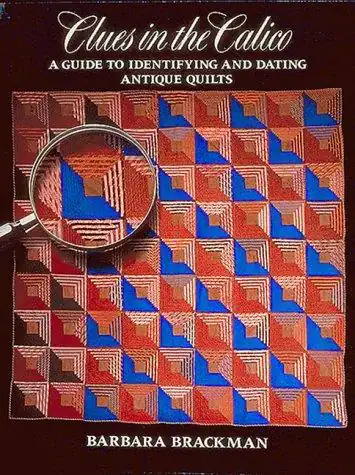
The other question is about a quilt made before the birth of the maker’s son 1885, in Clayhatchee, AL. It is a block quilt of 9-patches on point with pieced corners around each block. It is sashed with small 9 patches in the corners and the sashing is three strips of fabric, light, dark, light. What drew my attention was the claret fabric (this is the term B. Brackman uses for this color) used throughout the quilt. In 1989 when Clues came out it stated that this fabric was available after 1890. I’ve heard it’s slightly earlier since then, and this quilt with provenance tells us it was available in 1885. Do we know of an earlier confirmed date than that?
Thanks for any info, Kim Wulfert www.antiquequiltdating.com
Date: Tue, 28 Oct 2003 | From: “Maurice Northen”
Yes, you will want to search used books, and libraries for “Quilt Restoration” by Daphne Cognac. She worked with Nancy Kirk, and what and how she suggests solutions are real. She even shows thru diagrams, and photos. It is out of print, and has gotten pricey, but, you still want to continue to hunt. I use mine every day, and refer and quote to it each time a quilt appears for consideration.
Date: Tue, 28 Oct 2003 | From: “Marcia Kaylakie” <marciark@>
HI Gail, Here is my address! It was so much fun to meet you at AQSG and thanks again fro the roundtable! Marcia PS: I just got a telephone call from the Governor’s office about my project on Texas!!!
Date: Tue, 28 Oct 2003 | From: Kris Driessen <krisdriessen@>
I received an E-mail inquiry from someone looking for Cloth of Gold to do a restoration project. Does anyone have any they would like to sell, or have any suggestions for her?
Kris
Date: Wed, 29 Oct 2003 | From: “Jean Carlton” <jeancarlton@>
Hi all, I recently appraised a Crazy quilt which the owner said was made from scraps from a nearby high top shoe factory out east. Just curious about how silks and typical crazy quilt fabrics would be used in shoes? Lining? Any other insights? Jean
Date: Tue, 28 Oct 2003 22:10:34 | From: aol.com
Lining, possibly. And weren’t some evening shoes made of brocades or silk faille? I know there’s the whole business of dyeing bridal shoes to match the gowns, so I assume that it was done in the old days as well….
Karen Evans
Date: Tue, 28 Oct 2003 | From: Joan Kiplinger <jkip@>
Kris — CoG came in many fabrics, mostly lawns, nainsooks, longcloth and fine plains. What is she specifically looking for? I have some small pieces in blue and in white in the above first three.
Date: Tue, 28 Oct 2003 | From: Dana Balsamo <danabalsamo@>
Hi Jean, I was at an auction today with several lots of shoes from the 18th to 20th early century. Some looked delicate…not your typical leather shoes. Here’s a link: http://www.whitakerauction.com Click on Day 2 Catalog, page 3, #461, Evening Shoes…there’s a pic and the following. Also Page 5 #608, Lace Pink silk boots and wedding shoes.
Hugs, Danaer leather; one pair navy silk, all excellent-pristine
Jean Carlton <jeancarlton@> wrote: Hi all, I recently appraised a Crazy quilt which the owner said was made from scraps from a nearby high top shoe factory out east. Just curious about how silks and typical crazy quilt fabrics would be used in shoes? Lining? Any other insights? Jean
Material Pleasures http://www.rubylane.com/shops/materialpleasures Affordable Vintage Linens, Lace, Textiles, Buttons & More!
Date: Tue, 28 Oct 2003 | From: “Lynne Z. Bassett”
Dear Candace,
This fabric sounds similar to the type of fabric that was popular for small table cloths in the 1860s or so. (Look at almost any studio photograph of the period and you’ll see a man/woman/child leaning against a small table covered with one of these cloths.) I have never seen this red wool felt (or a heavily fulled woven cloth) printed with black designs used for a garment, though. Maybe you have one of these tablecloths in your museum’s collection and you can compare the two pieces.
Best, Lynne