November 30 – December 3, 2003
These restored messages come from the Quilt History List, an online forum where quilt historians, collectors, researchers, appraisers, and enthusiasts discussed antique quilts and related textiles. The archive dates from 1996 through approximately 2016 and is being restored gradually. Sign up in the form at the bottom of the page if you want to know when a new page is added. Original spelling, opinions, formatting, and inactive links may remain unchanged.
Primary topics of this QHL Digest:
- Thimble Use, Preferences, and Superstitions — A wide-ranging discussion of who does and doesn’t use a thimble, homemade alternatives, and folklore around thimble use.
- Lone Star Quilts and Southern Regional Traditions — Southern members trade stories, superstitions, and family history tied to Lone Star pattern quilts.
- The Rise of the Rotary Cutter and Fat Quarters — Members trace the popularization of rotary cutting and fat-quarter culture, crediting figures like Mary Ellen Hopkins.
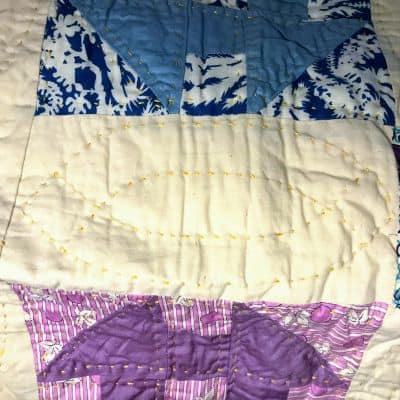
- Identifying a Discharge-Print Indigo Fabric — A blue-and-white fabric with an unusual selvedge is identified as a discharge print or related traditional dye technique. (see the article on indigo fabrics)
- Quilted Petticoats and Regional “Hoosierisms” — Continuing research into historic quilted petticoats turns up regional Indiana dialect terms in a period text.
Date: Mon, 1 Dec 2003 | From: “Charlotte Bull” <charlou@>
As we settle down on Monday Morning, after our delightful Holiday Correspondence, I wanted to tell you that you all were “ringing my bells” with your different topics. Thanks!
One of my favorite Lone Star quilts was made in Kansas by a Mennonite Lady in the 1920s. (Well, that’s the vague info I got when I bought it in Arkansas!) It is rather unusual solid colors, with lots of yellow and lavender. It has smaller LeMoyne or Lemon Stars in the squares & triangles. The back is a single charming print of simple white and green. Unusual for the source, but on the underneath side and much more helpful in dating the quilt than the top! One year during a very stressful family event a visiting 8 year old climbed out of bed and pulled the quilt from the display rack and curled up on the floor to sleep. Unfortunately she “wet the bed”!!! The quilt got carefully pulled up & folded in the morning and I did not discover this for a day or two! By then the stain had caused the print design to run & blur! The quilt HAD been in Mint Condition!!! Until Then. The top reveals no damage at all.
So, this has become the beginning of a Family Tradition! A Superstition??? If, as a child you dared to wet on G’ma’s antique quilts, that is what you inherit from her when she’s gone because it has your DNA on it! (And, yes, a few others have done that! But they were babies and it was their mothers who allowed it to happen! In every case the quilts were on display on a rack!) I hope & pray that they have all learned their lesson. Each will inherit specific quilts due to some odd family tradition, but hopefully there will be no more DNA choices made!
Now a quick comment. A few years ago I got a request from a young lady who was working on a term paper or graduate dissertation on the topic of Quilt Superstitions. She was a student at U of NE, of course! I apologize for not being able to find her letter in my files! She may have already written to QHL. But, if one of you has close contacts there in Lincoln, maybe you could check it out. I recall asking her to let me know if & when it was published or available for reading. I shared a few stories I’d heard, but they were the ordinary ones we all know. 13 tops required, no hearts, don’t sew on Sunday, tossing the cat etc. I’d love to know what happened & what she discovered! cb
Date: Mon, 1 Dec 2003 | From: “Charlotte Bull” <charlou@>
I have a question for you. Was there a superstition about having to wear a thimble? Why does everyone give me the “evil eye” when I say I don’t wear one?
Re Tossing the cat: I think it was gently done and a small kitten, not an 18 pound tom cat! Years ago I started a family Superstition/Tradition for not using a quilting frame. My 2 cats used my quilt as a trampoline – their own free will, not a tossing of the cat! So I took it down, and did what I call “clutch quilting” to finish it and I never looked back. All of my quilts are done without a frame, but I admit most are small ones. But some are queen size. I “came out of the closet” after hearing a lecture and seeing the work of a master quilter from St. Louis area! (A lady can be a master quilter! We wouldn’t want to call her a mistress quilter or a madam quilter!) A truly brilliant creative quilter of original masterpieces! If she can admit to not using a frame, than I can too. Thank you Suzanne!
Gaye, do you remember our quilter’s fairy tale with the Hurons vs. the Herons? You have made me look in my files for those copies from the good old days! Thanks!
Okay, I’ll shut down after I add that it was a dog who stole my ham 30 years ago! My cats stick to chicken thighs! cb-char-charlie-charlotte of the Ozarks, who Thanks Ya’ll for your friendship!
Date: Mon, 1 Dec 2003 | From: “Charlotte Bull” <charlou@>
I just wrote & got an instant reply from a shop owner, Kimberly, of today’s Quiltropolis Sponsor for Vintage Fabrics list – The Fat Quarter Shop. This is not an ad, Kris, just a friendly source for info! But it does prove that we should check out our daily sponsors! I’d asked her what she knew about Fat Quarter History. The topic has been circulating! She wrote this:
> What the Moda sales representative told me about fat quarters is this .. . . Shops really wanted to be able to have samples ready for classes and for customers to see new fabrics, but if they waited until the bolts arrived it did not give them much time. So Moda started selling them fat quarter bundles. They would arrive one month before the bolts (which is still the case). Stores would then have a month to put together samples before all of the fabric arrived. He said stores would just buy one; and then the customers wanted them, so now they are very popular.
Kimberly did not share any dates, but I don’t recall buying them until in the late 1980’s. By early 1990’s they were extremely popular. Then after a while the Obese Eights and Sweet Sixteens came along! I also recall seeing big packs of 6″ squares of an entire line being offered by some shops & catalogs. Now Benartex offers 4″ square packets through their Quarterly Club. (Pun intended?) Have any of you come up with dates? (No pun intended!) c
Date: Mon, 1 Dec 2003 | From: “Lynne Z. Bassett” <lzbassett@>
>And I > believe Lynne Bassett is on this list..? 🙂
Hello! I’m here–I was away from the computer for a few days in order to spend some time with my family over Thanksgiving. Now I’m catching up on the quilt list, and I guess there’s come discussion about whole cloth quilts going on.
Hazel brought up the subject of the “What’s New England About New England Quilts?” symposium proceedings. These are still available (in theory) from the Old Sturbridge Village bookstore, and also on the museum website. I think at this point they are out of stock, but they can and will print more, especially if people call and ask for them. I will give the manager of the bookstore a heads-up to get some more printed if people let me know that there’s a need.
I also published a short essay about whole cloth quilts as related to the design of bed rugs in the 1999 Proceedings of the Dublin Seminar for New England Folklife, _Textiles in New England II: Four Centuries of Material Life_, Boston University Press, 2001, and I wrote an article on whole cloth quilts for _PieceWork_ in the Sept./Oct. 1999 issue.
Is there a specific question I can answer?
Best, Lynne
Date: Mon, 1 Dec 2003 | From: Kittencat3@
All this conversation so inspired me that I spent most of yesterday selecting fabrics and cutting out diamonds for – you guessed it! – a Lone Star quilt for my bedroom. I feel like piecing this winter instead of quilting, and this should be perfect.
Thanks! 🙂
Lisa Evans
Date: Mon, 1 Dec 2003 | From: “Dorothy Osler” <do@>
On the subject of wholecloth quilts, I fully concur with the recommendation to look up Averil Colbybook Quilting. Dare I also mention two of my titles: Traditional British Quilts and North Country Quilts; Legend and Living Tradition. Both have significant sections that include wholecloth quilts and the latter has some good colour images of what are very difficult quilts to photograph.
Traditional British Quilts (published 1987) has long been out of print though used copies do appear from time to time on Amazon (at a price!). North Country Quilts, the catalogue of the exhibition at the Bowes Museum in County Durham in 2000 is still available (at a modest cost) and I do have a new stock. If anyone is interested, please email me separately for details.
Dorothy Osler
Date: Mon, 1 Dec 2003 | From: Kris Driessen <krisdriessen@>
My guess would be that the popularity of fat quarters and rotary cutters go hand-in-hand. I agree, 80’s sounds about right. I remember using a rotary cutter to make a gold and brown quilt, so that would make it earlier 80’s. 83? 85?
Kris
Date: Mon, 1 Dec 2003 | From: <chrisa@>
I thought it may have started with Mary Ellen Hopkins as she was such a part of the rotary cutter strip piecing movement. Her shop is long gone, but I called another long timer, Carolyn Reese, who started her a big quilt shop in LA over 20 years ago and she started the Road to California show, a big 4 day quilt event here.
Here is what she said. She doesn’t know who, when or where exactly. But she said it was the appliquers, more than 20 years ago, who started asking for bigger pieces. They asked the store to cut them half of a half yard, which worked better for their projects. Then the stores began selling the other half and called it a fat quarter. She said it did not start with Mary Ellen, as she catered to piecing rather than appliqué methods.
This is just one opinion, but maybe someone from the Appliqué Society can chime in on this theory?
Kim Wulfert www.antiquequiltdating.com
Date: Mon, 1 Dec 2003 | From: “Pepper Cory” <pepcory@>
Hello all-Been reading the Lone Star posts with interest. I thought that a large pieced center star with smaller stars etc. in the corners was a Star of Bethlehem. I was told by an old timey quilter that it says on the night Christ was born, one star was the brightest in the sky. That means it wasn’t alone but there were other smaller stars as well. Maybe all those pre-cut kits of Lone Stars (the diamonds came cut and stacked) produced a great many stars without their backgrounds? I see those come up on ebay sometimes. As for Southern cooking, I’ve been investigating the lowly sweet potato as the next miracle food-no kidding! See the NC Sweet Potato Commission site at http://www.ncsweetpotatoes.com . The nutrition in a sweet potato is better than broccoli! If you’ve only thought of sweet potatoes as that orange side dish topped with marshmallows, read some of the recipes and be amazed. This Thanksgiving I made sweet potato biscuits, sweet potato pound cake, sweet potato and cornbread stuffing, and sweet potato casserole with pecan crunch topping. I didn’t tell my guests the ‘mystery’ ingredient and they loved every one of ’em. But now I’m back on the Atkins diet in earnest and even my beloved sweet potato is a no-no. >From the state that produces the most sweet potatoes in the US- Pepper
Due to a late Thanksgiving, this year’s Christmas season is a week shorter than normal. In case any of you need help with your gift list, this 1882 article about Christmas ideas will surely solve your dilemma. sue reich
Daily Gazette Fort Wayne, Indiana December 9, 1882
TAKE THE HINT, GIRLS
Some of the Novelties in Christmas Gifts That Will Be Appreciated – Do Not Make The Gentlemen Any Slippers for They Will not Fit – What to Buy.
From this time until the holidays are over the subject of Christmas gifts will claim as much of everyone’s attention as can be spared from the hurly-burly of every day life. The society lady may be heard any day to remark that she has commenced already and picks up something every day. To be sure this is a delightful state of affairs, and the choice of elegantly bound books, rare engravings, costly pieces of bric-a-brack, precious jewels and symphonies in music and colors cannot be anything else than pleasing.
Equally valuable is the advice “to begin early” to those who can only demonstrate their affection for the loved ones in a linen handkerchief, a small volume of poems and a few trifles as light as a feather, but weighted down with a cargo of good wishes. It will be well for the busy little ladies of Fort Wayne who have a kingdom of loved ones, to remember that a Christmas gift is not estimated for its intrinsic value alone. Anybody can buy a diamond pin or a pair of kangaroo slippers, but it is not everybody who can show the admiration of a friend by sending a dainty toilet set, an ottoman, or a fine cambric handkerchief designed and executed by loving hands. Inquiry on the subject will always reveal the fact that a hand-made present is more acceptable and more highly prized than anything that can be purchased.
Apropos of handkerchiefs, a gift to be appreciated by almost any gentleman, is from one to a dozen hemstitched linen napkins, with the name or monogram etched in one corner. The articles can be purchased at from $2.50 to $12.00 per dozen as wholesale and marked at home. If unable to etch have some pretty scroll, or more novel, a skeleton picture stamped on it and then outline with silk or cotton, or else embroider over it. Should the lady have excellent eyesight and sufficient time there will be a monetary economy in buying a yard of fine linen lawn or mull. This will make four handkerchiefs that will out-wear a dozen store-bought napkins. Hemstitch the edge, embroider the corner with a large initial letter, and to the gentleman or lady that can appreciate them they will be a most welcome present. In the same way a case of silk handkerchiefs can be manufactured from a few yards a pongee silk.
A more delicate and perhaps more durable gift is a kerchief, and there are any number of pretty and simple patterns. The neatest is about the size of a lady’s handkerchief. Take of any two pretty colors, as blue and white, blue and gold, pink and olive, gold and scarlet, or pink and blue, half a yard of silk or satin. A rich effect is obtained of using maroon plush or velvet for the outside, with lemon silk for the interior. Place between them for lining a sheet of white wadding and two pieces of white cambric. Turn in or bind the four sides of the square, which the silk must form, and quilt in a fine diamond pattern of the machine. Two colors, of course, will be used in sewing. When done fold the four corners on the center and fasten with a pretty button or beaded rosette. If perfume is desired, procure a few grains of good sachet powder and insert between the folds of the lining.
Rattan and wire frames are inexpensive, and if covered with silver board or satin they make charming and very useful boxes for gloves, handkerchiefs and ties. You can save all the trouble of making them, however, by getting a fifty-cent or seventy-five cent Japanese box and lining it with some bright satin glued in with mucilage. The most expensive and withal most unsatisfactory present to a gentleman is a pair of slippers. We have yet to see the first successful attempt in this undertaking. Placing no estimate on the cost of velvet crewels, floss and stamping, and the days and nights that are spent in the embroidery, there is an outlay of never less than $7 for having them soled. If she doesn’t fail to get the right measure, Crispin does, and although he cheerfully stretches them to meet the dimensions of the loved one’s feet, or even goes to the length of resoling them, some of the upper is sure to be cut, and one or more of the precious flowerets perish.
Suspenders are still favorite gifts with the ladies, and as silk elastic or silk belting cloth are the materials selected, little decoration is necessary. In mittens black or brown only are offered to gentlemen, and his joy will be but partial if not made of silk. As a rule men dislike decorated gloves and a knowledge of the fact may save some over zealous little lady a vast deal of useless work. Fathers, husbands, brothers, cousins and really acknowledged sweethearts will get prettily painted boxes this year, containing a pair of silk socks. The monogram is worked in colors and placed on the inside of both stockings.
Smoking caps or wristlets knitted or crocheted, the former in dark and the latter in shaded colors, make gifts every gentleman will be gracious in acknowledging. A paint brush skillfully handled will transform a fifty-cent paper knife into a $3 beauty, and one yard of turquoise silk cut on the bias will make five handsome scarfs, for one of which any man will credit the giver with $1.25. Borrow a couple of discarded but new style of scarf and with a bit of fancy brocaded silk, a piece of wadding, some rubber and muslin, a duplicate can be made on the frame of the sample after it has been ripped up.
The plain perfumery bottles, covered and filled, though quilt common, have a particular charm for the boys, who are never slow to appreciate satin cushion, a broom rack and a clothes bag. The latter useful article appear this year in fancy cretonnes and java canvas, and some novelties are produced from silk elaborated with little pieces of velvet and plush put on like appliqué. The newest article of this kind is a willow basket with a cover having large scrap-book pictures pasted on the sides. Another attempt to make the linen basket attractive is shown in the two bands of colored ribbon that run in and out of the intersestices? and finish at one angle in a large jabot.
Shoe bags which no man was ever known to use, are made of grass linen and built three stories. The pockets are deep enough to cover the largest and most unsightly shoe, and being laid in a double box plaits, afford space for odd sketches in worsted. During the last couple of years college girls have made themselves remarkable by sending their most intimate friends beautiful white nightshirts. They were dispatched without a card but the recipients were none of the obtuse kind, and sent gratifying notes of acceptance. The idea, being novel, was sufficient to make it contagious, and we learn from the merchant tailors that they have more orders to cut out night-shirts than they can possibly attend to. Poor little know nothings!
They pay the cutter one dollar for the job, never dreaming that a paper pattern could be bought for twenty-five cents that would answer the same purpose. These useful garments are made of the finest linen – something too nice and cold to be soon worn out – and trimmed at the neck and wrists, and down the front with colored embroidery. Considerable pains are taken with the pocket, which has a lap that, fastens down with a gold button, scouring a dainty pocket handkerchief.
Date: Mon, 1 Dec 2003 | From: macdowel@
Hi —
Thanks to those who cited our book and exhibition. Just thought I would let you know that copies of our book To Honor and Comfort: Native Quilting Traditions are still available through the Michigan State University Museum. Also, if you want to view some of the virtual exhibits developed on this topic, go to http://35.8.122.90/MTAPStore/category.asp?time=173846&category=QOT to see quilt-related publications. The MSU Museum has also published several other books related to Native Americans, see http://35.8.122.90/MTAPStore/category.asp?time=173851&category=NA.
The National Museum of the American Indian has a virtual tour of “To Honor and Comfort.” See http://www.conexus.si.edu/quilts2/index.htm. Downloadable curriculum materials are also available at this site.
Also — we are still circulating a smaller version of the original 1977 exhibition “To Honor and Comfort: Native Quilting Traditions”. Check here is you are interested in seeing where it is booked or about booking it. http://museum.@/museum/tes/index.htm
We also put together another traveling exhibition of Native American and First Nation quilts from the Great Lakes region. See “Great Lakes Native Quilting Traditions” http://museum.@/museum/tes/index.htm
As to the date of introduction to quilting among the Plains Indian peoples, during our research for To Honor and Comfort we found scores of photographs showing quilts in use within Native communities on the Plains in the late 1800s and secondary references to quilting activity as early as the 1870s. One of the earliest dates re. intro to quilting among Native peoples for which we had secondary source info was 1820 at a Candy’s Creek (TN) Mission school for Cherokees. Simultaneously, there was the documented 1820 introduction of quilting to Native Hawaiians – an event often cited in studies of Hawaiian quilting. Circa two hundred years of quilting within Native communities!
There is much yet to do on this very under-researched part of quilting and North American Indian history. Hope to see lots more people engaged in the work that needs to be done on individual quilters, quilting customs (including ceremonial uses and symbolism), particular tribal based aesthetic systems, etc. etc. Along with Mary Waller, Jill Hemming, Carolyn O’Bagy Davis, Florence Pulford, Bea Medicine, and a few others, we have just begin to scratch the surface.
— Marsha MacDowell
Date: Mon, 1 Dec 2003 | From: Gaye Ingram <gingram@>
I apologize in advance for this, but I am alone and helpless to control my silly impulses this evening.
Aren’t fat quarters what one gets if she makes up all Pepper’s N.C. sweet potato recipes and then cannot forbear consuming them? And perhaps tops them off with a dab of Artillery Punch?
Oh the depths to which we can descend!
gaye
Date: Mon, 1 Dec 2003 | From: “Jocelyn” <jocelynm@>
> I have a question for you. Was there a superstition about having to wear > a thimble? Why does everyone give me the “evil eye” when I say I don’t > wear one?
Charlotte, I don’t wear one, either. I pinch the needle between thumb and first finger; I don’t drive it with my second finger unless the fabric is very tightly woven, so I don’t need one. It drives my mother, the sewing teacher, nuts. The comments I’ve always heard are from people who drive the needle with their 2nd finger, so they’re imagining pushing that sharp-eyed needle with tender skin, and they’re thunderstruck that I don’t want a needle. Well, different methods, different tools. 🙂 I also don’t use a hoop to quilt. I fold the quilt with my left hand as I stitch with my right hand held level- none of that stabbing-then-bending for me!<G> My stitches end up every bit as small. But then, I taught myself to do just about every kind of needlework I do, so I’ve invented my own methods for just about everything. I can’t stitch at a standing frame, and back when I used a hoop, I kept turning it so that I always stitched from east to west (never along the north-south line). I figure that if people can’t tell my methods from looking at the product, it doesn’t matter!<g>
Date: Mon, 1 Dec 2003 | From: “Jocelyn” <jocelynm@>
> > One of my favorite Lone Star quilts was made in Kansas by a Mennonite > Lady in the 1920s. (Well, that’s the vague info I got when I bought it > in Arkansas!)
Don’t know how far back it went, but every year there’s a major quilt auction to benefit Mennonite World Relief. I believe it’s held in Hutchinson (KS). You’ll see every sort of quilt imaginable there- the ladies make whatever they think will sell. I think there’s a website about it, but I don’t have the addy. FWIW, the younger Mennonites are not necessarily ‘plain’- I discovered that my neighbors were Mennonites only because the postman mis-delivered their church newsletter. He was a medical student, and she was a schoolteacher, and both dressed just like their colleagues. I knew several medical students who were Mennonites, including one family of three brothers. Imagine the tuition bills THEIR parents had suffered! <G>
> Anybody can > buy a diamond pin or a pair of kangaroo slippers, but it is not everybody > who can show the admiration of a friend by sending a dainty toilet set,
I read this as ‘a dainty toilet seat’. Now THAT’S a you-neek Christmas gift!<G> The kangaroo slippers are full of possibilities, too. <G>
Date: Mon, 1 Dec 2003 | From: Kittencat3@
I’ve never used a thimble. I make myself little shields of masking tape and push with my middle finger. I also don’t use a hoop when I do conventional quilting, preferring to bunch the fabric in my left hand.
I *do* use a hoop when I do large backstitch projects; it’s a bit more stable and promotes nice, even tension between front and back. Small backstitch projects, though, are done in my hands, not on a hoop or a frame.
Lisa Evans
Date: Mon, 1 Dec 2003 | From: “Judy Grow” <JudyGrow@>
> Small backstitch > projects, though, are done in my hands, not on a hoop or a frame. > > Lisa Evans
Lisa,
What is a “backstitch project?” I think that some of the 18th century English quilted petticoats were done with backstitch. Is that what you mean?
Judy in Ringoes, NJ judygrow@
Date: Mon, 1 Dec 2003 | From: maureen@
I have been a lurker up until now but English – particularly Durham and Welsh wholecloth quilts are my passion so I have taken the plunge!! I have very recently bought a book called North Country Quilts Legend and Living Tradition by Dorothy Osler. It is publiched by The Bowes Museum in County Durham England Here is the web page link: http://www.bowesmuseum.org.uk/
This book was published in 2000 to coincide with an exhibiton that held at the museum. It gives some history of the Durham quilting from 1780 through to the current time. The Averil Colby book mentioned ( which I also own) is well out of print but still available sometimes second hand.
I hope this information is useful to you.
Maureen Teager Australia
Date: Mon, 1 Dec 2003 | From: “Pam Weeks Worthen”
HI ya’ll!
(As I live in southern New Hampshire, and am just picking myself up off the floor from laughing while trying to read Gaye’s postings, I thought I would use that lovely greeting)
Well, there is still turkey left over in the ‘fridge, despite returned college freshmen circulating through the house all weekend and Turkey Tettrazini up the wazoo, and we have survived our fourth party of the Thanksgiving “break” with only one more brunch to go…
Yesterday afternoon was my cousin’s every-other-year-the-saturday-after-thanks-giving-party, and my aunt brought me a copyright 1933 McCall’s Lone Star quilt pattern envelope to look at. It contained a large tissue paper sheet with complete instructions on how to heat transfer the patterns to cardboard for tracing, how to cut, piece etc. But the patterns weren’t there, and something else had been whacked out of one of the corners, the quilting patterns perhaps?
The cover of the envelope showed two ways to piece it, one named Lone Star and the other, Broken Star. The quilting patterns were clearly illustrated as feathered wreaths. I didn’t have a chance to read through the whole thing, but will ask to borrow it to see if there was any mention of superstitions about the pattern, or history for that matter.
Second, we belonged to a congregational church in Dover, NH, for a short period of time, and proudly displayed in the church hall was (maybe still is) a lone star quilt from the Lakota Sioux. It’s blue in many shades and white, and the only other things I remember are that the fabrics are polyester, and was a gift given in thanks for some mission work that came from the NH church.
Pam in NH where try as it might, the wind just can’t knock my house over! Too much turkey in the refrigerator!
Date: Mon, 1 Dec 2003 | From: “Teddy Pruett” <aprayzer@>
> >”While you are resting, see how many Miss Americas you can name from >Southern States.
Except for Bess Myerson in 1945, weren’t they all?
Oh, I see the point has been made …………….(purr) Yall know we are just too prissy down here.
Just wanted to say that I, too, have long been aware of the superstition that a Lone Star quilt should not have plain squares and triangles at the edges – that they must be filled in with something or other. ANd, if you will notice pre-“war of northern aggression” quilts (Geeze, Gaye, you’ve got me doing this southern thang, too) they all have something inthose areas, many times smaller stars or Broderie Perse. I’ve known it for so long I can’t remember where I heard it or read it.
As for our Gaye, I already have dibs on living next door to her, and if her writing the the past few days is any indication, she is ingesting more than 1-2-3-4 cake!! I want some of that! Teddy in FLorida where it actually got cold last night, just long enough to kill flowers, and turned hot again by noon. Baloney.
Date: Mon, 1 Dec 2003 | From: Gaye Ingram <gingram@>
I am really intersted in these star quilt superstitions. Stars quilts are perhaps my favorite type of quilt. And I had no superstitions re them. My teetotaling grandmother refused to let me or any other human being my cousins and I ever discovered, sleep under her lovely feathered Drunkard’s Path quilt—for reasons easy to discern. But that was it. Our superstition s lay elsewhere. But it is interesting to learn about these. Also interesting that members are distinguishing between local superstitions and traditions.
BUT in a recent post, Ms. Teddy Pruett from the formerly southern state of Florida and now an extension of NY/NJ/Chicago, suggested that I had had one star too many. Specifically, she wrote, “if her [Gaye’s] writing the the past few days is any indication, she is ingesting more than 1-2-3-4 cake!” Not so. Just too much Texas country music to go with the file cleaning or reorganization that ends my weeklong holiday.
HOWEVER, I do have a contribution that will gladden the hearts and spirits of even the dreariest among us—and make those erring points APPEAR to match. So far as I know, it does not have a direct quilt connection. Unless, it could be related to the Temperance quilts and to the events that led grandmamas to keep their descendants from sleeping under Drunkard’s Path quilts.
I pass along in the spirit of the coming holiday this TRADITIONAL recipe fo r a punch that dates back to the days after the American Revolutionary War an d Savannah. It is called the Chatham Artillery Punch, and the only time we came close to making it precisely as directed, it had extraordinary effects ..
Back in the 1340 or so, there was a tradition among history grad students a t the University of Georgia that called on one’s fellows to throw a big party for a doctoral candidate when he passed his prelims. A covey of those students rented a large old house on a large old pond/lake, somewhere outside Athens, Georgia. And when my husband passed his exams, the party wa s scheduled out there. My husband requested that the Chatham Artillery Punch be served (Naturally, guess-who had discovered this recipe). And so it was.
Aside from the general merriment of the occasion, what I recall is the presence of a very bad bagpiper, a first-year grad student. As evening fell, he began to take his pipes and parade around the pond/lake. In time we forgot about him. In later years, that evening’s guests have often asked the question, “What ever happeed to X (the bagpiper)? And no one seems to know. Many contend he was never seen after that evening. So, I suggest that if yo u ever choose to make this punch in proportions more suitable for normal folks, you do not permit a bagpiper on your grounds. Unless, of course, you have a clause in your insurance to cover such possibilities as might arise. Or a superstition that requires you to have a bagpiper. So here’s the recipe, somewhat more dangerous than my mother’s 1-2-3-4 cake, Teddy. But not much.
The Chatham Artillery Company was a Revolutionary War unit formed in Chatha m County, Georgia, which includes Savannah. The company=B9s members held reunions for many years after the war, and the staple of the reunion was a fis house punch for which they became (justly, I suspect) famous. This is the recipe. On days when the world is too much with me, I can just read this recipe and feel elevated. The recipe is from Ms. Harriett Colquitt=B9s Savannah Cook Book.
Chatham Artillery Punch
Date: Mon, 1 Dec 2003 | From: “Marcia Kaylakie” <marciark@>
Well Gaye, If you have not started writing a book on all of this Southern-ness in general, you should!! Better yet, why not a book from Teddy and Gaye? What do you think? I know I’m opening email just to read the next “installment” of Gaye-isms. Teddy, of course, is just a perfect match for this. Marcia
Date: Mon, 1 Dec 2003 | From: Gaye Ingram
So kick me off the list, Kris, but I cannot forebear sending the Ogden Nash poem that graces the back of Colquitt’s “Savannah Cook Book”—if only for the last rhyme and that allusion to the foods which so many of us knew in the sixties or fifties.
gaye
from SAVANNAH COOK BOOK by Harriett Ross Colquitt
Pilgrim’s Progress is a good book, and so, I am told, is Deuteronomy,
But neither is to be compared with this epic of gastronomy.
Some people have to die to get to heaven, and others hitchhike in fiery chariots, But really intelligent people stay home alive and have heaven served them out of this volumne of Miss Harriet’s, For as everybody knows, life on Savannah victuals Is just one long round of Madeira and Skictuals. Certainly every schoolboy knows that famous remark made by the late Mark Hanna: “I care not who makes our Presidents as long as I can eat in Savannah>’ If you like dishes made out of a piece of lettuce and ground-up peanuts and a marashino cherry and marshmallow whip and a banana You will not get them in Savannah, But if you seek something headier than nectar and tastier than ambrosia and more palatable than manna, Set your feet, I beg you, in one of these specialities de Savannah, Everybody has the right to think whose food is the most gorgeous, And I nominate Georgia’s.
Ogden Nash
Date: Sun, 30 Nov 2003 | From: Gaye Ingram <gingram@>
on 11/30/03 6:12 PM, Marcia Kaylakie at marciark@ wrote:
> Well Gaye, If you have not started writing a book on all of this > Southern-ness in general, you should!! Better yet, why not a book from Teddy > and Gaye? What do you think? I know I’m opening email just to read the next > “installment” of Gaye-isms. Teddy, of course, is just a perfect match for > this. Marcia
I feel obliged to note that our Teddy is under the weather and so what you’re seeing is not her best at all. So just imagine!
And Marcia, I must tell you that Teddy drove to Houston listening to books-on-tape of Stonewall Jackson biographies. Was just fine. Fit as a fiddle.
Then, she was struck by a thunderbolt of an illness which has laid her somewhat low.
Mind you, I’m not blaming Texas, but since we’re on the subject of superstitions, from now on I’m crossing my windshield every time I cross the border going west.
And I’m packing Chatham Artillery.
You, Marcia, can start collecting us a bunch of those Texas country recordings—esp Emmylou Harris, Nanci Griffith, Van Zandt, et al. In fact, y’all did such a good job with Dallas, I think you should stage a “retreat” somewhere in the hill country and get some of those folks to sing for us while we make up superstitions/traditions and quilt. I’ll bring the recipe for the 1-2-3-4 cake. You bring the stars.
gaye
Date: Sun, 30 Nov 2003 | From: “Jocelyn”
> Arrow – look bewildered, then jump off at the first opportunity > and steal the > ham from the buffet table.
Benedict stole the ham last week. Ate at least a half a pound of it before I caught him. Then continued to run, jump and carouse all evening. If I’d eaten 6% of my body weight in ham, I’d’ve been moaning and groaning all night. Ah, kittens!
Date: Sun, 30 Nov 2003 | From: “Jocelyn” <jocelynm@>
> *wince* Not only is that dangerous to the bouncers, it must be > sheer hell > for the cat. Poor kitty!
Lisa, Depends upon how vigorously Kitty is bounced. 🙂 I’ve done it, with no ill effects for Kitty or quilt. You just have to have the right cat, and not bounce it any more vigorously than Kitty will bounce herself by jumping and leaping on a waterbed. 🙂 I have a friend whose cat loves to get into a plastic shopping bag and have you twirl her around and around. Not just by twisting the handles (like a child spinning on a swing) but by big arm circles! Her ‘mom’ actually did a full circle with her, 360 degrees, and the cat just purred away. Usually we’re afraid to go TOO high, because Tyler will sometimes decide to attack the bag and the bag will suddenly disintegrate. <G> I tried it with my new kitten, Benedict, and he didn’t seem to object, either. 🙂 But then, he’ll climb up on the shelves over the bed, and then dive onto the waterbed. So far, he and his brother have managed to miss me as they land, but it makes for uneasy sleeping. <G>
Date: Sun, 30 Nov 2003 | From: “Jocelyn” <jocelynm@>
> I am concerned that these quilts are in danger of being overinterpreted. > Although symbolism and hidden meaning may be used in star quilts or > in a specific quilt it worries me that ‘rules’ may be being imposed on > these quilts that do not apply.
A good point. Even if a Lakota woman makes a star quilt, it may mean something very different to her than it means to a fellow tribeswoman. She may choose to break the rules, to use the symbols in nontraditional ways. Or someone outside of the tribe may make HER star quilt for all the same traditional reasons! Or even, just imitate the culture, for different reasons. Look at how many Amish-style quilts there are! 🙂 Just because someone is of a particular culture doesn’t mean that that culture is responsible for every choice she makes. 🙂
Date: Sun, 30 Nov 2003 | From: “Jocelyn”
> asked about the symbolism of a character in one of her stories who wore a > black hat. She said, ‘I grew up in a day when men wore black hats. This > story is set in that time. So I gave my character a black hat.’
Reminds me of a class my sister took, where they read a literary analysis of the symbolism of the ruby slippers in The Wizard of Oz. Only problem is, in the book, the slippers were silver. But silver didn’t photograph well, so they used RED sequins in the movie. <G>
> > >Arrow – look bewildered, then jump off at the first opportunity > >and steal the > >ham from the buffet table. > > Benedict stole the ham last week. Ate at least a half a pound of it before I > caught him. Then continued to run, jump and carouse all evening. > If I’d eaten 6% of my body weight in ham, I’d’ve been moaning and groaning > all night. > Ah, kittens! > >
The whole ham??? Good heavens, I’m amazed he could move afterwards…then again, my cat Hunter Moon managed to stuff down most of a Beef Wellington when he was five weeks old and had barely cut his teeth. He was staying with a friend who had received said BW as a Rosh Hashanah gift and had given the leftovers to her cats….
Lisa
Date: Sun, 30 Nov 2003 | From: Gaye Ingram <gingram@>
While caught up in the silliness of my day, I stumbled on something that actually made some sense—-the distinction between traditions and superstitions and how very limited they may beto a single family, say.
A patterned behavior repeated through time in a family is no less a tradition than one that occurs in a larger group. Just different cultural units. And sometimes, I suspect, marriage spreads the traditions of a smaller group.
With time and repetition, a certain sacredness accrues—what the old Roman s called “pietas.” The pattern comes to represent or symbolize a more universal pattern, one that has transcend power and meaning.
No amount of rationality can remove the stigma conferred by serious superstition. We might “know” better rationally and consciously, but in our bone marrow and subconscious, we feel something very different. For instance , when my daughter was six years old, she fell ill with Hemolytic Uremic Syndrome, a terribly autoimmune response usually triggered by e-coli. We were in New Orleans when her symptoms became pronounced. A black cat had just crossed our path. I had, of course, “x-ed” the windshield, but……
Given the choice, I will drive to Ft. Worth, Houston, Nashville, etc rather than make the once happy and frequent trip to N.O. To this day, I grow tense as I approach the city. And I simply cannot eat at Arnaud’s, once one of our favorite little restaurants—not because my child became ill from food consumed there, but because that is where we were when she could no longer hide her symptoms.
And now that I think of it, I would not want a child or grandchild sleeping under a Drunkard’s Path quilt.
I suspect many of these traditions with quilts originated at a very primary level, one that can never be detected.
Not a brilliant thought, but better than some I’ve had today.
gaye
Date: Tue, 2 Dec 2003 | From: Marthapatches36@
Gaye, Will probably not get a retreat in the hills of Texas. But would like the recipe for you mama’s 1-2-3-4 cake. In rainy Puget sound, Martha
Date: Tue, 2 Dec 2003 | From: Kittencat3@
Backstitch was the favored technique on linen until the early 17th century. I work primarily in the medieval/Renaissance style and have done several projects using backstitch quilting instead of the running stitch. It works up surprisingly quickly and is quite attractive.
Besides, I have to use up the 16,000 yard cone of linen thread *somehow*….:)
Lisa
I sent this article in its entirety on August 821 of this year. I always wondered about the part that refers to “Star Quilts.” Here is that section of the article again. sue reich
Olean Democrat Olean, NY December 11, 1883 Patchwork is as old as the hills. Silk patches are an innovation on the calico quilts of our grandmothers, who early in their tender years were initiated into the mysteries of ‘star quilts’ – that of the ‘rising sun,’ ‘fox and geese,’ ‘flowers’ and the ‘log cabin’ – all the rage during the Presidential campaign of ‘Tippecanoe and Tyler, too,’ as the old Whig war-cry had it.”
“Tippecanoe and Tyler Too” – I’d forgotten all about that one. And wasn’t there a pattern called “54-40 or Fight”?
I love quilt block names…:)
Lisa Evans
Date: Tue, 2 Dec 2003 | From: Gaye Ingram
Somebody on this list ought to make Carolyn Miller come out of lurking and report on the Whig’s Defeat quilt she found in South Louisiana—-made by a relative of Pres. James K. Polk who is the man who created the Whig’s defeat!
Carolyn’s quilt has made me wonder about the presence of quilts in this pattern in the South—-whether more are in TN, MS, LA, TX, for instance— for Polk’s victory was a victory for the frontiersmen and “westerners” of the day. It was in his administration that Texas came into the union. I think the “54-40 or Fight” was of the same era and origin. (?)
A friend of mine owns one of these quilts that is dated, 1849. Carolyn’s is gorgeous. All are not, because of the means of the makers and the difficulty of the pattern, I suspect.
Any good Whig’s Defeat sitings?
Carolyn?
Gaye
Date: Tue, 2 Dec 2003 | From: <mreich@>
I feel like having some fun this holiday season with fashion, dress articles, and poems that tie into the world of quilts. Here are some suggestions for fashionable dress and possibly ideas for the Christmas gift list for the 1884 shopper. sue reich
The Sunday Gazette Fort Wayne, Indiana September 28, 1884
Origin of the Colored Petticoat —New Wraps, Round Capes and Jersey Basques — Notes
Black Quilted Petticoats Will be a favorite style for underskirts. A lady cannot do better in the way of making herself comfortably clad than to make up one or two such skirts. One seen, lately made, was of light but good black silk, the upper part gored on front and sides, and unlined. For the depth of sixteen inches it was lined with silk lightly wadded, and quilted neatly in rich wide diamonds with black silk thread. A narrow box-pleated ruffle finished the skirt at the foot. Use cardinal or gold colored silk to quilt if desired, but much color is neither as acceptable economically as all black, nor is it quite so genteel. There is a striped black farmers satin that makes up well in these skirts in place of silk. A good provision for the winter would be to have one of each. Medium length white underskirts, made plainly so as to be frequently changed and easily laundried, should be worn under them.
ORIGIN OF THE SCARLET PETTICOAT In searching ancient annals in regard to dates, etc., in dress sometime ago, it was found that there was a time many years ago, when the luxury of a night-robe was unknown to womankind. Later, we find that we are indebted to a freak of royalty for the comfort of a colored petticoat. Like other peasantry the milkmaids of Barmoral wear a stereotyped costume which consists in part of a scarlet petticoat and loose white bodice. While on a visit to this favorite resort gracious majesty the queen of England heard the Prince Consort express his admiration of the effect of the scarlet petticoats in the rural landscape, and to please his fancy Victoria immediately adopted a scarlet underskirt. Since that (1855-1856) colored skirts of many kinds have been worn in preference to white for winter and all ordinary wear, the substitution having been proved a good one. Thus to the affectionate desire of a wife to please her husband’s taste, in this as in many other ways that might be mentioned, are we indebted to a wife’s wisdom for comforts that otherwise might never have come to us men, poor dears, do sometimes become of use as well as ornament in a family.
“ITALIAN APRONS ARE THE RAGE AGAIN.” We have spoken of this fancy fashion ere this, for it has hardly gone out of vogue at all elsewhere since it was adopted several seasons ago. But Cleveland ladies have not taken to it kindly, and we see few worn here except the nondescript affairs of calico or gingham necessary for protection while “doing the work.” The little fashionable article referred to by the New York Tribune is meant to serve a double purpose. It is intended to protect the afternoon costume, the tea-gown, even the carriage visiting costume, and home reception dress, but is made at the same time to prove an ornament to a dressy toilette. “Italian” aprons, strickly speaking, should be straight, plainly trimmed with bands, braids, or embroidery, and hung by a cord and tassel, which is run through a casing wound round the waist and tied with long ends at one side of apron. The “Neapolitan” has a straight square bib. These are made now in linen, or cotton, etc., and decorated with bands of Roman ribbon or embroidery in crewels of washing silks. Some of the Italian peasantry from whom we copy this garment have it cut long enough to run the cord at two-thirds length, and allow the upper third (similarly trimmed to the lower part) to fall over the other. Besides these, all sorts of varieties of aprons are worn; black, colored, and ecru silks, surahs, and stain, daintily embroidered; white mull and lace exquisitely adorned with tucks, ruffles, and ribbons, etc., each being adapted to the dress with which it is to be worn. One made, but never worn, by a Cleveland lady of rare taste, was recently shown and greatly admired. It is in the form of two points of soft, rich black silk on both of which had been embroidered in delicate effective Kensington stitch, large, rich looking bunches of shaded crimson vases and olive green foliage. The upper point fell over the lower one, but not so as to conceal the lower embroidery; a vine of corresponding roses and buds were worked on the waistbands, and a few detached flowers appeared on the pointed bib. Another style is squared, and not more than ten or twelve inches deep, but extended round the waist (slightly gathered) far enough to protect the dress from the friction of the elbows. These are usually of mull, cambric, fancy nainsooks, etc., and are prettily trimmed with lace, ruffling, fancy crochet and fine braid trimmings. We urge ladies to adopt the apron craze according to their means and avocations. It will be found a protective tariff, of use to home industries, and conducive to economy.
Date: Tue, 2 Dec 2003 | From: Xenia Cord
I caught 2 “Hoosierisms” in Sue Reich’s most recent text on quilted petticoats: the word “laundried” and the word “strickly.” One also hears here the word “embroidried,” which must be akin to laundried, as both root words end in “dry”. Interesting that the terms were also current in the 1880s.
Xenia
Date: Tue, 2 Dec 2003 | From: ARabara15@
Hi all, I have a client who is interested in having a new double wedding band quilt made, using her daughter’s clothing. Her daughter is only 3 now and she wants to have the quilt made as a textile history of her childhood. She will give it to her when she is grown. Is there anyone out there who would be interested in taking on this project? Email me privaetley and I will give you my client’s email adress.You can take it from there. She lives in NJ just north of Flemington. Happy Holidays,
Donald Brokate The Crazy Quilt Collector Trenton, NJ
Date: Tue, 2 Dec 2003 | From: “Carol H. Elmore” <celmore@>
Does anyone have a copy of the following book that they would sell me:
Hearthside Hangings by Mimi Shimp
This is a book with patterns for seasonal wall quilts.
There is a newer one called More Hearthside Hangings but I don’t want it. I need the older one.
I have searched various out-of-print booksellers including several that deal with quilt books. No one has it listed.
If you’d be willing to sell it to me, please contact me privately.
Thanks, Carol Elmore Manhattan, KS
Date: Tue, 2 Dec 2003 | From: <mreich@>
I rechecked the spelling in the text of that article for those very words. My spell check didn’t like them at all. That’s the way they were printed in the 1880s. A regional characteristic! sue
Date: Wed, 3 Dec 2003 | From: RAGLADY@
Hi Carol You may have already done this…. but figured I would ask JIC… Have you contacted Mimi Shrimp and inquired abt her book? She has a website; lives in Vegas and has a shop there. Possible that she might have a copy or could provide whatever information you might need… if that is all that you are looking for.
Website address (phone number is also shown: http://www.quiltime.com/ Gloria raglady@ celmore@ writes: > Hearthside Hangings by Mimi Shimp > This is a book with patterns for seasonal wall quilts. > There is a newer one called More Hearthside Hangings but I don’t want it. I > need the older one. > > I have searched various out-of-print booksellers including several that deal > > with quilt books. No one has it listed. nIf you’d be willing to sell it to > me, please contact me privately. > > Thanks, > Carol Elmore > Manhattan, KS >
Date: Wed, 3 Dec 2003 | From: nomad1@
Dear Dorothy, I am most interested in buying a copy of your North Country Quilts. Could you please advise cost etc to: Hiranya Loder 19 Pemberton Street East Parramatta N.S.W. 2150 Australia
I positively adore your Traditional British quilts and am sure this too is absolutely fantastic. Many thanks for sharing your wonderful knowledge with the rest of the world. Yours in quilting, Hiranya Loder from oz : >
Date: Wed, 3 Dec 2003 | From: Judy Schwender <sister3603@>
John Flynn quilts without a thimble. He pushes the needle with the underside of his fingernail. I took his trapunto class, tried this technique and love it. If I put on a thimble, I unconsciously start pushing with the underside of a different fingernail, and the thimbled finger ends up doing nothing.
Maybe the evil eye is because you’re not observing the conventions???
This poem has been in my collection for a number of years. It reads like a crazy quilt description of fabrics from the mid-nineteenth century, and one girl’s insatiable fantasy with shopping and clothes. There are 20 stanzas. Here are the first four. Let me know your pick for the true author. sue reich
Supplement to the Courant Hartford, Connecticut September 5, 1857
We give to our readers to day the whole of the poem, “Nothing to Wear,” which has produced so much excitement with respect to its authorship. A daughter of Rev. Mr. Peck, an Episcopal clergyman in Greenwich, in this State — claims that the poem was written by herself. She asserts that she lost the manuscript while in or leaving an omnibus in New York. On the other hand, Mr. Wm. A. Butler, a lawyer in New York, claims to be the author, and says it was written by him during intervals of leisure, running through several months. Thus the matter stands, at present. But, whoever is the author, it is a brilliant production, and will well repay a perusal.
Nothing To Wear.
An Episode of City Life. —————- Miss Flora M’Flimsey, of Madison Square, Has made three separate journeys to Paris, And her father assures me, each time she was there, That she and her friend Mrs. Harris, (Not the lady whose name is so famous in history, But plain Mrs. H., without romance and mystery,) Spent six consecutive weeks without stopping, In one continuous round of shopping; Shopping alone, and shopping together, At all hours of the day, and in all sorts of weather: For all manner of things that a woman can put On the crown of her head or the sole of her foot, Or wrap round her shoulders, or fit round her waist; Or that can be sewed on, or pinned on, or laced, Or tied on with string, or stitched on with a bow, In front or behind, above or below; For bonnets, mantillas, capes, collars and shawls; Dresses for breakfast, and dinners, and balls; Dresses to sit in, and stand in, and walk in; Dresses to dance in, and flirt in, and talk in; Dresses in which to do nothing at all; Dresses for Winter, Spring, Summer or Fall; All of them different in color and pattern, Silk, muslin, and lace, crape, velvet and satin, Brocade, and broadcloth, and other material, Quite as expensive and much more ethereal; In short, for all things that could ever be thought of, Or milliner, modist, or tradesman be bought of, From ten thousand franc robes to twenty sous frills; In all quarters of Paris, and to every store, While M’Flimsey in vain stormed, scolded and swore, They footed the streets and he footed the bills.
The last trip, their goods shipped by the steamer Arago, Formed, M’Flimsey declares, the bulk of her cargo, Not to mention a quantity kept from the rest, Sufficient to fill the largest sized chest, Which did not appear on the ship’s manifest, But for which ladies themselves manifested Such particular interest, that they Invested Their own proper persons in layers and rows Of muslins, embroideries, worked under their clothes, Gloves, handkerchiefs, scarfs, and such trifles as those, Then wrapped in great shawls, like Circassian beauties, Gave good-bye to the ship, and go-by to the duties, Her relations at home all marvelled, no doubt, Miss Flora had grown so enormously stout. For an actual belle and a possible bride, But the miracle ceased when she turned inside out, And the truth came to light and the dry goods beside, Which in spite of Collector and Custom House sentry, Had entered the port without any entry.
And yet, though scarce three months have passed since the day This merchandise went, on twelve carts up Broadway, This same Miss M’Flimsey, of Madison Square, The last time we met, was in utter despair, Because she had nothing whatever to wear!
Nothing to Wear! Now as this is a true ditty, I do not assert – this, you know, is between us – That she’s in a state of absolute nudity, Like Powers’ Greek Slave, or the Medici Venus; But I do mean to say, I have heard her declare, When, at the same moment, she had on a dress Which costs five hundred dollars, and not a cent less, And jewels that cost ten times more, I should guess, That she had not a thing in the wide world to wear!
Date: Wed, 3 Dec 2003 | From: Joan Kiplinger <jkip@>
Sue — it took me a day or so to remember why this name was so familiar until I realized it the name of a famous doll. Per the Coleman’s Collector’s Book of Doll Clothes comes this this information…… 1861 was the beginning of the Sanitary Commisson Fairs held throughout nearly every large city during the Civil War to raise money for the Commission which was the forerunner to the American Red Cross. Dolls, mostly china heads, with their elaborate set of costumes were sold at these fairs. Dating from 1864, the Flora McFlimsey dolls were exceedingly popular. They were named after Flora McFlimsey of Madison Square who had a tremendous wardrobe but always complained she had nothing to wear and who, of course, was the heroine of the poem you mention. One of the Floras sold for $250, a handsome sum at that time. I’ll post to the eboard an illustration which appeared in Harper’s Weekly 1864 of Flora M’Flimsy along with description of her clothes.
mreich@ wrote:
>Supplement to the Courant >Hartford, Connecticut >September 5, 1857 > >We give to our readers to day the whole of the poem, “Nothing to Wear,” >which has produced so much excitement with respect to its authorship. A > > >
Date: Wed, 3 Dec 2003 | From: Joan Kiplinger <jkip@>
Now on eboard — Flora and her ensembles from 1864. http://vintagepictures.eboard.com or http://www.eboard.com/vintagepictures
Date: Wed, 3 Dec 2003 | From: “Cinda Cawley” <lrcawley@>
http://www.quiltstudy.org/exhibitions/quilt_of_the_month.html “Bold, yet graceful floral baskets and undulating vines create a stunning design in this quilt. Unlike common calico fabrics with white designs on indigo-blue background, this quilt is made of cotton with a blue pattern on a white ground. These expensive, labor-intensive textiles were mostly found in America and are often called “American Blue Resist.” Scholars are still searching to uncover the mystery of where and how these extraordinary fabrics were made.” The above is from the caption to the new Quilt of the Month from the IQSC. My qestion is whether only the blue pattern on white ground are the mysterious “American Blue Resist.” If it’s white on blue is it something different? Cinda on the cold Eastern Shore
Date: Wed, 3 Dec 2003 | From: “Patricia C Crews” <pcrews@>
Yes. If it is a white design on a blue ground, then generally it is a discharge print or a traditional resist ‘print,’ not one of the so-called ‘American Blue Resists.’ When it is a blue design on a white ground, scholars believe these were done by an unusually laborious resist process in which all the background areas had a wax resist applied to them so they would remain white; the unwaxed areas became the blue design when dyed in the indigo dyebath. When this unusual resist dyeing process has been done, these rare patterned fabrics are called “American Blue Resist” to distinguish them from the traditional resist dyeing technique. As you can imagine, it is much easier to apply a wax or paste resist in the pattern areas you wish to remain white and then dye the piece of fabric in indigo providing the blue ground. (This is difficult to explain. I hope that I have made myself clear. )
Scholars are still unsure where and how these “American Blue Resists” were produced, though there is some evidence that most were made in the New York area. It does not appear that they were produced in England, Scotland or Europe. Consequently, they are called “American Blue Resists.”
Patricia Cox Crews, Ph.D. Cather Professor of Textiles & Director, International Quilt Study Center Dept. of Textiles, Clothing & Design 234 HE Building P.O. Box 830838 University of Nebraska-Lincoln Lincoln, NE 68583-0838 PHONE: 402/472-6342 FAX: 402/472-0640 pcrews@
“Cinda Cawley” <lrcawley@ To: “Quilt History List” >
http://www.quiltstudy.org/exhibitions/quilt_of_the_month.html “Bold, yet graceful floral baskets and undulating vines create a stunning design in this quilt. Unlike common calico fabrics with white designs on indigo-blue background, this quilt is made of cotton with a blue pattern on a white ground. These expensive, labor-intensive textiles were mostly found in America and are often called “American Blue Resist.” Scholars are still searching to uncover the mystery of where and how these extraordinary fabrics were made.” The above is from the caption to the new Quilt of the Month from the IQSC. My qestion is whether only the blue pattern on white ground are the mysterious “American Blue Resist.” If it’s white on blue is it something different? Cinda on the cold Eastern Shore
Date: Wed, 3 Dec 2003 | From: “Cindy Brick” <brickworks@>
Hi all, I found the Madame Alexander version of Flora here:
http://pages.tias.com/6604/PictPage/1921147793.html//6604/PictPage/192114779
(although she only seems to have one dress — and yellow gingham, at that!) And a price of $1000-plus!
My memory kept saying that Ms. McFlimsey was also a Dickens character — but his (modeled after his emptyheaded former girlfriend) is Flora Finching, of Little Dorrit fame. I wonder if the poet was influenced by her, possibly… Cindy
P.S. Judy, I also quilt without a thimble, and use my fingernail, as well as the hardened top of the finger, to push the needle through. Although a layer of leather glove (cut from a fingertip) is also nice for tougher or extended quilting.
BRICKWORKS http://www.cindybrick.com
Date: Wed, 3 Dec 2003 | From: “Christine Thresh” <christine@>
I just purchased a yard of fabric with an indigo blue design on a white background. The selvedge says, “Guaranteed Dutch Wax, Vlisco” and “Veritable Wax Hollandais, Vlisco.” There are light blue “crack-type” lines on the white background with nice dark blue figures in the foreground. I purchased this piece of fabric on eBay. Perhaps it was made by coating the entire background area with wax.
Christine Thresh on an island in the California Delta http://www.winnowing.com
Date: Wed, 3 Dec 2003 | From: “Christine Thresh”
I just searched with Google on “Dutch Wax fabric” and found quite a few references. An article about this fabric being made in Africa is here: http://www.rnw.nl/special/en/html/ghana020408.html
Very interesting! Christine Thresh on an island in the California Delta http://www.winnowing.com
I should mention just here, that out of Miss Flora’s Two hundred and fifty or sixty adorers, I had just been selected as he who would throw all The rest in a shade, by the gracious bestowal On myself, after twenty or thirty rejections,, Of those fossil remains, which she calls her “affections,” And that rather decayed, but well known work of “art, Which Miss Flora persisted in calling “her heart.” So we were engaged. Our troth had been plighted, Not by moonbeam or starbeam, by fountain or grove, But in a front parlor, most brilliantly lighted, Beneath the gas-fixtures we whispered our love, Without any romance, or rapture, or sighs, Without any tears in Miss Flora’s blue eyes. Or blushes, or transports, or such silly actions, It was one of the quietest business transactions, With a very small sprinkle of sentiment, if any, And a very large diamond imported by Tiffany, On her virginal lips where I printed a kiss, She exclaimed, as a sort of parenthesis, And by the way of putting me quite at my ease, “You know I’m to polka as much as I please, And flirt when I like – now stop, don’t you speak – And you must not come here more than twice in the week, Or talk to me either at party or ball, But always be ready to come when I call. So don’t prose to me about duty and stuff, If we don’t break this off, there will be time enough, For that sort of thing; but the bargain must be That as long as I choose, I am perfectly free, For this is a sort of engagement, you see, Which is binding on you, but not binding on me.”
Well, having thus wooed Miss M’Flimsey and gained her, With the silks, crinolines, and hoops that contained her, I had, as I thought, a contingent remainder, At least in the property, and the best right, To appear as its escort by day and by night; And it being the week for the Stuck up’s grand ball – Their cards had been out for a fortnight or so, And set all the avenue on tip-toe – I considered it only my duty to call, And see if Miss Flora intended to go. I found her as all ladies are apt to be found, When the time intervening between the first sound Than usual – I found; I won’t say – I caught her – Intent on the pier-glass, undoubtedly meaning To see if perhaps it didn’t need cleaning. She turned as I entered – “Why, Harry, you sinner, I thought that you went to the Flashers’ to dinner!” “So I did,” I replied, “but the dinner is swallowed, And digested, I trust, for ‘tis now nine and more, So being relieved from that duty, I followed Inclination, which led me, you see, to you door. And now will your ladyship so condescend As just inform me if you intend Your beauty, and graces, and presence to lend, (All which, when I own, I hope no one will borrow) To the Stuck-up’s, whose party, you know, is to-morrow!)
The fair Flora looked up with a pitiful air. And answered quite promptly, “Why Harry, mon-cher, I should like above all things to go with you there; But really and truly – I’ve nothing to wear.”
“Nothing to wear! Go just as you are; Wear the dress you have on, and you’ll be by far, I engage, the most bright and particular star On the Stuck-up’s horizon” – I stopped, for her eye, Notwithstanding this delicate onset of flattery, Opened on me at once a most terrible battery Of scorn and amazement. She made no reply, But gave a slight turn to the end of her nose, (That pure Grecian feature) as much as to say, “How absurd that any sane man should suppose That a lady would go to a ball in the clothes, No matter haw fine, that she wears everyday!”
So I ventured again – “Wear your crimson brocade,” (Second turn up of nose) – “That’s too dark by a shade,” “Your blue silk” – “That’s too heavy,” “Your pink,” “That’s too light.” “Wear tulle over satin” – “I can’t endure white,” “Your rose colored then, the best of the batch” – “I haven’t a thread of point lace to match:” “Your brown moiré antique.” “Yes, and look like a Quaker,” “The pearl colored” – “I would, but that plaquey dressmaker Has had it a week” – “Then that exquisite lilac, In which you would melt the heart of Shylock.” (Here the nose took again the same elevation) “I wouldn’t wear that for the whole of creation.” “Why not? It’s my fancy there’s nothing could strike it As more comme il faut” – “Yes, but dear me, that lean Sophronia Stuck up has got one just like it, And I won’t appear dressed like a child of sixteen.” “Then that splendid purple, that sweet Mazarine; That superb point d’aiguille, that imperial green; That zephyr like tarleton, that rich grenadine,” “Not one of all which is fit to be seen,” Said the lady becoming excited and flushed. “Then wear,” I exclaimed, in a tone that quite crushed Opposition, “that gorgeous toilette which you spotted In Paris last Spring at the grand presentation, When you quite turned the head of the head of the nation And by all the grand court was so very much courted,” The end of the nose was portentously tipped up, And both the bright eyes shot forth indignation, As she burst upon me with the fierce exclamation, “I have worn it three times at the least calculation, And that and the most of my dresses are ripped up!” Here I ripped out something, perhaps rather rash, Quite innocent, though; but to use an expression, More striking than classic, it “settled my hash,” And proved very soon the last act of our session.
“Fiddlesticks, it is sir? I wonder the ceiling Doesn’t fall down and crush you – oh, you men have no feeling. You selfish, unnatural, illiberal creatures, Who set yourselves up as patterns and preachers, Your silly pretense – why what a mere guess it is! Pray, what do you know of a woman’s necessities? I have shown you and told you I’ve nothing to wear, And its perfectly plain you not only care, But you do not believe me, (here the nose went still higher,) I suppose if you dared you could call me a liar. Our engagement is ended, sir – yes, on the spot; You’r a brute, and a monster, and – I don’t know what.” I mildly suggested the words – Hottentot, Pickpocket, and cannibal, Tartar, and thief, But this only proved as a spark to the powder, And the storm I had raised came faster and louder, It blew and it rained, thundered, lightened, and hailed Interjections, verbs, pronouns, till language quite failed To express the abusive, and then its arrears Were brought up all at once with a torrent of tears. And my last, faint, despairing attempt at an obs- Ervation was lost in a tempest of sobs.
Well, I felt for the lady, and felt for my hat, too, Improvised on the crown of latter a tattoo. In lieu of expressing the feelings which lay Quite too deep for words, as Wordsworth would say; Then without going through the form of a bow, On door step and sidewalk, past lamp-post and square, At home and up stairs, in my own easy chair: Poked my feet into slippers, my fire into blaze, And said to myself, as I lit my cigar: Supposing a man had the wealth of a Czar Of the Russians to boot for the rest of his days, On the whole, do you think we would have much to spare If he married a woman with nothing to wear?