October 2 – 9, 2003
This page contains affiliate links. If you buy through them, I may earn a small commission at no extra cost to you. As an Amazon Associate I earn from qualifying purchases. Learn more
These restored messages come from the Quilt History List, an online forum where quilt historians, collectors, researchers, appraisers, and enthusiasts discussed antique quilts and related textiles. The archive dates from 1996 through approximately 2016 and is being restored gradually. Sign up in the form at the bottom of the page if you want to know when a new page is added. Original spelling, opinions, formatting, and inactive links may remain unchanged.
Primary topics of this QHL Digest:
- Wool Batting in Antique Quilts — An extended thread covers carding machines, wool-batt preparation, bearding, and dyeing batting to match the quilt top. (see the article on quilt batting)
- AQSG Conference Paper Preview — A member previews a paper on men who quilted historically, to be presented at the American Quilt Study Group seminar in Dallas.
- Coffin Quilt Research — Members help track down illustrations and prior research on the well-known ‘coffin quilt’ pattern.
- Egyptian Applique Hangings — A member asks about, and gets pointed to, information on Egyptian appliquéd wall hangings. (see the article on caring for antique quilts)
- Feedsack Collecting Introduction — A new list member introduces herself as a collector of vintage feedsacks and feedsack quilts. (see the article on the feedsack story)
Date: Thu, 2 Oct | From: Marthapatches36@
What a wonderful ending, so glad a quilter looked in the box. l Hate to think our airlines and/or airports would have deliberately taken it.
Date: Thu, 2 Oct [date inferred — no Date: header in source] | From: diane shink <dimacquilt@>
J DEra Jan I used a wool batt that has come through to the surface of my wall quilt . it was carded at Upper Canada village. Since then I have read about and actually seen wool batts enclosed in cheesecloth before being used as batting. Wish I had taken a picture of the one sighted in Vermont recently.Hope this infprmation helks. Diane Shink
Date: Thu, 2 Oct 2003 07:13:46 -0700 | From: “Christine Thresh” <christine@>
In the 1970s when I was a wool spinner I used a carding machine. The machine looks like an old fashioned mimeograph with little curved wires sticking out of the round cylinder. You place some fleece in the feed tray and crank the machine around. After you make several turns you pull the carded fleece (nice and flat) off the drum. It would be perfect for quilt batting. Perhaps these machines are still for rent somewhere.
Christine Thresh http://www.winnowing.com
Date: Thu, 02 Oct 2003 [date inferred — source gave only “Thu,” with no day/month/year — day-of-month inferred from this page’s date range] | From: “Charlotte Bull” <charlou@>
Re Wally. I’d say buy the fleece and design a dark quilt to fit the fleece! Then you’d always have special memories and a neat story to tell.
Re sleeping under a quilt with special memories. Right now my favorite nighttime warmth comes from a quilt I traded a goat for. Honest! The guy wanted a baby goat and I wanted a quilt. Obviously that was before I became a quilter. But it was a 1940s-50s Double Wedding Ring. Nothing special, but I think it subliminally created in me a love for dating fabrics and choosing curved piecing as well as collecting older quilts!
Re the letter about First Quilt we bought, the next old quilt I owned was bought, not traded. It was an 1880s Log Cabin mostly in blues with a red square! The third one was a 1930s Lone Star in yellow & gold & orange cotton sateen – probably from a Kit. But the fourth one really set my collecting standards. It was a Lancaster County Double Pink with that Eli Walker Green, Black & Yellow print which you will find in a very large number of my other quilts.
Cinda, I think that was a very thought provoking letter! I am a disorganized collector. At least I thought I was until I started looking at them as a group. I do seem to base my buying mostly upon the FABRICS used! The pattern or style or condition is not as fascinating to me as the actual fabrics??? And I do know that every quilt using “that green print” is among my favorites! And yet, I do not decorate my home in green! I am just a “tad weird”? Hey, it ain’t easy being green. Charlotte of the Ozarks, formerly of the Eastern Shore and a host of other locations!
Date: Thu, 02 Oct 2003 [date inferred — no Date: header in source] | From: “Christine Thresh” <christine@>
This link shows a picture of a carding machine (drum carder): http://www.joyofhandspinning.com/drumcarder.html
Christine Thresh http://www.winnowing.com
Date: Thu, 2 Oct 2003 18:09:37 +0100 | From: “Sally Ward” <sallytatters@>
What worries me is the phrase ‘prepared for felting’.
So, what happens when you wash it?
Sally W
Date: Thu, 2 Oct 2003 15:43:04 EDT | From: Senopera@
Judy –
Did you get this from someone? If not, let me know and I’ll find my book.
Hope all is well with the Grows. I went up for the Met’s opening night – it was, as always, a glorious affair. Had a wonderful time.
Sue
Date: Thu, 2 Oct 2003 15:43:04 EDT [date inferred — no Date: header in source] | From: “judygrow”
Thanks to everyone who scanned the photo(s) or offered to. Very kind of you all to take the time. What a wonderful list this is!
Judy in Ringoes, NJ judygrow@
Date: Thu, 2 Oct | From: QuilterB@
I had to respond to Cindy’s note in today’s letter! In the past I have mentioned all the work we are doing with the quilt collection at the Rochester (NY) Museum and Science Center (RMSC) and finally getting them the attention that they richly deserve. The Genesee Country Village has asked our club (Genesee Valley Quilt Club) to do the same sort of work with their collection (document, vacuum and refold where necessary).
There are quite a number of beautiful quilts and tops at the Genesee Country Village with unfortunately even poorer documentation that we have been dealing with at RMSC. (There is quite a bit of documentation for many of the quilts at RMSC but of course it is never complete for the quilts you really want it for!)
It is my understanding Genesee Country Village (very close to Rochester NY) is preparing also for a major exhibit which will be concurrent with our quilt show next fall. Our Club is working with several other venues in the area as well as the Rochester Visitor’s Center to coordinate activities at several places and getting the word out. With the work we have been doing at RMSC, we have been able to invite people in now to see specific quilts safely — most are now vacuumed, covered in tyvek and rolled, although our photography is not complete. With the money we have donated, we hope to have some conservation help as well for these quilts.
Look for us on Episode 922 of Simply Quilts this year. We share the episode with the lady who has worked with Shelburne and is reproducing patterns for some of the quilts. We don’t yet know when it will air but will let you know when we do.
Beth Brandkamp Karen Parrett Co-Chairs of the Genesee Valley Quilt Club/RMSC Quilt Project
Date: Fri, 03 Oct 2003 13:00:44 -0400 | From: tracy jamar <tjamar@>
Hello All, Does anyone know where I might find information about the Egyptian cotton applique hangings that seem to have been made in the 1920’s? They were made in Egypt for the tourist trade any where from placemat size to 10 feet long. The colors have usually faded quite a bit though they started out as quite brightly colored. Were they made earlier than the 20’s as in an earlier Egyptian craze during the late 1800’s? Any info would be appreciated. Thanks, Tracy Jamar
Date: Fri, 3 Oct 2003 13:04:02 -0700 | From: “Christine Thresh” <christine@>
Tracy asked about Egyptian applique hangings. I found one in 1999 and posted it on a web page: http://www.winnowing.com/egypt.html
I received several interesting answers from QHL members back then. I put the responses on the page with the pictures of my hanging. I don’t know much more about them even now.
Christine Thresh http://www.winnowing.com
From: “tracy jamar” <tjamar@> > Does anyone know where I might find information about the Egyptian > cotton applique hangings that seem to have been made in the 1920’s? > They were made in Egypt for the tourist trade any where from placemat > size to 10 feet long. The colors have usually faded quite a bit though > they started out as quite brightly colored. Were they made earlier than > the 20’s as in an earlier Egyptian craze during the late 1800’s? > Any info would be appreciated. > Thanks,
Date: Fri, 3 Oct 2003 [date inferred — source gave only “Fri, 3” with no month/year — unambiguous within this page’s date range] | From: AmyOKorn@
Here is the most recent commentary from the Midwest Fabric Dating Study Group. We sent photos to be added to the website as well.
The September 13, 2003 meeting of the Fabric Dating Study Group (Indiana, Ohio, Kentucky, and Illinois) was held at the Abundant Grace Lutheran Church in Greenwood, Indiana. Due to a last minute change of plans and e-mails gone astray, some of us toured the countryside beforehand but our trip was well worth the detour! Our focus this month was on Signature quilts fundrais ing quilts, leave-taking and presentation quilts, wedding quilts and friendship quilts. Cindy Claycamp led our discussion and began with several examples from a special antique exhibit held in 2001 at the Jackson County, Indiana fair inc luding a yellow and white cotton sateen quilt made by the Ladies Aid Socie ty of the Free Town United Methodist Church (IN) in the familiar Sunrays pattern. Next was a gold and white quilt in a nearly identical pattern with over 500 signatures embroidered in 6-ply thread but with an unknown provenance. A mysterious top purchased in Atlanta in the Lover Knot pattern, cir ca 1950, contained a variety of fabrics (including cheater cloth) and dates such as 1889, 1914, and 1956. Due to the wide disparity of years, we could only guess as to the quilt original purpose.
The oldest quilt was a Connecticut quilt dated 1846 with inked and stamped signatures and a wonderful array of period fabrics including several Ceccentrics in the traditional Album block pattern. Made for minister Nathanial Walker and his wife Laura Scott, the quilt may have been made to honor their weddin g or to wish them well at a leave taking. Another top was of an unusual basket pattern (Brackman #714 with an extra triangle at the end of each r ow) dated 1876 and purchased in Centerville, Indiana. Names and dates could be found on the back of several blocks. Next was a friendship quilt dated 1930-1932 made by Girl Guides (a worldwide organization originating in Canada) with solid colored fabrics and embroidered signatures in a circle alternating with a co mmon calico print. Another memorable quilt was made from exchange blocks from faithful listeners of WLS (World Largest Store i n Chicago referring to the department store, Sears). Each block exchanged had the listener na me, city and state and the radio station call letters.
Some of the most unusual quilts of the day included a Broken Star kit quilt made by the Supreme Forest Woodmen Circle, the ladiesE28099 auxilia ry of the Woodmen of the World (a fraternal and insurance organization) circa 1940 whi ch raised money for scholarships and other charitable events (newspaper clippin gs attached). A hexagonal star pattern on a vibrant yellow background that was a result of a chain letter block exchange. A 1937 quilt made as a fund raiser by the Casey, Illinois Gun Club in pink and white taffeta, machine quilted, Polka Dots pattern (Brackman #1451). And finally a quilt made in 20 01 called Celebrity Blue with signatures of famous people (Martha Stewart, Al Pacino, Bill Gates, Elizabeth Dole) made by the Illinois Country Stitchers as a fundraiser for the Crisis Nursery.
Our next meeting scheduled for the weekend of November 22-23 at the Frederic k Talbott Inn Fishers, Indiana will feature an in-depth study of chintz (graciously offered by Xenia Cord) combined with a tour of the Conner Prairi e textile storage area. Tentative plans include a visit to the Speed Art Museum in Louisville, KY in January to see the exhibit, Calico and Chintz: Ea rly American Quilts from the Smithsonian American Art Museum.
Date: Fri, 3 Oct 2003 20:24:17 EDT | From: JBQUILTOK@
I went to a quilt show at this museum about 10 yrs ago. (I grew up in Western NY & always plan visits home around 2 things – timed to miss any and all snow & what quilt related activities are going on back there.) I’m not sure if all of the antique quilts they had on display came from their collection or if they borrowed some, but it was the first & only time I’ve seen a quilted petticoat (got yelled at for crossing the rope to get a closer look!) They also had an unusual 7 pointed star. Looking forward to another trip to the museum next summer!
Janet Bronston
Date: Fri, 3 Oct 2003 20:24:17 EDT [date inferred — no Date: header in source] | From: “Jan Drechsler” <quiltdoc@>
Thanks for the response’s about this old fashioned wool bat I am considering.
Sally asked about the phrase ‘prepared for felting’. The wool has been washed and is squeeky clean and will not shrink when washed in cold water. To felt it, hot water or warm water and agitation will shrink and felt it. Right now it is just one fat bat-maybe even two inches in spots.
Diane, Was your wall quilt hand or machine quilted? Did it beard before washing? That bit about enclosed in cheesecloth is ringing a very tiny bell. Was the Vermont one very old? Has anyone ever seen the cheesecloth/wool combo and do you know exactly why it was done? Are there any references in books or journals about this?
Christine, That machine sounds great but your description says ‘You place SOME fleece in the feed tray and crank the machine around.’ So I assume I would have to chop poor Wally up to run her through this machine? Shudder! I am not sure I want to do that. But the web site is great. I book marked it to read through later.
Jan still thinking about it — Jan Drechsler in Vermont Quilt Restoration; Quilting teacher www.@/~bobmills
Date: Sat, 4 Oct 2003 [date inferred — no Date: header in source] | From: “judygrow” <judygrow@>
I remember hearing about cheesecloth too. I think it was to help prevent bearding, which I hear that wool bats do. Just reading in my 18th century history that some of the whole cloth quilts, the calamancos, had batting dyed the same color as the top so that the bearding wouldn’t be so noticeable. I don’t remember whether that was in Britain or here or both.
Judy in Ringoes, NJ judygrow@ —–
Date: Sat, 4 Oct 2003 [date inferred — no Date: header in source] | From: “Sally Ward” <sallytatters@>
batting > dyed the same color as the top so that the bearding wouldn’t be so > noticeable. I don’t remember whether that was in Britain or here or both.
This is a new notion to me. Of the few old wool-filled quilts I’ve seen I have not seen a dyed batting, but then English patchwork frame or wholecloth quilts are not usually on the dark side to need it. The obvious candidates would be the dark wool Welsh quilts, but the ones I’ve seen where damage allowed viewing of the batting all showed brownish/beige natural wool.
I must ask around….
Sally W in UK
Date: Sat, 4 Oct 2003 [date inferred — no Date: header in source] | From: “Patricia Magyar”
Hello all-The wool batting I’ve used for hand quilting and for making lovely warm tied quilts has always been encased in a cheesecloth covering. I get mine from the Frankenmuth Woolen Mill in Frankenmuth, Michigan. Different sizes and thicknesses available. Because so many wool batts were used in tied quilts, the cheesecloth makes sense–the outer quilt top/backing can be ‘untied’ and washed, the inner batt aired out, and then the whole reassembled. Or, if hand quilting, the cheesecloth is good to prevent loose little hairs from coming through the quilt’s surface. The cheesecloth adds nothing to the quilter’s difficulty while quilting. I love wool for hand quilting. It takes more basting but then after quilting, when you let the basting loose and the wool puffs up, the effect is beautiful. Happy quilting-Pepper Cory from the NC coast
Date: Sat, 4 Oct 2003 [date inferred — no Date: header in source] | From: “judygrow” <judygrow@>
For the first time in my life I’m actually able to cite the reference. It is in “New England’s Early Wool Quilts” by Lynne Z. Bassett, in the symposium papers of “What’s New England about New England Quilts” at Old Sturbridge Village, 1998.
…………”Occasionally one finds that a wool batting has been dyed, usually blue. The reason for this is probably that the fibers from a dyed batting or one made from the wool of a naturally dark sheep would not create an unattractive white fuzz if they worked through to the surface of a dark quilt (an effect called ‘bearding’). In one instance among the bed quilts examined, a dyed batting was used in a light-colored quilt:Shelburne Museum’s yellow wool quilt, which is probably British, has a yellow batting.”
Judy in Ringoes, NJ judygrow@
Date: Sat, 4 Oct 2003 | From: QuiltAlive@
Tracy:
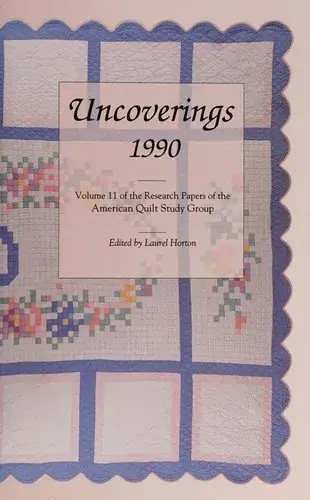
Blaire O. Gagnon will give a presentation on Egyptian Appliques at next week’s AQSG seminar in Dallas. Her paper is published in Uncoverings 2003, which will be available at the seminar. After the seminar, the volume is for sale at the AQSG office!
Merikay Waldvogel
Date: Sat, 4 Oct 2003 [date inferred — no Date: header in source] | From: Barb Garrett <bgarrett421@>
Good afternoon from chilly and rainy PA —
I was wandering around ebay and found this interesting listing of a children’s book with a quilt in it —
http://cgi.ebay.com/ws/eBayISAPI.dll?ViewItem&item=2194988433&category=13960
The listing states — “NURSERY STORIES FOR LITTLE FOLKS”, published by Thomas Nelson & Sons, New York. I found the book interesting — unusual enough to share. Story and picture featuring a quilt are in the second picture down the page.
Barb in southeastern PA
Date: Sat, 4 Oct 2003 [date inferred — no Date: header in source] | From: “Ann-Louise Beaumont”
One of the papers that will be presented at the American Quilt Study Group in Dallas this month is on Egyptian Applique. I’m signed up for the round table discussion on them and am looking forward to this immensely. “Uncoverings” for 2003 should contain the paper that is being presented. At the moment I don’t recall who is giving the paper. As I mentioned in Christine’s post quite a while ago, Marie Webster’s 1915 “Quilts. Their Story and How to Make Them” refers to them with some great pictures. Personally, I’m curious about the distinctive pieced border in many of them. Best Wishes, Ann-Louise Beaumont in Greeley, CO
Date: Sat, 4 Oct 2003 [date inferred — no Date: header in source] | From: Dana Balsamo <danabalsamo@>
Hi Barb, I know men quilt and quilted back then, too…but it is interesting that the story of a man and the quilt he made is in a children’s book. As acceptable as it was, wouldn’t it have been considered “woman’s work”? Would young boys and men be encouraged to quilt? Thank you for sharing that. Hugs, Dana
Date: Sun, 5 Oct 2003 [date inferred — source gave only “Sun, 5” with no month/year — unambiguous within this page’s date range] | From: Marthapatches36@
My mother used two quilted wool batts for at least thirty years that I remember. They were encased in a cheesecloth like fabric and quilted about every four inches. They were then covered with patchwork much like a duvet cover. She could then take the covers off to wash an d air the batting out. Once my brother was returning from summer church camp by ferry across Puget Sound . He had used the comforter as a sleeping bag, had it rolled up and tied. He put it on the railing and leaned on it, unfortunately he dropped it overboard int to the salty Puget Sound. Someone fished it out the ladies at a local church around Bremerton WA washed and dried it. When it was returned to us it was no worse for the wear. I must mention most of us don’t swim in PugetSound because it so cold year around. Since it was cold no felting occourred. After we suffered a house fire in 1965 Mom sent both comforters to us to use. She sent several old family quilts. My kids loved them literally to death. We used them until the 10 kids grew up so the ey were at least 45 years old or older because I don’t know when she made them before I could remember them in the early forties. Jan I would recommend the wool batt. I bought one several years ago it was sold like other batts specially for quilts. Quilted like butter. Martha
Date: Sun, 5 Oct | From: QuilterB@
Well, feast or famine! I don’t write for months and then I have yet another opportunity to see some neat quilts. This weekend a local antique co-op sponsored a show and sale of some quilts which included a “bed turning”. Much to my surprise, there was a wonderful collection of about 30 quilts from one family spanning 130 years of quilting (great grandma, grandma and mom). They were all extremely well made and some were for sale as well. There was extensive documentation on the family and the current daughter who was selling some of the quilts was there to answer questions. Needless to say, I came home with four and got a hug from the daughter. Many were 30’s quilts, some of which were obviously kit quilts. I bought one of these but searching through my books couldn’t find an example of it. Our local appraiser suggested I write Xenia which I will do as I know she is an expert on these!
I got the opportunity to help the owner with the “care and feeding” of the ones she was keeping (museum quality I think) and recommending that at some time she think about donating them to RMSC as they are all so Rochester centered but had a story with them (her mother was born in the Okla territory but came back to Rochester). We are also considering asking her if we could display them at our club quilt show next fall that we do at the museum (we always have museum goodies to show as well including last time several examples of quilted petticoats).
It was a great way to spend the day and such a surprise. You just never know when the next discovery will be made.
Beth Brandkamp
Date: Sun, 5 Oct [date inferred — no Date: header in source] | From: “Cinda Cawley” <lrcawleydmv.com>
First a brief geography lesson. Dorchester is Maryland’s largest county in area and the smallest in population. This is primarily because most of the huge area is marsh; dry land is as scarce as people. The Chesapeake Bay is on the west; the Choptank River on the north and the county is a spiderweb of streams, rivers and swamps. You can’t get anywhere directly if you venture off route 50, the highway which takes people from D.C. and Baltimore to Ocean City. There are parts of the county where it’s a forty mile round trip to buy a gallon of milk. This isolation has definitely affected quiltmaking in the county which was the most exciting thing about the quilt exhibit sponsored over the weekend by the public library.
The centerpiece was a c. 1840 album quilt made by Mary Dove Travers who probably designed the very large, rather primitive motifs herself (8″ wide leaves, pineapples on crossed branches). The quilt has 25-16″ blocks and is finished with a double scallop applique border. They had her 1790 sampler, 1820 quilt frame and 1830 sewing table on display as well. The family still owns four other quilts she made. Wonderful as that was I was more interested in the many quilts made in the mid-twentieth century which seemed out of sync with the times in which they were made: a church fundraiser, 1953 constructed as a strippy with a painting on silk of the church as a central medallion; an album made in 1970 for a bride with appliqued and embroidered scenes and symbols of her life; a Delectable Mountains, c. 1900 made (in Ely Walker fabrics) for Leander Talmadge Morris whose name is embroidered across the center of the quilt; two quilts from Elliott’s Island (one of the forty-mile milk runs) circa 1950, a Maple Leaf and Cake Basket.
I was astounded to see a beautifully constructed Carpenters Wheel dated 1960 with elegant quilting, made in typical 50s fabric (the setting fabric is a blue check with covered wagons!). The quilt was made in Crapo, MD–yes, that is a real place. John says it would be worth living there just for the postmark. One lady I talked to had brought in a Seven Sisters made in 1934 for her mother who was a minister by the ladies who attended a revival she preached. The same woman also exhibited a splendid 1840 Mariners Compass (its Turkey red turned to Swiss cheese, but still beautiful) with a delicate swag border and glorious quilting. An Alphabet quilt from the 1940s is a triumph of folk art. The letters are quirky; proportions change to fit the space and when she finished the requisite 26, the maker spelled out her name Rida Philips, each letter in a separate block. The maker’s daughter who is in her eighties quilted it; she is working her way through piles of tops her mother pieced.
I have the feeling that the remoteness of the area kept quilters doing things that the outside world had long ago left behind. I think it’s in “Pioneer Quiltmaker” that Carolyn O’Bagy Davis makes that point about Dorinda Moody Slade who lived in the remotest corner of Utah. Or was that some other book entirely.
Cinda on the Eastern Shore hoping to see some of you later this week in Dallas
Date: Sun, 5 Oct [date inferred — no Date: header in source] | From: Jennifer Hill <jennifer.hill@>
Help me here. I’m having lots of trouble visualizing how a cheesecloth layer can possibly prevent bearding of wool batts. Since cheesecloth is such an open weave compared to quilting cotton, I don’t see how it can provide any kind of barrier protection to loose fibres. However, I can see its utility if it is meant to enclose a batt so that an outer cover can be removed and replaced.
Several years ago I recall reading on some other quilting list about wool batts. I seem to recall a NZ quilter saying that the bearding was a temporary phenomenon that was self-curing after the quilt had been washed and used. Of course, gentle laundering is required (no severe temperature changes, no agitation) to avoid felting and distortion, but after some use, the bearded fibres break off, and the surface of the batt itself undergoes some micro-felting, which stabilizes it. It isn’t prone to the perpetual bearding associated with poly batts.
I understand wool batting is more common than cotton Down Under, so perhaps some Australian or New Zealand quilters can comment on its use and durability.
Jennifer Hill Calgary, AB
Date: Mon, 06 Oct 2003 | From: Palampore@
Finally the orange quilts, and teal quilts are on my site(www.textilepreservation.com). Pepper still needs to add text and we have about 5 more quilts to add, but I thought I would let you see some of them. I think that all but 1 are from NC. I am trying to get my life together so that I can head to Dallas on Thurs. Can’t wait to see many of you! I am also tidy-ing up my research on stain removers so that I will have copies available then. We had a big family wedding this weekend out of town so I am running with my tongue out… Lynn Lancaster Gorges Historic Textiles Studio New Bern, NC
Date: Mon, 06 Oct 2003 [date inferred — no Date: header in source] | From: “Sally Ward” <sallytatters@>
In one instance among the bed quilts > examined, a dyed batting was used in a light-colored quilt:Shelburne > Museum’s yellow wool quilt, which is probably British, has a yellow > batting.”
Judy, is there any possibility of a date, or a ‘thereabouts’ for this quilt?
Sally W
Date: Mon, 06 Oct 2003 [date inferred — no Date: header in source] | From: Kris Driessen
I received this E-mail from someone interested in starting a quilt study group in NC. If anyone is interested, or has information for her, please contact Sandy directly at s.bmason@
I am looking for information for quilting in the 18 Century and early
19th Century in North Carolina. I think we are going to start a group at the Latta Plantation and I am having trouble finding information that I need. I want to reproduce quilts of that era. I am not sure what he has in mind for this group, but I would imagine one of the things he wants is for us to dress in that period and show quilting and quilts. I have been searching on the net and can’t seem to come up with much. Would appreciate your help. Sandy s.bmason@
Date: Mon, 06 Oct 2003 [date inferred — no Date: header in source] | From: “Lynne Z. Bassett” <lzbassett@>
Dear Sally,
Since I’m the one who wrote the essay that Judy quoted from, I guess I should answer this question. The Shelburne Museum did not venture a guess as to a date in its cataloguing of this quilt. It is a typical British quilting design of a framed center medallion with geometric patterns–such a standard design used for so long that it’s hard to pin down with a date. My guess, judging from the fabrics used and from the design, is that it dates somewhere between 1780 and 1850.
Lynne
Date: Wed, 08 Oct 2003 [date inferred — source gave only “Wed, 08” with no month/year — unambiguous within this page’s date range] | From: nomad1@
G’Day Cinda, I am reeeeeeeeeeally hoping you will stay on for Houston???? If so I would dearly love to meet you at your convenience of course. Here’s hoping to meet. Smiles, Hiranya : >
Date: Wed, 08 Oct 2003 [date inferred — no Date: header in source] | From: “Sheryl Till”
I’m a lurker here…mostly interested in vintage feedsacks and quilts made from them. My group The Quilting Post will be meeting at noon on Saturday in Houston and would love for any of you to join us. We plan to be in the dining hall and will have something on our table so people can spot us.
Sheryl sctill@
Join me at Quilter’s Romp in the Ozarks, March 2004 http://www.thequiltingpost.com/Romp.htm http://www.laquiltworks.com >
Basically I am going to Quilt Fest at Houston- ( > yes! Little jig here, little jig there! ) and I would dearly love to > meet as many QHL’ers in the flesh. I have not heard from Jane aka > Baglady for yonks and would love to meet you, as well as all the other > faaab folk.
Date: Wed, 08 Oct 2003 [date inferred — no Date: header in source] | From: Beth Donaldson
Dear Nancy,
You couldn’t pick a worst time to make a visit to us. We are under construction in our storage facility so we can’t bring any quilts out. All our cabinets are draped in heavy black plastic and as I write two guys are tearing out my window and air conditioner!! But when it’s done it will be much better and our quilts will have all the latest climate control. Currently there is only one quilt on exhibit, the Martha Marian Lovina Hoskins Churn Dash signature quilt. You can also view this quilt on-line; http://www.museum.@/glqc/collections_sample_6654.1.html
The Great Lakes Quilt Center is part of the Michigan State University Museum and we only have quilt exhibits every other year. (You just missed our last exhibit, “Quilts Old and New: Reproductions from the Great Lakes Quilt Center” came down September 21.) We would love to have quilts out all the time, but must share our gallery space with the other 1,500,000 objects in our collections! All the rest of the (over 500) quilts are in storage. There are two other ways you can access our collections, both are by appointment only. First you can schedule a behind the scenes tour. The tours are only available when an exhibit is not scheduled. New tours will not be scheduled until February, 2004 due to construction needed for upgrading our heating and cooling systems. See http://www.museum.@/glqc/collections_behindscenes.html for more information on this program.
You may also access the collections for research by submitting your request to: Archivist Michigan Traditional Arts Program Research Collections 302 A Central Services, Red Cedar Lane East Lansing, MI 48824
To see which quilt exhibits are travelling and where, go to this site: http://museum.@/museum/tes/index.html
For more information on our programs visit our home page at http://www.museum.@/glqc/index.html
For directions, hours and parking go to: http://museum.@/generalinfo/HLPA/index.html
As for your request about antiquing, I would recommend Allen, Michigan. It is almost straight south of Marshall, about 30 miles at the Junction of 12 and 49. Along the strip of U.S.12 (the old Detroit to Chicago road before interstates) are many antique malls and shops. You should also see some beautiful fall color.
Thank you for your interest.
Beth Donaldson Quilt Collections Assistant Great Lakes Quilt Center at the Michigan State University Museum 201 Central Services East Lansing, Michigan 48824-1045 quilt line: 517-432-3800 quiltsmuseum.@ http://museum.@/glqc/index.html
Kris has been kind enough to post Karen Portwood’s photos on the Quilt Study Group website for the most recent meeting of the Midwest Fabric Dating Group on Signature Quilts. Here is the web address to view the photos and commentary: http://www.quilthistory.com/study/midwest.htm
Many of the quilts are also featured in Xenia Cord’s article in the most recent issue of AQSG’s Blanket Statements. Enjoy!
Amy Korn
Date: Thu, 9 Oct 2003 08:28:46 +0100 | From: “Sally Ward” <sallytatters@>
Can anyone tell me where to find an illustration of that famous ‘coffin quilt’ with the churchyard, the picket fence, and the coffins waiting round the edge for family members to move inside. I think it may be a Kentucky item? I’ve seen pictures of it many times, but now I want to show it to someone I just can’t find which book or magazine its in.
Sally W
Date: Thu, 9 Oct 2003 07:32:34 -0400 | From: “Joe MacDonald” <jmacdon6maine.@>
There is a book by Linda Otto Lipsett called Elizabeth Roseberry Mitchell’s Graveyard Quilt. http://home.@/~halsteadpub/elizab.html I did a quick search on google, but seem to be unable to find anything more than a thumbnail of the book’s cover which only has a partial picture of the quilt. I did find a news article about a fair where a woman named Barbara Burton displayed her reproduction of the quilt: http://www.oakridger.com/stories/072701/com_072707.html http://www.oakridger.com/images/072701/fairquilt.jpg She states that it is not an exact replica but it certainly looks like the original. I highly recommend the book if you are interested in the quilt’s story. It is fascinating. Monica in Maine
Date: Thu, 9 Oct 2003 [date inferred — source gave only “Thu, 9” with no month/year — unambiguous within this page’s date range] | From: “Karan Flanscha” <SadieRosecfu.net>
Sally and others interested, Here is a post I sent to QHL a while back on the Coffin Quilt:
Subj: Re: QHL: Book Bargain (Cemetary Quilt) Date: 02/27/2000 2:56:05 PM Central Standard Time From: SadieRose@ To: QHL@
There is a well documented “Cemetary Quilt” (perhaps the children’s fiction book mentioned by Audrey was based on this). The quilt has appeared in several books: “Quilt Digest Press” book #5, pgs. 11-13, also in “Kentucky Quilts 1800-1900 The Kentucky Quilt Project” pg. 53. Linda Otto Lipsett later did extensive research on this quilt & its maker, which culminated in “Elizabeth Roseberry Mitchell’s Graveyard Quilt – An American Pioneer Saga” published in 1995. (ISBN # 0-9629399-2-7). Here is a quote from Linda’s book that explains the purpose of this quilt: “Those graves were so far away. Having to leave a child’s grave behind was a terrible thing. Elizabeth Roseberry Mitchell had suffered that, too, having to leave for Kentucky with little John Vannatta’s grave in Monroe County, Ohio. Her loss over her child’s death had been so great that she and the girls had begun making the quilt top. Their stitches had comforted them then, cutting and sewing together little pieces of “school cloaths,” appliqueing picket fences, embroidering flowers and the willow tree, cross-stitching their baby brother’s name for remembrance. Still, they had comforted themselves that Johnny was not dead, he was just “gone before.” And text from below photos of Elizabeth’s quilt: “The quilt blocks are carefully arranged. On each symmetrical side of the quilt, there are eleven LeMoyne Star blocks with very light or bleached white backgrounds (possibly symbolic of Elizabeth’s eleven children). Many of the corner and triangular pieces in the other patchwork blocks appear to have been dipped in Elizabeth’s walnut dye pot in order to contrast with the lighter ones.”
Linda reveals that not only is there a quilt, but also an earlier quilt top, apparently a “practice piece that contained design flaws and did not include the entire family.” The top was probably begun in 1836, the year John Vannatta Mitchell died (at age 2 years, 8 mos.) – this date is cross-stitched on the top and the fabrics are from this period. Elizabeth’s son Mathias died at age nineteen in 1843. After the death of a second child/sibling, Elizabeth and her daughters began the “Graveyard Quilt” which contains fabrics found in the first top, as well as prints from the 1840’s. There are photos of both the practice top and the quilt on pages 114-115.
Elizabeth’s quilt created a fabric record and memorial of her family, which has survived longer than even their gravestones! She also took comfort in being able to bring them all together, although in actuality, the family members were buried hundreds of miles apart. If you are interested in reading more about Elizabeth Roseberry Mitchell, her life & her quilt… Linda’s book is excellent!! I purchased my copy at the MAQS bookstore in Paducah, KY…another source might be Quilting Books Unlimited. I would highly recommend any of Linda Otto Lipsett’s books….”Pieced From Ellen’s Quilt” is another haunting favorite of mine. Karan from sunny Iowa
Date: Thu, 9 Oct 2003 [date inferred — no Date: header in source] | From: “Sally Ward” <sallytatters@>
I love this list! Not only do I find out which book to look in for the picture but I get all this wonderful information from Karan. Thanks so much
Sally W
Date: Thu, 9 Oct 2003 | From: Marthapatches36@
In the book about the quilt ‘Elizabeth Roseberry Mitchell’s Graveyard Quilt” author Linda Otto Lipsett, published in 1995 by Halstead & Meadows Publishing, Dayton Ohio. ISBN 0-9629399-2-7. The book is entirely about this quilt “made in 1858, on a farm in Lewis County”. I have an autographed copy of this book in my library. Sorry I do not have a scanner so I send you the picture. Maybe you can find a copy of the book with this info. Martha in PugetSound enjoying the rain {has been drought conditions for months}.