Grandmother Clark’s 1931 Quilt Booklet
A Time Machine on Paper
I found a small quilting booklet dated 1931 called Grandmother Clark’s Oldfashioned Quilt Designs, Book No. 21. It is only 16 pages, but it is the kind of little paper treasure that can send me down a research rabbit hole.
It was easy to find out that the booklet was published by W.L.M. Clark, Inc. of St. Louis, Missouri, a company that sold needlework booklets, quilt patterns, templates, and pre-cut fabric pieces during the early 20th century. Antique Pattern Library describes the four related Grandmother Clark quilt booklets (Books #19 – #23) as stapled booklets with traditional patchwork patterns and pattern pieces shown at what appear to be full size. The one I found fits right into that world. It was meant to help a homemaker make something useful and pretty without buying a modern quilt pattern as we know it today.
Grandmother Clark’s Patchwork Quilt Designs. Book No. 20. ©1931.
Grandmother Clark’s Oldfashioned Quilt Designs. Book No. 21. ©1931.
Grandmother Clark’s Quilting Designs. Book No. 22. ©1932.
Grandmother Clark’s Authentic Early American Patchwork Quilts. Book No. 23. ©1932.
Grandmother Clark’s Patchwork Quilts. Book No. 19. ©1932.
Who Was Grandmother Clark?
Grandmother Clark was probably not a real grandmother. She was a trade name like Grandma Dexter or Betty Crocker, a friendly marketing character used by W.L.M. Clark, Inc. Companies in the 1920s and 1930s understood the power of a trustworthy name. “Grandmother” sounded thrifty, wise, old-fashioned, and safe. During the Depression years, that mattered.
A grandmotherly voice could sell quilt booklets, fabric scraps, stamped embroidery kits, and household needlework supplies without sounding too fancy or too expensive. Barbara Brackman notes that the W.L.M. Clark Company used the Grandmother Clark name to sell boxes of cotton factory cutaways, stamped needlework kits, templates, and quilting and patchwork pattern booklets.
Who was the author? It’s believed that most of the patterns were written by Winnifred (Worth) Clark. She was the lead designer for W.L.M Clark so she would have been in charge of the actual needlework designs and technical layoutss.
A Booklet from the Depression Era
The 1930s were a fascinating time for American quilting. Money was tight, but that did not mean quilts were dull. Many Depression-era quilts were cheerful, colorful, and full of movement. Quilters used scraps, feed sacks, leftovers, and carefully purchased bits of fabric. At the same time, companies sold affordable pattern booklets and pre-cut fabric pieces to make the process easier. W.L.M Clark put out over 30 needlework booklets under the name Grandmother Clark (later just Grandmother’s from 1938 – 1950) covering such topics as crochet, tatting, and rugmaking.
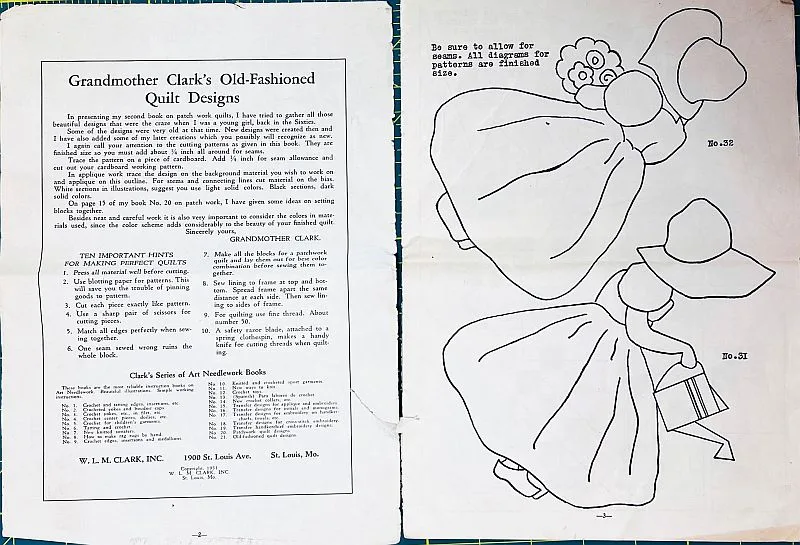
This little booklet offered traditional blocks with diagrams and templates, but it also sold the idea that anyone could make a good quilt with a little guidance. The copy I found includes blocks, cutting diagrams, and notes that tell quilters to add seam allowance. That is a very important detail. Modern quilt patterns usually include the 1/4″ seam allowance in the cutting directions. Older templates often did not. If you traced the shape exactly and forgot to add the seam allowance, your block would come up short.
What’s Inside Booklet # 21?
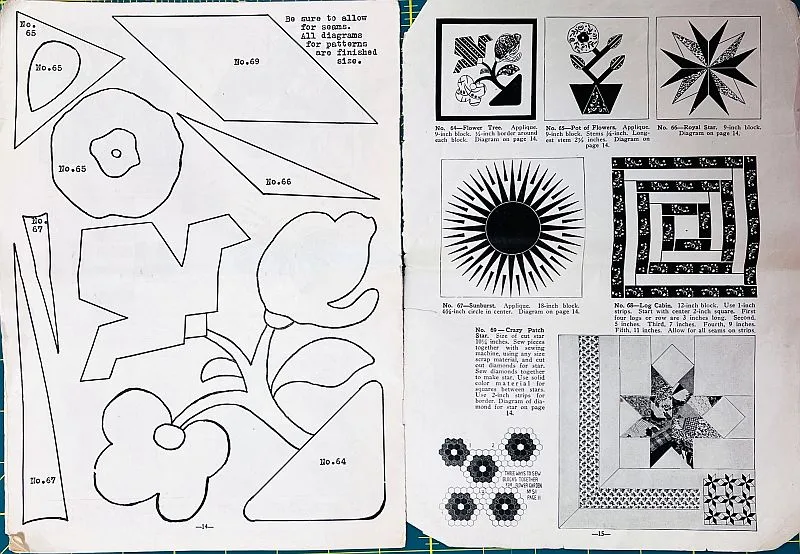
The booklet includes a wide range of traditional patchwork and applique designs. Some are still familiar today. Others have names that feel very much of their time. What I love about these pages is how much information is packed into it. There are tiny block drawings, numbered templates, and a reminder to allow for seams. It is not fancy, but it is efficient.
The blocks listed in this booklet include: Sun Bonnet Babies, Irish Chain Applique, Swastika, Jewel, Strawberry Basket, Pineapple, Rare Old Tulip, Pinwheel, Zigzag, Arbor Window, Egyptian Butterfly, Crazy Patch, Poinsettia, Chinese Puzzle, Pilot Wheel, Criss-Cross, Watermill, Star Flower, Cart Wheel, Flower Garden, Window Squares, Star of the East, Broken Squares, Star and Planets, Block Puzzle, Diamonds, Plain Butterfly, Pussy in the Corner, Aunt Mary’s Squares, Fancy Butterfly, Flower Tree, Pot of Flowers, Royal Star, Sunburst, Log Cabin, and Crazy Patch Star.
Let’s talk about some of those blocks
Book No. 21 is not just a quilt booklet. It is also a snapshot of how quilting was marketed during the Depression. The blocks themselves lean heavily on tradition: Log Cabin, Irish Chain Applique, Pineapple, Star of the East, Crazy Patch, Pinwheel, Sunburst, and flower designs such as Poinsettia, Rare Old Tulip, Flower Garden, Flower Tree, and Pot of Flowers. These names promised continuity. They suggested that the patterns came from the past, even when they were being sold through a very modern mail-order and commercial system.
That combination was powerful. A woman could buy a booklet from a company, possibly use pre-cut patches or factory scraps, and still feel connected to the quilts of mothers and grandmothers. It was nostalgia with a price tag, but a small one.
Blocks Reflecting the Time Period
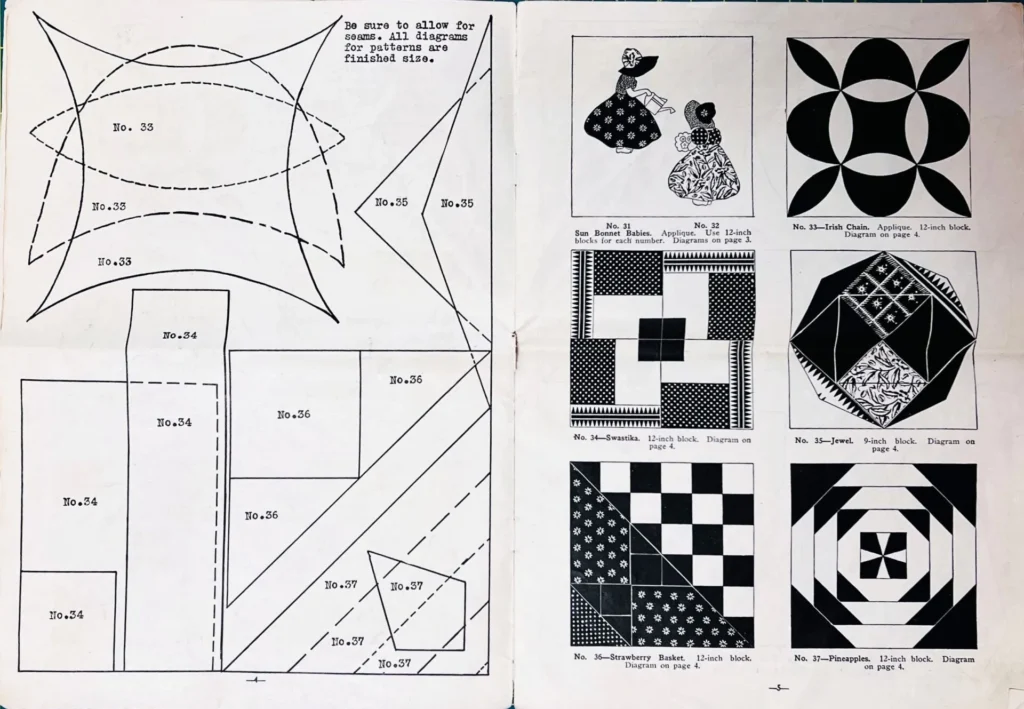
The Swastika
TIn 1931, this was still a traditional, highly positive Native American and global symbol for good luck, long life, and prosperity. It was a incredibly common quilt motif. However, as the Nazi party rose to power in Europe during the 1930s, American quilters completely abandoned this pattern. By WWII, many women went so far as to burn, destroy, or cut up old family quilts that contained this block.
The Egyptian Butterfly
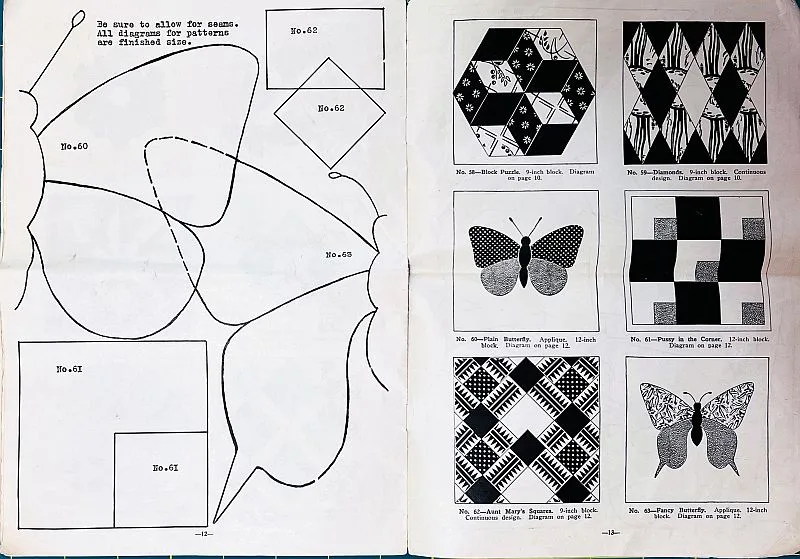
In 1922, King Tutankhamun’s tomb was discovered, sparking a decade-long global obsession with Egyptian revival design (“Egyptomania”). Fabric companies and pattern designers scrambled to label anything with angular lines or insect motifs as “Egyptian.” Grandmother Clark capitalized on this trend by offering three distinct variations including the Plain Butterfly and the Fancy Butterfly.
Crazy Patch varieties
Originally, Victorian “Crazy Quilts” were made of luxury silks and velvet with heavy embroidery. In the 1930s, Grandmother Clark stripped away the luxury and repurposed the technique for practical survival. These blocks allowed women to sew completely random, irregular scraps of cheap cotton together so absolutely no fabric went to waste. We do that now, with the Stack ‘n Slash technique.
Log Cabin
A universal 19th-century favorite that remained a staple in the 1930s. It was beloved during the Depression because it could be made entirely from thin, narrow strips of leftover fabric. These might be cut offs from dress making, salesmens samples, or even used-up clothes. There were a number of variations of the Log Cabin design.
Pussy in the Corner
A classic, simple geometric block dating back to the early 1800s. It was highly popular for beginners and used small, square scraps. The name eventually became “Puss in the Corner.”
Names that Changed over Time
Another example of a name that changed is what W.L.M. Clark marketed as “Arbor Window”. We now call it the Chimney Sweep Block and it is used extensively for signature quilts. Giving traditional blocks romantic, nature-inspired names (like “Arbor Window”) was a deliberate marketing tactic to make the patterns feel fresh and exclusive to her brand.
Sun Bonnet Babies: Today, the quilting world almost exclusively refers to this iconic motif as Sunbonnet Sue. Originally created by illustrator Bertha Corbett in the early 1900s, the applique design became an absolute phenomenon in 1930s quilts, representing an idealized, innocent rural childhood.
Flower Garden: Today, this is universally known as the Grandmother’s Flower Garden. It is made of hand-pieced hexagons and is probably the single most recognizable quilt pattern of the 1930s.
Irish Chain Applique: Typically, an Irish Chain is a pieced geometric grid. Offering an appliqued version was a way to market a more sophisticated, artistic, and time-consuming project. Applique quilts were generally reserved for “best” beds rather than everyday utility use.
Botanical & Whimsical Motifs
Pineapple, Strawberry Basket, Pot of Flowers, Flower Tree, Rare Old Tulip, Poinsettia: Floral and fruit appliques exploded in the 1930s. This was largely due to the introduction of new, highly reliable “fast-color” chemical dyes (especially solids). For the first time, housewives could applique a bright red strawberry or a green leaf onto a white background and trust that the colors wouldn’t bleed and ruin the quilt when washed.
Optical Illusions & Geometry
Chinese Puzzle / Watermill / Pilot Wheel / Pinwheel / Cart Wheel: These geometric blocks all use contrasting triangles to create a sense of spinning motion across the bed. They look complex but are built on simple grids, allowing quilters to showcase their technical sewing skills using alternating light and dark fabrics.
Star of the East / Royal Star / Sunburst: These star patterns required precision cutting and perfect seam allowances. Because the points meet at a single center, they are notoriously difficult to piece without puckering. W.L.M. Clark heavily pushed these blocks because they were incredibly difficult to draft by hand—which drove women to purchase their pre-cut cardboard templates and pre-cut fabric packs to ensure the points matched perfectly.
Broken Squares / Window Squares / Criss-Cross / Zigzag / Diamonds / Block Puzzle / Aunt Mary’s Squares / Jewel / Star and Planets: These are all strict template-based geometric designs. They relied on high contrast (often pairing a loud 1930s calico print with a solid pastel or solid white) to create a striking mosaic effect.
A Little Book with a Long Memory
What makes this booklet special is not just its age. It is the way it sits at the meeting point of tradition and creativity. Today we might look at a 16-page booklet and think it is slight. But in 1931, it could have been a very useful tool. It gave quilters access to many designs in one place. It helped standardize block names and layouts. It made quiltmaking feel possible for someone who wanted to use scraps, but did not want to draft every pattern from scratch.
The designs were old-fashioned on purpose. The “Grandmother Clark” name was old-fashioned on purpose. At the same time, this was a commercial product from a company that understood its market. W.L.M. Clark, Inc. sold not only ideas, but also supplies. The booklet helped quilters imagine what they could make, and the company was ready to sell them the pieces to make it easier.
These booklets also helped spread quilt designs across the country. A quilter in Missouri and a quilter in New York could make the same Star of the East or Sun Bonnet Babies block from the same printed source. Patterns began to be printed in newspapers under the names Nancy Page or Laura Wheeler as part of the newspaper circulation wars of the depression. Before blogs, Pinterest, YouTube, and printable PDF quilt patterns, these small booklets were part of the network that carried quilt ideas from one sewing basket to another.
Some things change. Some things do not. We still save scraps “just in case,” still argue with templates, and still believe one more quilt book will not hurt.
Clearly, Grandmother Clark knew us all along.
Patchwork Designs Book #36
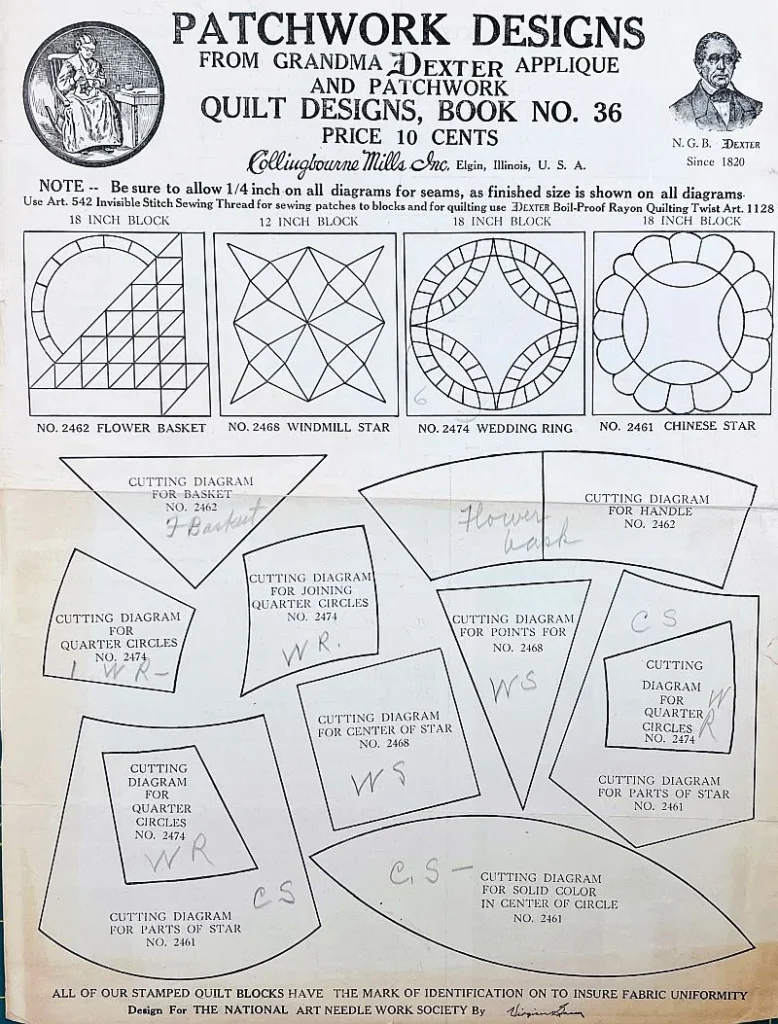
Judging from the other patterns, I am going to date this 1940.
