Telltale Textiles: A Nation in Outline Stitch
Every quilt carries clues about when it was made, if you know where to look. Telltale Textiles is an ongoing series digging into the fabrics, dyes, prints, and construction details that help pin down a quilt’s age. This entry: a set of fifty-state bird and flower blocks that turned out to be two different quilts wearing the same design, decades apart, and how a handful of birds gave the game away.
Two Sets of Blocks, One Estate Sale
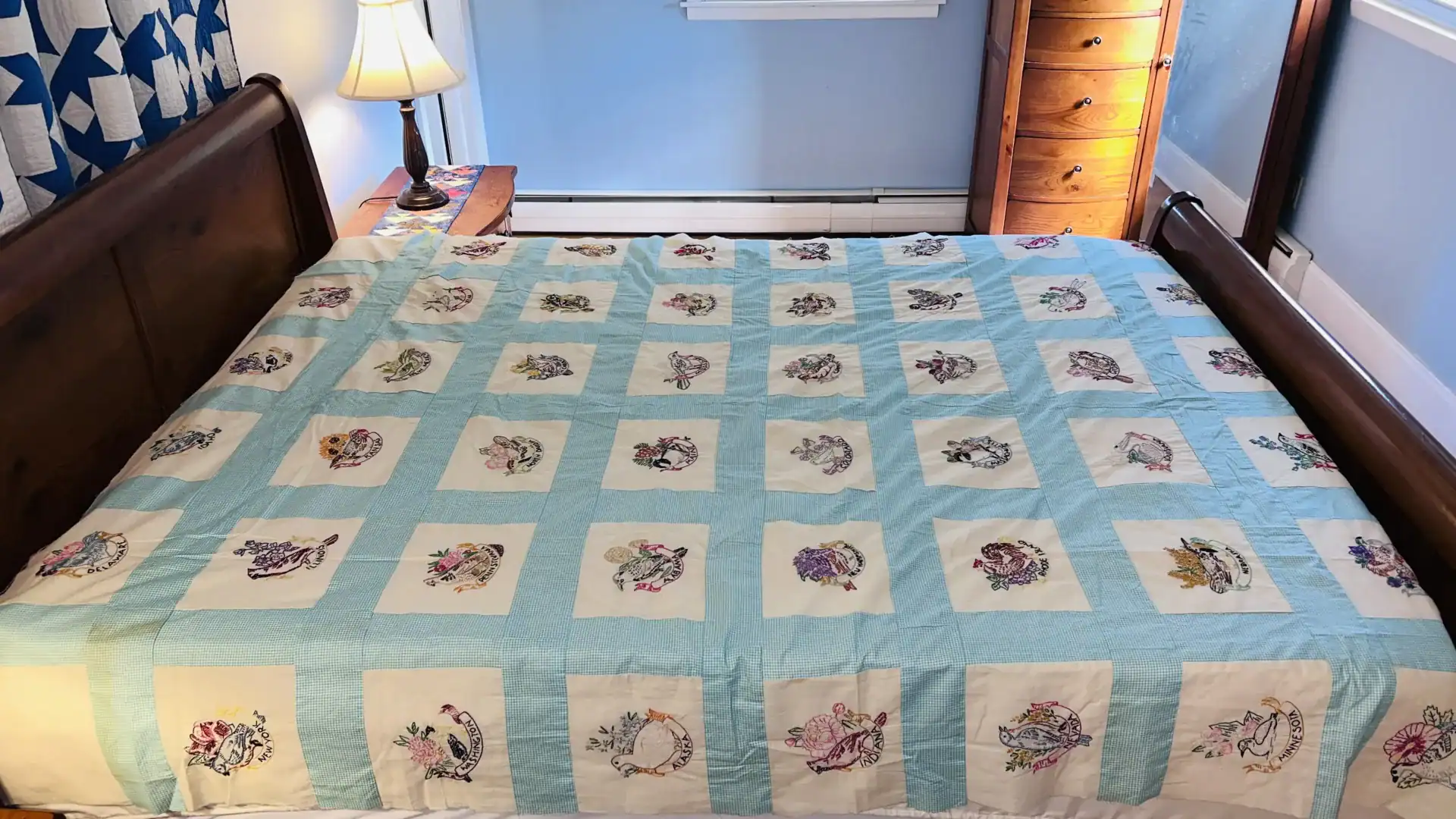
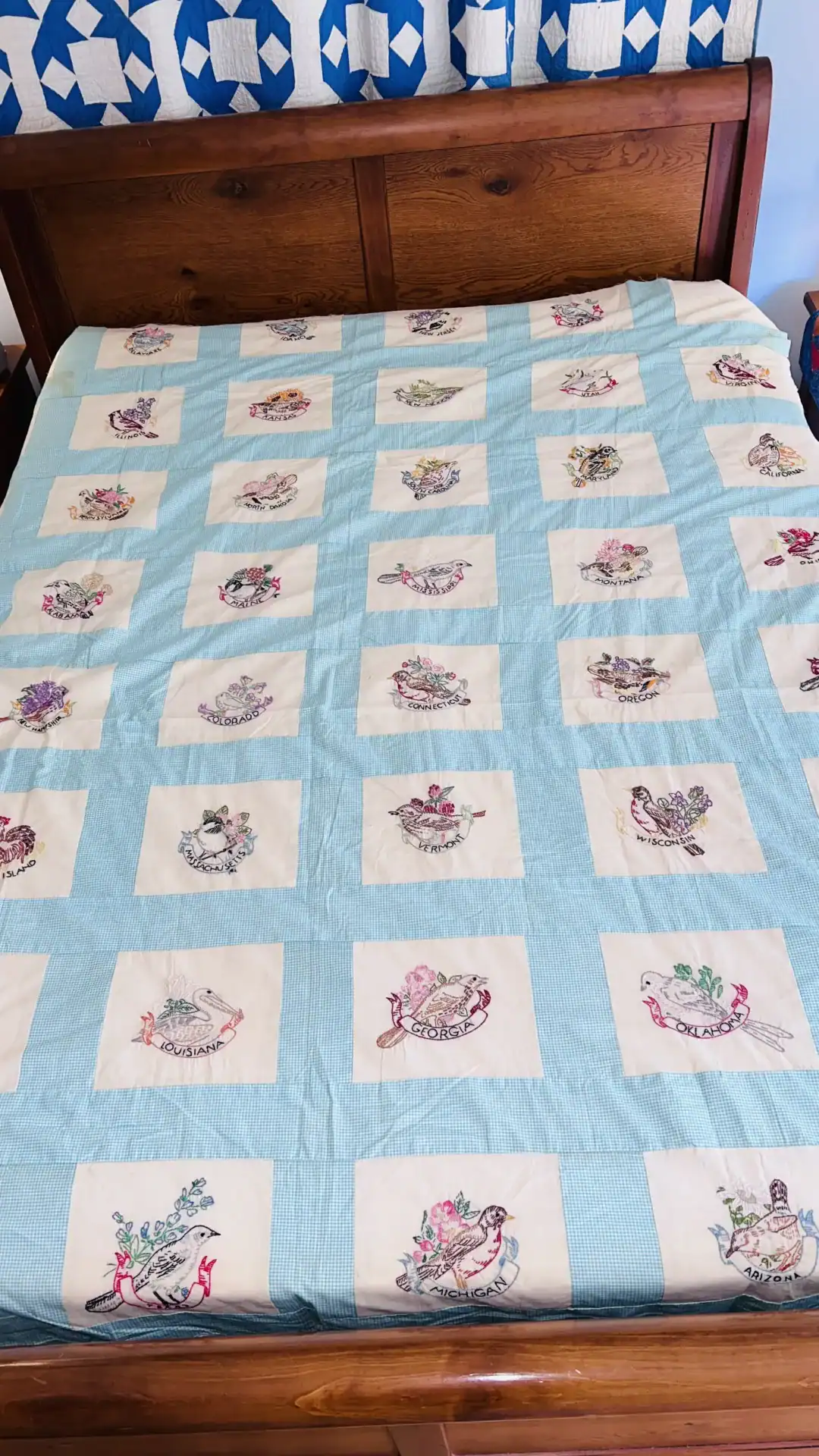
After attending the estate sale of Mrs. Emma Cole of Delanson, NY, I came home with a finished quilt top and a separate stack of loose blocks. The top is a large one, fifty-four blocks set in sashing, seven inches by eight inches each, with a blank block in every corner. The loose blocks are the same size and the same general design family: a state bird, a state flower, and the state’s name worked into a scrolling ribbon, all done in outline and stem stitch with bright cotton floss.
Same size, same idea, same hand at the needle, most likely. But a closer look at the blocks themselves tells a more interesting story. The loose blocks are older than the ones sewn into the top, and the birds prove it.
Why Everyone Was Stitching Outlines
The early 1930s through the 1940s were the golden age of the outline-stitch embroidered quilt, and it’s not hard to see why. The stitch itself is about as forgiving as embroidery gets: easy to learn, light on thread, portable enough to carry to the porch, and perfectly suited to a few minutes of work by lamplight after supper. It also looked good on the cheap unbleached cotton that was widely available during the Depression and war years, when a colorful, cheerful bed covering was worth a great deal and a trip to the fabric store was not always in the budget. In my case, both the blocks in the top and the loose blocks were worked on muslin.
State symbols turned out to be the perfect subject. Every state had spent the 1920s and 30s officially adopting a state bird and state flower, schools were teaching them, and patriotism was riding high. Put those two things together and you get a stitching craze that mapped the entire country, one embroidery hoop at a time.
Enter Aunt Martha
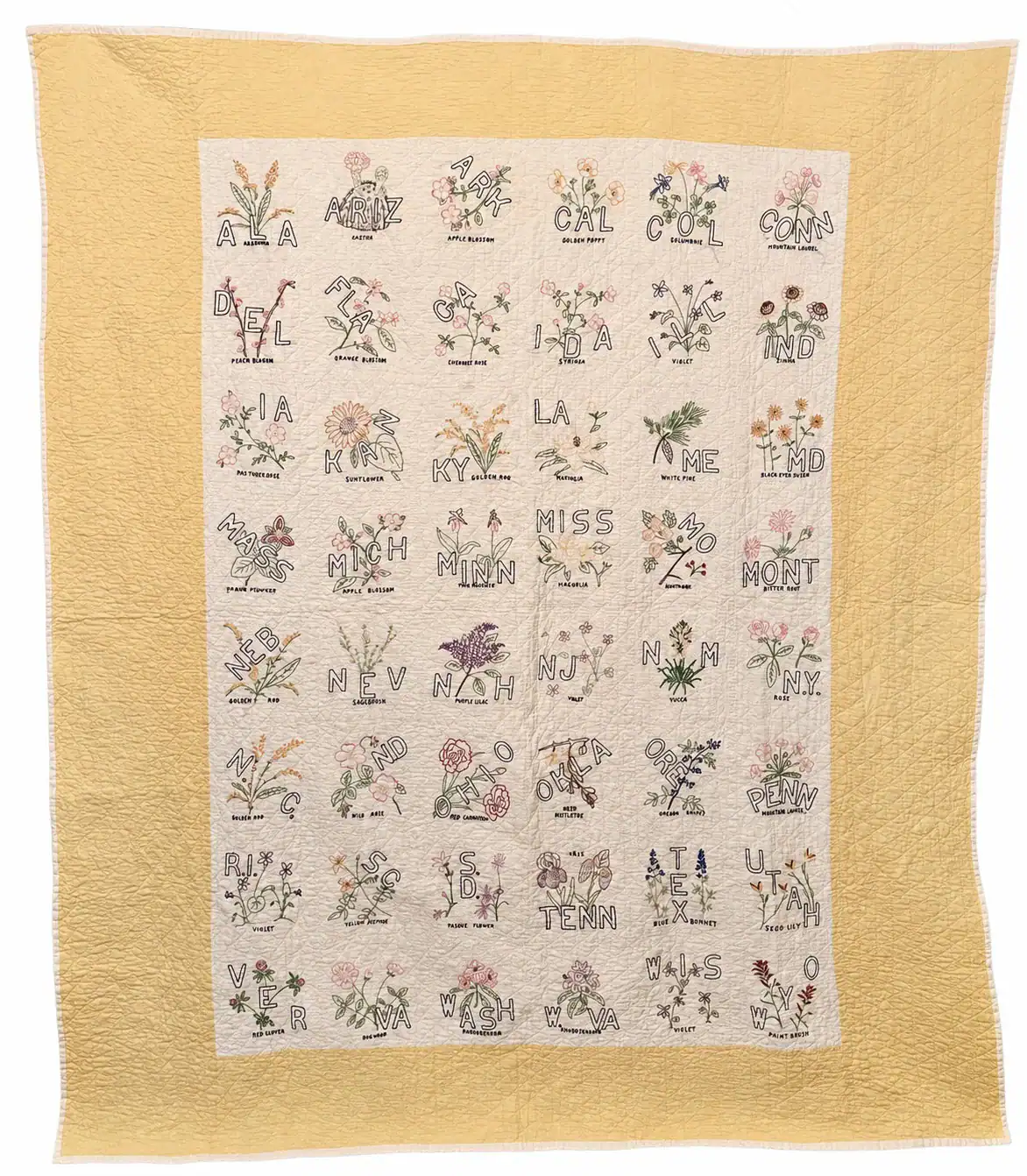
By the early 1930s, state-flower and state-bird quilt patterns were everywhere, sold by a whole shelf of companies with names like Ruby McKim, Vogart, Laura Wheeler, and Aunt Ellen and Aunt Martha. I believe the pattern for the quilt on the left below was put out by Rainbow Quilt Block Company of Cleveland, OH. (Click on the picture to see it up close.) Most patterns were distributed as hot-iron transfers, some were sold as fabric blocks pre-stamped with the design, and newspaper columns spread the patterns further still.
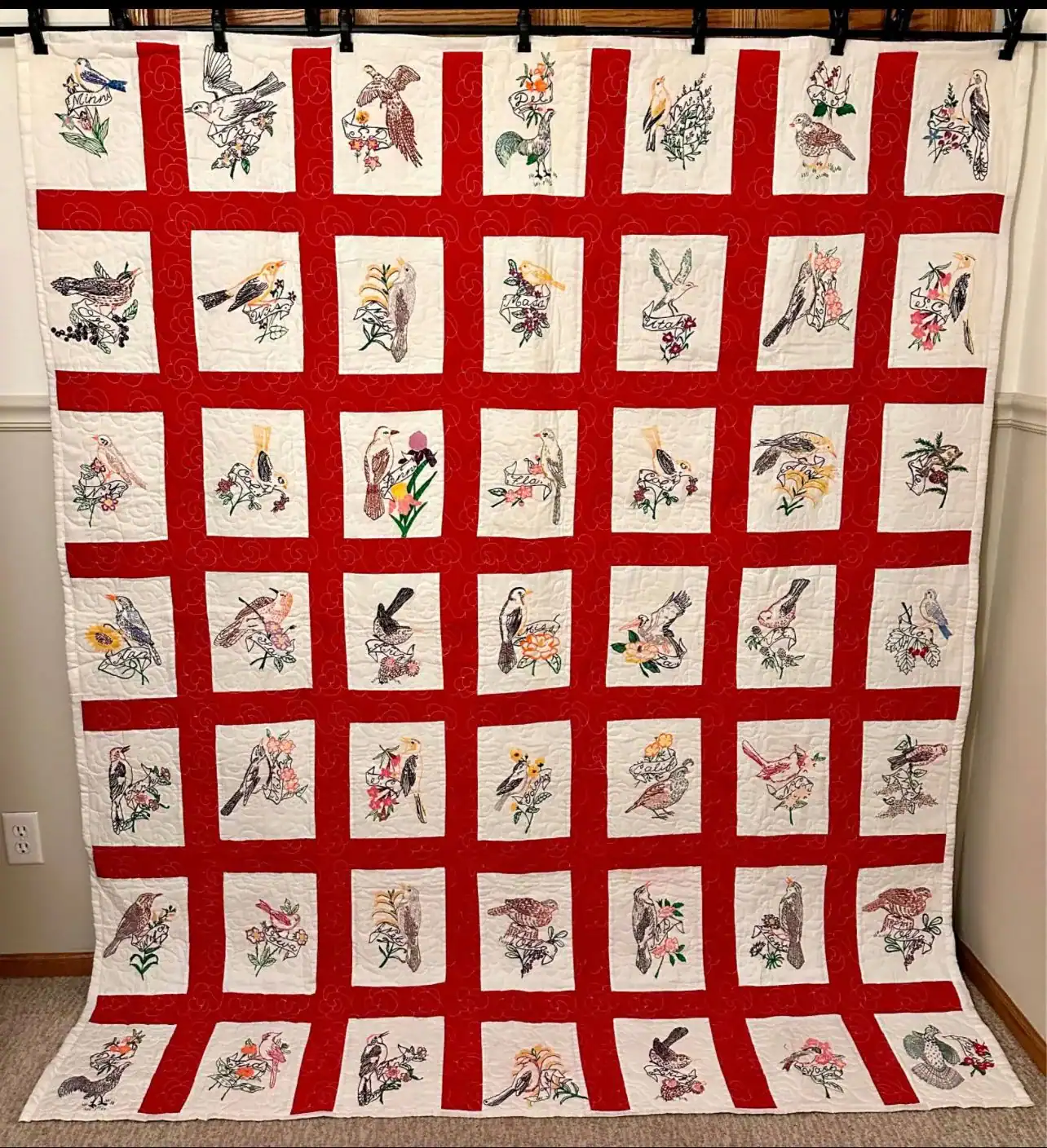
Both sets of Emma’s blocks trace back to Aunt Martha’s State Birds. Aunt Martha’s was practically a household name for hot-iron embroidery transfers, and the company had a long life: it started during the Depression as the Colonial Readicut Quilt Block Company in Kansas City, and later became Colonial Patterns, Inc, with its designs regularly showing up in Work Basket magazine.
The process was about as simple as embroidery transfers get. The paper pattern went ink-side down on the fabric, a hot iron transferred the lines, and the maker stitched over them. Some of Emma’s blocks still show faint blue transfer marks where the ink didn’t quite disappear under the thread, a nice little bonus clue that these really were made from a purchased transfer and not drawn freehand.
The Birds Provided the Clues
Here’s where it gets fun. Aunt Martha’s State Birds pattern wasn’t static. As states adopted new symbols, the company updated the design, and researcher Rose Marie Werner tracked those changes carefully in her 2009 American Quilt Study Group article comparing state bird and flower quilts. That research turns out to be exactly what’s needed to sort Emma’s two sets of blocks.
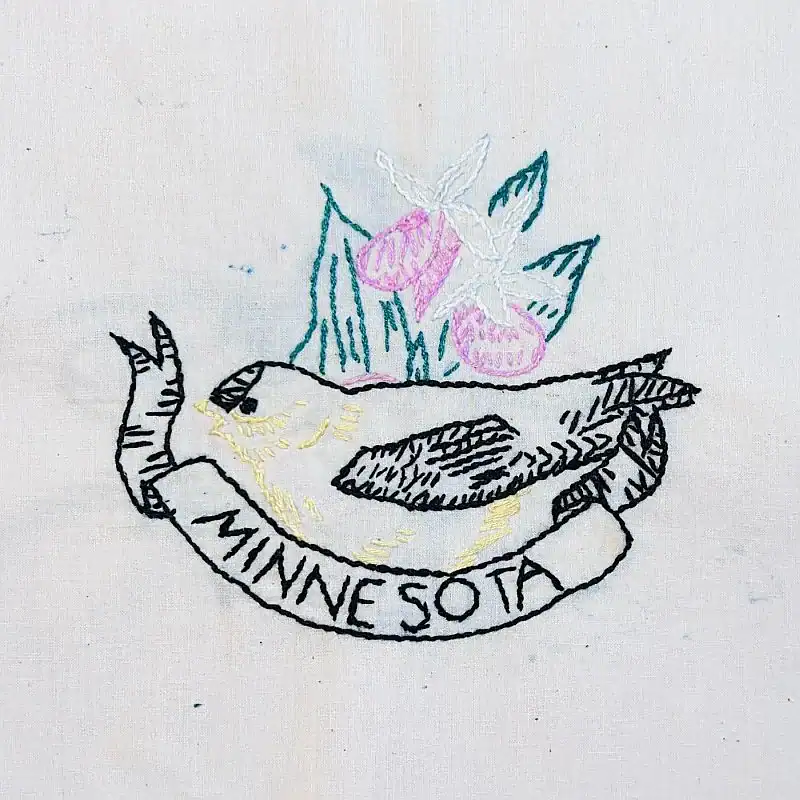
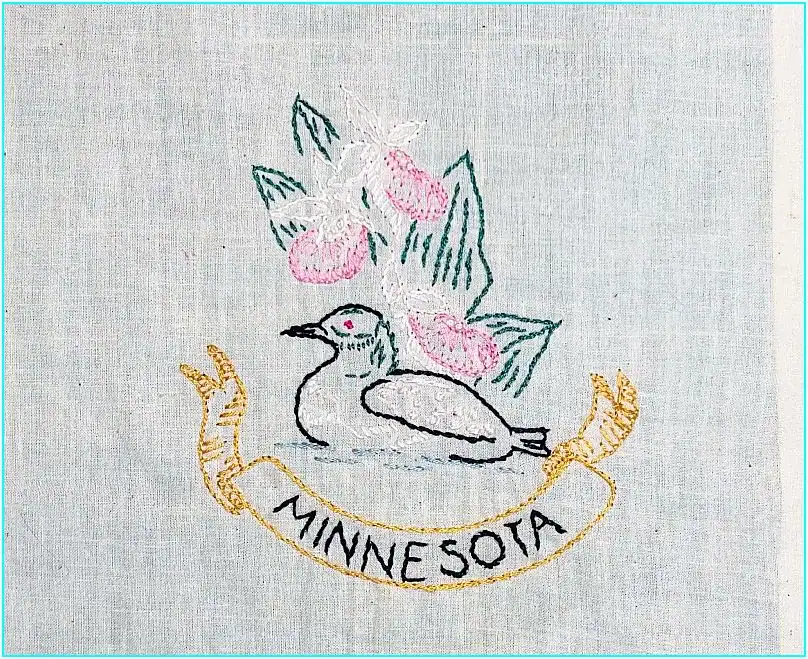
Take Minnesota. The loose block shows a goldfinch. The block in the finished top shows a loon. Minnesota didn’t adopt the common loon as its state bird until 1961, so a goldfinch block can only have come from before that date.
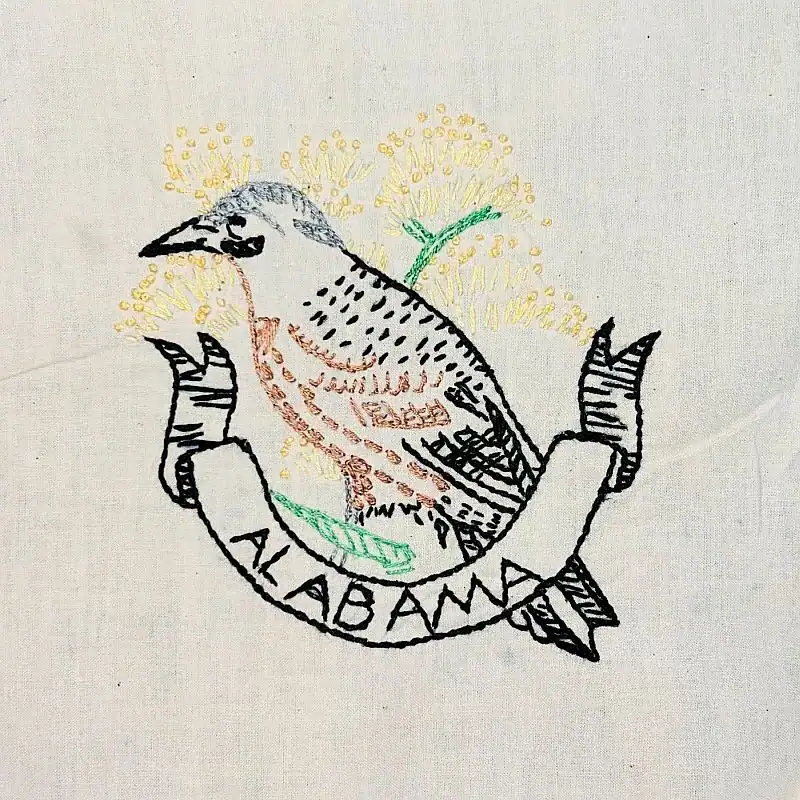
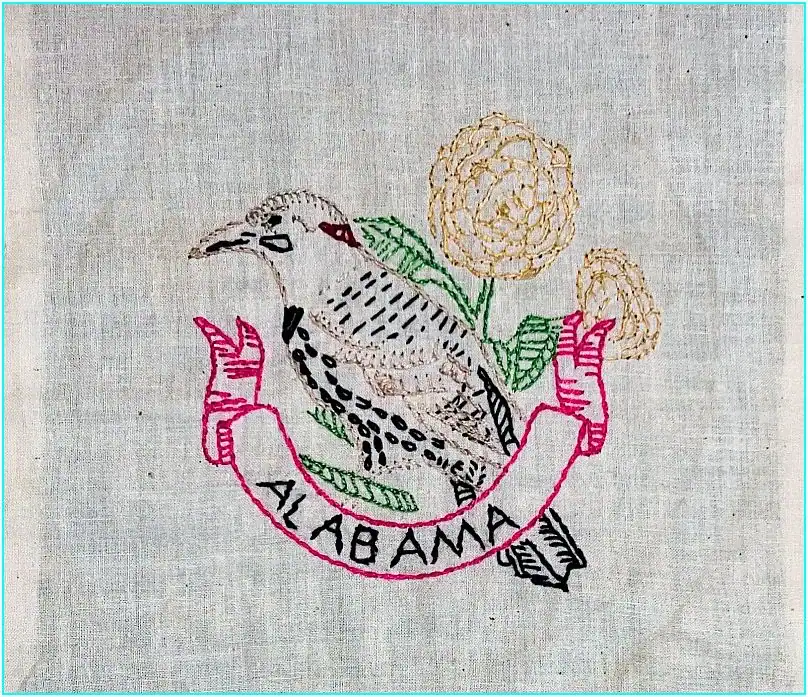
Alabama tells a similar story. The loose block pairs a flicker with sprays of goldenrod, which matches the earlier version of the pattern. The later edition swapped in a yellowhammer paired with camellias instead.
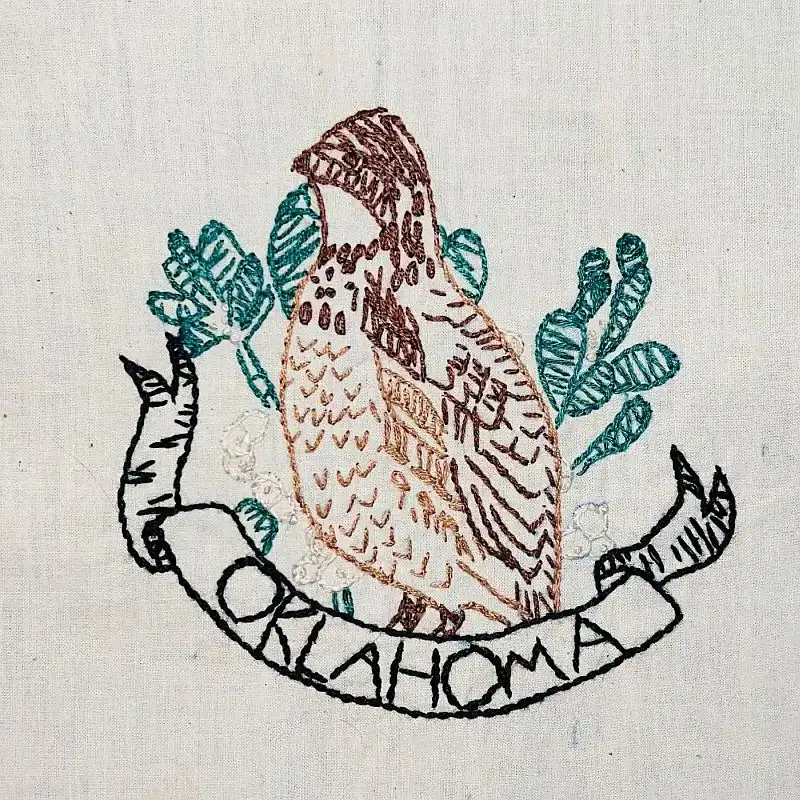
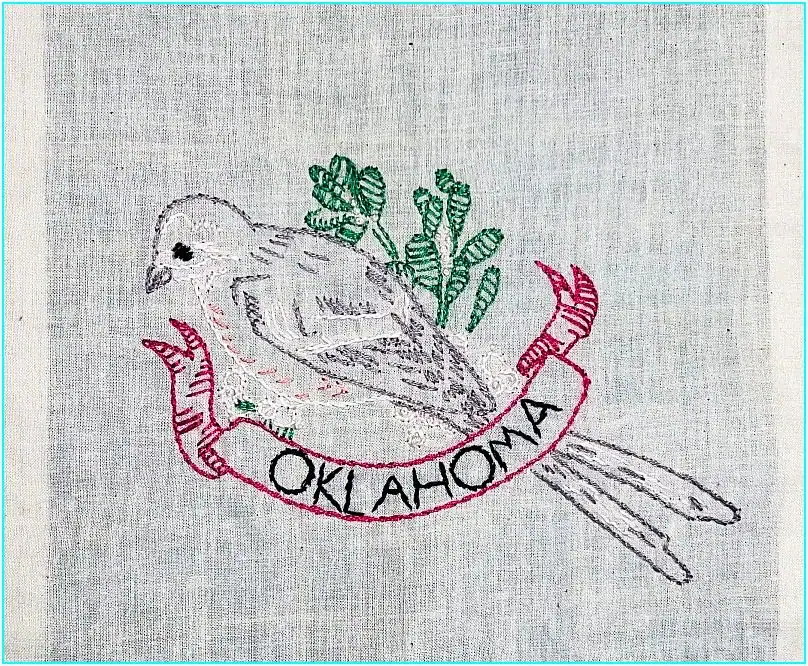
Oklahoma and South Carolina both confirm the pattern. The loose Oklahoma block shows the compact, short-tailed shape of a bobwhite, not the dramatically long, forked tail of the scissor-tailed flycatcher that replaced it later.
The loose South Carolina block has the slender body and long tail of a mockingbird, not the small, round Carolina wren that took over the design afterward.
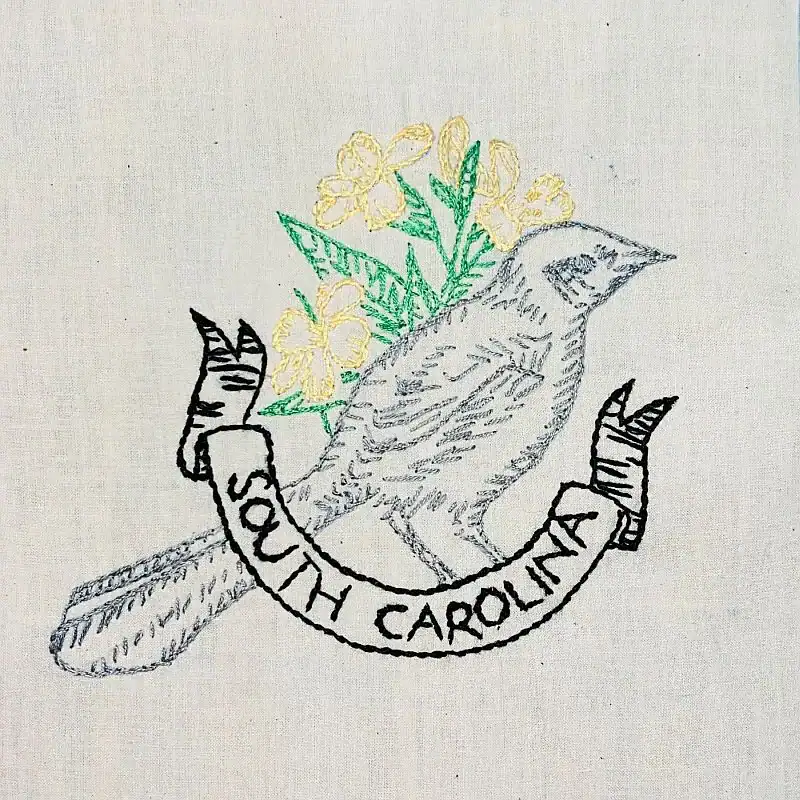
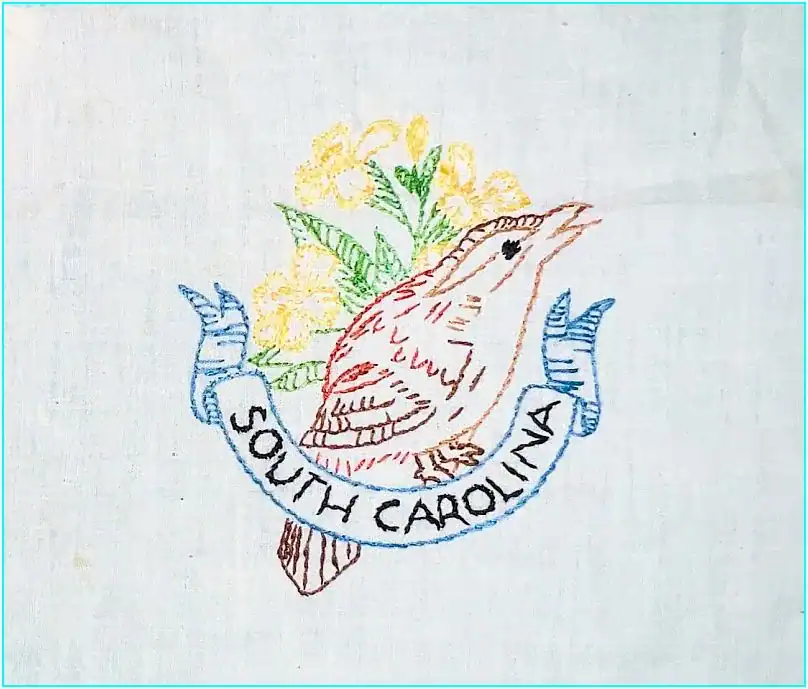
Four birds, four independent confirmations, all pointing the same direction: the loose blocks came from Aunt Martha’s earlier 48-state edition of pattern #626, the version documented in catalogs from the late 1940s and early 1950s.
So How Old Are They, Really?
Realistically, the bird styles date the pattern edition, not necessarily the moment the needle went through the fabric. Transfers could sit in sewing boxes for years before anyone used them, and popular patterns got reprinted, passed down, and traded among family members constantly. Emma would have been in her mid-thirties to early forties while this earlier edition was in circulation, which fits nicely, and the blocks came down through her daughter as part of Emma’s needlework. That’s a reasonable case for attributing them to her. It just isn’t proof, and without a label, a dated photograph, or a firmer family memory, it deserves to stay a belief rather than a fact.
The finished quilt top is on steadier ground. Emma’s daughter specifically remembers her mother working on it in the 1970s, and the top itself backs that up: it includes all fifty states, which means it has to date after Alaska and Hawaii joined the Union in 1959, and its birds and flowers match the later, revised edition of the pattern, likely #771. Whether Emma was working from a fresh purchase or rediscovering a pattern she already knew, the timing lines up with the approach of the Bicentennial, when quilts celebrating American history and regional identity were having a revival. State birds and flowers fit right in. They were colorful, educational, and patriotic, and they managed it without needing red, white, and blue to do all the heavy lifting.
One More Thing
The loose blocks never made it into a quilt, and there’s no way to know why. Maybe Emma meant to use them for a second project. Maybe they were practice pieces, or a set she set aside when the newer transfer edition caught her eye at the shop. Maybe they were a shared project with a friend. Whatever the reason, their unfinished state is exactly what makes them useful now. Sitting next to the completed top, three decades and one revised transfer apart, they turn a single family’s needlework into a small, surprisingly precise timeline of how one popular pattern changed along with the country it was stitched to celebrate.
Learn More
State Bird and State Flower Quilts: Identification Guide written by Rose Marie Werner
Library of Congress 1935 image
