February 25 – 29, 2004 (Part 1)
These restored messages come from the Quilt History List, an online forum where quilt historians, collectors, researchers, appraisers, and enthusiasts discussed antique quilts and related textiles. The archive dates from 1996 through approximately 2016 and is being restored gradually. Sign up in the form at the bottom of the page if you want to know when a new page is added. Original spelling, opinions, formatting, and inactive links may remain unchanged.
Primary topics of this QHL Digest:
- UGRR Coverage Continues — Reactions to a New Britain, CT library lecture on the Underground Railroad, plus a correction identifying the true author of the “Sue” newspaper article.
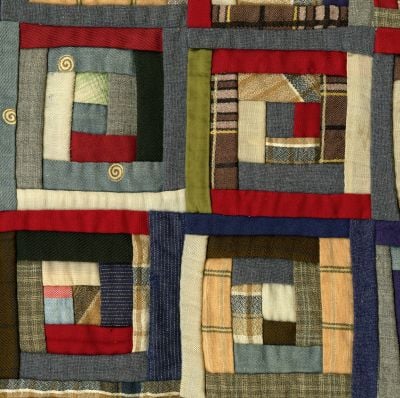
- Log Cabin Quilt Share — Donald Beld posts a small Log Cabin quilt made for a guild entry and invites feedback.
- “Talking Quilts” Exhibit at AFAM — Members share reviews and links for the Talking Quilts exhibit at the American Folk Art Museum.
- Squared Double Wedding Ring Variants — A member’s question about a “squared” Double Wedding Ring pattern draws detailed pattern-history answers.
From: Gail Ingram <gingram@>
Does anyone on this list know pattern source for quilt listed “Funky Forties Basket” in DSQSG meeting report?
Before my fall Outlook Express crash, a member had identified the source as a pattern that appeared in newspaper in 1940. Quilt was made in Briston, TN.
This quilt is around #30-35 in list of our photos from meeting.
Will appreciate any information.
From dark, gray, rainy North Louisiana, Gail
Date: Wed, 25 Feb 2004 13:14:40 -0500 | From: <mreich@>
Did anyone attend last night’s lecture at the New Britain Library on the UGRR? I am just curious about how it was received. Could you email me privately? Thanks, sue reich
From: Donald Beld <donbeld@>
Hi everyone, I am posting to the photo site (vintagepictures.eboard.com) a small, 22 x 22 inches, Log Cabin quilt I made for my entry into my guild’s (Citrus Belt Quilters, Redlands, California) annual small quilt challenge, which this year is entitled “Log Cabins Through the Ages”.
It is made entirely by hand–both pieced and quilted by me; using genuine 1860-1880’s fabrics. I thought you all might enjoy seeing what can be done today with period fabrics. (yes, the back has a label saying I made it this year.) Don Beld
From: <gingram@>
Suebaby,
I’m at school and haven’t time for a long disquisition, but I wanted to ask you, a nurse, this:
do you people SLEEP under a quilt of CONDOMS?
Would sleep seem to come easy with such covering, do you think?
I cant help it: there are idiots in every endeavor, and some of these “nontrad” things have left me howling.
Think I’ll asked my hormone-nuts jrs/sr iF they could sleep under such.
gi
From: <mreich@>
What! sue —–
From: “Cinda Cawley” <lrcawley@>
I spend a lot of time alone in my car and am addicted to recorded books. I just finished listening (it is such a different experience from reading, don’t you think?) to The Idea of Perfection by Kate Grenville. It’s described as “winner of the 2001 Orange Prize for fiction.” The central female character is a middle aged museum curator who is also a well known (the P.M owns one of her quilts) patchwork artist. There is much discussion of quiltmaking in a tiny town in New South Wales. I think it’s rare that a real novel (as opposed to those silly-IMHO- mysteries) discusses quilts/quilting seriously and at some length. I liked the book. The readers Australian accent was a bonus; I love the sound. Cinda on the Eastern Shore
From: “ChrisA” <chrisa@>
Leigh Fellner asked me to post this to QHL since the article she refers to was recently discussed on QHL.
“I asked Ms. Campbell if she’d mind if I passed this on to a QHL member for publication, and she said she’d appreciate it. So I’m shooting it off to you folks in the hope one of you’ll do just that.
On February 17 Jan Dreschler posted to the Quilt History List that… This [Emmittsburg Dispatch] is a small time paper, but here is one amusing article. The author indicates she has researched the claims made by those dismissing the blocks as the wrong era. She discovered the pre-cursor to Sunbonnet Sue. How could we have missed that? The part of the article Ms. Dreschler is referring to is this: Reference had been made to a “bonnet girl” quilt, but quilt historians say that “Sunbonnet Sue” did not exist until the ’20s. In my research I found that there were quilts of such a pattern in the early 1800s called “Sue Bonnet.” Instead of being a little girl like Sunbonnet Sue, the figure was what we now know as a colonial lady with a hoop skirt and bonnet.
I decided to drop a line to Mary Ellen Campbell, the author of the article, and ask her for the source for that info about “Sue”. She kindly phoned me this afternoon. What a genuinely nice woman!
It turns out that the article she submitted to the paper did indeed cite the source: an article by Serena Wilson (niece of Hidden in Plain View’s Ozella McDaniel) published in Traditional Quiltworks magazine in May 2002 – as far as I know, the first insertion of “Sue” into the “quilt code”. (My article disputing Ms. Wilson’s claims was published in the same magazine in March 2003; an expanded version appears on my site at www.hartcottagequilts.railroad.)
Unfortunately, in the editing process what originated as merely a quote of Ms. Wilson was transmogrified into Ms. Campbell’s own “research”. Ms. Campbell says this was not her intention at all, and in her words the whole thing turned into “a mess.” The newspaper’s collective ears have been burning ever since, and according to Ms. Campbell the editor has pretty much decided to delete that article from the paper’s archives.”
From: Kris Driessen
Boy, you never really know what’s going to come up at these quilt conferences, do you?
No pun intended, of course:-))
Kris, who is trying to figure out how you would get them all to stick together. Hot glue?
— gingram@ wrote: > Suebaby, > > I’m at school and haven’t time for a long disquisition, but I > wanted to ask you, a nurse, this: > > do you people SLEEP under a quilt of CONDOMS? > >
From: “Quiltstuff” <quiltstuffoptusnet.com.au>
I , too , am intrigued. Was it condoms.. or condom wrappers. If it was the former, I guess they would have to use all the different colours and textures to make it visibly pleasing. You could use a thread to stitch latex together…. after all it wouldn’t really matter if there was a hole in it… VBG
Suzy> > Kris, who is trying to figure out how you would get them all to stick > together. Hot glue? > >> > > > do you people SLEEP under a quilt of CONDOMS? > >
From: “J. G. Row” <JudyGrow@>
Cinda,
I read and enjoyed “The Idea of Perfection” also.. I found it on remainder tables and bought 4 to give to other members of our local Historic Preservation Committee. I liked the quilting stuff, but all the other things were so pertinent to our little community at the time. We’ve bought an old house and its 15 acres in Ringoes and are planning to turn it into a small park and local museum. I loved the descriptions of the local museum and the things that went into it; unimportant things in the flow of history, but so important to the daily lives of the local inhabitants.
We were/are also in continuing battle with the county highway department who want to turn all the one-lane 19th century stone-arch bridges and pony truss bridges over culverts and streams into standard flat, wide spans with no weight or speed limits. The “hero” of the book was a bridge engineer who also wanted to preserve the bridge he was sent to remove.
A few years ago my husband and I did a photographic inventory of all the historic bridges in our township. That meant sliding down embankments into icy water in early spring before any leaves came out. I’ve gotten to know the construction and the undersides of all our local bridges intimately. For some the interest from the County Historical Commission came too late, and they’d already been turned into concrete monstrosities over corrugated metal tubes. For others our interest may be just enough and just in time to save them.
Historic view-sheds are as important as historic buildings in defining a town, and all the old bridges are an important part of the view- sheds.
Judy “the Ringo Kid” in Ringoes, NJ judygrow@
From: Judy Schwender <sister3603@>
Someone recently asked about gold in cloth. I came across these web links, maybe they will be helpful. Judy Schwender
When Silk Was Gold: Central Asian and Chinese Textiles in The Cleveland and Metropolitan Museums of Art. The exhibition opened October 26, 1997: http://www.clemusart.com/exhibit/silk/index.html description of the accompanying catalog: http://www.clemusart.com/exhibit/silk/catalog.html
Date: Wed, 25 Feb 2004 | From: Joan Kiplinger <jkip@>
Leigh Fellner asked that I post this regarding the UGRR story ….She meant to say Mary Ellen CUMMINGS, not Campbell, who wrote the “Sue” article.
From: Patricia L Cummings
A big thank you to Leigh for forwarding that information. It is so easy to lose track of all of the details of this very involved discussion with all who have chirped in with various pieces of the puzzle.
In this political year, it is appropriate to share a short story with you that seems to loosely fit this situation. When I was growing up in a small town, my Dad was quite active in town affairs. On one occasion, he was to pick some document or other at the home of the matriarch of three men (who also held various offices in town). Upon arriving, he heard the woman calling “Man-Who”. She explained to Dad that that was the name given to her cat, named in another political year…”The Man-Who”…, named after having heard those words repeatedly as part of campaign strategies. This lovely lady always brought joy wherever she went because of her keen sense of humor and perceptive wisdom.
Well, we have a lot of “man-whos” and “woman-whos” in the field of art/quilt history, all with thoughts, reflections, and opinions of their own. Sometimes we “get it right” and sometimes not, a clear example of how history can begin to become distorted, even in our own time, and even with our concerted attempts to report events accurately and without creative embellishment.
So, it is with a cheerful spirit that I personally accept and value any corrections sent my way, whether it be to remind me that reindeer have hoof prints, not paw prints; or whether someone writes to me to tell me that the lady in my Victorian Trade Card article for Willimantic was holding old-fashioned ice skates, not ice-grappling hooks, as I had thought.
In any event, I try to be clear, concise, and correct in all of my writings, so I welcome any and all improvements and suggestions. It’s good to step back every now and then and just have a good belly laugh at one’s own expense. Life is too short not to include a measure of mirth and a dose of levity.
In this case, Leigh reminds me that Ozella’s niece, not she, was the first to mention the theory of “Sue Bonnet”, (which Leigh disputed). I’d love to see exact, documented published examples of this pattern. I’m familiar with 1930s Colonial Lady patterns such as the one we photographed in front of the Sheafe Warehouse at Prescott Park in Portsmouth, NH for my article about coverlets in The Quilter magazine.
At any rate, thanks, Leigh.
Pat Cummings www.quiltersmuse.com
From: “Jean Carlton” <jeancarlton@>
Interesting review of the Talking Quilts exhibit at the American Folk Art Museum (through Aug 1) ( forgive me if this has been posted already)
http://query.nytimes.com/gst/fullpage.html?res=9C04E3DB103AF930A25751C0A9629C8B63
Jean Carlton
Date: Thu, 26 Feb 2004 13:01:53 | From: <chrisa@>
http://www.historyofquilts.com/talking.html
This article is about the same exhibit and has pictures of two of the quilts. What a fabulous exhibit this appear to be. I’m hoping there will be a catalogue for sale.
Kim Wulfert www.antiquequiltdating.com/tours.html
Interesting review of the Talking Quilts exhibit at the American Folk Art Museum (through Aug 1) ( forgive me if this has been posted already)
http://query.nytimes.com/gst/fullpage.html?res=9C04E3DB103AF930A25751C0A9629 C8B63
Jean Carlton
From: “Charlotte Bull” <charloumo-net.com>
Please excuse this joint letter, but at this moment I am working on a imminent deadline! So, THANKS, many thanks, to the 5 different friends who have responded to me in regards to my question about forming a Quilt Study Group. I even met a lady on QHL who will be there too! Anyway, I have received much good info which has been very helpful. I shall be able to make better decisions and comments because I have your experience. By the way, the majority suggested KISS – Keep It Simple & Stressfree!
Now back to work! cb
From: Annette Gero
>Hi All,
>I was absolutely horrified by this article in our local newspaper. >What a silly thing to write. All it does is let everyone know what >to steal..But we really should learn from this and that is NOT to >give reporters information which they can use (like here) which puts >one at risk. One should never tell reporters the values of quilts or >where they are stored or how many you own..Being Vague is the best >safety. Reporters love to ask “OHhhh… How many quilt are in your >exhibition and (worse) what are they worth!!”
Annette Gero Shocked in Sydney Australia
>This was posted to another group – I thought y’all would find it >interesting. You can read it on line at http://snipurl.com/4p98 > >LEAVE THE JEWELS, GRAB THE QUILTS. >There’s a new international crime pattern, and quilters are nervous. >Deborah Cameron investigates. >
Date: Thu, 26 Feb 2004 | From: Marthapatches36@
The thread question us interesting. But why don’t you join some of those new younger quilters in a weekly bee?
From: “Jean Carlton” <jeancarlton@>
Hi I posted this elsewhere so you are not seeing double if you are on several lists. Does anyone know for sure if there was a dwr pattern which resulted in a ‘squared’ ring? I have always assumed those were the result of seam allowance/accuracy issues but another quilt enthusiast was SURE that the pattern was a variation of the round version and was meant to be that way. Anyone with documentation of any sort on this? Jean c
From: “J. G. Row” <JudyGrow@>
Quotations from one page of last week’s Sunday New York Times Book Review.
………..”a masterpiece of insinuation and supposition, employing all the techniques of pseudo-history to symphonic effect, justifying this slight of hand as an innovative scholarly technique… “
………….”the authors maintain that ‘only by such synthesis can one discern the underlying continuity, the unified and coherent fabric, which lies at the core of any historical problem.’ To do so, one must realize that ‘it is not sufficient to confine oneself exclusively to facts.”
…………”Thus liberated, [the authors] concoct an argument that is not so much factual as factish. Dozens of credible details are heaped up in order to provide a legitimizing cushion for rank nonsense. Unremarkable legends……….are characterized as suggestive clues of puzzles demanding solution. ………Highly contested interpretations…….are presented as established truth.”
“…..the authors spin one gossamer strand of conjecture over another, forming a web dense enough to create the illusion of solidity.”
What book do you think she is writing about? Hmmmmmm?
Gotcha!
These sentences were by Laura Miller from “The Last Word”, the final column in last weeks New York Times Book Review, titled “The Da Vinci Con.”
In the review Ms Miller debunks the fiction that is presented as “fact” at the beginning of “The Da Vinci Code” by Dan Brown. She cites the 1980’s book, “Holy Blood, Holy Grail” by Michael Baigent, Richard Leigh and Henry Lincoln as the source of Brown’s non-fiction material. And the three authors of that book stated that their material came from “a cache of clippings and pseudonymous documents that ……..were planted in the Bilbiotheque Nationale” before 1970. This hoax was found out and published in 1996, but “the set of shocking revelations hasn’t proved as popular as the fantasia……”
She ends the review with the sentence, “The only thing more powerful than a worldwide conspiracy, it seems, is our desire to believe in one.”
You can read the entire review at http://www.cesnur.org/2004/davinci_nyt.htm
Judy “the Ringo Kid” in Ringoes, NJ judygrow@
From: Ark Quilts <quiltarkmv@>
Dear Jean– There is a “square” pattern (made of 25 squares/triangle squares) called the Antique Wedding Ring or Wedding Ring or Wishing Well. It is listed in most quilt block encyclopedias. Sometimes you will find it in Amish quilts. Connie Ark
Date: Fri, 27 Feb 2004 | From: VILLAGMERC@
There is also a pattern called Chains of Love which looks like a squared off double wedding ring. Betty The Village Mercantile Boonville, IN
From: “colleen archbold”
Hi. I’m new to this group…well I’ve been here a while, but very silent, sorry. I live in Australia, and wanted to respond to Annette’s post. There is to be an article in the “Sunday Mail” (Adelaide) this weekend, following on from this, apparently. I teach in a shop in Adelaide, and my quilts are on the walls, along with many others. Recently 7 quilts were stolen (not mine, but devastating)., It is our opinion that quilts were in fact not the target of the break-in, but having found no cash in the shop, the thieves grabbed the quilts on the way out. Correct me if I’m wrong, but where is the market for these quilts? Now reporters have been snooping for a story like the one quoted. They got word of the stolen quilts, and I think they are being very irresponsible with the kinds of questions they are asking. It is horrifying. Have to be soooo careful what we say. It will be interesting to see what is printed, because I know the general thrust of what’s been told to the reporter. Now that the Sydney Morning Herald has printed this, it’s a difficult task to right it. It has many implications for security and insurance. A good reason for the international quilting community to be aware, protect our quilts. I’ll introduce myself more soon :o)
Colleen Archbold “Piecefully Patched”, quilt designer, teacher.
Date: Fri, 27 Feb 2004 | From: aol.com
And there’s a nine-patch pattern called Golden Wedding Ring that predates the Double Wedding Ring as far as I know; it’s in the Yvonne Khin pattern encyclopedia, and I believe it’s in Maggie Malone as well.
Karen Evans
From: “Charlotte Bull” <charloumo-net.com>
Check Brackman # 2686. There is a square DWR. From Old Chelsea Station under name Laura Wheeler. The 4 arcs came together, 2 per corner, at a triangle rather than a square. So 4 blocks together would create a simple 4 X look in the corner. When pieced together 2 blocks would form each small inner “melon slice”. The Big center shape was the center of each square block. Made piecing a block at a time possible. Think about it as a Glorified or Improved Nine Patch block. They are also pieced as squares.
From: Margareta.Faustcec.eu.int
—–Original Message—– From: Ady Hirsch Sent: Sunday, February 15, 2004 8:51 AM To: Quilt History List Subject: [qhl] Re: qhl digest: February 14, 2004
>I beg to correct the following: > And the Musee de l’Impressions sur Ettofes, Mulhouse, France (10 minutes by train from Strasbourg) – a babulous textile museum that held the French boutis exhibition a few years ago.
Mulhouse is actually about an hour’s train ride form Strasbourg. Anyway, BOTH cities are worth visiting! Here’s the website of the Printed textiles museum – in English: http://www.musee-impression.com/gb/default.html
When in Strasbourg, do visit the Musée Alsacien: http://www.musees-strasbourg.org/F/alsacien.html
They have excellent displays of folk costumes and ethnic embroidery, apart from lots of other things.
I also have a question to the person who mentioned the Augustinermuseum in Frankfurt: are you sure it was Frankfurt? I can only find an Augustinermuseum in Freiburg.
And if you’re in Germany, there’s a wonderful museum of samplers ALL 200 on display!!! It’s in Celle near Hamburg (Go to ‘Museums at a glance’ on your right): http://www.celle.de/index.phtml?La=3D2&start=3D1
From: Anne Copeland
Hi Jean, I have a very large collection of Double Wedding Rings, and through studying them carefully (I bought all eccentrics, so they offer lots of variations). Yes, there are squared versions, and whether there was an actual pattern or not, i am not certain, for often it seems to have more to do with the number and size of the pieces in the rings than an actual intentional thing. Also, solid rings are never squared, another reason I tend to believe that.
I found a number of interesting things about DWRs when I started collecting. I believe the DWR goes back before the 20s, to the early teens or perhaps even earlier, and that the orginal DWRs had solid rings. I have one that is definitely turkey red and two step green, and it is quilted in a style that seems more prevalent to me at the turn of the century than later on. Also, I have others that were clearly from that period in the early teens. Very turn of the century style and colors and the not so great quilting and thick battings. I had more that were stolen from my home in 1998.
I have also found DWRs appliqued on top of a wholecloth backing, and like I said, very eccentric DWRs in terms of design layout and coloring. I have a pretty decent collection that goes all the way from the turn of the century to the present. I even have a kit DWR that I am certain was made by the Mickey Company ca. 1930. Whole DWR sections in two print colors – that peachy pink and a soft green (not Nile green).
It’s funny because my taste never ran along the lines of DWRs but a friend got me started collecting them and now I love the graphic ones I have. I have one that is made like a dresden plate with colored (printed) melons, and it is absolutely to die for. It is just a top, but probably one of my best ones. Peace and blessings, Annie
Date: Fri, 27 Feb 2004 | From: “Charlotte Bull” <charloumo-net.com>
Was the “thread comment” directed to me when one of you asked why I didn’t join the quilters in a bee? If you were asking me, I’ll share that I founded a quilt guild in my new home town 17 years ago and we meet regularly twice a month to learn and share. At one time I was also active in 5 or 6 other guilds plus my state guild and the AQSG. I also traveled and taught! Meeting at a Senior Center 5 times a week to quilt for others and eat lunch did not fit into my schedule!
They are sweet ladies who quilt for friendship and to raise money to keep the almost free meals available as well as to make people who cannot quilt happy by finishing their inherited tops! They are the same ladies who were there quilting when I moved here and all were friends of my mother and aunt. However, at this point, I am fully occupied with research and restoration and don’t do much quilting since I have some physical problems bending over a big frame. I know I could not come up to their expectations! : ))) I do prefer to work at home and not drive back and forth!
But I did not mean to sound critical of them. They simply have no interest in doing research or serious study. And, I have to smile when I say this, I still think of them as being as old as my mother! Not my generation! So I’ll stick to my local guild where I am one of the “old ladies”. I’ll let the young ones offer to carry my stuff in & out of the meeting hall. I enjoy having them ask serious questions about block history or dating fabric. At every meeting there’s bound to be at least one gal with antique blocks or top who has questions. Now that is my kind of fun. So I’ll let these women do the quilting for others. I prefer a Quilt History Bee!
But I don’t mind your question. It is an aspect of quilt history, isn’t it? Quilt Bees were probably more about fellowship and getting a top quilted than about designing and sewing the quilts. cb
From: “Candace Perry”
We are having a program on the legend of the Holy Grail on Friday, March 12. A young scholar from our area who attends Vassar is going to present on the various legends (Parsifal, etc.)(he’s recently won an award from Vassar for his work on the subject) and then in keeping with the furor over the DaVinci Code, we will be encouraging audience discussion of the book afterward. This article is most helpful, as it will aid in dispelling some of the ideas that Brown puts forth as “fact.” So we’ll be doing our part to set things right in the world. Candace Perry (who still enjoyed the book, and also watches reality TV and reads gossip columns) Schwenkfelder Library & Heritage Center
From: Margareta.Faustcec.eu.int
—–Original Message—– From: Anne Copeland Sent: Friday, February 27, 2004 4:45 PM To: Quilt History List Subject: [qhl] Re: Double Wedding Ring quilts
“I have also found DWRs appliqued on top of a wholecloth backing”
Now this is interesting. I wonder how frequent it was in the 1930s to applique DWRs and, similarly, GFGs? My question is not entirely academic… I have some DWR arches (or whatever you call them), and it seems much more logical to me that you should applique them in order to avoid the bulging in the middle (which happened with the one completed block that came with the arches!) Also, I bought some GFG blocks and started adding the outer white hexagons – what a tedious task…!!!after a few I told my daughter I would applique them instead. Daughter (25), who has seen countless pictures of quilts in books and been dragged to lots of exhibits and fairs, said: IT’S NOT DONE. Since I’d like to make up my vintage blocks in a ‘vintage’ manner.. it would be ‘liberating’ to know there were instances of appliqueing DWR and GFG.
Happy quilting weekend, everyone, Margareta