August 12 – 13, 2004
These restored messages come from the Quilt History List, an online forum where quilt historians, collectors, researchers, appraisers, and enthusiasts discussed antique quilts and related textiles. The archive dates from 1996 through approximately 2016 and is being restored gradually. Sign up in the form at the bottom of the page if you want to know when a new page is added. Original spelling, opinions, formatting, and inactive links may remain unchanged.
Primary topics of this QHL Digest:
- Copyright and Truth Debate — The list’s ongoing debate over historical accuracy and copyright spills into a discussion of what scholarly “truth” means for quilt history writing.
- Textile Cleaning and Conservation Products — Members compare conservation-grade cleaning approaches, including Orvus soap and reversible treatments for antique textiles. (see the article on cleaning antique quilts)
- Virginia Quilt Museum — Several members recommend the Virginia Quilt Museum from personal visits, discussing its collection and admission. (see the article on quilt museums)
- Tumbling Blocks Quilting Question — A member asks about the predominant quilting pattern used on antique Tumbling Blocks quilts after seeing a TV lesson on the pattern.
- Identifying Author Patricia Cox — Members try to identify and locate quilt historian Patricia Cox, a Baltimore Album quilt scholar.
From: Anne Copeland <anneappraiser1@>
Somewhere, many, many years ago, I remember reading a reference somewhere in the course of doing some research related to quilt history, that some sort of quilt was put out in certain homes to show they were safe homes for slaves. I thought it was some sort of “Road” pattern. But I cannot imagine a whole conspiracy type situation where many types of quilts were put out to mean different things. If the slaves had been that well organized, I suspect there would not have been slavery for such a long time.
But it is interesting that I read that reference many years before the Hidden in Plain Sight book ever came out. That someone would take in slaves who ran away seems more plausible to me.
I think stories that show oppressed people finding ingenious ways to escape from their captors or tormentors are popular through many cultures, and it is possible that many of them are true (though certainly not the way that book was written). It may be that they appeal to members of those cultures because it enables them to feel a sense of empowerment when they relate such stories. This may be why the book at least initially was well received by many people.
Over the years there have been a number of books that have been as controversial as Hidden in Plain Sight. I can think of one by Von Daniken called Chariots of the Gods. Here is a case of a person with a theory taking things out of context to support the theory. When interviewed on a TV program, he actually admitted doing that, and he noted that he wrote the book because many people had lost their faith in traditional religion and needed something to believe in.
I suspect it is not important whether these stories of people escaping from oppressors by outsmarting them in some way are true or not. They serve their purpose at a time when people need to believe that there is hope even in the worst of circumstances. Peace and blessings, Annie
From: Gail Ingram <gingram@>
I am kicking myself for doing it, but may I put in a word for the value ofn truth?
If it is true that a quilt code existed, establish it in the legitimate ways open to historians.
If it is false, challenge the evidence put forward, subjecting it to the same standards.
It might just as easily be argued that a myth is compensatory, meeting a need to escape from some weakness or failure, as it can be argued that a myth embodies reality—–so long as fact does not matter.
But it does matter in establishing truth.
And discovering and publishing truth is the work of he legitimate historian.
Gail
From: Patricia L Cummings <quiltersmuse@>
re: Copyright issue –
http://www.quiltersmuse.com/copyright_and_quilts.htm
From: “Laura Syler” <texas_quilt.co@>
Judy, Can I have an “Amen, Sister!” ??? Years ago, before I sat down and took a deep breath, I decided to wash an antique quilt that I had purchased for my store. No, I didn’t throw it in the washer, but even soaking it in the bathtub proved to be a disaster! My advise to clients wanting to know if an antique quilt can be laundered is to first Consult a Professional. There are many of us who deal with antique textiles on various levels and over the years have learned to tell by a quick look at the seams and even by touch whether a quilt is going to withstand washing. As to products…my first suggestion is just clear water….then proceed as your heart tells you <G>. Laura Hobby Syler in no longer steamy N. Texas Bring on Fall!!!!
From: Joan Kiplinger <jkip@>
Judy and Laura — your advice is so sound. Many conservation experts advise a gentle vacuuming in lieu of a question-mark immersion. Also, strange as it may sound, experts in the antique doll field recommend gently rubbing white bread over bodies of cloth dolls which have become soiled, first vacuuming, then breading, then brushing or vacuuming again. While bread may not remove all stain or soil, it does improve the appearance. I’ve had good success with antique and old dolls which have cloth bodies and all-cloth or rag-type dolls.
From: Judy Knorr <jknorr@>
Just wanted to add a good word for the VA Quilt Museum. This is not a new museum as I visited it several years ago. Had to stay overnight and wait until it opened the next morning and it was well worth the wait. I hope they still have the sewing machine display that was in an upstairs room. As a toy sewing machine collector (as well as a quilter) I enjoyed seeing the display of big and little machines. Be sure to visit! Judy Knorr
From: Feedsackfanatic@
I visited the VA Quilt Museum more than five years ago, and would not hesitate to go back to see another collection. Here’s a page that gives some information: http://www.folkart.com/museums/m_vqm.htm.
Paula
From: Midnitelaptop@
is there a predominant quilting pattern in the antique tumbling blocks quilts? …most of the time it’s impossible to see the quilting in photographs of old quilts. tia jeanL
From: Judy Schwender <sister3603@>
The first rule of thumb for any conservation treatment (and that’s what cleaning is) is: Do no harm. Sometimes you have to project results several steps down the line to be sure you adhere to this maxim.
Based on replies thus far, I have further cautions:
1. If you use only “clear water” to immerse your quilt, be sure it is distilled water. In some areas of the country the water is so hard that you will end up with tiny rust dots all over your textile, and you are then faced with a whole ‘nuther issue.
2. If you do the bread treatment described by Joan (and I have heard of dry bread crumbs used on needlepoint to remove soil) you must be absolutely sure to remove any bread residue. Otherwise, again, you have a whole ‘nuther issue of attracting pests.
Vacuuming through a screen is simple, easy, and the least intrusive treatment.
From: “jocelynm@” <jocelynm@>
On August 12, 2004, Anne Copeland wrote:
> Somewhere, many, many years ago, I remember reading a reference somewhere > in the course of doing some research related to quilt history, that some > sort of quilt was put out in certain homes to show they were safe homes > for slaves. I thought it was some sort of “Road” pattern. But I cannot > imagine a whole conspiracy type situation where many types of quilts were > put out to mean different things. If the slaves had been that well > organized, I suspect there would not have been slavery for such a long > time.
Not to mention, how could such an elaborate code be known by every abolitionist from the Mason-Dixon line to the Canadian border, AND no slave-owner or slave-catcher EVER got wind of it? And no quilter EVER borrowed a pattern from a friend and made one of the UGRR secret code quilts without knowing its significance…and wasn’t surprised to have bands of Africans showing up on her doorstep after dark?
How would this code be passed from plantation to plantation? Those who claim that the slaves had an oral history tradition and exceptional memories, might want to look at 20th century anthropological research, in which the oral history tradition of African tribes was tested. The discovery was that the griots do NOT memorize the stories word for word, but they memorize key phrases word for word, which gives the impression the whole account is word for word. There are tapes over 40-50 years of individuals’ lives, in which they’re asked to tell the same story each time. Each time, the key events are the same, the key phrases keep coming up…but the rest of the story varies from telling to telling. Memorizing a quilt code, and passing it on, there would inevitably be small errors creeping in, even if every slave had been trained as a tribal historian.
HIPV implies that the code was widely known among slaves, even those on different plantations (ie, they would warn escaped slaves on how to hide by singing particular songs) and that preparing to go was a frequent activity on a plantation. If so, why did so few ever try to escape? If they were so intimidated by the idea of punishment for a failed attempt, how did they find the courage to teach the code and encourage each other to try to escape?
Too many logic holes in this story to hold together. I realize it’s a comforting legend to many people to imagine that the average slave was part of the escape route, either by teaching others or by escaping themselves, but that big of a secret just doesn’t stay out of the hands of the enemy forever.
From: Ark Quilts <quiltarkmv@>
Have read with great interest all the comments regarding copyright issues and quilts.
Due to experiences several years ago with a quilt teacher who took my classes & then copied my written lessons (and taught my classes to a different group & took the profit away from my teaching), everything I hand out in a lecture, class, or formal presentation of any kind bears my name & a copyright statement that spells out in very plain language that NO copies may be made without the permission of the author. I also review that during the introduction of any presentation I give. That stopped most of the copying problems.
I also go to great lengths to document information from other sources with footnotes & bibliographic notes. Again, explained as part of my presentation.
When I began to write patterns for resale, I gave the copyright statement much thought. The statement I put on anything I publish for resale states it may not be copied in any form, that the buyer has the right to make items from the pattern, but they do not have the right to mass produce them ( and I stated make more than 1of the item) for sale without the written permission of the copyright holder.
Most of the quilt things I make are my own designs….I don’t always like working with another person’s design. If I find one I really like, I put on the quilt label (& my design notes) credit for the designer….noting it is that person’s pattern or an adaptation of the pattern. I feel that is only fair and also the way I would like to be treated when someone uses one of my designs.
Since the state of Ohio where I live is also the home of an imported quilt design company, I try to be careful about copyright issues. Frequently people have asked me to reproduce an imported quilt that fell apart or had die migration problems or even to alter an imported quilt design….my answer is always “no… this is a copyrighted item and you need to contact the manufacturer”.
The following is an oral report about an imported quilt company that I was never able to verify directly with individuals involved directly in the deals; however, it was repeated many times to me and was generally accepted as common knowledge among Ohio’s professional Amish quiltmakers. Several Amish quiltmakers I have spoken too told me several years ago that an imported quilt design company was going to the Amish quilting community with photos of antique quilts from books and asking the quilters to reproduce a quilt from the photos and sell both the quilt and their design to the imported quilt company for about $200. Most newly made Amish quilts sell for an average cost of about $300-1,000. Needless to say, the Amish quilters quickly decided that they weren’t going to get any more profit from the deal beyond the $200 (which they regarded as not enough money for their effort and materials) and they were aware that the imported quilt company was producing thousands of quilts from their pattern and making a lot more than the $200 they offered to the quilters. Some of the quilters still work with the imported quilt company, but keep it quiet.
Just a few weeks ago, while traveling through an Amish community in another state I found a lovely quilt on display & asked if there was a pattern for the design. The store clerk explained that the Amish quilter would not sell the pattern and was protecting her business by not supplying the pattern but was the only person making & selling the quilt design. I stated that I completely understood her attempt to protect her business profits – the clerk replied that most people don’t and usually get angry because they can afford to buy the pattern, but not the $800 quilt.
Based on my past experiences, it is my recommendation to everyone to contact the copyright holders if you have any question about the appropriate use of the copyrighted materials. Most of the time, I have received more helpful information than expected & the copyright holders appreciated being asked. Thanks to those who posted the helpful web sites re: copyright issues.
Connie Ark form NW Ohio where it’s only 72 degrees in August no less!
From: “Barbara Obaker” <bobaker@>
This morning on Alex Anderson’s “Simply Quilts” they did a lesson on making tumbling blocks using Marci Baker’s method of strip-piecing. http://www.hgtv.com/ They also discussed quilting options. Alex said that the traditional way is to simply outline the block segments. Unfortunately, the website doesn’t show the quilting. Marci Baker also showed a way of quilting “bows & ribbon” on the blocks so that they look like presents.
Barb in Pittsburgh
From: Joan Kiplinger <jkip@>
Textile conservationists advise to read labels when buying purified water. For cleaning or non-drinking purposes, buy deonized water rather than distilled water . Deonized water has minerals removed through a special filtering system and are not added back. Label will state type of filtering method used and if minerals have been added back in as in the case of distilled water. Also recommended for non-textile conservators [you and I] is to look in the detergent aisle of natural food stores for detergents which don’t have perfumes, optical brighteners, etc. Today Orvus and other anionics are used only for cotton and linens; shampoo and other nonionics for proteins such as silk and wool.
From: Sylvia Adair <piecethepastwi.@>
The Virginia Quilt Museum has an excellent book, with great full-color pictures of quilts, and a few pictures/bios of quilt makers. There are also some pictures of the antique sewing machines in the back of the book (a big plus for me as I collect antique sewing machines). Here’s the info on the book: Knight, Joan. Virginia Quilt Museum. Charlottesville, VA: Howell Press, c2002. ISBN: 1-57427-105-9. It’s a paperback, and my copy cost $29.95. It’s not as good as actually visiting the museum, but just a little taste for those of us too far away. Sylvia Adair in Germantown, Wisconsin quilter and librarian
From: Judy Schwender <sister3603@>
The other main caveat for conservation treatments is that they be reversible. Wet cleaning is not reversible.
Date: Thu, 12 Aug 2004 12:40:01 EDT | From: Midnitelaptop@
i noticed the admission prices on the website for the VA Q museum and it was so nice to see affordable numbers… jeanL
From: “Newbie Richardson” <pastcrafts@>
Dear list, This might be late – I have been catching up on 3 weeks of posts. Cindy Brick brought up a good point on the copyright issue: the number mde for sale off of the copyrighted pattern.. If a quilt is a “craft”, then it is ok to make and sell products off a pattern up to 599 units. I know because when I had an active pattern business my husband and I designed and sold a line of ‘historically accurate’ patterns for doll’s dresses, quilts, and woodworking plans for doll furniture ( for the American Girl doll that was a real fad among elementary school girls in the late 1980’s early 1990’s.) I had crafters ask permission to make the items for resale. My copyright lawyer told me that they could do so up to 599 units. The prohibition is for mass manufacturing – not crafter sales. I always told them that if they could make a profit on the amount of time that was needed to make one of my 18th and 19th century dresses – more power to them! Maybe I am comparing apples to oranges, but one quilt from a pattern -which has been changed from the original – seems not to be a violation of copyright. If so, then the fashion design business would not have the trouble it does with “knock offs” of designer originals. Very few cases are pursued anymore because all you have to do to a dress design is change a bow, or the closure and the design is no longer protected by copyright. Newbie Richardson
From: Babette Moorleghen <happyquilterq@>
who Patricia Cox is? I’m not really sure where to look or who to ask. I was going through a box of “stuff” from my dearest MIL’s estate and found a wonderful applique basket pattern, pretty large size, with a signature “Patricia Cox 1984”. I’m guessing the pattern is for a medallion block since it’s set on point. Mom was a quilter and collected all sorts of patterns I’m sure she picked this up somewhere but I would be interested in more information. There was no envelope or anything I am relying on others for help! Thanks in advance. Hugs, Babette in Illinois
From: Hazelmacc@
Our wonderful reporter, Cinda from the Eastern Shore, was not present so I am going to give highlights of our August meeting of the Antique and Vintage Fabric Dating Club, a mouthful, but we’re commonly known as the Dating Club.
If you need a great theme that could be a contest, select “backings” of quilts. When these beautiful chintz and wonderful prints of the 1800s backings were put upon the table, top unseen, the clues were limiting. It was hard not to immediately turn up a corner.
We learned that more Amish quilts have small prints than plain backings. Bunnie Jordan showed her new acquisition of a Trip Around the World Amish and it indeed had a small print or plaid for the back. She then showed a strippy backing with centennial fabrics. Barb Garret asked if she could share one of her quilts at that juncture and sure enough she had a whole backing of the same fabric but in a different colorway. She also had the same fabric that had been reproduced in a larger scale. The top of her centennial backing was a beautiful basket quilt that had been machine quilted. Barb also shared a packaged “backing” labeled “Back by Peri-Lusta”, Styled by Paragon. It was unopened. What an exciting show and tell for this theme!
Bobbi Finley shared a favorite of hers, a Double X design that was sashed with a great Hershey chocolate sashing. It came from Los Angeles. Our truly dedicated collector, Debby Cooney brought some jewels: Circa 1830 Chintz that was a Quaker quilt, c. 1840 strippy from Maine, 1880s that coordinated with the top, a stripe back of a basket pattern with exceptional broad borders, c 1880 strippy back of a Rolling Stone pattern. But she surprised us all when showing her latest acquisition: 1920/30s bunny embroidery and applique. It was adorable. Others that were shown: a child’s c 1860 strippy quilt, a great wholecloth chintz with game birds in deep red background, one flannel backing was shown, a c 1900s strippy back with a star top with both front and back in blues. I shared my pillar back T-shaped 1830s quilt. There was pillar print in the pieced top so that aided in dating the quilt as backings can be much newer than the top. Berta Smith showed our finale` was a Dresdan Plate in blue prints and a surprising sashing of red, white and blue small Flying Geese. It had a nice wide border on this c. 1930s quilt that was finely quilted. It was the finishing touch to a wonderful sharing of quilts.
Hazel Carter
Date: Thu, 12 Aug 2004 21:50:17 EDT | From: Feedsackfanatic@
I have a book by Patricia Cox with Maggi McCormick Gordon, called “American Quilt Classics” from the Collection of Patricia Cox. It was published by Martingale & Company — That Patchwork Place. Paula
From: “Maureen” <maureen@>
I know, I know. I shouldn’t have done it, but I did. I promise I will never do it again.
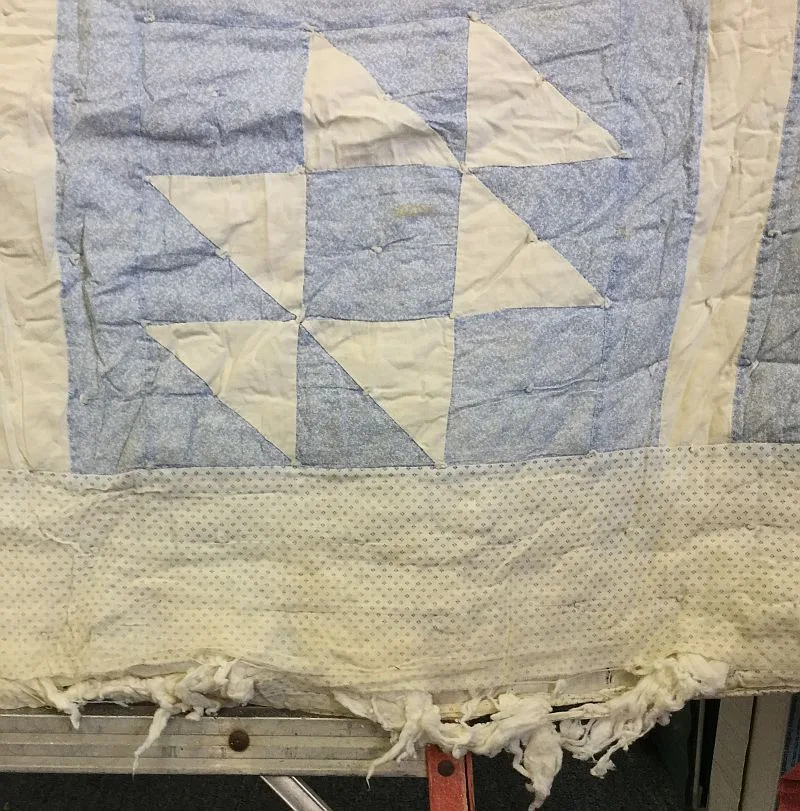
In 1999, I won an old quilt at an auction in Wayne, Nebraska. Bobbing and dancing to the call and poking Elmer in the belly to make sure he got my bid, I won that quilt for $4.00. It was an old quilt, a wool quilt with hand carded wool batting. I took the quilt to George the dry cleaner in Wayne, Nebraska. He was the only dry cleaner for miles around. I wanted to be sure that it was bug-free before I brought it into my home.
George the dry cleaner washed that quilt, and all the batting came out of the quilt and went into his dry cleaning machine. My quilt broke his machine. But, he cleaned it and I paid him $12.00.
Maureen Battistella Now in Ashland, Oregon.
From: Anne Copeland <anneappraiser1@>
All the tumbling block quilts I have ever seen have been quilted to pattern. Pretty straightforward. Peace and blessings, Annie
Date: Thu, 12 Aug 2004 23:08:09 -0700 | From: Anne Copeland <anneappraiser1@>
Someone noted in a post just in the last day or two that the royalties from a book couldn’t compare with the money a person would earn from the sale of a pattern. Well, that is certainly one way to look at it, but a pattern doesn’t take as long to design as a book takes to write either. So you see, there is always more than one way to look at a situation. So if I lost out on a book I had written because a publisher published it out of the country and sold it, it isn’t just about the money. What publisher would want to take on a book knowing that it had already been published outside the country, and that there might be thousands of copies already floating around? The issue gets more complex if you Stop to think about it. Peace and blessings, Annie
From: Anne Copeland <anneappraiser1@>
Good post, Gail, but I have to disagree. Such stories are the mythology of the population in different form perhaps, but they are in reality no different than myths. They arise because of a need in society to explain an event or set of events that create uncertainty and a feeling of helplessness. Many things exist in this world for which we may never know the “truth,” according to your definition.
I too am a quilt historian (gosh, maybe I am an illegitimate quilt historian–sounds kind of naughty!), and I also have a degree in Archaeology and a strong background in Anthropology. And I know that truth is an elusive thing. We want to believe that we can be objective about everything we encounter–that we can put it into some sort of format that makes sense to us in our version of “truth.” But the reality is that there are many different “truths” among individuals, and certainly among societies throughout the world.
I certainly agree that the authors put forth a book that is full of assumptions and with nothing to “prove” that it is true. They had a theory, and they went about collecting oral history which we all know is frequently flawed. But they obviously met a need in society or the book would not have sold so well, even to non-quilters. Many people still speak of that book in a way that demonstrates that it meets their need for truth colored in a way that they could accept it. I agree with you, Jocelyn, and I want to put a spin on this mythology. To imagine slaves having not only a means of escaping their owners, but having an organized way of escaping would give a race of people who currently live with some form of oppression on a daily basis something they could identify with. They could choose to make it their “truth” because it made sense of something in their world that does not make sense. It creates a sense of empowerment in a race that started in this country at the very bottom in terms of anyone treating them human dignity and respect and their freedom to choose even the most simple things that many people took for granted.
Yes, quilt historians are the scientists of the textile world. We Want to make sense of everything and to know that it is accurate vs. that which is passed on from generation to generation in oral history or even written history that is far from truth as you or I may know it. But that does not invalidate it. It only demonstrates again that truth is something that can be quite subjective. Each human being is like a little universe. You and I may believe that black is the color of mourning. It is our truth. But in another country, white is the color of mourning. Does that fact invalidate our truth that black is the color of mourning?
Do you remember when all the Chinese import quilts began to hit this country? Quilters everywhere were outraged at the thought that the Chinese prisoners who were making the quilts were being exploited. But we were seeing the situation through our own eyes, our daily living “truths.” Had we been living during the Industrial Revolution in this country, during the times when women and children sat at textile looms or worked in other dangerous jobs for many long hours with extremely low wages, we might have seen the situation from a different perspective. I wonder how many people thought about what the lives of these people were like before they had quilts to create. Perhaps their lives consisted of breaking rocks all day–12 to 16 hours a day. Or perhaps they were digging ditches or plowing fields in the cold or in the heat, or doing some other form of back-breaking work. Were they learning a skill or a trade with which they could someday perhaps earn a living in the future?
So while it is not a bad thing to want everything to be objective and accurate in its recounting, I am not certain that this will ever totally happen, or even that it should happen. It is ok for a thing to be just what it is. We can accept that it is not our truth and may never be, but we can also acknowledge that may be truth for others, or what others want to accept as their truth. How many people believed in Copernicus’ truth? Peace and blessings, Annie
From: “J. G. Row” <JudyGrow@> y
I have lost 75 pounds in 60 days!Buy my book to learn the method I used. Buy my book and I will give you the secret of my weight loss.
If I say it often enough my friends will start telling other people how much weight I have lost and how wonderful I look, and pretty soon every one will believe that I have great will power and look 25 years, nay, 30 years younger. My health will be much better and I will be empowered.
I can shout my claim to the entire world. I can be interviewed on Larry King about it. And then Oprah will have me on —————-and I’ll put her on.
No matter what I see in those wavy mirrors I’ve bought, it isn’t true. It is not subjective. It is simply false. (Darn it!~) I did not lose 75 pounds in 60 days. It did not happen, much as I’d like it to have happened. It did not happen. It is not true.
I lost 2 pounds.
Judy in Ringoes, NJ judygrow@
From: Judy Kelius <quilts2@>
At 10:12 AM 8/12/2004, you wrote: >is there a predominant quilting pattern in the antique tumbling blocks >quilts? …most of the time it’s impossible to see the quilting in >photographs of >old quilts.
I once owned a 1870s tumbling blocks with larger blocks that had a curved pattern in the pieces . . . the result was beautiful. The curves were rather deep (like hairpins) and the pattern flowed from block to block.
From: Edwaquilt@
I believe the Patricia Cox you are seeking lives in the Minneapolis area. She is the designer of the applique patterns.
Date: Fri, 13 Aug 2004 07:59:30 -0500 | From: “Barbara Vlack” <cptvdeo@>
Joan wrote: << Today Orvus and other anionics are used only for cotton and linens; shampoo and other nonionics for proteins such as silk and wool.>>
RESPONSE: The original use of/intention for Orvus is as a sheep shampoo. Wouldn’t it then follow that it would be WONDERFUL to launder wool? I use it for all my fine fabric laundering — wool, linen, silk, and cotton and QUILTS. I am always happy with the results.
Barb Vlack cptvdeo@
From: Joan Kiplinger <jkip@>
Hi Barb — ironic isn’t it that a horse and vetenarian’s cleanser is not the best for protein fabrics. 😀 Within the last 5 years or so consevationists have begun changing tactics. They note that because of its chemistry, Orvus wants to bond to protein fibers and is very difficult to rinse out. Orvus requires a lot of rinsing on cottons and other cellulose based fabrics, and more than likely will leave an unseen film or residue on proteins and have averse affects down the road, despite what might appear to be fine results after cleaning. Therefore conservationists look for nonionic detergents. Shampoo is one highly recommended product for proteins both by conservationists and professional specialty cleaners. Shampoo is much in the vein of the former French drycleaning when wools were oiled. The concentration in Orvus and like generic washing pastes makes those products desireable for hand washing, not in the machine, and most brands state on the label not to use in washing machine. As the recommended rinsing is 7 times for hand washing, machine rinsing is just not as effective in removing residue. This information was supplied by a conservationist and by a museum curator; they are recommendations only for the best in treatment and care; it is up to the individual to choose what products to use on what. Hope this better explains the recommendations.