January 2 – 15, 2001
These restored messages come from the Quilt History List, an online forum where quilt historians, collectors, researchers, appraisers, and enthusiasts discussed antique quilts and related textiles. The archive dates from 1996 through approximately 2016 and is being restored gradually. Sign up in the form at the bottom of the page if you want to know when a new page is added. Original spelling, opinions, formatting, and inactive links may remain unchanged.
Primary topics of this QHL Digest:
- Civil War Fabric & Quilts — Members discuss fabric availability during the Civil War, quilts made by soldiers’ wives, the Florida state quilt book, and whether quilts from that era necessarily used pre-war fabrics. (see the article on a Civil War quilt)
- Fading Fabric for Restoration — A discussion of methods for fading new fabric to match antique quilts, including Fabric Fade product, sun-fading in Arizona, and warnings about Turkey red’s colorfastness. (see the article on quilt restoration)
- Bed Coverings Through History — An extended thread on animal hides, sheepskins, leather, and bed rugs as bed coverings, with connections to Civil War soldiers, Appalachian frontiersmen, and Scandinavian rya rugs.
- Appliquéd Double Wedding Ring — An Australian member’s discovery of an appliquéd (rather than pieced) DWR quilt sparks discussion of Virginia Snow Studios kits and Ruby McKim’s 1931 recommendation of this method.
- Textiles in Wills & Inventories — A question about when textiles stopped appearing in wills and inventories leads to a wide-ranging discussion of labor value, household economics, and early American probate records.
- Blue & White Toile Reproductions — A member seeks an authentic-looking blue and white toile reproduction fabric and mentions an upcoming Antique Quilt and Textile day in Sturbridge, MA.
Date: Tue, 2 Jan 2001 22:57:30 -0700 | From: “Eileen Trestain” <ejtrestain [at] home [dot] com>
I happen to have a sales invoice, handwritten, during the war years, which lists fabrics being sold and for how much. Please, however, don’t ask me to hunt it down in the vintage papers and books right now, as I am preparing to move to Washington State. Quiltmaking didn’t stop. If anything, it increased during the war years, to supply quilts for the soldiers. Eileen Trestain
Date: Wed, 03 Jan 2001 09:41:23 +0000 | From: Bobbie Aug
I don’t think anyone would suggest that quilts weren’t being made during the Civil War. The suggestion was that fabric was not produced in the same quantities (if much at all) in the South during the Civil War as before or after the war. If there was fabric in existence – either US grown or imported and there were buyers – then I’m sure it was sold during this period. I am sure people depleted their “stash” of whatever – especially in the South – so raise money for the food for the table and the war effort. The suggestion was that the quilts made during the war had older fabric in them. Of course, this could be true at any time during our history. Even today I’m still dragging that old stuff off the shelves… BA
Date: Wed, 03 Jan 2001 16:37:36 -0800 | From: Denise Clausen <nadyne [at] oregoncoast [dot] com>
Hi quilt enthusiasts! I’ve been enjoying the discussion of Civil War quilts. A friend of mine had a quilt top that was made by an ancestor who was engaged to a Union soldier. He did not return from the war and she never quilted the top. My friend’s mother quilted it in the 1930s. She called the pattern “Star of the East”. I believe I have also seen this block called “Star and Crescent”. It was pieced in my favorite … indigo and white. To see a wonderful Civil War quilt and it’s history please see the Latimer Quilt and Textile Center’s web page. Click on the collections button at left. When the page is done loading, click on past features “Cvil War Quilt”. This quilt was in pristine condition when it was found in a box. We are now storing, for the owner, in our climate controlled storage facility (which you can visit anytime, just give us a call). All my best Denise Clausen Director LQTC
Date: Thu, 04 Jan 2001 08:33:44 -0500 | From: Judy White <jawhite [at] infi [dot] net>
For Christmas this year, I received a dear little book entitled, “Cats On Quilts” by Sandi Fox who also wrote “Wrapped In Glory; Figurative Quilts & Bedcovers 1700-1900.” “Cats On Quilts” is a small book of prose and poetry with illustrations of cats and pictures of cats as they appear on a selection of antique quilts. And on p. 88, there is photo of a wonderful quilt block – a red and white basket full of kittens. This particular quilt is owned by Darwin Bearly who I know contributes to the QHL list from time to time. I would recommend this lovely book for yourself and as a gift to anyone who loves cats and/or quilts. To make this EQ related, layering a cat drawing onto a pieced block would be good practice for EQers. Judy White – Ct
Date: Thu, 4 Jan 2001 10:35:32 -0000 | From: “Audrey Cameron” <audrey.cameron [at] virgin [dot] net>
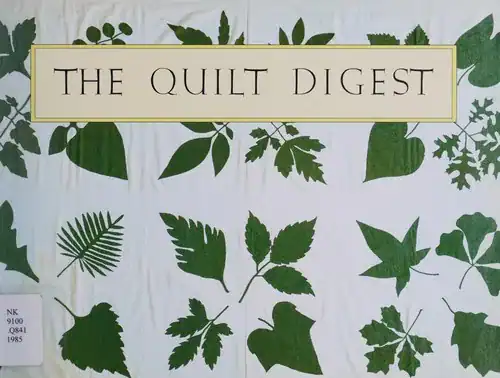
Happy New Year to all! A few weeks ago there was interest in Quakers & their quilt activities. I am recording my quilt books & came across an article by Patricia Herr in Quilt Digest (Vol. 3), unfortunately long out of print. The article is called All in Modesty & Plainness. Their quilts as shown in the article have no particular difference to those being made at the time (unlike folks such as the Amish/Mennonites). It’s an excellent history of their work & lives & worth looking for if you are interested. Audrey Cameron in Lincolnshire, England on a not too cold but very miserable wet, dark soggy day. It’s a great quilting day. audreycameron [at] onetel [dot] net [dot] uk audrey.cameron [at] virgin [dot] net
Date: Thu, 04 Jan 2001 21:15:21 -0500 | From: “Mary T. Voytko” <mtv28 [at] erols [dot] com>
Is there any way to remove the beige or ecru color from certain blocks in a tablecloth that was made with two different colors of crochet thread? It is unknown who made it or why different colors were used. Would bleach remove the color from the ecur and still not damage the white sections? Or is this a lost cause? Any ideas? Thanks. M. Voytko at MTV28 [at] erols [dot] com
Date: Fri, 5 Jan 2001 16:36:36 -0500 (EST) | From: Teri Klassen <teresak [at] bloomington [dot] in [dot] us>
The Florida state quilt book I believe shows 3 quilts made during the Civil War, one by a wife in Alabama for her soldier husband as she prayed for his return, one by slaves in Georgia for their owner to take to war with him (!), and I can’t remember the 3rd. Teri in Indiana
Date: Sat, 06 Jan 2001 08:03:56 -0500 | From: “Judy Kelius (judysue)” <judysue [at] ptd [dot] net>
What have you found to be the best method for fading a fabric for restoration of an antique quilt? I recently purchased a very nice red and green applique quilt from the mid 1800’s – the green is nicely faded and intact but all the red (also faded) is deteriorating. Both are solid colors, not prints. I want to fade a turkey red so that it fits in with the faded green. I have both antique and new turkey red fabrics. Thank goodness . . . there is a lot more green than red in the pattern, so restoring it is definitely doable. and the quilt is well worth restoring. Thanks!
Date: Sat, 06 Jan 2001 09:04:36 -0500 | From: Judy White <jawhite [at] infi [dot] net>
Judy, I have successfully used a product called Fabric Fade made by a company called By Jupiter. It comes with a little packet of washing soda and a packet of fading powder. I acutally kept a record (samples of before and after) of the fading experiments and I can scan it and send it to you if you like along with the info on this company. You mix up the powder, just a very little bit with water and cook the fabric on the back of the stove. You can do up to 3 yards at a time and you can also mix the colors together. (Once in a while, you will find a fabric that simply will not fade, no matter how long you cook it.) I did it in my kitchen with utensils dedicated to this and this only, using rubber gloves. Then when you have cooked it enough (this is a judgement call), washing the fabric in the washing machine or in the kitchen sink and hang it up to dry. It fades even more while it is drying. I used this process to fade fabric for a couple of quilt restoration projects and they came out fine. Less reliable is using bleach. That works too fast and is not controllable – that is just my personal opinion. Someone else may have had better results. Judy White – Ct
Date: Sat, 6 Jan 2001 14:10:05 EST | From: Karen Evans
First, I wouldn’t even try to fade antique fabric – it might well dissolve. Also, true Turkey red is one of the most color fast of dyes; I own an Egyptian table cover from the 1890s that has faded virtually everywhere but the Turkey red appliques. Congo reds or non-Turkey madder reds would fade, but the real Turkey red won’t without damaging the fabric. As for fading modern fabric, one way is simply to wash it in hot water until it’s soft and slightly nappy. You could also tape it to a sunny window and see what sunlight does. These might take a while, but I can’t imagine they’d do more harm to the fabric than bleaching it. Karen Evans
Date: Sun, 7 Jan 2001 08:14:35 EST | From: JBQUILTOK [at] aol [dot] com
>A letter dated June 29th, 1863, written by Confederate soldier, Matthew Boyd, from Camp >Narrows [Matthew enlisted in Chapman’s Battery on May 25, 1862 in Narrows,Virginia]: “I >have three blankets and a sheepskin for my bed. I sleep warm.” It has long been my >hypothesis that pioneers used animal hides for bed covering, to supplement handwoven >bedcovers.In times of necessity, such as the Civil War, it seems logical that soldiers would >use easily procurable animal hides for bedding. This letter is in the collection of Jim Costa of >Hinton, West Virginia. Fawn Valentine When I visited Mumford Village (a historic village museum near Rochester NY), the 1700’s log cabin was the representation of the oldest house. I asked the “owner” about the use of furs. She said that while it was sometimes done out of necessity, it was very looked down on. The Indians used furs & Indians were ‘dirty’ and ‘uncivilized’, so most European settlers wanted nothing to do with their ways. (Please, no flames about the merits of Native American ways over European – no matter how much we try, we can’t rewrite the emotions of our ancestors.) As for Civil War soldiers using hides, I doubt that many did. They’re heavy, not very supple, and depending on the animal, small &/or strangley shaped. Tanning was hard, dangerous & time-consuming work. You didn’t just shoot a bear for dinner & wrap up in the skin that night. Janet
Date: Sun, 7 Jan 2001 09:13:55 EST | From: Karen Evans
On the other hand, buffalo hide robes were quite fashionable as carriage accessories and/or parlor throws. This is one of the major reasons why the buffalo was almost hunted to extinction. Also, there’s a big difference between colonials eschewing wild animal hides and a Civil War soldier using the skin of a domesticated sheep for his bedroll. Soldiers in the field care about staying warm and dry, not about propriety (or, why my uncle’s unit in Patton’s army thought Patton was an idiot for insisting that they wear ties in the field. Dry socks were much, much more important). Karen Evans
Date: Sun, 7 Jan 2001 18:46:23 EST | From: Demsing [at] aol [dot] com
Judy, I have the same problem when I try to restore red fabric in older quilts. One method that I use is not fast but tends to give a more authentic look is to actually use faded fabric. I live in AZ where the sun can be a friend or a foe. I have often place red fabric in direct sunlight and let the sun do the work. I try to keep a stack of various shades of faded red, in case I need any. I haven’t had as much sucess with greens. The different overdyeing of 19th cent. fabric to get green doesn’t alway match up with today’s green. I would also be interested in other methods. Lenna in Phoenix
Date: Sun, 7 Jan 2001 23:41:09 EST | From: SadieRose [at] aol [dot] com
This post was sent to the Dear Jane list, and I contacted the sender, to get her permission to send this on to QHL. She said she does not know if Quilts will be a topic, but thought this might be of interest to the list. <For those of you not really interested in the Civil War delete now but to those of you who are interested in the Civil War please read on. Every year there is a Conference on Women in the Civil War. I have attended three and will continue to attend. These conferences are devoted to women and their roles in the Civil War. I thought some of you may be interested and have included the url for their website. http://womenandthecivilwar.org This year DH, Tom, will be one of the presenters and I am making a raffle quilt. It is being held at Hood College in Frederick, MD. 15 – 17 June 2001. Thanks for listening, Winnie >
Date: Mon, 8 Jan 2001 06:28:06 -0500 | From: “fawn” <fawn [at] cwv [dot] net>
Just a thought, many Appalachian frontiersmen (1700s) wore leather, = having adopted clothing and other survival habits from Native Americans. = The fringed tunic-like hunting jackets, leggings, and mocassins were leather. (Think Davy Crockett and his cookskin cap). Although tanning = hides is labor-intensive, it does not require as much time and = technology as spinning and weaving fabric. Of course, sheepskins are = still popular for bedding, especially for those who must remain in bed = and want to avoid bedsores. As far as bed coverings, my understanding is = that bed rugs predated coverlets, and that Scandinavian rya rugs (the = inspiration for “shag” carpets) were made to replicate animal hides = because the pile (long tufts woven into the fabric) served as insulation = and were used as bed covers, pile side down towards the body. This may = seem rather far afield from quilts, but the topic of what was used on = the bed may be of interest? Fawn Valentine in the Appalachian Mountains. = — **Date: Mon, 8 Jan 2001 22:48:50 EST | From: KRONEIL [at] aol [dot] com**
RE: Animal hides. I can completely understand what that Union soldier was thinking when he used sheepskin. I used to work for an importing company from NZ and purchased through them a 4 part sheepskin hide rug that was just way too beautiful to ever put on the floor, I draped it over the back of the couch. When I was later employed as a Residence Hall Director for a VERY small college, during Xmas vacation when the “kids” went home, they turned off the heat in my entire building. I had no place else to go so I made due with space heaters in the day, but at night, I don’t care how many quilts I had (even my wool backed in flannel one) it was just plain cold. That is until I took my sheepskin and placed it over my bed. Never had a moment of discomfort the whole time. Nowadays, we use them as bedding for our sleeping bags when we go tenting. RE: Brethren quilts. I work for a local Brethren church and I told my boss, the Pastor, about the notes we’ve been posting about what determines an “Amish” quilt. I also mentioned that someone had posted something about being able to see “Amish/Mennonite/Brethren” quilts. I don’t remember if this was a website or a museum display. If any one remembers this listing, please e-mail me privately so as not to clog up the works. The Pastor is interested because he cannot fathom what would be considered a “Brethren” quilt in particular, especially since these Brethren women are known to quilt at the drop of the word “disaster.” Thank you for your time and patience. Again, my apologies for AOL V.6. Patt in Olympia
Date: Wed, 10 Jan 2001 21:47:59 EST | From: EllynLK [at] aol [dot] com
Hi, All, I put up a lot of photos I took on my fiber arts tour of Mexico. Go to: http://albums.photopoint.com/j/AlbumList?u=1411687&Authúlse to “tag along” on my vacation. Haven’t been doing any quilting of late but I’ve been looking at my own version of “the misery quilt” that I’ve been making for my mom… it’s about time I pieced some more blocks together. I like the quilt, I like the fabrics, I like the design… but this quilt has caused me more grief than any other! I didn’t see any quilting in Mexico… lots of embroidery, though (some very nice but I didn’t buy any as much was done in astonishing fluorescent colors that hurt to look at!). Saw some lovely Guatemalan embroidery there, too, not as bright but just as lovely. Best, Lauri Klobas Southern California where it is raining at last! And my wall is leaking. And my landlord doesn’t seem to care… sigh.
Date: Thu, 11 Jan 2001 13:17:18 -0600 | From: “Vergamini, Linda” <lvergamini [at] chsomaha [dot] org>
I have 2 framed silk embroidered textiles and want to get them appraised. They are very similar, although I obtained them at different times and from different people. One is dated 1778 and the other is not dated. Both have some minor silk loss to the background area. I tried the local Gerald Ford Center for Conservation and Restoration, but they just lost their textile appraiser and there was no one there who could appraise them. They gave me a list of people who could RESTORE them, but no one who could appraise them. They did say that they are very old and are worth repairing and having appraised. I realize that this is not a “quilt” question per se, but is related to textiles, so I was hoping someone out there could recommend an appraiser. Linda Vergamini
Date: Fri, 12 Jan 2001 09:42:30 +1100 | From: Lorraine Olsson <sven [at] pnc [dot] com [dot] au>
On Tuesday I had a call from my friend who owns the local quilt shop, asking if I would look at a quilt that a client of hers had brought in. It was a Double Wedding Ring, in the typical soft 1930s arcs with green and purple intersects , set on a plain muslin. The back was muslin, as was the binding. It was lightly quilted in large stitches (4-5/”) . It had no wear or tear, and may have been washed a couple of times. What made me want to write about this quilt is this. It was an appliquéd piece. All of the arcs and intersects were appliquéd onto the muslin rather than being pieced. (there were 8 pieces per arc) Apart from the fact that I see very few American quilts other than my own here in Oz, I have not seen a DWR set this way. Can I please have some comments so I can pass them on to the owner. Thanks, Lorraine in Oz
Date: Thu, 11 Jan 2001 18:37:59 +0400 | From: Xenia Cord <xecord [at] netusa1 [dot] net>
Virginia Snow Studios, aka Collingbourne Mills, of Elgin, Illinois, marketed foundation fabric for doing Double Wedding Ring as an applique. While I have never seen a finished quilt done this way, or even a top, I have a number of the blank foundation pieces in my “kit quilts” collection. These are white muslin with blueprint lines. Some other normally pieced designs were also marketed this way by Virginia Snow Studios. Xenia, in Indiana
Date: Fri, 12 Jan 2001 14:47:18 +1100 | From: Lorraine Olsson <sven [at] pnc [dot] com [dot] au>
Hello from Australia, I am reposting your letter to me so it goes to the whole of QHL I was asked only yesterday to give a presentation on “The History Of Quilts” and was asked to make it about 30 minutes long. I politely declined, as even though I am an avid quilt collector and have a real interest in the history of quilts, I am by no means conversant on the whole subject. My gosh! and to fit it into 1/2 an hour!! There are many great books and you can find a lot of them here at this link. http://www.hickoryhillquilts.com/heritage.htm Good luck with your research, Lorraine in Oz
Date: Fri, 12 Jan 2001 08:13:33 | From: “Anne Copeland” <anneappraiser [at] hotmail [dot] com>
Hi Lorraine, I have a large collection of double Wedding Rings, and a couple of them are appliqued on like that. I suspect that the makers didn’t quite know how to set them in, and it seemed easier to applique them on top. One of mine is done by machine, and the other is done by hand. Cheers, Annie _________________________________________________________________ Get your FREE download of MSN Explorer at http://explorer.msn.com
Date: Fri, 12 Jan 2001 02:02:11 -0800 | From: “Colleen Rourke Silkwood” <silky [at] psln [dot] com>
Not too long ago I saw such a pattern, may even have it, in a magazine. Might have been an Australian one. I wasn’t impressed with the idea so I didn’t make much of a mental note about it. Colleen
Date: Fri, 12 Jan 2001 10:26:29 -0800 | From: Kathleen Reyes <kwiltlvr [at] earthlink [dot] net>
Hi, Just as this topic is up, a quilt appears on ebay for our viewing pleasure!! I know this seller to be very knowledgable, but am not affiliated. Kathi in cold &rainy SoCalif. http://cgi.ebay.com/aw-cgi/eBayISAPI.dll?ViewItem&item=541021631
Date: Sat, 13 Jan 2001 14:59:15 +0200 | From: Ady Hirsch <adamroni [at] netvision [dot] net [dot] il>
The notion of an applique DWR is not all that unusual. In her 1931 book,
Ruby McKim recommends this method as easier than the more common, pieced version – “This pattern you can readily cut, or easier still, simply applique the finished blocks onto white sheeting by turning all outside edges and placing together carefully” (101 patchwork Patterns – p. 54). Ady in Israel
Date: Mon, 15 Jan 2001 00:22:29 -0800 | From: “Ellen King” <esking [at] rcsis [dot] com>
Friends, Are there used quilting frames out there for sale? I have very little = space for quilting and need something bigger than the portable 14″round = hoop I use for lap sized quilts. Someone suggested a homemade one of = long 2×4’s but I don’t have room to set it up. It also has to be on a = stand, or off the floor, since I have cats that find new things on the = floor” very interesting” or worse. I’ve seen the advertisements for the = Ekman and the Grace stands, but I cannot afford them. The rooms I work = in are approximately 10×10 and have other furniture in them. Does = anyone have other suggestions? I am a new quilter, and about to finish = my first pieced quilt top. I am currently working on a lap sized whole = cloth print that I am hand quilting. Ellen in California
Date: Mon, 15 Jan 2001 07:22:45 EST | From: jean (forwarding Betsy Odegard)
betsy odegard sent this to another quilt list…thought it might be of interest to qhlers… jean ****************************************************************************** ***** I posted earlier today about the quilts at the Charley Russell Museum in Great Falls, MT. The exhibit ends Feb 11, 2001. For a peek at 6 of the quilts, go to www.cmrussell.org/exhibitions/index.html and enjoy. Betsy in Montana.
Date: Mon, 15 Jan 2001 08:13:03 -0600 | From: “Karen S Bush” <birdsong [at] accessmo [dot] com>
Ellen- my room is the same size and used the oval hoops on a frame that came with it. It’s a little larger than a l4″…it’s about 30 years old, so I don’t know if you can find one as Sturdy as this one. It seems like the ovals and rounds are made pretty thin and flimsy now. But, I could take it off the stand for my lap, or, leave it On the stand to hand quilt. Don’t know if that’s much help or not….:/ kb have very little space for quilting and need something bigger than the portable 14″round hoop I use for lap sized quilts. Someone suggested a homemade one
Date: Mon, 15 Jan 2001 13:44:23 -0500 | From: LE Miller
As a long time lurker I continue to be impressed by the information that is presented in this group. I have a question to pose to you all: I know that textiles were important in wills and inventories in the 17th and early 18th centuries, but at what point were they no longer considered valuable? Among some other documents I picked up in an antique shop this summer was a “memorandum” directing that items go to a women,s son “after I have done With them or at my Decease”. First on the list was 2 Feather Beads (sic). Also included were 1 set curtains, all of her wearing apparel, a warming pan and all of her table linen, among other things, including furniture. This was dated 1841 in Galway, which is in upstate NY.The notation on the back is that she died in 1856. I will look forward to any discussion you might have on this.
Linda Miller also in upstate NY.
Date: Mon, 15 Jan 2001 17:32:38 +0400 | From: Xenia Cord
Ok, I’ll be bold and jump in here with a thought: 1) as long as the testator lived in an area where obtaining textile items was either difficult or very labor-intensive; 2) as long as he/she had economic constraints prohibiting the easy acquisition of same; 3) as long as there was some question about who was entitled to the items, these items might be included in the will. 1) Obviously at different times and in different geographic areas of the colonies/US, easy access to manufactured textile items or fabrics was limited or even impossible. Some items, such as feather beds, required a lot of labor, to say nothing of all those chicken feathers, to make. The outer covering of fabric, even if the mattress were stuffed with straw, required some sort of outlay odf money or labor. Because of this, the items had value beyond their immediate use in the household. Finished items, such as table and bed linens, were probably the result again of intensive labor, done by the women of the household. For instance, it has been estimated that from the time standing flax was harvested, through the processing, spinning, and weaving, until a single bed sheet was finished required 600 hours of labor. Considering the sizes of some families, and the number of beds requiring linens, the outlay in time is again tremendous, creating value beyond the utilitarian. Household linens were often numbered and initialed in tiny counted cross stitch, allowing for inventory and rotation. 2) Even in areas where manufactured textile items were available, for some the cost would prohibit their acquisition, and purchased clothing might be considered very special. Most clothing, possibly excepting wool capes and coats, would have been made at home even if commercially available fabric was used. Practical economy suggests that garments could be reused, if not in their current form then in some sort of recycled form. Otherwise, what would one do with them when the owner died? 3) Regardless of size or value of the estate, some families will wrangle over every little bit. How much more sensible to enumerate bequests or the disposition of goods. In my husband’s family his g-g-g grandfather died intestate, just as his acquisitive son was seeking guardianship in court in another county. The local sheriff was required to send a team to inventory every item in the estate, and despite the fact that the wife was still living, everything was sold at auction. Interestingly enough, when the caretaking unmarried daughter was bidding, she was able to buy the item inexpensively. But when the acquisitive son bid, prices went sky-high (for 1846 in Kentucky). Among the items sold were bedsteads, feather beds, and other bedding, as well as all of the wife’s textile-making tools. (I found the handwritten inventory and the auction clerk’s records in the Fleming Co., KY courthouse.) I hope we can have more discussion on this interesting topic! Xenia If anyone knows of an authentic looking blue and white toile reproduction please email me privately with the manufacturer – I can’t find anything that acceptable in my area of California – thanks! Also wanted to mention that the next Antique Quilt and Textile day is being hosted by the Vintage and Antique Textiles shop in Sturbridge, MA on March 24. Hope to see some of you there. For more info go to: http://thequiltauction/help/sturbridge.html Deb Roberts
Date: [Jan 15, 2001] | From: Deb Roberts
If anyone knows of an authentic looking blue and white toile reproduction please email me privately with the manufacturer – I can’t find anything that acceptable in my area of California – thanks! Also wanted to mention that the next Antique Quilt and Textile day is being hosted by the Vintage and Antique Textiles shop in Sturbridge, MA on March 24. Hope to see some of you there. For more info go to: http://thequiltauction/help/sturbridge.html Deb Roberts
Date: Mon, 15 Jan 2001 23:28:02 EST | From: PatKoerner [at] aol [dot] com
For anyone in the Rocky Mountain Region there will be a lecture on Feb 3, 2001 by Raymond Dobard, co-auther of HIPV. Mr Dobard’s lecture, Patterning Freedom: Quilt patterns and the Underground RR, is being sponsered by Rocky Mountain Wa Shonaji Quilt Guild and will be held at the Macedonia Baptist Church, 3240 Adams St, Denver at 12noon. I plan to attend and will be glad to share what I learn. I would also like to include info about the current exhibit at Rocky Mountain Quilt Museum in Golden, Co. A wonderful exhibit of Amish quilts in the main gallery spans the evolution of Amish quilts from the wonderful traditional style that first inspired all the interest in Amish quilts, to the contemporary quilts being made today by the enterprising Amish. A good example of many of the comments on the list recently concerning what comprises an “Amish” quilt. The second Gallery holds a wonderful array of quilts by Tina Brewer Williams, very inspiring. This exhibit will be in place through March. The third and last thing that I would like to mention is that the museum gift shop is holding a quilt sale January 25, 26 & 27. For more info e-mail me privately patkoerner [at] aol [dot] com Thanks Pat Moore